Hubbry Logo
European green lizardEuropean green lizardMain
Open search
European green lizard
Community hub
European green lizard
logo
8 pages, 0 posts
0 subscribers
Be the first to start a discussion here.
European green lizard
from Wikipedia

European green lizard
Male
Female
Scientific classification Edit this classification
Kingdom: Animalia
Phylum: Chordata
Class: Reptilia
Order: Squamata
Family: Lacertidae
Genus: Lacerta
Species:
L. viridis
Binomial name
Lacerta viridis
(Laurenti, 1768)
Range of L. viridis in blue, and L. bilineata in green
Synonyms

Seps viridis Laurenti, 1768

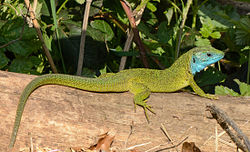
The European green lizard (Lacerta viridis) is a large lizard distributed across European mid-latitudes from Slovenia and eastern Austria to as far east as the Black Sea coasts of Ukraine and Turkey. It is often seen sunning on rocks or lawns, or sheltering amongst bushes.

Taxonomy

[edit]

There is an ongoing discussion as to whether Lacerta viridis and Lacerta bilineata are separate species. Genetic data weakly supports their separation into two species, but more investigation needs to be done.[1]

Description

[edit]

The lizard reaches up to 15 cm (5.9 in) from the tip of the muzzle to the cloaca. The tail can be up to twice the length of the body; the total length is up to 40 cm (16 in). This lizard sometimes sheds its tail (autotomy) to evade the grasp of a predator, regrowing it later.

The male has a larger head and a uniform green colour punctuated with small spots that are more pronounced upon its back. The throat is bluish in the adult male and to a lesser extent in the female. The female is more slender than the male and is more uniform in colour, often displaying between two and four light bands bordered by black spots.

Distribution and habitat

[edit]

The European green lizard is native to southeastern Europe. Its range extends from southern Germany, Austria, Hungary, the Czech Republic, Slovakia, the extreme northeast of Italy, Slovenia, Croatia, Bosnia & Herzegovina, Serbia, Montenegro, Albania, North Macedonia and Greece to southern Ukraine, Romania, Bulgaria and western Turkey. It is known from elevations up to 2,200 m (7,218 ft) above sea level; its typical habitat is dense bushy vegetation in open woodland, hedgerows, field margins, embankments and bramble thickets. In the northern part of its range it may be found on bushy heathland and in the southern part it prefers damp locations.[2]

Various attempts have been made to introduce green lizards into Britain since the late 19th century, and a colony identified as L. bilineata has survived at Bournemouth since the late 1990s.[3][4] L. bilineata also occurs in Jersey in the Channel Islands, where it may be native.[3] It has been introduced into the state of Kansas in the United States.[1]

Behaviour

[edit]
A pair of male European green lizards (Lacerta viridis viridis) fighting for dominance.

The European green lizard lives on the ground and in low, dense vegetation and likes to bask in the sun, early and late in the day. It feeds mainly on insects and other small invertebrates but it also sometimes takes fruit, birds eggs, fledglings, small lizards and even mice. In spring, the female lays six to twenty eggs which hatch in two to four months. Newly hatched juveniles are pale brown with a snout-to-vent length of 3 to 4 cm (1.2 to 1.6 in). They become mature the following year by which time they will have doubled in size.[2]

Predators

[edit]

Predators include red foxes, badgers, domestic cats, birds such as buzzards, kestrels and crows, and snakes (such as adders).[5]

Status

[edit]

The IUCN lists the European green lizard as being of "Least Concern". This is because it has a wide range and is common in at least part of that range. It is an adaptable species and no substantial threats have been identified over most of its range. However, in Turkey it may be affected by the use of pesticides.[1]

References

[edit]
[edit]
Revisions and contributorsEdit on WikipediaRead on Wikipedia
from Grokipedia
The European green lizard (Lacerta viridis) is a large-bodied of lacertid lizard native to much of southern and and parts of western . Males typically exhibit striking bright green dorsal coloration with black speckling, along with a vivid throat displaying high reflectance during the breeding season, while females are more subdued in appearance, often brownish-green with longitudinal stripes or bands bordered by dark spots. Adults reach a maximum total length of up to 40 cm, with males generally larger than females, and snout-vent lengths commonly ranging from 100 to 135 mm. This inhabits a variety of open and semi-open environments, including woodlands, scrublands, grasslands, rocky slopes, and shrubby edges, often preferring areas with dense low vegetation for cover and ample basking sites such as rocks or logs. It is diurnal and thermophilic, actively during warmer months from to October, and relies on solar basking to regulate body temperature while exhibiting territorial , particularly among males who defend home ranges through aggressive displays involving inflated throats and posturing. The diet is primarily insectivorous, consisting of , spiders, and other , though larger individuals may consume small vertebrates, eggs, or plant matter. Breeding occurs in spring, with females laying clutches of 6–20 eggs in burrows or under , which hatch after 2–4 months; juveniles reach maturity in 2–3 years, and lifespans can extend to 10–16 years in the wild. Although classified as Least Concern globally due to its wide distribution and stable populations in many areas, the European green lizard faces localized threats from , agricultural intensification, and , which may alter suitable thermal conditions in northern parts of its range.

Taxonomy

Classification

The European green lizard belongs to the genus Lacerta in the family Lacertidae, subfamily Lacertinae, order Squamata, and class Reptilia. Its binomial name is Lacerta viridis (Laurenti, 1768), originally described as Seps viridis in Laurenti's Specimen Medicum. Historically, L. viridis encompassed a broader range of populations across Europe, including those now classified as the closely related Lacerta bilineata (Daudin, 1802), which was long treated as a subspecies or synonym of L. viridis based on morphological similarities. Older classifications also recognized informal variants such as Lacerta viridis major (referring to larger eastern forms) and Lacerta viridis minor (smaller western forms), which reflected preliminary attempts to account for size and geographic variation but have since been subsumed into modern taxonomy. Ongoing taxonomic debate centers on the distinction between L. viridis and L. bilineata, supported weakly by studies showing divergent lineages with genetic distances of 2–6%, yet complicated by morphological overlap and potential hybridization in contact zones. Nuclear DNA analyses remain inconclusive on and boundaries, with post-2021 mitogenome research emphasizing the need for comprehensive genomic data to resolve whether L. bilineata warrants full status or demotion to . The recognizes L. viridis as a valid assessed as Least Concern (population trend unknown), while treating L. bilineata separately.

Subspecies and genetic variation

The European green lizard (Lacerta viridis) is classified into three recognized based on morphological and genetic distinctions: the nominal L. v. viridis (Laurenti, 1768), which occupies much of ; L. v. meridionalis Cyrén, 1933, distributed in southeastern Europe including parts of , , and northwestern ; and L. v. guentherpetersi Rykena, Nettmann & Mayer, 2001, restricted to mountainous regions in central Greece and the island of . A closely related western form, formerly treated as L. v. bilineata Daudin, 1802 and sometimes considered a , is now widely recognized as a distinct (Lacerta bilineata) due to consistent genetic and morphological separation, though debate persists regarding its elevation from status. An additional Balkan form, L. v. major, has been proposed for populations in the region but lacks formal recognition in current and may represent variation within L. v. meridionalis. Genetic studies using allozymes and (mtDNA) reveal low overall divergence within L. viridis, with sequence differences typically ranging from 2-5% in and control regions among ; for instance, complete mitogenome comparisons show approximately 4.6% divergence between L. viridis and its sister species L. bilineata. These analyses indicate limited genetic structuring, particularly in northern populations, but hybridization zones in regions such as eastern and demonstrate ongoing , especially between L. viridis and L. bilineata or Adriatic lineages, facilitating of alleles across contact areas. Nuclear markers further support this, showing shallow phylogeographic breaks that reflect recent postglacial expansion rather than deep isolation. The evolutionary origins of L. viridis trace back to the Miocene-Pliocene transition, with evidence of green lizards in the Lacerta viridis group appearing as early as the early in , adapting to warm, thermophilic habitats amid the diversification of lacertids during this period. Post-Pleistocene dynamics shaped current patterns, as southern refugia in the and preserved higher , allowing recolonization of northern ranges with reduced variation in peripheral populations. Recent genomic research, including whole-genome sequencing of L. viridis and related lineages, has identified adaptive loci under selection, particularly those linked to temperature tolerance and environmental stress responses, such as genes involved in tissue-specific and vascular remodeling that facilitate divergence despite . These studies highlight accelerated in Z-linked genes, contributing to local adaptations in across varied climates.

Description

Morphology

The European green lizard (Lacerta viridis) is a medium-sized lacertid with a snout-to-vent length (SVL) typically ranging from 10 to 15 cm in adults, and a total body length of up to 40 cm, including the tail which is approximately twice the SVL. This supports an active terrestrial lifestyle, with the elongated tail aiding in balance and locomotion. The head is robust and triangular, equipped with 7 to 9 conical premaxillary teeth, alongside up to 20 bicuspid maxillary teeth and numerous dentary teeth in adults, reflecting an ontogenetic shift from tricuspid juvenile to more robust adult forms adapted for insectivory. The limbs are well-developed and strong, each bearing five toes with adhesive pads absent but claws present for gripping substrates during terrestrial movement. The body is covered dorsally by numerous small, imbricated scales that are weakly to moderately keeled, and ventrally by large, smooth plates arranged in 6 to 8 longitudinal rows, providing flexibility and protection, while the tail features distinctly keeled scales that enhance rigidity and propulsion. These scalation patterns contribute to the lizard's overall armor-like protection without impeding agility. A key defensive is the capability for caudal , where the fractures readily at specialized intravertebral fracture planes in response to predation, allowing escape while the writhing detached distracts the . Regeneration follows, producing a functional but typically shorter with a cartilaginous core instead of the original bony vertebrae, resulting in reduced patterning and efficiency compared to the original. Sensory structures include the , or Jacobson's organ, which facilitates chemoreception by detecting pheromones and environmental scents via tongue-flicking. External openings are present, enabling auditory detection of airborne sounds and vibrations, a common trait among lacertids. Coloration exhibits , with variations elaborated in subsequent sections.

Coloration and sexual dimorphism

The adult European green lizard (Lacerta viridis) exhibits pronounced in coloration, size, and morphology. Males are typically brilliant emerald green dorsally with black speckles, a bright belly and legs, and develop a striking throat during the breeding season, which enhances their visibility for purposes. In contrast, females display a duller green-brown dorsal coloration, often mottled with a light green mid-dorsal band bordered by two to four creamy white lines, pale or greenish undersides, and an off-white throat speckled with black, providing subtler patterning suited to . Males are generally larger than females, with maximum snout-vent lengths (SVL) reaching up to 150 mm in males, and they possess broader heads and more vibrant overall hues, while females tend to be more slender, potentially facilitating egg production and laying. Juveniles differ markedly from adults, featuring a striped brown-gray ground color with dark blotches along the back bordered by two creamy white lines and light pearly dots on the flanks, which aids in among leaf litter and vegetation; this juvenile pattern transitions to adult coloration around 2-3 years of age as individuals reach . Seasonal variations in coloration are evident, particularly in males, whose turns brighter in spring during the mating period to signal readiness, fading afterward; both sexes adjust dorsal hues to match surrounding vegetation for outside breeding times, shifting toward browner tones in non-breeding seasons. Tail regeneration can briefly disrupt these color patterns, resulting in mismatched scales that may affect overall until regrowth completes.

Distribution and habitat

Geographic range

The European green lizard (Lacerta viridis) is native to southeastern Europe, with its range extending from and southward through the Balkan Peninsula (including , , , , , , , and ) and eastward to the coast in , , , , and . Populations occur at elevations up to 2,200 m, particularly in hilly and mountainous areas. The core of the distribution lies in , , and , where the species maintains relatively stable and abundant populations within suitable habitats. The range is fragmented in the due to topographic barriers that limit connectivity between populations. The current distribution reflects post-glacial colonization from refugia in the during the warming period, which enabled rapid northward and westward dispersal following the last . In contemporary times, the northern limit of the range is shifting northward due to warming, as evidenced by expansions of approximately 50 km in since 2000; however, the overall range remains fragmented in the , with isolated relict populations in northern areas like the and .

Habitat preferences

The European green lizard (Lacerta viridis) primarily inhabits sunny, open areas with a of , favoring scrublands, edges, meadows, and vineyards that provide both basking opportunities and . These habitats typically feature low to moderate cover, including shrubs and herbaceous , which allow for effective while offering escape cover from predators. The species avoids dense forests and tall grasslands, preferring instead heterogeneous landscapes with exposed substrates such as rocks or bare ground for basking and elevated positions for vigilance. Microhabitat selection emphasizes structural elements like rock debris, fallen logs, and dense bushes for hiding, alongside sunny spots on south- or east-facing slopes, particularly in northern parts of the range where the species is thermophilic and relies on high solar insulation. Lizards select sites with lower and moderate humidity, often in areas with cover exceeding 30% for refuge, while avoiding heavily shaded or urbanized environments unless populations have been introduced. Elevation ranges from to approximately 2,200 m, with optimal conditions in warmer, south-exposed terrains that support activity above 12–15°C. Recent studies in indicate a strong preference for afforested edges over abandoned lands, where cessation initially boosts heterogeneity through native regrowth, though extensive reduces suitability by increasing shade. Habitat fragmentation poses challenges, but L. viridis utilizes linear corridors such as hedges, unmown grass strips, and shrub rows to facilitate movement between patches, with males traveling up to 255 m along these features in vineyard landscapes. Such connectivity is essential in fragmented areas, where the species shows higher occupancy in edge habitats with permeable matrices like pastures over isolated, dense woodland interiors. For overwintering, individuals tolerate mild winters by hibernating in self-dug burrows or rodent holes, often under logs or roots in frost-free micro-sites.

Behavior and ecology

Activity patterns

The European green lizard (Lacerta viridis) exhibits strictly diurnal activity patterns, emerging from cover in the early morning to bask and becoming fully active during when temperatures are favorable. Individuals typically begin basking between 8 and 10 a.m., positioning themselves on sun-exposed rocks, logs, or low to raise their body temperature, after which they engage in , , and social interactions throughout the day. Activity peaks in sunny conditions, with retreating to shade or burrows during the hottest afternoons to avoid overheating, and they reduce movement as temperatures drop in the late afternoon. This pattern aligns with their heliothermic nature, where solar radiation is essential for maintaining optimal physiological function. Seasonally, the lizards are active from to early , entering in burrows, rock crevices, or underground refuges during the colder months from to to conserve energy and survive low temperatures. Upon emergence in spring, body temperatures may be as low as 12°C, but full activity resumes as environmental conditions warm. Hibernation sites are chosen for insulation, often in communal groups, and the duration varies slightly with and weather, being longer in northern parts of the range. For , the species employs behavioral shuttling between sunlit and shaded microhabitats to maintain body temperatures within a preferred range, typically achieving equilibrium faster in heating than cooling phases during active periods. Minimum activity thresholds are around 15°C, below which locomotion and metabolic rates decline sharply, limiting daily ranges. This strategy is critical in heterogeneous habitats, allowing precise control over thermal balance without physiological costs. Movement behaviors are influenced by territoriality, with adult males patrolling home ranges spanning 50–200 m, defending areas through displays and to secure resources and mates. Lizards frequently utilize linear features like fences and passages as movement corridors, particularly in fragmented landscapes; a 2025 study in Austrian vineyards found that lizards frequently utilize linear features like fences and passages as movement corridors, with some males using them for displacements up to 255 m, enhancing connectivity between habitat patches. Individual variations, characterized as bold (high risk-taking) versus shy (low risk-taking) phenotypes, affect dispersal patterns, with bolder individuals showing greater exploration and longer-distance movements, as evidenced in linking these traits to ecological outcomes across ontogenetic stages.

Diet and foraging

The European green lizard (Lacerta viridis) is primarily insectivorous, with arthropods comprising the majority of its diet, typically around 70-80% of consumed items. Common prey includes beetles (Coleoptera, up to 34% of diet), grasshoppers and crickets (, about 14%), spiders (Araneae, 8-21%), and insect larvae (10%). It also consumes snails (), small vertebrates such as other (indicating saurophagy), and occasionally plant matter like seeds, leaves, and fruits, which can account for up to 26% of the diet in adults. As an opportunistic predator, L. viridis employs a mixed foraging strategy, combining elements of sit-and-wait ambush tactics with active searching, often from elevated perches in vegetation or rocks to visually detect prey. It uses tongue flicking to detect chemical cues, aiding in prey identification, particularly for hidden or evasive items. Juveniles focus on smaller invertebrates like spiders and larvae, while adults target larger, harder prey such as beetles and orthopterans, with average prey sizes ranging from 1-2 cm. Dietary composition shows some seasonal variation, with plant matter intake increasing in spring and summer (up to 26%) compared to autumn, though overall prey taxonomic diversity remains consistent year-round. Males exhibit a broader dietary niche than females, preferring harder prey like centipedes and millipedes, while females favor softer items; both sexes demonstrate opportunistic feeding without evidence of tool use.

Reproduction

The mating season of the European green lizard (Lacerta viridis) typically begins in mid-April and extends through May, aligning with the emergence from and the onset of warmer temperatures. Males establish and defend territories through aggressive encounters, often approaching rivals with an arched back, lowered head, and inflated throat to display their nuptial coloration. This display highlights the ultraviolet-reflective blue throat patches, which signal male quality and influence fight outcomes, with higher UV reflectance correlating to dominance in confrontations. The species exhibits , where dominant males maintain access to multiple females within their territories, leading to ritualized fights that minimize injury while asserting reproductive priority. Following , females oviposit one or occasionally two clutches of 6–20 eggs, with clutch size varying based on maternal body size and showing greater plasticity at the southern edges of the range. Eggs are laid in shallow, sandy burrows dug in sun-exposed sites during June to July, providing optimal conditions for embryonic development. Incubation lasts 60–120 days, depending on soil temperature and moisture, with hatching occurring from August to September. In the L. v. bilineata, clutches can reach up to 22 eggs, reflecting slight regional adaptations in reproductive output. Hatchlings emerge at approximately 3.5–4 cm in snout-vent length (SVL), initially pale brown with stripes for , and are fully independent upon emergence, relying on innate foraging instincts without . is attained at 2–3 years of age, when individuals reach an SVL of about 70–80 mm, allowing participation in the next breeding cycle.

Predators and threats

Natural predators

The European green lizard (Lacerta viridis) is preyed upon by a variety of mammalian species across its range, including red foxes (Vulpes vulpes) and domestic cats (Felis catus). These predators primarily target adults and juveniles through opportunistic ambushes in vegetated or rocky habitats, where seek cover or bask. Avian predators represent a major threat, especially during basking periods when are exposed on elevated perches. Common buzzards (Buteo buteo), common kestrels (Falco tinnunculus), and common ravens (Corvus corax) frequently launch aerial attacks on adults and subadults, exploiting the lizard's thermoregulatory behavior. Juveniles, being smaller and less vigilant, face heightened risk from these opportunistic raptors. Reptilian predators include snakes that specialize in consuming lizards and their eggs. The smooth snake (Coronella austriaca) preys on small individuals and juveniles, constricting them before ingestion, while the common European adder (Vipera berus) ambushes ground-dwelling lizards. Grass snakes (Natrix natrix) occasionally target eggs and hatchlings in moist habitats. These ophiophagous reptiles contribute significantly to nest predation and early juvenile losses. Juveniles are particularly vulnerable to predation throughout their lifecycle, experiencing high mortality rates—up to 50% in some populations—due to their small size and limited escape capabilities. Adults fare better but still suffer notable losses during dispersal and seasons. Tail autotomy serves as a key defense mechanism, allowing to detach their tails and distract predators; this strategy is referenced in the species' morphology but incurs costs like reduced locomotor performance during regeneration.

Human-induced threats

Human activities pose significant non-predatory threats to the European green lizard (Lacerta viridis), primarily through alteration and environmental . and fragmentation, driven by and agricultural intensification, represent the most pressing dangers, converting suitable open woodlands, shrublands, and edge s into unsuitable landscapes. In regions like , where the species occupies vineyard areas, populations have experienced marked declines due to vegetation overgrowth from reduced maintenance and urban expansion, exacerbating isolation of remaining patches. Agricultural practices, including land conversion for intensive cropping, further fragment ranges and eliminate basking sites essential for . Pesticide use, particularly insecticides in agricultural zones, indirectly threatens populations by diminishing prey abundance, a core component of the lizard's diet. In , up to 65% of the species' climatically favored habitats may be exposed to , heightening risks through and reduced food availability. Lizards exhibit high sensitivity to these contaminants compared to other vertebrates, potentially leading to sublethal effects on growth and . Climate change alters the species' ecological dynamics, with warming temperatures enabling northward range shifts in while posing risks of contraction in southern drying regions through prolonged droughts and . Milder winters may shorten periods, disrupting energy budgets and increasing vulnerability to late frosts or early-season stressors. These shifts could benefit peripheral populations but threaten core southern habitats, with models predicting up to 50–80% range loss for many European reptiles under high-emission scenarios.

Conservation status

IUCN assessment

The European green lizard (Lacerta viridis) is classified as Least Concern (LC) on the for its global and European regional assessment. This status was determined in 2024, updating the previous 2009 assessment, based on the species' extensive native distribution across southern and , from the to the Black Sea region. The extent of occurrence is estimated at approximately 1,186,009 km², far exceeding the km² threshold that would trigger evaluation under criterion B for threatened status in the absence of severe fragmentation, decline, or fluctuations. The does not meet any of the IUCN criteria for threatened categories (A–E), as there is no evidence of a severe reduction (≥30% over three generations under criterion A), restricted area with decline or fluctuation (criteria B1/B2), small or declining (criteria C/D), or very small (criterion E). estimates indicate it is locally common throughout much of its range, though no precise global total is available due to the ' wide but patchy distribution. The overall trend is decreasing, primarily due to habitat loss and fragmentation in peripheral and northern areas of the range, but the broad extent and lack of widespread severe declines support the Least Concern designation. Regionally, the status varies; for example, it is assessed as Critically Endangered (CR) in under national IUCN criteria, reflecting localized threats at the northwestern edge of its distribution where populations are isolated and vulnerable to habitat degradation. Introduced populations, such as those in the United States, are not included in the global assessment and are monitored separately as they represent non-native ranges.

Conservation efforts

The European green lizard (Lacerta viridis) is protected under Annex IV of the EU , which mandates strict protection across its range within the to prevent capture, killing, and disturbance while requiring safeguards. This status integrates the into the network of protected areas, including key sites in climatically marginal northern regions such as the Nussberg vineyards near , , where wine-growing landscapes support fragmented populations. To address from and , conservation initiatives have established targeted connectivity structures. In Vienna's Nussberg area, a network of six habitat corridors totaling 900 meters was constructed between 2011 and 2013, featuring unmown grass strips, shrubs, and fallow land to link isolated embankment s; a 2025 study using photographic capture-recapture documented their use by male lizards for long-distance movements up to 255 meters, facilitating and population stability in this semi-natural setting. In , programs at facilities like those in maintain multiple documented lines of the subspecies L. v. viridis, preserving for potential reintroductions into threatened edge populations and supporting recovery efforts in isolated sites. Ongoing research emphasizes monitoring to inform , with radio-tracking techniques applied in studies of spatial behavior and connectivity, as referenced in post-2020 analyses of fragmented landscapes to guide restoration. These efforts particularly target northern populations in and , where the species faces heightened risks from habitat loss and climate limitations, while broader international collaboration through IUCN frameworks addresses regional threats, including in .

References

Add your contribution
Related Hubs
User Avatar
No comments yet.