Hubbry Logo
search
logo
1266517

Greg Street

logo
Community Hub0 Subscribers
Read side by side
from Wikipedia

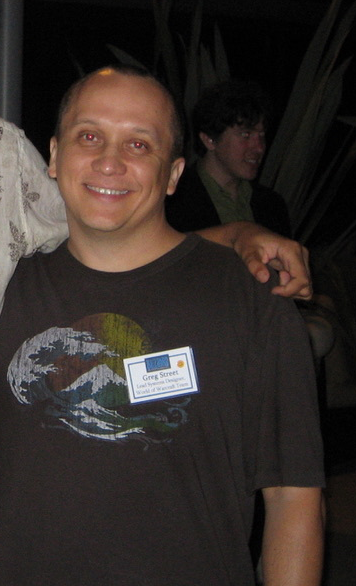
Greg Street is an American video game designer and former Head of Creative Development for Riot Games.[2]

Key Information

Street was previously employed by Blizzard Entertainment as Lead Systems Designer on the award-winning MMORPG World of Warcraft, and is also known by his screen name "Ghostcrawler" on the World of Warcraft forums and his own Twitter account. Prior to being employed by Blizzard, Street worked as a marine biologist, eventually moving into the game design field. He also worked with Ensemble Studios on the Age of Empires series of real-time strategy games, during which period he was also known by the screen name "Deathshrimp".[3]

In November 2013 he announced on his personal Facebook that he was leaving Blizzard Entertainment to pursue a "great opportunity for something new and exciting."[4][5] In January 2014, it was announced that Greg Street had become the Lead Game Designer for Riot Games[6][7][8] and in August 2018, Street shared the news that he would become Head of Creative Development at Riot, through a tweet in which he stated he would not be working directly on League of Legends anymore.[9]

On 28 July 2021, Street's name came up in a photo-op in the infamous Cosby Room with Alex Afrasiabi, who was named in California State lawsuit against Activision-Blizzard for mistreating women at the company.[10]

Education and early career

[edit]

Street graduated from McDaniel College in 1991 with Bachelor of Arts degrees in biology and philosophy, later earning a PhD in marine science. Between 1996 and 1998, Street worked as a research assistant professor at the University of South Carolina.[11] Street has said his work was only enjoyable to him "for the first several years or so...As I moved up the ranks, however, I was spending more and more of my time writing grant proposals, filling out paperwork and playing departmental politics." Street found that his profession involved "a lot of doing the same thing over and over again."[3]

Game design career

[edit]

Ensemble Studios, the team behind the real-time strategy series Age of Empires, employed Street as a designer in 1998.[11] With no education or experience in the game industry, Street suspects he was accepted due to his "writing and teaching experience, historical breadth, personal hygiene, gudd speling [sic], creativity, [and] my talent at capturing live alligators", as well as the user-created scenario for Age of Empires he submitted with his application, which later appeared in Age of Empires: The Rise of Rome. Street helped develop every Age of Empires game from Rise of Rome on, until his departure from the company. At first he designed in-game scenarios and maps, and later graduated to being the team's lead designer.[12]

Street was hired by Blizzard Entertainment in February 2008, and was the lead systems designer on the MMORPG World of Warcraft until November 2013.[11] He described his role at Blizzard as, "Systems design specifically is everything that is not level, story, quest, PvP or encounter design. My team handles everything from mechanics to items to trade skills to achievements to UI design." On the World of Warcraft message boards, he is known by his user name "Ghostcrawler". Street worked in a similar capacity with Blizzard as he did with Ensemble as a designer. "Game designers are not artists or programmers, but we use the tools developed by the programmers and the assets created by the artists to get content into the game. Programmers make the game run, artists make it beautiful, but it is the designer's job to make it fun."[13] Street became well-known in the World of Warcraft community during the public beta test for World of Warcraft: Wrath of the Lich King, during which he was frequently communicating with beta testers on the message boards. He was often on the message boards announcing changes to the game or discussing them with players.[14] Because "game balance is one of the most controversial aspects of any multiplayer game... I benefit from being able to engage the community directly."[13] Apart from discussions on the Blizzard forums, Street also interacted with the World of Warcraft community regularly via his Twitter account.

He left Riot in March 2023, claiming a combination of both personal and professional aspects led him to his decision.[15]

References

[edit]
Revisions and contributorsEdit on WikipediaRead on Wikipedia
from Grokipedia
Greg Street, known professionally by the alias Ghostcrawler, is an American video game designer specializing in massively multiplayer online role-playing games (MMORPGs).[1] With a background in oceanography, including a PhD in marine biology, he transitioned to game development in the late 1990s.[2] Street's career highlights include lead design roles on influential titles, shaping core gameplay systems through data-informed balance adjustments that prioritized player engagement and long-term viability.[3] Street began at Ensemble Studios, serving as lead designer for the Age of Empires series from 1998 to 2008, contributing to expansions like The Rise of Rome.[3] He joined Blizzard Entertainment in 2008 as Lead Systems Designer for World of Warcraft, overseeing class design, balance, and mechanics during expansions such as Wrath of the Lich King and Cataclysm, where his decisions—often communicated directly to players via official forums—drove iterative improvements but also elicited polarized responses from the community over perceived over-nerfs and class homogenization.[3][4] In 2013, he moved to Riot Games as Head of Creative Development, later becoming Executive Producer for an untitled League of Legends MMO, focusing on innovative combat and narrative systems. Departing Riot in 2023, Street founded the remote studio Fantastic Pixel Castle to develop Project Ghost, a fantasy MMO emphasizing player-driven progression and emergent gameplay.[5][6] As of October 2025, he remains Studio Head and Game Director, navigating challenges including NetEase's recent withdrawal as publisher while advancing early playtesting for feedback-driven refinement.[7][8][9]

Early Life and Background

Education and Marine Biology Career

Street earned Bachelor of Arts degrees in biology and philosophy from McDaniel College (formerly Western Maryland College) in 1991.[10] He subsequently pursued graduate studies at the University of Texas at Austin, where he obtained a PhD in marine science in 1996, focusing on marine biology.[11] Following his doctorate, Street completed a postdoctoral fellowship at the University of South Carolina, conducting research in marine biology and gaining exposure to academic life.[11] During this period, he worked as a research assistant professor, engaging in oceanographic studies that influenced his later online persona, "Ghostcrawler," derived from his interest in marine crustaceans like crabs.[12] His marine biology career involved empirical fieldwork and analysis of coastal ecosystems, though he ultimately found the prospects of a professorial path unappealing, leading him to pivot toward game design.[11][13]

Transition to Game Design

After completing a postdoctoral fellowship in marine biology at the University of South Carolina, Street opted against pursuing a tenure-track academic position, citing the intense competition, extensive grant-writing requirements, and administrative demands as deterrents.[14] Having maintained a lifelong interest in video games—from early computer gaming in high school to console play in college—he pivoted toward the burgeoning game development industry.[14] Street relocated to Texas, leveraging his regional ties, to join Ensemble Studios as an assistant designer on the original Age of Empires (1997), marking his professional entry into game design around 1997.[14] Though lacking prior experience with real-time strategy (RTS) genres, he quickly appreciated the series' emphasis on historical accuracy, unit diversity, and strategic depth, which aligned with his analytical background from scientific research.[14] This role allowed him to apply skills in data analysis and systems modeling—honed through marine biology studies—to game balancing and mechanics iteration.[15] By 1998, Street had advanced to lead designer at Ensemble Studios, overseeing expansions like Age of Empires: The Rise of Rome (1998) and subsequent entries in the franchise, solidifying his transition from empirical fieldwork to digital systems design.[16] His academic foundation in biology, including a Ph.D. from the University of Texas, informed a methodical approach to prototyping and testing, treating game elements akin to biological populations and ecosystems.[14]

Career at Ensemble Studios

Contributions to Age of Empires Series

Greg Street joined Ensemble Studios in 1998 as a designer on the Age of Empires series, beginning with the expansion The Rise of Rome released that year. In his early roles, he focused on creating in-game scenarios, maps, and campaigns, including those for Age of Empires II: The Age of Kings (1999) and its expansion The Conquerors (2000), where he handled narrative elements under the handle "DeathShrimp.") These contributions emphasized historical accuracy and strategic variety in single-player content, drawing from his background in marine science to inform environmental and resource mechanics.[15] Street progressed to lead designer for Age of Empires III, released on October 18, 2005, overseeing core gameplay systems and strategic direction.[17] Key innovations under his leadership included the Home City mechanic, representing a player's European capital that shipped resources, units, or improvements every few minutes based on accumulated experience points from gameplay progression, unlocking persistent upgrades across matches.[18] He directed enhancements to combat clarity through improved visuals and unit pathing, tactical terrain interactions such as downhill charge bonuses for cavalry, and unique asymmetries among eight civilizations—like the Portuguese emphasis on dual colonies or Spanish reliance on frequent shipments.[18] Multiplayer modes balanced accessibility for casual players, inspired by Age of Mythology, with competitive depth akin to Age of Empires II.[18] Street also managed design for the single-player campaign's storyline, integrating historical events with narrative arcs focused on colonial exploration and warfare.[19] The title incorporated rigorous historical research, such as reenactments of battles like Gettysburg, to ground mechanics in realism while prioritizing strategic depth over strict simulation.[18] For expansions, he served in a management capacity on The WarChiefs (October 17, 2006), introducing Native American factions and native alliances, and contributed to design on The Asian Dynasties (October 23, 2007), adding Asian civilizations with tech tree variants.[3] His work on the series culminated before Ensemble's closure in 2008, though later credits appear on remasters like Age of Empires III: Definitive Edition (October 15, 2020).[3]

Tenure at Blizzard Entertainment

Role as Lead Systems Designer for World of Warcraft

Greg Street assumed the role of Lead Systems Designer for World of Warcraft at Blizzard Entertainment in 2008, serving until his departure on November 27, 2013.[20] [21] In this capacity, he managed roughly half of the game's design staff, directing efforts in core systems including class design, combat mechanics, talent trees, itemization, and player-versus-player (PvP) balance.[22] His team focused on ensuring numerical coherence across gameplay elements, such as ability scaling, resource management, and stat interactions, to maintain engaging and balanced player experiences.[23] Street, operating under the online alias "Ghostcrawler," maintained a distinctive public presence by regularly posting on official World of Warcraft forums to explain design rationales, address player concerns, and preview upcoming adjustments.[23] This direct communication channel, initiated around 2008, allowed for real-time feedback integration into patches and expansions, though it sometimes amplified debates over tuning decisions.[24] During his tenure, Street contributed to the design of three expansions—Wrath of the Lich King (released November 13, 2008), Cataclysm (December 7, 2010), and Mists of Pandaria (September 25, 2012)—overseeing systemic foundations that supported their content releases.[25] The Lead Systems Designer position reported to the Game Director and collaborated with other leads on content, quests, and encounters, emphasizing iterative refinement based on playtesting data and community metrics.[22] Street's oversight extended to major revisions, such as talent system simplifications and class ability consolidations, aimed at reducing complexity while preserving specialization options for the game's approximately 12 million subscribers at the time.[24] His approach prioritized data-driven balance, drawing from internal analytics on player retention and performance disparities across specs.[23]

Key Design Changes in Expansions

During the Cataclysm expansion, released December 7, 2010, Street, as Lead Systems Designer, spearheaded a consolidation of class talent trees from multiple tiered structures into a single 31-point tree per class, with role specializations selectable as early as level 10. This redesign targeted the elimination of "filler" talents—such as minor boosts like +1% critical strike chance—in favor of more substantive choices that reinforced distinct spec identities, like unique rotations for DPS warriors or warlocks.[26] The overhaul also introduced the mastery secondary stat, which delivered spec-specific scaling effects, such as amplified periodic damage for applicable builds, to deepen progression without overwhelming early-level play.[27] In a June 1, 2011, developer post-mortem, Street noted improved balance margins (reducing spec disparities to 5-10% from prior 30-50% extremes) but conceded shortcomings, including "cookie-cutter" optimal paths that curtailed hybrid viability and player traps like skipping key talents such as Raging Blow in Fury warrior builds.[26] Building on this in Mists of Pandaria, launched September 25, 2012, Street's team shifted to a modular talent framework: players chose one option from three per row at levels 15, 30, 45, 60, 75, and 90, with core abilities granted baseline without per-level points. This "shelf" system diverged from vertical trees by emphasizing situational utility (e.g., root versus snare effects) over incremental stats, aiming to curb unviable synergies, simplify balance, and align selections with playstyle preferences rather than mandatory min-maxing after recognizing prior trees as "fundamentally flawed and unfixable."[28] Parallel stat revisions in Mists of Pandaria streamlined mechanics: spell resistance and penetration were removed to eliminate niche gearing demands; hit ratings unified melee and spell avoidance (with explicit percentages like 6% base miss chance against equals); critical strikes defaulted to double damage across abilities; block incorporated diminishing returns post-avoidance for tank sustainability; and resilience restructured into baseline 30% PvP defense plus gear-granted power, enhancing arena viability without universal penalties.[29] These adjustments prioritized accessibility and class fantasy cohesion, reducing bloat while preserving depth in endgame scaling.[29]

Community Controversies and Backlash

During his tenure as Lead Systems Designer for World of Warcraft, Greg Street, known online as Ghostcrawler, faced significant criticism from the player community over class balance decisions, talent system overhauls, and perceived imbalances in player-versus-player (PvP) content. Players frequently voiced frustration on official forums and third-party sites like MMO-Champion, arguing that changes under Street's direction homogenized class identities and prioritized accessibility over depth, leading to widespread dissatisfaction during the Cataclysm (released December 7, 2010) and Mists of Pandaria (released September 25, 2012) expansions.[30][31] In Cataclysm, Street oversaw a major redesign of talent trees, aiming to simplify specialization choices but resulting in complaints of reduced player agency and repetitive gameplay loops. Community backlash intensified as subscription numbers declined from a peak of approximately 12 million in October 2010 to around 7.6 million by early 2012, with forums citing class nerfs—such as repeated adjustments to frost mages despite data showing their underperformance—as evidence of unresponsive design. Street addressed some concerns in a March 7, 2012, official post-mortem, acknowledging that while the overhaul improved entry-level play, it fell short in delivering varied endgame experiences for veteran players.[32][31][33] Criticism persisted into Mists of Pandaria, where ongoing patch adjustments to abilities and gear scaling fueled accusations of favoritism toward certain playstyles, exacerbating PvP queue times and arena imbalances. Street's direct engagement on the official forums as Ghostcrawler, intended to foster transparency, often escalated tensions, with players perceiving responses as dismissive of empirical feedback from raid logs and combat data shared on sites like Warcraft Logs. By late 2013, this culminated in his announced departure from Blizzard on November 27, 2013, prompting a surge of negative commentary on platforms like WoWhead, where moderators removed inflammatory posts amid reports of thousands of critical threads.[34][35][30] Post-departure analyses attributed part of the era's subscriber attrition—dropping to 5.6 million by November 2013—to these systems changes, though Street maintained in later interviews that broader factors like life cycle fatigue played a larger role. Community sentiment, as reflected in ongoing forum discussions, held Street accountable for a perceived shift away from the game's original mechanical complexity, influencing hiring skepticism at subsequent roles.[31][36][37]

Period at Riot Games

Lead Designer for League of Legends Balance

Greg Street, known professionally as Ghostcrawler, assumed the role of Lead Designer for League of Legends balance at Riot Games in January 2014, following his departure from Blizzard Entertainment in November 2013.[38][39] In this position, Street directed the team's efforts to adjust champion statistics, item effectiveness, and gameplay systems through bi-weekly patches, aiming to foster a dynamic meta that rewarded skill while mitigating dominance by individual characters or strategies.[40] His approach drew on extensive player data analytics, prioritizing empirical metrics such as win rates across matchmaking tiers from Bronze to professional leagues, rather than anecdotal feedback alone.[41] Street advocated for a high "rate of change" in patches to counteract player adaptation and maintain engagement in a game with over 140 champions by 2017.[42] This philosophy manifested in targeted nerfs and buffs, exemplified by adjustments to marksman champions in Patch 7.4, which addressed perceived over-reliance on specific builds while preserving core identities.[43] At the 2017 Game Developers Conference, he detailed Riot's balancing framework, emphasizing the tension between accessibility for novice players and depth for experts, with decisions informed by simulations predicting post-patch outcomes.[44] Such methodologies contributed to League of Legends' sustained esports viability, as evidenced by stable professional pick-ban rates and viewer retention during Worlds tournaments in subsequent years.[40] Engagement with the community was a hallmark of Street's tenure, utilizing Twitter for direct queries on balance queries and unveiling iterative processes behind changes, such as evolving champion kits to align with data-driven viability.[45] However, his Blizzard background sparked initial skepticism among players, with some forums citing past World of Warcraft class redesigns as overly disruptive, though Riot's implementation under Street shifted toward more granular, evidence-based tuning.[39] By 2017, this role transitioned as Street contributed to broader design initiatives, including rune system overhauls that recalibrated resource management for summoner spells and keystones.[46]

Executive Producer for Untitled Runeterra MMO

In December 2020, Greg Street, then serving as Riot Games' vice president of intellectual property and entertainment, publicly confirmed the studio's development of an untitled massively multiplayer online role-playing game (MMORPG) set in the Runeterra universe of League of Legends, announcing his role as executive producer.[47][48] The project aimed to expand the franchise's lore into a persistent online world, distinct from the competitive arena of League of Legends, with Street emphasizing early-stage conceptualization focused on immersive storytelling and player-driven exploration rather than direct competition with established MMOs.[47] Under Street's leadership, Riot initiated hiring for key positions in March 2021, including roles in game design, engineering, and art to build the core team for the MMORPG, signaling a commitment to long-term development amid the studio's broader Runeterra ecosystem expansions like Legends of Runeterra and Arcane.[49] Street's prior experience designing systems for World of Warcraft informed the project's emphasis on scalable multiplayer mechanics and economic balance, though specific design details remained internal, with public updates limited to confirmations of active progress.[50] Street stepped down from the executive producer position and left Riot Games on March 7, 2023, after nearly a decade with the company, attributing the decision to a combination of personal bereavement and a desire to pursue independent creative endeavors.[51][52] His departure occurred during the project's pre-alpha phase, with no announced release timeline, and was followed by internal shifts, including a reported development reset in 2024 to refine the game's differentiation from contemporary MMOs.[53]

Founding Fantastic Pixel Castle

Establishment and Project Ghost Development

Fantastic Pixel Castle was established in 2023 by Greg Street, a veteran game designer previously involved in projects at Ensemble Studios, Blizzard Entertainment, and Riot Games.[54] The studio formed as a partnership with NetEase Games, operating as a fully remote, global entity to leverage international talent while maintaining a small team size for agile development.[55] Street serves as studio head and game director, drawing on his experience to prioritize open communication, player partnership, collaborative trust, and enjoyment in the development process.[55] The founding team, initially around 10 members, defined core values emphasizing player-focused iteration and high morale through anonymous surveys and value-aligned hiring.[55] The studio's establishment was publicly announced on November 2, 2023, highlighting its role as a AAA first-party development outfit under NetEase, aimed at creating innovative multiplayer experiences.[56] Street emphasized the benefits of remote work for rapid prototyping and early community engagement, contrasting with larger studio bureaucracies he encountered previously.[55] This setup allowed Fantastic Pixel Castle to begin pre-production swiftly, focusing on a new massively multiplayer online game codenamed Project Ghost.[54] Project Ghost is an original intellectual property set in a fantasy universe, designed as a modernized MMORPG with social and survival elements.[56] Development commenced immediately following the studio's formation, incorporating features such as "Blue Shards" for private survival realms and "Red Shards" for public competitive areas, alongside dozens of character classes optimized for alternate characters.[57] The central city hub evolves based on player actions, and combat systems blend updated controls with traditional RPG strategy.[57] Street committed to early and frequent playtesting to integrate community feedback, hosting an AMA livestream on November 8, 2023, to discuss progress.[56] As of mid-2025, the project remained in early stages, with dev blogs detailing prototype testing and iterative design to ensure alignment with player expectations.[57]

Funding Challenges and Industry Critiques

In October 2025, NetEase Games terminated its funding and publishing agreement with Fantastic Pixel Castle, leaving the studio without primary financial support for Project Ghost.[58] [7] Studio head Greg Street stated that the transition from NetEase's first-party structure would allow greater flexibility but emphasized the urgent need for a new publisher or investor to sustain operations.[59] Without such backing, Street warned, the studio would likely close, potentially halting development on the multiplayer online game entirely.[60] This followed earlier reports in August 2025 indicating financial pressures within NetEase's portfolio, with Fantastic Pixel Castle identified as at risk amid broader investor caution toward high-cost MMOs.[61] Street has publicly critiqued the games industry's funding landscape, attributing the studio's challenges to a persistent scarcity of capital for ambitious projects amid post-pandemic retrenchment.[62] In a LinkedIn post on October 20, 2025, he noted that despite outreach from potential backers, viable funding remained elusive, reflecting broader investor reluctance to commit to unproven titles in a market wary of overdevelopment.[63] He argued that industry practices favoring "gigantic investments" in sprawling live-service games have depleted resources, suggesting that reallocating a fraction of such capital to multiple smaller-scale efforts could yield more sustainable outcomes.[64] To adapt, Street floated the idea of a "downscoped" version of Project Ghost, potentially shifting from a full MMO to a less resource-intensive format to improve funding prospects.[65] These difficulties underscore Street's prior observations on structural inefficiencies in large-scale game development, including overly rigid timelines and misplaced priorities at major studios that prioritize scale over iterative progress.[66] He has also expressed concern over a shift away from humble, player-focused design toward arrogance in established firms like Blizzard and Riot, which he believes hampers innovation and adaptability in funding-constrained environments.[67]

Design Philosophy and Industry Impact

Core Principles in Game Systems Design

Greg Street's approach to game systems design emphasizes iterative improvements that enhance player mastery, depth, and replayability while avoiding arbitrary changes that merely shift power without advancing overall quality. In discussions on balancing competitive titles like League of Legends, he advocated for purposeful adjustments grounded in data and player feedback, such as overhauling masteries to restore engagement rather than implementing superficial tweaks.[68] This philosophy rejects a "rotational meta" where dominance cycles unpredictably among champion archetypes, instead pursuing a stable equilibrium where strategic choices remain viable without forcing players into disliked options due to raw power imbalances.[68] Central to Street's principles is designing systems that are accessible yet demand skill for mastery, exemplified by the "easy to learn, hard to master" model applied to champions and mechanics. He prioritized diversity in abilities—ensuring distinct roles, like differentiating dragon interactions for champions such as Shyvana—to foster meaningful decision-making and prevent homogenization.[69] Balance iterations, including buffs and nerfs, incorporate measured responses based on win rates, adaptation time for new elements, and community input, as seen in updates to assassins and older champions like Warwick to inject depth without disrupting established playstyles.[69] In massively multiplayer contexts, this extends to aligning core systems like progression and social dynamics with player reactions, promoting flexibility to evolve based on early feedback while maintaining a clear vision for target audiences.[70][71] Street's systems work also stresses innovation in targeted areas, such as combat or economy mechanics, while adhering to proven standards elsewhere to mitigate risks in ideation phases. During his tenure at Blizzard Entertainment, this manifested in talent and gear systems designed for progression that rewarded skill over rote grinding, informed by empirical player behavior data tempered by designer intuition. At Riot Games, similar tenets guided balance across skill levels, from novice to professional, ensuring systems supported diverse strategies without over-relying on metrics alone. In founding Fantastic Pixel Castle, he reinforced these by embedding player-centric adaptability into studio values, using anonymous surveys and direct engagement to refine MMO systems like those in Project Ghost.[71][70]

Achievements, Criticisms, and Legacy in MMOs

Greg Street served as Lead Systems Designer for World of Warcraft from 2008 to 2013, overseeing class balance, talent systems, and core gameplay mechanics during the Wrath of the Lich King, Cataclysm, and Mists of Pandaria expansions.[72] Under his leadership, the team implemented a major talent system overhaul in Cataclysm (released December 7, 2010), replacing modular talent points with choice-limited trees to reduce complexity and encourage specialization, which aimed to address player complaints about overpowered builds while promoting build diversity.[72] He also contributed to introducing account-wide achievements in patch 5.0.4 (August 28, 2012), allowing progress to carry across characters, enhancing accessibility for alt-heavy players.[73] Street's approach emphasized iterative balance patches, with frequent adjustments to class abilities based on data from millions of player sessions, as detailed in his Cataclysm post-mortem where he highlighted using telemetry to refine mechanics like resource management and crowd control.[72] This data-driven philosophy extended to PvP, where he advocated for regular tuning to prevent dominance by a few specs, influencing World of Warcraft's shift toward dynamic equilibrium over static power levels. His public engagement via the @Ghostcrawler Twitter account, starting around 2009, set a precedent for direct developer-player dialogue, with posts explaining rationale behind nerfs and buffs, fostering transparency amid growing community forums.[74] Criticisms of Street's tenure centered on perceived over-nerfing of popular classes, particularly paladins and hunters, which some players attributed to his decisions during Mists of Pandaria beta (2012), leading to widespread forum backlash and petitions for his removal.[75] Detractors argued that rapid patch cycles, such as multiple hotfixes in 2012 targeting healing output, disrupted player investment and favored PvE raid tuning over PvP viability, exacerbating subscription declines from 12 million peak in 2010 to under 8 million by late 2012.[76] While Street maintained these changes were team consensus informed by playtesting data, community sentiment often personalized blame on him as the public face, culminating in his departure announcement on November 21, 2013.[76] Street's legacy in MMOs lies in normalizing experimental, feedback-responsive design, where "bad" ideas like temporary ability swaps were tested to evolve systems, as he reflected post-Blizzard in discussions on embracing failure for innovation.[74] His work popularized telemetry-based balancing, now standard in titles like Final Fantasy XIV, and his advocacy for player agency in progression influenced hybrid reward structures blending dailies with flexible goals. Despite backlash, retrospective analyses credit him with sustaining World of Warcraft's relevance through Cataclysm's content density, which peaked concurrent players at over 1 million during launch.[72] Street's subsequent roles, including executive producer on Riot's canceled Runeterra MMO (announced 2019, leadership ended 2023) and founding Fantastic Pixel Castle for Project Ghost (2023–2025), underscore his enduring focus on ambitious, player-centric MMOs, though the latter faced funding cuts from NetEase on October 10, 2025, highlighting persistent industry risks he publicly addressed.[8]

References

User Avatar
No comments yet.