Hubbry Logo
Rob PardoRob PardoMain
Open search
Rob Pardo
Community hub
Rob Pardo
logo
8 pages, 0 posts
0 subscribers
Be the first to start a discussion here.
Rob Pardo
Rob Pardo
from Wikipedia

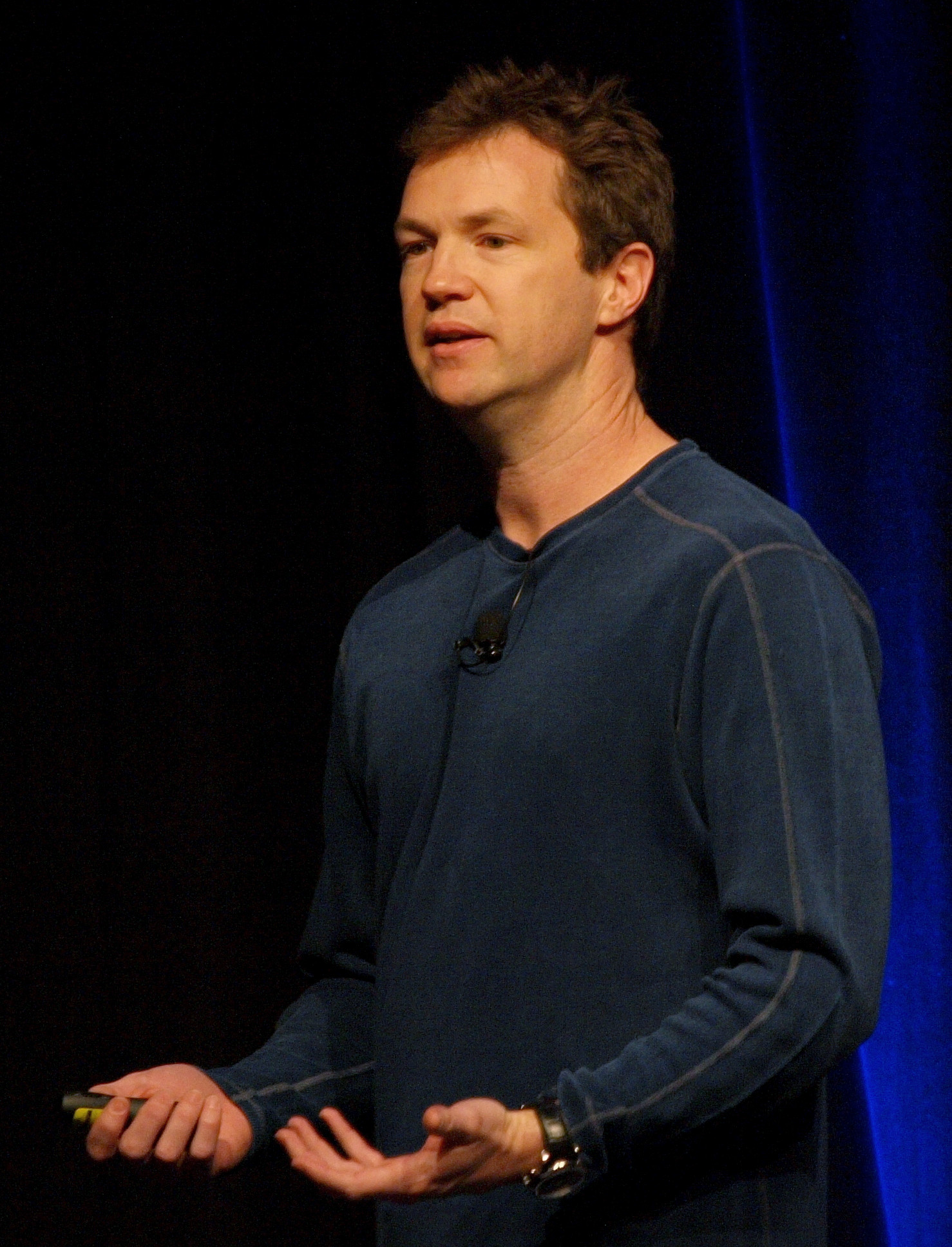
Rob Pardo (born June 9, 1970) is an American video game designer who is the founder of Bonfire Studios. He previously served as Chief Creative Officer of Blizzard Entertainment until resigning in 2014 after nearly 17 years with the company.

Key Information

Early life

[edit]

Born on June 9, 1970, in Southern California, Pardo became interested in game design after serving as Dungeon Master for his friends' Dungeons & Dragons games.[1] In a 2014 interview, Pardo reflected that his competitive nature came from being the only child of his similarly competitive father. Dissuaded by the difficulty of becoming a film director, Pardo attended the University of California, Irvine, intending to become a lawyer.[2] However, he joined Interplay Entertainment after seeing a co-worker at his electronics store job apply at the video game developer.[1]

Blizzard Entertainment

[edit]

After briefly working at Interplay, Pardo was hired by Blizzard Entertainment in 1997 because of his skill at real-time strategy games.[1] After working as a developer on StarCraft, Pardo was elevated to lead designer of its Brood War expansion and Warcraft III: Reign of Chaos.[3] Next promoted to Vice President of Game Design, Pardo used his experiences playing EverQuest to guide development of World of Warcraft.[4] In 2006, he was named on the Time 100 annual list of influential people, though Blizzard staff criticized Time magazine for attributing their collective work to a single individual.[1][5]

After the 2005 closure of Blizzard North restarted development of Diablo III, Pardo recruited Jay Wilson from Relic Entertainment to direct the game. Pardo was also responsible for proposing the game's controversial auction house, which would ultimately be removed in 2014.[1]

In 2008, Pardo initially supported development of a digital client for the World of Warcraft Trading Card Game, but he reassigned its developers to the Battle.net platform the following year. This pause would ultimately prove beneficial to the development of Hearthstone as a distinct game.[1]

After the success of World of Warcraft, Pardo began planning for Blizzard's successor MMORPG under the code name Titan. However, frequent disagreements with lead writer Chris Metzen led to development hell with staff divided between incompatible visions. In 2013, Pardo was named Chief Creative Officer, and he used this new authority to reboot development of Titan.[1] On July 3, 2014, Pardo left Blizzard, partially under pressure from Blizzard CEO Michael Morhaime to resign.[6] Despite criticism of Pardo's leadership, the Titan project would ultimately be reworked into the hero shooter Overwatch under the supervision of Jeff Kaplan, who Pardo had recruited.[1] Pardo met Kaplan through their EverQuest guild, Legacy of Steel, which was well-known for its world-first completions, and he initially hired Kaplan as a World of Warcraft quest designer.[7]

Later work

[edit]

In 2016, Pardo founded Bonfire Studios and raised $25 million in funding from venture capital firm Andreessen Horowitz and video game developer Riot Games.[8][9] In December 2021, Pardo invested in Bright Star Studios, which developed the MMORPG Ember Sword until its cancelation in May 2025.[10][11]

References

[edit]
[edit]
Revisions and contributorsEdit on WikipediaRead on Wikipedia
from Grokipedia
Rob Pardo is an American video game , , and executive best known for his pivotal role at , where he served as from 2008 until his departure in 2014 after 17 years with the company. He led the design of landmark titles including StarCraft: Brood War (1998), (2002), and (2004), shaping the and massively multiplayer online genres that defined Blizzard's success. In 2016, Pardo co-founded in , as its CEO and creative director, focusing on innovative multiplayer games; the studio's debut project, the team-based PvP Arkheron, was announced in September 2025 after nearly a decade of development. A graduate of the , Pardo earned a in criminology, law, and society, and began his career in the early as a tester at Interplay Productions in . There, he advanced to production roles, including producer on the DOS port of (1996), before joining in 1997 to work on the original StarCraft. At , Pardo was promoted to Vice President of Game Design following the successes of Warcraft III and its expansion The Frozen Throne (2003), where he oversaw core design for expansions and other franchises like (2010). As executive producer, he spearheaded the launch of Hearthstone: Heroes of Warcraft (2014), a that became one of Blizzard's most popular titles. Pardo's influence extended beyond development; he built Blizzard's game design department, mentored senior designers, and fostered a culture emphasizing polished, player-focused gameplay. His achievements were recognized by Time magazine, which named him one of the 100 most influential people in the world in 2006 for architecting virtual worlds like in , and by , which listed him among the top 25 power players in the . With , backed by over $80 million in venture funding including from , Pardo assembled a team of former Blizzard veterans to create genre-blending experiences like Arkheron, an isometric multiplayer game drawing from MOBAs, battle royales, and action RPGs such as Diablo, aiming to innovate in team-based PvP while emphasizing player connection and adventure.

Early years

Education

Rob Pardo was born on June 9, 1970, in Southern California. Pardo attended the University of California, Irvine (UCI), where he earned a Bachelor of Arts degree in criminology, law, and society in 1996. While studying at UCI, Pardo entered the professional gaming industry.

Interplay Productions

Rob Pardo entered the in 1994 when he joined Interplay Productions as a game tester. Initially, he spent approximately three to four months in , focusing on identifying bugs and ensuring functionality across various titles in Interplay's early lineup. During this period, Pardo contributed as additional crew to projects such as Cyberia (1994), a developed by Xatrix Entertainment and published by Interplay. Pardo quickly progressed to the role of junior at Interplay, where he supported production on multiple games from 1995 onward. In this capacity, he is credited as a for Whiplash (1995), a puzzle-platformer, the DOS port of (1996), and a 1995 adaptation of , handling tasks like coordinating development timelines and third-party collaborations. His tenure also involved work on titles such as Wild 9 in partnership with and FreeSpace with Software, amid Interplay's broader portfolio including Descent, Stonekeep, and Fallout. These roles emphasized managing external developers and providing production oversight without leading full-scale design. Through his time at Interplay, Pardo developed foundational skills in methodologies, including systematic bug reporting and playtesting protocols, as well as production basics such as scheduling, resource allocation, and iterative feedback processes. These experiences honed his understanding of collaborative game development in a fast-paced studio environment. In 1997, Pardo was recruited by Mike Morhaime to join .

Blizzard Entertainment

Game design contributions

Rob Pardo joined in 1997 and served as a on StarCraft (1998), where he provided key qualitative feedback on multiplayer balance, particularly for the game's asymmetrical races—Terran, , and Protoss—ensuring competitive viability across diverse playstyles. He contributed build order strategies to the AI programming, enhancing strategic depth in both single-player and multiplayer modes. As lead designer for the StarCraft: Brood War expansion (1998), Pardo oversaw unit design and campaign development, integrating narrative elements with balanced mechanics to create cohesive storytelling through missions that advanced the lore while testing multiplayer innovations. Pardo's work extended to (2002), where he led design efforts as executive producer, emphasizing unit diversity and (RTS) innovations that blended RPG elements into the genre. He introduced the , featuring persistent characters that level up and acquire abilities, which added progression and personalization to RTS gameplay and influenced subsequent titles in the genre. Units were crafted with unique, memorable abilities—such as the Mountain King's Thunderclap for area control and the Blademaster's Critical Strikes for high-risk combat—to promote tactical variety and counterplay in multiplayer skirmishes. As lead designer for (2004), Pardo shaped core MMO mechanics, including class systems with nine launch classes (Warrior, Hunter, Rogue, Mage, Priest, Druid, Warlock, Shaman, Paladin), each equipped with 30-40 abilities drawn from Warcraft III hero inspirations to ensure distinct roles in group content. He expanded quest structures dramatically, increasing their count tenfold during development after playtests revealed sparse progression felt unengaging, and introduced rested experience bonuses to mitigate player burnout by rewarding offline time. Pardo also designed foundational raiding and PvP systems, such as 40-player instances like Molten Core for cooperative endgame challenges and battlegrounds for structured player-versus-player combat, prioritizing accessibility and social interaction. Pardo continued his influence as lead designer on World of Warcraft: The Burning Crusade (2007), focusing on endgame content with eight major raid dungeons, including the Black Temple and Sunwell Plateau, which introduced tiered progression and flying mounts to enhance exploration in Outland. These designs emphasized scalable difficulty and rewarding group dynamics, building on vanilla mechanics to sustain long-term player engagement.

Executive roles

In the mid-2000s, Rob Pardo advanced to the role of Vice President of Game Design at Blizzard Entertainment, where he began overseeing multiple development teams across the company's portfolio. In this capacity, he guided high-level design strategies for ongoing projects, drawing on his earlier hands-on experience to foster collaboration between design, art, and programming disciplines. Pardo's responsibilities expanded significantly in late 2012 when he was promoted to Chief Creative Officer (CCO), a position in which he managed the creative direction for key franchises, including StarCraft II: Wings of Liberty (released 2010) and Diablo III (released 2012). As CCO, he served as executive producer on titles like Hearthstone: Heroes of Warcraft, ensuring alignment with Blizzard's overarching vision for immersive, multiplayer-focused experiences. His leadership emphasized empowering specialized teams while maintaining strategic oversight to integrate community feedback into development cycles. Under Pardo's influence, Blizzard refined its approaches to game monetization, notably committing to a subscription model for despite initial considerations of a , ad-supported structure, which he later reflected on as a pivotal decision for long-term player engagement. He also championed models for select titles, such as , viewing them as experimental opportunities to broaden accessibility while preserving core gameplay integrity. Pardo significantly shaped Blizzard's "polish" philosophy, advocating for a culture where refinement permeates every stage of development rather than being confined to end-phase tweaks. This involved deploying cross-functional "strike teams" for ongoing playtesting and iteration, ensuring features like unit interactions and balance achieved exceptional depth and responsiveness. His emphasis on iterative processes—prototyping, testing, and refining repeatedly—helped cultivate Blizzard's reputation for delivering games that were intuitive to learn yet challenging to master. Pardo resigned from Blizzard in July 2014 after 17 years with the company.

Later career

Departure and transition

On July 3, 2014, Rob Pardo announced his resignation as at after 17 years with the company, stating that the decision followed "long and careful contemplation" and stemmed from a desire to pursue new challenges beyond his tenure there. Following his departure, Pardo embarked on a year-long , during which he focused on spending time with his family, completing a new home, and taking extended vacations to recharge after years of intense industry involvement. In the subsequent phase, he gradually re-engaged with the gaming sector by serving as a creative advisor for , touring studios worldwide, and visiting friends' projects, which helped reignite his passion for game development. He also participated in industry discussions, including speaking at conferences and contributing to the documentary Video Games: The Movie, where he shared reflections on the evolution of gaming, such as the rise of mobile platforms, , and as transformative forces in the medium. This transitional period allowed Pardo to avoid immediate competitive roles in the industry while contemplating his next steps, culminating in the founding of Bonfire Studios in 2016.

Bonfire Studios

Bonfire Studios was established in 2016 by Rob Pardo, the former Chief Creative Officer of Blizzard Entertainment, in collaboration with several of his ex-colleagues from the company. The studio is headquartered in Irvine, California, and initially raised $25 million in funding from venture capital firm Andreessen Horowitz and Riot Games, with total investments reaching $80 million from additional backers including Altos Ventures and Founders Fund. The team at comprises approximately 70 seasoned game developers who prioritize a collaborative, self-driven environment to foster creativity and efficiency. The studio's core focus is on crafting ambitious AAA multiplayer games that emphasize social adventure, exploration, and player unity, aiming to create experiences where participants feel deeply connected. Drawing from Pardo's extensive background in massively multiplayer online game design at Blizzard, Bonfire's development philosophy stresses continuous iteration, player-centric design, and building communities through meaningful social interactions, informed by lessons on sustaining long-term engagement in shared worlds. In September 2025, the studio announced its debut title, Arkheron, a fast-paced, team-based PvP action game set in a dark fantasy world for PlayStation 5, Xbox Series X|S, and PC, blending elements of MOBAs, battle royales, and action RPGs. The announcement included an initial playtest from September 19 to 21, 2025, followed by community-run playtests announced on November 6, 2025.

References

Add your contribution
Related Hubs
User Avatar
No comments yet.