


Community hub
Recent from talks
Contribute something
Nothing was collected or created yet.
Grudziądz
View on Wikipedia
Grudziądz ([ˈɡrud͡ʑɔnt͡s] ⓘ; Latin: Graudentum, Graudentium, German: Graudenz) is a city in northern Poland,[2] with 92,552 inhabitants (2021).[1] Located on the Vistula River, it lies within the Kuyavian-Pomeranian Voivodeship and is the fourth-largest city in its province.
Key Information


.jpg)


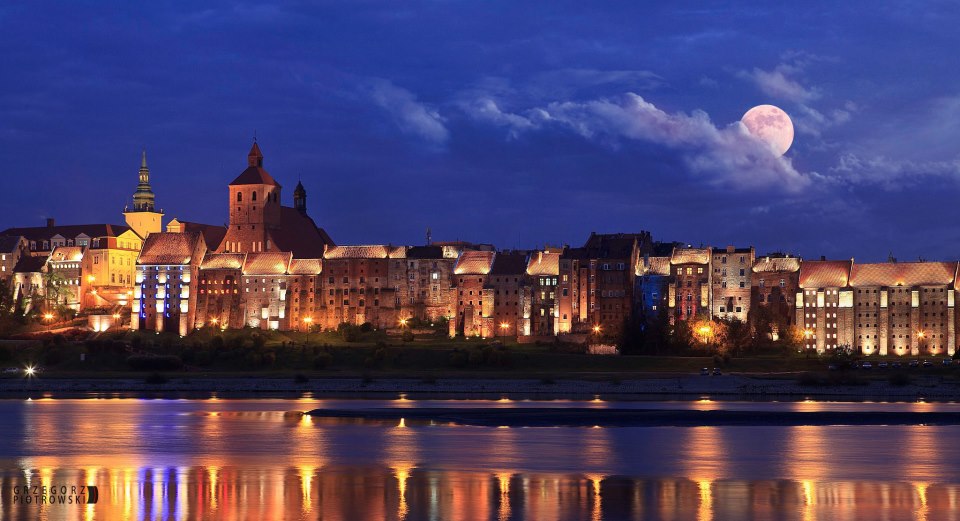
Grudziądz is one of the oldest cities in north-central Poland, founded by King Bolesław I the Brave over 1000 years ago. The well-preserved Old Town has various Gothic and Baroque landmarks, several included on the European Route of Brick Gothic, most notably the unique Grudziądz Granaries, declared a Historic Monument of Poland.[3] Grudziądz is a former royal city of Poland, and became known as the "City of Uhlans" being the location of the former Polish Cavalry Training Centre. Situated at the crossroads of important highways, it is a city of industry and services, and a noted centre for water sports and motorcycle speedway racing.
Geographical location
[edit]Grudziądz is located close to the east shore of the river Vistula.[4] It is located in Chełmno Land.
History
[edit]Early medieval Poland
[edit]Grudziądz was founded by the Duke of Poland, Bolesław I the Brave[5] of the Piast dynasty.
Initially Grudziądz was a defensive stronghold, known as a gord. The fortress and tower were built to protect the Poles from attacks by the Baltic Prussians.[6]
Monastic State of the Teutonic Knights
[edit]The settlement was re-fortified again from 1234 by the Teutonic Order. The erection of the castle, with the help of stone as building material, was begun around the middle of the 13th century. Under the protection of the castle the settlement gradually began to develop into a town.
In 1277 both "the castle and the town" were besieged heavily by the Yotvingians.[citation needed] The settlement adopted Kulm law in 1291 while under the rule of the monastic state of the Teutonic Knights.[6]
The oldest building parts of the Catholic St. Nicholas' Church stem from the end of the 13th century. The Holy Spirit Church, which apparently was founded during the 13th century, is mentioned together with the town's hospital for the first time in 1345.[citation needed] Other documents reveal that in the 14th century the town already had a well-developed infrastructure. A document of 1380, as an example, refers to the construction of an aqueduct, a fountain and a town-hall cellar.[citation needed]
In the 14th century, papal verdicts ordered the restoration of the town and region to Poland, however, the Teutonic Knights did not comply and continued to occupy it.[7] During the era of the Teutonic Knights, Graudenz had become a distinguished trade center in particular for textiles and agricultural products including grain.[citation needed] Around 1454, Graudenz had already reached about the same level of economic development as other towns in the western part of the State of the Teutonic Order, such as Danzig (Gdańsk), Elbing (Elbląg), Thorn (Toruń), Marienburg (Malbork), Kulm (Chełmno), Konitz (Chojnice), Neumark (Nowe Miasto Lubawskie) and Preußisch Stargard (Starogard Gdański).[citation needed]
Kingdom of Poland
[edit]
In 1440, the city co-founded the Prussian Confederation which opposed the Monastic State of the Teutonic Knights. At the beginning of the Thirteen Years' War (1454–66), the citizens forced the Teutonic Order to hand over the castle. The confederation asked the King of Poland, Casimir IV Jagiellon to join Poland. The King agreed and signed the act of incorporation in Kraków in March 1454.[8] Although there was support the Knights inside the city walls [citation needed] during the entirety of the war, both the city and the castle remained under Polish control. The 1466 peace treaty confirmed the re-incorporation of Grudziądz to Poland.[9]
Between 1454 and 1772 the city was part of the Polish Chełmno Voivodeship, which itself was since 1466 part of the Polish province of Royal Prussia, soon included in the larger Greater Poland Province. The Grudziądz Castle was seat of the local starostas (royal administrative officials). It was often visited by Polish kings.

After the great depression of the Thirteen Years' War, new economical growth in the town was slow before the middle of the 16th century. Economic progress was hampered by the religious struggles and by the Polish–Swedish wars throughout the 17th century.[citation needed] At the end of 1655, during the Swedish Deluge, the city and its castle were captured by the Swedes and occupied for four years. In 1659, the Swedes had been besieged for several days and retreated. During their departure, part of the town was destroyed by fire.[citation needed]
In 1522, Nicolaus Copernicus, who aside from his astronomical work was also an economist, presented his treatise Monetae cudendae ratio in Grudziądz. In it he postulated the principle that "bad money drives out good" which became known as the Gresham's law or the Gresham–Copernicus law. This work included an early version of the quantity theory of money – a key concept in economics.[10]

Following Protestant Reformation, in 1569 the local Protestants were given access to the Holy Spirit Church; in 1572 Catholicism seemed to have vanished almost entirely in the town.[citation needed] In 1597 King Sigismund III Vasa gave order that the Protestants had to return all churches taken over by them in the past to the Catholics, including all accessories. The Protestants remained in possession solely of St. George's Church until in 1618 when the base of the building was washed away by the Vistula River and the church was torn down. For a while, they used once more the vacant Holy Spoirit Church, until in 1624 this building together with the hospital had to be handed over to nuns of the Order of Saint Benedict for the purpose of founding an affiliated institution.[citation needed]
Since 1622 Jesuits from Toruń had a station in Grudziądz, which in 1640 was already so strong that it was able to form a residence in Grudziądz, despite objections from the side of the magistrate of the town.[citation needed] In 1648 construction work for building a Jesuit church was taken up.[citation needed] The Jesuits also founded the Jesuit College, which was the first high school in Grudziądz.[11]

The town proper was surrounded by town walls, except on the side of river Vistula, where instead of walls there stood huge massive grain silos, from where grain could be transported through wooden pipes to the embankment of the river.[12]
Prussian Partition of Poland
[edit]
Following the First Partition of Poland declared on 5 August 1772, the city was annexed by the Kingdom of Prussia. In 1773, it had a population of only 2,172 persons.[citation needed] In the late 18th and early 19th centuries, it was part of the area affected by the Partitions of Poland.[13] To stimulate municipal trade, Frederick the Great brought in 44 colonist families. Grain trade flourished. Among the most successful grain traders were the Schönborn family.[14] In 1776, a decision was made to build a fortress in the town. Between 1796 and 1804, by decision of the King of Prussia, the Grudziądz Castle was demolished. During the Napoleonic invasion in Prussia in 1806–1807, the fortress was successfully defended by General of Infantry Wilhelm René de l'Homme de Courbière against attacks by French troops.[15]
In 1871, Graudenz became part of the unified German Empire. Administratively it belonged to the administrative district of Regierungsbezirk Marienwerder in the Province of West Prussia. With the improvement of the railway network in Germany, Graudenz transiently lost its meaning as an important trading place for grain. In 1878, the railway line to Jabłonowo Pomorskie (then Germanized as Goßlershausen) opened. After the construction of a railroad bridge across the Vistula in 1878, a railway line to Laskowice (Laskowitz) opened. Graudenz became a rapidly growing industrialized city. In 1883 also the Thorn (Toruń)-Graudenz-Marienburg (Malbork) railway line went into operation.[citation needed]
In 1899, the Chamber of Commerce was established in Graudenz. The Imperial German Navy named a light cruiser class and its lead ship, the SMS Graudenz, after the city. The newspaper Der Gesellige, founded by book seller Rothe in 1826, belonged up to the end of World War I to the most widely spread newspapers of east Germany.[citation needed] Around the turn to the 20th century, Graudenz had become an important cultural centre in east Germany with numerous schools, municipal archives and a museum.
The city was the site of a military prison for Polish activists. In 1832, also 249 Polish insurgents the November Uprising were imprisoned by the Prussians in the local fortress and subjected to forced labour, malnutrition, beatings and insults.[16] Released prisoners who left Europe formed the Gromada Grudziądz in Portsmouth, England in 1835 as part of the Great Emigration movement.[17]
Germanisation of the Poles in the Prussian Partition
[edit]Frederick had nourished a particular contempt for the Polish state and people. Germanisation was enforced to assimilate residents.[18][19] He brought in German and Frisian workers and peasants, who in his opinion, were more suitable for building up his new civilization.[20] Frederick settled around 300,000 colonists in the eastern provinces of Prussia. Using state funds for colonization, German craftsmen were placed in all local Polish cities.[21] A second colonization wave of ethnic Germans was pursued by Prussia after 1832.[22] Laws were passed aimed at Germanisation of the Polish inhabited areas and 154,000 colonists were settled by the Prussian Settlement Commission before World War I. Professor Martin Kitchen writes that in areas where the Polish population lived alongside Germans a virtual apartheid existed, with bans on the Polish language and religious discrimination, besides attempts to colonize the areas with Germans.[23]
Approximately 16,850 Poles and about 26,000 Germans lived in the district of Graudenz.[24] To resist Germanisation,[25] Polish activists started to publish the newspaper "Gazeta Grudziądzka" in 1894. It advocated the social and economic emancipation of rural society and opposed Germanization – publishing articles critical of Germany. German attempts to repress its editor Wiktor Kulerski only helped to increase its circulation.[26] From 1898 to 1901, a secret society of Polish students seeking to restore Polish independence operated in the city, but the activists were tried by German courts in 1901, frustrating their efforts.[27]
In Graudenz, German soldiers were stationed in the local fortress as part of the Germanization measures, and the authorities placed soldiers with the most chauvinistic attitude towards the Poles there.[28] The German government brought in more stationed military, merchants and state officials to influence population figures.[29] In the 1910 census 84% of the population of the town and 58% of the county was recorded as German.[30]
.jpg)
Census figures published by the German Empire have been criticised as unreliable. Historians believe they have a high degree of falsification; formal pressure on census takers (predominantly school-teachers) was possible, and a new bilingual category was created to further complicate the results, as bilingual people (that is those who could speak both German and Polish) were classified as Germans.[31] Some analysts have asserted that all people registering as bilingual were classified as Germans.[32] The Polish population in this heavily Germanised city has been officially estimated at around 12–15% during this period.
The Polish population numbers rose steadily before the First World War.[33][34] In the German election of 1912, the National Liberal Party of Germany received 53% of all votes, whilst Polish candidates won 23% of votes. In 1912, Wiktor Kulerski founded the Polish Catholic Peasant Party in the city, which aimed at protecting the local Polish population[35]
In 1913, the Polish Gazeta Grudziądzka reached a circulation of 128,000, making it the third largest Polish newspaper in the world.[26]
Interwar Poland
[edit]On 23 January 1920, the regulations of the Treaty of Versailles became effective, the city was reincorporated under its Polish name Grudziądz into the reborn Polish state (Second Polish Republic), although a majority of its inhabitants were German. At that time Józef Włodek, the newly appointed Polish mayor, described his impression of the town as "modern but unfortunately completely German".[36]

Between 1926 and 1934 the number of Germans (34,194 in 1910) rose from 3,542 to 3,875.[37] Some Polish authors emphasize a wider emigration pattern motivated chiefly by economic conditions and the unwillingness of the German minority to live in the Polish state.[38] In 1935, Poles already constituted 93% of the inhabitants of Grudziądz, so within a few years the city became ethnically Polish again after the ethnic Germans left the city.
The German author Christian Raitz von Frentz writes that after the First World War ended, the Polish government tried to reverse the systematic Germanization of the past decades.[39]
Prejudices, stereotypes and conflicts dating back to German harsh rule and discrimination of Poles influenced Polish policies towards minorities in the new independent Polish state.[40]
The Polish authorities, supported by the public (e.g. the "explicitly anti-German" Związek Obrony Kresów Zachodnich), initiated a number of measures to further Polonization.[41] The local press was also hostile towards the Germans.
.jpg)
Fearful of a re-Germanization of the city, the Polish paper "Słowo Pomorskie" (23.19.1923) criticized the authorities of Grudziądz for tolerating the local German amateur theatre "Deutsche Bühne". The theatre was funded by money from Berlin.[42] Created before the war, its actors were mostly German officers stationed with the local garrison.[43] The mayor responded by pointing out that the theatre was being monitored because of suspected "anti-state activities". According to Kotowski, this episode indicates that even the most minor activities of the German minority were closely scrutinized by the Polish authorities beginning with the earliest phase of Polish policy towards the German minority.[44] The German theatre was re-opened by the Nazis in 1943,[45] while the last director of the Polish theatre in the city in the years 1922–24 was murdered by them.[46]
In the interbellum, Grudziądz served as an important centre of culture and education with one of the biggest Polish military garrisons and several military schools located both in and around the city. A large economic potential and the existence of important institutions like the Pomeranian Tax Office and the Pomeranian Chamber of Industry and Trade, helped Grudziądz become the economic capital of the Pomeranian Voivodeship in the interwar period. Grudziądz's economic potential was featured at the First Pomeranian Exhibition of Agriculture and Industry in 1925, officially opened by Stanisław Wojciechowski, President of the Second Polish Republic.

The 64th and 65th Infantry Regiments and the 16th Light Artillery Regiment of the Polish Army were stationed in Grudziądz during the 19 years of the inter-war period. They were part of the 16th Infantry Division, which had its headquarters in the city, as did the cavalry's famous 18th Pomeranian Uhlan Regiment. The Grudziądz Centre of Cavalry Training educated many notable army commanders, including future Polish resistance hero Witold Pilecki. Military education in Grudziądz was also provided by the Centre of the Gendarmerie, the Air School of Shooting and Bombarding, and the N.C.O. Professional School, which offered courses for infantry reserve officer cadets.
In 1920 a German-language school was founded.[47] In 1931 the Polish government decreed a reduction in the number of German classes in the school and requested lists of Catholic children and those pupils with Polish-sounding names which they viewed as victims of Germanization, from the German school. Although the list was not prepared, some of the children were transferred, which led to a school-strike.[48] The German school followed ideas and customs as those in Germany.[49] It was headed by a Nazi sympathiser Hilgendorf who praised Nazi ideology.[50] The Polish authorities were alarmed when a notebook of one female student was discovered by them, which contained the Nazi party anthem, the Horst Wessel Lied and revisionistic text. The discovery caused outrage and calls to dismiss Hilgendorf due to his irredentist beliefs[51] In November 1933 two German craftsmen were killed by a Polish mob during a local election campaign.[47]
World War II
[edit]
On 3 September 1939 units from the Wehrmacht entered the town after the Battle of Grudziądz and then occupied it. From 26 October 1939 to 1945 the city was part of the administrative district of Regierungsbezirk Marienwerder in the new province of Reichsgau Danzig-West Prussia.
Nazi atrocities
[edit]Following the German invasion, the Einsatzkommando 16 and Einsatzgruppen IV and V entered the city to commit crimes against the population.[52] They also carried out mass searches of Polish courthouses, organizations, police stations, etc., and seized large amounts of grain, textiles, coffee, equipment, and even homing pigeons.[52] On 7 September, 25 Polish citizens were detained as hostages[53] – priests, teachers and other members that enjoyed the respect of local society. They were threatened with execution if any harm came to the ethnic Germans from the city who were detained and held by the Polish authorities during the invasion of Poland. After their initial release on the return of the members of the German minority, they were re-arrested and most of them were shot.[54] On 9 September a further 85 Poles were imprisoned by the Germans.[53] The German authorities destroyed the city's monuments to Polish independence,[55] and banned Polish priests from speaking Polish during church masses.[56]
On 4 September, the Einsatzgruppe V demanded a list of names of all members of the 600-strong Jewish community within 14 hours, as well as a list of all their possessions. They were also fined 20,000 zlotych[57]
On 6 September, the whole city was covered with posters demanding that Jews and "mixed races" of category I and IInd degree (so-called Mischlinge, i.e. persons of mixed race) gather at the headquarters of the Einsatzgruppe V (established in the local school). Around 100 people responded to the demand and were immediately arrested and robbed. After this they were transported to an unknown destination and disappeared – it is believed that they were most likely executed by the Germans in the Mniszek-Grupa forests.[58][59]
On 19 October, the city was visited by the NSDAP Gauleiter (regional chief) Albert Forster. In a public speech to the Volksdeutsche, he declared that the area was to become "one hundred percent" German, and that Poles "have nothing to do here, and should be evicted"[60]
Grudziądz was the location of the German concentration camp Graudenz, a subcamp of Stutthof concentration camp.
Selbstschutz participation in mass murder
[edit]
Alongside the military and Einsatzgruppen administration, the first structures of Selbstschutz were established – a paramilitary formation of members of the German minority in the region. The head of Selbstschutz in Grudziądz was Doctor Joachim Gramse.[61][62] In October 1939, Selbstschutz created an internment camp for Poles seeking to restore Polish independence, whose commandant was a local German Kurt Gotze.[62]
Teachers, officials, social workers, doctors, merchants, members of patriotic organisations, lawyers, policemen, farmers and 150 Polish priests were held in this camp.[63] There were also around 200 Polish boys, students of local schools, who were soon deported to forced labour in Germany.[63] It is estimated that around 4,000 to 5,000 people went through the camp.[63] Other arrested Poles were held in the cellars of the Grudziądz Fortress.[61] The local Germans who ran the camp established their own "court" which decided the fate of the prisoners. The "court" comprised: Kurt Gotze, Helmut Domke, Horst Kriedte, Hans Abromeit (owner of a drugstore), Paul Neuman (barber).[64] Based on their decisions, some of the prisoners were sent to concentration camps, 300 were murdered en masse; only a few were released.[63][65] Those sentenced to death were mostly executed through shooting by the Selbstschutz in Księże Góry near Grudziądz; in October and November 1939 several hundred people were murdered there and their bodies buried in five mass graves.[66] The victims were usually shot at the edges of already dug out graves.[67]
Further executions were carried out in desolate areas of Grudziądz: on 11 November 1939 near Grudziądz Fortress, the Selbstschutz executed ten Polish teachers, four Polish priests and four women.[68] Additionally, 37 people were murdered in Grudziądz city park.[66] On 29 October 1939 a unit of Selbstschutz mass-murdered ten Polish hostages as revenge for posters that had appeared in the city calling for resistance against Nazi occupation.[64]
Final months of World War II
[edit]
As the result of heavy fighting in 1945, over 60% of the city was destroyed. Soviet Major Lev Kopelev participated in those battles and covered the final surrender of the German garrison in his book "To Be Preserved Forever". He describes the joint psychological warfare in March 1945 by the Red Army and members of the NKFD. From March 9 to 12, 1945, the Russians removed residents from the city center, then looted it, including the personal property of the residents.[69] In the following months, the Russians looted local factories and enterprises of several hundred tons of finished products, semi-finished goods, raw materials, scrap metal, machinery, tools, etc.[69] In April, the Poles began rebuilding the industry, which had been looted more by the Russians than destroyed in the fighting.[69] The NKVD operated a camp for arrested Poles from Pomerania in the city.[70]
As the war ended, the German population of the city fled or was expelled to Germany in accordance with the Potsdam Agreement.[47] Local Polish survivors were joined by Poles who had emigrated from Polish areas annexed by the Soviet Union east of the Curzon line, where they had been asked by the Soviet authorities to either accept incorporation into the U.S.S.R. or to leave what had been their former homeland.
Demographics
[edit]In 2018, it was populated by 95,045 inhabitants. [citation needed]
Education
[edit]
- Nicolaus Copernicus University
- Grudziądzka Szkoła Wyższa
Sport
[edit]Grudziądz has two professional sports teams. The largest following has the popular speedway team GKM Grudziądz, who race at the Grudziądz Speedway Stadium and compete in the Ekstraliga (Poland's top division), whereas the local football team Olimpia Grudziądz has a slightly more modest following, playing in the lower leagues (as of 2025). GKS Olimpia Grudziądz is also a multi-sports club with athletics and judo sections.[71]

One of the key elements of the city’s sports infrastructure is the Bronisław Malinowski Central Stadium, also referred to as the Grudziądz Municipal Stadium. It serves as the home ground of the local football club, Olimpia Grudziądz, and provides facilities not only for professional matches but also for community events and youth training. The stadium plays an important role in promoting physical activity and strengthening the city’s identity through sport.[72]
Notable people
[edit]- Piotr of Grudziądz (c. 1400–1480), composer
- Johann Stobäus (1580–1646), composer
- Alfred Wohl (1863–1946), German chemist
- Alexander Pohlmann (1865–1952), politician
- Max Winkler (1875–1961), Mayor of Graudenz
- Ernst Hardt (1876–1947), writer
- Waldemar Kophamel (1880–1934), U-boat commander
- Leo White (1882–1948), stage performer
- Alfons Hoffmann (1895–1963), Polish engineer
- Bolesław Orliński (1899–1992), Polish aviator and test pilot
- Kurt Weyher (1901–1991), Admiral
- Erich Witte (1911–2008), stage actor, operatic tenor and opera director
- Antoni Czortek (1915–2003), Polish boxing champion
- Henryk Sawistowski (1925–1984), dean of City and Guilds College of London Institute
- Waldemar Baszanowski (1935–2011), Olympic champion weightlifter
- Stefania Toczyska (born 1943), mezzo-soprano
- Bronisław Malinowski (1951–1981), Olympic Champion in the 3000m steeplechase race, 1980 Summer Olympics
- Mateusz "scriptwelder" Sokalszczuk (born 1985), flash game developer, author of Waterworks!, a game that takes place in the city
- Krzysztof Buczkowski (born 1986), motorcycle speedway rider
Twin towns – sister cities
[edit]Grudziądz is twinned with:
|


italicized that this city is suspended due to Russian Invasion of Ukraine.
Sights
[edit]-
 Szultz Port (at present Grudziadz Marina)
 -
 Memorial to Polish soldiers, main market square
 -
 St. Mary's Church
 -
 Church of St. Francis Xavier
 -
 Sobieski High School
 -
 St. Nicholas' Basilica (Bazylika św. Mikołaja)
 -
 The Piotr Janowski City Park (Park Miejski im. Piotra Janowskiego)
 -
 Main Post Office
 -
 Klimek Tower (Wieża Klimek)
 -
 Witold Pilecki monument
 -
 Uhlan and Girl Monument
 -
 The Bronisław Malinowski Bridge
 -
 After factory water tower
 -
 War cemetery


.jpg)


See also
[edit]References
[edit]- ^ a b "Local Data Bank". Statistics Poland. Retrieved 9 August 2022. Data for territorial unit 0462000.
- ^ "Główny Urząd Statystyczny" [Central Statistical Office] (in Polish). To search: Select "Miejscowości (SIMC)" tab, select "fragment (min. 3 znaki)" (minimum 3 characters), enter town name in the field below, click "WYSZUKAJ" (Search).
- ^ Rozporządzenie Prezydenta Rzeczypospolitej Polskiej z dnia 22 listopada 2017 r. w sprawie uznania za pomnik historii "Grudziądz - zespół zabytkowych spichlerzy wraz z panoramą od strony Wisły", Dz. U., 2017, No. 2271
- ^ "Grudziądz | Poland | Britannica". www.britannica.com. Retrieved 5 April 2023.
- ^ Wielka encyklopedia polski: Tom 1 Wojciech Słowakiewicz, Jacek Słowiński, Piotr Turkot page 270 Fogra, 2000
- ^ a b "Grudziądz". Encyclopædia Britannica Online. Archived from the original on 22 March 2014. Retrieved 8 May 2013.
- ^ "wojny polsko-krzyżackie". Encyklopedia PWN (in Polish). Retrieved 19 April 2024.
- ^ Górski, Karol (1949). Związek Pruski i poddanie się Prus Polsce: zbiór tekstów źródłowych (in Polish). Poznań: Instytut Zachodni. p. 54.
- ^ Górski, p. 88-89, 206-207
- ^ Angus Armitage, The World of Copernicus, 1951, p. 91.
- ^ Roman Pawlak, Zabytkowe ratusze. Warsaw, MUZA SA, 2003, p. 68-69
- ^ Johann Friedrich Goldbeck: Vollständige Topographie des Königreichs Preußen. Teil II, Marienwerder 1789, p. 28, no. 1.
- ^ "Partitions of Poland Facts | Britannica". www.britannica.com. Retrieved 17 May 2022.
- ^ Hans-Jürgen Bömelburg: Zwischen polnischer Ständegesellschaft und preußischem Obrigkeitsstaat, Oldenbourg, Munich 1995, p. 404 (restricted preview Archived 25 April 2016 at the Wayback Machine)
- ^ Fischer, Paul (1907). Feste Graudienz 1807 unter Gouverneur de Courbiere - Geschichte der Blockade und Belagerung (PDF) (in German). Graudenz: Verlag Arnold Kriedte. Archived (PDF) from the original on 1 October 2020. Retrieved 22 September 2020.
- ^ Kasparek, Norbert (2014). "Żołnierze polscy w Prusach po upadku powstania listopadowego. Powroty do kraju i wyjazdy na emigrację". In Katafiasz, Tomasz (ed.). Na tułaczym szlaku... Powstańcy Listopadowi na Pomorzu (in Polish). Koszalin: Muzeum w Koszalinie, Archiwum Państwowe w Koszalinie. pp. 177–178.
- ^ Historia Polski, 1795–1918 Stefan Kieniewicz Państwowe Wydawnictwo Naukowe, 1975 page 142
- ^ Ritter, Gerhard (1974). Frederick the Great: A Historical Profile. Berkeley: University of California Press. pp. 172. ISBN 0-520-02775-2.
- ^ Hans-Jürgen Bömelburg: Zwischen polnischer Ständegesellschaft und preußischem Obrigkeitsstaat, Oldenbourg, Munich 1995, p. 205 ff. (restricted preview)
- ^ Ritter, Gerhard (1974). Frederick the Great: A Historical Profile. Berkeley: University of California Press. pp. 180. ISBN 0-520-02775-2.
- ^ Fryderyk II Stanisław Salmonowicz Zakład Narodowy im. Ossolińskich, 1985 "Z funduszy na kolonizację osiedlano w miastach fachowców z krajów niemieckich"
- ^ Wielka historia Polski t. 4 Polska w czasach walk o niepodległość (1815–1864). Od niewoli do niepodległości (1864–1918) Marian Zagórniak, Józef Buszko 2003 page 186
- ^ A history of modern Germany, 1800–2000 Martin Kitchen Wiley-Blackwel 2006, page 130
- ^ Michael Rademacher: Deutsche Verwaltungsgeschichte Provinz Westpreußen, Stadt- und Landkreis Graudenz Archived 27 May 2013 at the Wayback Machine (2006).
- ^ Kraj a emigracja. Ruch ludowy wobec wychodźstwa chłopskiego do krajów Ameryki Łacińskiej (do 1939 roku) Muzeum Historii Polskiego Ruchu Ludowego 2006, page 290
- ^ a b Kraj a emigracja. Ruch ludowy wobec wychodźstwa chłopskiego do krajów Ameryki Łacińskiej (do 1939 roku) Muzeum Historii Polskiego Ruchu Ludowego 2006, page 285
- ^ Filomaci Pomorscy: tajne związki młodzieży polskiej na Pomorzu Gdańskim w latach 1830–1920, Jerzy Szews, Polska Akademia Nauk, Instytut Historii Nauki, Oświaty i techniki, Zakład Dziejów Oświaty, 1992 – page 129
- ^ Studia i materiały do dziejów Wielkopolski i Pomorza, Tom 18, Wydanie 1 Polskie Towarzystwo Historyczne. Oddział w Poznaniu, page 119, Państwowe Wydawnictwo Naukowe
- ^ Chwalba, Andrzej (2007). Historia Polski 1795–1918 (in Polish). Wydawnictwo Literackie. p. 444.
- ^ Gemeindelexikon für die Regierungsbezirke Allenstein, Danzig, Marienwerder, Posen, Bromberg und Oppeln (in German). Berlin: Königlich Preußisches Statistisches Landesamt. 1912.
- ^ Neither German nor Pole: Catholicism and National Indifference in a Central European Borderland, James E. Bjork, 2008, page 152-153; University of Michigan Press
- ^ National Identity and Weimar Germany: Upper Silesia and the Eastern Border, 1918–1922, T. Hunt Tooley, page 13; University of Nebraska Press.
- ^ Przegląd zachodni, Tom 34, Instytut Zachodni, Instytut Zachodni., 1978 page 214
- ^ Życie kulturalno-literackie Grudziądza w latach 1918–1939 Eugenia Sławińska Gdańskie Towarzystwo Naukowe, 1980 – 211, page 11
- ^ Dzieje Wielkopolski: Lata 1793–1918, Jerzy Topolski, Wydawn. Poznańskie 1973, page 503,
- ^ Borodziej, Wlodzimierz; Endres, Gerald; Lachauer, Ulla (2009). Als der Osten noch Heimat war (in German). Rowohlt. p. 127. ISBN 978-3-87134-644-6. Quotation:"Es habe auf ihn,..., den Eindruck einer modernen und "leider völlig deutschen" Stadt gemacht,"
- ^ Kotowski, Albert S. (1998). Polens Politik gegenüber seiner deutschen Minderheit 1919–1939 (in German). Forschungsstelle Ostmitteleuropa, University of Dortmund. p. 55. ISBN 3-447-03997-3. Archived from the original on 25 September 2021. Retrieved 2 October 2020.
- ^ Niemiecka mniejszość narodowa w Polsce w latach 1919-1939, Paweł Kacprzak, Wydawnictwo Państwowej Wyższej Szkoły Zawodowej, Studia Lubuskie. 2007, 3, s. 145–158
- ^ A Lesson Forgotten: Minority Protection Under the League of Nations: The Case of the German Minority in Poland, 1920-193 page 8 LIT Verlag Berlin-Hamburg-Münster, 1999
- ^ Polens Politik gegenüber seiner deutschen Minderheit 1919–1939 Albert S. Kotowski p. 43
- ^ Polens Politik gegenüber seiner deutschen Minderheit, 1919–1939 (Studien der Forschungsstelle Ostmitteleuropa an der Universität Dortmund). S. 94.
- ^ Hauser, Przemysław (1998). Mniejszość niemiecka na Pomorzu w okresie międzywojennym (in Polish). UAM. p. 219.
- ^ Historia Pomorza: 1850–1918, pt. 2. Polityka i kultura Gerard Labuda, Stanisław Salmonowicz – 2002, page 398 -
- ^ Polens Politik gegenüber seiner deutschen Minderheit, 1919–1939 (Studien der Forschungsstelle Ostmitteleuropa an der Universität Dortmund). S. 94–95.
- ^ Pamiętnik teatralny: kwartalnik poświẹcony historii i krytyce teatru, Tom 46 Państwowy Instytut Sztuki (Poland), Instytut Sztuki (Polska Akademia Nauk) page 464
- ^ Rocznik Gdański, Tom 50, Wydanie 2, Gdańskie Towarzystwo Naukowe. Wydział I Nauk Społecznych i Humanistycznych, page 215
- ^ a b c Borodziej, Wlodzimierz; Endres, Gerald; Lachauer, Ulla (2009). Als der Osten noch Heimat war (in German). Rowohlt. ISBN 978-3-87134-644-6.
- ^ Eser, Ingo (2010). Volk, Staat, Gott, Die deutsche Minderheit in Polen und ihr Schulwesen 1918–1939 (in German). Nordost Institut, University of Hamburg. p. 415. ISBN 978-3-447-06233-6. Archived from the original on 25 September 2021. Retrieved 2 October 2020.
- ^ Hauser, Przemysław (1998). Mniejszość niemiecka na Pomorzu w okresie międzywojennym (in Polish). UAM. p. 293.
- ^ Mniejszości narodowe i wyznaniowe na Pomorzu w XIX i XX wieku:zbiór studiów Mieczysław Wojciechowski Uniwersytet Mikołaja Kopernika, 1998 – 292, page 82,90
- ^ Volk, Staat, Gott!«Die deutsche Minderheit in Polen und ihr Schulwesen 1918–1939, page 585
- ^ a b Wardzyńska, Maria (2009). Był rok 1939. Operacja niemieckiej policji bezpieczeństwa w Polsce. Intelligenzaktion (in Polish). Warszawa: IPN. p. 109.
- ^ a b Wardzyńska, p. 110.
- ^ Barbara Bojarska: Eksterminacja inteligencji polskiej na Pomorzu Gdańskim (wrzesień – grudzień 1939). Poznań: Instytut Zachodni, 1972, pp. 78–79.
- ^ Zbigniew Otremba: Grudziądz. Kronika miasta. Gdańsk: wydawnictwo Regnum, 2007, page 81–82. ISBN 978-83-920686-1-7
- ^ Jan Sziling. Niektóre problemy okupacji hitlerowskiej w Grudziądzu (1939–1945). "Rocznik Grudziądzki". V-VI, ss. 448–449, 1962.
- ^ Jochen Böhler, Klaus-Michael Mallmann, Jürgen Matthäus: Einsatzgruppen w Polsce. Warszawa: Bellona, 2009, page. 89
- ^ Jan Sziling. Niektóre problemy okupacji hitlerowskiej w Grudziądzu. S. 450.
- ^ Barbara Bojarska: Eksterminacja inteligencji polskiej na Pomorzu Gdańskim p. 124.
- ^ Zbigniew Otremba: Grudziądz. Kronika miasta. Gdańsk: wydawnictwo Regnum, 2007, ss. 81–82. ISBN 978-83-920686-1-7.
- ^ a b Jan Sziling. Niektóre problemy okupacji hitlerowskiej w Grudziądzu... p. 451
- ^ a b Henryk Bierut: Martyrologia grudziądzan podczas okupacji hitlerowskiej. Grudziądz: Wydawnictwo Komitetu Ochrony Pamięci Walk i Męczeństwa w Grudziądzu, 1999, p. 9
- ^ a b c d Wardzyńska, p. 171.
- ^ a b Henryk Bierut: Martyrologia grudziądzan podczas okupacji hitlerowskiej. pages 10–11
- ^ Bogdan Chrzanowski: Eksterminacja ludności polskiej w pierwszych miesiącach okupacji (wrzesień − grudzień 1939) w: Stutthof: hitlerowski obóz koncentracyjny. Warszawa: Interpress, 1988, page 16.
- ^ a b Wardzyńska, p. 172
- ^ Henryk Bierut: Martyrologia grudziądzan podczas okupacji hitlerowskiej, page 54.
- ^ Zbigniew Otremba: Grudziądz. Kronika miasta. Gdańsk: wydawnictwo Regnum, 2007, pages 81–82.
- ^ a b c Golon, Mirosław (2022). "Na zapleczu frontów Armii Czerwonej. Sowieckie zbrodnie, represje i grabieże na ziemiach polskich w 1945 r. (na przykładzie wybranych miast)". Studia Toruńskie (in Polish). Vol. 17. p. 66. ISSN 2392-1463.
- ^ Baziur, Grzegorz (2002). "Armia Czerwona na Pomorzu Gdańskim 1945–1947". Biuletyn Instytutu Pamięci Narodowej (in Polish). 7. IPN: 36.
- ^ "Oficjalna Strona GKS Olimpia Grudziądz" (in Polish). Retrieved 12 March 2023.
- ^ "Miejski Ośrodek Rekreacji i Wypoczynku w Grudziądzu". moriw.pl. Archived from the original on 10 September 2025. Retrieved 23 September 2025.
External links
[edit] Media related to Grudziądz at Wikimedia Commons
- Official website
- History website
- . Encyclopædia Britannica. Vol. 12 (11th ed.). 1911. p. 381.

| City counties |  | |
|---|---|---|
| Land counties | ||
Seat (not part of the county): Grudziądz | ||
| Urban-rural gminas |  | |
| Rural gminas | ||
| International | |
|---|---|
| National | |
| Geographic | |
| Other | |

Grudziądz
View on GrokipediaGrudziądz is a city in northern Poland's Kuyavian-Pomeranian Voivodeship, situated on the right bank of the lower Vistula River.[1] With a population of approximately 93,000, it functions as a regional hub for industry, services, and transportation at the intersection of major highways.[1][2]
Originally established as a Slavic stronghold in the 10th century, Grudziądz was refortified by the Teutonic Order in the 13th century with a brick castle overlooking the river, which facilitated control over trade routes.[3] The city's medieval granaries, uniquely elevated for flood protection and grain storage, exemplify its historical economic reliance on Vistula commerce, while 19th-century Prussian fortifications expanded its defensive architecture into one of Europe's largest inland fortress systems.[4][1] Today, its economy centers on manufacturing sectors such as metal foundries, food processing, and lumber, bolstered by industrial parks and emerging energy infrastructure including a nearing-completion gas-steam power plant.[5][6] Grudziądz also hosts notable sports facilities for water activities on the Vistula and motorcycle speedway racing.[1]
Geography
Location and Topography
Grudziądz is situated in north-central Poland within the Kuyavian-Pomeranian Voivodeship, on the eastern bank of the Vistula River, at coordinates approximately 53°29′N 18°45′E.[7] The city lies roughly 100 km southeast of the Tricity metropolitan area (Gdańsk, Gdynia, Sopot) and 50–60 km northeast of both Toruń and Bydgoszcz, positioning it as a regional hub in the Lower Vistula Valley amid postglacial lowlands.[8] The topography of Grudziądz features an escarpment along the Vistula River, with the urban area spanning elevations from about 15 m above sea level in the southern, lower sections to 50 m in the northern, higher parts, reflecting the river valley's glacial morphology.[9] The surrounding terrain includes gently rolling hills and morainic deposits characteristic of the postglacial landscape in northern Poland, with city-wide elevations ranging from a minimum of 11 m near the floodplain to a maximum of 91 m, averaging 31 m.[10] This escarpment setting has historically influenced settlement patterns, with higher ground providing defensive advantages and views over the river, while the proximity to the Vistula—known for its meandering course and occasional low-water shoals—shapes local flood dynamics and land use.[11]Climate and Environmental Features
Grudziądz features a temperate oceanic climate classified as Cfb under the Köppen-Geiger system, marked by mild summers, cool winters, and relatively even precipitation distribution across seasons.[12][13] The annual average precipitation totals approximately 678 mm, with moderate monthly variations; the wettest periods occur in late summer and winter, including December with around 50-60 mm on average.[14][15] Summer temperatures peak in July, the warmest month, with average daily highs of 24°C (75°F) and lows of 13°C (56°F); comfortable conditions prevail, though occasional heatwaves can exceed 30°C. The cold season spans from mid-November to mid-March, with January recording average highs near 2°C and lows around -3°C, accompanied by frequent frost and limited snowfall averaging 20-30 cm annually. Spring and autumn serve as transitional periods with increasing rainfall and variable winds influenced by the nearby Vistula River, which moderates extremes but elevates local humidity levels year-round. Environmental conditions in Grudziądz reflect broader regional patterns in northern Poland, with air quality generally compliant with EU standards outside peak heating seasons, though occasional exceedances of PM2.5 and PM10 occur in winter due to residential combustion.[16] The city's riverside position on the Vistula supports riparian ecosystems, including floodplain meadows and limited wetlands, which aid in flood mitigation and biodiversity but face pressures from upstream agricultural runoff.[17] Urban green coverage, including parks and forested hills like Góra Księże, contributes to localized cooling and recreation, aligning with Polish efforts in urban greening for climate adaptation.[18]History
Early Settlement and Medieval Origins
Archaeological evidence from the castle site reveals occupation phases predating the Teutonic Order, including a pre-Teutonic period with identified faunal remains suggesting earlier human activity in the area.[19] The region, part of the Chełmno Land historically inhabited by Prussian tribes, featured a wooden fortification likely established by Slavic or Prussian groups prior to Teutonic arrival.[3] The first documented reference to Grudziądz appears in 1065, during a period when the site served as a border stronghold amid Polish efforts against Prussian incursions. Teutonic Knights arrived in the vicinity around 1243, following the papal legate's transfer of lands previously under Bishop Christian, marking the beginning of systematic conquest and fortification in the 1230s.[3] Medieval origins solidified with the construction of the brick Teutonic castle, known as Graudenz, in the second half of the 13th century, replacing earlier wooden structures to serve as a key defensive and administrative center.[20] The town proper received its charter in 1291 under Teutonic rule, establishing Grudziądz as a fortified settlement with rights modeled on those of Chełmno, facilitating German colonization and trade along the Vistula River.[8] This development integrated the site into the Monastic State of the Teutonic Knights, emphasizing its strategic position for controlling regional waterways and resisting Polish influence.[21]Era of the Teutonic Knights
The Teutonic Knights established control over Grudziądz following the 1228 grant of Chełmno Land by Duke Konrad I of Masovia, though initial military setbacks occurred, such as their defeat at Lake Rządz in 1243.[22] A commandery was set up in the mid-13th century, with construction of a brick castle commencing around 1260 on the site of an earlier wooden fortification.[3] [20] The castle featured a trapezoidal layout with a prominent bergfried tower known as Klimek, measuring 30 meters in height and 8.9 meters in diameter, along with a chapel consecrated in 1290 and completed structures by 1299.[20] On June 18, 1291, Country Master Meinhard of Querfurt issued the foundation charter for the city of Grudziądz, granting it Kulm Law and integrating it into the Teutonic monastic state.[22] The settlement developed as a fortified administrative center overlooking the Vistula River, with St. Nicholas Church construction beginning in 1286 and additional infrastructure like granaries completed by 1351.[22] In 1330, Grand Master Werner von Orseln utilized the castle as his headquarters during conflicts with Poland, underscoring its strategic military importance.[3] [20] The castle underwent repairs after a 1388 landslide collapsed the west wing, which was rebuilt with added farmyards, and by 1396, its arsenal included six light cannons and two stone-ball throwers.[22] [3] Following the Polish victory at the Battle of Grunwald on July 15, 1410, Commandant Wilhelm von Helfenstein was killed, and Polish forces briefly occupied the site before withdrawing due to Livonian reinforcements; the Teutonic Knights recaptured it by year's end.[20] [22] In May 1411, Mikołaj of Ryńsk was imprisoned and executed there for desertion.[3] Teutonic dominance ended on February 8, 1454, when local insurgents of the Prussian Confederation seized the castle after a week-long siege amid the Thirteen Years' War, expelling the Knights; subsequent recapture attempts in 1455 failed.[3] [20] [22] The territory was formally ceded to Poland under the Second Peace of Thorn in 1466.[3]Royal Prussia and Polish Integration
Following the Second Peace of Toruń on October 19, 1466, which concluded the Thirteen Years' War, Grudziądz was transferred from Teutonic Knight control to the Kingdom of Poland and incorporated as a royal city within the newly formed province of Royal Prussia, part of the Chełmno Voivodeship.[23] Royal Prussia retained semi-autonomous status under the Polish Crown, with its Prussian estates granted privileges such as tax exemptions and representation in local diets in exchange for loyalty to the king, fostering a distinct regional identity while tied to Polish sovereignty.[22] Grudziądz quickly emerged as a key administrative hub, hosting the first session of the provincial diet (sejmik) of Royal Prussia in 1466, underscoring its political centrality in the province's governance.[22] The city's strategic location on the Vistula River bolstered its role in trade and defense, with early urban improvements including the construction of the first brick houses around 1500, signaling economic expansion beyond wooden structures.[22] Politically, Grudziądz served as the seat for starostas—royal administrators overseeing justice, taxation, and military affairs—reinforcing Polish administrative integration while accommodating local Prussian customs.[1] A notable event occurred on March 21, 1522, when Nicolaus Copernicus, then administrator of Olsztyn, presented his treatise De aestimatione monetae (On the Estimation of Coinage) to the Prussian Diet assembled in the city, addressing currency debasement and advocating for stable monetary standards to combat inflation—a precursor to his later Monetae cudendae ratio.[24] This gathering highlighted Grudziądz's function as a forum for economic policy in Royal Prussia, directly linked to Polish royal oversight. Full integration into the Polish Crown advanced with the Union of Lublin in 1569, which abolished Royal Prussia's special autonomy, merging it administratively and legally into the greater Polish-Lithuanian Commonwealth while preserving local diets until the partitions.[22] Under subsequent kings like Sigismund Augustus, who in 1552 authorized the Trynka Canal project (designed by Copernicus) to improve water supply and navigation, Grudziądz saw infrastructural enhancements supporting trade.[22] The city hosted visits from Polish monarchs, including Casimir IV Jagiellon, Sigismund Augustus, and Stephen Báthory, affirming its loyalty during events like the Swedish Deluge (1655–1660), when Swedish forces under Charles X Gustav used the castle as headquarters in 1656 before Polish forces under Jerzy Lubomirski recaptured it in 1659, despite partial destruction.[1] By the late 18th century, Grudziądz remained a fortified trade center in the Chełmno Voivodeship, with its granaries and river port vital to Polish commerce until the First Partition of 1772 transferred it to Prussia.[23]Prussian Partition and Germanization Efforts
Following the First Partition of Poland, formalized by treaty on 5 August 1772 and effective occupation by 21 September 1772, Grudziądz (known as Graudenz in German) was annexed by the Kingdom of Prussia and incorporated into the Province of West Prussia.[25] The Prussian authorities promptly abolished the existing Polish starostwo (county administration) and reorganized local governance under German-speaking officials, initiating a process of administrative centralization aligned with Prussian bureaucratic standards.[26] As a strategically located fortress on the Vistula River, Graudenz retained and expanded its military significance, serving as a key defensive bastion with ongoing fortifications and a substantial Prussian garrison that bolstered German demographic and cultural presence. Germanization policies in Graudenz mirrored broader Prussian efforts in the partitioned territories, emphasizing linguistic assimilation and demographic shifts. German was established as the sole official language in administration, courts, and public life, while Polish usage was progressively marginalized; by the early 19th century, elementary schools shifted to German-medium instruction, limiting Polish-language education to private or clandestine settings.[27] Prussian authorities encouraged the immigration of German settlers, officials, and artisans, particularly after 1772, to alter the ethnic composition of urban areas like Graudenz, where the military garrison further reinforced German influence through conscription and settlement privileges for veterans. These measures aimed at cultural integration, with economic incentives such as land grants facilitating German colonization in West Prussia. Intensification occurred after Prussian unification into the German Empire in 1871, under Chancellor Otto von Bismarck's direction, incorporating Kulturkampf elements targeting Polish Catholic institutions. In Graudenz and surrounding districts, policies included the expropriation of Polish-owned lands via royal settlement commissions established in 1886, which purchased estates for German colonists, reducing Polish rural holdings by thousands of hectares across West Prussia by 1914.[28] Restrictions on Polish associations, newspapers, and religious practices were enforced, though local resistance persisted through secret Polish societies and economic self-help initiatives; despite these efforts, Prussian modernization— including railway connections in 1852 and industrial growth—intertwined with assimilation, leading to a predominantly German-speaking urban population by the early 20th century.[29] Prussian records indicate that by 1905, Germans comprised over 70% of Graudenz's residents, reflecting the cumulative impact of these policies.Interwar Independence and Military Role
Following the ratification of the Treaty of Versailles, Grudziądz was incorporated into the Second Polish Republic on 23 January 1920, marking the end of over a century of Prussian and German administration.[1] The city, situated in the Polish Corridor providing access to the Baltic Sea, became a focal point for Polish national revival, with Polish authorities establishing control amid a mixed population that included a significant German minority.[30] This reincorporation facilitated the Polonization of public life, including the renaming of streets and institutions to reflect Polish heritage. Grudziądz emerged as a major military garrison during the interwar period, hosting the headquarters of the 16th Pomeranian Infantry Division.[31] The city accommodated key units such as the 64th and 65th Infantry Regiments, alongside the 16th Light Artillery Regiment, underscoring its defensive role along the vulnerable western border. Its fortifications, originally from the Teutonic era and expanded under Prussian rule, were maintained and integrated into Polish defenses, contributing to the Pomeranian fortress system.[32] The establishment of the Cavalry Training Center (Centrum Wyszkolenia Kawalerii) in 1920 transformed Grudziądz into the "City of Uhlans," the largest such facility in Europe for training mounted troops.[33] This center trained officers and specialized in equestrian skills, producing riders who achieved international success, including at the 1926 Nice equestrian competition.[34] The emphasis on cavalry reflected Poland's interwar military doctrine, prioritizing mobile forces for rapid response in the region's flat terrain, while the garrison's presence bolstered local economy through military spending and infrastructure development.World War II Occupation and Atrocities
German forces seized Grudziądz on 5 September 1939 after the Battle of Grudziądz, part of the broader Nazi invasion of Poland that began on 1 September. The city, a key Polish defensive position with fortifications along the Vistula River, saw intense combat involving Polish units such as the 16th Infantry Division, resulting in significant casualties on both sides before the German 4th Army overran the defenses. Immediately following the occupation, Nazi occupiers under the direction of Einsatzkommando 16—Gestapo units from Gdańsk—and local Selbstschutz militias launched systematic repressions against the Polish population, targeting the intelligentsia, clergy, officials, and other community leaders as part of the Intelligenzaktion Pommern. This operation aimed to eliminate potential sources of resistance by decapitating Polish society. Detainees were confined in makeshift prisons, including a former boarding school in Grudziądz, before facing public executions in the city park to instill terror among civilians. These actions formed part of the Pomeranian Massacre, which encompassed direct extermination efforts from September to December 1939 across the region.[35] The repressions in Grudziądz contributed to the regional toll of 20,000 to 50,000 victims killed through shootings, with additional thousands arrested and deported to early concentration camps like Stutthof near Gdańsk. Priests such as Anthony Miętki and Anthony Sobisz were among those executed in or near the city in late 1939. Further atrocities persisted throughout the occupation, including forced labor and the establishment of the Graudenz subcamp of Stutthof in 1944, where prisoners faced starvation, beatings, and disease under SS control. As Soviet forces approached in early 1945, additional executions occurred at sites like the "Księże Góry" valley near Grudziądz, where mass graves hold remains of Polish victims.[35]Postwar Reconstruction and Communist Era
Grudziądz was captured by Soviet forces on March 6, 1945, after a siege lasting from late January that inflicted severe damage amid the final stages of World War II in the region. The city emerged with over 60% of its infrastructure destroyed, ranking among the three most devastated urban centers in Poland due to artillery barrages, fires, and ground combat.[36][37][1] Reconstruction commenced promptly under the newly imposed communist administration, focusing on restoring essential services, housing, and historic landmarks amid resource shortages typical of postwar Poland. Key efforts included rebuilding the Water Gate, gutted by fire in 1945, and comprehensive renovation of the 14th-century granary complex from 1946 to 1966, which preserved defensive structures originally adapted for grain storage. By the mid-1950s, foundational repairs had stabilized the urban core, enabling expansion of residential blocks and public facilities in line with centralized planning directives.[26][38][39] During the Polish People's Republic (1944–1989), Grudziądz transitioned into an industrial center, with state-driven initiatives emphasizing manufacturing and processing sectors to support national quotas. The economy incorporated food production facilities and mechanical works, reflecting broader communist prioritization of heavy industry over consumer goods, though inefficiencies and shortages persisted as in other provincial cities. The city's prewar military heritage, anchored by its extensive fortress system, continued under the Polish People's Army, hosting training units and garrisons that underscored its strategic position near the Vistula River.[40] Social dynamics under communism featured coerced labor campaigns, such as "czyny społeczne" in the 1970s, where residents participated in voluntary-yet-mandated public works to accelerate infrastructure projects. By the late 1970s, with a population nearing 90,000, Grudziądz became a hub for anticommunist dissent, including early Solidarity-affiliated groups that organized strikes and underground publications against regime controls, contributing to nationwide pressures that eroded one-party rule.[41]Post-1989 Developments and Modern Challenges
Following Poland's transition from communism in 1989, Grudziądz underwent rapid economic restructuring amid the nationwide shift to a market-oriented system, characterized by privatization of state enterprises and exposure to global competition. This process led to the collapse of key local industries reliant on central planning, resulting in widespread job losses and a near-complete loss of the city's traditional economic base by the early 2000s.[42] The economic shocks exacerbated demographic pressures, with Grudziądz's population falling from around 100,000 in the late 1980s to 92,552 by 2021, primarily due to net out-migration of working-age residents to larger Polish cities or Western Europe. [43] Annual population declines have averaged approximately 0.4% in recent years, contributing to an aging demographic structure and reduced tax revenues for municipal services.[44] To counter these trends, local government initiatives have emphasized investment attraction and infrastructure modernization. The Grudziądz Industrial Park, established to develop prepared land and support small and medium enterprises, aims to enhance regional competitiveness through incentives for external capital.[6] Notable projects include the 560 MW Grudziądz Combined Cycle Gas Turbine power plant, with construction contracts awarded in 2022 and nearing completion by 2024, expected to improve energy reliability and generate employment.[45] [5] Complementary developments, such as the Rossmann logistics center equipped with advanced water management systems and expansions by furniture producer Sits, reflect diversification into logistics and manufacturing.[46] [47] However, persistent challenges include structural unemployment, limited high-skill job creation, and dependence on EU funds for sustaining growth amid national patterns of urban shrinkage in mid-sized cities.[48]Demographics
Population Trends and Statistics
As of the 2021 Polish census, Grudziądz had a population of 90,890 residents across an area of 57.76 km², yielding a density of 1,574 inhabitants per km². By 2023, estimates indicated a further reduction to 88,658, reflecting an annual decline rate of about 0.90% from 2021 onward, driven by negative natural population growth and net out-migration. Historical trends show significant post-World War II expansion, with the population rising from approximately 32,700 in 1900 to peaks exceeding 100,000 by the late 1980s, fueled by industrialization, urban development, and internal migration under the communist regime.[44] Growth stalled after 1994 amid Poland's transition to a market economy, leading to consistent depopulation thereafter, with the city losing over 10% of its residents between 2000 and 2020 due to economic restructuring, factory closures, and younger cohorts relocating to larger metropolitan areas like Gdańsk or Warsaw for employment.[49] Demographic aging exacerbates the decline, with 25.2% of the population in post-productive age (over 60 for women, 65 for men), 57.3% in working age, and only 17.5% pre-productive as of recent GUS data; over 20% are aged 65 or older, surpassing national averages and straining local resources.[50][51] The dependency ratio reached 71.8 non-working individuals per 100 working-age persons in the late 2010s, up from lower figures earlier in the decade, signaling reduced labor force participation and fiscal pressures.[52] GUS projections forecast continued shrinkage, with regional trends pointing to fewer total residents but a rising proportion of elderly by 2030, absent interventions in housing, healthcare, and job creation to curb emigration.[51] This positions Grudziądz among Poland's shrinking cities, where socioeconomic stagnation amplifies demographic challenges beyond national patterns of low fertility (around 1.3 births per woman locally, below replacement).[49]Ethnic and Religious Composition
Historically, Grudziądz exhibited ethnic diversity shaped by successive political controls, including Polish, Teutonic, Prussian, and interwar Polish periods, featuring Polish, German, and Jewish communities. In the Prussian era (1772–1919), German speakers formed a majority in the city due to colonization and administrative policies favoring settlement, with Poles as a significant minority and a small but growing Jewish population numbering around 926 by 1885.[53] By the interwar Second Polish Republic (1919–1939), ethnic Poles constituted the plurality, bolstered by repatriation and administrative Polonization, alongside a German minority estimated at 20–30% based on 1931 language declarations and a Jewish community of approximately 1,500–2,000 residents.[53] World War II drastically altered this: Nazi occupation led to the near-total extermination of the Jewish population through deportations and killings, while postwar expulsions (1945–1947) removed nearly all remaining Germans, replacing them with Polish settlers from central Poland and repatriates from eastern territories annexed by the Soviet Union.[53] In the 2021 National Census, Grudziądz's population of 90,890 is ethnically homogeneous, with over 99% declaring Polish nationality and 99.9% holding Polish citizenship, indicating negligible non-Polish ethnic groups amid broader Polish demographic uniformity.[54] Religiously, the city has long been dominated by Christianity, reflecting regional patterns. During Teutonic and Prussian rule, Catholic Poles coexisted with Protestant Germans, though conversion efforts targeted Poles with limited success. The Jewish community maintained synagogues and rituals until the Holocaust eradicated it. Post-1945 homogenization aligned with Poland's Catholic majority; today, Roman Catholicism prevails, with active parishes serving the vast majority, supplemented by minor Protestant (Evangelical-Augsburg) and Orthodox presence under 1% combined, per national surveys extrapolated to local homogeneity.[53] No significant non-Christian communities persist, underscoring the postwar shift to uniform Polish Catholicism.[55] ![Klasztor Opatek monastery in Grudziądz][center]Migration and Social Dynamics
Following World War II, Grudziądz underwent significant population displacement as part of Poland's western territories, where the pre-war German majority—estimated at over 90% of the approximately 52,000 residents in 1939—was largely expelled between 1945 and 1947 under the Potsdam Agreement, reducing the local population to around 20,000 by late 1945 due to flight, deaths, and forced removals.[56] This was followed by resettlement of ethnic Poles, primarily from eastern Polish territories annexed by the Soviet Union (known as the Kresy), with over 1.5 million such repatriates arriving in western Poland overall by 1950, including to Grudziądz, where they formed the core of the post-war Polish population amid efforts to "Polonize" the region.[56] A smaller influx of Polish Jews, numbering around 30,000 nationwide in similar resettlements, also contributed, though Grudziądz's Jewish community remained minimal post-1945.[56] During the communist era (1945–1989), migration stabilized with limited internal movements tied to industrialization; Grudziądz saw modest rural-to-urban inflows from surrounding Kujawsko-Pomorskie areas, supporting factory growth, but overall population grew slowly to about 85,000 by 1988 amid state-controlled mobility that suppressed large-scale emigration.[52] Post-1989, after Poland's transition to democracy and EU accession in 2004, Grudziądz experienced net out-migration, particularly of working-age youth seeking opportunities in larger cities like Gdańsk or abroad (e.g., UK, Germany), contributing to a negative internal migration balance of -147 persons in 2016 and persistent annual declines of 0.4–1% through the 2020s.[57] [44] In recent years, Grudziądz's overall migration saldo has been negative at -1.1 to -3.2 per 1,000 residents annually (2010s–2020s), driven by domestic outflows exceeding inflows, though foreign migration shows a slight positive trend due to returns from emigration and arrivals from Ukraine following the 2022 Russian invasion, with Ukraine as the top origin for new residents.[52] [58] This has resulted in a population drop from 97,000 in 2002 to an estimated 88,658 in 2023, exacerbating an aging demographic with over 20% aged 65+ and low fertility rates below 1.3 children per woman.[54] Social dynamics reflect a historically homogeneous Polish-Catholic society, with ethnic minorities under 5% in recent censuses (primarily Ukrainians and Belarusians post-2022), fostering high social cohesion but challenges in integrating newcomers amid economic stagnation and youth exodus, which strains family structures and local services.[59] [60] Pre-war German-Polish tensions, intensified by interwar policies and wartime atrocities, have largely dissipated through generational turnover and post-war Polonization, though residual cultural divides persist in historical memory.[56] Contemporary issues include brain drain, with out-migrants often citing limited job prospects in legacy industries, leading to social isolation for remaining elderly populations and reliance on remittances.[58]Economy
Historical Economic Foundations
Grudziądz's economic foundations were established during the medieval period under Teutonic Knights' rule, leveraging its strategic location on the Vistula River for trade and agriculture. Initially fortified as a Polish stronghold in the 10th century, the site came under Teutonic control in the 1230s, with castle construction commencing in the mid-13th century to secure and administer the surrounding fertile lands. This development integrated the city into broader Baltic trade networks, where the river served as a vital artery for transporting grain and other commodities from inland Pomerania to export ports like Gdańsk. The Teutonic Order's policies emphasized economic exploitation, granting the settlement privileges that fostered commerce, including rights to collect tolls and store goods.[20] By 1291, Grudziądz received municipal privileges under Kulm law, which formalized its status as an urban center and stimulated growth in trade and craftsmanship. The 14th century marked its emergence as a prominent grain trade hub, with the Order issuing further economic concessions that enabled the construction of extensive granary infrastructure along the riverbank. These facilities, numbering up to 26 Gothic brick structures that persist today, facilitated the storage, processing, and intermediary sale of rye and other cereals harvested from regional estates, generating revenue through fees and duties. The city's prosperity derived from its role in aggregating agricultural surpluses for export, capitalizing on the Vistula's navigability and the demand in Western European markets, though this was intermittently disrupted by conflicts like the Thirteen Years' War (1454–1466).[61][4] These medieval patterns laid the groundwork for sustained agrarian and riverine commerce, even as political shifts—such as incorporation into the Polish Crown in 1466—preserved the trade-oriented economy. Surrounding lands supported mixed farming, with early milling operations harnessing river hydraulics for grain processing, a practice rooted in 13th-century regional developments in Chełmno Land. Brewing and lumber activities emerged as adjuncts, drawing on local resources, but the core reliance on grain intermediation endured until infrastructural changes like 19th-century railways began to erode the river's dominance in bulk transport.Key Industries and Infrastructure
Grudziądz hosts several manufacturing sectors, including agricultural machinery production at the UNIA Group's facility, which traces its origins to a local factory established in 1882 and specializes in machines, tools, and grain storage systems across one of its four Polish plants.[62][63] The city also features dairy processing operations through Polmlek Grudziądz Sp. z o.o., a subsidiary of the Polmlek Group focused on cheese manufacturing and other dairy products.[64][65] In the packaging sector, a recycled containerboard mill operated by Schumacher Packaging (acquired by Saica Group in October 2024) produces materials supporting regional industry, with an annual capacity contributing to Poland's paper output.[66][67] Electronics manufacturing is represented by Kitron's 8,200 square meter facility, opened in 2019 within the Pomeranian Special Economic Zone, employing over 200 workers in complex assembly processes.[68][69] The Grudziądz Industrial Park supports economic activity by offering approximately 40 hectares of undeveloped land, industrial buildings totaling 12,000 square meters, and full technical infrastructure to attract investors and enhance regional competitiveness.[70][71] A significant infrastructure development is the 560 MW combined-cycle gas turbine (CCGT) power plant under construction by Energa (part of the ORLEN Group), with turbine installation advancing as of mid-2024 and expected to supply electricity to up to one million households upon completion.[72][5] Transportation infrastructure includes rail connectivity via Line No. 207, revitalized over approximately 40 km between Chełmża and Grudziądz, featuring track replacement, upgraded crossings, and enhanced safety measures to support freight and passenger services.[73] The line forms part of broader regional networks linking to Malbork, facilitating industrial logistics.[74] The city's position along the Vistula River provides potential for waterway transport, though primary reliance remains on road and rail for goods movement tied to local factories.Contemporary Economic Performance and Issues
In 2024, Grudziądz's unemployment rate stood at 9.2% as of June, significantly higher than the national average of approximately 5% and contrasting sharply with nearby Toruń's 3.0%.[75] This elevated figure reflects structural challenges in transitioning from legacy industries to higher-value sectors, amid broader regional trends of population decline and outward migration to larger urban centers.[76] Recent investments signal efforts to bolster manufacturing and energy infrastructure. The Grudziądz Industrial Park, spanning 40 hectares with available industrial halls, has attracted foreign direct investment, including a 2019 electronics assembly plant by Norwegian firm Kitron, which created up to 400 jobs.[70][77] In September 2025, a subsidiary of Energa signed a contract with Siemens Energy for a 560 MWe gas-fired power block (Grudziądz II), valued at around 3.1 billion PLN, aimed at enhancing energy security and local employment.[78] These developments leverage the city's position in the Polish Investment Zone, offering tax exemptions to new projects.[79] Persistent issues include low productivity in small and medium-sized enterprises, reliance on traditional sectors like food processing and chemicals, and insufficient diversification into high-tech fields.[76] The city's GDP per capita lags behind the Kuyawsko-Pomorskie Voivodeship average, which rose to 66,500 PLN by recent estimates, exacerbating fiscal strains and hindering competitiveness against Poland's more dynamic eastern regions.[80] Addressing these requires sustained policy focus on skills training and infrastructure upgrades to mitigate brain drain and align with national growth trajectories.[81]Government and Administration
Local Governance Structure
Grudziądz functions as a miasto na prawach powiatu (city with county rights), integrating municipal and county governance under a single administrative framework as defined by Polish local government law. This structure allows the city's organs to handle both gmina (municipality) responsibilities, such as urban planning and local services, and powiat (county) duties, including secondary education oversight and county roads.[82] Executive authority is exercised by the President of the City (Prezydent Miasta Grudziądza), directly elected by residents for a five-year term via majoritarian voting in two rounds if necessary. The president manages daily administration, proposes budgets, and represents the city in external relations, while also serving ex officio as the county head (starosta). Maciej Jan Glamowski, an economist by training, has occupied this role since November 19, 2018, following his initial election and subsequent re-election in the April 7, 2024, local elections.[83][84] Legislative powers reside with the City Council (Rada Miejska Grudziądza), a unicameral body of 23 councilors elected every five years through proportional representation across four electoral districts encompassing 54 polling precincts. The council approves budgets, enacts local statutes, and oversees the president; in its county capacity, it addresses inter-municipal coordination and public health. The current council, seated after the 2024 elections, features clubs from parties including Law and Justice (PiS, reduced to five seats from eight) and coalitions like the Civic Coalition, with committees handling finance, spatial planning, and social affairs.[85][86] Administrative support is provided by the City Office (Urząd Miasta Grudziądza), headquartered at Ratuszowa 1, with departments for finance, education, and infrastructure executing policies. The president appoints up to two deputies and department heads, subject to council approval for certain positions, ensuring operational continuity across the city's 92,000-plus residents.[87]Political Developments and Policies
Maciej Glamowski, an economist with a PhD, has served as president of Grudziądz since his election in 2018.[84] He secured re-election in the first round of the April 7, 2024, local elections, defeating challengers with support from a coalition including Polska 2050, Nowa Lewica, and Polskie Stronnictwo Ludowe.[88][89] This outcome reflected continuity in local governance amid Poland's broader post-1989 decentralization, which empowered municipalities like Grudziądz with direct mayoral elections and expanded fiscal autonomy following the 1990 Local Government Act and subsequent reforms.[90] Glamowski's administration has prioritized economic revitalization and infrastructure, as detailed in the city's Development Strategy for 2024-2035, which sets strategic goals across five priorities including sustainable urban growth, social cohesion, and investment attraction.[91] Key initiatives encompass expanding the Pomeranian Special Economic Zone through land sales for production and logistics, totaling 8.2 hectares in recent offerings, and advancing public participation via the annual Grudziądz Citizen's Budget, whose 2026 edition allocated funds based on resident voting from September 1–19.[92][93] Fiscal policies underscore these efforts, with 2025 budget corrections projecting revenues exceeding 1.03 billion PLN and expenditures approaching 1.15 billion PLN, funding deficits through borrowing for projects like road reconstructions (e.g., Ulica Południowa) and a new gas-steam power plant.[94][95] In 2022, the city formalized cooperation under Integrated Territorial Investments with the county and neighboring gminas to coordinate development funding from EU and national sources.[96] These measures address Grudziądz's socioeconomic challenges, including population decline and industrial transition, without reported major partisan conflicts at the local level.Culture and Education
Architectural and Historical Landmarks
The ruins of the Teutonic Castle, constructed between 1260 and 1299 by the Teutonic Knights on a quadrilateral plan atop a hill overlooking the Vistula River, represent one of Grudziądz's earliest major fortifications.[20] The complex featured a high tower known as the Klimek Tower, approximately 30 meters tall with a diameter of 8.9 meters and glazed brick decorations, alongside vaulted rooms and a 50-meter-deep well.[20] It endured multiple damages, including partial collapse in 1388, occupation during the 1410 Battle of Grunwald aftermath, and Swedish incursions in 1655, before systematic demolition ordered by Prussian King Frederick William II between 1801 and 1804; the Klimek Tower was destroyed by explosion in 1945.[20] Today, remnants include basements of the southern wing and gate fragments, complemented by a modern 20-meter lookout tower added in 2013.[97] Grudziądz's granaries form a distinctive 14th-century complex along the Vistula River bank, initially built before 1341 with major expansion from 1346 to 1351, serving as both grain storage for trade and defensive barriers integrated into the city walls.[4] Numbering 14 by 1504 and peaking at around 30 by the 18th century, these brick structures feature multi-story designs—up to five or six floors facing the river—with thick walls exceeding 2 meters, external buttresses, and ridge-to-ridge orientation to maximize fortification height of 20-25 meters.[4] [39] Damaged in conflicts such as 1455 sieges and 1945 wartime destruction, several were rebuilt between 1946 and 1966; preserved examples near the Water Gate now function as museums or residences, earning designation as a Historical Monument in 2017.[39] [97] The city's early 14th-century defensive walls, laid out in an elongated quadrilateral plan along the river with north-south alignment, incorporated gates and towers, of which fragments persist alongside the granaries.[21] The Water Gate (Brama Wodna), dating to the early 14th century as one of four original entrances, provided access from the river; though rebuilt after fires in 1659 and 1945—losing some Gothic elements—it retains an arched passage and now houses the Town Museum.[98] [1] In the Old Town, Gothic architecture prevails in landmarks like St. Nicholas Church, begun in 1286 with its chancel completed before 1310 and nave extended mid-14th century, elevated to basilica status in 2010.[97] The Main Market Square (Rynek), measuring 54 by 70 meters and paved in 1843, features tenement houses from the 17th century and a relocated Gothic town hall from the mid-19th century.[97] Baroque elements appear in structures such as the Church of St. Francis Xavier, constructed 1647–1723 with Jesuit funding and oriental decorative motifs.[97]Cultural Institutions and Traditions
The primary cultural institution in Grudziądz is the Museum named after [Fr. dr. Władysław Łęga](/page/Władysław Łęga), founded on 15 June 1884 as the Municipal Museum of Antiquity with an initial focus on archaeological artifacts from the region.[99] By 2024, marking its 140th anniversary, the museum had expanded to include multiple branches such as the Water Gate exhibit, Castle Hill, and the Vistula Trade Flis Museum, which opened in 2022 to document the historical rafting and commerce practices of Vistula flis (river tradesmen).[100] [101] These sites house collections on local archaeology, Polish cavalry history, and art, alongside educational programs like lectures, workshops, and temporary exhibitions.[102] Complementing the museum, the Centrum Kultury Teatr operates as Grudziądz's main venue for theater productions, concerts, and community cultural events, located at a central address with programming that includes dramatic performances and musical shows.[103] The Municipal Library further supports cultural engagement by maintaining extensive collections, hosting readings, and offering digital access to resources, particularly emphasized during periods of restricted physical access in 2020.[104] Additional bodies, such as the Grudziądz Cultural Society, promote arts through initiatives like choirs and local heritage preservation, though their activities remain smaller in scale compared to the museum and theater.[105] Local traditions in Grudziądz draw heavily from its Vistula River legacy, including the flis customs of seasonal rafting expeditions for timber and grain transport, which historically peaked in the 18th and 19th centuries and are now commemorated through museum displays and reenactments.[101] Annual events reinforce these roots, such as the Congress of Vistula River Municipalities held in August with traditional boat parades demonstrating historical navigation techniques.[106] The Festival of Organ and Chamber Music, reaching its 8th edition by 2023, features concerts on 11 and 25 August in historic venues, blending classical repertoire with regional organ traditions tied to the city's ecclesiastical past.[107] Broader celebrations like Grudziądz Days incorporate seasonal festivals with music and dance, echoing Pomeranian folk practices adapted to urban settings.[108]Education System and Institutions
The education system in Grudziądz operates within Poland's national framework, mandating compulsory schooling from age 7 to 18, encompassing eight years of primary education followed by secondary-level options such as three-year general lyceums (licea ogólnokształcące), five-year technical schools (technika), and vocational schools (szkoły branżowe).[109] The city supports this through a network of public primary schools, special schools for students with disabilities, and secondary institutions including general high schools, an art lyceum, technical schools, and vocational programs of first and second degree, catering to local youth's diverse needs.[109] Post-secondary non-tertiary education is available via policealne schools, which provide one- to two-year professional training in areas like healthcare assistance, cosmetology, and administrative services, often in daytime or weekend formats to accommodate working adults.[110] Institutions such as TEB Edukacja and Żak offer over 40 specialized tracks, emphasizing practical skills for immediate workforce entry.[111] Higher education centers on the Akademia Nauk Stosowanych im. ks. Jerzego Popiełuszki w Grudziądzu, a non-public institution upgraded from its prior status as Wyższa Szkoła Demokracji, delivering bachelor's and master's degrees alongside postgraduate courses.[112] It features three main faculties—Technical Sciences, Medical and Health Sciences, and Humanities and Social Sciences—covering fields like mechanical engineering, nursing, pedagogy, and social work, with accreditation from the Ministry of Science and Higher Education ensuring alignment with national standards.[112] Operating for over 14 years, the academy prioritizes applied, market-oriented training, including engineering master's programs.[112] Historically, Grudziądz hosted Poland's first aviation officer school in 1925, though it relocated shortly thereafter.[113]Sports and Leisure
Major Sports Facilities and Clubs
Grudziądz maintains a robust sports infrastructure supporting professional and amateur athletics, with emphasis on speedway racing, football, and water-based activities owing to its Vistula Riverfront position. Key venues include multi-purpose stadiums and halls managed municipally or by clubs, facilitating regional competitions.[114] The Stadion Żużlowy w Grudziądzu serves as the home for GKM Grudziądz, the city's premier speedway club competing in the Polish Ekstraliga. This southern district facility accommodates 8,000 spectators and features a dedicated track for motorcycle racing events.[115][116] Olimpia Grudziądz, the leading football club in the II liga (Betclic 2 Liga), plays at Stadion Miejski im. Bronisława Malinowskiego, a central venue with 5,323 seats, undersoil heating, and dual use for track and field.[117][118] Handball club MKS Grudziądz, active in the II liga since promotion in 2006, trains and competes in city sports halls, continuing a tradition dating to 1950.[119] Additional infrastructure encompasses Przystań nad Wisłą for rowing and kayaking, tennis courts, and six Orlik 2012 synthetic pitches for youth football and community use.[120][114]Sporting Achievements and Events
Grudziądz holds historical significance in equestrian sports due to the Cavalry Training Center established there between 1928 and 1939, which was the largest military training unit for cavalrymen in Europe during the Second Polish Republic.[34] The city's association with uhlans (lancers) underscores its role in Polish horsemanship traditions, with local riders contributing to national equestrian efforts, including competitions in the interwar period.[121] In modern speedway, GKM Grudziądz competes in the PGE Ekstraliga, Poland's top division, having secured promotion via a wild card in 2014 and achieving a 5th-place finish in 2016.[122] The team reached a historic play-off spot in 2024, powered by strong performances from riders such as Michael Jepsen Jensen and Rasmus Fricke, who scored maximum points in key matches.[123] The Grudziądz Speedway Stadium, opened in 1967 with roots tracing to a 1920s motorcycle section in Olimpia club, hosts league races and Polish individual finals.[115] Football club Olimpia Grudziądz, founded on 30 June 1923, advanced to the semi-finals of the Polish Cup on 1 March 2022 after defeating Wisła Kraków in a penalty shoot-out, marking its deepest run in the competition.[124] Currently in II liga following promotion in the 2022–23 season, the club plays at the Stadion Miejski im. Bronisława Malinowskiego.[125] The city has hosted national athletics championships at its stadium in 1986 and 1988, accommodating various track and field events.[126] In ballooning, Grudziądz hosted the 6th FAI Junior World Hot Air Balloon Championship in 2023 and a German-Polish Balloon School Exchange in 2024, emphasizing wind dynamics in flights.[127] [128] Annual cycling events include La Coupe du Président de la Ville de Grudziądz, with competitive stages drawing international participants.[129] Community initiatives like the "Catch Up with the Champion" series, launched on 5 June in Grudziądz, promote youth sports engagement.[126]Notable People
Historical Figures
Petrus Wilhelmi de Grudencz (c. 1392 – c. 1480), known in Polish as Piotr of Grudziądz, was a medieval composer born in the city during its period under Teutonic rule. Active primarily as a priest and musician, he studied at the University of Kraków starting in 1417 and composed motets, songs, and liturgical works, with approximately 40 pieces attributed to him surviving in European manuscripts. His compositions reflect the ars subtilior style influenced by Franco-Flemish traditions, and he likely served in courts in Silesia, Bohemia, and possibly Rome before his death.[130][131] Johann Stobäus (1580–1646) was another prominent composer born in Grudziądz, then known as Graudenz in Prussian territories. Trained under Johannes Eccard, he became cantor at Königsberg Cathedral in 1602 and later Kapellmeister to the Elector of Brandenburg-Prussia in 1626, producing polyphonic sacred music, lieder, and lute works that blended Renaissance and early Baroque elements. His output includes over 500 compositions, emphasizing Lutheran chorales adapted for instrumental performance.[132][133] The city's strategic role in Teutonic Prussia also featured military administrators, such as Commander Heinrich von Dobyn, who oversaw the construction and defense of Grudziądz Castle in the 1280s, fortifying it against Polish incursions during the Order's expansion into the region.[3]Contemporary Notables
Krzysztof Buczkowski (born April 30, 1986, in Grudziądz) is a professional motorcycle speedway rider who developed through the local GKM Grudziądz club, debuting in 2002 and returning multiple times, including 2015–2020.[134] He has competed in Poland's top-tier PGE Ekstraliga, with recent activity in 2023 for Enea Falubaz Zielona Góra, contributing to promotion efforts.[135] Buczkowski resides in Grudziądz and maintains strong ties to the city.[136] Artur Mroczka (born November 2, 1989, in Grudziądz) is another prominent speedway rider and product of the city's GTŻ Grudziądz youth system, obtaining his license in 2006.[137] He achieved the European Junior Championship in 2008 and two Team World Junior Championships, transitioning to senior competition across Polish clubs like Wybrzeże Gdańsk and Unia Tarnów.[138] Mroczka remained active into 2024, expressing interest in returning to Grudziądz-based teams.[139] Mariusz Czajka (born April 9, 1961, in Grudziądz) is an actor known for roles in Polish television and film, including the series Spellbinder (1995) and Ekstradycja (1995). His work spans over two decades in productions like Enak, establishing him in Poland's entertainment industry.International Relations
Twin Towns and Partnerships
Grudziądz maintains formal partnerships with three foreign cities, fostering exchanges in culture, education, economy, and youth programs. These relationships emphasize practical cooperation, such as joint cultural events and EU-funded initiatives like the C-City project, which promotes citizen engagement across European twin towns.[140][141] The partnership with Gütersloh, Germany, was established in 1989, marking one of the earliest post-Cold War town twinnings between Poland and West Germany. This collaboration has included commemorative events, such as the 30th anniversary celebrations in 2019 and participation in Gütersloh's 200th city charter jubilee in 2025, focusing on shared historical reflections and economic ties.[140][142][143] Grudziądz signed a twinning agreement with Falun, Sweden, in 1991, building on mutual connections through Gütersloh, which also partners with Falun since 1994. Exchanges have emphasized environmental and cultural initiatives, including joint participation in Scandinavian-Polish cultural festivals.[140][144] A cooperation agreement with Nanning, China, was formalized in October 2011, extending Grudziądz's international outreach beyond Europe to promote trade and educational exchanges in agriculture and urban development. This partnership reflects Poland's growing economic ties with Asia, though it has involved fewer public events compared to European links.[141][145]| Partner City | Country | Year Established | Key Focus Areas |
|---|---|---|---|
| Gütersloh | Germany | 1989 | Culture, economy, youth exchanges[140] |
| Falun | Sweden | 1991 | Environment, cultural festivals[140] |
| Nanning | China | 2011 | Trade, education, agriculture[141] |