


Community hub
Recent from talks
Contribute something
Nothing was collected or created yet.
Grumman JF Duck
View on Wikipedia | This article needs additional citations for verification. (January 2015) |
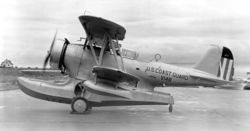
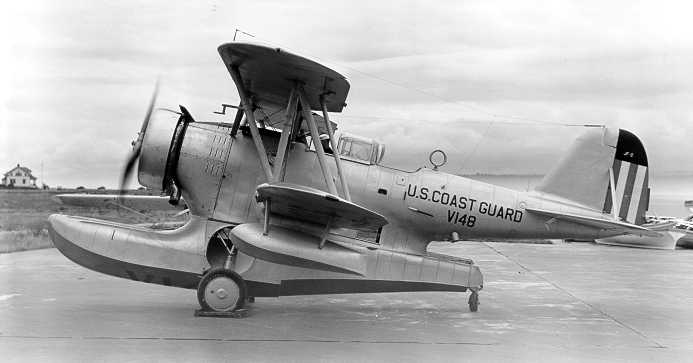
The Grumman JF "Duck" was an American single-engine amphibious biplane built by Grumman for the United States Navy during the 1930s. The J2F Duck was an improved version of the JF, with its main difference being a longer float.[1]
Key Information


Design and development
[edit]The Grumman JF Duck was manufactured from 1934 until 1936, when production switched to the J2F Duck and later variants.[2] The more obvious external appearance clue to distinguish a JF from an early J2F is the deletion of the inter-aileron strut between the wings on the J2F; less noticeable perhaps is the J2F's slightly longer rear fuselage/float joining fillet beneath the tail.[2]
The Duck's main pontoon was part of the fuselage, almost making it a flying boat, although it appears more like a standard aircraft with an added float. The XJF-1 prototype first flew on 24 April 1933 piloted by Grumman test pilot Paul Hovgard.[3]
Operational history
[edit]![[icon]](https://en.wikipedia.org/wiki/File:Wiki_letter_w_cropped.svg) | This section needs expansion. You can help by adding to it. (April 2017) |
The JF-1 that was first ordered had the same Pratt & Whitney R-1830-62 engine as the XJF-1 prototype. The US Navy ordered 27 JF-1s with the first Ducks delivered beginning in May 1934 to Norfolk NAS. These early production series had provisions for mounting a machine gun at the rear seat facing aft, as well as a single bomb rack mounted under each wing, capable of carrying a 100 lb (45.4 kg) bomb or depth charge on each. The main float was also a Grumman design (Grumman Model "A") and like the prototype, it included retractable main landing gear, making the Duck a true amphibian. Ducks served as general/utility amphibians for photographic, target-towing, scouting, and rescue work.[citation needed]
Variants
[edit]- XJF-1
- Prototype with 700 hp Pratt & Whitney R-1535-62 engine, one built (BuNo 9218).

- JF-1
- Production variant with 700 hp Pratt & Whitney R-1830-62 Twin Wasp engine, 27 built (BuNos 9434-9455, 9523-9527).
- JF-2
- Variant for the United States Coast Guard powered by a 750 hp Wright R-1820-102 Cyclone engine, 14 built with the first entering service in October 1934 (BuNo 0266, 00371-00372, 01647, USCG V141-V155).[4]
- JF-3
- JF-2 for the U.S. Navy, five built (BuNos 9835-9839).
- Grumman G-20
- Armed version of the Grumman JF-2 for export to Argentina. Eight built.[5]
Operators
[edit]
- Argentine Navy – Operated eight G-20s.[6]

- United States Navy
- United States Coast Guard
- United States Marine Corps – Operated one JF-2
Specifications (JF-2)
[edit]Data from [7]
General characteristics
- Crew: 2–4
- Length: 33 ft 0 in (10.06 m)
- Wingspan: 39 ft 0 in (11.89 m)
- Height: 12 ft 8 in (3.86 m)
- Wing area: 409.0 sq ft (38.00 m2)
- Empty weight: 4,100 lb (1,860 kg)
- Gross weight: 5,760 lb (2,613 kg)
- Fuel capacity: 150 US gal (120 imp gal; 570 L)
- Powerplant: 1 × Pratt & Whitney R-1830 Twin Wasp 14-cyl two row air-cooled radial piston engine, 775 hp (578 kW)
Performance
- Maximum speed: 185 mph (298 km/h, 161 kn) at 7,000 ft (2,100 m)
- Cruise speed: 155 mph (249 km/h, 135 kn)
- Stall speed: 63 mph (101 km/h, 55 kn)
- Range: 620 mi (1,000 km, 540 nmi)
- Service ceiling: 22,000 ft (6,700 m)
- Rate of climb: 1,600 ft/min (8.1 m/s)
See also
[edit]Related development
Aircraft of comparable role, configuration, and era
References
[edit]Notes
[edit]- ^ Allen 1983, p. 49.
- ^ a b Jordan, Corey C. "Grumman's Ascendency: Chapter Two." Archived 2012-03-25 at the Wayback Machine Planes and Pilots Of World War Two, 2000. Retrieved: 22 July 2011.
- ^ Thruelson 'The Grumman Story' 1976, p. 77.
- ^ "Grumman JF-2 "Duck"". www.history.uscg.mil/. Retrieved January 6, 2025.
- ^ Allen Air Enthusiast Twenty-three, p.78.
- ^ Allen Air Enthusiast Twenty-three, pp. 47–48.
- ^ Aviation April 1937, pp. 70–71
Bibliography
[edit]- Allen, Francis J. "A Duck Without Feathers". Air Enthusiast, Issue 23, December 1983 – March 1984, pp. 46–55, 77–78. Bromley, Kent UK: Pilot Press, 1983.
- "Specifications of American Airplanes". Aviation, Volume 36, No. 4, April 1937, pp. 66–71. (Registration required)
- Lezon, Ricardo Martin & Stitt, Robert M. (January–February 2004). "Eyes of the Fleet: Seaplanes in Argentine Navy Service, Part 2". Air Enthusiast (109): 46–59. ISSN 0143-5450.
- Thruelsen, Richard. The Grumman Story. New York: Praeger Publishers, Inc., 1976. ISBN 0-275-54260-2.
- Treadwell, Terry. Ironworks: Grumman's Fighting Aeroplanes. Shrewsbury, UK: Airlife Publishers, 1990. ISBN 1-85310-070-6.
Further reading
[edit]- Ginter, Steve (2009). Grumman JF/J2F Duck. Naval Fighters. Vol. Nº84 (First ed.). California, United States: Ginter Books. ISBN 978-0-942612-84-4. Retrieved 31 January 2015.
- Nuñez Padin, Jorge Félix (2002). Grumman G.15, G.20 & J2F Duck. Serie Aeronaval (in Spanish). Vol. Nº15. Buenos Aires, Argentina: Museo de la Aviación Naval, Instituto Naval.
External links
[edit]
Grumman JF Duck
View on GrokipediaDesign and Development
Origins and Prototype
In the early 1930s, Grumman Aircraft Engineering Corporation shifted its focus toward amphibious aircraft designs, building on the success of its retractable landing gear innovation first demonstrated in the XFF-1 fighter, which had its maiden flight in December 1931. This pivot was influenced by prior work on floats for the Navy's O2U-1 Scout, addressing the service's dissatisfaction with existing amphibian performance.[6] In 1932, the U.S. Navy issued a requirement for a new utility amphibious biplane to replace aging Loening OL models, emphasizing versatility for carrier-based operations, scouting, and general utility roles.[4] Grumman responded with a proposal that evolved into the XJF-1 prototype (BuNo 9218), led by company founder Leroy Grumman and chief designer William Schwendler, both former Loening engineers experienced in amphibious concepts.[7] Construction of the single XJF-1 began in 1933 at Grumman's Farmingdale facility, featuring a boat-like fuselage pontoon for water operations, retractable landing gear that folded into the hull, and an all-metal semi-monocoque structure with fabric-covered aluminum wings.[6] Powered by a 700 hp Pratt & Whitney R-1535-62 Twin Wasp Junior radial engine, the prototype incorporated an enclosed cockpit for two crew members and provisions for passengers or cargo, prioritizing ruggedness and multi-role capability.[8] The XJF-1 made its first flight on April 24, 1933, from a grass strip adjacent to Grumman's factory in Farmingdale, New York, piloted by test pilot Paul Hovgard.[6] Initial tests revealed stability challenges, particularly in lateral handling, prompting modifications including reshaping the vertical stabilizer and adjustments to improve water handling and spray characteristics during takeoff and landing.[4] Navy evaluation trials commenced later in 1933 at facilities including Floyd Bennett Field, assessing the aircraft's performance against requirements for speed, climb rate, and amphibious efficiency, where it demonstrated significant improvements in speed and climb rate over predecessors like the Loening OL.[6] These positive results led to a production contract in early 1934 for 27 JF-1 aircraft (BuNos 9434-9455, 9523-9527), establishing the foundation for the series and paving the way for its evolutionary successor, the J2F Duck.[2]Production and Design Features
Following successful evaluation of the prototype, the U.S. Navy awarded Grumman an initial production contract for 27 JF-1 aircraft in 1934, with deliveries commencing in late 1934.[2] The JF series embodied key engineering refinements for amphibious utility operations, featuring a single-bay biplane configuration with fabric-covered metal wings of equal span and staggered incidence, supported by interplane struts and bracing wires.[1] The fuselage integrated an aluminum alloy pontoon for water landings, complemented by a retractable wheeled undercarriage that enabled operations from both land and sea, while an enclosed tandem cockpit accommodated a crew of two, with provisions for up to two additional passengers on a rear bench or for specialized equipment.[4] This streamlined design, credited to Grumman engineer Charles Tilgner and drawing from the earlier FF-1 fighter, emphasized rugged construction primarily of aluminum alloy to withstand harsh maritime environments.[2] The JF incorporated provisions for light armament and versatile utility roles, including a flexible .30-caliber machine gun mount in the rear cockpit and underwing racks capable of carrying two 100-pound bombs for scouting or anti-submarine duties.[9] It also supported reconnaissance photography via internal camera mounts and target towing with optional gear, enhancing its multi-role capabilities for naval utility squadrons.[1] Engine selections varied across early production batches to balance power and reliability: the JF-1 used a 700-horsepower Pratt & Whitney R-1830-62 Twin Wasp radial, while the JF-2 and JF-3 featured the 750-horsepower Wright R-1820-102 Cyclone for improved performance in patrol and rescue tasks.[2] Production remained limited from 1934 to 1936, yielding a total of 46 aircraft for U.S. services—comprising 27 JF-1s for the Navy (BuNos 9434-9455, 9523-9527), 14 JF-2s for the Coast Guard (V-166 to V-179), and 5 JF-3s for Navy shore-based operations (BuNos 9835-9839)—along with 8 unarmed exports to Argentina as the G-20 variant.[2][5][10] This modest run reflected the U.S. Navy's evolving preferences toward monoplane designs for greater speed and efficiency, curtailing further JF development. The series concluded with the shift to the J2F in 1936, which introduced a longer fuselage pontoon for enhanced buoyancy and fuel capacity, alongside the elimination of inter-aileron struts between the upper and lower wings to reduce drag and simplify maintenance.[3]Operational History
United States Navy Service
The Grumman JF Duck entered United States Navy service with the delivery of the first JF-1 aircraft to Naval Air Station Norfolk in May 1934, where it underwent utility training and evaluation.[11] The Navy had ordered 27 JF-1s following successful prototype trials, equipping them with the Pratt & Whitney R-1830-62 engine for versatile amphibious operations.[1] These aircraft were assigned to utility and patrol squadrons, including Scouting Squadron 3 aboard the USS Lexington, marking the beginning of their integration into fleet activities. One JF-1 was also transferred to the U.S. Marine Corps for utility roles.[11] In the 1930s, the JF primarily fulfilled roles such as scouting, photographic reconnaissance, target towing for gunnery practice, and early air-sea rescue missions during fleet exercises.[4] Their rugged design enabled operations from shore bases, seaplane tenders, and aircraft carriers, supporting patrol duties along coastal regions.[1] The Navy later acquired five JF-3 variants in 1935 for reserve units, optimized for shore-based tasks without arresting gear, bringing the total JF inventory to 32 aircraft.[11] The JF series was phased out beginning in 1940 in favor of the more advanced J2F Duck monoplane and other types, with remaining units relegated to secondary roles into the early 1940s. The JF did not see combat use during World War II.[1]United States Coast Guard Service
In 1934 and 1935, the United States Coast Guard ordered 14 JF-2 Ducks specifically tailored for non-combat maritime roles, with the first aircraft delivered in October 1934 and subsequent units arriving through 1935. These amphibians were distributed to key air stations, including Cape May, New Jersey—where up to eight were based—and the newly established Air Station San Diego, California, in 1937, enabling widespread coastal coverage along both Atlantic and Pacific shores.[9][5][12][13] Adapted from the Navy's JF-1 scout version, the Coast Guard's JF-2s operated in an unarmed configuration without arresting gear or weaponry, emphasizing utility over combat. They featured enhanced radio direction-finding equipment, including a prominent loop antenna, to support search-and-rescue (SAR) coordination, and relied on a 750 hp Wright R-1820 Cyclone radial engine for reliable performance in rough sea conditions. This setup provided a ferry range of 759 miles, ideal for extended coastal patrols and rapid response to distress calls.[1][9] Throughout the 1930s, JF-2s conducted maritime law enforcement patrols and numerous air-sea rescues, including critical support during hurricanes and shipwrecks. A notable example occurred on November 4, 1935, when a JF-2 from Air Station St. Petersburg, Florida, piloted by Lieutenant W.D. Shields, braved the Yankee Clipper hurricane to deliver lifesaving supplies and evacuate survivors from the storm-ravaged Upper Keys, demonstrating the aircraft's rugged amphibious capabilities in extreme weather. The Ducks also participated in pre-World War II Greenland Patrol operations and set speed records, such as 191 mph achieved by pilot CDR Elmer F. Stone on December 20, 1934, underscoring their versatility in remote and hazardous environments.[14][15][5] By 1941, the JF-2 fleet was phased out in favor of the more modern Grumman J4F Widgeon, which offered improved performance for SAR and patrol duties. Several surviving JF-2s were transferred to the Navy for wartime use, marking the end of their primary Coast Guard service after contributing to over a decade of lifesaving operations.[16][17]Argentine Naval Service
In 1937, the Argentine Navy acquired eight Grumman G-20 aircraft, an armed export variant of the JF-2 Duck, directly from the manufacturer to bolster its naval aviation capabilities. These biplanes, designated as JF Ducks in Argentine service, featured a Wright R-1820 radial engine producing approximately 790 horsepower and were equipped for observation and utility roles, with provisions for light armament including machine guns and bomb racks. The order marked one of the early international exports of the Duck design, reflecting Argentina's efforts to modernize its fleet amid regional tensions in South America.[18][11][19] The aircraft were delivered on March 27, 1937, and assigned serial numbers M-O-1 through M-O-8, initially operating from the Escuadrilla de Observación based at the Estación Aeronaval Punta Indio near La Plata. At Punta Indio, they supported training for naval aviators and utility missions, including liaison flights between naval bases. By 1939, the squadron had relocated elements to Punta Alta near Bahía Blanca, where the Ducks conducted maritime reconnaissance patrols along the Argentine coast during the country's period of neutrality in the lead-up to World War II. Their amphibious design proved suitable for operations from both land and water, enabling flexible deployment in coastal environments.[18][20] During the 1940s, the G-20 Ducks performed limited border patrol duties, focusing on observation and transport rather than combat, as Argentina maintained neutrality until declaring war on the Axis powers in March 1945. They contributed to the formation of dedicated naval observation squadrons, providing eyes for fleet movements and supporting liaison with ground forces. Several incidents marred their service, including crashes of M-O-5 on May 27, 1938, and later redesignated aircraft in 1947, leading to the loss of at least four airframes by the decade's end. Serials were updated in 1939 to 2-O-1 through 2-O-8 and again in 1947 to 0068 through 0074, reflecting administrative changes in the Armada Argentina.[18][19] The Ducks remained in active naval service through the late 1940s, with withdrawals from use beginning in 1947 (e.g., 0068) and completing by 1948 for the remaining airframes. No combat engagements occurred due to Argentina's non-involvement in major conflicts until the war's final months, when their roles were primarily non-offensive. Post-war, the type saw no documented local modifications for tropical conditions, though their rugged construction supported operations in varied Argentine terrains. Some surplus Ducks transitioned to civilian applications in South America, but specific Argentine conversions are sparsely recorded. By the early 1950s, they had been fully phased out in favor of more advanced aircraft.[18][19]Variants and Operators
Variant Descriptions
The Grumman JF Duck series encompassed several variants developed during the mid-1930s, each tailored to specific operational needs while sharing the core amphibious biplane design featuring a single radial engine, retractable landing gear, and a large central float. The initial prototype, designated XJF-1, was a single experimental aircraft constructed in 1933 and powered by a 700 hp Pratt & Whitney R-1830-62 Twin Wasp radial engine. It underwent U.S. Navy evaluation trials, demonstrating the aircraft's potential for utility roles such as transport and reconnaissance, with its all-metal fuselage and fabric-covered wings providing robust performance over water and land.[3][1] The JF-1 marked the first production variant, ordered by the U.S. Navy in 1934 with 27 aircraft built, retaining the 700 hp R-1830-62 engine of the prototype. This version included provisions for armament, such as 45 kg bomb racks under the wings and an optional .30-caliber machine gun, along with a tailhook for carrier operations, distinguishing it from later unarmed models. Its enclosed cockpit accommodated a crew of two, with space for additional passengers or cargo, emphasizing versatility in naval utility missions.[6][1][4] In response to U.S. Coast Guard requirements, the JF-2 variant was produced in 14 examples between 1934 and 1935, substituting the 700 hp Wright R-1820-102 Cyclone engine for improved reliability in search and rescue operations. Lacking the arresting hook and armament of the JF-1, it featured an extended range through additional fuel capacity and a radio direction finder loop antenna on the fuselage for navigation in remote areas, with the first nine units using the initial engine rating and the subsequent five upgraded to the 750 hp R-1820-08 for enhanced performance. This configuration prioritized endurance over combat capability, reflecting the Coast Guard's non-military focus.[1][6] The JF-3 represented a minor refinement for Navy shore-based use, with five aircraft completed in 1936 equipped with the 750 hp R-1820-08 engine. It omitted the carrier arresting gear but incorporated options for a fuselage-mounted loop antenna and a defensive machine gun, while retaining the bomb racks for light attack potential; subtle aerodynamic tweaks to the tailplane and control surfaces improved handling stability compared to earlier JF models. This variant bridged the gap between the JF series and the subsequent J2F production, focusing on efficiency for administrative and liaison duties.[1] For export, Grumman developed the G-20 variant in 1937, delivering eight unarmed aircraft to Argentina that closely mirrored the JF-3 in design but without U.S. Navy-specific features like the tailhook. Powered by the Wright R-1820 Cyclone engine, these machines received local designations upon delivery and were configured for general utility transport, underscoring the Duck's adaptability for international markets. Overall, the JF series totaled 55 aircraft, including the prototype, with no significant variants emerging post-World War II as production shifted to the improved J2F Duck.[1][11]Primary Operators
The primary operators of the Grumman JF Duck were the United States Navy, United States Coast Guard, United States Marine Corps, and Argentine Navy, with a total global fleet of fewer than 60 units across all variants.[21] The United States Navy acquired 32 JF Duck aircraft, comprising 27 JF-1s and 5 JF-3s, which entered service in 1934 and remained operational until 1943; these were primarily based at facilities such as Naval Air Station Norfolk and Patrol Wing Base at Pearl Harbor.[21][11] The United States Marine Corps received one JF-1.[4] The United States Coast Guard operated 14 JF-2 variants from 1934 to 1941, deploying them from air stations including Elizabeth City, North Carolina, and Miami, Florida.[5][22] The Argentine Navy received 8 G-20 (export JF Duck equivalents) aircraft in 1937, which served through the 1950s from bases at Punta Indio and Comandante Espora.[21][23]Specifications
JF-2 Technical Data
The Grumman JF-2 Duck was a single-engine amphibious biplane designed primarily for utility roles within the United States Navy and Coast Guard, featuring accommodations for a crew of 2 to 4 personnel, including a pilot, observer, and optional gunner or additional passengers for rescue operations. This configuration allowed flexibility in missions such as reconnaissance, transport, and search-and-rescue, with the crew seated in a tandem arrangement under an enclosed canopy.[1] Key structural dimensions of the JF-2 included a length of 33 ft 0 in (10.06 m), a wingspan of 39 ft (11.89 m), a height of 12 ft 8 in (3.86 m), and a wing area of 409 sq ft (38.00 m²), contributing to its compact yet robust form suitable for carrier and water operations. Weight specifications comprised an empty weight of 4,100 lb (1,860 kg) and a gross weight of 5,760 lb (2,613 kg), balancing payload capacity with operational efficiency. The aircraft was powered by a single 750 hp (560 kW) Wright R-1820-102 Cyclone 9-cylinder air-cooled radial engine, mounted in the nose and driving a three-bladed propeller; this represented the standard powerplant for the Coast Guard variant.[1]| Specification | Details |
|---|---|
| Crew | 2–4 (pilot, observer, gunner) |
| Length | 33 ft 0 in (10.06 m) |
| Wingspan | 39 ft (11.89 m) |
| Height | 12 ft 8 in (3.86 m) |
| Wing area | 409 sq ft (38.00 m²) |
| Empty weight | 4,100 lb (1,860 kg) |
| Gross weight | 5,760 lb (2,613 kg) |
| Powerplant | 1 × Wright R-1820-102 Cyclone radial, 750 hp (560 kW) |
Performance Characteristics
The Grumman JF-2 Duck demonstrated solid performance for its era as an amphibious utility biplane, powered by a Wright R-1820 Cyclone radial engine rated at 750 horsepower, which provided adequate thrust for both air and water operations. Its maximum speed reached 185 mph at 7,000 feet, allowing for effective scouting and transport roles in coastal environments. Cruise speed was 155 mph, while the stall speed was 63 mph, ensuring stable handling during low-speed maneuvers over water or land. Range extended to 620 miles with a standard fuel load of 150 US gallons, complemented by 20 US gallons of oil, enabling up to 6 hours of endurance suitable for extended patrol or rescue missions without frequent refueling. The service ceiling stood at 22,000 feet, with a rate of climb of 1,600 feet per minute, reflecting the aircraft's ability to quickly gain altitude for observation duties. These metrics underscored the JF-2's efficiency in utility applications, balancing payload capacity with operational range. On water, the JF-2 exhibited reliable handling characteristics, with a takeoff run of 600 yards and a landing speed of 65 mph, facilitated by its retractable wheeled central float and stabilizing wingtip floats. This performance envelope, derived from 1930s U.S. Navy and Coast Guard testing, highlighted the aircraft's versatility as a multi-role platform despite its biplane configuration.| Performance Metric | Value | Notes |
|---|---|---|
| Maximum Speed (7,000 ft) | 185 mph | Optimal altitude performance |
| Cruise Speed | 155 mph | Economic setting for range |
| Stall Speed | 63 mph | With full flaps |
| Range | 620 miles | With 150 US gal fuel |
| Endurance | 6 hours | At cruise power |
| Service Ceiling | 22,000 ft | Absolute altitude limit |
| Rate of Climb | 1,600 ft/min | At sea level |
| Takeoff Run (Water) | 600 yd | Calm conditions |
| Landing Speed (Water) | 65 mph | Typical approach |
| Fuel Capacity | 150 US gal | Main tanks |
| Oil Capacity | 20 US gal | Engine lubrication |