Hubbry Logo
GoiabadaGoiabadaMain
Open search
Goiabada
Community hub
Goiabada
logo
8 pages, 0 posts
0 subscribers
Be the first to start a discussion here.
Goiabada
Goiabada
from Wikipedia
Not found
Revisions and contributorsEdit on WikipediaRead on Wikipedia
from Grokipedia
Goiabada is a traditional Brazilian confection consisting of a thick, dense paste made primarily from ripe fruit () cooked with sugar until it achieves a firm, jelly-like consistency that can be sliced or molded. This sweet preserve, known for its vibrant reddish hue and intense tropical flavor, serves as both a standalone and an ingredient in various dishes, embodying Brazil's colonial culinary heritage. Originating in the during Brazil's colonial period, goiabada evolved as a local adaptation of the Portuguese marmelada, a quince-based paste, when European settlers substituted the abundant native for the scarce . , indigenous to tropical America and cultivated in since pre-colonial times, was boiled down with in pots over wood fires—a method still used in artisanal production—to create a shelf-stable treat that preserved the fruit's seasonality. This innovation not only addressed needs in the humid climate but also integrated indigenous ingredients into European confectionery techniques, making goiabada a staple across Brazilian regions, particularly in where it holds cultural heritage status. In , goiabada is most famously paired with creamy white cheeses like queijo minas, forming the iconic known as Romeu e Julieta—a nod to the contrasting sweet and savory flavors that "fall in love" on the plate. It appears in diverse forms, from smooth commercial varieties to artisanal types like goiabada cascão, which incorporates whole pieces of peel for added texture and is produced in limited quantities in rural areas of southern using native guava cultivars. Beyond s, it enhances baked goods, sauces, and even savory fillings, reflecting its versatility and enduring popularity in both home cooking and festive traditions.

History

Origins

Goiabada originated in as settlers adapted traditional European preservation techniques to the abundant local (), transforming it into a thick, sweetened paste. , native to tropical regions of the including parts of and , was already a staple for , who consumed it fresh, cooked, or for medicinal purposes long before European contact. However, the confection's distinctive form—boiled pulp reduced with —emerged only after the arrival of cultivation and processing methods introduced by colonizers in the . This Brazilian innovation directly stemmed from the Portuguese marmelada, a quince-based paste that colonizers brought with them and modified using due to its prevalence in Brazil's climate and the scarcity of . Early production occurred during the colonial period in households, where the sweet integrated into , reflecting the fusion of recipes with ingredients. The broader of pastes like goiabada traces to medieval Islamic culinary practices in the , where Moorish scholars and cooks developed sugar-based confections during . A key example appears in the 13th-century Anonymous Andalusian Cookbook, which includes a recipe for paste prepared by pounding the , cooking it with until thickened, and forming it into molds—methods that influenced subsequent and Spanish versions before their adaptation in Brazil. This Moorish legacy, spread through conquest and , introduced refined sugar preservation to , enabling colonial sweets like goiabada.

Colonial Development

During the Portuguese colonization of Brazil, which began in the early , European settlers introduced techniques for preserving fruits by cooking them into dense pastes with sugar, a practice rooted in the tradition of making marmelada from . In the tropical climate of Brazil, where (), a native fruit of the , grew abundantly, colonists adapted these methods by substituting guava for the scarce quince, leading to the creation of goiabada as a local confection. This adaptation was particularly prominent in regions like , where the 18th-century spurred agricultural diversification and the need for durable amid mining booms and famines. In , goiabada production became integral to colonial economy and daily life, with family-based workshops using pots (tachos de cobre) heated over wood fires to simmer pulp and sugar for hours, often incorporating fruit peels for texture in variants like goiabada cascão. The process, which required constant stirring with wooden paddles to achieve the desired consistency, allowed the sweet to be stored for months without refrigeration, facilitating trade along mule convoys to urban centers like . Oral traditions attribute the invention of goiabada cascão to São Bartolomeu in the , tying it to the area's role as a supplier of provisions during the colonial gold cycle. In 2008, goiabada cascão and related traditional sweets from São Bartolomeu were recognized as Immaterial by the municipality of , underscoring their enduring historical value. French naturalist Auguste de Saint-Hilaire, traveling through in 1816–1822, documented the region's prowess in his accounts, noting the widespread production of fruit-based sweets initially modeled on pastes but increasingly reliant on due to its availability. He observed that locals paired these confections with cheese, a practice that foreshadowed the iconic Romeu e Julieta , and remarked on the skill of Mineiro artisans despite their heavy use of , which sometimes overwhelmed the fruit's natural flavor. By the early , goiabada had evolved from a mere substitute into a staple of colonial , reflecting the fusion of techniques with indigenous and African labor influences in rural households and convents.

Description

Ingredients

Goiabada is a traditional Brazilian confection primarily made from ripe fruit () and , which together form its signature thick, jam-like consistency. The contributes the intense tropical flavor, vibrant color, and natural that enables the mixture to gel without additional thickening agents. Ripe red or white guavas are preferred for their balanced sweetness and higher content, typically harvested at peak maturity to maximize juiciness and reduce cooking time. In authentic recipes, the ratio of ingredients is straightforward: approximately 1 kg of mature to 600 g of crystal sugar, with a small amount of —often around 320 —added to facilitate cooking. This is traditionally obtained by the guava briefly to extract their pectin-rich , enhancing both texture and flavor without introducing external additives. The sugar, usually granulated or crystal form, not only sweetens the paste but also helps preserve it through during prolonged . Variations in preparation influence ingredient handling but not the core composition. For goiabada cascão, the rustic version, whole guavas including the skin are used, imparting a granular texture and additional , while smoother goiabada involves peeling and seeding the fruit for a creamier result. Commercial formulations may include as an acidulant to adjust , improve stability, and mimic the fruit's natural tartness, though traditional methods depend entirely on the guava's inherent acidity.

Physical Characteristics

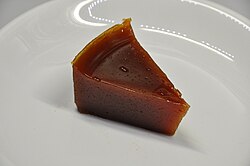
Goiabada is a dense, gelatinous confection with a firm, solid consistency that allows it to be cut into bars or blocks without crumbling, typically achieving a solids content of around 73° through prolonged cooking of pulp and sugar. Its texture is smooth and homogeneous in the standard variety, resulting from the removal of seeds and thorough mixing during preparation, though it exhibits slight adhesiveness and reduced cohesiveness under lower acidity conditions. The color of goiabada ranges from reddish-yellow to reddish-brown, influenced by the guava cultivar, pulp-to-sugar ratio, and processing factors such as citric acid concentration, which can promote non-enzymatic browning and reduce luminosity in higher-sugar formulations. In traditional varieties like goiabada cascão, the appearance includes embedded whole pieces of guava peel, providing a rustic, heterogeneous texture contrasting the smooth pulp base, while the overall hue remains vibrant and bright due to cooking in copper pots. Firmness in goiabada is enhanced by higher levels of (e.g., 0.5%), which increases rigidity by limiting pectate dissociation, making the product more fracture-prone and suitable for slicing. According to Brazilian standards, the confection must maintain these physical traits alongside a characteristic typically ranging from 3.4 to 4.3 to ensure stability and cuttability.

Preparation

Traditional Methods

Traditional methods of preparing goiabada involve a slow-cooking process using ripe guavas and sugar, a technique adapted from colonial marmalade-making traditions applied to the native Brazilian guava fruit (). This artisanal approach emphasizes minimal ingredients and manual labor, resulting in a dense, sweet paste that highlights the fruit's natural for thickening without additives. The process is deeply rooted in Brazilian rural culture, particularly in regions like , where it has been passed down through generations as part of family and community heritage. The preparation begins with selecting firm, ripe guavas, which are washed, peeled, and seeded to separate the pulp from the skins. The pulp is then blended or mashed into a smooth consistency, while the skins—often reserved for textured varieties like goiabada cascão—are finely chopped to incorporate later. Equal parts pulp and crystal sugar (typically by weight) are combined in a large pot, sometimes with a splash of water or lemon juice to aid initial cooking, and heated over low to medium flame while stirring continuously to prevent sticking. Cooking continues for 1 to 2 hours until the mixture thickens to a glossy, firm paste that pulls away from the pot's sides, achieving the desired consistency through and . In traditional settings, especially in , this is done in large copper cauldrons (tachos de cobre) over wood fires, which impart a subtle smoky flavor and even heat distribution, enhancing the rustic quality. Once ready, the hot goiabada is poured into greased molds or trays to cool and set, often cut into blocks or rolls for storage and serving. This method preserves the fruit's tangy-sweet profile and yields a product free from preservatives, contrasting with industrial versions.

Modern Production

In modern industrial production, goiabada is typically manufactured using guava pulp as the base ingredient, often sourced from off-season processing to ensure year-round availability. The process begins with the preparation of fresh guava fruits, such as the 'Paluma' cultivar, which are selected for ripeness and quality before being washed, liquefied with peels and seeds intact, and homogenized. This initial pulp extraction involves grinding the fruits and inactivating enzymes through pasteurization at 90°C for 6 minutes, which concentrates key compounds like ascorbic acid and phenolics while removing seeds via sieving or deseeding equipment. The resulting pulp is then sterilized, packaged, and frozen at -18°C for storage and transport to production facilities. The core cooking stage transforms the pulp into goiabada through a multi-step concentration process in large-scale stainless steel kettles or cookers equipped with agitators for uniform heating. Pulp is mixed with sugar (typically in a 1:1 ratio by weight), citric acid for pH adjustment (around 3.5-4.0), and sometimes pectin (0.5-1.5%) to enhance gelation and texture. The mixture undergoes controlled heating: initial mixing at 70°C for 35 minutes to dissolve sugar, followed by concentration at 70-75°C for 35 minutes to evaporate water and build viscosity. Subsequent caramelization occurs at 100°C for 15 minutes to develop the characteristic amber color and flavor, with final concentration at 80°C for 15 minutes until reaching 70-75° Brix, indicating the desired semi-solid consistency. This staged approach minimizes overheating, preserves antioxidants to some extent (though losses of up to 42% in ascorbic acid occur), and ensures scalability in factories handling thousands of kilograms per batch. Post-cooking, the hot goiabada is cooled rapidly in cooling tunnels or on conveyor belts to prevent and achieve a firm yet pliable texture, often cut into blocks, rolls, or slices using automated molding and slicing machines. Packaging follows in vacuum-sealed plastic films, tins, or boxes under hygienic conditions to extend up to 12 months without refrigeration. Industrial facilities in Brazil's guava-producing regions, like and , incorporate advanced equipment such as helical screw pumps for transferring viscous mixtures without shear damage, along with automated controls for temperature and monitoring to maintain product quality and compliance with standards like those from ANVISA. This mechanized production has enabled goiabada to meet growing domestic and export demands.

Culinary Uses

Traditional Pairings

Goiabada's most iconic traditional pairing in is with cheese, forming the beloved dessert or snack known as Romeu e Julieta. This combination juxtaposes the dense, sweet paste against the mild saltiness and creaminess of fresh white cheese, creating a harmonious sweet-savory balance that has been enjoyed for generations. The name draws from Shakespeare's , symbolizing the contrasting yet inseparable natures of the two elements, and it remains a staple in Brazilian households due to the ingredients' affordability and longevity. The cheese most commonly used is queijo minas frescal, a soft, tangy variety originating from , sliced and served alongside equal portions of goiabada for a simple, no-cook presentation. Variations may incorporate queijo minas padrão or queijo canastra, both semi-firm options from the same region that add a subtle firmness to the pairing. In rural , goiabada is also traditionally enjoyed with requeijão, a creamy spreadable cheese, enhancing its role as an everyday accompaniment during or afternoon tea in family settings. This cheese pairing reflects broader Latin American traditions of combining fruit pastes with , but in , it underscores the cultural significance of goiabada as a versatile, communal treat often served on a plate with toothpicks for easy sharing.

In Desserts and Baked Goods

Goiabada's dense, jam-like texture and intense flavor make it a staple filling and topping in Brazilian desserts and baked goods, where it provides a sweet, tangy contrast to lighter doughs and custards. Commonly sliced or melted, it is layered into cakes or enclosed in pastries to enhance moisture and fruitiness without overpowering other components. This incorporation dates to colonial influences, blending indigenous with techniques to create enduring sweets. A quintessential baked good featuring goiabada is , a rolled cake originating from in northeastern . It consists of ultra-thin, crepe-like layers of egg batter baked sequentially and alternated with sheets of goiabada, then tightly rolled into a log for a spiral cross-section. The goiabada melts slightly during assembly, binding the layers while contributing a chewy, caramelized essence; it is often topped with additional melted paste or served with for added indulgence. This dessert exemplifies goiabada's role in structured baking, balancing crisp edges with soft, fruity interiors. In simpler cornmeal cakes like bolo de fubá com goiabada, the paste is diced and folded into the batter before or applied as a glossy glaze post-baking, infusing the rustic, crumbly crumb with tropical . Similarly, rocambole de goiabada, a jelly-roll style , uses softened goiabada as a primary filling, rolled tightly to distribute the flavor evenly. These applications highlight goiabada's versatility in everyday baked treats, often enjoyed at family gatherings or festive occasions. Beyond cakes, goiabada elevates custard-based desserts such as pudim de goiabada, a baked where pureed guava paste is combined with eggs, , and to form a creamy, caramel-topped flan-like confection that sets in the . In suflê de goiabada, the paste is whipped into egg whites and baked briefly to create a light, puffed with a molten center, offering a dramatic finish to meals. These underscore goiabada's ability to bridge baked and steamed preparations, transforming it from a simple preserve into sophisticated elements.

Variations

Regional Adaptations

Goiabada's regional adaptations are most prominently featured in the state of , where traditional production methods yield distinct textures and flavors tied to local varieties and historical practices. The goiabada cascão, originating from the southern regions of such as the Mata and Campos das Vertentes areas, incorporates pieces of guava peel (cascão meaning "shell") during cooking, resulting in a rustic, textured paste that contrasts with smoother varieties. This adaptation uses native guava fruits () harvested in late summer, with the pulp sieved to remove seeds, mixed with sugar, and boiled for approximately two hours in large pots over fires while being continuously stirred with wooden paddles. The inclusion of peels not only enhances the fruit's natural flavor and aroma but also reflects the resourcefulness of colonial-era production in senzalas (slave quarters), where entire guavas—including skins and seeds—were utilized. Authentic goiabada cascão is poured into wooden boxes lined with banana leaves or modern containers after reaching a firm, cuttable consistency, and it is particularly celebrated in towns like São Bartolomeu () and Ponte Nova, where annual festivals highlight this heritage product. This version pairs ideally with , amplifying its regional cultural significance. In contrast to the industrial goiabada lisa (smooth goiabada), which relies on pulp alone and modern aluminum equipment often with added preservatives, the cascão maintains a more pronounced taste without chemical aids, preserving artisanal traditions in . While goiabada production occurs nationwide, with major guava cultivation in other Brazilian states influencing fruit quality, the cascão remains a uniquely Minas adaptation emblematic of the region's sweet-making legacy. Other regional variations include those from the Northeast, such as in , where local cultivars may yield slightly different flavors due to climatic influences, often produced on a larger scale.

International Equivalents

Goiabada, a dense guava-based confection, shares conceptual and textural similarities with various pastes across and the , where colonial influences led to adaptations using local fruits like or . These equivalents typically involve cooking pulp with to achieve a firm, sliceable consistency, often paired with cheese to balance sweetness with savory notes. In , de guayaba serves as a close counterpart, prepared by slowly cooking ripe pulp with sugar until it forms firm blocks. This treat, originating from the Andean region, is commonly enjoyed as a or with fresh cheese. Mexico's ate de guayaba mirrors goiabada in its method of reducing guava with sugar to a thick, moldable paste, often shaped into bars or blocks for easy slicing. Produced commercially and artisanally, it emphasizes the fruit's natural tartness and is a staple in regional sweets, such as paired with queso , reflecting indigenous and Spanish culinary traditions. Further south in and other countries, dulce de guayaba functions similarly as a conserve, boiled down to a glossy, semi-solid form that can be spread or cut into pieces for desserts. This variant, influenced by and Spanish recipes, is integrated into baked goods, highlighting guava's adaptability in post-colonial sweets. Beyond guava-specific versions, Spain's dulce de membrillo—made from rather than guava—offers a textural equivalent, with its firm, amber-hued paste achieved through prolonged of fruit and sugar. Though quince imparts a sharper tang, the pairing with cheese parallels goiabada's traditional combinations, underscoring a shared Iberian heritage in fruit conserves.

References

Add your contribution
Related Hubs
User Avatar
No comments yet.