


Community hub
Recent from talks
Contribute something
Nothing was collected or created yet.
HD 166473
View on Wikipedia
  | |
| Observation data Epoch J2000.0[1] Equinox J2000.0[1] | |
|---|---|
| Constellation | Corona Australis |
| Right ascension | 18h 12m 25.83474s |
| Declination | −37° 45′ 09.2713″ |
| Apparent magnitude (V) | 7.953[2] |
| Characteristics | |
| Spectral type | A5pSrCrEu[2] |
| B−V color index | 0.42[3] |
| J−H color index | -0.018[4] |
| J−K color index | -0.026[4] |
| Variable type | α2 CVn variable[2] |
| Astrometry | |
| Radial velocity (Rv) | −22.5±3.0 km/s |
| Proper motion (μ) | RA: -2.767[1] mas/yr Dec.: −12.785[1] mas/yr |
| Parallax (π) | 7.1672±0.0337 mas[1] |
| Distance | 455 ± 2 ly (139.5 ± 0.7 pc) |
| Absolute magnitude (MV) | 1.60,[5] 2.197[6] |
| Details[5] | |
| Mass | 2.29 M☉ |
| Radius | 2.25 R☉ |
| Luminosity | 18.03 L☉, 9.811[6] L☉ |
| Surface gravity (log g) | 4.00 cgs |
| Temperature | 7760 K |
| Rotation | 3836 ± 30 d |
| Age | 1.00 Gyr |
| Other designations | |
| CD−37°12303, CPD−37°7956, Gaia DR2 4037543655114296576, HD 166473, PPM 749478, TIC 368866492, TYC 7900-2776-1, GSC 07900-02776, 2MASS J18122583-3745092, V694 CrA[4] | |
| Database references | |
| SIMBAD | data |
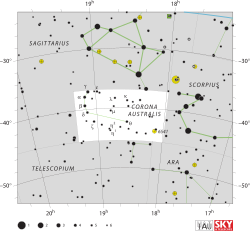
HD 166473 is a rapidly oscillating Ap star (roAp star) and an α2 CVn variable located about 455 light-years (140 parsecs) away in the southern constellation of Corona Australis. It has the variable star designation V694 Coronae Australis (sometimes abbreviated to V694 CrA). With an apparent magnitude of 7.953, it is too faint to be seen by the naked eye from Earth, but can be observed using binoculars.[7]
Properties
[edit]As is thought to be the case with most roAp stars, it has an overabundance of rare-earth elements as well as chromium and cobalt, solar-like levels of iron and nickel, and deficiencies in carbon and oxygen.[8]
HD 166473 possesses one of the strongest magnetic fields of any Ap star at up to −4160±226 G,[9] around ten thousand times stronger than Earth's magnetic field (0.25-0.65 G[10]). The strength and orientation of the magnetic field is strongly correlated with the layer of the atmosphere specific elements land in.[9] This can be seen in the difference in radial velocity variations caused by pulsations of the star, which are observed in the emission lines of different elements within the spectrum of the star. In particular, rare-earth elements show an amplitude as high as 110 m/s, while other elements including iron show no signs of variation at all.[11]
It is also an extremely slow rotator, taking over a decade to rotate on its axis once. For comparison, the Sun's rotation period is only 25.38 days.[12] Despite this, the magnetic properties of the star are essentially the same as that of Ap stars that rotate faster.[13]
Observational history
[edit]
Oscillations of the star were first discovered in 1987, with three distinct frequencies that each correspond to periods between 8.8 and 9.1 minutes and have low amplitudes between 0.25 and 0.49 millimagnitudes. Because the frequencies are not equally spaced apart, it cannot be explained using the oblique pulsator model,[14] which is unusual since in general the model can accurately depict pulsations of roAp stars.[15]
In 2003, the pulsations were further resolved into standing and travelling waves in the stellar atmosphere utilizing the VLT, making HD 166473 the first star other than the Sun for such observations to be conducted.[16]
In 2020, the rotation period of the star was determined to be 3,836 days (10.50 years), making it only the fourth ever Ap star with a rotational period exceeding ten years whose magnetic field has been observed for an entire cycle or more.[13]
See also
[edit]- Other slow-rotating Ap stars:
- GY Andromedae (HD 9996)
- KQ Velorum (HD 94660)
- Przybylski's star (HD 101065)
- HD 187474
References
[edit]- ^ a b c d Brown, A. G. A.; et al. (Gaia collaboration) (2021). "Gaia Early Data Release 3: Summary of the contents and survey properties". Astronomy & Astrophysics. 649: A1. arXiv:2012.01533. Bibcode:2021A&A...649A...1G. doi:10.1051/0004-6361/202039657. S2CID 227254300. (Erratum: doi:10.1051/0004-6361/202039657e). Gaia EDR3 record for this source at VizieR.
- ^ a b c Bychkov, V.D.; et al. (July 2021), "Stellar magnetic rotational phase curves. II", Vizier Online Data Catalog, Centre de Donnees Strasbourg (CDS), Bibcode:2021yCat..36520031B, doi:10.26093/CDS/VIZIER.36520031, retrieved 15 October 2024
- ^ Høg, E.; et al. (February 2000). "The Tycho-2 Catalogue of the 2.5 Million Brightest Stars". Astronomy and Astrophysics. 355 (1): L27 – L30. Bibcode:2000A&A...355L..27H.
- ^ a b c "HD 166473". SIMBAD. Centre de données astronomiques de Strasbourg. Retrieved 15 October 2024.
- ^ a b Glagolevskij, Yu. V. (2019). "On Properties of Main Sequence Magnetic Stars". Astrophysical Bulletin. 74 (1). Pleiades Publishing Ltd: 66–79. Bibcode:2019AstBu..74...66G. doi:10.1134/s1990341319010073. ISSN 1990-3413. Record for this source at VizieR.
- ^ a b Scholz, R.-D.; et al. (August 2019), "Gaia DR2-based catalogue of 237 Ap stars", Vizier Online Data Catalog, Centre de Donnees Strasbourg (CDS), Bibcode:2019yCat..36280081S, doi:10.26093/CDS/VIZIER.36280081, retrieved 15 October 2024
- ^ Zarenski, Ed (2004). "Limiting Magnitude in Binoculars" (PDF). Cloudy Nights. Archived (PDF) from the original on 21 July 2011. Retrieved 6 May 2011.
- ^ Gelbmann, M.; et al. (April 2000). "Abundance analysis of roAp stars. V. HD 166473". Astronomy and Astrophysics. 356: 200–208. Bibcode:2000A&A...356..200G.
- ^ a b Järvinen, S P; et al. (28 September 2020). "The anomalous atmospheric structure of the strongly magnetic Ap star HD 166473". Monthly Notices of the Royal Astronomical Society. 499 (2). Oxford University Press (OUP): 2734–2743. arXiv:2009.10553. doi:10.1093/mnras/staa2887. ISSN 0035-8711.
- ^ Finlay, C. C.; et al. (December 2010). "International Geomagnetic Reference Field: the eleventh generation". Geophysical Journal International. 183 (3): 1216–1230. Bibcode:2010GeoJI.183.1216F. doi:10.1111/j.1365-246X.2010.04804.x. hdl:20.500.11850/27303.
- ^ Mathys, G.; et al. (6 August 2007). "Pulsation in the presence of a strong magnetic field: the roAp star HD 166473★". Monthly Notices of the Royal Astronomical Society. 380 (1). Oxford University Press (OUP): 181–198. Bibcode:2007MNRAS.380..181M. doi:10.1111/j.1365-2966.2007.12080.x. ISSN 0035-8711.
- ^ Williams, D. R. (1 July 2013). "Sun Fact Sheet". NASA Goddard Space Flight Center. Archived from the original on 15 July 2010. Retrieved 12 August 2013.
- ^ a b Mathys, G.; et al. (2020). "The 10.5 year rotation period of the strongly magnetic rapidly oscillating Ap star HD 166473". Astronomy & Astrophysics. 636. EDP Sciences: A6. arXiv:2002.11689. Bibcode:2020A&A...636A...6M. doi:10.1051/0004-6361/201936624. ISSN 0004-6361.
- ^ a b Kurtz, D. W.; et al. (1987). "The discovery and analysis of oscillations with periods between 8.8 and 9.1 min in the cool magnetic Ap star HD 166473". Monthly Notices of the Royal Astronomical Society. 226 (1). Oxford University Press (OUP): 187–193. doi:10.1093/mnras/226.1.187. ISSN 0035-8711.
- ^ Martinez, Peter (June 1996). "The p-mode spectra of the roAp stars". Bulletin of the Astronomical Society of India. 24: 359. Bibcode:1996BASI...24..359M.
- ^ Kurtz, D. W.; et al. (21 July 2003). "New heights in asteroseismology: VLT spectroscopy of the roAp star HD 166473". Monthly Notices of the Royal Astronomical Society. 343 (1). Oxford University Press (OUP): L5 – L9. Bibcode:2003MNRAS.343L...5K. doi:10.1046/j.1365-8711.2003.06817.x. ISSN 0035-8711.
| Pulsating |
| ||||||||
|---|---|---|---|---|---|---|---|---|---|
| Eruptive |
| ||||||||
| Cataclysmic | |||||||||
| Rotating |
| ||||||||
| Eclipsing | |||||||||

