Hubbry Logo
HTTP 451HTTP 451Main
Open search
HTTP 451
Community hub
HTTP 451
logo
8 pages, 0 posts
0 subscribers
Be the first to start a discussion here.
Contribute something
HTTP 451
HTTP 451
from Wikipedia

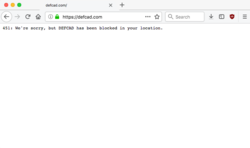
A 451 status code returned by the Defense Distributed website to a client in Pennsylvania, 30 July 2018.[1]

In computer networking, 451 Unavailable For Legal Reasons is an HTTP status code used when the user requests a resource which cannot be served for legal reasons, such as a web page censored by a government. The number 451 is a reference to Ray Bradbury's 1953 dystopian novel Fahrenheit 451, in which books are outlawed.[2] 451 provides more information than HTTP 403, which is often used for the same purpose.[3] This status code is currently a proposed standard in RFC 7725, which updated the IANA HTTP Status Codes Registry to include 451.[4]

Examples of situations where an HTTP 451 error code could be displayed include web pages deemed a danger to national security, or web pages deemed to violate copyright, privacy, blasphemy laws, or any other law or court order.

After introduction of the General Data Protection Regulation (GDPR) in the European Economic Area (EEA) it became common practice for websites located outside the EEA to serve HTTP 451 errors to EEA visitors instead of trying to comply with this new privacy law. For instance, many regional U.S. news sites no longer serve web browsers from the EU.[5][6][7]

The RFC is specific that a 451 response does not indicate whether the resource exists but requests for it have been blocked, if the resource has been removed for legal reasons and no longer exists, or even if the resource has never existed, but any discussion of its topic has been legally forbidden (see injunction).[8] Some sites have previously returned HTTP 404 (missing) or similar if they are not legally permitted to disclose that the resource has been removed. It is used in the United Kingdom by some Internet service providers utilising the Internet Watch Foundation blacklist, returning a 404 message or another error message instead of showing a message indicating the site is blocked.[9][10]

The status code was formally proposed in 2013 by Tim Bray, following earlier informal proposals by Chris Applegate[11] in 2008 and Terence Eden[12] in 2012. It was approved by the Internet Engineering Task Force (IETF) on 18 December 2015.[13] It was published as in the Proposed Standard RFC 7725 in February 2016.

HTTP 451 was mentioned by the BBC's From Our Own Correspondent programme, as an indication of the effects of sanctions on Sudan and the inability to access Airbnb, the App Store, or other Western web services.[14]

Usage

[edit]
A 451 error message being displayed when visiting a website in mainland China

When an entity intercepts the request and returns status 451, it should include a "Link" HTTP header field whose value is a URI reference identifying itself. The "Link" header field must then have a "rel" parameter whose value is "blocked-by". This is intended to identify the entity implementing the blocking (an ISP, DNS provider, caching system, etc.), not the legal authority mandating the block.[15] At an IETF hackathon, participants used a web crawler to discover that several implementations misunderstood this header and gave the legal authority instead.[16]

Additional uses

[edit]

The meaning of "a resource which cannot be served for legal reasons" has been interpreted to extend beyond government censorship:

  • When content cannot be shown in the user's country, due to contractual or licensing restrictions with the content owner, for example, a TV program may not be available to users in some countries.[citation needed]
  • When a publisher refuses to serve content to a user, because the user's country adds regulatory requirements that the publisher refuses to comply with, e.g. websites based outside of the EU may refuse to serve users in the EU because they do not want to comply with the GDPR.[citation needed]

Example

[edit]
An American website not served to European users to avoid compliance with the GDPR.
HTTP/1.1 451 Unavailable For Legal Reasons
Link: <https://search.example.net/legal>; rel="blocked-by"
Content-Type: text/html

<html>
 <head><title>Unavailable For Legal Reasons</title></head>
 <body>
  <h1>Unavailable For Legal Reasons</h1>
  <p>This request may not be serviced in the Roman Province
  of Judea due to the Lex Julia Majestatis, which disallows
  access to resources hosted on servers deemed to be
  operated by the People's Front of Judea.</p>
 </body>
</html>

See also

[edit]

References

[edit]
[edit]
Revisions and contributorsEdit on WikipediaRead on Wikipedia
from Grokipedia
HTTP 451 Unavailable For Legal Reasons is a Hypertext Transfer Protocol (HTTP) status code that indicates a server is denying access to a requested resource due to a legal demand or restriction. Defined in RFC 7725, published in February 2015, the code serves to provide transparency to users about the reasons for unavailability, distinguishing legal obstacles from technical failures or non-existence of the resource, without confirming whether the resource actually exists. Servers returning this code are recommended to include an explanatory message in the response body and optionally a "Link" header identifying the blocking authority. The code was formally proposed in a 2013 Internet Draft by , then a engineer, building on earlier informal suggestions to address the inadequacy of existing codes like 403 Forbidden for scenarios. Its numeric designation references Ray Bradbury's Fahrenheit 451, which depicts a dystopian society where books are burned to suppress knowledge, symbolizing the intent to highlight content suppression rather than obscure it. Initially met with resistance from the (IETF) steering group over concerns of politicizing protocol standards, the proposal gained approval amid rising global instances of mandated content blocking. Adoption of HTTP 451 remains limited but notable in scenarios involving compliance with regulations such as the EU's (GDPR), where sites block access from certain regions to avoid legal penalties, and by content delivery networks like for handling court-ordered restrictions. The code's experimental status underscores ongoing debates about balancing transparency with server operators' legal risks, yet it promotes causal awareness of mechanisms over opaque error handling.

Definition and Purpose

Technical Definition

HTTP status code 451, designated "Unavailable For Legal Reasons", is a 4xx client error response code standardized in RFC 7725, published by the (IETF) on February 14, 2016. It signifies that the server is denying access to the requested resource specifically as a consequence of a legal demand imposed on the server operator. This demand may arise from legislation, regulation, or policy enforcement, such as court orders, directives, or restrictions, and applies not only to origin servers but also to intermediaries like content delivery networks, ISPs, or search engines that block access. The code is intended to promote transparency in cases of legally mandated unavailability, distinguishing it from technical or authorization failures. Servers returning 451 SHOULD generate a response body containing a human-readable explanation of the legal obstacle, including details such as the demanding party (e.g., ), the cited or decision, and the specific resources or persons affected. Furthermore, servers SHOULD include a Link header field with a rel="blocked-by" relation pointing to a resource identifying the blocking entity, facilitating automated detection and analysis of patterns. Responses with 451 are cacheable by default under the rules of RFC 7234, unless overridden by cache-control directives, allowing intermediaries to store and reuse the denial without repeated legal consultations. The code does not imply the resource's existence or non-existence; access might fail for other reasons even absent legal barriers, and it differs from 403 Forbidden by explicitly attributing denial to legal causes rather than general prohibition.

Historical Inspiration and Rationale

The designation of 451 as the status code draws direct inspiration from Ray Bradbury's 1953 dystopian novel , in which the temperature 451°F represents the auto-ignition point of paper, symbolizing the state's systematic burning and outlawing of to suppress and enforce ideological conformity. This literary reference underscores the code's intent to highlight content suppression by legal or governmental authority, paralleling the novel's theme of disguised as protection. The proposal originated in June 2012 from Tim Bray, then an Android advocate engineer at Google, who drafted an initial specification for "451 Unavailable For Legal Reasons" to address the opacity of existing HTTP error codes like 403 Forbidden when applied to legally mandated blocks. Bray's rationale stemmed from observations of real-world practices, such as British Internet service providers returning generic 403 responses for sites blocked under court orders related to copyright infringement or child protection laws, which obscured the legal basis for denial and hindered public awareness of censorship. By introducing a dedicated code, the intent was to enable servers to transparently signal that access denial resulted from "a legal demand," distinguishing it from technical failures, voluntary restrictions, or non-legal prohibitions, thereby fostering accountability and potentially deterring overreach by making such interventions visible to users and researchers. This approach aligned with broader advocacy against untransparent internet filtering, including campaigns by groups like the Open Rights Group, which in 2012 petitioned for a similar code to expose blocks imposed without clear justification. The rationale emphasized empirical transparency over evasion: unlike ambiguous codes that could mask state or corporate compliance with dubious laws, 451 would provide diagnostic value, allowing clients to infer legal causation without requiring additional probing, while avoiding endorsement of the underlying restrictions. Initial resistance from the (IETF) in 2013 cited concerns over politicizing protocol semantics, but growing instances of global online censorship—such as blocks in authoritarian regimes or under regimes—ultimately supported its standardization in RFC 7725 by 2015.

Development and Standardization

Initial Proposal

The initial informal calls for a dedicated HTTP status code to denote legal unavailability emerged in response to opaque content blocking practices. In December 2008, web developer Chris Applegate highlighted the absence of a specific code for in a blog post critiquing aggressive by authorities and ISPs, which often masked restrictions behind generic errors like 403 Forbidden. The explicit proposal for code 451 originated in June 2012 from British technologist Terence Eden, who encountered a court-ordered ISP block on site, enforced via a nondescript 403 response that obscured the legal basis. Eden's blog post argued for a new status code, 451 "Unavailable For Legal Reasons," to enable transparent signaling of such interventions, allowing users and researchers to distinguish from technical or access-denied issues without relying on custom error messages prone to variation or suppression. He suggested the code could include headers detailing the legal authority, jurisdiction, and rationale, facilitating automated detection and analysis of blocks. Concurrently, in June 2012, , a software engineer at , advanced the idea by authoring an IETF Internet-Draft titled "An HTTP Status Code to Report Legal Obstacles." Bray's draft specified 451 as a 4xx client error for resources denied due to legal demands, explicitly excluding voluntary publisher choices or enforcement to focus on governmental or third-party mandates. He selected 451 to evoke Ray Bradbury's 1953 novel , wherein firemen burn prohibited books, underscoring the code's intent to highlight suppression of information. The proposal recommended optional response details, such as a human-readable explanation and links to legal documents, while cautioning against overuse that might enable mass circumvention or invite retaliation against publishers. Bray's effort built on Eden's suggestion amid rising global instances of mandated blocks, including rulings against file-sharing sites and similar actions elsewhere, where generic codes hindered transparency and empirical tracking of patterns. The draft emphasized first-principles utility: enabling servers, proxies, and clients to programmatically identify and respond to legal barriers, potentially aiding compliance, , or policy scrutiny without embedding political advocacy in the protocol itself. Initial discussions in technical forums noted risks, such as governments pressuring implementers to avoid the code, but proponents argued its value in fostering accountability outweighed such concerns.

IETF Approval and RFC Publication

The draft document specifying HTTP status code 451, authored by and titled "An HTTP Status Code to Report Legal Obstacles," progressed through the IETF's review process, including discussions within the HTTPBis Working Group on reviving and refining the proposal amid concerns over its potential to enable or highlight . On December 18, 2015, the Internet Engineering Steering Group (IESG) approved the draft for publication following last-call reviews and consensus evaluation, marking the culmination of efforts initiated in earlier individual submissions dating back to 2012. RFC 7725 was formally published in February 2016 as a Proposed Standard, defining the 451 status code for scenarios where legal restrictions prevent resource access, distinct from general access denials. This advancement elevated the code from experimental status to an official IETF recommendation, enabling broader implementation in HTTP servers and intermediaries.

Technical Specifications

Core Requirements from RFC 7725

RFC 7725 defines the HTTP 451 status code, "Unavailable For Legal Reasons," for use by servers or intermediaries to indicate that a requested resource cannot be served due to a legal demand, such as government censorship or court orders prohibiting disclosure. This code applies regardless of whether the denying entity is the origin server, and it promotes transparency by signaling that the denial stems from legal constraints rather than technical issues or discretionary access controls. Servers returning a 451 response SHOULD include a human-readable explanation in the response body, specifying details of the legal demand, including the demanding party, the relevant or , and the persons or resources affected by the restriction. For example, a compliant response might use HTTP/1.1 451 Unavailable For Legal Reasons followed by a Content-Type: text/[html](/page/HTML) body describing the block, such as compliance with laws. This explanation aids users in understanding the basis for denial without necessarily revealing the resource's existence, which the code deliberately avoids to prevent aiding circumvention attempts. To further identify the blocking entity, servers SHOULD include a Link HTTP header field with a rel parameter value of "blocked-by", linking to a URI describing the implementer of the block (e.g., the ISP or platform enforcing it), though this must not point to the mandating authority itself if distinct. The header format follows RFC 5988, such as Link: <https://example.blocker/policy>; rel="blocked-by". This requirement enhances traceability while protecting against misuse. 451 responses are cacheable by default under the rules of RFC 7234, permitting intermediaries to store and reuse them unless overridden by cache-control directives. Clients receiving 451 may employ technical workarounds like VPNs or anonymization tools, but the code itself imposes no mandatory client behaviors beyond standard HTTP processing. Unlike 403 Forbidden, which signals general failures without specifying cause, 451 explicitly denotes legal barriers to encourage public awareness of such restrictions. HTTP 451, designated as "Unavailable For Legal Reasons," differs from HTTP 403 ("Forbidden") in that the latter signals a general refusal by the server to authorize access, typically due to insufficient credentials, failures, or policy-based restrictions unrelated to external legal mandates, whereas 451 explicitly denotes denial stemming from a legal demand imposed on the server operator. The RFC standardizing 451 notes that 403 is unsuitable for legal obstacles, as it obscures the specific cause, potentially hindering transparency for users and operators affected by such restrictions. In contrast to ("Not Found"), which indicates that the server cannot locate the requested —often employed to mask by implying non-existence—451 affirms the resource's potential availability absent legal constraints, thereby providing clearer attribution to governmental or judicial actions without feigning absence. This distinction promotes accountability, as 451 responses may include explanatory details in the body or headers linking to the blocking authority, unlike 404's neutral implication of error or absence. 451 also diverges from client-error codes like ("Bad Request") or 401 ("Unauthorized"), which pertain to malformed requests or credential issues, respectively, rather than server-side compliance with legal prohibitions that override normal access. While intermediaries might misuse 403 or 404 for similar to evade scrutiny, 451's semantic precision enables better diagnostics and policy analysis, though its adoption remains optional and not universally enforced.

Usage and Scenarios

Government-Mandated Censorship

The HTTP 451 status code serves to explicitly signal when a resource is unavailable due to a mandate prohibiting its disclosure or access, such as orders to suppress content for reasons of , , or political control. This distinguishes it from opaque blocking techniques, allowing intermediaries like ISPs or content hosts to comply with legal demands while informing users of the deliberate restriction. For instance, a server might return 451 when denying access to a webpage hosting government-criticized reports, as required by akin to the hypothetical Lex Julia Majestatis example in RFC 7725, where ancient would block resources associated with prohibited groups. In practice, adoption for overt government remains limited, as regimes often favor undetectable methods like DNS tampering or TCP resets to evade scrutiny and maintain . China's Great Firewall exemplifies this, routinely blocking sites such as foreign news outlets without error codes, instead simulating network failures to users. Proponents argue that 451's transparency could empower users to circumvent blocks via VPNs or proxies and enable researchers to document patterns of state intervention, but censors in countries with extensive controls—such as or —rarely implement it, prioritizing concealment over candor. The code's standardization in RFC 7725, published February 2016, emphasizes its role in highlighting legal obstacles without endorsing the underlying policies, potentially fostering accountability in jurisdictions where courts issue takedown orders for or . However, without mandatory enforcement, its use depends on voluntary compliance by providers, which may conflict with government pressure to obscure interventions. No verified large-scale deployments in state-directed have been documented as of 2025, underscoring a gap between intent and application in high-control environments.

Intellectual Property Enforcement

HTTP 451 enables servers and intermediaries to signal that a resource is unavailable due to intellectual property-related legal demands, such as copyright infringement claims, distinguishing these from technical failures or discretionary blocks. RFC 7725 specifies that this status code applies when access is denied as a consequence of a legal obligation, including those stemming from IP enforcement mechanisms like takedown notices or court injunctions, and recommends including a "Legal-Document-Field" header with a URI to the authoritative legal demand for transparency. In the United States, notices often prompt hosting providers or content delivery networks to remove infringing material, with some implementations returning 451 to indicate compliance. , for instance, has deployed 451 responses for specific URLs on piracy-focused websites following DMCA takedowns; as of December 9, 2024, this targeted blocking of individual links on sites like those distributing unauthorized media, rather than entire domains, to enforce legal removals while preserving other content. European jurisdictions provide additional contexts for 451 in IP enforcement, where courts issue injunctions against intermediaries to block access to sites enabling copyright violations. Under Article 8(3) of the Copyright Directive (2001/29/EC) and Article 11 of the IPR Enforcement Directive (2004/48/EC), ISPs may be ordered to restrict sites used for unauthorized distribution of films, TV shows, or e-books; the Court of Justice of the upheld such measures in UPC Telekabel Wien v Verleih (C-314/12, March 27, 2014), allowing blocks that seriously discourage infringement without requiring perfect efficacy. Examples include a High Court order for British ISPs to block portals offering pirated e-books and a Tel Aviv District Court ruling in 2015 mandating Israeli ISPs to block a site for illegal film and TV sharing, scenarios where 451 could transparently report judicially mandated unavailability. This application of 451 promotes causal accountability in IP regimes by revealing enforcement actions, potentially deterring evasion through proxies or VPNs, though adoption remains selective as some providers prefer 403 Forbidden to minimize disclosure of legal pressures. Legal demands under privacy and data protection laws represent a key category of constraints prompting the use of . For example, the European Union's (GDPR), effective May 25, , has led some operators to block access from IP addresses to avoid obligations like obtaining explicit for or honoring "" requests under Article 17, which mandates erasure of in certain cases. In response, a notable increase in 451 errors was observed starting around , with U.S. news sites and other services denying content to visitors to sidestep compliance liabilities rather than adapt to the regulation's requirements. Additional applications include jurisdictions enforcing laws against specific activities, such as prohibitions. Servers may return 451 when denying access to gambling-related resources to intermediaries or users in regions where such operations violate local statutes, signaling the block stems from statutory restrictions rather than technical failure. Similarly, violations of norms, like unauthorized disclosure of protected information, can trigger 451 responses to halt dissemination pending legal resolution, distinguishing these from voluntary . In broader terms, HTTP 451 accommodates court orders or regulatory directives unrelated to core censorship or , such as temporary restraints on content deemed to infringe personal rights or public safety mandates, provided the denial traces to enforceable legal authority as outlined in RFC 7725. This usage underscores the code's role in transparently conveying non-discretionary blocks, though real-world deployment remains selective due to varying interpretations of "legal demand."

Adoption and Implementation

Support in Servers and Intermediaries

Major web servers such as include native support for HTTP 451 in their core status code definitions, allowing administrators to return the code through configuration directives like mod_rewrite or custom error handlers. supports returning HTTP 451 via simple return statements in server blocks, often used for conditional responses such as or legal compliance checks. Microsoft's (IIS) permits custom status codes including 451 through modules or HTTP response modules, though specific built-in error pages for it are not predefined and require manual setup. Intermediaries like content delivery networks (CDNs) and proxies have adopted HTTP 451 to enforce legal restrictions transparently. Cloudflare, a prominent CDN and proxy service, returns 451 in response to court orders, trademark infringement notices, or regional legal blocks, such as limiting access to content violating UK-specific laws even for non-UK users in some cases. This implementation aligns with RFC 7725's intent for intermediaries to signal legal unavailability without obscuring the reason, though evasion via VPNs or alternative DNS remains possible. Other proxies may return 451 indirectly through upstream server directives, but widespread default support in non-Cloudflare CDNs like Akamai or Fastly lacks public documentation as of 2025. Adoption in servers and intermediaries remains configuration-dependent rather than automatic, with usage spiking in scenarios like GDPR compliance or copyright enforcement post-2015 RFC publication, as evidenced by increased error observations in web crawls. Despite technical feasibility, full ecosystem support is limited by the code's niche application to legal constraints, contrasting with more common codes like 403 or 404.

Notable Real-World Deployments

has deployed HTTP 451 for enforcement, particularly in response to DMCA notices. In February 2020, returned 451 errors to German users attempting to access specific pages on a site, indicating blocks due to legal demands from rights holders. More recently, in December 2024, applied the code to individual URLs on torrent sites like YTS.mx, linking removals to Lumen Database reports of DMCA takedowns, thereby providing transparency on censored links without blocking entire domains. In compliance with the EU's (GDPR), effective May 2018, several U.S.-based outlets implemented via HTTP 451 to restrict access from EU IP addresses, avoiding the regulatory burdens of data protection compliance. Notable examples include KPC News, which displays a 451 response accompanied by a GDPR disclaimer for European visitors, and Penn State's The Collegian, which outright blocks EU access with the status code. This practice, observed across approximately 560 small local U.S. sites hosted on shared platforms, peaked as a fraction of web requests (up to 0.8%) and resolved when accessed from non-EU locations, highlighting targeted legal avoidance rather than technical failure. Following legal actions, other platforms have returned 451 errors. In 2018, Backpage.com reportedly issued the code after the secured a related to site content, signaling unavailability due to court orders. Such deployments underscore HTTP 451's role in distinguishing legally mandated inaccessibility from other server issues, though adoption remains selective among intermediaries and governments.

Criticisms and Limitations

Challenges in Enforcement and Adoption

Despite its standardization in RFC 7725 published in February , HTTP 451 has seen limited adoption, with only 526 IPv4 hosts observed returning the code as of July 2017, including just 17 among the top million websites. This scarcity stems from its voluntary implementation, as servers and intermediaries often opt for generic status codes like 403 Forbidden or 404 Not Found to block access without disclosing legal motivations, thereby avoiding potential scrutiny or liability. In jurisdictions enforcing content restrictions, authorities frequently issue orders that do not specify the use of HTTP 451, allowing providers to employ less transparent methods such as DNS-level blocking or custom error pages. Implementation challenges further hinder widespread use, including inconsistent response formatting where some servers pair 451 with misleading elements like "404 Not Found" titles or omit required explanatory details in the body, such as the demanding party or applicable legislation. The RFC's guidance leaves room for interpretation, leading to varied handling across servers (e.g., and have supported it sporadically) and limited proxy or intermediary compliance, particularly in ISP or CDN contexts where blocks occur below the HTTP layer. Additionally, potential conflicts with pre-existing uses of code 451 in non-HTTP contexts, such as errors, have complicated standardization efforts. Enforcing consistent application of HTTP 451 faces structural barriers, as no regulatory body mandates its use over alternative blocking techniques, and legal demands often prioritize compliance without transparency requirements. Even when deployed, such as in European GDPR-related geofencing observed around 2018, the code's effectiveness is undermined by easy circumvention via VPNs, proxies, or Tor, which mask user locations and server-side restrictions without addressing the underlying legal disclosure . In politically sensitive environments, deploying 451 risks highlighting , prompting authorities to favor opaque methods that evade the code's transparency goals.

Risks of Misuse or Evasion

One risk of HTTP 451 arises from its potential misuse by servers or intermediaries to obscure non-legal blocks as ostensibly mandated , contrary to the intent outlined in RFC 7725, which limits its application to genuine legal demands or contractual restrictions on content access. For instance, in 2013, employed the code to voluntarily restrict access to an article on Prince Harry without any , framing a self-imposed decision as a legal obstacle. Similarly, following the 2018 implementation of the 's (GDPR), approximately 560 small U.S. news outlets, including university publications, began returning 451 errors to geofence IP addresses, treating regulatory compliance burdens as equivalent to prohibitive legal demands despite the RFC's narrower scope. This pattern, concentrated in EU-hosted data centers, risks conflating voluntary policy choices with enforced censorship, potentially eroding the code's value for genuine transparency. Governments or authorities may further misuse the code by mandating alternative status codes like 403 or 404 to mask legal interventions, thereby evading the transparency HTTP aims to provide. IETF HTTP working group chair Mark Nottingham highlighted this concern in 2015, observing that "censorious governments will disallow the use of , to hide what they're doing," as evidenced by ISPs employing opaque 404 responses for blocks under the Internet Watch Foundation's Cleanfeed system rather than disclosing legal bases. Such practices undermine user awareness of motives and could normalize hidden blocks, complicating efforts to document or challenge them empirically. Evasion of HTTP 451 blocks poses enforcement challenges, as the status code serves primarily as an informational signal without inherent technical barriers, allowing circumvention through tools like virtual private networks (VPNs), proxy servers, or DNS resolvers that mask user locations or routes. Clients can retry requests unchanged, per HTTP/1.1 semantics for 5xx codes, potentially succeeding via these methods and rendering legal blocks ineffective against technically savvy users. This ease of evasion, while preserving web access, risks diminishing the deterrent effect of legal demands, as blocked resources remain retrievable through mirrors or anonymization services, thereby limiting the code's utility in high-stakes scenarios like restrictions.

Impact and Reception

Benefits for Transparency and User Awareness

The HTTP 451 status code enhances transparency by explicitly signaling that a resource's unavailability stems from legal constraints rather than technical failures or voluntary content removal, as defined in RFC 7725 published in April 2016. This distinction prevents conflation with generic errors like 404 (Not Found) or 403 (Forbidden), which obscure the underlying cause and could mislead users into assuming non-legal issues. By embedding this indicator in the HTTP protocol, servers can communicate compliance with court orders, government mandates, or intellectual property rulings without necessarily disclosing sensitive details that might breach nondisclosure agreements. For user awareness, the code serves as a direct notification mechanism, alerting individuals to instances of enforced inaccessibility and fostering greater public scrutiny of legal interventions in online content. Organizations such as the Center for Democracy & Technology have highlighted how this protocol-level transparency enables users to recognize patterns of , distinguishing state-imposed blocks from other disruptions and potentially spurring or circumvention efforts. In regions with frequent content restrictions, such as those involving or laws, encountering 451 prompts users to question the legitimacy of the block, rather than accepting opacity that might normalize suppression. This approach also facilitates aggregate monitoring by researchers and , as standardized reporting of responses can quantify the scale of legal barriers across domains or jurisdictions, aiding empirical analysis of trends without relying on . For instance, widespread adoption could generate data on block frequencies tied to specific laws, informing debates and highlighting discrepancies in , though implementation remains voluntary and uneven as of 2025. Ultimately, by prioritizing causal disclosure over evasion, aligns web infrastructure with principles of accountability, empowering informed navigation of legally constrained digital spaces.

Broader Implications for Web Freedom

The introduction of HTTP 451 as defined in RFC 7725 enables servers to explicitly signal when legal demands prevent resource access, thereby distinguishing such blocks from technical failures or voluntary content removal. This transparency mechanism, proposed in and standardized in , aims to make or legal restrictions more visible to users, potentially fostering greater public scrutiny of overreaching laws. For instance, in jurisdictions enforcing content blocks for political or regulatory reasons, the code alerts users to the nature of the denial, which can inform advocacy efforts and empirical studies on global patterns. Proponents argue that HTTP 451 bolsters web by embedding accountability into the protocol, encouraging intermediaries to report legal pressures rather than obscuring them under generic errors like 403 Forbidden. This visibility has been likened to a "censorship-aware error," drawing from Ray Bradbury's to symbolize resistance against information suppression, and it supports free expression by enabling users and researchers to map and challenge opaque blocking practices. In practice, its deployment in browsers and servers, such as experimental support in , could empower circumvention tools or legal challenges, as users encountering 451 responses gain evidence of targeted restrictions. However, critics contend that while HTTP 451 highlights legal barriers, it does not mitigate their enforcement and may inadvertently legitimize them by providing a standardized protocol for compliance, potentially eroding the open web's resistance to authoritarian controls. In regions with expansive interpretations of "legal reasons"—encompassing not only orders but also private IP claims or vague provisions—the code risks normalizing pervasive filtering without addressing underlying free speech infringements. Limited adoption to date, often confined to specific intermediaries rather than universal implementation, underscores its potential as a diagnostic tool rather than a transformative safeguard, leaving broader vulnerable to untransparent or evadable blocks.

References

Add your contribution
Related Hubs
Contribute something
User Avatar
No comments yet.