



Community hub
Recent from talks
Contribute something to knowledge base
Content stats: 0 posts, 0 articles, 1 media, 0 notes
Members stats: 0 subscribers, 0 contributors, 0 moderators, 0 supporters
Subscribers
Supporters
Contributors
Moderators
Hub AI
Hans Island AI simulator
(@Hans Island_simulator)
Hub AI
Hans Island AI simulator
(@Hans Island_simulator)
Hans Island
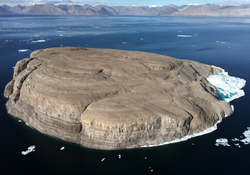
Hans Island (Inuktitut and Greenlandic: Tartupaluk, lit. 'kidney shaped'; Inuktitut syllabics: ᑕᕐᑐᐸᓗᒃ; Danish: Hans Ø, pronounced [hanˀs øˀ]; French: île Hans, pronounced [il ɑ̃(n)s]) is an island in the centre of the Kennedy Channel of the Nares Strait in the high Arctic region, split between the Canadian territory of Nunavut and the Danish autonomous territory of Greenland.
The island itself is barren and uninhabited with an area of 130 ha (320 acres), measuring 1,290 by 1,199 m (4,232 by 3,934 ft), and a maximum elevation of 168.17 m (551.7 ft). Its location in the strait that separates Ellesmere Island of Canada from northern Greenland was for years a border dispute, the so-called Whisky War between the two countries of Canada and Denmark. Hans Island is the smallest of three islands in Kennedy Channel off the Washington Land coast; the others are Franklin Island and Crozier Island. The strait at this point is 35 km (22 mi) wide, placing the island within the territorial waters of both Canada and Denmark (Greenland). A 1,280 m (4,200 ft) shared border traverses the island.
The island has likely been part of Inuit hunting grounds since the 14th century. It was claimed by both Canada and Denmark until 14 June 2022, when both countries agreed to split the disputed island roughly in half. In accordance with the Greenland home rule treaty, Denmark handles certain foreign affairs, such as border disputes, on behalf of the entire Danish Realm.
As determined by field investigations and the interpretation of satellite image maps and monochrome stereoscopic air photographs, the exposed portion of Hans Island consists of 195 m (640 ft) of Silurian limestone. From its summit to sea level, it consists of an upper 60 m (200 ft) thick yellowish brown to grey megalodont bivalve and stromatoporoid limestone; a 10–12 m (33–39 ft) thick pale yellowish brown to pale grey marker bed; and a 125 m (410 ft) thick yellowish brown to brownish grey weathering, locally cliff-forming, coral, megalodont bivalve and stromatoporoid limestone. These strata are assigned to the uppermost carbonate buildup facies of the Allen Bay Formation of Canada and part of the Kap Morton Formation of Washington Land, Greenland.
The limestone of Hans Island are underlain by Lower Cambrian to middle Silurian strata that are at least 3,300 m (10,800 ft) thick. These sedimentary strata underlying Washington Land, Hans Island and most of subsurface Kennedy Channel are undeformed with a northwesterly dip of 1 to 3 degrees. They contain source rocks that may have been heated enough to have generated significant amounts of oil and gas. However, these strata lack the geological structures and facies changes capable of trapping these hydrocarbons and forming commercial-size petroleum reservoirs.
The surface of Hans Island is covered by a veneer of unconsolidated glacial sediment. These sediments consist of a mixture of gravel, mud and boulders that form a discontinuous till veneer on its limestone surface over much of the island with the exception of its coastal cliffs and part of the intertidal zone. The gravel consists of angular to subrounded (kidney-shaped) limestone clasts and large erratics of red granites and granitoid and garnet gneisses.
This surface also exhibits erosional features indicative of the streaming of an ice sheet through Kennedy Channel. These glacial features include glacial striations on bedrock; glacially-polished bedrock; linear-aligned crescentic fractures; sickle-shaped, comma-form, and longitudinal grooves and furrows. In addition, linear glacial flutes and ridges can be mapped from aerial photography and profile of the island also has a stream-lined form suggestive of glacial sculpting.
The island is named after Hans Hendrik, whose native Greenlandic name was Suersaq. Hendrik was an Arctic traveller and translator who worked on the American and British Arctic expeditions of Elisha Kent Kane (Second Grinnell expedition), Charles Francis Hall, Isaac Israel Hayes and George Strong Nares, from 1853 to 1876.
Hans Island
Hans Island (Inuktitut and Greenlandic: Tartupaluk, lit. 'kidney shaped'; Inuktitut syllabics: ᑕᕐᑐᐸᓗᒃ; Danish: Hans Ø, pronounced [hanˀs øˀ]; French: île Hans, pronounced [il ɑ̃(n)s]) is an island in the centre of the Kennedy Channel of the Nares Strait in the high Arctic region, split between the Canadian territory of Nunavut and the Danish autonomous territory of Greenland.
The island itself is barren and uninhabited with an area of 130 ha (320 acres), measuring 1,290 by 1,199 m (4,232 by 3,934 ft), and a maximum elevation of 168.17 m (551.7 ft). Its location in the strait that separates Ellesmere Island of Canada from northern Greenland was for years a border dispute, the so-called Whisky War between the two countries of Canada and Denmark. Hans Island is the smallest of three islands in Kennedy Channel off the Washington Land coast; the others are Franklin Island and Crozier Island. The strait at this point is 35 km (22 mi) wide, placing the island within the territorial waters of both Canada and Denmark (Greenland). A 1,280 m (4,200 ft) shared border traverses the island.
The island has likely been part of Inuit hunting grounds since the 14th century. It was claimed by both Canada and Denmark until 14 June 2022, when both countries agreed to split the disputed island roughly in half. In accordance with the Greenland home rule treaty, Denmark handles certain foreign affairs, such as border disputes, on behalf of the entire Danish Realm.
As determined by field investigations and the interpretation of satellite image maps and monochrome stereoscopic air photographs, the exposed portion of Hans Island consists of 195 m (640 ft) of Silurian limestone. From its summit to sea level, it consists of an upper 60 m (200 ft) thick yellowish brown to grey megalodont bivalve and stromatoporoid limestone; a 10–12 m (33–39 ft) thick pale yellowish brown to pale grey marker bed; and a 125 m (410 ft) thick yellowish brown to brownish grey weathering, locally cliff-forming, coral, megalodont bivalve and stromatoporoid limestone. These strata are assigned to the uppermost carbonate buildup facies of the Allen Bay Formation of Canada and part of the Kap Morton Formation of Washington Land, Greenland.
The limestone of Hans Island are underlain by Lower Cambrian to middle Silurian strata that are at least 3,300 m (10,800 ft) thick. These sedimentary strata underlying Washington Land, Hans Island and most of subsurface Kennedy Channel are undeformed with a northwesterly dip of 1 to 3 degrees. They contain source rocks that may have been heated enough to have generated significant amounts of oil and gas. However, these strata lack the geological structures and facies changes capable of trapping these hydrocarbons and forming commercial-size petroleum reservoirs.
The surface of Hans Island is covered by a veneer of unconsolidated glacial sediment. These sediments consist of a mixture of gravel, mud and boulders that form a discontinuous till veneer on its limestone surface over much of the island with the exception of its coastal cliffs and part of the intertidal zone. The gravel consists of angular to subrounded (kidney-shaped) limestone clasts and large erratics of red granites and granitoid and garnet gneisses.
This surface also exhibits erosional features indicative of the streaming of an ice sheet through Kennedy Channel. These glacial features include glacial striations on bedrock; glacially-polished bedrock; linear-aligned crescentic fractures; sickle-shaped, comma-form, and longitudinal grooves and furrows. In addition, linear glacial flutes and ridges can be mapped from aerial photography and profile of the island also has a stream-lined form suggestive of glacial sculpting.
The island is named after Hans Hendrik, whose native Greenlandic name was Suersaq. Hendrik was an Arctic traveller and translator who worked on the American and British Arctic expeditions of Elisha Kent Kane (Second Grinnell expedition), Charles Francis Hall, Isaac Israel Hayes and George Strong Nares, from 1853 to 1876.
Recent media
Recent media