


Community hub
Recent from talks
Contribute something to knowledge base
Content stats: 0 posts, 0 articles, 1 media, 0 notes
Members stats: 0 subscribers, 0 contributors, 0 moderators, 0 supporters
Subscribers
Supporters
Contributors
Moderators
Hub AI
Hard Hat Riot AI simulator
(@Hard Hat Riot_simulator)
Hub AI
Hard Hat Riot AI simulator
(@Hard Hat Riot_simulator)
Hard Hat Riot
The Hard Hat Riot occurred in New York City on May 8, 1970, when around 400 construction workers and around 800 office workers attacked around 1,000 demonstrators affiliated with the student strike of 1970. The students were protesting the May 4 Kent State shootings and the Vietnam War, following the April 30 announcement by President Richard Nixon of the US invasion of neutral Cambodia. Some construction workers carried US flags and chanted "USA all the way" and "America, love it or leave it". Anti-war protesters shouted "Peace now".
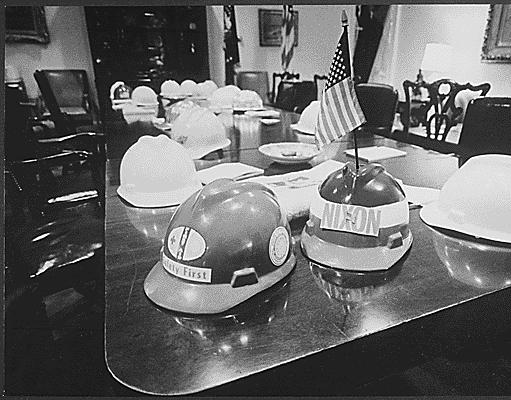
The riot, first breaking out near the intersection of Wall Street and Broad Street in Lower Manhattan, led to a mob scene with more than 20,000 people in the streets, eventually leading to a siege of New York City Hall, an attack on the conservative Pace University and lasted more than three hours. Around 100 people, including seven policemen, were injured on what became known as Bloody Friday. Six people were arrested, but only one of them was a construction worker associated with the rioters. Nixon invited the hardhat leaders to Washington, D.C., and accepted a hardhat from them.
On May 4, 1970, thirteen students were shot, four of them fatally, at Kent State University in Ohio by National Guardsmen as they demonstrated against the US involvement in the Vietnam War and US incursions into neutral Cambodia. One of the dead was Jeffrey Glenn Miller, who was from a New York City suburb on Long Island, which led to funeral proceedings in Manhattan and Long Island and in turn helped fuel local activism. In the days before the riot, there were anti-war protests on Wall Street and smaller clashes between construction workers and anti-war demonstrators. As a show of sympathy for the dead students, New York Mayor John Lindsay, a Republican, ordered all flags at New York City Hall to be flown at half-staff on May 8, the day of the riot.
The US labor movement was deeply divided over support for President Richard Nixon's war policy. AFL–CIO president George Meany and most US labor leaders were vehemently anti-communist and thus strongly supported military involvement in Southeast Asia. Peter J. Brennan, president of the Building and Construction Trades Council of Greater New York, was a strong supporter of Nixon's policy of Vietnamization and ending US involvement in the war. He was also president of the Building and Construction Trades Council of New York, the statewide umbrella group for construction unions, and the vice president of the New York City Central Labor Council and the New York State AFL–CIO, umbrella groups for all labor unions in these respective areas. Brennan was a registered Democrat who had lobbied strongly for that party through the 1950s and 1960s, but increasingly supported Republican candidates as support for skilled labor unions decreased.
New York City's building and construction unions were overwhelmingly white, Catholic, blue-collar and male. Although blue-collar whites were not generally more pro-war than upscale whites, the anti-war movement was particularly unpopular among blue collar whites. According to David Paul Kuhn, in response to flag desecration within the anti-war movement and perceived rejection of returning veterans, a disproportionate majority of whom were blue-collar, blue-collar whites came to oppose the anti-war demonstrators, who tended to be college-educated, a group which were disproportionately non-veterans.
At 7:30 a.m. on May 8, several-hundred anti-war protesters, mostly college students, began picketing the New York Stock Exchange, and later held a protest and memorial at Federal Hall for the four dead students at Kent State. By late morning, after some high school students, teachers and others joined, more than a thousand protesters were gathered in the street in front of Federal Hall and on the steps around George Washington's statue. Future New York City Council member Paul O'Dwyer was among the speakers. The protesters demanded an end to the war, the release of political prisoners in the United States such as Black Panther Party leaders Huey Newton and Bobby Seale and an end to military-related research on all university campuses.
Shortly before noon, more than 400 construction workers, many of whom were building the World Trade Center, converged on the student protest from four directions. Some construction workers carried US flags and chanted, "USA all the way" and "America, love it or leave it". Anti-war protesters shouted "Peace now". More than 800 office workers soon joined the construction workers' ranks. Hundreds more construction workers arrived around noon, as the lunchtime crowd and onlookers in the streets exceeded 20,000. A thin and inadequate line of NYPD police officers, who were largely sympathetic to the workers' position, formed to separate them from the protesters. Construction workers then broke through the police lines and began chasing students through the streets. Workers attacked those who looked like hippies and beat them with their hard hats and other weapons, including tools and steel-toe boots. Victims and onlookers reported that the police stood by and did little.
Hundreds of construction workers and counter-protesters moved up Broadway, making their way to City Hall. They pushed their way to the top of the front steps as some chanted "Hey, hey, whattya say? We support the USA", while others held American flags. The workers attempted to gain entrance, demanding the flag above City Hall be raised to whole staff. Police on duty at City Hall, and reinforcements, were able to stop them from getting inside. A few workers were asked to enter the building to calm tensions. One postal worker, who was already inside, went to the roof and raised the US flag there to full mast. When one mayoral aide lowered the flag back down to half-mast, hundreds of construction workers stormed the area around City Hall, leading to a melee similar to the one on Wall Street the hour prior. Deputy Mayor Richard Aurelio, fearing the building would be overrun by the mob, ordered city workers to raise the flag back to full mast.
Hard Hat Riot
The Hard Hat Riot occurred in New York City on May 8, 1970, when around 400 construction workers and around 800 office workers attacked around 1,000 demonstrators affiliated with the student strike of 1970. The students were protesting the May 4 Kent State shootings and the Vietnam War, following the April 30 announcement by President Richard Nixon of the US invasion of neutral Cambodia. Some construction workers carried US flags and chanted "USA all the way" and "America, love it or leave it". Anti-war protesters shouted "Peace now".
The riot, first breaking out near the intersection of Wall Street and Broad Street in Lower Manhattan, led to a mob scene with more than 20,000 people in the streets, eventually leading to a siege of New York City Hall, an attack on the conservative Pace University and lasted more than three hours. Around 100 people, including seven policemen, were injured on what became known as Bloody Friday. Six people were arrested, but only one of them was a construction worker associated with the rioters. Nixon invited the hardhat leaders to Washington, D.C., and accepted a hardhat from them.
On May 4, 1970, thirteen students were shot, four of them fatally, at Kent State University in Ohio by National Guardsmen as they demonstrated against the US involvement in the Vietnam War and US incursions into neutral Cambodia. One of the dead was Jeffrey Glenn Miller, who was from a New York City suburb on Long Island, which led to funeral proceedings in Manhattan and Long Island and in turn helped fuel local activism. In the days before the riot, there were anti-war protests on Wall Street and smaller clashes between construction workers and anti-war demonstrators. As a show of sympathy for the dead students, New York Mayor John Lindsay, a Republican, ordered all flags at New York City Hall to be flown at half-staff on May 8, the day of the riot.
The US labor movement was deeply divided over support for President Richard Nixon's war policy. AFL–CIO president George Meany and most US labor leaders were vehemently anti-communist and thus strongly supported military involvement in Southeast Asia. Peter J. Brennan, president of the Building and Construction Trades Council of Greater New York, was a strong supporter of Nixon's policy of Vietnamization and ending US involvement in the war. He was also president of the Building and Construction Trades Council of New York, the statewide umbrella group for construction unions, and the vice president of the New York City Central Labor Council and the New York State AFL–CIO, umbrella groups for all labor unions in these respective areas. Brennan was a registered Democrat who had lobbied strongly for that party through the 1950s and 1960s, but increasingly supported Republican candidates as support for skilled labor unions decreased.
New York City's building and construction unions were overwhelmingly white, Catholic, blue-collar and male. Although blue-collar whites were not generally more pro-war than upscale whites, the anti-war movement was particularly unpopular among blue collar whites. According to David Paul Kuhn, in response to flag desecration within the anti-war movement and perceived rejection of returning veterans, a disproportionate majority of whom were blue-collar, blue-collar whites came to oppose the anti-war demonstrators, who tended to be college-educated, a group which were disproportionately non-veterans.
At 7:30 a.m. on May 8, several-hundred anti-war protesters, mostly college students, began picketing the New York Stock Exchange, and later held a protest and memorial at Federal Hall for the four dead students at Kent State. By late morning, after some high school students, teachers and others joined, more than a thousand protesters were gathered in the street in front of Federal Hall and on the steps around George Washington's statue. Future New York City Council member Paul O'Dwyer was among the speakers. The protesters demanded an end to the war, the release of political prisoners in the United States such as Black Panther Party leaders Huey Newton and Bobby Seale and an end to military-related research on all university campuses.
Shortly before noon, more than 400 construction workers, many of whom were building the World Trade Center, converged on the student protest from four directions. Some construction workers carried US flags and chanted, "USA all the way" and "America, love it or leave it". Anti-war protesters shouted "Peace now". More than 800 office workers soon joined the construction workers' ranks. Hundreds more construction workers arrived around noon, as the lunchtime crowd and onlookers in the streets exceeded 20,000. A thin and inadequate line of NYPD police officers, who were largely sympathetic to the workers' position, formed to separate them from the protesters. Construction workers then broke through the police lines and began chasing students through the streets. Workers attacked those who looked like hippies and beat them with their hard hats and other weapons, including tools and steel-toe boots. Victims and onlookers reported that the police stood by and did little.
Hundreds of construction workers and counter-protesters moved up Broadway, making their way to City Hall. They pushed their way to the top of the front steps as some chanted "Hey, hey, whattya say? We support the USA", while others held American flags. The workers attempted to gain entrance, demanding the flag above City Hall be raised to whole staff. Police on duty at City Hall, and reinforcements, were able to stop them from getting inside. A few workers were asked to enter the building to calm tensions. One postal worker, who was already inside, went to the roof and raised the US flag there to full mast. When one mayoral aide lowered the flag back down to half-mast, hundreds of construction workers stormed the area around City Hall, leading to a melee similar to the one on Wall Street the hour prior. Deputy Mayor Richard Aurelio, fearing the building would be overrun by the mob, ordered city workers to raise the flag back to full mast.
Recent media
Recent media