Hubbry Logo
Harmony (ISS module)Harmony (ISS module)Main
Open search
Harmony (ISS module)
Community hub
Harmony (ISS module)
logo
8 pages, 0 posts
0 subscribers
Be the first to start a discussion here.
Harmony (ISS module)
from Wikipedia

Harmony
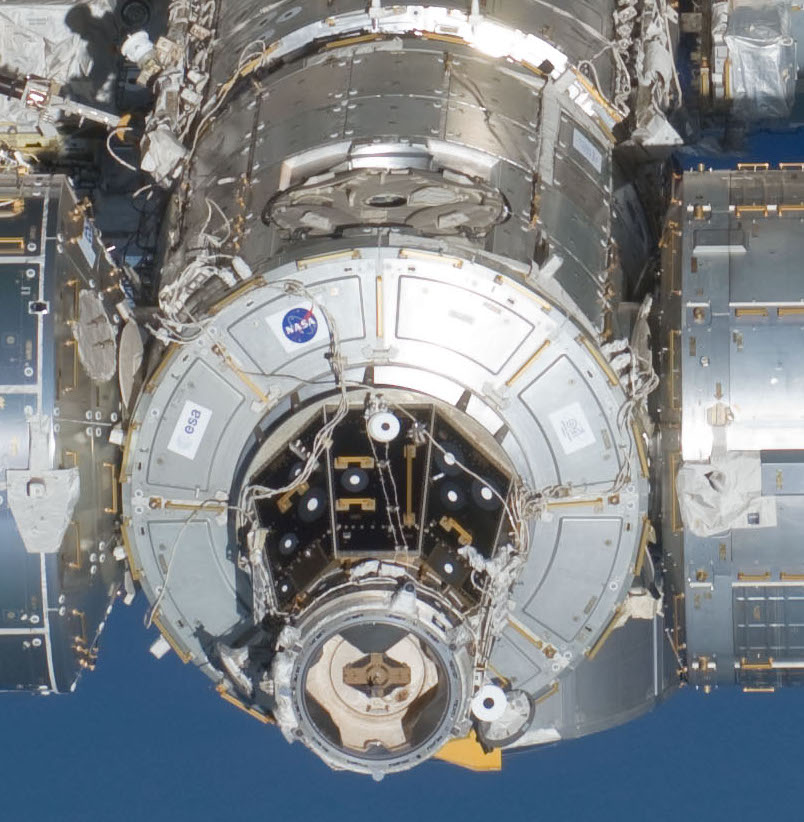
Harmony shown connected to Columbus, Kibō, and Destiny. PMA-2 faces towards the camera. The nadir and zenith locations are open.
Module statistics
Part ofInternational Space Station
Launch dateOctober 23, 2007, 15:38:19 UTC[1]
Launch vehicleSpace Shuttle Discovery
Berthed
  • October 26–November 12, 2007: Unity port
  • November 14, 2007–present: Destiny forward
Mass14,300 kg (31,500 lb)
Length7.2 m (24 ft)
Diameter4.4 m (14 ft)
Pressurized volume70 m3 (2,500 cu ft)
References: [2]
Configuration

Graphic showing the six CBMs on Harmony

Harmony, also known as Node 2, is a module of the International Space Station (ISS) that serves as its "utility hub". It connects the laboratory modules of the United States, Europe and Japan, while also providing electrical power and data. The module also has sleeping cabins for four astronauts.[3]

Harmony has six Common Berthing Mechanism (CBM) ports. It is attached to Destiny at its aft port, with Columbus to starboard and Kibō to port. Its forward and zenith ports are each equipped with a Pressurized Mating Adapter (PMA) and International Docking Adapter (IDA) for docking visiting spacecraft. The nadir CBM, the only one without permanently mounted equipment, is typically used for berthing cargo spacecraft.

Harmony was launched aboard STS-120 on October 23, 2007.[4][5] It was first attached temporarily to the port side of the Unity module[6][7] before being moved to its permanent location on the forward end of Destiny on November 14, 2007.[8] The module added 70 m3 (2,500 cu ft) of habitable volume to the station, increasing its living space by nearly 20%, from 420 to 490 m3 (15,000 to 17,000 cu ft).

Origin of name

[edit]
Interior of Harmony

The unit formerly known as Node 2 was renamed Harmony in March 2004.[9] The name was chosen in a competition where more than 2,200 students from 32 states participated.[10][11] The Node 2 Challenge required students to learn about the space station, build a scale model, and write an essay explaining their proposed name for the module, which will serve as a central hub for science labs. The six winning classes were: Paul Cummins' 8th grade class at Browne Academy, Alexandria, Va.; Mrs.Sue Wilson's 3rd grade class at Buchanan Elementary School, Baton Rouge, La.; Brigette Berry's 8th grade class at League City Intermediate School, League City, Texas; Bradley Neu's 9th grade science class at Lubbock High School, Lubbock, Texas; Russell Yocum 's 3rd grade class at West Navarre Intermediate School, Navarre, Fla.; and, David Dexheimer's students at the World Group Home School, Monona, Wisconsin.[12]

Specifications

[edit]
Crew members hanging out of the USOS crew quarters

Harmony is the second of three node modules on the United States Orbital Segment (USOS).[13] It is composed of a cylindrical, 5.1 cm (2.0 in) thick 2219-T851 aluminium alloy pressure shell with two endcones and is thermally insulated by a goldised Kapton blanket. It is protected from micrometeoroids by 98 panels, each made from a composite sandwich of stainless steel and 6061-T6 aluminium alloy, and a secondary barrier of Kevlar/resin.[14][15] The design is based on the existing Multi-Purpose Logistics Module, as well as the European Space Agency's Columbus module (both of which have only one passive Common Berthing Mechanism [CBM]).[13] There are six CBMs on Harmony: the aft CBM that connects it to Destiny is passive; the rest are active.[16]

Harmony is managed by NASA's Marshall Space Flight Center in Huntsville, Alabama. Its deployment expanded the Space Station, allowing it to grow from the size of a three-bedroom house, to the space equivalent of a typical five-bedroom house, once the Japanese Kibō and European Columbus laboratories are attached. The Space Station robotic arm, Canadarm2, is able to operate from a powered grapple fixture on the exterior of Harmony.[17] Harmony is equipped with eight International Standard Payload Racks: four avionics racks and four for stowage or crew quarters.[15] The first two were delivered on STS-126 and the second two on STS-128.[18][19] After the cancellation of the Habitation Module, Harmony was chosen to house the American Crew Quarters.[20][21]

Construction agreement

[edit]
Harmony during assembly at the Space Station Processing Facility

Harmony was built within the ESA–NASA ISS bartering system. Under this arrangement, the European Space Agency (ESA) agreed to provide NASA with the fully integrated Harmony and Tranquility node modules, along with additional equipment and parts, in exchange for the launch of ESA's Columbus module and its initial payload aboard the Space Shuttle. This barter allowed ESA to secure launch services without a direct financial transaction, and enabling those funds to remain within ESA member states.[22][23]

To build the nodes, ESA partnered with the Italian Space Agency (ASI) and Thales Alenia Space, which manufactured them at its facility in Turin, Italy.[17]

Harmony arrived at Kennedy Space Center in Florida on June 1, 2003, after being transported aboard an Airbus Beluga oversize cargo aircraft. Following a post-transportation inspection, the ASI formally handed over Harmony to the ESA. ESA then transferred ownership to NASA on June 18, 2003, during a ceremony at the Space Station Processing Facility at Kennedy Space Center.[24]

Launch and installation

[edit]
Harmony inside the payload bay of Space Shuttle Discovery while on its way to the ISS.

Harmony was launched on October 23, 2007, aboard Space Shuttle Discovery during mission STS-120, as the primary component of assembly mission ISS-10A.[25][26][27] Discovery docked at Pressurized Mating Adapter-2 (PMA-2) on the forward port of the Destiny laboratory module on October 25. The next day, the station's Canadarm2 removed Harmony from Discovery's cargo bay and temporarily attached it to the port side of the Unity node. On October 27, the crew entered Harmony for the first time.[28][29]

After the shuttle's departure, the Expedition 16 crew used the Canadarm2 to relocate PMA-2 from Destiny's forward port to Harmony's forward port on November 12. Two days later, on November 14, Harmony, with PMA-2 attached, was berthed at its final position on the forward port of Destiny.[8] This process spanned several days and required three spacewalks.[29][30]

Connecting modules and visiting vehicles

[edit]

After Harmony's final installation, all subsequent Space Shuttle missions docked at PMA-2 on its forward port. Since the Shuttle's retirement, this port has remained the primary docking location for visiting Dragon and Starliner spacecraft.

On February 11, 2008, ESA's Columbus laboratory module was attached to Harmony's starboard port during the STS-122 mission flown by Space Shuttle Atlantis.

On March 14, 2008, the Experiment Logistics Module Pressurized Section (ELM-PS), part of the future Kibō laboratory module, was temporarily attached to Harmony's zenith (space-facing) port during mission STS-123 aboard Space Shuttle Endeavour.

On June 3, 2008, the Kibō laboratory module was installed on Harmony's port side during mission STS-124 aboard Discovery. Three days later, on June 6, the ELM-PS was relocated from Harmony's zenith port to its permanent position on Kibō's zenith port.

When the Shuttle delivered Multi-Purpose Logistics Modules, they were temporarily berthed to Harmony's nadir (Earth-facing) port.[31] The same port has also been used for cargo spacecraft including the Japanese HTV and American Dragon and Cygnus.

Harmony's zenith port was originally intended for the Centrifuge Accommodations Module, which was later canceled. On January 25, 2010, PMA-3 was moved from Unity's port berthing mechanism to Harmony's zenith mechanism for temporary storage during the installation of the Tranquility node module on mission STS-130. On February 16, 2010, PMA-3 was relocated to Tranquility's port side.[32] It was ultimately returned to Harmony's zenith port on March 26, 2017, where it now serves as a secondary docking port for visiting Dragon and Starliner spacecraft.[33]

References

[edit]
[edit]
Revisions and contributorsEdit on WikipediaRead on Wikipedia
from Grokipedia
Harmony, also known as Node 2, is a cylindrical pressurized module of the International Space Station (ISS) that functions as a central utility hub, connecting the U.S. Destiny laboratory module to the European Columbus and Japanese Kibo laboratory modules while providing docking ports for international and commercial spacecraft. It measures 22 feet in length and 14 feet in diameter, with a mass of approximately 32,599 pounds, and adds significant living and working space to the station by distributing essential resources such as air, power, water, and data signals across connected segments. Additionally, it serves as a mounting platform for the Canadarm2 robotic arm, facilitating external operations and maintenance. Developed under a cooperative agreement between and the European Space Agency (ESA), Harmony was constructed by Italian firm as part of Europe's contributions to the ISS program. The module launched on October 23, 2007, aboard the during the mission as part of Assembly Mission 10A, marking the first major addition of pressurized volume to the ISS since the Russian Pirs docking compartment in 2001. It was initially installed temporarily on the port side of Node 1 (Unity) during a spacewalk on October 26, 2007, before being relocated to its permanent position at the forward end of the Destiny module later that day at 17:38 CEST (15:38 UT). Harmony's primary role is to enable the integration of international partner modules, supporting advanced scientific research in microgravity by providing six Common Berthing Mechanisms (CBMs) for attachments and two active Common Docking Mechanisms (CDMs) for spacecraft like the and . Since its installation during Expedition 16, it has been pivotal in expanding the ISS's capabilities, including ongoing docking operations for cargo and crew resupply missions as recently as October 2025.

Background and Development

Origin of Name

The name "Harmony" for the International Space Station's Node 2 module was officially announced by on March 15, 2007, during a ceremony at the in , marking a shift from its previous designation as Node 2. This name emerged from 's Node 2 Challenge, a nationwide launched in 2006 that engaged over 2,200 participants from kindergarten through high school across 32 U.S. states. Students were required to collaborate in classes or schools to propose names, submitting each entry alongside a of the module and an essay of up to 100 words explaining the choice and its connection to the module's purpose. The guidelines emphasized creativity, educational value, and relevance to the International Space Station's mission, encouraging submissions that highlighted themes of unity and international collaboration. Judging was conducted by a panel of educators, engineers, scientists, and senior management, who evaluated entries based on the name's symbolic significance, originality, and alignment with the module's function as a connecting hub. Six winning classes were selected: Paul Cummins' 8th grade at Browne Academy in ; Sue Wilson's 3rd grade at Buchanan Elementary in ; Brigette Berry's 8th grade at League City Intermediate in ; Bradley Neu's 9th grade at Lubbock High School in ; Yocum Russell's 3rd grade at West Navarre Intermediate in ; and David Dexheimer's students at World Group Home School in Monona, . The selected name "" was chosen for its reflection of the module's critical role in linking international laboratory modules, such as the U.S. Destiny, European Columbus, and Japanese Kibo, thereby fostering unity among the space station's multinational partners. This symbolic emphasis on underscored the broader goals of the ISS program, promoting global harmony in space .

Construction Agreement

The development of Harmony, originally designated as Node 2, stemmed from a barter agreement between the National Aeronautics and Space Administration () and the (ESA) within the (ISS) program. Under this arrangement, ESA committed to supplying NASA with the Node 2 module in exchange for U.S. services, primarily Space Shuttle launches to deliver and install the European Columbus laboratory module to the ISS. Manufacturing of the module was assigned to (formerly Alenia Spazio) at its facility in , , under contract from the (ASI) on behalf of ESA, with work commencing following the June 1997 contract award and progressing through design and production phases into the early 2000s. The module's structure was completed by 2001, after which integration and verification activities began, leading to its declaration as ready for shipment in May 2003. Node 2 arrived at in on June 1, 2003, via specialized for final processing. Ownership was formally transferred from ESA to on June 18, 2003, during a in the Processing Facility at . The agreement delineated clear responsibilities: ESA oversaw the design, development, manufacturing, and initial testing of the module, while handled subsequent integration, outfitting, verification testing, and transportation to . This division ensured compliance with ISS standards while leveraging each agency's expertise in the collaborative effort.

Design and Specifications

Physical Characteristics

The Harmony module, designated as Node 2, features a cylindrical structure with a launch mass of approximately 14,500 kg (32,000 pounds). Its dimensions include a of 6.7 meters (22 feet) and a of 4.3 meters (14 feet), providing a compact yet versatile form factor for integration into the (ISS). The module's pressurized volume measures 70 cubic meters, which contributed an approximate 20% increase to the ISS's overall living space upon installation. Constructed primarily from aluminum alloys, the module's pressure shell utilizes Aluminum 2219-T851 for structural integrity, while its micrometeoroid and orbital debris protection system incorporates Aluminum Al-6061-T6 bumpers and /resin secondary barriers. It is equipped with six (CBM) ports, enabling connections to adjacent modules such as the U.S. Destiny laboratory, the European Columbus laboratory, and the Japanese Kibo module. In terms of power and environmental systems, Harmony includes integration points for solar array-derived electrical power distribution and advanced thermal control mechanisms, with overall systems management handled by NASA's . These features ensure reliable resource allocation, including air, water, and power, to connected elements while maintaining habitable conditions.

Internal Layout and Features

The interior of the Harmony module features a cylindrical layout designed to maximize usable space within its pressurized volume, accommodating eight Payload Racks (ISPRs) for scientific experiments and equipment integration. These racks are mounted along the module's walls, providing standardized interfaces for operations while allowing for efficient crew movement through the central passageway. Crew accommodations in Harmony include four dedicated sleeping cabins, each equipped with private spaces featuring integrated lighting, ventilation fans, power outlets, and stowage for personal items to support rest and privacy. The module also incorporates provisions for , such as mounts and utility connections to facilitate physical training routines essential for long-duration missions. As the primary utility hub of the U.S. Orbital Segment, Harmony houses critical support systems for power distribution, data handling, and environmental control, enabling the transfer of electrical power, thermal regulation, and air revitalization resources to connected laboratory modules. These systems include processors for inter-module communication and , ensuring seamless integration of functions across the station. Additional interior features comprise Common Berthing Mechanisms (CBMs) at the end ports, configured for internal attachment of other modules and providing structural and utility interfaces for expansion. The module further serves as a multifunctional passageway with integrated storage compartments for supplies and equipment, optimizing its role in daily operations and resource management.

Launch and Integration

Launch Details

The Harmony module, also known as Node 2, was launched on October 23, 2007, at 11:38 a.m. EDT from Launch Complex 39A at NASA's Kennedy Space Center in Florida, aboard the Space Shuttle Discovery during mission STS-120. The shuttle was configured with the Super Lightweight External Tank ET-120 and the reusable Solid Rocket Booster pair BI-131, which provided the initial ascent propulsion for the 32,599-pound module secured in Discovery's payload bay alongside other payloads like the Power and Data Grapple Fixture and Main Bus Switching Unit. This launch marked the 23rd Space Shuttle mission to the International Space Station and the primary objective was the delivery of Harmony to enable future module attachments. The crew, consisting of seven astronauts, was led by Commander Pamela C. Melroy, a U.S. colonel on her third shuttle flight, who oversaw all mission operations including the deployment preparations for Harmony. Pilot George D. Zamka handled shuttle navigation and rendezvous, while mission specialists and , as lead extravehicular crew members, performed key tasks during spacewalks to prepare the module for release from the payload bay. Additional specialists Stephanie D. Wilson, from the , and supported internal operations, including initial power and systems monitoring for the module. Following orbital insertion on Flight Day 1, Discovery docked with the International Space Station on Flight Day 3, October 25, 2007, allowing the combined crews to begin joint activities. Harmony remained berthed in the shuttle's payload bay during this period, where it underwent initial activation and checkout procedures powered by the shuttle's electrical systems via the launch-to-activation cabling. On Flight Day 4, October 26, during Extravehicular Activity 1, Parazynski and Wheelock removed protective covers from the passive common berthing mechanism, released the launch-to-activation cable, and used the Shuttle Remote Manipulator System to extract and unberth the module from the payload bay. This initiated a brief free-flight phase, during which the module was maneuvered into position and subjected to visual inspections and structural verifications to confirm readiness for handover to the ISS robotic arm.

Installation Process

The installation of the module to the began shortly after its arrival via on the mission. On October 26, 2007, during (EVA) 1, astronauts Scott Parazynski and Douglas Wheelock, supported by robotic operations from the shuttle and station crews, temporarily berthed to the port port of the Unity module (Node 1). This six-hour, 14-minute spacewalk involved aligning and securing the module's , enabling initial electrical, data, and fluid connections for testing purposes. The temporary attachment allowed for outfitting and verification of systems over the following weeks, with remaining in this position until November 12, 2007. Preparation for permanent installation included reconfiguring docking infrastructure. On November 12, 2007, the Pressurized Mating Adapter-2 (PMA-2) was relocated from the forward port of the Destiny laboratory to 's forward port using the station's Mobile Transporter and , freeing Destiny's port for the module's arrival. The next day, final checks confirmed readiness. On November 14, 2007, Expedition 16 Flight Engineer Daniel Tani, with commands from Commander , used the Canadarm2 to unbolt and maneuver the 32,599-pound Harmony module from Unity to Destiny's forward port. The one-hour relocation involved retracting 16 motorized bolts and achieving precise alignment, after which hard mate capture was confirmed at 4:21 a.m. EST, allowing immediate crew ingress ahead of schedule. Activation followed swiftly to integrate Harmony into station operations. Crew members equalized pressure between Destiny and Harmony, conducting initial leak checks that confirmed structural integrity. Power-up sequences activated internal systems, including environmental controls and data interfaces. However, a minor air leak was detected on November 28, 2007, during a vestibule pressure integrity verification between Destiny and Harmony, prompting detailed inspections. Using an ultrasonic leak detector, the crew traced and resolved the issue without evidence of ongoing loss, attributing it to temporary seal settling. Further outfitting occurred during EVAs on November 20 and 24, 2007, where astronauts connected external power, cooling lines, and utility cables, ensuring full functionality. By late November 2007, all pressurization, leak verification, and power systems were nominal, marking Harmony's operational readiness.

Role and Operations

Connecting Permanent Modules

Harmony, positioned as a central connecting node in the (ISS), plays a pivotal role in linking the core laboratory modules through its (CBM) ports, enabling the structural and functional integration of the European and Japanese contributions to the station. These connections facilitate the seamless sharing of resources, including electrical power distribution, networks, and a common pressurized atmosphere, which are essential for the coordinated operation of the interconnected modules. The CBM ports, designed for permanent attachments, use active and passive halves to ensure secure docking and resource transfer, with Harmony serving as the hub that bridges the U.S. Destiny laboratory to international partners' facilities. On February 11, 2008, the European Space Agency's Columbus laboratory module was attached to Harmony's starboard CBM port via the Space Shuttle Atlantis during mission STS-122, marking the first permanent connection of a non-U.S. laboratory to the ISS core structure. This attachment involved the use of the Shuttle's robotic arm to berth Columbus precisely, followed by crew activities to activate power, command, and thermal control systems shared through the CBM interface, allowing Columbus to draw up to 6.5 kilowatts of power from the station's distribution network while contributing its own environmental control capabilities. The integration enhanced the ISS's research capacity by adding Columbus's specialized facilities for microgravity experiments in fields like fluid physics and biology. Similarly, on June 3, 2008, the Japanese Aerospace Exploration Agency's Kibō laboratory—comprising the Pressurized Module and Exposed Facility—was connected to Harmony's forward (port) CBM port during Discovery's mission, completing the attachment of Japan's primary ISS contribution. The berthing process utilized the for initial positioning, with subsequent crew extravehicular activities and internal outfitting to establish interconnections for power (up to 9 kilowatts supplied to Kibō), Ethernet-based data links for scientific control, and atmospheric equalization to maintain a breathable environment across the linked modules. This connection expanded the station's external experiment capabilities, particularly through Kibō's unique ability to host payloads exposed to space vacuum. Harmony's zenith CBM port hosted the Pressurized Mating Adapter-3 (PMA-3) from January 2010 until its relocation on March 26, 2017, during NASA Expedition 50 operations using the Canadarm2 robotic arm, which freed the port for potential future permanent module attachments while PMA-3 was moved to the forward port of the Harmony node to support commercial crew vehicle dockings. Throughout these connections, the CBM ports' engineering design ensures robust resource sharing: power is routed via the station's integrated truss structure and distribution panels, data flows through a fiber-optic network for real-time telemetry and command exchange between Harmony, Destiny, Columbus, and Kibō, and atmosphere is maintained via inter-module ventilation and pressure equalization valves, all verified through pre- and post-attachment leak checks and system activations.

Docking Visiting Vehicles

The Harmony module serves as a key interface for short-term visiting vehicles on the (ISS), utilizing its forward and ports to accommodate resupply and crew transportation under NASA's Commercial Resupply Services and . These ports enable the delivery of cargo, scientific experiments, and personnel rotations, supporting the station's operational sustainability without permanent structural changes. The forward port of is the primary docking location for SpaceX's spacecraft, both cargo and crew variants, as well as Boeing's CST-100 Starliner, following the installation of the International Docking Adapter-2 (IDA-2) in August 2016. This adapter, delivered via the mission, converts the port's Pressurized Mating Adapter-2 (PMA-2) to the Docking System (NDS) standard, also known as the (IDSS), allowing automated docking for commercial vehicles. For instance, SpaceX Crew missions, such as Demo-2 in May 2020, have routinely docked here to ferry astronauts, while Cargo resupplies continue to use this port for efficient transfers. Boeing's Starliner is also certified for this port, with its uncrewed Orbital Flight Test-2 successfully docking in May 2022 after initial challenges. In contrast, Harmony's nadir port has been dedicated to berthing operations for uncrewed cargo vehicles, including the Japan Aerospace Exploration Agency's (JAXA) H-II Transfer Vehicle (HTV) through its retirement in 2020 and Northrop Grumman's Cygnus spacecraft since the company's first operational mission in 2016. These vehicles, lacking independent docking capability, are captured by the ISS's Canadarm2 robotic arm and manually berthed to the Common Berthing Mechanism (CBM) interface, facilitating the transfer of up to several thousand kilograms of supplies per mission. The HTV series, operational from 2009 to 2020, completed nine successful berthings to this port, with the final HTV-9 in May 2020 delivering experiments and departing with waste. Cygnus, evolving from Orbital ATK's demonstrations in 2013–2014, has become a staple for U.S. commercial resupply, with missions like NG-20 in 2024 underscoring its reliability for pressurized and unpressurized cargo. Key historical milestones highlight Harmony's evolving role in commercial docking. The first SpaceX Dragon visit occurred on May 25, 2012, when the C2+ mission was berthed to the nadir port via Canadarm2, marking the inaugural private spacecraft to deliver cargo to the ISS and paving the way for routine resupply. Boeing's Starliner faced setbacks during its December 2019 uncrewed Orbital Flight Test, where software errors caused an orbital misalignment, preventing docking to the forward port and necessitating a repeat mission. These events underscored the transition from manual berthing to automated NDS docking, with IDA installations enabling safer, more frequent visits by crewed vehicles. Port adaptations on reflect broader ISS upgrades to accommodate next-generation . Originally equipped with CBMs for berthing Russian and U.S. vehicles, the forward port's PMA was retrofitted with IDA-2 to support NDS/IDSS protocols, standardizing power, data, and mechanical interfaces for autonomous operations by and Starliner. This conversion, part of 's strategy to retire the aging PMA fleet, enhances docking precision and redundancy, freeing other ports for future use while maintaining compatibility with legacy systems on the side.

Ongoing Functions and Recent Activities

As of 2025, the Harmony module continues to serve as a critical utility hub on the (ISS), providing continuous power distribution, data relay, and environmental control support to connected laboratory modules such as Columbus and Kibo. This role ensures stable operations for ongoing scientific research and crew activities across the station's nodal network. In recent activities, Harmony has facilitated key docking events, including the SpaceX CRS-33 Cargo , which autonomously docked to its forward port on August 25, 2025, at 11:05 UTC, delivering over 5,000 pounds of supplies, experiments, and equipment for Expedition 73. Similarly, the SpaceX Crew-11 spacecraft, carrying astronauts and Mike Fincke along with international partners, docked to 's zenith port on August 2, 2025, at 2:26 a.m. EDT, enabling a handover and extending station residency to 11 members temporarily. These operations highlight 's ongoing utility for international and commercial vehicle integrations. Scientific utilization of Harmony has included protein crystal growth experiments in 2025, where crew members processed samples inside portable glove bags within the module to advance research in microgravity. The module has also supported missions, such as Axiom Mission 4, whose capsule "Grace" docked to Harmony's space-facing port on June 26, 2025, allowing private astronauts to conduct over two weeks of science, outreach, and commercial activities aboard the ISS. Looking ahead, is positioned to play a transitional role in the ISS's evolution toward commercial low-Earth orbit destinations, with planning to attach its Payload Power and Thermal Module (PPTM) to the module's forward port no earlier than 2027, followed by additional modules by 2028 to form the foundation of the Station. As of 2025, no specific deorbit plans target independently, as it remains integral to the overall ISS retirement scheduled for 2030–2031 via NASA's U.S. Deorbit Vehicle. Maintenance efforts for have involved routine extravehicular activities (EVAs) focused on port inspections and upkeep, contributing to the module's reliability since 2017, with no major structural or functional failures reported. These activities, including a May 1, 2025, EVA lasting 5 hours and 49 minutes for general station maintenance, underscore Harmony's sustained operational integrity.

References

Add your contribution
Related Hubs
User Avatar
No comments yet.