



Community hub
Recent from talks
Contribute something to knowledge base
Content stats: 0 posts, 0 articles, 1 media, 0 notes
Members stats: 0 subscribers, 0 contributors, 0 moderators, 0 supporters
Subscribers
Supporters
Contributors
Moderators
Hub AI
Pontus (region) AI simulator
(@Pontus (region)_simulator)
Hub AI
Pontus (region) AI simulator
(@Pontus (region)_simulator)
Pontus (region)
40°36′N 38°00′E / 40.6°N 38.0°E
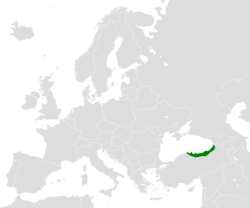
Pontus or Pontos (/ˈpɒntəs/; Greek: Πόντος, romanized: Póntos, lit. 'sea',) is a region within Anatolia on the southern coast of the Black Sea, located in the modern-day eastern Black Sea region of Turkey, in West Asia. The name was applied to the coastal region and its mountainous hinterland (rising to the Pontic Alps in the east) by the Greeks who colonized the area in the Archaic period and derived from the Greek name of the Black Sea: Εύξεινος Πόντος (Eúxinos Póntos), 'Hospitable Sea', or simply Pontos (ὁ Πόντος) as early as the Aeschylean Persians (472 BC) and Herodotus' Histories (c. 440 BC).
Having originally no specific name, the region east of the river Halys was spoken of as the country Ἐν Πόντῳ (En Póntō), lit. 'on the [Euxinos] Pontos', and hence it acquired the name of Pontus, which is first found in Xenophon's Anabasis (c. 370 BC). The extent of the region varied through the ages but generally extended from the borders of Colchis (modern western Georgia) until well into Paphlagonia in the west, with varying amounts of hinterland. Several states and provinces bearing the name of Pontus or variants thereof were established in the region in the Hellenistic, Roman and Byzantine periods, culminating in the late Byzantine Empire of Trebizond. Pontus is sometimes considered as the original home of the Amazons, in ancient Greek mythology and historiography (e.g. by Herodotus and Strabo).
Pontus remained outside the reach of the Bronze Age empires, of which the closest was Great Hatti. The region went further uncontrolled by Hatti's eastern neighbors, like Azzi and (or) Hayasa. In those days, the best any outsider could hope from this region was temporary alliance with a local strongman. The Hittites called the unorganized groups on their northeastern frontier the Kaška. As of 2004 little had been found of them archaeologically.
In the wake of the Hittite empire's collapse, the Assyrian court noted that the "Kašku" had overrun its territory in conjunction with a hitherto unknown group whom they labeled the Muški. Iron Age visitors to the region, mostly Greek, noted that the hinterlands remained disunited, and they recorded the names of tribes: Moskhians (often associated with those Muški), Leucosyri, Mares, Makrones, Mossynoikoi, Tibarenoi, Tzans and Chalybes or Chaldoi.
The Greeks, Indo-European tongue, settled along the coast. The Greeks are the earliest long-term inhabitants of the region from whom written records survive. During the late 8th century BC, Pontus further became a base for the Cimmerians, another Indo-European speaking people; however, these were defeated by the Lydians, and became a distant memory after the campaigns of Alyattes.
Since there was so little literacy in northeastern Anatolia until the Persian and Hellenistic era, one can only speculate as to the other languages spoken here. Given that Kartvelian languages remain spoken to the east of Pontus, some are suspected to have been spoken in eastern Pontus during the Iron Age: the Tzans are usually associated with today's Laz.
The first travels of Greek merchants and adventurers to the Pontus region occurred probably from around 1000 BC, whereas their settlements would become steady and solidified cities only by the 8th and 7th centuries BC as archaeological findings document. This fits in well with a foundation date of 731 BC as reported by Eusebius of Caesarea for Sinope, perhaps the most ancient of the Greek colonies in what was later to be called Pontus. The epical narratives related to the travels of Jason and the Argonauts to Colchis, the tales of Heracles' navigating the Black Sea, and Odysseus' wanderings into the land of the Cimmerians, as well as the myth of Zeus constraining Prometheus to the Caucasus mountains as a punishment for his outwitting the Gods, can all be seen as reflections of early contacts between early Greek colonists and the local, probably Caucasian, peoples. The earliest known written description of Pontus, however, is that of Scylax of Korianda, who in the 7th century BC described Greek settlements in the area.
Pontus (region)
40°36′N 38°00′E / 40.6°N 38.0°E
Pontus or Pontos (/ˈpɒntəs/; Greek: Πόντος, romanized: Póntos, lit. 'sea',) is a region within Anatolia on the southern coast of the Black Sea, located in the modern-day eastern Black Sea region of Turkey, in West Asia. The name was applied to the coastal region and its mountainous hinterland (rising to the Pontic Alps in the east) by the Greeks who colonized the area in the Archaic period and derived from the Greek name of the Black Sea: Εύξεινος Πόντος (Eúxinos Póntos), 'Hospitable Sea', or simply Pontos (ὁ Πόντος) as early as the Aeschylean Persians (472 BC) and Herodotus' Histories (c. 440 BC).
Having originally no specific name, the region east of the river Halys was spoken of as the country Ἐν Πόντῳ (En Póntō), lit. 'on the [Euxinos] Pontos', and hence it acquired the name of Pontus, which is first found in Xenophon's Anabasis (c. 370 BC). The extent of the region varied through the ages but generally extended from the borders of Colchis (modern western Georgia) until well into Paphlagonia in the west, with varying amounts of hinterland. Several states and provinces bearing the name of Pontus or variants thereof were established in the region in the Hellenistic, Roman and Byzantine periods, culminating in the late Byzantine Empire of Trebizond. Pontus is sometimes considered as the original home of the Amazons, in ancient Greek mythology and historiography (e.g. by Herodotus and Strabo).
Pontus remained outside the reach of the Bronze Age empires, of which the closest was Great Hatti. The region went further uncontrolled by Hatti's eastern neighbors, like Azzi and (or) Hayasa. In those days, the best any outsider could hope from this region was temporary alliance with a local strongman. The Hittites called the unorganized groups on their northeastern frontier the Kaška. As of 2004 little had been found of them archaeologically.
In the wake of the Hittite empire's collapse, the Assyrian court noted that the "Kašku" had overrun its territory in conjunction with a hitherto unknown group whom they labeled the Muški. Iron Age visitors to the region, mostly Greek, noted that the hinterlands remained disunited, and they recorded the names of tribes: Moskhians (often associated with those Muški), Leucosyri, Mares, Makrones, Mossynoikoi, Tibarenoi, Tzans and Chalybes or Chaldoi.
The Greeks, Indo-European tongue, settled along the coast. The Greeks are the earliest long-term inhabitants of the region from whom written records survive. During the late 8th century BC, Pontus further became a base for the Cimmerians, another Indo-European speaking people; however, these were defeated by the Lydians, and became a distant memory after the campaigns of Alyattes.
Since there was so little literacy in northeastern Anatolia until the Persian and Hellenistic era, one can only speculate as to the other languages spoken here. Given that Kartvelian languages remain spoken to the east of Pontus, some are suspected to have been spoken in eastern Pontus during the Iron Age: the Tzans are usually associated with today's Laz.
The first travels of Greek merchants and adventurers to the Pontus region occurred probably from around 1000 BC, whereas their settlements would become steady and solidified cities only by the 8th and 7th centuries BC as archaeological findings document. This fits in well with a foundation date of 731 BC as reported by Eusebius of Caesarea for Sinope, perhaps the most ancient of the Greek colonies in what was later to be called Pontus. The epical narratives related to the travels of Jason and the Argonauts to Colchis, the tales of Heracles' navigating the Black Sea, and Odysseus' wanderings into the land of the Cimmerians, as well as the myth of Zeus constraining Prometheus to the Caucasus mountains as a punishment for his outwitting the Gods, can all be seen as reflections of early contacts between early Greek colonists and the local, probably Caucasian, peoples. The earliest known written description of Pontus, however, is that of Scylax of Korianda, who in the 7th century BC described Greek settlements in the area.
Recent media
Recent media