Hubbry Logo
Henry Chapman MercerHenry Chapman MercerMain
Open search
Henry Chapman Mercer
Community hub
Henry Chapman Mercer
logo
8 pages, 0 posts
0 subscribers
Be the first to start a discussion here.
Henry Chapman Mercer
from Wikipedia

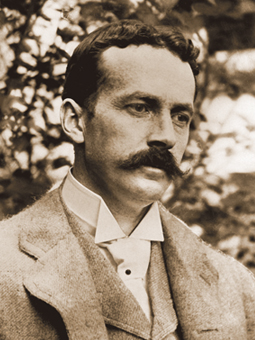
Henry Chapman Mercer (June 24, 1856 – March 9, 1930)[1] was an American archeologist, artifact collector, tile-maker, and designer of three distinctive poured concrete structures: Fonthill, his home; the Moravian Pottery and Tile Works; and the Mercer Museum.

Key Information

Biography

[edit]
The Mercer Museum in Doylestown, Pennsylvania
Fonthill Castle

Henry Mercer was born in Doylestown, Pennsylvania on June 24, 1856. Mercer first traveled to Europe in 1870. He attended Harvard University between 1875 and 1879, obtaining a liberal arts degree. Mercer went on to study law at the University of Pennsylvania Law School between 1880 and 1881, and he read law with the firm of Freedley and Hollingsworth. The same year he began studying at the University of Pennsylvania, he became a founding member of the Bucks County Historical Society.[2][3]

Mercer, however, never practiced law;[2] he was admitted to the Philadelphia County Bar on November 9, 1881, but departed for Europe the same month.[4] From 1881 to 1889, he traveled extensively through France and Germany.[3]

The University of Pennsylvania Museum appointed Mercer as the Curator of American and Prehistoric Archaeology in the early 1890s. He was elected to the American Philosophical Society in 1895.[5] Leaving his position with the Museum in the late 1890s, Mercer devoted himself to finding old American artifacts and learning about German pottery. Mercer believed that American society was being destroyed by industrialism, which inspired his search for American artifacts. Mercer founded Moravian Pottery and Tile Works in 1898 after apprenticing himself to a Pennsylvania German potter. He was also influenced by the American Arts and Crafts Movement.

Mercer is well known for his research and books about ancient tool making, his ceramic tile creations, and his engineering and architecture. He was among the paleontologists who investigated Port Kennedy Bone Cave. He wrote extensively on his interests, which included archaeology, early tool making, German stove plates, and ceramics. He also published a collection of tales of the supernatural, November Night Tales in 1928. He assembled the collection of early American tools now housed in the Mercer Museum. Mercer's tiles are used in the floor of the Pennsylvania State Capitol Building in Harrisburg, Pennsylvania and in many other noteworthy buildings and houses. In the Pennsylvania State Capitol, Mercer created a series of mosaic images for the floor of the building. The series of four hundred mosaics trace the history of the Commonwealth of Pennsylvania from prehistoric times, and is the largest single collection of Mercer's tiles. Other collections of tiles by Mercer can be found at Kykuit, the Rockefeller estate in Pocantico Hills, New York; Grauman's Chinese Theatre in Hollywood, California; the Casino at Monte Carlo in Monaco; the St. Louis Public Library; and the former Morton (Richmond) High School Building in Richmond, Indiana.

Besides making mosaics, Mercer also painted, drew, and wrote poetry. Sometimes, he blended these interests together, such as in the pastel painting October, which also showcases his fascination with rural life.[6]

Mercer was an outspoken opponent of the plume trade.[7]

Henry Ford stated that the Mercer museum was the only museum worth visiting in the United States, and the Mercer Museum was apparently Henry Ford's inspiration for his own museum, The Henry Ford, located in Dearborn, Michigan. The Mercer Museum houses over forty thousand artifacts from early American society. Mercer died on March 9, 1930, at Fonthill, the house he designed and constructed from reinforced concrete in 1908-1912.

The Bucks County Historical Society now owns Fonthill, which is open to the public, and the Mercer Museum. The Moravian Pottery and Tile Works is owned by the Bucks County Department of Parks & Recreation and operated as a working history museum by The TileWorks of Bucks County, a non-profit organization. These three buildings make up "the Mercer Mile". All three buildings were designed and constructed by Henry Mercer in the early part of the 20th century.

Publications

[edit]
  • The Lenape Stone, or the Indian and the Mammoth (1885)
  • The Hill-Caves of Yucatan (1895)
  • The Antiquity of Man in the Delaware Valley and the Eastern United States (1897)
  • Guidebook to the Tiled Pavement in the Pennsylvania State Capitol (1908)
  • The Bible in Iron (1914)
  • November Night Tales (1928)
  • Ancient Carpenters' Tools (1929)
[edit]

Notes

[edit]

References

[edit]
[edit]
Revisions and contributorsEdit on WikipediaRead on Wikipedia
from Grokipedia
Henry Chapman Mercer (1856–1930) was an American archaeologist, architect, tilemaker, antiquarian, and author renowned for his contributions to the Arts and Crafts movement, his innovative use of in , and his extensive collection of pre-industrial artifacts. Born on June 24, 1856, in , into a prominent family, Mercer was influenced early by his maternal grandfather, a and U.S. Congressman, and by travels with his mother and aunt that sparked his interest in and culture. He graduated from in 1879 with studies in , , and fine arts, followed by a law degree from the University of Pennsylvania in 1881, though he never practiced law, instead pursuing scholarly and creative endeavors. Mercer's early career centered on , where he excavated Native American sites in the Delaware Valley, Yucatan, , , and , and served as curator of American and prehistoric at the Museum from 1894 to . A founding member of the Bucks County Historical Society in 1880, he published influential works such as The Lenape Stone in 1885, analyzing a controversial artifact depicting humans and a , and later Tools of the Nationmaker in , showcasing his growing collection of early American tools. His passion for preserving vanishing crafts led him to amass over 50,000 pre-industrial artifacts, which he displayed in innovative exhibitions and eventually housed in his purpose-built Mercer Museum. As a leader in the Arts and Crafts movement, Mercer founded the in 1898 (operational from 1899), where he revived traditional handmade ceramic techniques to produce richly colored, narrative tiles depicting historical scenes, local life, and biblical motifs. These tiles adorned notable structures, including the in Harrisburg (1906) and his own designs, and he innovated production with a custom tile press to make artistic ceramics more accessible. Mercer's architectural legacy includes three landmark reinforced concrete buildings in Doylestown: his eccentric home, Fonthill Castle (constructed 1908–1912), featuring over 40 rooms, winding staircases, and extensive tilework; the adjacent Moravian Tile Works (1910–1912); and the encyclopedic Mercer Museum (1913–1916), a maze-like structure designed to display his artifact collection thematically by trade and craft. He also authored key books like The Bible in Iron (1914), documenting early American ironwork, and Ancient Carpenters' Tools (1929), reflecting his deep knowledge of historical craftsmanship. Mercer died on March 9, 1930, at Fonthill, leaving his properties to the Bucks County Historical Society, which now operates them as public museums preserving his vision of celebrating human ingenuity and handiwork. His multifaceted work continues to influence fields from ceramics and to historical preservation, earning him honorary degrees including a from Franklin and Marshall College in 1916 and a Doctor of Laws from in 1929.

Early Life and Education

Family Background and Childhood

Henry Chapman Mercer was born on June 24, 1856, in Doylestown, Pennsylvania, into a wealthy family with deep roots in early American history, including Quaker heritage through maternal ancestors. His father, William Robert Mercer, was a U.S. Navy officer from a middle-class Philadelphia background who later became a gentleman farmer after retiring to Doylestown, where he pursued interests in sailing and local agriculture. Mercer's mother, Mary Rebecca Chapman Mercer, came from a prominent Bucks County family; she was the daughter of Judge Henry Chapman, a Pennsylvania state senator and influential figure in local government, and she herself taught Sunday school while engaging in painting as a personal artistic pursuit. The family's heritage traced back through maternal ancestors, including connections to the renowned folk artist and preacher Edward Hicks, reinforcing a cultural emphasis on simplicity, community, and historical preservation. Raised primarily in his grandfather Judge Chapman's stately home in Doylestown—a hub of early American political and social life—Mercer experienced an upbringing steeped in the town's rich historical fabric. Travels with his mother and aunt further sparked his interest in history and culture. The Chapman-Mercer lineage linked to Philadelphia's elite society through judicial and mercantile ties, providing young Mercer with access to stories of colonial and Revolutionary-era figures that ignited his lifelong curiosity about the past. Doylestown's surroundings, dotted with Quaker meetinghouses and remnants of pre-industrial life, offered constant exposure to artifacts like tools, pottery, and farm implements, which Mercer later recalled as sparking his fascination with archaeology and traditional craftsmanship during family outings and local explorations. The family estate environment, characterized by collecting heirlooms and preserving Quaker-influenced artifacts, further nurtured Mercer's interests in history and , shaping his aversion to industrialization and his commitment to safeguarding everyday objects from the pre-machine age. His mother's artistic endeavors, including watercolor paintings of local scenes, introduced him to creative expression early on, complementing the intellectual discussions in a household connected to Bucks County's cultural elite. These formative years in Doylestown laid the groundwork for Mercer's diverse pursuits, leading him to pursue formal at in the 1870s.

Academic Training

Henry Chapman Mercer attended from 1875 to 1879, where he pursued a with a focus on , , and the fine arts. Although not a standout student, his coursework laid the groundwork for his later interests in historical and cultural artifacts. He graduated in 1879 with an A.B. degree, supported by his family's resources that enabled his academic pursuits. Following Harvard, Mercer enrolled at the University of Pennsylvania Law School from 1880 to 1881, reading law under a firm while preparing for the bar. He was admitted to the County Bar in November 1881 but never practiced, instead redirecting his energies toward after developing a keen interest in historical artifacts during this period. This shift was influenced by his early involvement with local historical societies, including co-founding the Bucks County Historical Society in 1880, where he first encountered Native American artifacts that sparked his passion for prehistoric studies. In the early , Mercer's growing expertise led to his appointment as Curator of American and Prehistoric at the Museum, a role he held from 1894 to 1897. This position marked his formal entry into professional archaeology, building directly on the foundations of his university training and early artifact explorations.

Archaeological and Anthropological Career

Early Excavations and Discoveries

Mercer's early archaeological pursuits began with his involvement in the controversy surrounding the Lenape Stone, a slate artifact discovered in , in 1872, which appeared to depict Native Americans hunting a . In 1885, he published a detailed defense of its authenticity in his book The Lenape Stone; or, The Indian and the Mammoth, arguing that the incised figures represented prehistoric knowledge of extinct , though the artifact was later widely regarded as a likely 19th-century . This work marked his entry into archaeological debate and highlighted his interest in linking Native American culture to paleontological evidence. In his 1885 publication, while defending the artifact's potential authenticity, he concluded that the evidence for its genuineness was inconclusive. Building on his academic training in law and natural history, Mercer conducted extensive fieldwork in the early 1890s across and the Northeast, surveying Native American sites along the lower , Lehigh, and Susquehanna Rivers. In 1891, he explored lower Delaware Valley locations, mapping potential habitation areas, while in 1892 he documented artifacts from riverine settlements, publishing his findings in The American Naturalist in 1895. His 1893 excavations included an argillite quarry at Gaddis Run near Neshaminy Creek in Bucks County, as well as caves such as Durham Cave and Hartman's Cave, yielding stone tools and evidence of prehistoric quarrying and shelter use. Additionally, he investigated burial sites, including an at Sandy Hill on the in in 1891–1892, which revealed human remains and indicative of Native American mortuary practices akin to mound-builder traditions. In 1894-1895, as part of the University of Pennsylvania's Corwith Expedition, Mercer explored hill-caves in , investigating for signs of early human occupation. A significant paleontological effort came from Mercer's excavations at the Port Kennedy Bone Cave near , from 1894 to 1896, where over 1,200 Pleistocene-era fossils were uncovered, including bones of extinct mammals like the and . These discoveries provided key insights into Ice Age fauna in the region and were documented in Mercer's 1899 article in the Journal of the Academy of Natural Sciences of Philadelphia. His growing reputation from these endeavors led to his election as a member of the in 1895, recognizing his contributions to and .

Contributions to Prehistoric Studies

Henry Chapman Mercer advocated for a greater antiquity of human presence in , challenging the prevailing timelines of the late that limited indigenous occupation to post-glacial periods. Through detailed artifact analysis, particularly from gravel deposits in the Delaware Valley, he argued that stone tools found in association with extinct indicated human activity dating back to the Pleistocene epoch, potentially tens of thousands of years earlier than commonly accepted. For instance, his examinations of gravel deposits and other sites in the Delaware Valley supported this view by linking human-modified stone tools to strata associated with extinct . As Curator of American and Prehistoric at the Museum from 1894 to 1897, Mercer played a key role in organizing and cataloging collections of prehistoric artifacts, including stone tools, , and other implements from North American indigenous cultures. In this position, he also managed the Department of and , overseeing exhibitions that highlighted the technological and cultural sophistication of prehistoric societies, such as displays of Eastern Woodlands and lithic artifacts at events like the 1893 . Mercer promoted interdisciplinary approaches to and through active involvement in scholarly societies and public lectures. He was a founding member of the Bucks County Historical Society in 1880 and served as its president from 1887, where he organized meetings that integrated archaeological findings with historical and ethnographic insights. Elected to the in 1895, he contributed to discussions blending , , and human . His lectures, such as those delivered before historical societies on artifact interpretation and , emphasized the value of combining fieldwork with comparative studies from global to better understand American . Mercer critically engaged with pseudoscientific claims in prehistoric studies, including a reevaluation of his own earlier work on the Stone. Initially defending the artifact's authenticity in 1885 as evidence of ancient Native American pictographic traditions depicting interactions with mammoths, he later concluded through further investigation that the evidence for its genuineness was inconclusive, highlighting the risks of uncritical acceptance in archaeological interpretation. This shift underscored his commitment to rigorous, evidence-based scholarship in countering unsubstantiated assertions about North American antiquity.

Architectural Innovations

Development of Concrete Construction Techniques

Henry Chapman Mercer, a self-taught architect without formal engineering training, began experimenting with reinforced concrete in the early 1900s, driven by his observations of European medieval structures during travels to sites like Haddon Hall in England and Genoa in Italy. These visits inspired him to adapt concrete for durable, fireproof buildings suited to local Bucks County needs, particularly to house and protect his growing collection of prehistoric and industrial-era artifacts from decay and fire risks prevalent in wooden structures. His initial trials involved small-scale batches of hand-mixed concrete, testing additives like cornstalks for porosity, though such experiments often failed due to debris contamination, leading him to refine simpler, more reliable formulations. Mercer's key innovation was the "poured-in-place" method, which allowed for organic, castle-like forms unattainable with traditional masonry. He constructed wooden molds from unplaned boards salvaged from demolished buildings, secured with wire loops and battens to create irregular walls up to two feet thick, poured in layers to form arches and vaults using earth mounds as temporary supports—a technique borrowed from his kiln-building experience. consisted of local junkyard materials, such as hollow iron pipes and galvanized farm fencing, embedded in a mix of one part , 2.5 parts yellow sand from , and five parts crushed from Rockhill Station, ensuring structural strength without reliance on industrial suppliers. This approach emphasized hand-crafted adaptability, aligning with Arts and Crafts principles that valued material plasticity over machine precision, much like working with clay in . During construction, Mercer overcame significant challenges related to material sourcing and structural integrity, often testing methods on-site without professional engineers. Local sourcing minimized costs but introduced inconsistencies, such as wind-induced bulging in forms and wall height variations of up to 12 inches, which he addressed through post-pour corrections and selective plastering to maintain aesthetic roughness. Skepticism from concrete experts was countered by his persistent supervision, averting major accidents despite harsh weather, and incorporating ventilation holes via collapsible wooden boxes to prevent issues—demonstrating 's pliability for experimental, non-rectilinear designs. were dug into ledges for stability, with ongoing tests revealing no significant or cracking beyond minor repairs. Philosophically, Mercer's embrace of concrete stemmed from a desire to create enduring enclosures that preserved the tactile evidence of pre-industrial life against the encroaching decay of time and . He viewed the material's fireproof and weather-resistant qualities as essential for safeguarding artifacts symbolizing America's craft heritage, rejecting industrialized building methods that alienated people from historical continuity. This rationale tied directly to his archaeological work, positioning not merely as a structural medium but as a force, with interiors later finished using his own tiles for seamless integration of form and decoration.

Major Buildings: Fonthill and Mercer Museum

Henry Chapman Mercer began construction on Fonthill Castle in 1908, completing it by 1912 as his personal residence in . At age 51, Mercer personally designed the structure without formal blueprints, using clay models and sketches to plan its 44 interconnected rooms, including five bedrooms, ten bathrooms, and eighteen fireplaces, creating a labyrinthine layout that served as both home and showcase for his archaeological artifacts. The castle's irregular towers and vaulted ceilings, built with poured , incorporated innovative on-site material mixing and hollow-wall techniques to enhance durability and aesthetics. Mercer oversaw the entire process, employing eight to ten unskilled laborers paid $1.75 per day under supervisor Patrick Trainor, ensuring hands-on management from foundation to finish over three summers. Adjacent to Fonthill, Mercer constructed the Moravian Tile Works building from 1910 to 1912 using similar reinforced concrete techniques, creating a functional space for his pottery and tile production that integrated his artistic and architectural visions. Following Fonthill, Mercer initiated the Mercer Museum in 1913, finishing construction in 1916 to permanently house his extensive collection of pre-industrial American tools and artifacts. Designed as a six-story concrete castle, the museum accommodated over 50,000 objects organized by trade—such as tinsmithing, dairying, and healing arts—in alcoves and galleries spiraling around a central atrium that displayed large items like stagecoaches and whale boats. Architectural elements included towering irregular forms up to 115 feet high, vaulted interiors, and strategic window placements for natural light integration, all crafted without detailed plans to reflect Mercer's organic design philosophy. He again directed the build personally, utilizing a small team of workmen to pour the reinforced concrete structure, adapting techniques from Fonthill to create a monumental repository for everyday history.

Tile Making and Artistic Works

Founding of Moravian Pottery and Tile Works

In 1898, Henry Chapman Mercer founded the in , as a deliberate effort to revive and preserve traditional pottery techniques amid the rise of industrial manufacturing. Inspired by the folk pottery traditions of the Moravian settlers and Pennsylvania Germans, as well as the ideals of the Arts and Crafts Movement, Mercer sought to counter the dehumanizing effects of by emphasizing handmade craftsmanship and historical authenticity. To prepare, he apprenticed himself to a local Bucks County redware potter, gaining practical knowledge of traditional methods before launching the enterprise. Mercer's early experiments focused on hand-pressed tiles made from local Bucks County clay, which he sourced to create durable, low-fired that captured the earthy tones and textures of historical . These initial efforts were driven by a mission to safeguard forms against the encroachment of industrialized goods, resulting in a small-scale operation that prioritized quality and artistic expression over high-volume output. By refining techniques such as mold-making and glazing, Mercer developed a production process that blended innovation with reverence for pre-industrial practices, ensuring the tiles' longevity and aesthetic appeal. The factory's layout evolved over time, but from its inception, it featured modest workshops designed for efficient handcrafting, later expanded into a structure completed between 1911 and 1912 to accommodate growing operations. Mercer assembled a dedicated of skilled artisans and laborers, many of whom he trained as apprentices in historical techniques, fostering a collaborative environment that emphasized manual skill and creative input. This hands-on approach allowed for personalized oversight, with Mercer directly involved in design and production to maintain the works' artisanal integrity. The initial products included pictorial tiles featuring biblical scenes, historical narratives, and folk motifs, which showcased Mercer's scholarly interest in storytelling through ceramics and were produced continuously until his death in 1930. These tiles not only served decorative purposes but also found application in Mercer's own architectural projects, such as Fonthill Castle.

Notable Commissions and Designs

One of Henry Chapman Mercer's most prominent commissions was the design and production of mosaic tiles for the floors of the in Harrisburg, undertaken between 1906 and 1910. He created approximately 400 pictorial tiles depicting 254 distinct scenes that chronicle the from prehistoric eras through the early , covering themes such as Native American life, European settlement, natural resources, industries, and technological advancements. These tiles, set into 16,000 square feet of red quarry flooring, include motifs like the representing Native American influences, spinning wheels and factories symbolizing industrial progress, and natural elements such as , bears, and , all rendered in a folk-art style that complements the building's marble interiors. Mercer's international reach extended to high-profile installations, including a fireplace and extensive tilework at the Casino de Monte-Carlo in , where his handcrafted pieces added decorative flair to the opulent interior. Similarly, at , the estate in , Mercer supplied tiles for various interior applications, blending his signature motifs with the estate's grandeur during its early 20th-century development. These works, produced at the , showcased Mercer's ability to adapt his designs for diverse architectural contexts while maintaining historical and thematic depth. In the 1920s, Mercer received commissions in Hollywood, most notably for the forecourt of , where his tiles contributed to the theater's exotic and thematic pavement design. Across his projects, Mercer's custom motifs frequently intertwined medieval European patterns—drawn from historical sources—with Native American and industrial symbols, creating a unique visual narrative that celebrated America's multifaceted heritage. This eclectic approach not only highlighted his artistic versatility but also embedded educational elements into functional spaces.

Publications

Major Books and Articles

Henry Chapman Mercer's first major publication was The Lenape Stone; or, The Indian and the Mammoth, issued in 1885 by in New York and . The book documents the discovery of an engraved argillite artifact found in 1872 near , featuring carvings interpreted as a figure pursuing a , and explores its potential implications for prehistoric presence in the region while addressing debates over its authenticity. In 1896, Mercer published The Hill-Caves of Yucatan: A Search for Evidence of Man's Antiquity, detailing his archaeological expeditions and findings in Mayan cave sites. Another early work, Tools of the Nation Maker: A Descriptive Catalogue of Objects in the Museum of the of Bucks , Penna., appeared in 1897, cataloging early American tools from his collection. Mercer's 1914 book, The Bible in Iron; or, Pictured Stoves and Stove Plates of the Pennsylvania Germans, examines cast-iron stove plates with biblical and folk motifs, highlighting Pennsylvania German craftsmanship. In his later career, Mercer produced November Night Tales in 1928, a limited-edition collection of six short stories published privately in . The volume includes tales such as "Castle Valley," "The North Ferry Bridge," "The Blackbirds," "The Fawn's Postern," "The Twilight of the Gods," and "The Well of Monte Corbo," drawing on and historical motifs. Mercer's final significant book, Ancient Carpenters' Tools: Together with the Implements of the Lumberman, Joiner and Cabinet Maker in Use in the Eighteenth Century, appeared in 1929 through the Bucks County Historical Society in . This illustrated work catalogs and explains over 400 pre-industrial tools from his collection, emphasizing their form, function, and historical context in colonial America. Beyond books, Mercer contributed numerous articles to scholarly journals, particularly on archaeological discoveries tied to his excavations in the and Susquehanna valleys. Examples include "Researches on the Aboriginal Remains of the Susquehanna Valley" in the Proceedings of the (1897) and "The Survival of the of Illuminative Writing Among Pennsylvania Germans" in the same journal (volume 36, 1897, pages 423–432).

Themes and Scholarly Impact

Mercer's writings frequently emphasized the evolution of tools as key indicators of cultural progress and human ingenuity, particularly in his seminal work Ancient Carpenters’ Tools (1929), where he cataloged and analyzed eighteenth-century implements to illustrate their role in shaping early American society. By tracing the development from rudimentary forms to more sophisticated designs, Mercer argued that these artifacts provided insight into the "vitality of the American beginning," highlighting how craftsmanship embodied broader societal advancement before industrialization disrupted traditional practices. This approach positioned tools not merely as functional objects but as historical narratives of progress, influencing subsequent studies in and . In November Night Tales (1928), Mercer blended archaeological knowledge with to make accessible and engaging, weaving elements into stories that drew on his interests to evoke the mysteries of ancient life. These narratives served to popularize historical and prehistoric themes, transforming dry facts into imaginative tales that underscored the enduring human connection to the past. Through this fusion, Mercer aimed to bridge scholarly rigor with popular appeal, encouraging readers to appreciate as a lens for understanding cultural origins. Throughout his publications, Mercer advocated strongly for the preservation of artifacts as a bulwark against the dehumanizing effects of and industrialization, which he viewed as eroding and traditional skills. In works like Tools of the Nation-Maker (), he lamented the loss of pre-industrial heritage and called for systematic collection and study to safeguard these items for future generations, directly shaping early twentieth-century practices focused on contextual display rather than mere curation. His emphasis on artifacts as vital links to influenced institutions dedicated to American history, promoting preservation as an active scholarly endeavor. Mercer's scholarly reception was mixed; while his books were pioneering and remain in print as foundational texts, contemporaries often criticized his romanticized portrayal of American antiquity, viewing his enthusiasm as overly idealistic and biased toward a narrative of cultural decline under . Despite initial dismissal by some academics, his ideas gained traction over time, redefining tools and in historical analysis and contributing to a relativist understanding of early American culture.

Personal Life and Legacy

Later Years and Death

Following the completion of the Mercer Museum in 1916, a six-story structure designed to house his extensive collection of pre-industrial tools and artifacts, Henry Chapman Mercer continued to oversee operations at the into the 1920s. The facility, established in 1912, maintained active production of decorative tiles inspired by Pennsylvania German folk art, with Mercer directing designs and output until the end of the decade. Throughout this period, he sustained his scholarly pursuits, including archaeological research and leadership in the Bucks County Historical Society. Mercer, who never married and had no children, devoted his life to his scholarly and creative pursuits. In the late 1920s, his health began to decline significantly due to chronic conditions, leading him to withdraw from public life and limit his involvement in daily operations at his institutions. By early 1930, suffering from and , his condition worsened rapidly. Mercer died on March 9, 1930, at his home, Fonthill Castle, in , at the age of 73. In the immediate aftermath, he had arranged for the Mercer Museum and an endowment to pass to the Bucks County Historical Society, ensuring its preservation as a public institution. Fonthill Castle and related properties were bequeathed to his longtime housekeeper, Laura M. Swain, and her husband, Frank, who managed the estate following his death.

Influence and Recognition

Henry Chapman Mercer's innovative approach to collecting and displaying pre-industrial artifacts profoundly influenced the development of open-air museums in the United States, most notably inspiring Henry Ford's creation of Greenfield Village in . Mercer's emphasis on preserving tangible elements of American craftsmanship and , as exemplified in his Mercer Museum, encouraged Ford to assemble relocated historic structures and tools to create immersive educational experiences for the public. The trio of Mercer's key sites—Fonthill Castle, the Mercer Museum, and the —collectively known as the "Mercer Mile," received designation as a District in 1985, recognizing their pioneering use of construction and their role in safeguarding American industrial heritage and Arts and Crafts artistry. This preservation effort, initiated in the 1970s and formalized in the 1980s, ensures the ongoing accessibility of these structures as exemplars of early 20th-century cultural conservation. In the , Mercer's Moravian tiles have experienced a significant revival within the Arts and Crafts movement, with reproductions and restorations integrating his designs into modern architectural projects. For instance, the TileWorks of Bucks County continues to produce reissues of original Moravian patterns using traditional methods, supplying tiles for contemporary building restorations and custom commissions that echo Mercer's folk-inspired motifs. At the in , conservation efforts since 2012 have meticulously restored Mercer's custom tile floors in galleries such as the Gothic Room, with a 2023 cleaning project revealing their vibrant original colors and underscoring their enduring aesthetic value. Recent exhibitions have further highlighted Mercer's multifaceted legacy, including the Mercer Museum's "Awaken" project from 2021 to 2023, which reimagined underutilized spaces with experimental displays of his artifacts to foster and reinterpret his vision of human ingenuity. In 2025, Bryn Mawr College's "History Underfoot" showcased Mercer's designs in the historic Old Library floors, drawing attention to his contributions to and preservation. Scholarly reevaluations in the have reaffirmed Mercer's archaeological work, particularly his cultural relativist perspective on pre-industrial tools and artifacts, positioning him as a foundational figure in American studies whose methods continue to inform contemporary historical interpretations.

References

Add your contribution
Related Hubs
User Avatar
No comments yet.