Hubbry Logo
Henry MethvinHenry MethvinMain
Open search
Henry Methvin
Community hub
Henry Methvin
logo
8 pages, 0 posts
0 subscribers
Be the first to start a discussion here.
Henry Methvin
Henry Methvin
from Wikipedia

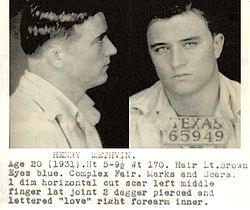
Henry Methvin (April 8, 1912 – April 19, 1948) was an American criminal, a bank robber, and a Depression-era outlaw. He is best remembered as the final member of Bonnie and Clyde's gang. His role in the gang has often been misattributed to teenage gang member W. D. Jones as both men were portrayed as composite character "C. W. Moss" in the film Bonnie and Clyde (1967).

Key Information

Biography

[edit]

Early life

[edit]

Henry Methvin was born in Louisiana on April 8, 1912, to Ivan "Ivy" T. Methvin and Avie Stephens.[1]

Barrow gang

[edit]

Methvin was serving a 10-year prison sentence at the Eastham prison farm in Huntsville, Texas when Bonnie and Clyde came to break out Raymond Hamilton on January 16, 1934. One guard was killed and another wounded in the prison break. In the confusion, Methvin and three other inmates took the opportunity to escape with Hamilton.[1] Though Hamilton initially ordered them to go back, Clyde welcomed the convicts and offered to let them join the gang. Though the three other opportunistic inmates chose to take their chances alone, Methvin accepted Clyde's offer to stay. He remained with the gang until their end four months later.[2]

About a month after the breakout, on February 19, Methvin joined Hamilton and Barrow in stealing guns and ammunition from a National Guard armory in Ranger, Texas, under the cover of darkness. Eight days later, the men used the weapons to steal $4,138 from a bank in Lancaster. Bonnie and Clyde agreed to drive Methvin to visit his father near Gibsland, Louisiana, on March 1. Methvin was present when, on April 1, the gang shot and killed Texas state troopers E. B. Wheeler and H. D. Murphy.[1]

Conflicting reports from relatives and alleged eyewitnesses have implicated each of the four gang members. Barrow was inconsistent about who he believed was the shooter. He wrote to relatives blaming Methvin, who he claimed had misunderstood Barrow's suggestion that they "take" the troopers, meaning to disarm and take them for a "joyride", and instead opened fire. In a later letter to authorities, Barrow named Hamilton as the killer.[2]

Regardless of Methvin's role, he was part of another of the gang's murders five days later. On April 6, their car became stuck in mud near Commerce, Oklahoma. While trying to get the car moving, they were surprised by two local officers out on patrol and fired at them. Constable Cal Campbell was killed, and Police Chief Percy Boyd was wounded. Boyd was taken hostage by the gang and later released at Mangle Corner, near Fort Scott, Kansas. The next day, while eating at a cafe in Stillwater, they abruptly left when a patrolman passed by. Methvin and the gang remained on the run for the next few months.[2]

On April 30, Methvin took part in a Kansas bank robbery with the Barrow gang, joined by Joe Palmer, and they escaped with $2,800. On May 1, the gang was identified in a bank robbery in Sac City, Iowa. Two days later they took $700 from a bank in Everly. They traveled south to meet relatives in Dallas on May 6, and another family meeting with Methvin's father in Louisiana. On May 19, Methvin was sent into a diner to get sandwiches for the gang. While he was at the counter, a police car passed the diner, and Clyde drove off, leaving Methvin behind. He hitchhiked to Ruston, where his parents were living at the time.[2]

According to most versions of the story, Methvin told his father that the gang had planned a spot for a rendezvous in the event that any of the gang were separated. Methvin was supposed to meet the gang on a deserted stretch of highway south of Arcadia. Ivan Methvin, then being harassed by lawmen in pursuit of his son and the rest of the gang, was alleged to have given this information to Louisiana sheriff Henderson Jordan, who then passed it on to Texas Ranger Frank Hamer. In exchange, Methvin was promised that his son would not get the death penalty for the murders of Troopers Wheeler and Murphy in Grapevine, Texas two months earlier. It is unclear whether Henry Methvin was aware of this arrangement.[2]

On May 23, 1934, Ivan Methvin parked his truck near the meeting spot and removed one of the wheels as if changing a flat tire. When Bonnie and Clyde stopped to assist Methvin, Hamer gave the signal and his six-man posse fired, killing both of them. An alternate scenario in the 1990s, supposedly suppressed for over 60 years, claimed that Ivan Methvin had been forced to go along with the ambush. He was stopped by lawmen on the highway and tied to a tree while his truck was parked on the road so that Bonnie and Clyde would slow and be looking in the wrong direction when the ambush was sprung. Afterwards Hamer reassured Ivan Methvin that Henry had not been present or killed, and made a deal with him that Henry would not be charged for the Grapevine killings in exchange for Ivan Methvin saying nothing about unlawful confinement.[2]

Although Henry Methvin avoided legal culpability for the Grapevine murders, his arrangement did not preclude prosecution for the Oklahoma murder of Constable Campbell. While he was locked up in the county jail, he and another prisoner tried to escape by overpowering the jailer. Their plan was to rush the jailer and the other prisoner would stab the jailer to death with a large pocket knife they had concealed in their cell. The jailer, a Seneca Cayuga Native American man by the name of Tom Armstrong, overpowered Methvin and the escape was foiled. Another inmate helped the jailer by securing the other prisoner until Armstrong was able to detain Methvin.[1][2]

Methvin spent the rest of his pre-trial time in the hole. He was found guilty of Constable Campbell's murder and sentenced to death on December 20, 1935. His sentence was commuted to life imprisonment on September 18, 1936. He was paroled on March 20, 1942. Methvin continued to remain in trouble with the law. In November 1945, he was jailed for fighting and carrying a shotgun. Eleven months later he was arrested for attempted robbery and drunk driving near Shreveport, Louisiana.[1][2]

Death

[edit]

On April 19, 1948, Methvin was intoxicated while attempting to cross a railroad track and was killed by an oncoming train. Although it has been speculated that his death was retribution for the deaths of Bonnie and Clyde, especially after the similar death of his father Ivan 16 months earlier, no evidence of foul play has ever been produced.[1][2]

[edit]

Television

[edit]

References

[edit]
[edit]
Revisions and contributorsEdit on WikipediaRead on Wikipedia
from Grokipedia
Henry Methvin (April 8, 1912 – April 19, 1948) was an American criminal and outlaw during the era, best known as the final member of the led by Bonnie Parker and Clyde Barrow. He joined the gang under duress after a and participated in several robberies and murders before betraying Parker and Barrow by informing authorities of their location, which enabled a ambush that killed the pair on May 23, 1934, near Sailes, . Born in to Ivy Terrell Methvin and Avie "Eva" Stephens, Methvin grew up in a rural and worked on their farm before turning to crime in his late teens. In 1930, at age 18, he was convicted in of assault with intent to murder after slashing the throat of a man named Charles Hughes during a dispute, receiving a 12-year sentence. He served his time at the Eastham State in , where harsh conditions fueled resentment among inmates, including plans for escapes. On January 16, 1934, Methvin was one of five inmates who escaped Eastham Prison Farm in a raid orchestrated by Clyde Barrow, who fired on guards to create a diversion and free associates like and Hilton Bybee. Barrow then coerced the 21-year-old Methvin into joining the , threatening death if he refused or attempted to flee. Over the next four months, Methvin traveled with the gang across , , and , participating in armed robberies of stores and filling stations, as well as the April 6, 1934, murder of Commerce, Oklahoma, constable Cal Campbell during an attempted arrest. Though Methvin claimed he did not fire the fatal shots—attributing them to Barrow—he admitted to aiding the crime under gang coercion. As federal and state lawmen intensified their pursuit, Methvin and his father, Ivy, negotiated a deal with authorities in late April 1934 to trade information on the gang's movements for leniency on Methvin's outstanding charges. Ivy placed a prearranged obstacle on a rural road to signal the ambush site, leading to the shootout that ended Parker and Barrow's lives; Methvin was absent but had provided key details on their route. In exchange, Texas Governor Miriam A. Ferguson granted Methvin a full pardon on August 14, 1934, clearing his prior escape and other state offenses. However, Oklahoma authorities charged him with Campbell's murder; tried in September 1935, Methvin was convicted and initially sentenced to death, but the sentence was commuted to life imprisonment on appeal due to his testimony and youth. Methvin served about eight years at the in McAlester before his parole in 1942. He returned to but struggled to stay out of trouble, facing arrests in 1946 for car theft and driving while intoxicated. On April 19, 1948, at age 36, Methvin died in , after being struck by a Southern Pacific while attempting to crawl underneath it, reportedly while intoxicated. He was buried in Social Springs Cemetery in Red River Parish.

Early Life

Family Background

Henry Methvin was born on April 8, 1912, in rural , to parents Ivy Terrell Methvin, a , and Avie Stephens Methvin. Ivy Methvin, born in 1885, supported the family through agricultural work in the state's rural areas, reflecting the agrarian economy prevalent in early 20th-century . The Methvins raised Henry in a modest working-class household marked by financial constraints, common among farming families in the region during the . He was one of at least three siblings, including older brother Terrell W. Methvin (born 1910) and younger brother Cecil F. Methvin (born 1915), in a family that navigated the challenges of limited resources and manual labor. The family's early residence was in , where they depended on farming for sustenance amid the area's sandy soils and seasonal uncertainties. The onset of the in 1929 exacerbated the Methvins' economic struggles, intensifying the instability already inherent in rural agricultural life. Like many families in Depression-era , the Methvins faced heightened financial pressures, including potential disruptions to farming income and the need for supplemental manual labor to maintain household stability. This environment of hardship shaped the early family dynamics, with Ivy later transitioning to work as a to adapt to changing economic conditions.

Initial Criminal Record

Henry Methvin's initial encounter with the law occurred in 1930, at age 18, when he was arrested in , for assaulting oil field worker Charles Hughes by slashing his throat during a dispute and possessing Hughes's stolen automobile. These offenses stemmed from the that plagued his family as sharecroppers in rural . Convicted of assault with intent to murder and auto theft, Methvin was sentenced to a twelve-year term at the Eastham in , where he began serving time in late 1930. Eastham, notorious as the "Hell on the Brazos," subjected inmates to brutal forced labor in cotton fields under armed guards, with frequent whippings and dangerous working conditions that often led to injury or death. These harsh realities fostered deep resentment among prisoners like Methvin toward the Texas penal system. Methvin remained incarcerated at Eastham until his escape on , 1934, an event that ultimately connected him to the .

Association with the Barrow Gang

Recruitment and Entry

On , 1934, Clyde Barrow led the in a bold raid on the Eastham in Waldo, Texas, where he and accomplices including Parker and Floyd Hamilton used machine guns and shotguns to overpower guards and free several inmates. Among those liberated were , serving 266 years for auto theft, , and ; Joe Palmer, with a 25-year sentence for ; Henry Methvin, who had been imprisoned there since 1930 on a 12-year term for with intent to ; and Hilton Bybee. The resulted in the death of one guard, Major Joe Crowson, and allowed the escapees to flee in stolen vehicles amid covering fire from Barrow; five inmates escaped in total. Following his escape, Methvin was coerced into joining the under duress, with Barrow threatening death if he refused or attempted to flee; he traveled with them from late January 1934 as a . This was influenced in part by the shared animosity toward the notoriously brutal conditions at Eastham, where like Methvin had endured harsh treatment, including beatings and forced labor, fueling a desire for retribution against the system that Barrow himself had vowed to target. In his initial months with the gang, Methvin took on roles as a driver and lookout, contributing to their mobility across and while building trust through the common experience of the daring breakout. He integrated into the group's dynamics, meeting key members such as Clyde Barrow, the strategic leader; Bonnie Parker, his constant companion; and , a longtime associate handling logistics and enforcement. This period marked Methvin's full entry into the outlaw collective, solidifying his position amid their nomadic and high-risk lifestyle.

Participation in Robberies and Murders

Methvin's involvement with the began shortly after his escape from Eastham Prison Farm on , 1934, and he quickly became an active participant in the group's escalating criminal operations under Clyde Barrow's , often under . From February to May 1934, Methvin contributed to a series of robberies and violent acts that highlighted the gang's shift toward more aggressive tactics, including vehicle thefts to facilitate quick escapes and the use of safe houses for evasion. The violence intensified on April 1, 1934, near , when Barrow and Bonnie Parker ambushed two officers, H.D. Murphy and Edward Bryant Wheeler, killing both in a roadside attack; some disputed accounts claim Methvin was present and fired several shots from an automatic weapon, contributing to the officers' deaths. Just five days later, on April 6, 1934, near , Methvin participated under duress in the killing of Constable William "Cal" Campbell, who approached the gang's disabled Ford V8 sedan along with Percy Boyd; as the officers neared, the car backed into a ditch, and while Methvin, armed with a , assisted in the shooting and disarming of the wounded Boyd, he claimed he did not fire the fatal shots from a automatic rifle that mortally wounded Campbell, attributing them to Barrow. Methvin was later convicted in for this murder as an aider and abettor, receiving a life sentence in after an initial death penalty. Amid these incidents, Methvin's participation extended to minor crimes such as stealing cars for the gang's mobility and scouting locations for temporary safe houses, underscoring his integration into the group's increasingly lethal routine.

Role in the Downfall of

Family Involvement in the Betrayal

In late April 1934, Ivy Methvin, father of member Henry Methvin, contacted authorities through an intermediary to offer assistance in luring Parker, Clyde Barrow, and the gang into an in exchange for immunity and legal protection for his son and family. This outreach came amid escalating pressure on the gang following Henry's participation in violent crimes, including the April 6, 1934, murder of Cal Campbell during a confrontation near . Ivy's motivations stemmed primarily from deep concern for Henry's safety, as the intensifying nationwide manhunt—bolstered by federal involvement and substantial rewards—placed the young gang member at ever-greater risk of capture or without intervention. Additionally, Ivy sought to secure reduced charges and potential pardons for Henry, who faced severe penalties for multiple offenses across state lines, including murders in and . The specific arrangement negotiated with law enforcement required Ivy to position his wood-hauling truck along Highway 154 near Sailes in Bienville Parish as a visual signal marking the , with the truck's front wheel removed to simulate a breakdown and draw the gang to a stop. This plan was orchestrated by Bienville Parish Sheriff Henderson Jordan in coordination with Texas Rangers, including and Bob Alcorn, who promised Ivy a full for Henry on charges—such as the Grapevine officers' murders—along with reward shares totaling up to $2,000 from federal and state bounties.

The Ambush Event

On May 23, 1934, a posse of six officers from and set up an ambush along Louisiana State Highway 154, south of Gibsland in Bienville Parish, near the community of Sailes. The officers, including retired Texas Ranger , B.M. "Manny" Gault, , Bob Alcorn, Henderson Jordan, and Prentiss Oakley, concealed themselves in the underbrush on either side of the rural road, armed with high-powered rifles such as semi-automatics and Model 12 shotguns. Their position provided a clear for several hundred yards, allowing them to wait undetected from before dawn until mid-morning. As arranged in prior negotiations with the Methvin family, Ivy Methvin positioned his truck across a side road near the site to serve as a signal for the approaching vehicle. Henry Methvin had parted company with Parker and Barrow two days earlier, on May 21, , in , and was not present at the . Around 9:15 a.m., Clyde Barrow drove a gray Ford V8 sedan containing himself and Parker toward the location. Upon spotting Ivy Methvin's truck blocking the road, the pair slowed, allowing the officers to open fire. The lawmen unleashed a barrage exceeding 100 rounds in less than two minutes, riddling the Ford with bullets and killing Barrow, aged 27, and Parker, aged 23, almost instantly; Barrow was struck at least 17 times, while Parker sustained around 26 wounds. Methvin, who had provided key details on the gang's movements, escaped involvement in the by virtue of his earlier separation. In the immediate aftermath, the officers approached the smoking wreckage to confirm the deaths, finding the couple slumped in the front seat amid a cache of weapons and ammunition. This marked the violent end of the Barrow Gang's reign.

Post-Gang Life and Imprisonment

Capture and Trial

Following the ambush that killed Bonnie Parker and Clyde Barrow on May 23, 1934, Henry Methvin escaped but was soon captured by authorities. His family had previously negotiated with law enforcement for leniency toward him in exchange for information leading to the gang's downfall, a deal that reportedly included promises from officials not to seek the death penalty if he cooperated. Methvin surrendered to Oklahoma authorities in July 1934 near , and was extradited to face charges in connection with his crimes during his time with the . Methvin's primary charge was the of Cal Campbell on April 6, 1934, near , where he was accused of Clyde Barrow in the shooting. The case was tried in the District Court of . The first trial in March 1935 ended in a mistrial after the failed to reach a . A second trial commenced later that year, resulting in Methvin's conviction for on September 20, 1935. On October 2, 1935, he was sentenced to death by . Methvin appealed his conviction to the Oklahoma Court of Criminal Appeals, arguing and by the , among other grounds. On September 18, 1936, the court affirmed the conviction but exercised its revisory under state law to modify the death sentence to at in the state penitentiary. The court affirmed the conviction but modified the death sentence to under its revisory , citing Methvin's youth (age 22 at the time of the crime), the fact that he was coerced into joining the gang, and that the evidence did not warrant .

Prison Sentence and Parole

Following his conviction, Henry Methvin entered the on October 2, 1935, to serve an initial death sentence for the murder of Constable Cal Campbell. His sentence was commuted to on September 18, 1936, after an appeal to the Oklahoma Court of Criminal Appeals. Methvin's time in prison passed without notable disciplinary incidents, during which he participated in standard inmate labor assignments typical of the facility. His cooperation in testifying about his involvement with the during his 1935 trial contributed to considerations for his eventual release, alongside credits for good behavior. On March 20, 1942, Governor Leon C. Phillips granted Methvin after he had served approximately seven years of his life sentence. The parole included standard conditions, such as refraining from criminal activity and regular reporting to authorities, as part of a broader release of several life-term inmates. After his release, Methvin relocated to , settling with his family in areas including and near . He attempted to lead a low-profile life, though he faced further legal troubles. In 1946, Methvin was arrested in , for car theft and driving while intoxicated.

Death and Legacy

Circumstances of Death

Henry Methvin died on April 19, 1948, at the age of 36, in Sulphur, , after being struck by a Southern Pacific while on or near the railroad tracks. At the time of the incident, Methvin was intoxicated and attempted to cross the tracks by crawling under a stationary Southern Pacific as it began to move, resulting in him being crushed; he may have been asleep or severely disoriented from alcohol consumption. A officially ruled the death accidental, attributing it to Methvin's impatience in waiting for the train to pass completely. However, some accounts and reports have suggested possible foul play, including a beating that may have left him incapacitated on the tracks prior to the train's arrival, potentially motivated by for his role in the Barrow Gang's downfall, though no concrete evidence or arrests ever materialized. Methvin was buried in Social Springs Cemetery in Hall Summit, Red River Parish, Louisiana, following a local service. His father, Ivy Methvin, had consistently worked to shield the family legacy by portraying Henry as minimally involved in the gang's violent activities, a stance that the family maintained in the years following Ivy's own death in 1946.

Depictions in Media and Historical Impact

Henry Methvin's role in the Barrow Gang has been depicted in popular media primarily through composite characters that blend his traits with other members, emphasizing his youth, impulsiveness, and eventual betrayal. In the seminal 1967 film Bonnie and Clyde, directed by Arthur Penn, Methvin served as one of the inspirations for the character C.W. Moss, portrayed by Michael J. Pollard, who is shown as a naive, stuttering mechanic whose family aids in the gang's downfall by cooperating with law enforcement. This portrayal highlights Methvin's real-life betrayal, where his father Ivy negotiated immunity in exchange for information leading to the 1934 ambush of Bonnie Parker and Clyde Barrow, underscoring themes of fractured loyalty within the gang. Beyond the film, Methvin receives minor but detailed mentions in historical accounts of the Barrow Gang, such as Jeff Guinn's 2009 book Go Down Together: The True, Untold Story of Bonnie and Clyde, which examines his recruitment, participation in robberies, and the informant deal that ended the gang's reign, portraying him as a desperate young man driven by family pressures during the Great Depression. In television, Methvin appears more directly in the 2013 A&E miniseries Bonnie & Clyde, where actor Garrett Kruithof plays him as a volatile accomplice whose father's reluctant involvement sets up the fatal ambush, though the series focuses broadly on the gang's exploits rather than Methvin's individual arc. The Methvin family's betrayal is also depicted in the 2019 film The Highwaymen, which centers on the lawmen who ambushed Bonnie and Clyde. Episodic references to Methvin occur in documentaries and true-crime series, but no major standalone TV adaptations center on his story. Historically, Methvin symbolizes the precarious limits of loyalty in Depression-era outlaw gangs, where economic desperation and aggressive tactics eroded even close-knit criminal alliances. His case exemplified early informant deals, as Texas Rangers and federal agents offered his family to secure his location, a strategy that pressured the into vulnerability and marked a shift toward coordinated pursuits of public enemies during crime wave. This betrayal highlighted the era's blend of familial bonds and survival instincts, influencing perceptions of outlaws as both romantic rebels and inevitable victims of systemic crackdowns. Scholarly analysis of Methvin remains limited, particularly regarding his post-parole life after release in 1942, with most works prioritizing the Barrow Gang's dramatic end over his subsequent obscurity as a farm laborer and minor offender. Some later accounts have suggested unverified alternative narratives to the —such as Ivy Methvin being coerced rather than willingly complicit—but these lack corroboration from primary records and have not significantly altered mainstream .

References

Add your contribution
Related Hubs
User Avatar
No comments yet.