Hubbry Logo
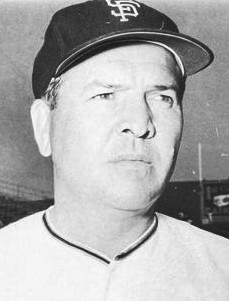
Herman FranksHerman FranksMain
Open search
Herman Franks
Community hub
Herman Franks
logo
8 pages, 0 posts
0 subscribers
Be the first to start a discussion here.
Herman Franks
Herman Franks
from Wikipedia

Herman Louis Franks (January 4, 1914 – March 30, 2009)[1][2] was an American catcher, coach, manager, general manager and scout in Major League Baseball. He was born in Price, Utah, to Italian-American immigrant parents[3] and attended the University of Utah.

Key Information

Playing career

[edit]

A left-handed hitter who threw right-handed, Franks was listed at 5 feet 10 inches (1.78 m) tall and 187 pounds (85 kg). He broke into professional baseball with the Hollywood Stars of the Pacific Coast League in 1932. Three years later, he was acquired by the St. Louis Cardinals and joined their vast farm system.

He made the Cardinals for just 17 games and 17 at-bats in 1939, before being drafted by the Brooklyn Dodgers, where he served as a second-string catcher in 1940–41 and began his long association with Leo Durocher, then Brooklyn's manager. As a Dodger, Franks caught Tex Carleton's no-hitter on April 30, 1940.[4]

Franks missed 3+12 seasons during World War II, when he served in the United States Navy in the Pacific Theater of Operations and attained the rank of lieutenant (junior grade).[5] He resumed his playing career in 1946 with the Triple-A Montreal Royals, then became the playing manager of the Dodgers' St. Paul Saints affiliate in the Triple-A American Association in 1947. In August of that season, however, he resigned his post to return to the Major Leagues as a backup catcher with the Philadelphia Athletics, where he appeared in 48 games in 1947–48 and batted .221.

Coaching career

[edit]

In 1949, Franks received his first coaching assignment, as an aide to Durocher with the New York Giants, and was activated for one final MLB game on August 28, 1949—going 2-for-3 against the Cincinnati Reds in a 4–2 New York triumph.[6]

As a coach with the Giants from 1949 to 1955, he was a member of two National League championship clubs (1951, 1954) and was the third-base coach of the World Series (1954) title team. However, he performed multiple tasks for Durocher during those seven seasons. According to author Joshua Prager in his 2006 book The Echoing Green, Franks played a critical role in the Giants' Bobby Thomson's famous pennant-winning home run in the 1951 NL tiebreaker playoffsBaseball's Shot Heard Round The World. According to Prager, Franks was stationed in the Giants' center-field clubhouse at the Polo Grounds, their home field, stealing the opposing catcher's signs through a telescope and relaying them through second-string catcher Sal Yvars (positioned in the bullpen) to the Giants' coaches and hitters.[7] When asked where he was when Thomson hit his home run, Franks said, in 1996, that he was "doing something for Durocher" at the time.[7]

Whatever his role may have been on that day, Franks was known as a devotee of Durocher-style, win-at-any-cost baseball, including intimidation through flying spikes and brushback pitching. Dodger outfielder Carl Furillo told author Roger Kahn that Franks was known to poke his head into the Brooklyn clubhouse before games, to taunt Furillo that Giant pitchers were planning to throw at his head in the upcoming contest.[8] Furillo, whose hatred for Durocher was so intense that he would engage Durocher in a fistfight in a Giant dugout filled with enemy players,[8] said of the Giants, in Peter Golenbock's book Bums: An Oral History of the Brooklyn Dodgers, "They were dirty ballplayers ... They all wanted to be like Durocher, to copy Durocher. That Herman Franks, he was another one."[9]

Managing career

[edit]
Herman Franks, Cubs manager, 1977

Durocher quit the Giants after the 1955 season, and the team relocated to San Francisco after 1957. From 1956 to 1964, Franks was briefly a Giants' scout, then the general manager of the PCL Salt Lake City Bees. He also spent two additional one-year terms (in 1958 and 1964) as a San Francisco Giants coach before succeeding Alvin Dark as the club's manager a half‐hour after the conclusion of the 1964 season on October 4.[10]

Even though the team featured future Hall of Famers Willie Mays, Orlando Cepeda, Willie McCovey, Juan Marichal and Gaylord Perry, Franks's four seasons (1965–68) managing the Giants each produced frustrating second-place finishes in the National League. The club lost close pennant races to the Los Angeles Dodgers by two games in 1965 and 1+12 games in 1966. It finished farther behind the Cardinals the next two years, 10+12 lengths out in 1967 and nine back in 1968. After he stepped down as skipper following the conclusion of the 1968 season, he was quoted as saying, "Is finishing second so evil?" He was replaced by Clyde King.[11]

A highly successful businessman off the field, Franks spent the next eight years out of the Major League spotlight, apart from a partial season (August and September 1970) as a pitching coach under Durocher with the Chicago Cubs. Franks returned to the major leagues as newly appointed Cubs general manager Bob Kennedy's first and only choice to replace Jim Marshall as manager on November 24, 1976.[12] In 1977, he led the Cubs back to the .500 level, but the team lost ground in 1978 and was just one game above the break-even mark in September 1979 when Franks resigned (issuing a number of complaints about certain players).[13] He succeeded Kennedy as the Cubs' interim general manager on May 22, 1981.[14] However, most of his tenure was taken up by the 1981 players' strike. He was replaced by Dallas Green just under five months later on October 15 as part of the franchise ownership transition from William Wrigley III to Tribune Company.[15]

Although Franks compiled a poor record as a player (a batting average of .199 with three home runs and 43 RBI in 188 games over parts of six seasons), he notched a winning record as a manager: 605–521, .537.

References

[edit]

Bibliography

[edit]
[edit]
Revisions and contributorsEdit on WikipediaRead on Wikipedia
from Grokipedia
Herman Franks is an American former professional baseball catcher, coach, and manager best known for his managerial tenures with the San Francisco Giants from 1965 to 1968 and the Chicago Cubs from 1977 to 1979. Born on January 4, 1914, in Price, Utah, he played briefly in Major League Baseball as a left-handed batting catcher for the St. Louis Cardinals in 1939, the Brooklyn Dodgers from 1940 to 1941, and the Philadelphia Athletics from 1947 to 1948, before and after serving in the U.S. Navy during World War II. Franks enjoyed a long coaching career, most notably as a coach for the New York Giants under Leo Durocher from 1949 to 1955, where he contributed to National League pennants in 1951 and 1954 as well as the Giants' 1954 World Series championship over the Cleveland Indians. He later served as a coach for the San Francisco Giants in 1958 and 1964 before taking over as manager. During his four seasons managing the Giants, he compiled a 367–280 record and finished second in the National League each year despite strong teams featuring Hall of Famers such as Willie Mays, Juan Marichal, Willie McCovey, and Gaylord Perry. Franks resigned after the 1968 season when the team again fell short of a pennant and returned to managing with the Chicago Cubs from 1977 until mid-1979. Outside of baseball, he built a successful career in business in Salt Lake City, became a millionaire, and served as a financial adviser to players including Willie Mays, Willie McCovey, and Ernie Banks. He was inducted into the Utah Sports Hall of Fame in 1974 and died in Salt Lake City on March 30, 2009, at age 95.

Early life

Background and entry into baseball

Herman Louis Franks was born on January 4, 1914, in Price, Utah, to Celeste Franks, an Italian immigrant from northern Italy, and Edith Dozzi, who was of Italian descent and born in Colorado. He grew up in Utah and attended the University of Utah in Salt Lake City before pursuing a career in baseball. Franks entered professional baseball at age 18 when he signed his first contract with the Hollywood Stars of the Pacific Coast League in 1932. He appeared in a limited capacity that season, recording three hits in eight at-bats across four games, including a home run. After struggling in initial appearances with the Stars in 1932 and 1933, Franks impressed at a St. Louis Cardinals tryout camp in Houston during the spring of 1935 and was signed to the Cardinals organization. Standing 5 feet 10 inches (1.78 m) tall and weighing 187 pounds (85 kg), Franks batted left-handed and threw right-handed. This marked the beginning of his path through the minor leagues with the Cardinals system prior to his later major league debut.

Playing career

Professional and Major League playing (1932–1949)

Herman Franks began his professional baseball career in 1932 at age 18 with the Hollywood Stars of the Pacific Coast League, appearing in four games. He spent the next few years developing in the minors, including limited stints with the Hollywood Stars in 1933 and the Omaha Packers in 1934, before joining the St. Louis Cardinals organization in 1935 and receiving regular playing time with affiliates such as Jacksonville in the West Dixie League and Houston in the Texas League. His most productive minor league seasons came with the Sacramento Solons of the PCL in 1937 and 1938, where he caught over 200 games combined and batted .274 with nine home runs in 143 games during his standout 1938 campaign. Franks made his Major League debut with the St. Louis Cardinals on April 27, 1939, appearing in 17 games primarily as a late-inning defensive replacement and pinch hitter. The Brooklyn Dodgers purchased his contract in February 1940, and he went on to play 65 games that season, hitting his first home run as a Dodger in his initial at-bat on April 23 and catching Tex Carleton's no-hitter against the Cincinnati Reds on April 30. In 1941, Franks played 57 games for the pennant-winning Dodgers and appeared in Game 1 of the World Series, going 0-for-1 in his only plate appearance. His career was interrupted by World War II military service; Franks enlisted in the U.S. Navy in May 1942, served in the Pacific Theater, attained the rank of lieutenant (junior grade), and missed three and a half seasons before his discharge in January 1946. He returned to play for the Montreal Royals in 1946 and the St. Paul Saints in 1947 while also managing the latter club. Franks then appeared in eight games for the Philadelphia Athletics in late 1947 after his contract was sold, followed by 40 games with the Athletics in 1948. Franks' final Major League appearance came in one game with the New York Giants in 1949. Over his six-year MLB career spanning 188 games as a catcher and occasional pinch hitter, he compiled a .199 batting average, three home runs, 43 RBI, a .302 on-base percentage, .275 slugging percentage, and -0.1 WAR. After that last game, he transitioned to coaching roles.

Coaching career

Coaching with the New York Giants and other roles

After retiring from playing following the 1948 season, Herman Franks joined the New York Giants as a coach under manager Leo Durocher, serving continuously from 1949 through 1955. He worked primarily with young pitchers during this tenure. In 1951, Franks was allegedly involved in a sign-stealing operation from the center-field clubhouse at the Polo Grounds during the Giants' comeback pennant drive, though he consistently denied any involvement. He contributed to the Giants' National League pennant victories in 1951 and 1954, as well as their four-game sweep of the Cleveland Indians in the 1954 World Series. Franks transitioned to a scouting role with the Giants for the 1956 and 1957 seasons before returning briefly to coaching. He coached the relocated San Francisco Giants in 1958 and again in 1964. In 1970, Franks served as pitching coach for the Chicago Cubs for part of the season, once more under Durocher's management. Known as a close ally of Durocher, Franks maintained a long and fruitful working relationship with him across multiple teams.

Managerial career

San Francisco Giants (1965–1968)

Herman Franks managed the San Francisco Giants from 1965 to 1968, compiling a record of 367 wins, 280 losses, and 2 ties for a .567 winning percentage across 649 games. The Giants finished second in the National League each of those four seasons without winning a pennant or reaching the postseason. In 1965, Franks led the team to a 95–67–1 record, finishing 2 games behind the Dodgers. The following year, the Giants posted a 93–68 mark, ending 1½ games behind the Dodgers. In 1967, they went 91–71, trailing the Cardinals by 10½ games, and in 1968 the club finished 88–74–1, 9 games behind the Cardinals. Despite the consistent second-place finishes and the Giants owning the best overall record in Major League Baseball during those four years, Franks resigned after the 1968 season. Franks became associated with a notable quip amid the repeated runner-up finishes, asking "Is finishing second so evil?" upon stepping down in 1968. During his tenure, he was ejected from games a total of 6 times.

Chicago Cubs (1977–1979)

Herman Franks served as manager of the Chicago Cubs from 1977 to 1979, compiling an overall record of 238 wins and 241 losses for a .497 winning percentage across 479 games. The team achieved an 81–81 mark in 1977, finishing fourth in the National League East division. In 1978, the Cubs posted a 79–83 record and placed third in the division. During the 1979 season, Franks managed 155 games to a 78–77 record before his departure, with the team ultimately finishing fifth in the NL East. Franks was ejected a total of 10 times during his Cubs tenure, with 4 ejections in 1977, 3 in 1978, and 3 in 1979. The Cubs did not qualify for the postseason or win any pennants under his management. He resigned in September 1979 after publicly complaining about certain players.

Executive and scouting roles

Scouting, general management, and later baseball activities

After resigning as manager of the Chicago Cubs in 1979, Herman Franks returned to front-office roles in baseball. Earlier in his career, Franks served briefly as a scout for the New York Giants from 1956 to 1957. He subsequently acted as general manager and owner of the Salt Lake City Bees of the Pacific Coast League in the late 1950s and early 1960s. In 1961 he also briefly managed the Bees before stepping down to focus on his general manager duties. In 1981, Franks was appointed interim general manager of the Chicago Cubs on May 22, replacing Bob Kennedy amid a poor team start. He held the position until the end of the 1981 season, a tenure that overlapped with the 1981 Major League Baseball players' strike. Franks retired from baseball following the conclusion of his interim general manager role in 1981.

Controversies

Sign-stealing involvement and managerial reputation

Herman Franks played a central role in the New York Giants' sign-stealing operation during the 1951 season, as detailed in Joshua Prager's reporting. As a coach under manager Leo Durocher, Franks positioned himself in the center-field clubhouse at the Polo Grounds with a telescope to decode opposing catchers' signs, even when disguised with runners on base. He relayed the information via a buzzer system to the bullpen, where reserve catcher Sal Yvars typically signaled the incoming pitch to batters—remaining motionless for a fastball or tossing a ball in the air for a breaking pitch. This scheme reportedly began on July 20, 1951, during the Giants' comeback from a large deficit. Franks consistently refused to confirm or deny his involvement in the sign-stealing, declaring in a later interview, "They say that I stole Brooklyn’s signs that day and I’ve never admitted to anything. And I never will." When asked in 1996 where he was amid the celebration after Bobby Thomson's pennant-winning home run, Franks replied that he was "doing something for Durocher." Franks adhered closely to Durocher's "win-at-any-cost" philosophy, embracing aggressive tactics including bench jockeying, flying spikes, and brush-back pitching to intimidate opponents. Brooklyn Dodgers outfielder Carl Furillo described the Giants' approach as "dirty" and characterized Franks as another emulator of Durocher's confrontational style. Reports also noted Franks engaging in direct intimidation, such as taunting players like Furillo about impending brushback pitches or egging on confrontations.

Personal life and death

Family, later years, and legacy

Herman Franks married Amneris Lorenzon in 1948 after meeting her in Philadelphia during his time with the Athletics in 1947, and they remained married for 61 years. The couple had three children: Daniel, Herman Jr., and Cyndi (later Cyndi Wright). In his later years, Franks returned to Salt Lake City after his final managerial stint with the Chicago Cubs ended in 1979 and a brief role as interim general manager in 1981, focusing on successful real-estate ventures and other business interests he had developed since the late 1950s. He served as a financial adviser to several former players, including Willie Mays, Willie McCovey, and Ernie Banks, while maintaining involvement in baseball alumni activities and occasionally sharing insights on the game. Franks died on March 30, 2009, at his home in Salt Lake City at age 95 from congestive organ failure, surrounded by his family. He was survived by his wife Amneris and their three children, along with seven grandchildren. His son Dan described him as smart, tough, direct, and sometimes brusque, yet softhearted, generous, and a loving father who cherished his lifelong baseball connections. Franks' legacy includes his induction into the Utah Sports Hall of Fame in 1974 and the naming of a sports complex near Liberty Park in Salt Lake City in his honor. He remained a respected figure in Utah baseball as one of the state's early major leaguers and for his long career in various roles, with friends and family noting his enduring sharpness and love for sharing baseball stories until the end.
Add your contribution
Related Hubs
User Avatar
No comments yet.