Hubbry Logo
Larry JansenLarry JansenMain
Open search
Larry Jansen
Community hub
Larry Jansen
logo
8 pages, 0 posts
0 subscribers
Be the first to start a discussion here.
Larry Jansen
Larry Jansen
from Wikipedia

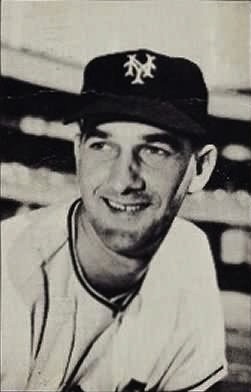
Lawrence Joseph Jansen (July 16, 1920 – October 10, 2009) was an American right-handed pitcher and coach in Major League Baseball. A native of Oregon, he played minor league baseball in the early 1940s before starting his Major League career in 1947 with the New York Giants. Jansen played nine seasons in the big leagues, and was twice an All-Star, winning 122 games in all. He later coached in the Major Leagues and minor leagues. Jansen is a member of the Oregon Sports Hall of Fame and the Pacific Coast League Hall of Fame.

Key Information

Early life

[edit]

Lawrence Jansen was born in Verboort, Oregon, on July 16, 1920.[1] He was raised in the community of Verboort located near Forest Grove in Washington County where he graduated from Verboort High School in 1938.[1] While still in school Jansen started his baseball career playing semi-pro ball. In 1940 Jansen was discovered by a scout and started playing for the Salt Lake City Bees, a Class C club at that time.[1] Jansen married the former Eileen Vandehey that year, and they had 10 children.[1] In 1941, he started playing for the San Francisco Seals in the Pacific Coast League, but in 1943, given the choice between being drafted to fight in World War II or taking a deferment to work on the family dairy farm back in Oregon, he chose the latter. He played semi-pro ball there part-time and returned to the Seals late in the 1945 season.

MLB career

[edit]

Breaking in as a 27-year old rookie, Jansen became a key member of the New York Giants starting rotation from 1947 to 1953, twice winning more than 20 games. He was purchased from the Triple-A Seals after leading the Pacific Coast League in wins (30), earned run average (1.57) and winning percentage (.833) in 1946. In his rookie major league season in 1947, Jansen won 21 of 26 decisions, leading the National League in winning percentage (.808), and finished second in the voting for Rookie of the Year behind the Brooklyn Dodgers' Jackie Robinson.[1]

He pitched five innings of one-hit scoreless baseball in the 1950 All-Star Game, which lasted 14 innings.

In 1951, he paced the NL-champion Giants with 23 victories and helped lead their improbable August and September comeback against the Dodgers. Jansen was the winning pitcher in the famous game on October 3, 1951, featuring the Shot Heard 'Round the World. Jansen, however, lost his only two decisions in the 1951 World Series. Jansen also won 19 games (1950) and 18 games (1948) for the New York club.

As an indication of the low salaries of even accomplished players in the mid-twentieth century, Jansen worked in a hardware store in Forest Grove, Oregon, during the off-seasons of his best years.

Arm miseries kept Jansen from a major role in the Giants' 1954 world championship; he spent part of that season inactive, as a coach. His playing career ended after eight appearances with the 1956 Cincinnati Redlegs. During his nine-year NL career, Jansen won 122 games and lost 89 (.578) with an ERA of 3.58. He had five 15-win seasons and two 20-win seasons.[citation needed]

Coaching career

[edit]

Jansen returned to the Pacific Coast League as a player-coach with Seattle (1955 and 1957) and Portland (1958–60). After a call from former teammate Alvin Dark, Jansen returned to the Major Leagues as pitching coach for the San Francisco Giants in 1961, with Dark as manager.[1][2] Jansen remained as pitching coach for eleven seasons, and helped to develop future Hall-of-Famers Juan Marichal and Gaylord Perry.[3] During his tenure, the Giants made appearances in the 1962 World Series and 1971 National League Championship Series. He then moved on to his final MLB coaching job, handling pitchers for the Chicago Cubs in 197273, working for his old Giants manager, Leo Durocher, and then former teammate Whitey Lockman.

Author

[edit]

In retirement, Larry Jansen (along with his co-author, George Jansen MD and illustrator Karl van Loo) left behind in book form his accumulated wisdom on every aspect of pitching in professional baseball: The Craft of Pitching (Masters Press, 1977).

Previously, Jansen had contributed a section on pitching in The Sporting News 1951 publication How to Play Baseball. Besides Jansen, the publication had other authors on specific topics: "Catching by Ray Schalk; Batting by Rogers Hornsby; Base Running by Bernie DeViveiros; First Base by George Sisler; Second Base by Rogers Hornsby; Shortstop by Honus Wagner; Third Base by George Kell; Outfield by Joe DiMaggio; and How to Umpire by George Barr."[4]

Awards and honors

[edit]

Jansen was inducted into the Oregon Sports Hall of Fame in 1980.[5] Sports Illustrated selected Jansen as one of Oregon's Fifty Greatest Athletes in 2004.[2]

In 2010, Jansen was inducted into the Pacific Coast League Hall of Fame.[6]

Later life and death

[edit]

After retiring from baseball, he returned to his hometown Verboort, Oregon, where he sold real estate and lived the remainder of his life in the house he had built in 1951.[1][2]

Lawrence Jansen died in his sleep in Verboort at the age of 89 on October 10, 2009. The cause of death was congestive heart failure and pneumonia. Jansen was survived by his wife Eileen, their ten children and their families.[1][3]

See also

[edit]

References

[edit]
[edit]
Revisions and contributorsEdit on WikipediaRead on Wikipedia
from Grokipedia
Larry Jansen was an American professional baseball pitcher and coach known for his effective nine-season Major League career primarily with the New York Giants, where he earned two All-Star selections and played a key role in the team's dramatic 1951 National League pennant victory, including a critical relief appearance in the famous playoff game against the Brooklyn Dodgers that ended with the "Shot Heard 'Round the World" home run. After retiring as a player due to injuries, he became a respected pitching coach for the San Francisco Giants from 1961 to 1971 and briefly for the Chicago Cubs, contributing to the development of standout pitchers during the Giants' strong contending era in the 1960s. Born on July 16, 1920, in the small Dutch-American community of Verboort, Oregon, Jansen grew up on a family farm and began his professional career in the minor leagues before dominating the Pacific Coast League in 1946 and reaching the majors at age 26. He remained closely tied to his Oregon roots throughout his life, raising ten children with his wife Eileen while pursuing his baseball career, and returned permanently to Verboort after retiring from coaching in the early 1970s to work in real estate and enjoy outdoor activities with his family. Jansen died in Verboort on October 10, 2009, at the age of 89.

Early life

Birth and family background

Larry Jansen was born Lawrence Joseph Jansen on July 16, 1920, in the small rural community of Verboort, Washington County, Oregon. Verboort, a tight-knit Dutch-settled area in northwestern Oregon, provided a modest farming environment for his early years. He was the son of Albert Jansen and Dora (Vandyke) Jansen, who raised their family on a 90-acre farm near Verboort. Jansen was one of eight children in the household, growing up in this agricultural setting within a close community centered around Visitation Parish. His rural upbringing in Verboort remained a constant throughout his life, as he was born, raised, and later died in the same location.

Youth and entry into professional baseball

Larry Jansen grew up on his family's 90-acre farm in the Dutch community of Verboort, Oregon, where his father Albert fostered an early love for baseball. At age nine, he earned his first glove by picking strawberries for three cents per box, and he initially played shortstop before shifting to pitching when needed in a local game. Jansen excelled in Oregon's semipro leagues while attending high school, dominating competition to the point that his manager arranged a tryout with the San Francisco Seals of the Pacific Coast League during a Portland visit. After rejecting a low offer from the Seals for the 1939 season and resolving a contract dispute that declared him a free agent following an unsigned deal with the Boston Red Sox, Jansen signed with the Seals and was assigned to the Salt Lake City Bees of the Class C Pioneer League in 1940. He led the Bees to a pennant by 12½ games with a 20-7 record and a league-leading 2.19 ERA, earning all-star recognition. Promoted to the Seals in the Pacific Coast League for 1941, he posted a 16-10 record with a 2.80 ERA over 238 innings. His 1942 season was more challenging at 11-14 with a 4.32 ERA, though he began developing a slider under coach Larry Woodall. Jansen sat out organized baseball in 1943 and 1944 due to wartime farm work on his family's property, which deferred his military induction, while continuing to pitch twice weekly in Portland and Eugene semipro leagues and refining his slider. He returned to the Seals late in 1945, going 4-1 in seven starts. In 1946, he delivered a standout Pacific Coast League campaign with the Seals, compiling a 30-6 record, a 1.57 ERA over 321 innings, 31 complete games, and 171 strikeouts while leading the circuit in wins and ERA to help win the pennant and Governor's Cup. This performance marked the pinnacle of his minor league tenure before his transition to the major leagues.

Major League playing career

Rise with the New York Giants

Larry Jansen made his Major League debut with the New York Giants on April 17, 1947, at age 26, initially appearing in relief before securing his first start on May 10 against the Boston Braves, where he pitched a complete-game 2-1 victory on 96 pitches with no walks. In his rookie season, he finished 21-5 with a 3.16 ERA over 248 innings pitched across 42 games (30 starts), leading the National League in winning percentage (.808) and tying for third in complete games (20), while ranking among league leaders in fewest walks per nine innings; he became the last NL pitcher to win 20 or more games in his first major-league season and placed second in the inaugural Rookie of the Year voting. The right-handed Jansen quickly established himself as a reliable starter known for exceptional control and composure on the mound, rarely issuing walks and earning praise from manager Leo Durocher as “my kind of pitcher” for his ability to work efficiently and induce weak contact even without overpowering stuff. In 1948, he compiled an 18-12 record with a 3.61 ERA over 277 innings (second-most in the league), again leading the NL in fewest walks per nine innings while posting the third-highest win total in the circuit. After a 15-16 season in 1949 with a 3.85 ERA over 259.2 innings, Jansen rebounded strongly in 1950, going 19-13 with a 3.01 ERA (fourth-lowest in the NL) across 275 innings and 40 games (35 starts). He led the league with a 1.065 WHIP and five shutouts, issued only 55 walks (1.8 per nine innings, second-best in the NL), and threw three consecutive shutouts in June as part of a 30-inning scoreless streak. His performance earned him selection to the National League All-Star team, where he pitched five scoreless relief innings, striking out six of the first nine batters he faced and helping extend the game to extra innings. Across his first four MLB seasons (1947–1950), all with the Giants, Jansen amassed a 73-46 record (.613 winning percentage), a 3.40 ERA over 1,059.2 innings, and 13 shutouts, solidifying his reputation as one of the league’s most dependable and control-oriented starting pitchers.

1951 season and World Series

In 1951, Larry Jansen delivered his finest major league campaign, posting a 23-11 record with a 3.04 ERA across 278.2 innings pitched while leading the National League in victories. He was named to the All-Star team for the second consecutive year and finished 14th in the NL Most Valuable Player voting. As the Giants mounted their historic comeback from 12.5 games behind the Brooklyn Dodgers on August 12, Jansen anchored the pitching staff by winning eight of his ten decisions during the team's 37-7 stretch drive, earning him the nickname "Meal Ticket" from teammate Monte Irvin. He closed the regular season strongly, completing his final four starts while surrendering just four earned runs over 36 innings. Jansen's contributions culminated in the NL playoff on October 3, 1951, when he relieved Sal Maglie in the top of the ninth inning against the Dodgers with the Giants trailing 4-1, retiring the side in order to preserve the opportunity for Bobby Thomson's dramatic pennant-winning home run in the bottom half, known as the "Shot Heard 'Round the World." In the ensuing World Series against the New York Yankees, which New York won four games to two, Jansen went 0-2 with a 6.30 ERA over three appearances covering 10 innings. He started Game 2 at Yankee Stadium, allowing two earned runs in six innings of a 3-1 loss, and started Game 5 at the Polo Grounds, surrendering seven runs (including a grand slam to Gil McDougald) in just 2⅓ innings of a 13-1 defeat. He made a final relief appearance in Game 6, pitching a scoreless eighth inning as the Giants fell 4-3 and were eliminated. Jansen appeared as himself in the 1951 World Series TV Mini Series, credited in three episodes as a New York Giants pitcher.

Later MLB years

Following his 23-win 1951 season, Larry Jansen's major league performance declined due to chronic back problems that later contributed to arm trouble. In 1952 with the New York Giants, he recorded an 11–11 mark with a 4.09 ERA over 167.1 innings. The next year, he went 11–16 with a 4.14 ERA in 184.2 innings, continuing to battle health issues. Injuries restricted Jansen to just 13 appearances in 1954, where he posted a 2–2 record and 5.98 ERA in 40.2 innings. The Giants granted him an unconditional release on July 12, 1954. He did not pitch in the majors in 1955, instead playing for the Seattle Rainiers in the Pacific Coast League. Jansen returned to the big leagues in 1956 when the Cincinnati Redlegs purchased his contract from Seattle on August 5 amid their pennant contention. In eight appearances (seven starts) with Cincinnati, he compiled a 2–3 record and 5.19 ERA across 34.2 innings. He earned complete-game victories on August 10 (8–1 over the Milwaukee Braves) and August 17 (8–2 over the Braves). His final major league appearance occurred on September 25, 1956, against the Braves, when he pitched 1.2 innings in a loss. Plagued by persistent injuries, Jansen did not return to the majors after 1956, concluding his playing career with 122 wins overall.

Coaching and post-playing career

Coaching roles in MLB and minors

After his major league playing career ended in 1954, Larry Jansen transitioned into coaching roles in the minor leagues while continuing to pitch sparingly as a player-coach. He served as a player-coach for the Seattle Rainiers of the Pacific Coast League in 1957. In 1958, he moved to the Portland Beavers (PCL) as a player-coach and briefly acted as interim manager after Tommy Heath's injury, guiding the team to a 78-76 record and fourth-place finish. He continued with Portland as pitching coach in 1959 and 1960 (with limited pitching appearances). In 1961, his former New York Giants teammate Alvin Dark, hired as manager of the San Francisco Giants, brought Jansen on as the team's pitching coach. Jansen held this position for eleven consecutive seasons through 1971, contributing to the development of the Giants' pitching staff during a period that included the team's 1962 National League pennant. Following his release from the Giants after the 1971 season, Jansen joined the Chicago Cubs as pitching coach, serving in that role for two seasons (1972-1973) before retiring from professional coaching.

Contributions to teams

Jansen made his most enduring contributions as a pitching coach for the San Francisco Giants from 1961 to 1971, helping shape one of the National League's strongest staffs during a period of consistent contention. He mentored future Hall of Famers Juan Marichal and Gaylord Perry, among others, with a philosophy that balanced technical refinement and trust in established talent. For Marichal, Jansen focused primarily on conditioning while leaving his distinctive delivery and repertoire largely unchanged, later reflecting that the best contribution was to "make sure he got in shape and stay out of his way"; Marichal responded with his breakout 18-win season in 1962. He taught Perry the slider over roughly a year and a half until the pitcher mastered it, an adjustment Perry credited as pivotal, calling Jansen "the most important coach in my career" during his 1991 Hall of Fame induction speech. In the same 1962 pennant-winning season, Jansen persuaded Jack Sanford to work low in the strike zone instead of high, resulting in Sanford's career-best 24 victories. Other pitchers thrived under his guidance that year, including Billy O'Dell (19 wins) and Billy Pierce (16-6 record), contributing to the Giants' playoff victory over the Dodgers and their overall pitching strength. The staff posted notably low team ERAs of 2.92 in 1967 and 2.71 in 1968, underscoring the sustained impact of Jansen's work across multiple managers. Jansen suffered a serious heart attack on August 19, 1966, requiring nearly three weeks of hospitalization, but made a full recovery and returned to his role for the 1967 season. Jansen also served as pitching coach for the Chicago Cubs in 1972 and 1973, following his Giants tenure. Earlier in his post-playing career, he gained experience in the Pacific Coast League as a player-coach with the Seattle Rainiers (1957) and Portland Beavers (1958-1960), where he briefly acted as interim manager for Portland in 1958. These roles built his coaching foundation before his return to the major leagues with the Giants. In reflections on his Giants years, Jansen noted he helped keep Perry in the majors despite organizational doubts, recognizing his strong arm and advocating for his opportunity. He also emphasized practical adjustments, such as extended warm-ups and neck warmers for pitchers in Candlestick Park's cold conditions.

Media appearances

Television and film credits

Larry Jansen's television and film appearances were strictly limited to on-camera roles as himself in archival sports broadcasts tied directly to his Major League Baseball career. These credits reflect coverage of live games and events in which he participated as a player, rather than any professional acting work. He appeared as the National League pitcher in the 1950 MLB All-Star Game television special. In 1951, Jansen featured in the TV mini-series 1951 World Series, appearing in three episodes credited as New York Giants Pitcher. Both entries consist of historical footage and game-related segments documenting his contributions on the field during those seasons. No additional scripted television or film roles are documented for Jansen.

Personal life

Marriage and family

Larry Jansen married his hometown sweetheart, Eileen Vandehey, on January 18, 1940, at the Visitation Catholic Church in Verboort, Oregon, where both were born and raised. The couple's marriage lasted nearly 70 years, ending with Jansen's death on October 10, 2009, three months before their 70th wedding anniversary. They raised ten children—five sons and five daughters—in Verboort while building a large family that remained central to their lives. At the time of Jansen's passing, the family included 22 grandchildren, over 40 great-grandchildren, and three great-great-grandchildren. Eileen survived him by three years, passing on September 1, 2012, with the family then encompassing ten children, 22 grandchildren, over 40 great-grandchildren, and three great-great-grandchildren.

Life in Oregon

Larry Jansen maintained a lifelong connection to Verboort, Oregon, a small rural Dutch community in Washington County where he was born and raised on a family farm. He returned to Verboort after the end of his coaching career following the 1973 season, settling there permanently around 1974 and earning a living by selling real estate in the local area. In retirement, Jansen remained active in his community as a lifelong member of Visitation Parish in Verboort, reflecting his ongoing ties to the local area. He also shared his pitching expertise by co-authoring the book The Craft of Pitching with George A. Jansen in 1998. His life in Oregon centered on this quiet hometown residence and modest post-career pursuits in the region he never fully left behind.

Death and legacy

Final years and death

Larry Jansen died on October 10, 2009, in Verboort, Oregon, at the age of 89. The cause of death was congestive heart failure and pneumonia, as reported by his daughter Darlene Greene. He passed away in his hometown, where he had resided in the house he built in 1951. Jansen was buried at Visitation Cemetery in Verboort. At the time of his death, he was three months shy of his 70th wedding anniversary to his wife Eileen, whom he had married in 1940.

Honors and remembrance

Larry Jansen's contributions to baseball earned him recognition in several halls of fame reflecting his playing and coaching legacy. He was inducted into the Oregon Sports Hall of Fame in 1980, honored for his success as a major and minor league pitcher and his extensive work as a pitching coach. Posthumously, following his death on October 10, 2009, Jansen was inducted into the Pacific Coast League Hall of Fame in 2010, in recognition of his exceptional 1946 season with the San Francisco Seals, where he posted a 30-6 record and 1.57 ERA, along with his overall PCL mark of 102-62 across ten seasons. He is enduringly associated with the 1951 New York Giants' National League pennant triumph, most notably as the winning pitcher who preserved the victory in the decisive playoff game against the Brooklyn Dodgers, culminating in Bobby Thomson's "Shot Heard 'Round the World." Jansen's legacy as a coach is highlighted by his mentorship of future Hall of Famers during his eleven seasons with the San Francisco Giants, including Gaylord Perry, who credited him as the most important coach in his career in his 1991 Hall of Fame induction speech. In Oregon, where he returned after retiring from baseball, tributes following his passing described him as a beloved local figure and devoted family man from Verboort.
Add your contribution
Related Hubs
User Avatar
No comments yet.