



Community hub
Recent from talks
Contribute something
Nothing was collected or created yet.
High availability
View on Wikipedia
High availability (HA) is a characteristic of a system that aims to ensure an agreed level of operational performance, usually uptime, for a higher than normal period.[1]
There is now more dependence on these systems as a result of modernization. For example, to carry out their regular daily tasks, hospitals and data centers need their systems to be highly available. Availability refers to the ability of the user to access a service or system, whether to submit new work, update or modify existing work, or retrieve the results of previous work. If a user cannot access the system, it is considered unavailable from the user's perspective.[2] The term downtime is generally used to refer to describe periods when a system is unavailable.
Resilience
[edit]High availability is a property of network resilience, the ability to "provide and maintain an acceptable level of service in the face of faults and challenges to normal operation."[3] Threats and challenges for services can range from simple misconfiguration over large scale natural disasters to targeted attacks.[4] As such, network resilience touches a very wide range of topics. In order to increase the resilience of a given communication network, the probable challenges and risks have to be identified and appropriate resilience metrics have to be defined for the service to be protected.[5]
The importance of network resilience is continuously increasing, as communication networks are becoming a fundamental component in the operation of critical infrastructures.[6] Consequently, recent efforts focus on interpreting and improving network and computing resilience with applications to critical infrastructures.[7] As an example, one can consider as a resilience objective the provisioning of services over the network, instead of the services of the network itself. This may require coordinated response from both the network and from the services running on top of the network.[8]
These services include:
- supporting distributed processing
- supporting network storage
- maintaining service of communication services such as
- access to applications and data as needed
Resilience and survivability are interchangeably used according to the specific context of a given study.[9]
Principles
[edit]There are three principles of systems design in reliability engineering that can help achieve high availability.
- Elimination of single points of failure. This means adding or building redundancy into the system so that failure of a component does not mean failure of the entire system.
- Reliable crossover. In redundant systems, the crossover point itself tends to become a single point of failure. Reliable systems must provide for reliable crossover.
- Detection of failures as they occur. If the two principles above are observed, then a user may never see a failure – but the maintenance activity must.
Scheduled and unscheduled downtime
[edit] |
A distinction can be made between scheduled and unscheduled downtime. Typically, scheduled downtime is a result of maintenance that is disruptive to system operation and usually cannot be avoided with a currently installed system design. Scheduled downtime events might include patches to system software that require a reboot or system configuration changes that only take effect upon a reboot. In general, scheduled downtime is usually the result of some logical, management-initiated event. Unscheduled downtime events typically arise from some physical event, such as a hardware or software failure or environmental anomaly. Examples of unscheduled downtime events include power outages, failed CPU or RAM components (or possibly other failed hardware components), an over-temperature related shutdown, logically or physically severed network connections, security breaches, or various application, middleware, and operating system failures.
If users can be warned away from scheduled downtimes, then the distinction is useful. But if the requirement is for true high availability, then downtime is downtime whether or not it is scheduled.
Many computing sites exclude scheduled downtime from availability calculations, assuming that it has little or no impact upon the computing user community. By doing this, they can claim to have phenomenally high availability, which might give the illusion of continuous availability. Systems that exhibit truly continuous availability are comparatively rare and higher priced, and most have carefully implemented specialty designs that eliminate any single point of failure and allow online hardware, network, operating system, middleware, and application upgrades, patches, and replacements. For certain systems, scheduled downtime does not matter, for example, system downtime at an office building after everybody has gone home for the night.
Percentage calculation
[edit]Availability is usually expressed as a percentage of uptime in a given year. The following table shows the downtime that will be allowed for a particular percentage of availability, presuming that the system is required to operate continuously. Service level agreements often refer to monthly downtime or availability in order to calculate service credits to match monthly billing cycles. The following table shows the translation from a given availability percentage to the corresponding amount of time a system would be unavailable.
| Availability % | Downtime per year[note 1] | Downtime per quarter | Downtime per month | Downtime per week | Downtime per day (24 hours) |
|---|---|---|---|---|---|
| 90% ("one nine") | 36.53 days | 9.13 days | 73.05 hours | 16.80 hours | 2.40 hours |
| 95% ("one nine five") | 18.26 days | 4.56 days | 36.53 hours | 8.40 hours | 1.20 hours |
| 97% ("one nine seven") | 10.96 days | 2.74 days | 21.92 hours | 5.04 hours | 43.20 minutes |
| 98% ("one nine eight") | 7.31 days | 43.86 hours | 14.61 hours | 3.36 hours | 28.80 minutes |
| 99% ("two nines") | 3.65 days | 21.9 hours | 7.31 hours | 1.68 hours | 14.40 minutes |
| 99.5% ("two nines five") | 1.83 days | 10.98 hours | 3.65 hours | 50.40 minutes | 7.20 minutes |
| 99.8% ("two nines eight") | 17.53 hours | 4.38 hours | 87.66 minutes | 20.16 minutes | 2.88 minutes |
| 99.9% ("three nines") | 8.77 hours | 2.19 hours | 43.83 minutes | 10.08 minutes | 1.44 minutes |
| 99.95% ("three nines five") | 4.38 hours | 65.7 minutes | 21.92 minutes | 5.04 minutes | 43.20 seconds |
| 99.99% ("four nines") | 52.60 minutes | 13.15 minutes | 4.38 minutes | 1.01 minutes | 8.64 seconds |
| 99.995% ("four nines five") | 26.30 minutes | 6.57 minutes | 2.19 minutes | 30.24 seconds | 4.32 seconds |
| 99.999% ("five nines") | 5.26 minutes | 1.31 minutes | 26.30 seconds | 6.05 seconds | 864.00 milliseconds |
| 99.9999% ("six nines") | 31.56 seconds | 7.89 seconds | 2.63 seconds | 604.80 milliseconds | 86.40 milliseconds |
| 99.99999% ("seven nines") | 3.16 seconds | 0.79 seconds | 262.98 milliseconds | 60.48 milliseconds | 8.64 milliseconds |
| 99.999999% ("eight nines") | 315.58 milliseconds | 78.89 milliseconds | 26.30 milliseconds | 6.05 milliseconds | 864.00 microseconds |
| 99.9999999% ("nine nines") | 31.56 milliseconds | 7.89 milliseconds | 2.63 milliseconds | 604.80 microseconds | 86.40 microseconds |
| 99.99999999% ("ten nines") | 3.16 milliseconds | 788.40 microseconds | 262.80 microseconds | 60.48 microseconds | 8.64 microseconds |
| 99.999999999% ("eleven nines") | 315.58 microseconds | 78.84 microseconds | 26.28 microseconds | 6.05 microseconds | 864.00 nanoseconds |
| 99.9999999999% ("twelve nines") | 31.56 microseconds | 7.88 microseconds | 2.63 microseconds | 604.81 nanoseconds | 86.40 nanoseconds |
The terms uptime and availability are often used interchangeably but do not always refer to the same thing. For example, a system can be "up" with its services not "available" in the case of a network outage. Or a system undergoing software maintenance can be "available" to be worked on by a system administrator, but its services do not appear "up" to the end user or customer. The subject of the terms is thus important here: whether the focus of a discussion is the server hardware, server OS, functional service, software service/process, or similar, it is only if there is a single, consistent subject of the discussion that the words uptime and availability can be used synonymously.
Five-by-five mnemonic
[edit]A simple mnemonic rule states that 5 nines allows approximately 5 minutes of downtime per year. Variants can be derived by multiplying or dividing by 10: 4 nines is 50 minutes and 3 nines is 500 minutes. In the opposite direction, 6 nines is 0.5 minutes (30 sec) and 7 nines is 3 seconds.
"Powers of 10" trick
[edit]Another memory trick to calculate the allowed downtime duration for an "-nines" availability percentage is to use the formula seconds per day.

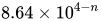
For example, 90% ("one nine") yields the exponent , and therefore the allowed downtime is seconds per day.


Also, 99.999% ("five nines") gives the exponent , and therefore the allowed downtime is seconds per day.


"Nines"
[edit]Percentages of a particular order of magnitude are sometimes referred to by the number of nines or "class of nines" in the digits. For example, electricity that is delivered without interruptions (blackouts, brownouts or surges) 99.999% of the time would have 5 nines reliability, or class five.[10] In particular, the term is used in connection with mainframes[11][12] or enterprise computing, often as part of a service-level agreement.
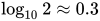
Similarly, percentages ending in a 5 have conventional names, traditionally the number of nines, then "five", so 99.95% is "three nines five", abbreviated 3N5.[13][14] This is casually referred to as "three and a half nines",[15] but this is incorrect: a 5 is only a factor of 2, while a 9 is a factor of 10, so a 5 is 0.3 nines (per below formula: ):[note 2] 99.95% availability is 3.3 nines, not 3.5 nines.[16] More simply, going from 99.9% availability to 99.95% availability is a factor of 2 (0.1% to 0.05% unavailability), but going from 99.95% to 99.99% availability is a factor of 5 (0.05% to 0.01% unavailability), over twice as much.[note 3]
A formulation of the class of 9s based on a system's unavailability would be



(cf. Floor and ceiling functions).
A similar measurement is sometimes used to describe the purity of substances.
In general, the number of nines is not often used by a network engineer when modeling and measuring availability because it is hard to apply in formula. More often, the unavailability expressed as a probability (like 0.00001), or a downtime per year is quoted. Availability specified as a number of nines is often seen in marketing documents.[citation needed] The use of the "nines" has been called into question, since it does not appropriately reflect that the impact of unavailability varies with its time of occurrence.[17] For large amounts of 9s, the "unavailability" index (measure of downtime rather than uptime) is easier to handle. For example, this is why an "unavailability" rather than availability metric is used in hard disk or data link bit error rates.
Sometimes the humorous term "nine fives" (55.5555555%) is used to contrast with "five nines" (99.999%),[18][19][20] though this is not an actual goal, but rather a sarcastic reference to something totally failing to meet any reasonable target.
Measurement and interpretation
[edit]Availability measurement is subject to some degree of interpretation. A system that has been up for 365 days in a non-leap year might have been eclipsed by a network failure that lasted for 9 hours during a peak usage period; the user community will see the system as unavailable, whereas the system administrator will claim 100% uptime. However, given the true definition of availability, the system will be approximately 99.9% available, or three nines (8751 hours of available time out of 8760 hours per non-leap year). Also, systems experiencing performance problems are often deemed partially or entirely unavailable by users, even when the systems are continuing to function. Similarly, unavailability of select application functions might go unnoticed by administrators yet be devastating to users – a true availability measure is holistic.
Availability must be measured to be determined, ideally with comprehensive monitoring tools ("instrumentation") that are themselves highly available. If there is a lack of instrumentation, systems supporting high volume transaction processing throughout the day and night, such as credit card processing systems or telephone switches, are often inherently better monitored, at least by the users themselves, than systems which experience periodic lulls in demand.
An alternative metric is mean time between failures (MTBF).
Closely related concepts
[edit]Recovery time (or estimated time of repair (ETR), also known as recovery time objective (RTO) is closely related to availability, that is the total time required for a planned outage or the time required to fully recover from an unplanned outage. Another metric is mean time to recovery (MTTR). Recovery time could be infinite with certain system designs and failures, i.e. full recovery is impossible. One such example is a fire or flood that destroys a data center and its systems when there is no secondary disaster recovery data center.
Another related concept is data availability, that is the degree to which databases and other information storage systems faithfully record and report system transactions. Information management often focuses separately on data availability, or Recovery Point Objective, in order to determine acceptable (or actual) data loss with various failure events. Some users can tolerate application service interruptions but cannot tolerate data loss.
A service level agreement ("SLA") formalizes an organization's availability objectives and requirements.
Military control systems
[edit]High availability is one of the primary requirements of the control systems in unmanned vehicles and autonomous maritime vessels. If the controlling system becomes unavailable, the Ground Combat Vehicle (GCV) or ASW Continuous Trail Unmanned Vessel (ACTUV) would be lost.
System design
[edit]On one hand, adding more components to an overall system design can undermine efforts to achieve high availability because complex systems inherently have more potential failure points and are more difficult to implement correctly. While some analysts would put forth the theory that the most highly available systems adhere to a simple architecture (a single, high-quality, multi-purpose physical system with comprehensive internal hardware redundancy), this architecture suffers from the requirement that the entire system must be brought down for patching and operating system upgrades. More advanced system designs allow for systems to be patched and upgraded without compromising service availability (see load balancing and failover). High availability requires less human intervention to restore operation in complex systems; the reason for this being that the most common cause for outages is human error.[21]
High availability through redundancy
[edit]On the other hand, redundancy is used to create systems with high levels of availability (e.g. popular ecommerce websites). In this case it is required to have high levels of failure detectability and avoidance of common cause failures.
If redundant parts are used in parallel and have independent failure (e.g. by not being within the same data center), they can exponentially increase the availability and make the overall system highly available. If you have N parallel components each having X availability, then you can use following formula:[22][23]
Availability of parallel components = 1 - (1 - X)^ N

So for example if each of your components has only 50% availability, by using 10 of components in parallel, you can achieve 99.9023% availability.
Two kinds of redundancy are passive redundancy and active redundancy.
Passive redundancy is used to achieve high availability by including enough excess capacity in the design to accommodate a performance decline. The simplest example is a boat with two separate engines driving two separate propellers. The boat continues toward its destination despite failure of a single engine or propeller. A more complex example is multiple redundant power generation facilities within a large system involving electric power transmission. Malfunction of single components is not considered to be a failure unless the resulting performance decline exceeds the specification limits for the entire system.
Active redundancy is used in complex systems to achieve high availability with no performance decline. Multiple items of the same kind are incorporated into a design that includes a method to detect failure and automatically reconfigure the system to bypass failed items using a voting scheme. This is used with complex computing systems that are linked. Internet routing is derived from early work by Birman and Joseph in this area.[24][non-primary source needed] Active redundancy may introduce more complex failure modes into a system, such as continuous system reconfiguration due to faulty voting logic.
Zero downtime system design means that modeling and simulation indicates mean time between failures significantly exceeds the period of time between planned maintenance, upgrade events, or system lifetime. Zero downtime involves massive redundancy, which is needed for some types of aircraft and for most kinds of communications satellites. Global Positioning System is an example of a zero downtime system.
Fault instrumentation can be used in systems with limited redundancy to achieve high availability. Maintenance actions occur during brief periods of downtime only after a fault indicator activates. Failure is only significant if this occurs during a mission critical period.
Modeling and simulation is used to evaluate the theoretical reliability for large systems. The outcome of this kind of model is used to evaluate different design options. A model of the entire system is created, and the model is stressed by removing components. Redundancy simulation involves the N-x criteria. N represents the total number of components in the system. x is the number of components used to stress the system. N-1 means the model is stressed by evaluating performance with all possible combinations where one component is faulted. N-2 means the model is stressed by evaluating performance with all possible combinations where two component are faulted simultaneously.
Reasons for unavailability
[edit]A survey among academic availability experts in 2010 ranked reasons for unavailability of enterprise IT systems. All reasons refer to not following best practice in each of the following areas (in order of importance):[25]
- Monitoring of the relevant components
- Requirements and procurement
- Operations
- Avoidance of network failures
- Avoidance of internal application failures
- Avoidance of external services that fail
- Physical environment
- Network redundancy
- Technical solution of backup
- Process solution of backup
- Physical location
- Infrastructure redundancy
- Storage architecture redundancy
A book on the factors themselves was published in 2003.[26]
Costs of unavailability
[edit]In a 1998 report from IBM Global Services, unavailable systems were estimated to have cost American businesses $4.54 billion in 1996, due to lost productivity and revenues.[27]
See also
[edit]Notes
[edit]- ^ Using 365.25 days per year; respectively, a quarter is a ¼ of that value (i.e., 91.3125 days), and a month is a twelfth of it (i.e., 30.4375 days). For consistency, all times are rounded to two decimal digits.
- ^ See mathematical coincidences concerning base 2 for details on this approximation.
- ^ "Twice as much" on a logarithmic scale, meaning two factors of 2:

References
[edit]- ^ Robert, Sheldon (April 2024). "high availability (HA)". Techtarget.
- ^ Floyd Piedad, Michael Hawkins (2001). High Availability: Design, Techniques, and Processes. Prentice Hall. ISBN 9780130962881.
- ^ "Definitions - ResiliNetsWiki". resilinets.org.
- ^ "Webarchiv ETHZ / Webarchive ETH". webarchiv.ethz.ch.
- ^ Smith, Paul; Hutchison, David; Sterbenz, James P.G.; Schöller, Marcus; Fessi, Ali; Karaliopoulos, Merkouris; Lac, Chidung; Plattner, Bernhard (July 3, 2011). "Network resilience: a systematic approach". IEEE Communications Magazine. 49 (7): 88–97. Bibcode:2011IComM..49g..88S. doi:10.1109/MCOM.2011.5936160. S2CID 10246912.
- ^ accesstel (June 9, 2022). "operational resilience | telcos | accesstel | risk | crisis". accesstel. Retrieved May 8, 2023.
- ^ "The CERCES project - Center for Resilient Critical Infrastructures at KTH Royal Institute of Technology". Archived from the original on October 19, 2018. Retrieved August 26, 2023.
- ^ Zhao, Peiyue; Dán, György (December 3, 2018). "A Benders Decomposition Approach for Resilient Placement of Virtual Process Control Functions in Mobile Edge Clouds". IEEE Transactions on Network and Service Management. 15 (4): 1460–1472. Bibcode:2018ITNSM..15.1460Z. doi:10.1109/TNSM.2018.2873178. S2CID 56594760.
- ^ Castet J., Saleh J. Survivability and Resiliency of Spacecraft and Space-Based Networks: a Framework for Characterization and Analysis", American Institute of Aeronautics and Astronautics, AIAA Technical Report 2008-7707. Conference on Network Protocols (ICNP 2006), Santa Barbara, California, USA, November 2006
- ^ Lecture Notes M. Nesterenko, Kent State University
- ^ Introduction to the new mainframe: Large scale commercial computing Chapter 5 Availability Archived March 4, 2016, at the Wayback Machine IBM (2006)
- ^ IBM zEnterprise EC12 Business Value Video at youtube.com
- ^ Precious metals, Volume 4. Pergamon Press. 1981. p. page 262. ISBN 9780080253695.
- ^ PVD for Microelectronics: Sputter Desposition to Semiconductor Manufacturing. 1998. p. 387.
- ^ Murphy, Niall Richard; Beyer, Betsy; Petoff, Jennifer; Jones, Chris (2016). Site Reliability Engineering: How Google Runs Production Systems. p. 38.
- ^ Josh Deprez (April 23, 2016). "Nines of Nines". Archived from the original on September 4, 2016. Retrieved May 31, 2016.
- ^ Evan L. Marcus, The myth of the nines
- ^ Newman, David; Snyder, Joel; Thayer, Rodney (June 24, 2012). "Crying Wolf: False alarms hide attacks". Network World. Vol. 19, no. 25. p. 60. Retrieved March 15, 2019.
leading to crashes and uptime numbers closer to nine fives than to five nines.
- ^ Metcalfe, Bob (April 2, 2001). "After 35 years of technology crusades, Bob Metcalfe rides off into the sunset". ITworld. Retrieved March 15, 2019.
and five nines (not nine fives) of reliability
[permanent dead link] - ^ Pilgrim, Jim (October 20, 2010). "Goodbye Five 9s". Clearfield, Inc. Retrieved March 15, 2019.
but it seems to me we are moving closer to 9-5s (55.5555555%) in network reliability rather than 5-9s
- ^ "What is network downtime?". Networking. Retrieved December 27, 2023.
- ^ Trivedi, Kishor S.; Bobbio, Andrea (2017). Reliability and Availability Engineering: Modeling, Analysis, and Applications. Cambridge University Press. ISBN 978-1107099500.
- ^ System Sustainment: Acquisition And Engineering Processes For The Sustainment Of Critical And Legacy Systems (World Scientific Series On Emerging Technologies: Avram Bar-cohen Memorial Series). World Scientific. 2022. ISBN 978-9811256844.
- ^ RFC 992
- ^ Ulrik Franke, Pontus Johnson, Johan König, Liv Marcks von Würtemberg: Availability of enterprise IT systems – an expert-based Bayesian model, Proc. Fourth International Workshop on Software Quality and Maintainability (WSQM 2010), Madrid, [1] Archived August 4, 2012, at archive.today
- ^ Marcus, Evan; Stern, Hal (2003). Blueprints for high availability (Second ed.). Indianapolis, IN: John Wiley & Sons. ISBN 0-471-43026-9.
- ^ IBM Global Services, Improving systems availability, IBM Global Services, 1998, [2] Archived April 1, 2011, at the Wayback Machine
External links
[edit]- Lecture Notes on Enterprise Computing Archived November 16, 2013, at the Wayback Machine University of Tübingen
- Lecture notes on Embedded Systems Engineering by Prof. Phil Koopman
- Uptime Calculator (SLA)
High availability
View on GrokipediaFundamentals
Definition and Importance
High availability (HA) refers to the design and implementation of computer systems, networks, and applications that ensure continuous operation and minimal downtime, even in the presence of hardware failures, software errors, or other disruptions.[10] It focuses on maintaining an agreed level of operational performance, typically targeting uptime of 99.9% or higher, to support seamless service delivery over extended periods.[11] This approach integrates redundancy, failover mechanisms, and monitoring to prevent single points of failure from halting services.[12] The scope of HA extends across hardware components like servers and storage, software architectures such as distributed applications, network infrastructures for connectivity, and operational processes for maintenance and recovery.[13] Unlike basic reliability, which measures a system's probability of performing its functions correctly without failure over time, HA proactively minimizes interruptions through built-in resilience, emphasizing rapid detection and recovery to sustain user access.[14][15] HA is critically important in sectors reliant on uninterrupted operations, including finance, healthcare, e-commerce, and telecommunications, where downtime can incur massive financial losses, regulatory penalties, and safety risks.[16] In finance, for example, a 2012 software glitch at Knight Capital resulted in $440 million in losses within 45 minutes due to unintended stock trades.[17] Healthcare systems face similar threats; the 2024 cyberattack on Change Healthcare led to over $2.45 billion in costs for UnitedHealth Group and widespread disruptions in claims processing and patient care.[18] In e-commerce, brief outages at platforms like Amazon can cost around $220,000 per minute in foregone sales.[19] These examples underscore how HA safeguards revenue, compliance, and trust in mission-critical environments.[20]Historical Context
The origins of high availability (HA) in computing trace back to the mid-20th century, driven by the need for reliable systems in military and critical applications. In the 1950s and 1960s, the Semi-Automatic Ground Environment (SAGE) air defense system, developed by IBM and MITRE for the U.S. Air Force, represented an early milestone in fault-tolerant design. SAGE employed dual AN/FSQ-7 processors per site, with one on hot standby to ensure continuous operation despite the unreliability of vacuum tubes, achieving approximately 99% uptime through redundancy and marginal checking to detect failing components before total breakdown.[21] This emphasis on fault tolerance influenced subsequent mainframe developments, such as IBM's System/360 in the 1960s, where modular designs and error-correcting memory began addressing mean time between failures (MTBF) that were often limited to hours in early systems.[22] By the 1970s, commercial HA systems emerged, exemplified by Tandem Computers' NonStop architecture, introduced in 1976. The Tandem/16, deployed initially for banking applications like Citibank's transaction processing, featured paired processors with lockstep execution and automatic failover, enabling continuous operation without data loss in fault-tolerant environments.[23] The 1980s and 1990s saw significant advancements in distributed and storage technologies. Unix-based clustering gained traction, with systems like DEC's VMS Cluster (evolving from the 1970s) and Sun Microsystems' early work in the 1980s enabling shared resources across nodes for improved resilience.[24] Concurrently, the introduction of Redundant Arrays of Inexpensive Disks (RAID) in 1987 by researchers at UC Berkeley provided a framework for data redundancy, with the 1988 paper outlining levels like RAID-1 (mirroring) and RAID-5 (parity) to enhance storage availability against disk failures.[25] Hot-swappable hardware also proliferated in this era, particularly in mid-1990s rackmount servers from vendors like Compaq and HP, allowing component replacement without system downtime to support enterprise HA.[26] The 2000s marked a pivotal shift influenced by the internet boom and e-commerce, where downtime directly impacted revenue, prompting the widespread adoption of service level agreements (SLAs) with explicit uptime guarantees, often targeting 99.9% or higher availability.[27] A key catalyst was the 1988 Morris Worm, which infected thousands of Unix systems, causing 5-10% of the early internet to go offline and underscoring the vulnerabilities in networked environments, thereby accelerating investments in resilient architectures and the formation of the CERT Coordination Center for incident response.[28] Post-2000, virtualization technologies transformed HA practices; VMware's Workstation, released in 1999, enabled x86-based virtual machines, paving the way for clustered virtualization features introduced in Virtual Infrastructure 3 (2006), which automated VM migration and failover to minimize outages and evolved into vSphere (introduced 2009).[29][30] The 2010s ushered in the cloud era, with Amazon Web Services (AWS), launching EC2 in 2006, and Microsoft Azure, debuting in 2010, popularizing elastic HA through auto-scaling groups, multi-region replication, and managed failover services that abstracted infrastructure complexity for global-scale availability.[31] These platforms shifted HA from hardware-centric to software-defined models, enabling dynamic resource provisioning to meet SLA commitments in distributed environments.[32]Core Principles
Reliability and Resilience
Reliability in high availability systems refers to the probability that a system or component will perform its required functions without failure under specified conditions for a designated period of time. This concept is foundational to ensuring consistent operation, drawing from established reliability engineering principles that emphasize the prevention of faults through robust design and material selection. Core metrics for assessing reliability include Mean Time Between Failures (MTBF), which quantifies the average operational time between consecutive failures in repairable systems, and Mean Time To Repair (MTTR), which measures the average duration required to restore functionality after a failure. Higher MTBF values indicate greater system dependability, while minimizing MTTR supports faster recovery, both critical for maintaining service continuity in demanding environments like data centers or critical infrastructure. Resilience, in contrast, encompasses a system's capacity to anticipate, withstand, and recover from adverse events such as hardware malfunctions, software bugs, or cyberattacks, while adapting to evolving threats without complete loss of functionality. This involves principles like graceful degradation, where the system reduces non-essential operations to preserve core services during overload or partial failure, ensuring partial operability rather than total shutdown. Complementing this are self-healing mechanisms, which enable automated detection, diagnosis, and remediation of issues, such as restarting faulty components or rerouting traffic, thereby minimizing human intervention and downtime in dynamic IT ecosystems. These elements allow resilient systems to maintain essential capabilities even under stress, as outlined in cybersecurity frameworks. The interplay between reliability and resilience lies in their complementary roles: reliability proactively minimizes the occurrence of failures through inherent design strengths, while resilience reactively limits the consequences when failures inevitably arise, creating a layered defense for high availability. For instance, in civil engineering, bridge designs incorporate reliable structural materials to prevent collapse (high MTBF) alongside resilient features like flexible joints and redundant supports that absorb shocks from earthquakes, allowing the structure to deform without catastrophic failure and recover post-event. Adapted to IT, this means building systems with reliable hardware (e.g., fault-tolerant processors) that, when combined with resilient software protocols (e.g., automatic failover), ensure minimal disruption—preventing minor glitches from escalating into outages. Such integration not only enhances overall system robustness but also serves as a prerequisite for accurate availability measurement by clearly delineating "available" as a state of functional performance despite perturbations.Redundancy Fundamentals
Redundancy is a foundational strategy in high availability (HA) systems, involving the duplication of critical components, processes, or data to prevent any single point of failure (SPOF) from disrupting overall system operation.[33] By incorporating backup elements that can seamlessly take over during failures, redundancy ensures that services remain accessible and functional, minimizing downtime and supporting continuous business operations.[34] This approach is essential for eliminating SPOFs, where a single component failure could otherwise cascade into widespread unavailability.[35] Common types of redundancy configurations include active-active, active-passive, and N+1 setups. In an active-active configuration, multiple systems operate simultaneously, sharing the workload and providing mutual failover support without idle resources.[36] An active-passive setup, by contrast, maintains one primary active system handling all operations while a secondary passive system remains on standby, activating only upon failure detection to assume responsibilities.[36] The N+1 model provisions one extra unit beyond the minimum required (N) to handle normal loads, allowing the system to tolerate the loss of any single component while preserving capacity.[34] The primary benefits of redundancy lie in its ability to eradicate SPOFs and enhance system reliability through failover mechanisms. For instance, hardware redundancy examples include dual power supplies in servers, which ensure uninterrupted power delivery if one supply fails, and redundant network interface cards to maintain connectivity despite link failures.[37] In software contexts, mirrored databases replicate data across multiple nodes, enabling immediate access to backups if the primary instance encounters issues, thus preventing data loss or service interruption.[38] These implementations directly support resilience by establishing alternative paths for operation, allowing systems to recover swiftly from faults without user impact.[35] Despite its advantages, redundancy introduces notable challenges, particularly in terms of increased system complexity and operational costs. Duplicating components requires additional resources for procurement, maintenance, and monitoring, elevating overall expenses while complicating management and troubleshooting.[39] Synchronization across redundant elements poses further difficulties, such as maintaining data consistency in replicated systems, where asynchronous updates can lead to temporary discrepancies or conflicts during failover.[40] These issues demand careful design to balance availability gains against the added overhead.Measurement and Metrics
Uptime Calculation
Uptime in high availability systems is quantified using the basic formula for availability: Availability = (Total Time - Downtime) / Total Time, typically expressed as a percentage.[41] This metric represents the proportion of time a system is operational over a defined period, such as a month or year.[42] To convert availability percentages to allowable downtime, the equation Downtime (hours per year) = 8760 × (1 - Availability) is commonly applied, assuming a non-leap year with 365 days × 24 hours.[42] For leap years, the total time adjusts to 8784 hours, slightly reducing allowable downtime for the same percentage (e.g., 99.9% availability permits approximately 8.76 hours in a non-leap year but 8.78 hours in a leap year).[43] The "nines" system provides a shorthand for expressing high availability levels, where each additional "nine" after the decimal point indicates greater reliability. For instance, three nines (99.9%) allows about 8.76 hours of downtime per year, while five nines (99.999%) permits roughly 5.26 minutes annually.[42] This system emphasizes the exponential decrease in tolerable outages as nines increase. A common mnemonic for five nines is the "five-by-five" approximation, recalling that 99.999% equates to approximately 5 minutes of downtime per year.[42] Additionally, the "powers of 10" approach aids quick estimation: each additional nine divides the allowable downtime by 10, as unavailability scales from 0.1 (one nine) to 0.00001 (five nines) of total time.[42] The following table details allowable annual downtime for availability levels from one to seven nines, based on 8760 hours in a non-leap year:| Nines | Availability (%) | Downtime (days) | Downtime (hours) | Downtime (minutes) | Downtime (seconds) |
|---|---|---|---|---|---|
| 1 | 90 | 36.5 | - | - | - |
| 2 | 99 | - | 87.6 | - | - |
| 3 | 99.9 | - | 8.76 | - | - |
| 4 | 99.99 | - | - | 52.56 | - |
| 5 | 99.999 | - | - | 5.256 | - |
| 6 | 99.9999 | - | - | - | 31.536 |
| 7 | 99.99999 | - | - | - | 3.1536 |