



Community hub
Recent from talks
Contribute something
Nothing was collected or created yet.
Availability
View on WikipediaIn reliability engineering, the term availability has the following meanings:
- The degree to which a system, subsystem or equipment is in a specified operable and committable state at the start of a mission, when the mission is called for at an unknown, i.e. a random, time.
- The probability that an item will operate satisfactorily at a given point in time when used under stated conditions in an ideal support environment.
Normally high availability systems might be specified as 99.98%, 99.999% or 99.9996%. The converse, unavailability, is 1 minus the availability.
Representation
[edit]The simplest representation of availability (A) is a ratio of the expected value of the uptime of a system to the aggregate of the expected values of up and down time (that results in the "total amount of time" C of the observation window)
![{\displaystyle A={\frac {E[\mathrm {uptime} ]}{E[\mathrm {uptime} ]+E[\mathrm {downtime} ]}}={\frac {E[\mathrm {uptime} ]}{C}}}](https://wikimedia.org/api/rest_v1/media/math/render/svg/6a13c554d027a918a13c630f348ca125406f63ad)
Another equation for availability (A) is a ratio of the Mean Time To Failure (MTTF) and Mean Time Between Failure (MTBF), or

If we define the status function as


therefore, the availability A(t) at time t > 0 is represented by
![{\displaystyle A(t)=\Pr[X(t)=1]=E[X(t)].\,}](https://wikimedia.org/api/rest_v1/media/math/render/svg/fd270a9c1dfca193e9847b39c530f3d42ec4ecb3)
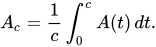
Average availability must be defined on an interval of the real line. If we consider an arbitrary constant , then average availability is represented as

Limiting (or steady-state) availability is represented by[1]
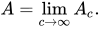
Limiting average availability is also defined on an interval as,
![{\displaystyle [0,c]}](https://wikimedia.org/api/rest_v1/media/math/render/svg/d8f04abeab39818aa786f2e5f9cdf163379e60c6)

Availability is the probability that an item will be in an operable and committable state at the start of a mission when the mission is called for at a random time, and is generally defined as uptime divided by total time (uptime plus downtime).
Series vs Parallel components
[edit]
Let's say a series component is composed of components A, B and C. Then following formula applies:
Availability of series component = (availability of component A) x (availability of component B) x (availability of component C) [2][3]
Therefore, combined availability of multiple components in a series is always lower than the availability of individual components.
On the other hand, following formula applies to parallel components:
Availability of parallel components = 1 - (1 - availability of component A) X (1 - availability of component B) X (1 - availability of component C) [2][3]

In corollary, if you have N parallel components each having X availability, then:
Availability of parallel components = 1 - (1 - X)^ N [3]
Using parallel components can exponentially increase the availability of overall system. [2] For example if each of your hosts has only 50% availability, by using 10 of hosts in parallel, you can achieve 99.9023% availability. [3]
Note that redundancy doesn’t always lead to higher availability. In fact, redundancy increases complexity which in turn reduces availability. According to Marc Brooker, to take advantage of redundancy, ensure that:[4]
- You achieve a net-positive improvement in the overall availability of your system
- Your redundant components fail independently
- Your system can reliably detect healthy redundant components
- Your system can reliably scale out and scale-in redundant components.
Methods and techniques to model availability
[edit]Reliability Block Diagrams or Fault Tree Analysis are developed to calculate availability of a system or a functional failure condition within a system including many factors like:
- Reliability models
- Maintainability models
- Maintenance concepts
- Redundancy
- Common cause failure
- Diagnostics
- Level of repair
- Repair status
- Dormant failures
- Test coverage
- Active operational times / missions / sub system states
- Logistical aspects like; spare part (stocking) levels at different depots, transport times, repair times at different repair lines, manpower availability and more.
- Uncertainty in parameters
Furthermore, these methods are capable to identify the most critical items and failure modes or events that impact availability.
Definitions within systems engineering
[edit]Availability, inherent (Ai) [5] The probability that an item will operate satisfactorily at a given point in time when used under stated conditions in an ideal support environment. It excludes logistics time, waiting or administrative downtime, and preventive maintenance downtime. It includes corrective maintenance downtime. Inherent availability is generally derived from analysis of an engineering design:
- The impact of a repairable-element (refurbishing/remanufacture isn't repair, but rather replacement) on the availability of the system, in which it operates, equals mean time between failures MTBF/(MTBF+ mean time to repair MTTR).
- The impact of a one-off/non-repairable element (could be refurbished/remanufactured) on the availability of the system, in which it operates, equals the mean time to failure (MTTF)/(MTTF + the mean time to repair MTTR).
It is based on quantities under control of the designer.
Availability, achieved (Aa) [6] The probability that an item will operate satisfactorily at a given point in time when used under stated conditions in an ideal support environment (i.e., that personnel, tools, spares, etc. are instantaneously available). It excludes logistics time and waiting or administrative downtime. It includes active preventive and corrective maintenance downtime.
Availability, operational (Ao) [7] The probability that an item will operate satisfactorily at a given point in time when used in an actual or realistic operating and support environment. It includes logistics time, ready time, and waiting or administrative downtime, and both preventive and corrective maintenance downtime. This value is equal to the mean time between failure (MTBF) divided by the mean time between failure plus the mean downtime (MDT). This measure extends the definition of availability to elements controlled by the logisticians and mission planners such as quantity and proximity of spares, tools and manpower to the hardware item.
Refer to Systems engineering for more details
Basic example
[edit]If we are using equipment which has a mean time to failure (MTTF) of 81.5 years and mean time to repair (MTTR) of 1 hour:
- MTTF in hours = 81.5 × 365 × 24 = 713940 (This is a reliability parameter and often has a high level of uncertainty!)
- Inherent availability (Ai) = 713940 / (713940+1) = 713940 / 713941 = 99.999860%
- Inherent unavailability = 1 / 713940 = 0.000140%
Outage due to equipment in hours per year = 1/rate = 1/MTTF = 0.01235 hours per year.
Literature
[edit]Availability is well established in the literature of stochastic modeling and optimal maintenance. Barlow and Proschan [1975] define availability of a repairable system as "the probability that the system is operating at a specified time t." Blanchard [1998] gives a qualitative definition of availability as "a measure of the degree of a system which is in the operable and committable state at the start of mission when the mission is called for at an unknown random point in time." This definition comes from the MIL-STD-721. Lie, Hwang, and Tillman [1977] developed a complete survey along with a systematic classification of availability.
Availability measures are classified by either the time interval of interest or the mechanisms for the system downtime. If the time interval of interest is the primary concern, we consider instantaneous, limiting, average, and limiting average availability. The aforementioned definitions are developed in Barlow and Proschan [1975], Lie, Hwang, and Tillman [1977], and Nachlas [1998]. The second primary classification for availability is contingent on the various mechanisms for downtime such as the inherent availability, achieved availability, and operational availability. (Blanchard [1998], Lie, Hwang, and Tillman [1977]). Mi [1998] gives some comparison results of availability considering inherent availability.
Availability considered in maintenance modeling can be found in Barlow and Proschan [1975] for replacement models, Fawzi and Hawkes [1991] for an R-out-of-N system with spares and repairs, Fawzi and Hawkes [1990] for a series system with replacement and repair, Iyer [1992] for imperfect repair models, Murdock [1995] for age replacement preventive maintenance models, Nachlas [1998, 1989] for preventive maintenance models, and Wang and Pham [1996] for imperfect maintenance models. A very comprehensive recent book is by Trivedi and Bobbio [2017].
Applications
[edit]Availability factor is used extensively in power plant engineering. For example, the North American Electric Reliability Corporation implemented the Generating Availability Data System in 1982.[8]
See also
[edit]References
[edit]- ^ Elsayed, E., Reliability Engineering, Addison Wesley, Reading, MA,1996
- ^ a b c Sandborn, Peter; Lucyshyn, William (2022). System Sustainment: Acquisition And Engineering Processes For The Sustainment Of Critical And Legacy Systems. World Scientific. ISBN 9789811256868.
- ^ a b c d Trivedi, Kishor S.; Bobbio, Andrea (2017). Reliability and Availability Engineering: Modeling, Analysis, and Applications. Cambridge University Press. ISBN 978-1107099500.
- ^ Vitillo, Roberto (23 February 2022). Understanding Distributed Systems, Second Edition: What every developer should know about large distributed applications. Roberto Vitillo. ISBN 978-1838430214.
- ^ "Inherent Availability (AI)". Glossary of Defense Acquisition Acronyms and Terms. Department of Defense. Archived from the original on 13 April 2014. Retrieved 10 April 2014.
- ^ "Achieved Availability (AI)". Glossary of Defense Acquisition Acronyms and Terms. Department of Defense. Archived from the original on 13 April 2014. Retrieved 10 April 2014.
- ^ "Operational Availability (AI)". Glossary of Defense Acquisition Acronyms and Terms. Department of Defense. Archived from the original on 12 March 2013. Retrieved 10 April 2014.
- ^ "Mandatory Reporting of Conventional Generation Performance Data" (PDF). Generating Availability Data System. North American Electric Reliability Corporation. July 2011. pp. 7, 17. Archived (PDF) from the original on 2022-10-09. Retrieved 13 March 2014.
Sources
[edit] This article incorporates public domain material from Federal Standard 1037C. General Services Administration. Archived from the original on 2022-01-22. (in support of MIL-STD-188).
- K. Trivedi and A. Bobbio, Reliability and Availability Engineering: Modeling, Analysis and Applications, Cambridge University Press, 2017.

External links
[edit]
Availability
View on GrokipediaFundamental Concepts
Definition of Availability
Availability is a key metric in reliability engineering that quantifies the proportion of time a system is operational and capable of performing its intended function under specified conditions. It is typically expressed as the ratio of uptime to the total time considered, which includes both operational and non-operational periods:This measure reflects the system's readiness to deliver services, emphasizing the balance between periods of successful operation and interruptions due to failures or maintenance.[8] The core components of availability are uptime and downtime, which are derived from fundamental reliability and maintainability parameters. Uptime is closely tied to the mean time to failure (MTTF), representing the average duration a system operates before experiencing a failure in non-repairable contexts, or more generally the mean time between failures (MTBF) for repairable systems. Downtime, conversely, is characterized by the mean time to repair (MTTR), the average time required to restore the system to operational status after a failure. These building blocks allow availability to be approximated as under steady operating conditions, highlighting how improvements in either failure resistance or repair efficiency enhance overall system readiness.[9][8] Availability can be assessed in different forms, including instantaneous availability, which captures the probability of operational status at a specific point in time, and steady-state availability, which represents the long-term equilibrium proportion of uptime as observation periods extend indefinitely. Steady-state availability is particularly emphasized in engineering practice for evaluating sustained operational readiness, assuming constant failure and repair rates over time. Unlike reliability, which measures the likelihood of uninterrupted performance over a fixed interval without considering recovery, availability incorporates the system's restorability, making it a broader indicator of dependability.[8][9] In critical infrastructure such as power grids, transportation networks, and healthcare systems, high availability is essential to ensure continuous service delivery and minimize disruptions that could have severe economic or safety consequences. For instance, achieving availability levels above 99.9% is often targeted to support the uninterrupted operation of these vital systems, underscoring its role in broader dependability frameworks.[10]
Related Metrics in Reliability Engineering
In reliability engineering, reliability is defined as the probability that a system or component will perform its required functions under stated conditions for a specified period of time without failure. This metric emphasizes failure-free operation over a defined interval, differing from availability, which assesses the proportion of time a system is in an operational state during steady-state conditions. While reliability focuses on the likelihood of avoiding breakdowns within a mission duration, availability incorporates both failure prevention and recovery, providing a broader measure of system dependability over extended periods.[11][12] Maintainability quantifies the ease and speed with which a failed system can be restored to operational status using prescribed procedures and resources.[9] It directly influences downtime in availability assessments by minimizing the time required for repairs, inspections, or modifications, thereby enhancing overall system uptime.[13] For instance, effective maintainability reduces repair complexity through better design features like modular components, which in turn lowers the total non-operational time and supports higher availability levels.[14] Key supporting metrics include Mean Time Between Failures (MTBF), which represents the average operating time between consecutive failures in repairable systems, and Mean Time To Repair (MTTR), the average duration to restore functionality after a failure.[9] In high-reliability systems where MTTR is significantly smaller than MTBF, availability can be approximated as , illustrating how reliability (via MTBF) and maintainability (via MTTR) jointly determine operational readiness.[15] This relationship underscores the interdependence of these metrics in predicting long-term system performance. Collectively, reliability, availability, and maintainability form the RAM triad, a foundational framework in engineering standards for evaluating system dependability and life-cycle costs.[9] Adopted in military and industrial guidelines, such as those from the U.S. Department of Defense, the RAM approach integrates these attributes to guide design, testing, and sustainment decisions aimed at maximizing mission capability.[14]Mathematical Modeling
Core Formulas for Availability
In reliability engineering, the core formulas for availability in simple, non-configured systems are derived from probabilistic models assuming exponential distributions for failure and repair times, which imply constant failure and repair rates. These models treat the system as alternating between operational (up) and failed (down) states, often analyzed using Markov processes or renewal theory. The instantaneous availability represents the probability that the system is operational at time , starting from an operational state at . For a repairable system with constant failure rate and repair rate , where MTTF is the mean time to failure and MTTR is the mean time to repair, the formula is This expression is obtained by solving the Kolmogorov forward equations for the two-state Markov chain describing the system: the up-state probability satisfies , with initial condition , yielding the steady-state term plus a transient exponential decay.[16][17] As , the transient term vanishes, resulting in the steady-state availability , or equivalently , where MTBF is the mean time to failure (synonymous with MTTF for repairable systems in this context), precisely in the exponential model. This formula assumes constant failure and repair rates, leading to memoryless exponential inter-failure and repair times, and holds in the long-run limit regardless of initial conditions under general renewal theory conditions. The derivation follows from the limiting proportion of time spent in the up state in an alternating renewal process, where the steady-state probability is the ratio of mean up time to total cycle time.[19] Inherent availability is a specific case of steady-state availability that excludes logistical delays, administrative times, and supply issues, focusing solely on active repair time: . It represents the availability achievable under ideal support conditions with instantaneous logistics. In contrast, operational availability accounts for real-world delays, using , where MTBM is the mean time between maintenance actions (including preventive maintenance) and MMDT is the mean maintenance downtime incorporating repair, supply, and administrative delays. These distinctions highlight how provides an upper-bound measure of design-inherent reliability and maintainability, while reflects actual field performance.[8][20] Availability is a dimensionless ratio ranging from 0 (always down) to 1 (always up), interpreted as the proportion of time the system is operational. It is commonly expressed as a percentage, such as 99.9% (known as "three nines"), which equates to about 8.76 hours of downtime per year for a continuously operating system, establishing critical benchmarks for high-reliability applications like telecommunications or aerospace.[8]Configurations in Series and Parallel Systems
In reliability engineering, systems composed of multiple components can be arranged in series or parallel configurations, each affecting overall availability differently under the assumption of component independence. For a series system, where the failure of any single component causes the entire system to fail, the steady-state availability is calculated as the product of the individual component availabilities: .[21][22] This multiplicative effect means that even minor unavailability in one component significantly degrades the overall system performance; for instance, in a power plant's gas turbine and dual-fuel subsystem arranged in series, the system's availability drops to the product of their individual values, such as 91.67% for the turbine multiplied by 60.76% for the fuel system over operational periods.[22] In contrast, a parallel system incorporates redundancy, where the system remains operational as long as at least one component functions, failing only if all components fail simultaneously. The steady-state availability for such a configuration is given by , reflecting the complement of the joint unavailability of all components.[21][22] An example is a redundant cooling tower setup in a thermal power plant, where multiple units operate in parallel; the system availability approaches 1 if individual unit availabilities are high, as failure in one unit does not halt operations provided others remain functional.[22] Series configurations inherently amplify downtime risks because unavailabilities compound multiplicatively, making the system more vulnerable to single points of failure and often resulting in lower overall availability compared to individual components. Parallel configurations, however, mitigate this through redundancy, pushing system availability closer to 1 and providing fault tolerance, though at the cost of increased complexity and resource use.[21] These calculations assume component independence, meaning the failure or repair of one does not influence others, and often identical repair times across components for steady-state analysis. A key limitation arises from common-cause failures, where shared environmental or design factors (e.g., a bird strike affecting multiple airplane engines) violate independence, potentially underestimating unavailability in both configurations.[21][23]Advanced Modeling Techniques
Advanced modeling techniques extend beyond basic series and parallel configurations to address the probabilistic dynamics and complexities of real-world systems, such as repair dependencies, non-Markovian behaviors, and multi-state failures. These methods enable more accurate predictions of availability in scenarios involving time-varying failure rates, shared resources, or stochastic repair processes, often requiring computational tools to handle the increased dimensionality.[24] Markov chain models represent system states—typically up (operational) and down (failed)—as a continuous-time Markov process, where transitions occur due to failures or repairs at exponential rates. State-transition diagrams illustrate these changes, with absorbing states sometimes used for permanent failures, though repairable systems focus on transient or recurrent states. Steady-state availability is derived by solving the global balance equations, , where is the steady-state probability vector and is the infinitesimal generator matrix, subject to the normalization ; the availability is then the sum of probabilities of up states. This approach excels in capturing load-sharing or standby redundancies but assumes memoryless (exponential) distributions.[25] Monte Carlo simulation estimates availability by generating numerous random sequences of failure and repair events, sampling from underlying distributions to simulate system behavior over time and computing the proportion of operational time. This method is particularly valuable for systems with non-exponential distributions, such as Weibull or lognormal lifetimes, where analytical solutions are intractable, allowing incorporation of operational dependencies like phased missions or correlated failures. For instance, in power systems analysis, simulations have quantified availability under variable repair times, achieving convergence with 10^4 to 10^6 trials depending on system scale.[26][27] Fault tree analysis (FTA) integrates with availability modeling by constructing top-down logic diagrams of failure events, using gates (AND, OR, k-out-of-n) to propagate basic component failures to top events like system outage, then quantifying probabilities via minimal cut sets or Monte Carlo for dynamic aspects. When combined with availability metrics, FTA assesses the impact of repair rates on outage duration, enabling sensitivity analysis for critical paths; for example, in nuclear safety, it has identified dominant failure modes contributing to unavailability exceeding 10^{-4} per demand. This hybrid approach handles coherent systems effectively but requires careful event ordering for time-dependent faults.[28][29] Software tools facilitate these computations: SHARPE supports hierarchical modeling of Markov chains, fault trees, and Petri nets for availability evaluation, using symbolic manipulation to avoid state explosion in moderately sized systems. OpenFTA provides an open-source platform for constructing and analyzing fault trees, incorporating Monte Carlo for probability estimation and minimal cut set enumeration. However, both tools face scalability limitations for large-scale systems with thousands of components, often requiring approximations or parallel computing to manage exponential growth in model complexity.[30][31][32]Practical Applications
Examples in System Design
In system design, availability calculations often begin with simple components to establish baseline performance. Consider a single server system where the mean time between failures (MTBF) is 1000 hours and the mean time to repair (MTTR) is 10 hours. The steady-state availability is computed as , or 99%. This indicates the server is operational 99% of the time in the long run.[21] To enhance availability, redundancy is commonly introduced, such as deploying two identical servers in parallel configuration, where the system remains operational if at least one server functions. For each server with , the parallel system availability is , achieving approximately 99.99%. This demonstrates how redundancy multiplies individual component reliabilities to significantly boost overall system uptime, a principle rooted in parallel system modeling.[33] Design choices like maintenance strategies further influence availability targets, such as the industry benchmark of "five nines" (99.999% uptime, allowing about 5.26 minutes of annual downtime). In the single server example, reducing MTTR to 1 hour yields , or three nines, but achieving five nines requires MTTR below 0.1 hours alongside higher MTBF, highlighting the need for proactive repair processes in design. For the parallel setup, the same MTTR reduction elevates to nearly 99.9999%, underscoring redundancy's role in meeting stringent targets.[34][21]Case Studies from Engineering Fields
In telecommunications, high-availability networks are engineered to achieve 99.999% uptime, often referred to as "five nines" reliability, to ensure continuous service for critical infrastructure such as emergency communications.[35] This target minimizes outages through redundant routing protocols and fault-tolerant devices, which automatically reroute traffic during failures to maintain connectivity.[36] Following the widespread adoption of fiber optic technologies in the early 2000s, carriers shifted from copper-based systems to dense wavelength-division multiplexing (DWDM) over fiber, enabling scalable redundancy with duplicated routes or hybrid fiber-microwave backups to enhance overall network resilience against physical disruptions.[37][38] For instance, optical network designs incorporating edge-disjoint paths have demonstrated availability levels up to 99.9995%, significantly reducing downtime in service provider backbones.[39] In aerospace engineering, aircraft systems are designed to exceed 0.999 availability, aligning with Federal Aviation Administration (FAA) standards that emphasize probabilistic safety assessments for critical components like avionics and flight controls. These requirements, evolving from FAA Advisory Circular 25.1309 issued in the 1980s, mandate that catastrophic failure probabilities remain below 10^{-9} per flight hour, directly influencing availability through rigorous reliability allocations. Predictive maintenance strategies, leveraging sensor data and analytics, further bolster this by forecasting component degradation.[40] The FAA's Required Communication Performance (RCP) 240 criteria, for example, specify aircraft system availability thresholds to support en-route navigation, ensuring uninterrupted global positioning system (GPS) integration even under partial failures.[41] Power grid engineering highlights availability challenges through the analysis of cascading failures, as exemplified by the August 14, 2003, Northeast blackout that affected over 50 million people across eight U.S. states and Ontario, Canada. Triggered by overgrown trees contacting high-voltage lines and compounded by software failures in alarm systems, the event propagated through interconnected transmission lines, illustrating series system vulnerabilities where the failure of one component sequentially overloads others.[42] The U.S.-Canada Power System Outage Task Force report identified inadequate real-time monitoring and inadequate protective relaying as key contributors, leading to a loss of 61,800 megawatts of power and emphasizing the need for modeled availability in parallel configurations to isolate faults.[42] Post-incident reforms, including enhanced vegetation management and synchrophasor technology for wide-area monitoring, have improved grid availability by mitigating similar cascading risks, with subsequent analyses showing reduced outage durations in vulnerable series-linked substations.[43] For healthcare devices, pacemaker design under ISO 13485 quality management standards prioritizes high availability to ensure life-sustaining functionality, with requirements focusing on robust component selection and failure mode mitigation to achieve MTBF exceeding 10 years. The FDA's premarket approval process for implantable cardiac pacemakers mandates demonstration of reliability through accelerated life testing and clinical data, targeting availability greater than 99.9% over the device's lifespan to prevent abrupt failures. Design strategies emphasize mean time to repair (MTTR) reductions via modular architectures and remote monitoring capabilities, allowing non-invasive diagnostics that cut intervention times from days to hours in post-implant scenarios. Hermetic sealing and redundant battery circuits have historically contributed to high reliability in pacemaker systems, underscoring the impact of ISO-compliant processes on long-term availability.Historical Development
Origins and Evolution of Availability Concepts
The concept of availability in engineering traces its roots to the 1940s and 1950s, emerging from military logistics during and after World War II, where initial efforts focused on reliability measures to ensure equipment functionality in combat scenarios. In the U.S. military, particularly the Army, the push for quantifiable reliability began with analyses of electronic failures in radar and vacuum tube systems, where over 50% of stored airborne equipment failed to meet operational standards due to logistical and maintenance challenges. This period saw the introduction of mean time between failures (MTBF) as a key metric, influenced by early reliability modeling from the German V-2 rocket program, where mathematician Erich Pieruschka developed probabilistic survival models under Wernher von Braun; these ideas were adopted post-war by the U.S. Army for missile and electronics systems, evolving reliability from a binary "works or fails" view to probabilistic assessments that laid groundwork for availability by incorporating repair times.[44][45] By the 1960s, availability concepts were formalized in NASA's space programs, distinguishing them from pure reliability for mission-critical systems in the Apollo missions. NASA initially lacked a unified reliability philosophy, blending statistical predictions with engineering judgment, but emphasized redundancy—such as triple backups in spacecraft subsystems—to enhance operational readiness and minimize downtime, implicitly advancing availability as the proportion of time systems could perform required functions. The "all-up" testing approach for the Saturn V rocket, introduced in 1963 by George Mueller, integrated these ideas by launching fully assembled vehicles from the first flight, achieving success in all 13 missions and highlighting availability through reduced maintenance intervals in high-stakes environments.[46] Standardization efforts in the 1970s and 1980s further refined availability amid the computing boom, with publications like MIL-HDBK-217 providing methods for predicting electronic failure rates via parts count and stress analysis to compute MTBF, enabling availability estimates for repairable systems. First issued in 1961 and revised extensively (e.g., MIL-HDBK-217C in 1979), this handbook supported military logistics by incorporating environmental factors into reliability models. Concurrently, the International Electrotechnical Commission (IEC) Technical Committee 56, established in 1965, began developing dependability terminology, culminating in IEC 60050 chapters on reliability and service quality by the late 1980s, which defined availability as the ability to perform under stated conditions, influencing global engineering practices.[47][48] Post-2000 developments integrated availability into IT service management, notably through the ITIL framework's 2001 release, which formalized availability management processes to optimize IT infrastructure uptime, including monitoring and contingency planning for services. This shift addressed the rise of cloud computing and cyber-physical systems, where availability evolved to encompass dynamic scalability and resilience against cyber threats, building on earlier engineering foundations to support distributed, always-on architectures.[49]Influential Literature and Standards
Martin L. Shooman's 1968 book, Probabilistic Reliability: An Engineering Approach, provided a comprehensive engineering perspective on probabilistic methods, deriving core formulas for availability in repairable systems and highlighting its distinction from pure reliability through the inclusion of maintainability factors.[50] The text became a staple for deriving steady-state availability expressions, such as for single-unit systems, where is the failure rate and the repair rate, influencing subsequent reliability curricula and practices.[51] Kishor S. Trivedi's 2002 edition of Probability and Statistics with Reliability, Queuing, and Computer Science Applications extended these foundations to information technology domains, updating Markov chain models to predict availability in computing systems and incorporating queuing theory for performance-reliable designs. With over 5,000 citations, it emphasized non-Markovian models for more accurate availability assessments in distributed systems, bridging classical reliability with modern IT applications. Standards have formalized availability practices across industries. The IEEE Std 1413-1998, titled IEEE Standard Methodology for Reliability Predictions and Assessment for Electronic Systems and Equipment, established a framework for implementing reliability programs that incorporate availability predictions, guiding engineers in selecting methods to quantify and improve system uptime in electronic hardware. Complementing this, the ISO/IEC/IEEE 24765:2017, Systems and Software Engineering—Vocabulary, defines availability as "the degree to which a system, product or component is operational and accessible when required for use," providing a standardized terminology that supports consistent application in software and systems engineering.[52] Recent literature has advanced availability prediction through AI integration, addressing gaps in traditional models for dynamic environments. A seminal post-2010 contribution is the 2020 review by Z. M. Çınar et al. in Sustainability, which analyzes machine learning techniques like neural networks and random forests for predictive maintenance, enabling proactive availability enhancement in Industry 4.0 manufacturing by reviewing methods that achieve high forecasting accuracies, such as up to 98.8% in motor fault detection benchmarks.[53] Similarly, A. Theissler et al.'s 2021 paper in Reliability Engineering & System Safety explores deep learning for automotive predictive maintenance, highlighting how neural networks, including convolutional variants, enhance predictions through real-time sensor data analysis in practical use cases.[54] These works, cited over 500 times collectively as of 2025, highlight AI's role in scaling availability modeling beyond static formulas to adaptive, data-driven approaches in cloud and cyber-physical systems. Recent advancements as of 2025 include the integration of large language models for interpretable anomaly detection in distributed availability systems, further evolving predictive capabilities in edge computing environments.[55]References
- https://sebokwiki.org/wiki/System_Reliability%2C_Availability%2C_and_Maintainability
- https://extapps.ksc.[nasa](/page/NASA).gov/Reliability/Documents/Availability_What_is_it.pdf