Hubbry Logo
Hit ParaderHit ParaderMain
Open search
Hit Parader
Community hub
Hit Parader
logo
7 pages, 0 posts
0 subscribers
Be the first to start a discussion here.
Hit Parader
Hit Parader
from Wikipedia

Hit Parader
October 2025 (#1 revival) issue featuring Yungblud
EditorNathan Yocum Ryan Swanson
CategoriesMusic magazine
FrequencyMonthly
PublisherSumerian Publishing Group
First issue1942
CompanyCharlton Publications (1942–91)
Sumerian Publishing Group (2025-present)
CountryUnited States
Based inNashville, Tennessee
LanguageEnglish
Websitehitparader.com
ISSN0162-0266

Hit Parader is an American music magazine that operated originally between 1942 and 2008 before being relaunched in 2025. A monthly publication, it focused on rock and pop music in general until the 1970s, when its focus began turning to hard rock and heavy metal. By the early 1980s, Hit Parader focused exclusively on heavy metal[1] and briefly produced a spinoff television program entitled Hit Parader's Heavy Metal Heroes. The magazine reached its circulation peak in the mid-to-late 1980s, selling a half-million copies every month, as heavy metal music achieved high levels of popularity and commercial success. The recent relaunch features Yungblud on the inaugural cover and focuses once again on rock and pop music and rock culture as a whole.

History

[edit]

Early years

[edit]

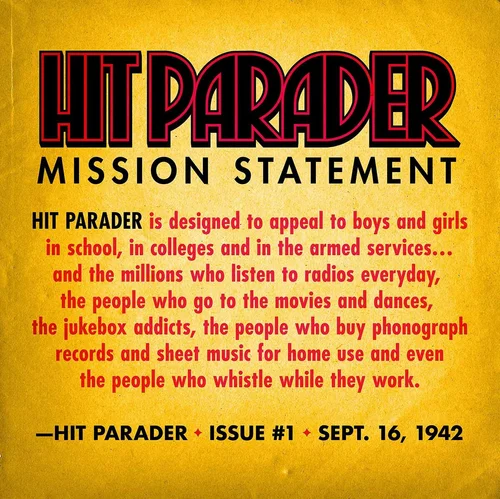
Hit Parader was launched in 1942[1] by Charlton Publications, based in Derby, Connecticut. Publishing its first issue on September 16, 1942, the magazine's original mission statement read as follows:

Hit Parader is designed to appeal to boys and girls in school, in colleges, and in the armed services... and the millions who listen to radio every day, the people who go to the movies and dances, the jukebox addicts, the people who buy phonograph records and sheet music for home use, and even the people who whistle while they work.[2]

Along with the likes of Billboard, DownBeat and Song Hits, Hit Parader was among the first and longest-lasting American music magazines. The magazine's title referenced the popular music "hit parade", a list of current hit singles determined either by sales or airplay. In its early years, the magazine largely consisted of lyrics to the hit songs of the day, a practice that remained until 1975 when licensing of the rights became too expensive. From that point onward it featured interviews, color photos, and feature articles on popular rock musicians.[3]

Emergence of rock music

[edit]

For much of the 1960s, Jim Delehant worked as a staff writer and editor for the magazine. According to his recollection, Hit Parader covered "an extremely boring music scene" in the early 60s prior to the emergence of hugely popular rock groups such as the Beatles and the Beach Boys in 1964. At that time, it was a common practice among music magazines to write fake articles pieced together from sources such as bios and publicity material distributed by the record companies. Hit Parader employed traveling rock journalists who spent time with the artists and wrote legitimate feature articles about them.[4] In addition to Delehant's contributions, Hit Parader also published articles by music journalists Ellen Sander, Keith Altham and Derek Taylor. Over the following decade, its contributors included Nick Logan, Barbara Charone, Lenny Kaye, Jonh Ingham, and Alan Betrock.[1]

Transition from rock to punk and new wave

[edit]

During the 1970s, Hit Parader frequently covered rock acts such as Led Zeppelin, the Rolling Stones, Elton John, David Bowie, Blue Öyster Cult, the Kinks, Three Dog Night, the Who, Cheap Trick, Kiss, and Van Halen. As the decade progressed the magazine began covering punk and new wave artists as well.[5] The magazine typically featured song lyrics, artist photos, feature articles, album reviews, interviews, reader mail, bits of trivia on popular rock acts, and readers' polls.

Secher era

[edit]

Longtime editor Andy Secher joined the magazine as an assistant editor in 1979 when the staff consisted of essentially two people. Secher was hired on the strength of an interview he had done with AC/DC which appeared in the New York Daily News and has said that Hit Parader's mission at that time was to simply survive month to month. During this period, editor Lisa Robinson had begun taking the magazine in the direction of new wave music, traveling to England four times a year to interview the Clash and positioning Hit Parader to be on the cutting edge of what Secher would later refer to as "the whole Avant-Garde, New Wave movement". The magazine struggled, printing 200,000 monthly copies but only selling approximately 30% of them. In 1980 Secher replaced Robinson as the magazine's editor and Shelton Ivany came on board as editor-in-chief, and it was under their leadership that Hit Parader moved away from new wave music for good, becoming the first monthly publication to focus exclusively on hard rock and heavy metal.[6][5]

"...we were the first magazine in the world to focus exclusively on hard rock/heavy metal. We were a bit lucky in that the New Wave of British Heavy Metal was just kicking in, and the West Coast Metal Explosion was about to launch. Our timing was very good. We've stayed loyal to hard rock throughout the years because that's where my interest remains. Trends, bands and fans have come and gone, but hard rock has stayed strong." - Andy Secher in 2004[5]

The move paid immediate dividends and Hit Parader began selling a half-million copies every month, a 450% increase in sales.[6] Secher recognized the magazine's target demographic as the young suburban male, whom he referred to as "some 17-year-old kid in Iowa, not a socialite in Manhattan", and attributed Hit Parader's longevity and success to its ability to anticipate trends in music months in advance.[5]

By 1984, the magazine was focusing solely on heavy metal.[3] The magazine's top-selling issue of all time was its June 1984 issue which was the first cover story devoted to a rising band from Los Angeles called Mötley Crüe. Upon arriving in Mexico in December 1983 to interview the band, Secher was met by lead vocalist Vince Neil and taken to the group's hotel where he found "this young woman, spread eagle on the bed, naked, and they're going at her with a wine bottle". Though he had to sanitize the story heavily before it could be published, the issue nonetheless created a firestorm of controversy which saw retailers such as 7-Eleven threaten to take the magazine off its shelves. Over the ensuing decade, Hit Parader became one of America's leading heavy metal publications, providing extensive coverage of the era's popular acts such as Mötley Crüe, Quiet Riot, Def Leppard, Ratt, and Ozzy Osbourne. During this period the magazine also published special bonus issues with titles such as Hit Parader's Heavy Metal Hot Shots and Hit Parader's Heavy Metal Heroes. Secher often went on the road to meet the artists personally. "Ozzy in Brazil, Dio in Japan, Bon Jovi in Canada, the Scorpions in Sweden...it goes on and on. There's no question that the times were bigger and brighter in the '70s and '80s," he has said of this era.[5][6]

Secher produced a spinoff television program entitled Hit Parader's Heavy Metal Heroes on USA Network which featured heavy metal music videos and short interviews with the artists who regularly appeared in the magazine.[6] During its 1980s heyday, Hit Parader featured the work of rock journalists such as Charley Crespo, Jodi Summers, Wolfgang Schnapp, Adrianne Stone, Rob Andrews, Winston Cummings, and Rick Evans.

Post-1980s decline

[edit]

Hit Parader fell into decline in the 1990s, with a handful of factors contributing to this. Facing financial troubles in 1991, Charlton sold off Hit Parader to raise money.[3] Later that year, Guns N' Roses' hugely successful Use Your Illusion II album included a track entitled "Get in the Ring", the lyrics of which accused Secher and Hit Parader of "printin' lies instead of the things we said" and "rippin' off the fuckin' kids … [and] startin' controversy". The song was written in response to a March 1991 Hit Parader cover piece written by Secher in which the band's vocalist Axl Rose and Sebastian Bach of Skid Row were ostensibly interviewed together for the first time. However, it soon came to light that rather than the exclusive it claimed to be, the interview was instead merely a transcript of a telephone conversation between the two musicians and Howard Stern that had earlier been broadcast on Stern's popular radio-show. The pair, along with Rose's then-wife Erin Everly, had talked to Stern during a party at Rose's home, and some observers questioned whether it even constituted a true interview.[7] Rose and Bach both claimed that Hit Parader editor Andy Secher was misleading his readers with such tactics.

With the dramatic decline in the popularity of heavy metal in the 1990s, Hit Parader's monthly readership began a steady decline. Many observers have noted that everything changed almost overnight with the emergence of Nirvana and grunge music in 1991, and Secher agrees wholeheartedly with this conclusion. Of the magazine's 1970s and 1980s heyday, Secher has said "The stories are too many, and in some cases too wild, to be printed here."[5]

Speaking to the music website rockcritics.com in the early 2000s, Secher identified the magazine's target readership as "a young, male demographic … They want short, pithy interviews and features – along with BIG color photos. The formula is fairly basic." He also defended Hit Parader's championing of heavy metal, despite the disapproval the genre attracted from some music critics, saying: "I always sensed that people like Christgau had to justify their existence by promoting the artistic aesthetics of the rock form. I've never taken any of this that seriously. Hit Parader isn't the New York Times … it's a frikkin' fanzine, and proud to be exactly that."[5]

The magazine closed down following the publication of its December 2008 issue.[3] During its years of operation, Hit Parader also published issues dedicated to "Top 100" lists, such as "Top 100 Metal Bands", "Top 100 Guitarists", "Top 100 Vocalists" and "Top 100 Bassists & Drummers".

Rebirth as a production studio

[edit]

In 2020, entertainment industry veterans Matt Pinfield, Ash Avildsen, and Josh Bernstein purchased the rights to Hit Parader and resurrected it as a branded production company. The new Hit Parader was headquartered in the Panasonic building in Universal City with a mission statement to focus "on original content and immersive experiences." It announced plans for a new television series entitled Paradise City, which Avildsen described as "a mix of the young angst of Euphoria, the entertainment biz authenticity of Entourage and the supernatural fun of Sabrina", featuring Drea de Matteo and Bella Thorne. An eight-episode season airing on Amazon Prime was released in 2021.[8] The use of the Hit Parader brand remained rather inactive other than its use sponsoring festivals such as 2024's relaunch of the Mayhem Festival.

Relaunch of print magazine

[edit]

On October 2, 2025 the musician Yungblud announced that he would be the initial cover on the relaunch of Hit Parader. He went on to state "Honoured to be on the first cover of the revamped Hit Parader! I grew up with this magazine and the legends that were on the cover. Available in print now."[9] The first edition of the magazine was released in October with monthly editions set to be released thereafter.[10] Alongside this announcement, it was revealed that Yungblud played a surprise event at the private Hit Parader Club in Nashville, Tennessee for the final stop on his IDOLS Tour in the United States on September 25, 2025.

Subsequent issues released have featured artists like Orville Peck and Zedd on the cover. [11]

References

[edit]
[edit]
Revisions and contributorsEdit on WikipediaRead on Wikipedia
from Grokipedia
Hit Parader was an American music magazine published monthly from 1942 to 2008 by Charlton Publications, initially featuring to popular before evolving into a key outlet for , , and heavy metal coverage. Founded on September 1, 1942, in , the magazine began as a digest of song and trivia aimed at general audiences during the and . By the mid-1960s, it expanded to include news, album reviews, artist interviews, and polls, prominently featuring emerging acts like , , and , which broadened its scope and hired professional journalists. In the 1970s and 1980s, Hit Parader solidified its reputation in rock with in-depth interviews from icons such as , , , and The Who, while shifting its primary focus to heavy metal and under editor Andy Secher, which significantly boosted its readership during the genre's rise. The magazine's coverage during this era included extensive features on metal bands, contributing to its status as a staple for fans of the style, though it faced circulation declines in the amid the movement and changing music media landscapes. Publication ceased in 2008 after 66 years, marking the end of its print run, but in 2020, the brand was revived as a production studio by Sumerian Records founder Ash Avildsen, music executive , and personality , focusing on TV series, films, live events, and music competitions like the scripted show and the event series Golden Gods. In 2025, the magazine was relaunched in print on October 2 by Sumerian Publishing Group in , with as the cover star of the first issue, edited by Nathan Yocum and returning to its roots in rock and pop coverage. This reimagining positions Hit Parader as a multimedia entity rooted in its legacy of championing rock and metal culture.

Overview

Founding and Initial Scope

Hit Parader was launched in by Charlton Publications, Inc., based in , as a monthly dedicated to . The first issue appeared in September of that year, priced at 15 cents, marking Charlton's expansion from printing song sheets into full periodicals. The magazine's initial scope centered on promoting through lyrics of current hit songs drawn from radio broadcasts, , and stage productions, alongside brief features on entertainment trends. Early issues highlighted popular tunes of the era, such as "He Wears a Pair of Silver Wings," reflecting the sound dominant at the time. Content emphasized accessibility for fans, tying directly into radio hits to encourage home and sheet music sales. Charlton Publications originated as a song lyric printing operation founded by Italian immigrant John Santangelo in the early , partnering with Ed Levy to formalize the business. The company, previously known for pulp-style sheets with print runs reaching millions monthly by , rebranded and professionalized Hit Parader to capture the era's music enthusiasm. Circulation launched strongly at 600,000 copies per month, supported by newsstand distribution and ASCAP licensing for official lyrics.

Evolution of Focus and Format

In the 1940s, Hit Parader was published in a standard format of approximately 8.5x11 inches, with predominantly black-and-white interiors focused on text-heavy layouts featuring song and basic information. Content-wise, the early 1950s saw Hit Parader emphasizing and doo-wop acts, with features on popular crooners and vocal groups that dominated the charts, including coverage of Bill Haley's rising influence as rock 'n' roll began to take shape. As the decade progressed, the magazine pivoted toward influences, incorporating more reviews and bios of s blending R&B with emerging rock elements, while maintaining its core of song to aid fans in following hits. The branding as "The Magazine of Hit Songs" endured through this period into the , underscoring its dedication to accessible music content like , short biographies, and record critiques. This growth set the foundation for the magazine's full immersion in during the .

Publication History

Early Years (1942–1950s)

Following , Hit Parader expanded its coverage to include more content on variety shows and Hollywood productions, reflecting the era's booming entertainment industry. Issues from 1945 frequently featured song tied to film soundtracks, such as those from Warner Bros.' To Have and Have Not starring and , alongside popular tunes like "The Trolley Song" and "I'll Walk Alone." This approach helped the magazine capitalize on the postwar surge in movie musicals and radio broadcasts of hit songs, providing readers with accessible and for songs dominating the charts. The magazine encountered significant operational challenges during 1946–1947 due to widespread postwar paper shortages that plagued the publishing sector, resulting in thinner issues with reduced page counts compared to prewar standards. For instance, the April 1946 edition, while maintaining core features like for "Just a Little Fond Affection" and references to films such as Swing Parade of 1946, appeared more compact amid these resource constraints. Additionally, rising competition from and the emergence of 45 RPM records in the late 1940s—introduced by RCA Victor in 1949—pressured Hit Parader to adapt by incorporating more song reviews and chart summaries to stay relevant in the shifting consumption landscape. Key milestones marked the magazine's maturation in the late 1940s and early , including the introduction of color covers, which enhanced visual appeal amid recovering print capabilities. By , Hit Parader launched reader polls for top hits, engaging its primary audience of young adults and teens with interactive features on popular tunes. Content often highlighted jukebox charts and licensing details from organizations like ASCAP and BMI, as seen in the September issue crediting songs such as "" (ASCAP) and "" (BMI). This focus catered to a demographic eager for insights into the era's sales and broadcast royalties, solidifying the magazine's role in the ecosystem before rock influences began emerging in the late .

Rock Emergence and Growth (1960s–1970s)

In the mid-1960s, Hit Parader adapted to the rising popularity of amid the , beginning with extensive coverage of in issues such as the November 1964 edition, which also featured and . By 1965, the magazine introduced dedicated sections on emerging rock acts, including profiles of The Who and other Invasion-era bands, reflecting a pivot from its earlier emphasis on popular song lyrics to more dynamic rock-oriented content. This shift aligned with the genre's cultural surge, as the publication incorporated interviews and articles that captured the energy of the era's transatlantic sound. The magazine's circulation grew steadily through the late 1960s into the 1970s, driven by the rock boom and expansions like poster inserts of popular artists and reviews of major events. For instance, following the 1969 Woodstock festival, Hit Parader published aftermath coverage that highlighted performances by acts like and , contributing to its appeal among teenage readers. These innovations, including color posters and live concert recaps, helped double the publication's relevance in a competitive market, with content increasingly tailored to the counterculture's album-driven tastes. Entering the 1970s, Hit Parader diversified its rock coverage to encompass and glam styles, exemplified by a January 1971 feature interview with Led Zeppelin's discussing the band's evolving dynamics. Similarly, 1972 issues spotlighted David Bowie's glam persona amid his rise with albums like The Rise and Fall of Ziggy Stardust and the Spiders from Mars, integrating photography-heavy layouts that responded to the format popularized by FM radio stations. This era marked an editorial evolution, with the magazine reducing in favor of visual elements and in-depth artist profiles, sustaining circulation while bridging the gap to emerging punk influences by the decade's end.

Heavy Metal Dominance and Transitions (1980s)

During the early 1980s, Hit Parader shifted its editorial focus almost exclusively to heavy metal and music, reflecting the genre's rising commercial prominence. This specialization was evident in frequent cover features and in-depth interviews with key bands, such as and , which highlighted the New Wave of British Heavy Metal and established acts dominating the scene. To engage its readership, the magazine launched its annual Heavy Metal Awards in the mid-1980s, recognizing top performers in categories like best album and vocalist, with early editions spotlighting acts including Mötley Crüe, , and . While the publication occasionally nodded to emerging trends like punk and new wave—such as a September 1980 cover story on —it quickly pivoted back to metal-centric content amid the genre's explosive growth. In response to the launch of in 1981, Hit Parader began incorporating reviews starting around 1982, adapting to the visual shift in rock promotion by critiquing clips from bands like and . The heavy metal emphasis, particularly the "hair metal" substyle popularized by bands like Mötley Crüe, propelled circulation to its highest levels in the mid-, coinciding with expanded distribution that reached international markets including . However, this era also brought challenges, as the 1985 formation of the (PMRC) sparked widespread backlash against explicit content in heavy metal lyrics and imagery, prompting Hit Parader to moderate its language in subsequent issues to navigate parental concerns and potential regulatory scrutiny. In the early , incoming editor Andy Secher began influencing the magazine's direction toward further refinements in coverage.

Secher Era Innovations

Andy Secher assumed the role of editor at Hit Parader in , drawing on his prior experience in music , including contributions to a syndicated column called "Rock USA." His tenure marked a pivotal shift toward and in-depth artist profiles, transforming the magazine into a key platform for and heavy metal coverage. This approach helped differentiate Hit Parader from competitors by prioritizing substantive reporting over superficial content. One of Secher's key innovations was the complete reorientation of the magazine's focus to heavy metal and starting in , which resulted in a 450% increase in readership, with sales improving significantly from around 60,000 and the press run reaching 500,000 copies monthly by 1984. To extend the brand's reach, he launched the companion TV series Heavy Metal Heroes on the in 1984, featuring video clips and interviews that mirrored the magazine's content. In the late , Secher introduced enhanced production elements, including upgraded glossy paper stock and thematic issues that explored specific subgenres and trends within metal. A notable example was the 1990 "Women in Metal" feature, highlighting artists like and amid the male-dominated scene. Coverage under Secher evolved to include deeper explorations of emerging styles, such as , with a prominent 1989 feature on Metallica that delved into the band's aggressive sound and growing influence. As gained traction in the early , the magazine adapted by previewing acts, including a 1991 profile on Nirvana that anticipated their breakthrough with . These shifts helped stabilize circulation at approximately 500,000 issues per month during the late 1980s and early , sustaining the publication amid broader industry changes in heavy metal's popularity.) Secher departed as editor in 1992 following ownership transitions at the publisher, leaving a legacy of modernized visuals and content strategies that temporarily staved off the magazine's decline. His emphasis on fan engagement and genre evolution positioned Hit Parader as an influential voice in music journalism during a transitional era for rock.

Decline and Cessation (1990s–2008)

In the 1990s, Hit Parader encountered significant challenges as the popularity of heavy metal waned with the rise of grunge and alternative rock, contributing to the magazine's reduced relevance amid growing competition from broader music publications. The shift in musical tastes diminished the demand for its traditional heavy metal focus, exacerbating financial pressures on the industry. Ownership changes marked a turbulent period for the publication. In 1991, original publisher Charlton Publications, facing severe financial troubles, sold Hit Parader to new owners as part of efforts to stabilize the company before its eventual bankruptcy. Subsequent attempts to revitalize the magazine, such as special issues on heavy metal themes in the early , struggled against declining in a fragmenting print market. By the early 2000s, Hit Parader sought to adapt by covering emerging nu-metal acts, exemplified by its August 2000 cover featuring , though its established style increasingly appeared outdated to younger audiences. However, the rapid dominance of and online music platforms eroded print circulation and ad support across the sector, rendering traditional magazines like Hit Parader unsustainable. The magazine published its final issue in December 2008, concluding over six decades of operation and marking the end of its print era.

Revival as Production Studio (2020)

In July 2020, Hit Parader was revived by music industry executives Ash Avildsen and Josh Bernstein as a multimedia production studio under Hit Parader LLC, marking a shift from its print roots to creating branded content in television, film, and live events. The relaunch emphasized legacy rock and metal genres, with Avildsen serving as CEO and former MTV VJ Matt Pinfield appointed as vice president of artist relations to guide creative partnerships. No print publications were planned at the outset, focusing instead on revenue streams from new productions and licensing of the magazine's iconic archival covers and imagery. Early initiatives included development of scripted and unscripted television projects tailored to rock audiences, such as the scripted series Paradise City, which drew on the brand's heavy metal heritage, and the reality competition No Cover, hosted by Pinfield and pitched as a rock-oriented talent showcase. Additional formats encompassed Roadie Rage, a music competition highlighting behind-the-scenes industry roles, and exploratory ventures like a global rock-themed esports tournament in partnership with Super League Gaming. The studio also announced intentions to revive legacy events, including the Mayhem Festival and Golden Gods Awards, to blend live experiences with media production. By 2023, the production arm had established a core team to oversee these endeavors, prioritizing high-impact collaborations within the rock and metal ecosystem while generating income through content licensing and event tie-ins. This phase laid the groundwork for Hit Parader's evolution, culminating in a return to print magazine format in 2025.

2025 Magazine Relaunch

In May 2025, Hit Parader LLC announced the relaunch of the magazine in print format, with bassist joining as a to contribute regular features. The full relaunch was confirmed in September 2025, marking a return to physical publication after building on the foundation of the 2020 revival as a production studio. Issue #1, released in October 2025, featured on the cover and included interviews with contemporary rock artists, reprints of select archival content from the magazine's history, and McKagan's debut column detailing the early years and evolution of . To celebrate the relaunch, a launch party took place on September 25, 2025, in , highlighted by a live performance from . The relaunch aims to bridge classic heavy metal roots with emerging rock talents.

Content and Editorial Approach

Magazine Style and Features

Hit Parader employed a visually dynamic style characterized by bold, typography that emphasized headlines and artist names, creating an energetic and attention-grabbing aesthetic aimed at engaging young music fans. From the onward, issues frequently incorporated full-page artist photographs and fold-out posters, such as the centerfold poster in the September 1972 edition, which allowed readers to display band imagery prominently. By the , color interiors became standard, enhancing the vibrancy of photo spreads and , as seen in the May 1978 issue featuring vivid depictions of rock acts like and . Recurring features formed the backbone of the magazine's content, providing consistent touchpoints for readers across decades. The "Hit List" charts, originating in the and continuing through the , ranked popular songs and albums, offering a curated snapshot of current hits similar to the "Hit List" segment in the August 1995 issue. Record reviews utilized a 1–5 star to evaluate new releases, delivering concise that balanced with critique, as exemplified by the 4/5 star assessment of a 1986 album in the magazine's pages. The fan letters section, often titled "We Read Your Mail" or akin to "Parader's Postbag," showcased reader correspondence, fostering a sense of community; for instance, the August 1967 edition published letters praising emerging groups like . The layout balanced editorial content with commercial elements, typically allocating 8–10 pages to advertisements per issue, including record promotions and concert tie-ins that supported the music industry's ecosystem. From the , thematic departments such as "New Releases" and "Concert Guide" became staples, guiding readers through upcoming albums and tour schedules, as evident in the August 1987 issue's dedicated sections. Overall, issues maintained a length of 60–80 pages, allowing space for , trivia, and in-depth features without overwhelming the reader. The magazine's tone was consistently enthusiastic and fan-oriented, adopting a conversational prose that mirrored the excitement of its audience. In 1960s issues, writers incorporated era-specific slang like "groovy" to describe innovative sounds, such as in coverage of psychedelic rock acts, cultivating an accessible, insider feel. This approach persisted into later decades, with promotional language like "the powerful new album" in 1980s reviews, though the Secher era briefly refined it toward more polished narratives.

Notable Interviews and Covers

Hit Parader's reputation for capturing pivotal moments in rock and metal history was built through landmark covers and interviews that spotlighted emerging and established icons, often coinciding with cultural shifts in music. One of the magazine's earliest breakthroughs came with its May 1964 cover featuring , marking the publication's transition from pop standards to rock acts amid and boosting its visibility among youth audiences. This issue, centered on the band's rapid rise, symbolized Hit Parader's pivot toward rock coverage, with features on their U.S. invasion and influence on global pop culture. In the heavy metal era, the March 1981 cover spotlighted during his post-Black Sabbath solo phase, following the 1980 release of , and included discussions on his evolving sound and personal challenges after leaving the band. Similarly, the May 1985 issue featured an in-depth interview with Mötley Crüe bassist , where the band shared candid tour confessions about their hedonistic lifestyle and the excesses of the Theatre of Pain era, resonating with fans during the glam metal boom. The January 1975 cover with Led Zeppelin captured the band at their commercial peak, aligning with the release of and underscoring their dominance in , though specific sales figures for the issue remain undocumented in archival records. Standout interviews further cemented the magazine's legacy, such as the January 1968 feature with , where he reflected on his creative process post-Monterey Pop Festival performance and offered insights into tracks like "," including its psychedelic inspirations drawn from a science-fiction novel, preserving quotes like his description of the song as evoking a "purple haze all in my brain." In September 1992, discussed Nirvana's ethos and the pressures of fame in the interview "Nirvana Smells Like Success," providing rare personal reflections amid the band's explosion. The September 2001 issue highlighted during nu-metal's zenith, featuring the band alongside contemporaries like Korn and exploring their fusion of rap and aggression in the wake of Chocolate Starfish and the Hot Dog Flavored Water. The 2025 relaunch amplified this tradition with its inaugural issue cover starring (Dom Harrison), who reflected on the magazine's influence from his youth and its role in bridging with modern punk revival. These selections were chosen for their cultural resonance, prioritizing stories that captured era-defining artists and preserved archival quotes, such as Hendrix's, in music collections.

Key Editors and Contributors

In its formative years during the and , Hit Parader was published by Charlton Publications and primarily featured content on standards, though specific editorial leadership from this period remains sparsely documented in historical records. The magazine's shift toward rock coverage began in the under the influence of key staff like Jim Delehant, who served as a writer and editor from 1962 to 1968, contributing profiles and interviews that captured the era's emerging artists such as and . Other notable contributors during this time included , who provided profiles on acts like in 1968–1969, and Val Wilmer, who covered blues and jazz figures from 1964 to 1969. These writers helped expand the publication's scope beyond to more dynamic rock journalism, with editors overseeing a modest team of 5–10 staff and freelancers. By the 1970s, took over as editor, steering Hit Parader toward new wave and punk influences with her frequent trips to for exclusive interviews, while maintaining a core staff that emphasized timely music reporting. Contributors from this decade included freelancers like and Alan Betrock, who added depth to coverage of and emerging rock scenes, alongside photographers such as , whose shoots documented key 1970s performances. The 1980s marked a pivotal era under Andy Secher, who joined as assistant editor in 1979 and succeeded Robinson as editor in 1980, transforming the magazine into a leading heavy metal outlet with innovative layouts that highlighted band histories and visual storytelling. Secher oversaw a growing but still lean operation—starting with just two staff members—that ballooned to include 5–10 writers and regular freelance photographers like Brad Elterman and Paul Natkin, whose images captured the era's metal icons. In the magazine's 2025 relaunch, bassist joined as a , contributing insights from his decades in rock to the revived publication's inaugural issue in October.

Legacy and Impact

Cultural Role in Music Journalism

Hit Parader played a pivotal role in popularizing heavy metal in the United States during the by shifting its editorial focus exclusively to the genre, which resulted in a 450% increase in readership and a monthly press run of 500,000 copies. This transition, beginning around 1980 under editor Andy Secher, emphasized coverage of commercial heavy metal acts such as , , and , helping to elevate the genre's visibility and commercial viability within mainstream discourse. The magazine's features and contributed to building dedicated fan communities, often through tie-ins like advertisements for mail-order merchandise that allowed enthusiasts to access band-related products directly. In the broader landscape of , Hit Parader positioned itself as a more accessible alternative to publications like , which increasingly covered punk, new wave, and broader pop acts during the late and , while Hit Parader remained steadfastly dedicated to the heavy metal niche. It fostered artist-fan connections through in-depth interviews and reader engagement sections, such as letters to the editor that captured the era's fan sentiments and debates. These elements not only bridged performers and audiences but also preserved oral histories of the genre's via extensive artist profiles archived in collections. Despite its influence, Hit Parader faced criticisms for in the 1980s, particularly in its portrayal of heavy metal's "sex, drugs, and rock 'n' roll" tropes, as seen in controversial stories about bands like Mötley Crüe that boosted sales but risked alienating retailers. Following its cessation in 2008, the magazine's legacy endured in niche music media, and its 2025 relaunch as a print publication has been framed as a nostalgia-driven effort to revive tangible amid digital dominance.

Archives, Collectibility, and Availability

Vintage issues of Hit Parader from the 1960s to hold significant collectible value among enthusiasts, driven by their coverage of seminal artists and the magazine's role in documenting the era's music scene. Factors such as overall condition, presence of posters or centerfolds, and iconic cover features—particularly those involving or heavy metal bands—greatly influence market prices, with well-preserved copies often commanding premiums over common issues in fair condition. For instance, the May 1964 issue featuring , , and is listed at $49.95 by specialty retailers, while the May 1970 Beatles cover (sans label) sells for $29.95, reflecting the heightened demand for Beatlemania-era editions. Similarly, the November 1964 issue centered on "A Hard Day's Night With ," Peter & Gordon, and , appears in good condition on auction sites, typically valued in the $20–$50 range depending on wear, though rarer autographed or complete lots from the heavy metal period can exceed $100. Archival preservation of Hit Parader content is facilitated by several digital repositories, providing researchers and fans with access to historical material. Rocks Backpages maintains a subscription-based library with 192 digitized articles, interviews, and reviews from the magazine, spanning from 1964 to 1983 and covering artists from The Beatles to early heavy metal acts. The Internet Archive hosts an extensive collection of 722 items, including partial scans of individual issues uploaded since 2022, available for free download, borrowing, or streaming to support public access. Partial scans and full-issue PDFs also circulate through online marketplaces like eBay, where digital lots of 400+ issues from the 1960s–1990s are offered for $29.99 on USB drives. Back issues of Hit Parader remain available through a mix of physical and digital channels, catering to collectors and casual readers alike. Physical copies, especially from the , are sold via online platforms like and dedicated vintage magazine outlets such as Original Magazines, which stocks over 60 issues from that period in excellent condition, often including original posters. For the 2025 relaunch, new print editions featuring covers like are obtainable directly from hitparader.com, with one-year subscriptions promoted at $0.00 introductory rates (no automatic renewal), potentially including digital access to fresh content. Historical digital editions are primarily accessed via the archives noted above, enhancing availability without requiring physical ownership. Preservation efforts for Hit Parader's legacy gained momentum with its revival as a production studio under CEO Ash Avildsen, focusing on , film, and live events to reintroduce the brand's rock heritage through projects like the reality series No Cover. Fan-driven initiatives have further supported archival work, with communities such as r/hairmetal and r/vanhalen sharing links to scanned collections and folders of issues since early 2024, intensifying after the 2025 magazine relaunch to preserve rare content amid growing . These community efforts complement formal , ensuring broader dissemination of the magazine's interviews and features.

References

Add your contribution
Related Hubs
User Avatar
No comments yet.