Hubbry Logo
BeatlemaniaBeatlemaniaMain
Open search
Beatlemania
Community hub
Beatlemania
logo
8 pages, 0 posts
0 subscribers
Be the first to start a discussion here.
Contribute something
Beatlemania
Beatlemania
from Wikipedia
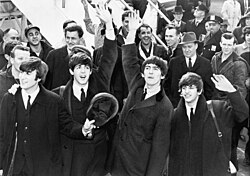
The Beatles arriving in the United States at John F. Kennedy International Airport in Queens, New York. 7 February 1964

Beatlemania was the fanaticism surrounding the English rock band The Beatles from 1963 to 1966. The group's popularity grew in the United Kingdom in late 1963, propelled by the singles "Please Please Me", "From Me to You" and "She Loves You". By October, the British press adopted the term "Beatlemania" to describe the scenes of adulation that attended the band's concert performances. By 22 February 1964, the Beatles held both the number one and number two spots on the Billboard Hot 100, with "I Want to Hold Your Hand" and "She Loves You", respectively.

In February 1964, the Beatles arrived in the United States and their televised performances on The Ed Sullivan Show were viewed by approximately 73 million people. There, the band's instant popularity established their international stature, and their unprecedented domination of the national sales charts was mirrored in numerous other countries. Their August 1965 concert at New York's Shea Stadium marked the first time that a large outdoor stadium was used for such a purpose, and with an audience of 55,000, set records for attendance and revenue generation. To protect themselves from their fans, the Beatles typically travelled to these concerts by armoured car. From the end of that year, the band embraced promo clips for their singles to avoid the difficulties of making personal appearances on television programmes. Their December 1965 album Rubber Soul marked a profound change in the dynamic between fans and artists, as many Beatles fans sought to appreciate the progressive quality in the band's look, lyrics and sound.

In 1966, John Lennon controversially remarked that the group had become "more popular than Jesus". Soon afterwards, when the Beatles toured Japan, the Philippines and the US, they were entangled in mob revolt, violence, political backlash and threats of assassination. Frustrated by the restrictions of Beatlemania and unable to hear themselves play above their fans' screams, the group stopped touring and became a studio-only band. Their popularity and influence expanded in various social and political arenas, while Beatlemania continued on a reduced scale from then and into the members' solo careers.

Beatlemania surpassed any previous examples of fan worship in its intensity and scope. Initially, the fans were predominantly young adolescent females, sometimes called "teenyboppers", and their behaviour was scorned by many commentators. By 1965, their fanbase included listeners who traditionally shunned youth-driven pop culture, which helped bridge divisions between folk and rock enthusiasts. During the 1960s, Beatlemania was the subject of analysis by psychologists and sociologists; a 1997 study recognised the phenomenon as an early demonstration of proto-feminist girl power.[citation needed] The receptions of subsequent pop acts – particularly boy bands and Taylor Swift – have drawn comparisons to Beatlemania.

Interpretations and precursors

[edit]

In the description of author and musician Bob Stanley, the band's domestic breakthrough represented a "final liberation" for the nation's teenagers and, by coinciding with the end of National Service, the group "effectively signaled the end of World War II in Britain".[1]

During the 1840s, fans of Hungarian pianist and composer Franz Liszt showed a level of fanaticism similar to that of the Beatles. Poet Heinrich Heine coined "Lisztomania" to describe this.[2] Once it became an international phenomenon in 1964, Beatlemania surpassed in intensity and reach any previous examples of fan worship, including those afforded to Rudy Vallée,[3] Frank Sinatra, and Elvis Presley.[4] One factor in this development may have been the post–World War II baby boom, which gave the Beatles a larger audience of young fans than Sinatra and Presley had a decade earlier.[2]

Psychologists during the 1960s were especially drawn to the significance of the long hair preferred by the Beatles and the bands that emerged soon after their breakthrough. Academics proposed that the long hair signalled androgyny and thus presented a less threatening version of male sexuality to teenage girls, as well as allowing male fans to view the group in a sexual regard that they normally reserved for young females. Other concerns related to the Beatles' own sexuality; whether the haircuts were a projection of latent homosexuality or confident heterosexuality.[5] In their 1986 book Re-making Love: The Feminization of Sex, authors Barbara Ehrenreich, Elizabeth Hess and Gloria Jacobs argued that the band's presentable suits meant that they seemed less "sleazy" than Presley to middle-class whites.[4]

In February 1964, Paul Johnson wrote an article in the New Statesman which stated that the mania was a modern incarnation of female hysteria and that the wild fans at the Beatles' concerts were "the least fortunate of their generation, the dull, the idle, the failures".[6] The article became the "most complained-about piece" in the magazine's history.[7] A 1966 study published in the British Journal of Clinical Psychology rejected Johnson's assertion; the researchers found that Beatles fans were not likelier to score higher on Minnesota Multiphasic Personality Inventory's hysteria scale, nor were they unusually neurotic. Instead, they described Beatlemania as "the passing reaction of predominantly young adolescent females to group pressures of such a kind that meet their special emotional needs".[8]

1963: UK success

[edit]

"Please Please Me" and first UK tours

[edit]

The Beatles attracted a fan frenzy in the north of England since the start of the 1960s. Beatles historian Mark Lewisohn says that some who attended the band's 27 December 1960 show in Litherland claim that Beatlemania was "born" there, while Bob Wooler, who regularly presented the Beatles at Liverpool's Cavern Club, wrote in August 1961 that they were "the stuff that screams are made of" and were already playing to "fever-pitch audiences" at the Cavern. However, national recognition of "Beatlemania" eluded the band until late 1963.[9]

The Beatles outside the Birmingham Hippodrome, November 1963. Because the crowds were so thick, they had to be smuggled into the venue with assistance from local police.[10]

With the success of their second single "Please Please Me", the Beatles found themselves in demand for the whole of 1963. In the UK, the song reached number two on the Record Retailer chart (subsequently adopted as the UK Singles Chart),[11] and topped both the NME and Melody Maker charts.[12] The band released their first album in March 1963, also titled Please Please Me.[13] They completed four nationwide tours and performed at a great many single shows around the UK throughout the year, often finishing one show only to travel straight to the next show in another location – sometimes even to perform again the same day.[14][15] The music papers were full of stories about the Beatles, and magazines for teenage girls regularly contained interviews with the band members, colour posters, and other Beatle-related articles.[16] Lennon's August 1962 marriage to Cynthia Powell was kept from public view as a closely guarded secret.[17][nb 1]

On 2 February 1963, the Beatles opened their first nationwide tour at a show in Bradford featuring Helen Shapiro, Danny Williams, Kenny Lynch, Kestrels, and the Red Price Orchestra.[18] Heading the tour bill was 16-year-old Shapiro followed by the other five acts – the last of which was the Beatles. The band proved immensely popular during the tour, however, as journalist Gordon Sampson observed. His report did not use the word "Beatlemania", but the phenomenon was evident. Sampson wrote that "a great reception went to the colourfully dressed Beatles, who almost stole the show, for the audience repeatedly called for them while other artists were performing!"[19] The Beatles' second nationwide tour began on 9 March at the Granada Cinema in London, where the group appeared on a bill headed by American stars Tommy Roe and Chris Montez, both of whom had firmly established themselves in the UK singles charts.[20] Throughout the tour, the crowds repeatedly screamed for the Beatles, and the American stars were less popular than a homegrown act for the first time. The Beatles enjoyed the overwhelming enthusiasm, but they also felt embarrassment for the American performers at this unexpected turn of events, which persisted at every show on the tour.[21]

In May, the Beatles achieved their first number 1 single on the Record Retailer chart with "From Me to You".[1] McCartney later cited the song title, along with that of its B-side, "Thank You Girl", as an example of him and Lennon directly addressing the group's fans and appreciating that such a seemingly personal message resonated with their audience.[22] According to Stanley, the band provided a sense of liberation for fans of both sexes, in that "The boys could make as much noise as possible; the girls had something with dirt under its fingernails they could scream at."[1]

The Beatles began their third nationwide tour on 18 May, the bill this time headed by Roy Orbison. Orbison had established even greater UK chart success than either Montez or Roe, with four hits in the top 10,[23] but he proved less popular than the Beatles at the tour's opening show staged at the Adelphi Cinema, Slough. It soon became obvious that this was not going to change, and a week into the tour the covers of the souvenir programs were reprinted to place the Beatles above Orbison. Starr was nonetheless impressed with the response that Orbison still commanded, saying: "We would be backstage, listening to the tremendous applause he was getting. He was just doing it by his voice. Just standing there singing, not moving or anything."[24] The tour lasted three weeks and ended on 9 June.[25]

"She Loves You" and coinage of "Beatlemania"

[edit]

There was tremendous anticipation ahead of the release of the Beatles' fourth single, "She Loves You". Thousands of fans ordered the single as early as June 1963, well before its title had been known.[27] In July, the band convened at EMI Studios for the song's recording session, an occasion that was publicised in advance by the weekly pop papers.[28] More than a hundred fans congregated outside the studios, and dozens broke through a police blockade, swarming the building in search of the band.[29] By the day before the single went on sale in August, some 500,000 advanced orders had been placed for it.[27] "She Loves You" topped the charts and set several UK sales records.[30] The song included a "Yeah, yeah, yeah" refrain that became a signature hook for their European audiences; in addition, the song's falsetto "Ooh!"s elicited further fan delirium when accompanied by the vocalists' exaggerated shaking of their moptop hair.[31]

McCartney, Harrison, Swedish pop singer Lill-Babs, and Lennon on the set of the Swedish television show Drop-In, 30 October 1963

On 13 October, the Beatles starred on Val Parnell's Sunday Night at the London Palladium, the UK's top variety show.[32] Their performance was televised live and watched by 15 million viewers. One national paper's headlines in the following days coined the term "Beatlemania" to describe the phenomenal and increasingly hysterical interest in the Beatles – and it stuck.[32] Publicist Tony Barrow saw Beatlemania as beginning with the band's appearance on that program,[31] at which point he no longer had to contact the press but had the press contacting him.[33] Scottish music promoter Andi Lothian said that he coined "Beatlemania" while speaking to a reporter at the band's Caird Hall concert, which took place as part of the Beatles' mini-tour of Scotland on 7 October.[34][35] The word appeared in the Daily Mail on 21 October for a feature story by Vincent Mulchrone headlined "This Beatlemania".[36]

On 23 October 1963, the band flew from London to Stockholm for a seven-day concert tour to five cities in Sweden; their very first international tour as a famous group.[37] When they returned to London Airport on 31 October, they were greeted in heavy rain by 10,000 screaming fans,[38] 50 journalists and photographers, and a BBC TV camera crew. The wild scenes at the airport delayed the British Prime Minister Alec Douglas-Home, being chauffeured in the vicinity, as his car was obstructed by the crowds. The Miss World at the time was passing through the airport as well, but she was completely ignored by journalists and the public.[39] Ed Sullivan was also among those held up at the airport. He was told the reason for the delay and responded: "Who the hell are the Beatles?"[40]

Autumn UK tour and Christmas shows

[edit]

An admirer from their pre-fame days in Liverpool was shocked to witness a Beatles performance in 1963, at which every note of their music was buried beneath the screams of young girls. Why didn't they listen to their idols? she asked. "We came to see the Beatles", a fan replied. "We can hear them on records. Anyway, we might be disappointed if we heard them in real life."[41]

– Author Peter Doggett

On 1 November, the Beatles began their 1963 Autumn Tour, their first tour as undisputed headliners.[42] It produced much the same reaction from those attending, with a fervent, riotous response from fans everywhere they went. Police attempting to control the crowds employed high-pressure water hoses, and the safety of the police became a matter of national concern, provoking controversial discussions in Parliament over the thousands of police officers putting themselves at risk to protect the Beatles.[43]

On the first tour date, at the Odeon in Cheltenham, the volume of sound from the screaming crowds was so great that the Beatles' amplification equipment proved unequal to it – the band members could not hear themselves speaking, singing or playing.[39] The next day, the Daily Mirror carried the headline "BEATLEMANIA! It's happening everywhere ... even in sedate Cheltenham".[36] The Daily Telegraph published a disapproving article in which Beatlemania and the scenes of adulation were likened to Hitler's Nuremberg Rallies.[42][44] Adults, who had been accustomed to wartime deprivation in their youth, expressed concerns at the frenzied reaction given to pop groups such as the Beatles.[45] Alternatively, a Church of England clergyman remarked that a Beatles version of the Christmas carol "O Come, All Ye Faithful", sung as "O Come, All Ye Faithful Yeah Yeah Yeah",[26] might restore the popularity and relevance of the church in Britain.[46]

The tour continued until 13 December, with stops in Dublin and Belfast,[47] and marked the "pinnacle of British Beatlemania", according to Lewisohn.[48][nb 2] Maureen Lipman attended a concert in Hull as a sceptic, but 50 years later she recalled her "road to Damascus moment" when Lennon sang "Money (That's What I Want)": "Someone very close to me screamed the most piercing of screams, a primal mating call … I realised with an electric shock that the screaming someone was me." Lipman heard that the theatre "cleared away 40 pairs of abandoned knickers" from other young female fans, and she concluded, "life, as I knew it, was never the same again."[50]

On 21 and 22 December, the band gave preview performances of The Beatles' Christmas Show in Bradford and Liverpool, respectively.[51] Designed for the group's fans and performed with several other acts, the presentation combined comedy with musical sets and was subsequently performed twice daily (apart from on New Year's Eve) at the Finsbury Park Astoria in north London from 24 December to 11 January 1964.[52][nb 3] The Beatles also recorded the first of their annual fan club Christmas records, an initiative suggested by Barrow, which again included comedy skits and musical segments.[53] With the November 1963 release of their second album, With the Beatles, the group inaugurated a tradition of issuing a new Beatles LP in time for the Christmas sell-in period,[54] leading fans to congregate and hold listening parties over the holiday season.[55] Author Nicholas Schaffner, a teenager during the 1960s, said that these albums came to "evoke an intangible sense of Christmas" for many listeners as a result.[56]

1964–1965: International success

[edit]

US breakthrough and "I Want to Hold Your Hand"

[edit]

EMI owned Capitol Records, but Capitol had declined to issue any of the band's singles in the US for most of the year.[57] The American press regarded the phenomenon of Beatlemania in the UK with amusement.[58] Newspaper and magazine articles about the Beatles began to appear in the US towards the end of 1963, and they cited the English stereotype of eccentricity, reporting that the UK had finally developed an interest in rock and roll, which had come and gone a long time previously in the US.[58] Headlines included "The New Madness"[59] and "Beatle Bug Bites Britain",[58] and writers employed word-play linking "beetle" with the "infestation" afflicting the UK.[58] The Baltimore Sun reflected the dismissive view of most adults: "America had better take thought as to how it will deal with the invasion. Indeed a restrained 'Beatles go home' might be just the thing."[60] Rather than dissuading American teenagers, such disapproval from adults strengthened their connection with the band.[60]

The Beatles' American television debut was on 18 November 1963 on The Huntley–Brinkley Report, with a four-minute report by Edwin Newman.[61][62] On 22 November, the CBS Morning News ran a five-minute feature on Beatlemania in the UK which heavily featured their UK hit "She Loves You". The evening's scheduled repeat was cancelled following the assassination of President John F. Kennedy the same day. On 10 December, Walter Cronkite decided to run the piece on the CBS Evening News.[63]

American chart success began after disc jockey Carroll James obtained a copy of the British single "I Want to Hold Your Hand" in mid-December and began playing it on AM radio station WWDC in Washington, DC.[64] Listeners repeatedly phoned in to request a replay of the song, while local record shops were flooded with requests for a record that they did not have in stock.[65] James sent the record to other disc jockeys around the country, sparking similar reaction.[60] On 26 December, Capitol released the record three weeks ahead of schedule.[65] It sold a million copies and became a number-one hit in the US by mid-January.[66] Epstein arranged for a $40,000 American marketing campaign,[64] a deal Capitol accepted due to Ed Sullivan's agreement to headline the Beatles on The Ed Sullivan Show.[67]

First visit to the US and Ed Sullivan Show performances

[edit]

In advance of the Beatles' arrival in the US, Time magazine reported that the "raucous sound" of the band's screaming fans made their concerts "slightly orgiastic". The seating at venues would be soaked in urine after each show and, in Doggett's description, "Sociologists noted that witnessing a pop group provoked orgasms amongst girls too young to understand what they were feeling."[41] David Holbrook wrote in the New Statesman that it was "painfully clear that the Beatles are a masturbation fantasy, such as a girl presumably has during the onanistic act – the genial smiling young male images, the music like a buzzing of the blood in the head, the rhythm, the cries, the shouted names, the climaxes."[68]

On 3 January 1964, The Jack Paar Program ran Beatles concert footage licensed from the BBC "as a joke" to an audience of 30 million viewers.[60] On 7 February, an estimated 4,000 Beatles fans were present as Pan Am Flight 101 left Heathrow Airport.[69] Among the passengers were the Beatles on their first trip to the US as a band, along with Phil Spector and an entourage of photographers and journalists.[70] On arrival at New York's newly renamed John F. Kennedy International Airport, they were greeted by a crowd of 4,000 Beatles fans and 200 journalists.[71] A few people in the crowd were injured, and the airport had not previously experienced such a large crowd.[72] The band held a press conference where they met disc jockey Murray the K, then they were driven to New York City, each in a separate limousine.[73] On the way, McCartney turned on a radio and listened to a running commentary: "They have just left the airport and are coming to New York City."[74] When they reached the Plaza Hotel, they were besieged by fans and reporters.[75] Author André Millard, writing in his book Beatlemania: Technology, Business, and Teen Culture in Cold War America, says that it was this constant fan presence – outside the band's hotels, UK residences, and recording studios – that gave Beatlemania an "extra dimension that lifted it above all other incidents of fan worship".[76]

The Beatles with Ed Sullivan, February 1964

The Beatles made their first live US television appearance on 9 February,[77] when 73 million viewers watched them perform on The Ed Sullivan Show at 8 pm – about two-fifths of the American population.[78] According to the Nielsen ratings audience measurement system, the show had the largest number of viewers that had been recorded for an American television program.[79] The Beatles performed their first American concert on 11 February at Washington Coliseum, a sports arena in Washington, DC, attended by 8,000. They performed a second concert the next day at New York's Carnegie Hall, which was attended by 2,000, and both concerts were well received.[80] The Beatles then flew to Miami Beach and made their second television appearance on The Ed Sullivan Show on 16 February, which was broadcast live from the Napoleon Ballroom of the Deauville Hotel in Miami Beach with another 70 million viewers. On 22 February, the Beatles returned to the UK and arrived at Heathrow airport at 7 am, where they were met by an estimated 10,000 fans.[80]

An article in The New York Times Magazine described Beatlemania as a "religion of teenage culture" that was indicative of how American youth now looked to their own age group for social values and role models.[81] The US had been in mourning, fear and disbelief over the assassination of President John F. Kennedy on 22 November 1963,[82] and contemporary pundits identified a link between the public shock and the adulation afforded the Beatles eleven weeks later.[83] According to these writers, the Beatles reignited the sense of excitement and possibility that had faded in the wake of the assassination.[83] Other factors cited included the threat of nuclear war, racial tensions in the US, and reports of the country's increased involvement in the Vietnam War.[84][nb 4]

The first Beatles album issued by Capitol, Meet the Beatles!, hit number one on the Billboard Top LPs chart (later the Billboard 200) on 15 February, and it maintained that position for 11 weeks of its 74-week chart stay.[86] On 4 April, the group occupied the top five US single chart positions, as well as seven other positions in the Billboard Hot 100.[87] As of 2024, they are one of only 3 acts to hold the top five, the others being Drake and Taylor Swift (twice).[88][89] As of 2013, they had also broken 11 other chart records on the Hot 100 and the Billboard 200.[90] Author David Szatmary states, "In the nine days, during the Beatles' brief visit, Americans had bought more than two million Beatles records and more than 2.5 million US dollars worth of Beatles-related goods."[91] The Beatles' Second Album on Capitol topped the charts on 2 May and kept its peak for five weeks of its 55-week chart stay.[92]

1964 world tour

[edit]
Members of the media swarm the Beatles at Amsterdam's Schiphol Airport in June 1964, as fans await them on top of the airport terminal.
Holding a press conference in the Netherlands at the start of their first world tour, June 1964

The Beatles' success established the popularity of British musical acts for the first time in the US. By mid 1964, several more UK acts came to the US, including the Kinks, the Dave Clark Five, the Rolling Stones, the Animals, Billy J. Kramer, Herman's Hermits, Gerry & the Pacemakers, and Petula Clark.[93][94] Completing what commentators termed the British Invasion of the US pop market, one-third of all top ten hits there in 1964 were performed by British acts.[95] The Beatles' chart domination was repeated in countries around the world during 1964, as were the familiar displays of mania wherever the band played.[96] Fans besieged their hotels, where sheets and pillowcases were stolen for souvenirs. As the phenomenon escalated over 1964–65, travelling to concert venues involved a journey via helicopter and armoured car.[97] These arrangements came to resemble military operations, with decoy vehicles and a level of security normally afforded a head of state.[98][nb 5] Contrary to the presentable image the Beatles maintained for reporters covering the tours, their evening parties often descended into orgies with female admirers, which Lennon later likened to the scenes of Roman decadence in Frederico Fellini's film Satyricon.[97]

When the group toured Australia in June, as part of their 1964 world tour, the population afforded the visit the status of a national event.[99] Despite arriving in Sydney on 11 June amid heavy rain, the Beatles were paraded at the airport on an open-top truck. A woman ran across the airport tarmac and threw her intellectually disabled young child into the truck, shouting, "Catch him, Paul!" McCartney did so before telling her the boy was "lovely" and that she should take him back. Once the truck had slowed, the woman kissed her boy and declared: "He's better! Oh, he's better!"[100] Starr later said that scenes of alleged miracle working by the Beatles were commonplace around the world, including in the UK.[101][nb 6]

A crowd of 300,000 – roughly half the city – welcomed the Beatles to Adelaide on 12 June.[103] This figure was the largest recorded gathering of Australians in one place,[104] and twice the number of people that had greeted Queen Elizabeth II on her royal visit in 1963.[105] They were given a similar welcome in Melbourne on 14 June.[104][106] Fans lined the city streets and then lay siege outside the Beatles' hotel; cars were crushed and 50 people were hospitalised, some having fallen from trees in an attempt to gain a vantage point of their heroes. The Beatles were asked to make an appearance on their hotel balcony in the hope of placating the crowd. The mass of people and sound was reminiscent of film footage of 1930s Nuremberg rallies.[106] According to author Keith Badman, this prompted Lennon to give a Nazi salute "and shout 'Sieg Heil!', even holding his finger to his upper lip as a Hitler-style moustache".[107][nb 7] Lennon also took to giving crowds an open-palmed benediction in the style of the Pope.[109]

During the first concert in Sydney, on 18 June, the audience's habit of hurling Jelly Babies at the stage – a legacy of Harrison saying earlier in the year that he liked Jelly Babies[110] – forced the band to twice stop the show, with McCartney complaining that it was "like bullets coming from all directions".[111] In addition to the sweets, fans threw miniature koalas and packages as gifts for the band.[111] Hurling objects at the group became a fan ritual carried out wherever the Beatles performed.[110]

The world tour moved on to New Zealand later in the month. There, the authorities expressed their disapproval of the Beatles and their fans' behaviour by refusing to supply a police escort and by allocating a maximum of three officers to control the thousands of screaming fans outside venues and hotels. In Auckland and Dunedin, the band were left to fight their way through crowds with the help of their road managers, Mal Evans and Neil Aspinall; Lennon was later vocal in his disgust with the local authorities.[112] On 22 June, a young woman broke into the hotel in Wellington where the Beatles were staying, and slashed her wrists when Evans refused her access to the band's rooms.[113] Following the Beatles' arrival in Christchurch on 27 June, a girl threw herself in front of the band's limousine and bounced off the car's bonnet. Unharmed, she was invited by the group to join them at their hotel.[114]

A Hard Day's Night

[edit]
The London Pavilion showing A Hard Day's Night, August 1964

The Beatles starred as fictionalised versions of themselves in the feature-length motion picture A Hard Day's Night.[115] Originally to be titled Beatlemania,[116] it portrayed the members as struggling with the trappings of their fame and popularity.[117] The making was complicated by the real-life Beatlemania that arose wherever the crew were shooting on a given day.[117] Some reviewers felt that its concert scene, filmed at a London theatre with an audience of fans who were paid extras, had been deliberately sanitised in its depiction of Beatlemania.[117]

A Hard Day's Night had its world premiere on 6 July, attended by members of the royal family; 12,000 fans filled Piccadilly Circus in central London, which had to be closed to traffic.[116] A separate premiere was held for the north of England on 10 July, for which the Beatles returned to Liverpool. A crowd estimated at 200,000 (a quarter of the city's population) lined the streets as the band members were driven to Liverpool Town Hall to meet local dignitaries; once there, in Barry Miles' description, Lennon "enlivened proceedings by making a series of Hitler salutes to the crowd".[118][nb 8]

Stanley highlights the Hard Day's Night LP as the album that best demonstrates the band's international appeal, saying: "There was adventure, knowingness, love, and abundant charm [in the songs] ... the drug was adrenaline. The world loved them, and the world was their plaything."[120] The album spent 14 weeks at number one on the Billboard Top LPs chart during a 56-week stay – the longest run of any album that year.[121] In the UK, it was number one for 21 weeks and became the second best selling album of the year, behind the group's December 1964 release, Beatles for Sale, which replaced it at the top of the chart.[122]

First US tour

[edit]

I went absolutely mad round about 1964. My head was just so swollen. I thought I was a God, a living God. And the other three looked at me and said, Excuse me, I am the God. We all went through a period of going mad.[123]

The band returned to the US for a second visit on 18 August 1964,[124] this time remaining for a month-long tour.[125] The Beatles performed 30 concerts in 23 cities, starting in California and ending in New York.[125] One of the major stipulations was that the band would not perform for segregated audiences or at venues which excluded Black people.[126] The tour was characterised by intense levels of hysteria and high-pitched screaming by female fans, both at concerts and during their travels.[91] At each venue, the concert was treated as a major event by the local press and attended by 10,000 to 20,000 fans whose enthusiastic response produced sound levels that left the music only semi-audible.[125]

George Martin, the Beatles' record producer, assisted in taping the band's 23 August Hollywood Bowl concert for a proposed live album; given the audience's relentless screaming, he said it was "like putting a microphone at the end of a 747 jet".[127] When the Beatles played in Chicago on 5 September, a local policeman described the adulation as "kind of like Sinatra multiplied by 50 or 100".[128] Variety reported that 160 females were treated for injuries and distress in Vancouver, after thousands of fans charged at the security barriers in front of the stage.[129] At Jacksonville on 11 September, 500 fans kept the Beatles trapped in the George Washington Hotel car park after the group had given a press conference at the hotel. With only a dozen police officers on hand, it took the band 15 minutes to move the 25 feet from the lift to their limousine.[130] Harrison refused to take part in the scheduled ticker-tape parades, given Kennedy's assassination the previous year.[131] He said that the constant demand on their time, from fans, city officials, hotel management and others, was such that the band often locked themselves in their hotel bathroom to gain some peace.[132]

Police escort Harrison and McCartney through fans gathered at the George Washington Hotel in Jacksonville, Florida, September 1964.

The tour earned the group over a million dollars in ticket sales, and stimulated a further increase in record and Beatles-related merchandise sales.[125] Robert Shelton of The New York Times criticised the Beatles for "creat[ing] a monster in their audience" and said that the band should try to subdue their fans "before this contrived hysteria reaches uncontrollable proportions".[133][76] Reports at this time likened the intensity of the fans' adulation to a religious fervour.[109] Derek Taylor, the band's press officer, was quoted in the New York Post as saying, "Cripples threw away their sticks [and] sick people rushed up to the car ... It was as if some savior had arrived and all these people were happy and relieved." In a report from London for the Partisan Review, Jonathan Miller wrote of the effects of the Beatles' extended absence overseas: "They have become a religion in fact ... All over the place though there are icons, devotional photos and illuminated messiahs which keep the tiny earthbound fans in touch with the provocatively absconded deities."[109] American social commentators Grace and Fred Hechinger complained that adults had failed to provide youth with an adequate foundation for their creativity, and they especially deplored the tendency for "creeping adult adolescence", whereby parents sought to share their children's "banal pleasures".[134]

During the 1964 tour, the Beatles met Bob Dylan in their New York hotel. Lennon later enthused about the meeting; he said that Beatlemania was "something Dylan can understand and relate to" and recalled Dylan explaining the intensity of his following.[135] In his book Can't Buy Me Love: The Beatles, Britain, and America, author Jonathan Gould comments on the musical and cultural significance of this meeting, since the Beatles' fanbase and that of Dylan were "perceived as inhabiting two separate subcultural worlds".[136][nb 9] As a result, according to Gould, the traditional division between folk and rock enthusiasts "nearly evaporated" over the following year, as the Beatles' fans began to mature in their outlook and Dylan's audience embraced the new, youth-driven pop culture.[139]

Capitol Records exploited the band's popularity with a 48-minute documentary double LP The Beatles' Story,[140] released in November 1964 and purporting to be a "narrative and musical biography of Beatlemania".[141] It included a portion of "Twist and Shout" from the Hollywood Bowl concert[142] and segments such as "How Beatlemania Began", "Beatlemania in Action" and "'Victims' of Beatlemania".[140]

Shea Stadium and 1965 US tour

[edit]
The Beatles at a press conference during their August 1965 North American tour

The Beatles attended the London premiere of their film Help! in July 1965, after completing a two-week tour of France, Italy and Spain, and then returned to the US for another two-week tour.[143] In advance of the tour, the American cultural press published appreciations of the Beatles' music, marking a turnaround from the dismissiveness shown towards the band in 1964. Written by musicologists, these articles were informed by the media's realisation that, rather than a short-term fad, Beatlemania had become more ingrained in society, and by the group's influence on contemporary music.[144]

The Beatles' August 1965 performance at Shea Stadium (pictured in 1964) was the first of its kind.

The US tour commenced at Shea Stadium in New York City on 15 August. The circular stadium had been constructed the previous year with seating arranged in four ascending decks, all of which were filled for the concert.[143] It was the first time that a large outdoor stadium had been used for such a purpose[145][146] and attracted an audience of over 55,000 – the largest of any live concert that the Beatles performed.[143] The event set records for attendance and revenue generation, with takings of $304,000 (equivalent to $3.03 million in 2024).[147][nb 10] According to The New York Times, the collective scream produced by the Shea Stadium audience escalated to a level that represented "the classic Greek meaning of the word pandemonium – the region of all demons".[149] The band were astonished at the spectacle of the event, to which Lennon responded by acting in a mock-crazed manner[150] and reducing Harrison to hysterical laughter as they played the closing song, "I'm Down".[151][152] Starr later said: "I feel that on that show John cracked up ... not mentally ill, but he just got crazy ... playing the piano with his elbows."[151]

The rest of the tour was highly successful, with well-attended shows on each of its ten dates,[143] most of which took place in stadiums and sports arenas.[148] In Houston, fans swarmed over the wings of the Beatles' chartered Lockheed Elektra; three days later, one of the plane's engines caught fire, resulting in a terrifying ordeal for the band on the descent into Portland.[153][nb 11] A 50-minute concert film titled The Beatles at Shea Stadium was broadcast in the UK in March 1966.[155] In the view of music critic Richie Unterberger, "there are few more thrilling Beatles concert sequences than the [film's] 'I'm Down' finale".[156]

Also in 1965, the band's influence on American youth was the subject of condemnation by Christian conservatives such as Bob Larson and David Noebel,[157] the latter a Baptist minister and member of the Christian Crusade.[158] In a widely distributed pamphlet titled Communism, Hypnotism, and the Beatles, Noebel wrote that patriotic Americans were "in the fight of our lives and the lives of our children", and urged: "Let's make sure four mop-headed anti-Christ beatniks don't destroy our children's mental and emotional stability and ultimately destroy our nation."[158] Later that year, Lennon complained about the 1965 US tour: "people kept bringing blind, crippled and deformed children into our dressing room and this boy's mother would say, 'Go on, kiss him, maybe you'll bring back his sight.' We're not cruel. We've seen enough tragedy in Merseyside ... We're going to remain normal if it kills us."[159]

Rubber Soul and December 1965 UK tour

[edit]

On 26 October 1965, 4,000 fans gathered outside Buckingham Palace in central London while the Beatles received their MBEs from the Queen. As the crowd chanted "Yeah, yeah, yeah!", some fans jostled with police officers and scaled the palace gates.[160] The impossibility of travelling without being mobbed led to the Beatles abandoning live television appearances to promote their singles.[161] In November, they filmed promotional clips for their double A-side single, "We Can Work It Out" / "Day Tripper", which could be played on shows such as Ready Steady Go! and Top of the Pops. This relieved the band from travelling to TV studios around the UK and allowed them to focus on recording their next album, Rubber Soul.[162] In her study of Beatlemania, sociologist Candy Leonard says that Rubber Soul challenged some young fans, due to its more sophisticated lyrical and musical content, but its release in December 1965 marked the moment when "the Beatles came to occupy a role in fans' lives and a place in their psyches that was different from any previous fan–performer relationship."[163]

Front cover of the Rubber Soul LP (designed by Robert Freeman)

The LP's cover contained a distorted, stretched image of the band's faces, which were nevertheless so instantly recognisable that no artist credit was necessary.[164][165] Its surreal quality led some fans to write to the band's official fanzine, Beatles Monthly, alarmed that the group's appearance resembled that of corpses.[164] Leonard writes that Rubber Soul initiated "close listening" among the Beatles' fanbase, particularly with regard to song lyrics, and studying the cover was part of the listening experience.[166] Fans were fascinated by the photo and the change in the band's look. In Leonard's study, male fans recalled the significance of the band members' longer hair, individual clothes, and collective self-assuredness. The reaction from female fans varied; one found the cover "very sensual ... they looked grown up and sexy", while another described it as "scary, difficult, unpleasant", adding: "They looked menacing, like they were looking down on a victim. They looked like wooly mammoths, brown and leathery."[167]

In the UK, the release was accompanied by speculation that the group's success would soon end, given that most acts there faded after two or three years at the top.[168] The Beatles had also defied convention and Epstein's wishes by drastically reducing their concert schedule in 1965,[169] and they disappointed fans by refusing to reprise their annual Christmas Show season.[170] During the band's UK tour that December, some newspapers reported that the intensity of the fans' passion appeared to have diminished. In his review of the opening show in Glasgow, Alan Smith of the NME wrote that "Crazy Beatlemania is over, certainly", despite the prevalence of "fainting fits, and thunderous waves of screams".[171] By the end of the tour, however, following a series of concerts in London, Smith wrote: "without question, BEATLEMANIA IS BACK! ... I have not seen hysteria like this at a Beatles show since the word Beatlemania erupted into headlines!"[172]

1966: Final tours and controversies

[edit]

Germany, Japan and the Philippines

[edit]

After spending three months away from the public eye in early 1966, the Beatles were eager to depart from the formula imposed on them as pop stars, both in their music and in their presentation.[173] Their first full group activity of the year was a photo session with photographer Robert Whitaker,[174] who, having witnessed Beatlemania throughout the 1965 US tour, sought to humanise the band and counter impressions of their iconic status.[175] A photo from this shoot, showing the group dressed in white butchers' coats and draped with pieces of raw meat and parts from plastic baby dolls, was submitted as the original cover image of a forthcoming US album, Yesterday and Today.[176] In one explanation he subsequently gave, Whitaker said the meat and dismembered limbs symbolised the violence behind Beatlemania and what the band's fans would do to them without the presence of heavy security at their concerts.[177]

By 1966, the Beatles were no longer willing to play shows in small venues such as the UK cinemas, but recognised the merit in continuing to perform in large stadiums.[178] They played their final UK show on 1 May 1966 when they performed a short set at the NME Poll-Winners Concert, held at the Empire Pool in north-west London.[179] In an opinion poll published in Melody Maker, 80 per cent of respondents expressed deep disappointment in the group for their paucity of concert, TV and radio appearances, and most of those readers said that Beatlemania was in decline.[180]

The Beatles' performance at the Budokan in Tokyo (pictured 2009) caused controversy as the venue was considered sacred ground.

After completing the recording for Revolver in late June, the Beatles set off on a tour combining concerts in West Germany, Japan and the Philippines. German police used tear gas and guard dogs to control fans in Essen, and in Tokyo, there was fear of terrorism surrounding the band's stay, forcing the members to be placed under heavy security in response to death threats from the country's hardline traditionalists.[181] While in the Philippines in July, the group unintentionally snubbed first lady Imelda Marcos, who had expected them to attend her breakfast reception at Malacañang Palace in Manila.[182] Epstein had declined the invitation on the band's behalf, as it had never been his policy to accept such official invitations.[183] Riots resulted which endangered the group, and they escaped the Philippines with difficulty.[184]

According to author Steve Turner, the three-country tour represented the dark side of Beatlemania and the band's fame. Whereas crowds breaking through a police barrier would have been the biggest concern up until the previous year, "Now it was mob revolt, violence, political backlash, and threats of assassination."[185] In George Harrison's recollection:

Everywhere we were going [in 1966], there was a demonstration about one thing or another. In America the race riots were going on when Beatlemania had come to town. In Japan there were student riots, plus people were demonstrating because the Budokan (where we were playing) was supposed to be a special spiritual hall reserved for martial arts ... [In Manila] the whole place turned on us ... there were all the government officials or police, who were trying to punch us ... and then underneath that were the young kids who were still around doing the mania.[186][excessive quote]

[edit]

The Beatles returned to the US on 11 August, shortly after the release of Revolver, for what became their last tour.[187] It coincided with a storm of American public protest caused by Lennon's remark that the Beatles had become more popular than Christ.[188][189][nb 12] Epstein had considered cancelling the 14-concert tour, fearing for their lives because of the severity of the protests, which included Beatles' records publicly burned and claims that the Beatles were "anti-Christ".[191] There were disturbances on the tour, and one performance was brought to a temporary halt when a member of the audience threw a firecracker, leading the Beatles to believe that they were being shot at.[187] They received telephone threats, and the Ku Klux Klan picketed some concerts.[187] An ITN news team sent from London to cover the controversy reported that many teenagers in the US Bible Belt were among those offended by the Beatles.[192] Lennon's comments had caused no upset when originally published in the UK, in March.[193] However, John Grigg, in his column for The Guardian, had applied Lennon's description of Christ's disciples as "thick and ordinary" to the band's fans, saying: "Beatle maniacs are a distinct obstacle to higher appreciation of the Beatles."[194]

Candlestick Park, the last concert venue the Beatles performed

When the group arrived in New York, midtown traffic was brought to a standstill as two female fans, perched on a 22nd-storey ledge above Sixth Avenue, threatened to jump unless the Beatles visited them. Outside the Warwick Hotel, where the band stayed, clashes ensued between Christian demonstrators and the crowd of adoring fans.[195] Throughout the tour, the US press nevertheless seized the opportunity to predict the end of Beatlemania, citing the bonfires and radio bans, but also, as detrimental factors to the Beatles' teenage appeal, the group's financial wealth and the artiness of their latest records.[196]

The US tour ended on 29 August with a concert at Candlestick Park in San Francisco.[187] While commercially successful, the tour had been affected by the prevailing mood of controversy; there were rows of empty seats at some venues[197] and, according to Schaffner, "The screaming had also abated somewhat – one could occasionally even hear snatches of music."[195] Comparing the 1965 Shea Stadium concert with the previous year's event, one commentator recalled that as before, "when the Beatles sang, the looks in the girls' eyes were faraway", but "It was different ... This time, we boys were almost as entranced, and the experience was more unifying than dividing."[198] The band's final concert marked the end of a four-year period dominated by touring and concerts, with over 1,400 shows performed worldwide.[199]

By 1966 the Beatles had become disenchanted with all aspects of touring – including fans offering themselves sexually to the band, the high-pitched screaming, and regular confinement in hotel rooms – and they were frustrated that the quality of their live performances was so at odds with the increasingly sophisticated music they created in the studio.[200][nb 13] Harrison was the first to tire of Beatlemania, while McCartney had continued to thrive on the adulation. McCartney finally ceded to his bandmates' insistence that the group stop touring towards the end of the 1966 tour.[202] Lennon said that their concerts had become "bloody tribal rites" where crowds came merely to scream.[203] Harrison later likened Beatlemania to the premise of Ken Kesey's novel One Flew over the Cuckoo's Nest, "where you are sane in the middle of something and they're all crackers".[204] According to Starr, they gave up touring "at the right time", since "Four years of Beatlemania was enough for anyone."[205]

Post-touring fan culture and legacy

[edit]

Response to revamped image and retirement from touring

[edit]

1966 certainly marked the end of, as one irate Beatles Monthly correspondent put it, "The Beatles we used to know before they went stark, raving mad" ... But to the vast majority there was something uncanny, almost magical, about the Beatles' startling evolution. John, Paul, George, and Ringo seemed to have an unerring knack for staying one step ahead of their fans, so we made them our leaders and spokesmen, fondly imagining they had all the answers.[206]

The Beatles gave no more commercial concerts from the end of their 1966 US tour until their break-up in 1970, instead devoting their efforts to creating new material in the recording studio.[207] By late 1966, many young fans in the US had temporarily turned away from the Beatles, having found Revolver overly austere and lacking the fun aspect they expected of the band's music.[208] Sensing this, two aspiring Hollywood filmmakers Bob Rafelson and Bert Schneider created The Monkees, a show starring an eponymous four-piece band in the Beatles' mould[209] and evoking the spirit of their films A Hard Day's Night and Help![210] An immediate commercial success, the Monkees captured the teenybopper audience[211][212] and elicited the frenzied adulation of early Beatlemania.[213] For the younger Beatles fans, a weekly King Features cartoon series, titled The Beatles, maintained the innocent "moptop" image of previous years.[213]

Following their final tour, the band members focused on individual interests and projects,[214] and willingly ceded their traditionally dominant position over the Christmas sales period for 1966.[215] The group's inactivity and lack of new music was reflected in the results of the end-of-year popularity polls conducted by magazines such as the NME, Record Mirror and Bravo.[216][nb 14] Their comments to the press also reflected a disillusionment with fame. In a feature article in Woman's Mirror magazine, Starr was quoted as saying that their image had become a "trap" in which they were pigeonholed as "Siamese quads eating out of the same bowl", while Lennon said, "We sort of half hope for the downfall. A nice downfall."[218][nb 15]

Lennon in 1967

The Beatles issued a double A-side single containing "Strawberry Fields Forever" and "Penny Lane" – their first new music since Revolver – in February 1967. The accompanying promotional films eschewed performance in favour of avant-garde imagery;[220] they showed the band members' adoption of facial hair,[221][222] a detail that challenged the convention for youthful-looking pop stars.[223][224] The films confused many of their fans[225] and drew unfavourable responses from the audience on American Bandstand, the leading pop music show in the US.[226][227] When the single failed to reach number one on the Record Retailer chart, British press agencies speculated that the group's run of success might have ended, with headlines such as "Beatles Fail to Reach the Top", "First Time in Four Years" and "Has the Bubble Burst?"[228] However, the American cultural press, responding to appreciations of the Beatles' artistry in Time and Newsweek, lauded the two songs for their experimental qualities. According to author Bernard Gendron, "An adult Beatlemania was in effect replacing the apparently fading 'teenybopper' Beatlemania, supplanting the screams and rituals of worship with breathless reportage and grandiloquent praise."[229]

Sgt. Pepper's Lonely Hearts Club Band was released in May and became a major critical and commercial success. According to Gould, the album immediately revolutionised "both the aesthetics and the economics of the record business in ways that far outstripped the earlier pop explosions triggered by the Elvis phenomenon of 1956 and the Beatlemania phenomenon of 1963".[230]

Final public gatherings

[edit]

Beatlemania continued on a reduced scale after the band's retirement from live performances and into their solo careers.[231] In late August 1967, 2000 fans protested outside Shea Stadium at the band's failure to perform in the US that summer.[232] When the Beatles traveled around the south of England filming their television film Magical Mystery Tour in September 1967, it was the first opportunity for most members of the public to see the band together in over a year.[233] Gavrik Losey, a production assistant on the film, recalled: "We were staying in a little hotel outside West Malling and the crowd that came pushed in the front window of the hotel ... That level of adoration is just amazing to be around."[234]

The last mass display of fan adulation took place at the world premiere of the Beatles' animated film Yellow Submarine,[235][236] held at the London Pavilion in Piccadilly Circus on 17 July 1968.[237] The event was attended by the four band members and, according to Miles, "Fans as usual brought traffic to a standstill and blocked the streets."[237] A rare example of the Beatles interacting with fans was when they filmed a promotional clip for their "Hey Jude" single in September 1968, surrounded by a studio audience.[238] Marc Sinden, later an actor and film director, recalled: "It was the days of screaming, but nobody screamed. We were suddenly in the presence of God. That's the only way I can describe it. These people had changed history. We grew up with them."[239]

Social impact

[edit]

The Beatles' popularity and influence grew into what was seen as an embodiment of socio-cultural movements of the decade. In Gould's view, they became icons of the 1960s counterculture and a catalyst for bohemianism and activism in various social and political arenas, fuelling movements such as women's liberation and environmentalism.[240] A 1997 study titled "Beatlemania: A sexually defiant consumer subculture?" argued that Beatlemania represented a proto-feminist demonstration of girl power.[241] In their 1986 book, Ehrenreich, Hess and Jacobs comment that, but for the girls' hairstyles and clothing, the photos and footage of young Beatles fans in confrontation with police suggest a women's liberation demonstration from the late 1960s rather than a 1964 pop event. The authors add: "Yet if it was not the 'movement,' or a clear-cut protest of any kind, Beatlemania was the first mass outburst of the '60s to feature women – in this case girls, who would not reach full adulthood until the '70s – and the emergence of a genuinely political movement for women's liberation."[4] Derek Taylor, the band's press officer in 1964 and from 1968 until their break-up, described the relationship between the Beatles and their fans as "the twentieth century's greatest romance".[242]

The first band after the Beatles to receive widespread attention for its fan following in the UK was T.Rex,[243] a glam-rock group led by Marc Bolan.[244] In the early 1970s, the fan frenzy surrounding the band earned comparisons with Beatlemania and became known as "Bolanmania"[245] and "T.Rextasy".[244][246] Coincidentally, in the same vein of the british Glam Rock movement, David Bowie in 1972-1973 during his Ziggy Stardust Tour, and with 5 albums in the UK charts according to the press reach a Beatle-like popularity in the UK.[247] Later in the decade, the British press coined the term "Rollermania" for female fans' adulation of the Bay City Rollers.[248] Writing in The Observer in 2013, Dorian Lynskey said, "the tropes of Beatlemania have recurred in fan crazes from the Bay City Rollers to Bros, East 17 to One Direction: the screaming, the queuing, the waiting, the longing, the trophy-collecting, the craving for even the briefest contact."[2] In their book Encyclopedia of Classic Rock, David Luhrssen and Michael Larson state that while boy bands such as One Direction continue to attract audiences of screaming girls, "none of those acts moved pop culture forward or achieved the breadth and depth of the Beatles' fandom."[249] André Millard similarly writes that, just as Beatlemania's "scale and ferocity" far surpassed the scenes of adulation inspired by Sinatra, Presley and Johnnie Ray, "nobody in popular entertainment has been able to repeat this moment in all its economic and cultural significance."[250]

See also

[edit]

Notes

[edit]

References

[edit]
[edit]
Revisions and contributorsEdit on WikipediaRead on Wikipedia
from Grokipedia
Beatlemania was the ecstatic, predominantly female-led fan frenzy surrounding the English rock band , spanning from 1963 to 1966 and defined by mass hysteria, screaming crowds, and unprecedented commercial dominance in . The phenomenon ignited in the in October 1963 following the band's appearance on the television program Sunday Night at the London Palladium, where over 300 fans overwhelmed police barriers, signaling the onset of widespread public mania. It escalated internationally after the in February 1964, drawing a record 73 million American viewers and catalyzing explosive , with "I Want to Hold Your Hand" alone selling over 12 million copies worldwide.
The era's defining trait was the auditory chaos at live performances, where fans' incessant shrieks drowned out the music, as documented in eyewitness accounts from concerts where audiences surged toward stages and required heavy security intervention. Peak manifestations included the concert, which set attendance and records with 55,600 spectators generating $304,000 in ticket —the largest for any pop act at the time. Beatlemania waned by 1966 as the band retired from touring amid exhaustion and creative shifts, though its legacy reshaped global by amplifying teen consumerism and media-driven .

Definition and Precursors

Core Characteristics of Beatlemania

Beatlemania manifested as an ecstatic, predominantly female-led fan phenomenon centered on teenage girls from to , characterized by high-pitched , fainting, and at public appearances and concerts. Fans exhibited ritualistic behaviors such as relentless wailing that often drowned out the performers' music, with crowds attempting to breach barricades or chase through streets, necessitating police intervention. For instance, on 5 October at the Odeon, girls fainted en masse, leaving seats wet and creating pandemonium described as "collective hypnotism." Psychological analyses, such as the 1964 concert study involving 346 participants, revealed no clinical but highlighted heightened emotional instability and excitability among adolescent females, with behaviors like swaying, clapping, and stage-rushing as transient developmental responses amplified by advance publicity. This frenzy extended to organized fan clubs, "Beatle Bobbies" enforcing , and widespread collection of merchandise including magazines, dolls, and wigs, reflecting a communal identity tied to the band's approachable "Mop top" image and Merseybeat sound. Media saturation played a pivotal role, with television broadcasts like drawing 73 million viewers on 9 February 1964, contagiously spreading the hysteria globally and marking Beatlemania's uniqueness through its scale and rapid dissemination via visual newsreels. Unlike prior musical fads, the phenomenon combined intrinsic band charisma with extrinsic factors like the baby boom's affluent youth demographic, fostering unprecedented commercial success and cultural against sexual repressiveness.

Musical and Cultural Influences Preceding the Phenomenon

The movement of the mid-1950s provided a foundational influence on British youth aspiring to form bands, characterized by its use of improvised or inexpensive instruments like washboards, tea-chest basses, and guitars, drawing from American folk, , and traditions. Lonnie Donegan's 1955 recording of "Rock Island Line," originally from a 1954 session with Chris Barber's Jazz Band, achieved a number-one hit upon its commercial release in January 1956, selling over three million copies worldwide and igniting a craze that boosted annual guitar sales to 250,000 units in Britain. This accessibility encouraged amateur musicians, including , , and , to start playing in groups like around 1956-1957, blending with emerging rock elements. American rock 'n' roll and imports further shaped the pre-Merseybeat scene, particularly in port cities like , where sailors and dockworkers smuggled rare 45 rpm records from the starting in the late 1950s. Influences included artists such as , whose 1956 UK hits like "" popularized hip-shaking rhythms and electric guitars, alongside Chuck Berry's guitar riffs and Little Richard's energetic vocals, which local bands adapted into a harder-edged sound. By the late 1950s, 's jazz clubs, such as the Cavern, shifted from traditional jazz to accommodate rock 'n' roll, fostering a competitive ecosystem of over 350 amateur groups by 1961 that emphasized tight harmonies, basic instrumentation (guitars, bass, drums), and cover versions of American hits. Post-World War II economic recovery in Britain, marked by the end of in 1954 and sustained growth through the , created conditions for a distinct with disposable income directed toward and consumption. The generation, comprising an unprecedented proportion of the population by the late , emerged as a market force, with working-class teenagers spending on records, instruments, and live shows amid rising affluence and . In , despite localized and industrial decline, the city's maritime trade facilitated early exposure to global sounds, while communal venues offered escape and social bonding, priming audiences for the collective hysteria that would characterize Beatlemania.

Rise in the United Kingdom (1963)

Initial UK Breakthrough with "Please Please Me"

The Beatles released their second single, "Please Please Me"/"Ask Me Why", on January 11, 1963, through Records. The track, produced by , featured a harmonica intro by and marked a refinement of the band's sound from their debut single "Love Me Do", which had peaked at number 17 the prior year. Martin had encouraged the group to accelerate the tempo and add close vocal harmonies, transforming the original slower demo into a more energetic pop song capable of radio appeal. "Please Please Me" entered the UK Singles Chart on January 23, 1963, and climbed to number 2, held off the top spot by Frank Ifield's "", while spending 18 weeks in the top 50. This performance represented the band's first major national hit, driven by manager Brian 's promotional efforts, including targeted press and regional tours that built grassroots momentum from their and origins. Epstein, who had secured their contract after initial rejections, focused on professional presentation—uniform suits and polished stagecraft—to appeal to broader audiences beyond clubs. Radio airplay on BBC's Light Programme and early television spots further amplified exposure, signaling the onset of wider public frenzy. Capitalizing on the single's momentum, the Beatles' debut album, , was rush-recorded and released on March 22, 1963. Ten of its 14 tracks, including covers like "", were captured in a single marathon session on February 11, 1963, at , showcasing the band's vocal endurance and live-wire energy. The album debuted on the on April 6, 1963, ascended to number 1 by May 11, and held the position for 30 weeks, accumulating 70 weeks total on the chart. This sustained dominance, amid a landscape dominated by pre-existing acts like , underscored the initial breakthrough, as fan letters and concert demands surged, laying groundwork for escalating hysteria later in 1963. Epstein's strategic timing and Martin's production polish were pivotal, enabling the group to transition from regional novelty to chart-topping phenomenon without relying on novelty trends.

"She Loves You" and the Emergence of Mass Hysteria

The single "," written primarily by and , was composed over two days beginning on 26 June 1963, following a concert at the Majestic Ballroom in ; the pair completed the lyrics and melody in a hotel dining room the next day. The song was recorded on 1 July 1963 at EMI Studios in , with producing and featuring the group's characteristic harmonized "yeah, yeah, yeah" refrain, which contributed to its energetic appeal. Released on 23 1963 in the United Kingdom with "" as the B-side, it quickly gained traction through radio play and live performances, marking a escalation from the modest success of prior singles like "." "She Loves You" entered the UK Singles Chart shortly after release and ascended to number one by early September , holding the top position for six weeks and becoming the ' second chart-topper that year. It sold approximately 1.8 million copies in the UK alone by the end of , making it the best-selling single of the year and the group's highest-selling release to date, surpassing previous records and reflecting unprecedented demand among teenage audiences. This commercial breakthrough amplified the ' visibility, with the song's infectious rhythm and relatable lyrics about youthful romance resonating widely, as evidenced by its rapid accumulation of sales figures that outpaced contemporaries. The explosive popularity of "" catalyzed the onset of mass hysteria among fans, characterized by high-pitched screaming, fainting, and chaotic crowds at public appearances, a the press soon termed "Beatlemania." A pivotal moment occurred on 13 October 1963, during ' performance on the ITV variety program Sunday Night at the London , viewed by an estimated 15 million people; outside the venue, hundreds of predominantly female gathered, generating such intense screams that were deployed to manage the throng, with reports of girls climbing lampposts and causing traffic disruptions. The set included "," which heightened the frenzy, as fans' reactions drowned out the music and signified a shift from controlled enthusiasm to uncontrollable fervor, with similar scenes recurring at subsequent concerts, such as in on 5 November where audiences exhibited hysterical sobbing and collapse. Contemporary media, including the on 2 November 1963, critiqued the outbreaks as "mass hysteria" filling "empty heads," underscoring the cultural shock of the scale, driven by the song's ubiquity and the Beatles' accessible, high-energy persona. This hysteria marked a departure from prior pop fandoms, as the intensity—predominantly from adolescent girls—reflected a collective emotional release amid post-war social shifts, though some observers attributed it to amplified by media coverage.

Escalation During Autumn Tours and Holiday Shows

The Beatles launched their 1963 Autumn Tour on 1 at the ABC Cinema in , , their inaugural outing as top-billed headliners without opening for other acts. This 15-date itinerary across and , supported by acts including Tommy Quickly and , capitalized on the chart-topping success of "," which had sold over 1.1 million copies in the UK by October. Venues such as (capacity approximately 2,500) and Southampton Gaumont saw immediate sell-outs, with ticket demands far exceeding supply, prompting and fan disappointments. Fan hysteria intensified markedly during the tour, manifesting in unprecedented crowd behaviors that necessitated enhanced security measures. Outside Birmingham's ATV studios following a televised appearance in late October, around 3,000 fans rioted, overwhelming police lines and causing minor injuries from pushing and fainting spells. Similar scenes recurred at tour stops, where thousands gathered beyond venue capacities—up to 5,000 in some cases—leading to mounted police interventions and barriers to prevent rushes toward stages or exits. Performances were frequently inaudible amid sustained , with later reporting exhaustion from the physical strain of competing against the noise. The escalation peaked with the band's holiday engagements, particularly the Christmas season residency at London's Astoria Theatre in from 21 December 1963 to early January 1964, comprising 18 shows over seven days to capitalize on seasonal demand. Total attendance exceeded 43,000 across the run, with daily crowds of up to 6,000 queuing in freezing conditions, some camping overnight despite sub-zero temperatures. performed through a severe cold, delegating vocals, while the frenzy resulted in dozens of medical cases from and crushes, underscoring the phenomenon's shift from enthusiasm to collective hysteria requiring riot-geared policing. These events solidified Beatlemania as a national spectacle, straining logistical limits and foreshadowing international challenges.

International Expansion (1964)

"I Want to Hold Your Hand" and Entry into the US Market

"I Want to Hold Your Hand," recorded by the Beatles on October 17, 1963, at Abbey Road Studios, was released as a single in the United Kingdom on November 29, 1963. It entered the UK Singles Chart at number 10 and ascended to number 1 the following week, maintaining the top position for five weeks over the Christmas period. The song's catchy melody and harmonious vocals contributed to its rapid success, building on the momentum from prior hits like "She Loves You." Capitol Records, the American affiliate of the Beatles' UK label EMI, had previously rejected four Beatles singles for the US market, citing doubts about the commercial viability of British acts amid a preference for domestic rhythm and blues and surf music. Persistent efforts by manager Brian Epstein, coupled with the demonstrated UK sales success of "She Loves You" and advance pressings of "I Want to Hold Your Hand," finally persuaded Capitol executive Dave Dexter Jr. to commit to a US release. Anticipating demand, Epstein distributed promotional copies to influential US disc jockeys in late 1963, prompting early airplay on stations like WWDC in Washington, D.C., even before official availability. This unauthorized radio exposure generated buzz and prompted Capitol to advance the release date from January 13, 1964, to December 26, 1963, to capitalize on the growing interest. The single sold 250,000 copies in its first three days of US availability and reached number 1 on the Billboard Hot 100 chart on February 1, 1964, displacing prior hits and signaling the Beatles' breakthrough. Within two weeks of release, it had sold one million copies, fueling advance fan hysteria through media reports of screaming teenagers and flooded switchboards at radio stations. The song's US chart dominance marked the entry point for Beatlemania into the American market, with Capitol investing in national promotion including full-page ads and television spots, a departure from their prior caution. By early , pre-order demand exceeded supply, and the phenomenon of mass teenage fandom—characterized by frenzied calls, fainting at public appearances, and scalped tickets—began manifesting stateside, setting the stage for the Beatles' physical arrival. This commercial and cultural penetration was amplified by the post-assassination zeitgeist following President Kennedy's , where youth sought escapist uplift amid national mourning, though direct causation remains correlative rather than proven.

Debut US Performances on the Ed Sullivan Show

The Beatles' debut on The Ed Sullivan Show occurred on February 9, 1964, broadcast live from Studio 50 (later renamed the Ed Sullivan Theater) in New York City, marking their first major live television exposure in the United States. The band performed five songs during the episode: "All My Loving," "Till There Was You," "She Loves You," "I Saw Her Standing There," and "I Want to Hold Your Hand." Over 700 fans filled the studio audience, generating intense screaming that often drowned out the music, while an estimated 73 million viewers tuned in nationwide, representing approximately 45.3% of U.S. television households and setting a record for the largest audience ever for a U.S. variety show at the time. This performance, following the rapid ascent of "I Want to Hold Your Hand" to the top of the Billboard charts, catalyzed widespread Beatlemania across America, with teenage fans exhibiting hysterical fervor similar to that observed in the UK. The broadcast's unprecedented viewership—more than one-third of the U.S. population—underscored the phenomenon's immediate cross-Atlantic impact, prompting a surge in record sales and fan club memberships overnight. Ed Sullivan himself introduced the group after spotting their reception at London Heathrow Airport months earlier, a decision driven by their burgeoning U.S. record success rather than prior familiarity. A week later, on February 16, 1964, the Beatles delivered their second appearance, pre-recorded on February 9 at the Deauville Hotel in , and aired live to audiences. They performed six songs: "," "," "," "," "," and "I Want to Hold Your Hand," before a crowd of about 3,500 at the hotel. This episode drew roughly 70 million viewers, maintaining high engagement despite competition from other programming, and reinforced the band's dominance in American pop culture. The Miami taping occurred amid relaxed poolside rehearsals, contrasting the New York frenzy, yet fan hysteria persisted, with local police managing crowds. These consecutive Sullivan appearances solidified the Beatles' U.S. breakthrough, shifting public perception from novelty act to cultural force and paving the way for their sold-out concert tours; within days, reported over 2 million advance ticket sales for upcoming shows. The events exemplified early Beatlemania's core traits—mass adoration, media saturation, and logistical challenges from fan crowds—while demonstrating the power of television in amplifying musical phenomena globally.

Impact of the Film "A Hard Day's Night"

The film A Hard Day's Night, released in the United Kingdom on July 6, 1964, and in the United States on August 11, 1964, dramatized a fictionalized day in the Beatles' lives amid the chaos of fame, thereby encapsulating and amplifying the core elements of Beatlemania for a broader audience. Produced on a modest budget of $560,000, it achieved substantial commercial success, grossing $1.48 million in the US and $2.39 million worldwide, including over $20,000 in its first week at London's Pavilion Theatre, setting attendance records there. This financial performance not only recouped costs rapidly but also drove record and merchandise sales, as the film's integration of Beatles songs—such as the title track and "Can't Buy Me Love"—reached cinema-goers unable to attend sold-out live performances amid the hysteria. Critically, the film received acclaim for its innovative style and energetic portrayal of youthful rebellion, earning Academy Award nominations for Best Original Screenplay and Best Original Score in 1965, alongside wins from the Las Vegas Film Critics Society and Boxoffice Blue Ribbon Award. Reviewers highlighted its joyous originality, with the narrative's depiction of fans' frenzied pursuits and the band's witty evasion mirroring real Beatlemania episodes, such as sieges and riots, thus validating the phenomenon's intensity without condescension. This reception elevated from mere pop idols to cultural icons capable of sustaining multimedia appeal, influencing subsequent rock films and establishing a template for pop star personas that blended humor, music, and authenticity. By visualizing the Beatles' charisma and the surrounding pandemonium—through rapid cuts, handheld camerawork, and improvised banter—the film extended Beatlemania's reach to non-concert attendees, particularly in international markets during the 1964 expansion, and prefigured music videos by prioritizing visual rhythm synced to songs. It reinforced causal drivers of the mania, like the band's relatable yet unattainable allure, while introducing folk-rock elements in tracks like "I'll Cry Instead," broadening musical influences amid the frenzy. Overall, A Hard Day's Night intensified global momentum by commodifying the hysteria into an accessible, repeatable experience, sustaining peak enthusiasm into late 1964 without diluting the empirical reality of fan-driven chaos.

First North American Tour and Global Momentum

The Beatles' first North American tour commenced on August 19, 1964, at the in , , drawing 17,130 attendees for the opening concert. Spanning 32 performances across 25 cities in the United States and over 31 days, the tour concluded on September 20, 1964, in , with most venues selling out rapidly and crowds ranging from 4,000 in smaller markets to 28,000 in larger ones like . Performances were marked by intense fan hysteria, requiring heavy police presence; for instance, in on September 6, 3,000 fans surged toward the band upon their arrival at Metropolitan Airport at 12:30 a.m. In on September 7, two shows at sold 35,522 tickets, generating $93,000 in revenue. The tour's logistical challenges underscored the scale of Beatlemania's transatlantic export, with the band traveling by chartered aircraft and train amid constant security threats from overzealous crowds, including a in . Financially, it grossed approximately $1.5 million, equivalent to over $14 million in 2024 dollars, affirming the ' commercial dominance following their February appearances. Media coverage amplified the frenzy, with outlets documenting scenes of teenage fans fainting, rioting, and overwhelming venues, which paralleled earlier experiences but on a continental scale. This North American success propelled global momentum, building on prior 1964 excursions to , , and , where the band had already encountered massive receptions, such as 300,000 onlookers lining streets during their June Australian tour. The U.S. tour's triumph validated international demand, spurring further expansion; in Australia, the Beatles' visit catalyzed local rock scenes, inspiring new bands and shifting toward global pop influences. By late 1964, Beatlemania had permeated multiple continents, with record sales topping charts in nine countries and live shows setting precedents for rock touring economics and fan mobilization.

Peak Intensity (1965)

Worldwide Touring Including Shea Stadium Concert

The Beatles conducted a European tour from 20 June to 3 July 1965, comprising 15 concerts across nine dates in five countries. Performances began with two shows at the Palais des Sports in Paris, France, on 20 and 21 June, followed by dates in Lyon, Milan (two nights), Rome (two nights), Madrid, Barcelona, and Nice. The tour featured standard setlists including "Twist and Shout," "She's a Woman," and newer tracks from the forthcoming Help! album, amid intense fan enthusiasm that necessitated police intervention and caused logistical challenges such as delayed starts due to crowd control. Following the European leg, the Beatles launched their second North American tour on 12 August 1965, encompassing 14 dates in the United States and one in Canada over three weeks. The itinerary included shows in and before proceeding to U.S. venues like in and in , with the tour grossing approximately $1.5 million from ticket sales. The tour's highlight occurred on 15 August 1965 at in , where 55,600 fans attended, establishing a for the largest paid audience at a pop concert. Promoter Sid had secured the venue a year in advance, anticipating the band's draw; tickets sold out in hours despite a $5.75 to $100 price range, generating over $300,000 in revenue. The Beatles arrived via helicopter on the field amid roaring crowds, performing a 30-minute set of 12 songs including "" and "," but acoustic feedback and screaming rendered onstage monitors inaudible, forcing reliance on visual cues. The event, attended by celebrities like and , symbolized the commercial zenith of stadium-scale rock concerts, though the band later described the experience as isolating due to the distance from the audience and overpowering noise. Subsequent North American dates, such as the 13 August show at in with 15,000 attendees, replicated the frenzy but highlighted growing performance limitations, including poor sound quality and security demands that isolated the group. The tour concluded on 31 August at the in , after which the Beatles retreated from extensive live performances, citing exhaustion and dissatisfaction with live sound amid Beatlemania's scale.

Release of "Rubber Soul" and Shifts in Fan Dynamics

The Beatles released , their sixth studio album, on 3 December 1965 in the United Kingdom via Parlophone Records, with the US version following on 6 December via Capitol Records. Recorded primarily between October and November 1965 at EMI Studios, the album featured 14 tracks showcasing a departure from earlier pop-oriented singles toward more introspective and eclectic songwriting. Key innovations included George Harrison's use of the sitar on "Norwegian Wood (This Bird Has Flown)," folk-rock influences, and personal lyrical themes, as in "," which reflected on reminiscence and maturity—inspired in part by Bob Dylan's recent work. Commercially, achieved immediate success, topping the for eight weeks and remaining on the chart for 42 weeks total, while in the US it held the summit for six weeks starting 8 January 1966 and charted for 59 weeks. The album's cohesive maturity earned critical praise for elevating pop music's artistic potential, with producer noting it as a step beyond formulaic hits. In the context of Beatlemania's peak hysteria, catalyzed subtle shifts in fan dynamics, encouraging deeper lyrical analysis over superficial idolization. Retrospective fan accounts describe perceptions evolving alongside the music's complexity, with some young listeners, like a nine-year-old in 1965, reporting a personal maturation mirroring the Beatles' introspective turn. While concert screaming persisted during the concurrent December UK tour, the album's emphasis on themes like relationships and —evident in tracks such as "Nowhere Man" and —drew fans toward appreciating compositional depth, foreshadowing a broader transition from mass frenzy to engaged artistry that intensified post-touring.

December UK Tour Amid Heightened Frenzy

The Beatles undertook their final tour of the from December 3 to 12, 1965, performing 18 shows across nine venues in eight cities, including double bills at most locations. The itinerary began with two concerts at the Odeon Cinema in on December 3, followed by performances in , , , , Birmingham, (at Hammersmith Odeon and Finsbury Park Astoria), and concluding with two shows at the Capitol Cinema in on December 12. Each concert featured an 11-song setlist dominated by recent material from and Help!, such as "I Feel Fine," "Nowhere Man," "Yesterday," and "," with support from acts including and the Paramounts. Fan fervor reached extreme levels, exemplified by the overwhelming demand and physical toll on audiences, underscoring the persistent intensity of Beatlemania despite the band's growing disenchantment with live performances. In on December 5, over 40,000 ticket applications flooded the Empire Theatre for its 2,550 seats across two shows, leaving thousands disappointed and prompting local fans to campaign for the preservation of outside the venue. Similarly, in Newcastle on December 4, 7,000 fans competed for available tickets at the City Hall, resulting in 120 requiring and seven hospitalizations amid scenes of mass hysteria described by observers as a "silent thunderstorm" of screams that drowned out the music. One incident involved a female fan nearly stripped of her clothing by the crowd surge, necessitating a for coverage. Security protocols were stringent to manage the crowds, including venue closures to non-ticket holders and last-minute hotel relocations, as in where manager shifted accommodations to evade mobbing. Yet disruptions persisted: during the Cardiff finale, a male fan physically grabbed and , requiring immediate intervention by security. later recalled the London shows at Astoria on December 11 as among the band's most electric, with nonstop screaming from entry to exit. The tour's convoy faced constant vehicle pursuits by fans, though only minor mishaps occurred, such as the loss of Harrison's guitar on the . This outing, coinciding with the release of on December 3, highlighted Beatlemania's domestic peak through sustained logistical challenges and audience overload, even as the privately contemplated retiring from touring due to the chaos overshadowing their musicianship. Venues like Birmingham's Odeon on December 9 required bolstered police presence to control perimeter crowds, reflecting the era's pattern of public safety strains from unchecked enthusiasm.

Waning and Final Phases (1966)

Challenges in Asia and Europe Tours

The Beatles' 1966 world tour commenced with dates in West Germany on 24 June in Hamburg, followed by Munich and Essen, where audiences exceeding 10,000 per show generated intense crowd pressure on security forces, including police lines to prevent stage rushes amid persistent screaming that drowned out the music. These European performances highlighted ongoing logistical strains from fan hysteria, though without unique political interference, as amplified sound systems failed to overcome the noise, rendering concerts more spectacle than audible event. Transitioning to Asia, the Japanese leg from 29 to 30 June at Tokyo's arena drew nationalist backlash for hosting Western rock in a venue traditionally reserved for wrestling and , sparking right-wing protests and anonymous death threats against . Authorities deployed approximately 3,000 police officers inside the venue and up to 55,000 external personnel to contain crowds of 10,000 fans per night, confining the Beatles to their suite for safety and prohibiting public outings amid a typhoon-delayed arrival. Despite the isolation and threats—revealed to only post-departure—the two sold-out shows proceeded under tight control, netting significant revenue but underscoring cultural clashes and security burdens. The Philippine stop on 4 July in escalated risks further when the band, through manager , declined an unconfirmed invitation to a hosted by First Lady at , prompting the regime to interpret it as a deliberate snub and revoke all police protection. Concerts at attracted 30,000 to 80,000 attendees across two performances, but post-show departure devolved into chaos: without escorts, the group faced jostling mobs at the airport, physical handling by military personnel demanding unofficial fees, and flight delays, leaving them dehydrated and traumatized. This incident, involving authoritarian overreach and absence of diplomatic protocol, amplified touring hazards, with later describing it as a pivotal factor in ' resolve to end live shows, as uncontrolled frenzy merged with host-country volatility. In a March 1966 interview with journalist Maureen Cleave for the London Evening Standard, John Lennon remarked on the declining influence of organized religion in Britain, stating, "Christianity will go. It will vanish and shrink... We're more popular than Jesus now." The comment, published on March 4, 1966, elicited minimal response in the United Kingdom, where secular trends and the Beatles' dominance were widely accepted cultural observations. The statement gained traction in the United States when republished by the teen magazine Datebook on , 1966, prompting widespread outrage particularly in the region. Southern radio stations, including WAQY in , initiated bans on Beatles recordings starting in early August 1966, with programmers citing the remark as blasphemous. Public demonstrations followed, including organized bonfires of Beatles records and memorabilia in locations such as , and , , where effigies of the band members were burned alongside the discs. As the Beatles prepared for their third North American tour, scheduled to begin on August 12, 1966, in , the backlash escalated into direct threats against the group's safety, raising fears of violence and potential cancellations. Death threats targeted Lennon specifically, while groups like the staged protests and issued warnings; on August 19, 1966, in , six KKK members in regalia picketed the , distributing literature urging boycotts and claiming prior threats of bombing the venue. Manager faced pressure to cancel dates amid reports of anonymous calls promising disruptions, but the tour proceeded under intensified security measures, including police escorts and restricted access. Lennon addressed the uproar at a on August 11, 1966, in , expressing regret for any offense caused while clarifying that his intent was to highlight Christianity's waning appeal in rather than to denigrate the faith itself. Despite the apology, some stations maintained bans, and protests persisted; the tour concluded on August 29, 1966, at San Francisco's , after which retired from live performances, citing exhaustion and the inability to be heard over crowds as compounding factors, though underscored growing risks of public frenzy.

Retirement from Live Touring

The Beatles' final paid public concert occurred on August 29, 1966, at in , , marking the end of their live touring career. The event drew approximately 25,000 attendees to the 42,500-capacity stadium, with ticket prices ranging from $4.50 to $6.50, leaving significant sections unsold amid waning frenzy and backlash from John Lennon's "" comments. The setlist included 11 songs, such as "Rock 'n' Roll Music," "," and "," performed in under 30 minutes, with the band relying on visual cues rather than audible feedback due to overpowering fan screams and inadequate amplification. captured photographs during the show, later recalling it as a deliberate farewell, underscoring the group's premeditated decision to cease touring. The retirement stemmed primarily from technical and logistical failures in live performances, where screaming audiences drowned out the music, rendering concerts musically unsatisfactory for the band. Amplifiers and sound systems of the era could not compete with the noise, preventing the from hearing themselves or delivering complex arrangements akin to their evolving studio work, such as tracks from released earlier that year, which were omitted from the tour. Exhaustion from relentless schedules, compounded by security threats including death threats following the religious controversy, further eroded their enthusiasm for the road. Post-tour, the Beatles shifted exclusively to studio production, enabling innovations like Sgt. Pepper's Lonely Hearts Club Band in 1967, as live demands had hindered artistic growth. described the touring lifestyle as having transformed them into "a racket" rather than musicians, while noted the physical toll of non-stop travel and performances. This pivot allowed greater creative control, free from the constraints of Beatlemania's chaos, though they briefly reunited for the 1969 Let It Be sessions and rooftop concert, which were not formal tours.

Causal Factors and Psychological Underpinnings

Media Amplification and Marketing Strategies

, appointed as the ' manager in January 1962, implemented key marketing strategies that professionalized the band's image and presentation. He insisted on tailored suits, bowing to audiences after performances, and a disciplined stage demeanor, shifting from their earlier leather-clad, rowdy style to a cleaner, more marketable aesthetic appealing to mainstream audiences. Epstein also secured high-profile bookings, including residencies at the London Palladium on October 13, 1963, which generated significant press coverage and fan hysteria, further amplifying their visibility. In the United States, , after initial reluctance, acquired exclusive rights to ' recordings on December 4, 1963, following pressure from and the success of imported singles on smaller labels. The label aggressively promoted "I Want to Hold Your Hand," released on December 26, 1963, through radio play, teaser campaigns, and advance publicity, propelling it to number one on the by January 18, 1964, just weeks before the band's arrival. coordinated pre-tour hype, including Capitol's distribution of promotional films and 's personal lobbying for television exposure, building anticipation for ' February 7, 1964, landing at New York's JFK Airport, where over 3,000 fans greeted them amid intense media scrutiny. Television played a pivotal role in media amplification, with the Beatles' debut on The Ed Sullivan Show on February 9, 1964, drawing an estimated 73 million viewers—over 40% of the U.S. population and 60% of television-owning households—far surpassing typical ratings for the program. The two consecutive appearances (February 16 followed) showcased synchronized performances of hits like "I Want to Hold Your Hand" and "She Loves You," instantly converting viewers into fans and triggering nationwide hysteria, with record sales surging 10,000% in the immediate aftermath in some markets. Newspapers and broadcasts amplified scenes of screaming crowds, creating a feedback loop where media coverage of fan behavior intensified the phenomenon, as outlets competed to document and sensationalize the frenzy. Merchandising strategies capitalized on the hype, with negotiating licensing deals that spawned products like wigs, dolls, and , generating millions in revenue within months of the U.S. breakthrough; for instance, one gum brand alone sold enough to earn over $4 million by mid-1964. These efforts, combined with strategic press conferences and synchronized global releases, sustained momentum, though the rapid escalation raised questions about manufactured hype versus organic appeal, with some contemporaries attributing the scale to 's orchestration rather than solely musical innovation.

Sociological Drivers Including Post-War Youth Demographics

The post-World War II in the markedly expanded the youth demographic, with live births surging to annual peaks exceeding 900,000 in the late before stabilizing at high levels through the . This resulted in the population under age 20 growing from roughly 3 million in 1945 to over 7 million by 1962, amid a total population of approximately 52 million in . By the mid-1960s, teenagers aged 13-19 constituted a substantial cohort of 5-6 million individuals, forming a dense market segment with shared developmental and cultural needs distinct from the smaller, war-affected generations preceding them. Economic prosperity in the era amplified this demographic's influence, as and wage growth enabled young workers—often entering the labor force at age 15 or 16—to access unprecedented disposable income relative to prior youth cohorts. British teenagers directed earnings toward pursuits, including consumption, , and social outings, fostering a nascent sub-economy tailored to adolescent tastes. This spending power, combined with extended schooling and reduced family obligations compared to the , cultivated time for cultural engagement, setting the stage for mass phenomena in entertainment. Sociologically, the youth bulge intensified peer dynamics and collective behaviors, propelling Beatlemania's rapid escalation from October 1963 onward, as the amplified number of adolescents—far exceeding those during earlier idols like —facilitated viral spread via schools, fan networks, and media echo chambers. This generation, shaped by parental narratives of wartime hardship and yet benefiting from reconstruction-driven optimism, channeled frustrations and aspirations into idol worship, manifesting in synchronized , fainting, and mobbing at events as ritualistic assertions of group identity against adult norms. The concentration of impressionable teens, with their economic autonomy, thus causally magnified modest musical appeal into a self-reinforcing , underscoring how demographic scale lowers thresholds for cultural tipping points.

Biological and Psychological Explanations for Fan Behavior

The behaviors characteristic of Beatlemania, including mass screaming, fainting, and obsessive pursuit of , were predominantly exhibited by adolescent females aged 13 to 15, reflecting heightened emotional responsiveness during rather than . A empirical study of 72 keen Beatle fans in , , administered standardized tests including the Hysteria scale from the and measures of , finding no elevated scores indicative of or delinquency; participants were psychologically typical for their age group, with enthusiasm driven by social conformity and peer influences meeting developmental emotional needs. This contradicted contemporaneous media portrayals of "mass ," which lacked empirical support and overlooked normal collective dynamics in youth crowds. Psychologically, the frenzy exemplified and in large groups, where individuals' inhibitions diminish amid shared arousal, amplifying screams and synchronized behaviors as a form of social bonding. For adolescents, Beatlemania served as a safe outlet for identity exploration and against post-war parental , with fans deriving a sense of and from collective rituals like chanting and venues, akin to rites of passage in tribal societies. This enthusiasm was transient, peaking in 1964-1965 before waning as fans matured, underscoring its roots in stage-specific pressures rather than enduring . Biologically, the reactions involved autonomic overarousal from rhythmic music stimulating the , releasing in the to heighten and motivation, while spikes from crowd density induced fight-or-flight responses manifesting as and fainting via vasovagal syncope. Pubertal hormonal surges, particularly and testosterone fluctuations in females, intensified and attraction to charismatic figures signaling high status and genetic fitness, an evolutionary holdover prompting mate-choice displays like vocalizations. Oxytocin release during group further fostered affiliation, turning individual excitement into herd-like , though without evidence of neurological abnormality. These mechanisms, amplified by novel media exposure, explain the scale without invoking unsubstantiated .

Criticisms and Societal Backlash

Public Safety and Order Disruptions

Beatlemania frequently overwhelmed public safety measures, with uncontrolled crowds leading to injuries, property damage, and strained law enforcement resources. During the at , fans surged toward the stage, prompting police to order off mid-performance to prevent a full ; the event resulted in multiple injuries and contributed to a temporary ban on rock concerts in the city. In the same tour stop, authorities expended $17,000 in overtime pay—equivalent to over $175,000 in contemporary terms—for security over two days, highlighting the extraordinary burden on local police. Similar disorders erupted internationally, as seen in Dublin on November 7, 1964, where post-concert crowds rioted outside Arnotts department store, leading to numerous arrests and injuries amid window-breaking and clashes with police. In the UK, early 1963 tours required police escorts due to fans chasing vehicles, fainting in hysteria, and storming venues, with one ballroom incident seeing a mob crush the band upon entry despite a constable's presence. Upon the Beatles' February 7, 1964, arrival at New York's Kennedy Airport, thousands of fans breached barriers, necessitating police logs to document containment efforts against the horde. These incidents underscored broader risks to public order, including near-riots at venues like San Francisco's in 1965, where inadequate drew criticism from manager , and potential disturbances in in August 1965 tied to the band's hotel stay. Police in multiple locations resorted to extreme measures, such as high-pressure hoses, amid concerns for officers' safety, reflecting how fan fervor disrupted normal civic functions and escalated to threats of violence.

Conservative Critiques of Moral and Cultural Decay

Conservative critics in the early 1960s targeted the ' appearance, particularly their "mop-top" hairstyles, as emblematic of and defiance against traditional norms, with some preachers invoking 1 Corinthians 11:14 to argue that on men signified and moral disorder. Religious leaders and youth pastors further condemned the group's tight-fitting suits and synchronized stage movements as promoting sensualism and , fostering premature sexual awareness among adolescents. The rhythmic "beat" of the music itself drew ire from evangelical figures, who characterized it as inherently seductive and demonic, capable of inciting uncontrolled passions and eroding self-discipline in listeners, regardless of lyrical content. This perspective aligned with broader anxieties over rock 'n' roll's association with , where Beatlemania's frenzied concerts—marked by screaming crowds and fainting fans—were seen as catalysts for disobedience, emotional hysteria, and rebellion against parental and societal authority. Commentators like framed the phenomenon within a cultural , decrying as harbingers of superficiality and mass idolatry that supplanted rational discourse and traditional values with primal mob enthusiasm. Christian anti-rock advocates linked such to fears of social disintegration, viewing the erosion of deference to elders and institutions as an early symptom of impending moral collapse, exacerbated by ' displacement of established hierarchies in .

Economic Exploitation and Manufactured Hype

Manager orchestrated much of Beatlemania's public image through deliberate strategies, including styling the band in matching suits, enforcing polite bows at performances, and staging controlled media appearances to cultivate an aura of accessibility and novelty. These tactics, combined with Epstein's purchase of bulk copies of early singles like "" to inflate chart positions, amplified perceived demand and created a feedback loop of hype that media outlets eagerly propagated. While Epstein denied exploiting teenage emotions in a 1964 interview, claiming instead to "develop" talent, critics later viewed these efforts as engineered scarcity and buzz to maximize commercial viability rather than . The merchandising boom exemplified economic opportunism, with Epstein granting U.S. rights to Seltaeb (Beatles spelled backward) in a lopsided deal that allowed the firm to flood markets with low-quality items like wigs, dolls, and apparel, generating millions in revenue while received minimal royalties due to Epstein's inexperience in negotiating terms. Seltaeb's operations prioritized volume over quality, producing shoddy products that capitalized on fan but eroded long-term value, underscoring how intermediaries profited disproportionately from the mania's peak between and 1966. This exploitation extended to live events, where official ticket prices ranged from $2.50 to $5.50—equivalent to about $25–$55 in 2024 dollars—but resold them at multiples amid overwhelming demand, as seen in the frenzy surrounding 1964–1966 tours. Critics, including historian Matthew Street, have characterized Beatlemania's commercial undercurrents as cynical , with the band's management and partners leveraging demographics for profit without reciprocal cultural , contrasting the era's narratives. Epstein's own missteps, such as undervaluing merchandising rights, left the Beatles vulnerable to such profiteering, contributing to internal strains by 1967. Despite the hype's role in driving exceeding 1 million copies weekly in the U.S. by early 1964, these practices highlighted a causal disconnect between fan devotion and equitable economic returns, prioritizing short-term gains over sustainable artist control.

Economic and Industry Ramifications

Boom in Merchandising and Record Sales

The surge in fan enthusiasm during Beatlemania drove explosive growth in The ' record sales, marking a commercial phenomenon in the music industry. In the , the single "," released on August 23, 1963, sold 1.92 million copies, establishing it as the best-selling single of the year and holding the record for the UK's top-selling single until 1977. Their second album, With the Beatles, released November 22, 1963, achieved sales of 1.1 million units. By the end of 1963, the group had sold over one million records in the UK alone. In the United States, sales accelerated after the band's February 9, 1964, appearance on , which drew 73 million viewers and catalyzed demand. That year, secured 15 million-selling releases—nine singles and six LPs—totaling over 25 million units sold in the US market. Globally, cumulative sales reached approximately 80 million records by August 1964, reflecting the scale of the frenzy. Parallel to record sales, merchandising expanded rapidly, capitalizing on the demand for Beatles-branded items. In December 1963, Seltaeb was formed to manage licensing, enabling quick production of products like T-shirts, with one licensee selling over one million units in three days following a $100,000 deal. Beatle wigs became a staple, with factories producing up to 35,000 per day to meet fan interest in replicating the band's mop-top , priced at around $3 each. Toys manufactured Beatles dolls, alongside other goods such as trays, wallets, and keyrings, flooding retailers and generating tens of millions in revenue for producers—though early contracts funneled most profits away from the band, resulting in an estimated $100 million loss in potential royalties. This merchandising wave not only amplified the economic footprint of Beatlemania but also set precedents for fan-driven product tie-ins in entertainment.

Transformations in the Music Industry Structure

Beatlemania prompted a professionalization of artist , exemplified by Brian Epstein's strategies in handling from late 1961 onward. Epstein introduced structured business practices, including refined stage presentation with matching suits and bows, disciplined touring schedules, and proactive negotiation of recording deals, such as the June 1962 contract with Records under . These innovations transformed from gig-booking into a centralized role focused on branding, media coordination, and revenue maximization, setting a template for future managers who often secured equity shares in acts they developed. His model emphasized long-term career planning over short-term performances, influencing industry norms where managers became pivotal intermediaries between artists and labels. The frenzy surrounding The Beatles accelerated the decline of reliance on external songwriters and cover versions, favoring self-contained bands that composed original material. Prior to their breakthrough, pop acts typically performed publisher-supplied songs, limiting artist earnings to performance royalties; The Beatles' shift to originals like "Please Please Me" in January 1963 allowed retention of publishing income, providing greater financial independence and creative leverage in negotiations. This practice, amplified by Beatlemania's commercial success— with over 1.5 million UK sales of "She Loves You" by October 1963—pressured labels to scout and promote groups capable of generating proprietary content, eroding the Tin Pan Alley-style song factories and reshaping talent development pipelines. Record labels adapted structurally to Beatlemania's scale, prioritizing synchronized global releases and integrated marketing to exploit simultaneous demand across markets. , after initial rejections, committed to heavy promotion post the band's U.S. debut, coordinating radio play, print ads, and television tie-ins that generated $1 million in pre-orders for "I Want to Hold Your Hand" by December 1963. This necessitated expanded international distribution networks and cross-label collaborations, such as EMI's partnerships for North American licensing, establishing a blueprint for handling blockbuster acts through data-driven hype rather than organic regional growth. The phenomenon also elevated the role of producers like , who innovated studio techniques to meet rapid release demands, influencing labels to invest in advanced facilities and artistic oversight as core competencies.

Enduring Legacy

Influence on Subsequent Fan Cultures and Media

Beatlemania's model of ecstatic, youth-driven fandom, marked by mass screaming at concerts, organized fan clubs, and widespread media amplification, served as a foundational template for subsequent music phenomena, influencing behaviors in acts from the onward. The frenzy, which peaked with events like the Beatles' 1964 North American tour drawing over 100,000 attendees to on August 15, 1965, normalized large-scale public expressions of devotion that later groups emulated, such as the ' "Tartanmania" in 1975, where similar crowd hysteria led to injuries and police interventions in the UK and US. This pattern extended to and boy bands like , whose 1989 saw fans fainting and camping out, mirroring Beatlemania's logistical challenges and economic windfalls from ticket sales exceeding $100 million. In the digital era, groups such as have drawn direct parallels, with their replicating Beatlemania's rapid escalation through viral performances and international tours; 's appearance and subsequent sold-out arenas echoed the Beatles' 1964 Show breakthrough, boosting global membership to over 40 million self-identified fans by 2020. The Beatles' group cohesion and harmonious appeal provided a blueprint for modern boy bands like and , whose synchronized choreography and fan-voted interactions built on Beatlemania's emphasis on accessible, relatable idols, resulting in phenomena like the 2010s "1D" tours where adolescent girls dominated attendance and generated secondary markets for fan merchandise valued in billions. Academic analyses highlight how both eras' fan cultures relied on formation, with Beatlemania's female-led "screamers" evolving into structured online communities that sustain artist longevity through streaming advocacy and . Media depictions of Beatlemania as a hysterical , often pathologizing fans in outlets like The Daily Mirror's coverage of "screaming mobs," established sensationalist tropes that persisted in portrayals of later fandoms, such as the 2013 documentary Crazy About One Direction, which framed teen enthusiasts as delusional while ignoring their agency in cultural production. This coverage pattern, prioritizing disruption over nuance, influenced journalistic approaches to events like Taylor Swift's 2023 , where reports emphasized crowd sizes of 2.3 million across 60 dates but echoed Beatlemania-era dismissals of emotional investment as irrational. Documentaries and films, starting with ' own A Hard Day's Night (), which satirized fan pursuit, inspired mockumentary styles in media like This Is Spinal Tap (), embedding exaggerated mania as a staple of rock narrative.

Modern Reassessments and Cultural Reflections

Scholars in the have reassessed Beatlemania not merely as irrational but as a multifaceted response shaped by musical appeal, social conformity, and contextual factors like youth autonomy and media amplification, challenging earlier dismissals of fans—predominantly adolescent females—as psychologically deficient. Cass Sunstein's behavioralist model, positing the as driven by reputational cascades where fans mimicked others' enthusiasm based on from experiments involving over 14,000 participants, has faced criticism for ignoring situated complexities such as gender-specific expressions of agency and totemic collective veneration akin to Durkheimian rituals. These critiques emphasize that Beatlemania's intensity arose from the band's novel synthesis of , , and in a pre-digital era, rather than isolated aesthetic judgments. Contemporary fandom exhibits "Reatlemania," a resurgence mirroring fervor, propelled by Paul McCartney's activities from 2018 to 2022, which enabled intergenerational access to intimacy through live events and media. McCartney's 2018 "" episode amassed over 69 million views, drawing fans to his childhood home in spontaneous gatherings evocative of original pilgrimages, while his July 2018 performance saw ticket rushes and reports of fainting, directly echoing Beatlemania's physical manifestations. His 2022 headline set, attended by 100,000 in person and viewed by nearly 4 million on television, featured a virtual duet with using AI technology, blending nostalgia with modern innovation to sustain fan devotion. Newer generations (aged 18–35) continue to derive cultural and personal value from the Beatles, though with moderated intensity compared to older cohorts (mean influence score 3.88 vs. 4.19, p=0.002), often via online communities like groups with 10,000 to 389,000 members that promote , strategies, and social identity through lyrical themes of tolerance and . A 2021 analysis of superfans documents persistent excitement undiminished by time, with digital platforms facilitating global connections absent in the , yet reflections note Beatlemania's uniqueness in fostering unmediated crowd dynamics now supplanted by virtual participation. Culturally, reassessments frame it as a precursor to of youth subcultures, but underscore causal roles of industry promotion and societal shifts in consumer agency, cautioning against romanticizing it as purely organic amid evidence of coordinated hype.

References

Add your contribution
Related Hubs
Contribute something
User Avatar
No comments yet.