Hubbry Logo
Howa Type 89Howa Type 89Main
Open search
Howa Type 89
Community hub
Howa Type 89
logo
8 pages, 0 posts
0 subscribers
Be the first to start a discussion here.
Howa Type 89
Howa Type 89
from Wikipedia

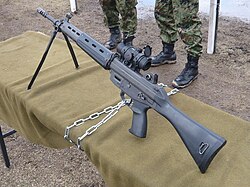
The Howa Type 89 assault rifle (89式小銃, hachi-kyū-shiki-shōjū), referred to as the Type 89 5.56 mm rifle (89式5.56mm小銃, hachi-kyū-shiki-go-ten-go-roku-miri-shōjū),[6][7] is a Japanese assault rifle used by the Japan Self-Defense Forces,[7] the Japan Coast Guard's Special Security Team units,[7] and the Special Assault Team.[8] It has never been exported outside Japan due to its strict Japanese arms-export ban.[9] It is known in JGSDF service as the Hachikyū (a Japanese reading of the number 89) or by its nickname Buddy.[7][10]

Key Information

The Type 89 was introduced to replace the Howa Type 64 battle rifle in frontline units, entering service in 1989. It has remained Japan's principal service rifle since then. Small numbers of the Type 89's successor, the Howa Type 20, were purchased in 2020. The Type 20 is intended to supplement and eventually replace the Type 89.

History

[edit]

Like most other nations, Japan began the Cold War with a battle rifle – the 7.62×51mm NATO Howa Type 64. However, over time, especially during the Vietnam War, the battle rifle's shortcomings became apparent, and ultimately, battle rifles began to be replaced with assault rifles, which fired intermediate cartridges, though they had a weaker effective range compared to battle rifles. The 5.56×45mm round (SS109), first used in the M16 rifle, eventually became the standard of ammunition type for all NATO member assault rifles. In accordance with this, the Defense Agency began development on their next generation assault rifle to replace the Type 64 battle rifle after its 25-year span of service.[7][11]

Development was handled primarily by Howa since it was already licensed to produce the AR-180 version of the Armalite AR-18 rifle for commercial purposes, and some of the Type 89's internal workings are the same as those of the AR-18 - the Type 89 uses the same short-stroke gas piston system with a rotating bolt as the AR-18, but not its dual recoil springs.[12][13] In order to determine the suitability of the rifle, it was issued in limited numbers to the Japan Self-Defense Forces for field testing purposes. After the data collected from the field testing stage of the AR-18 was examined, formal development of the next-generation assault rifle began with its designation as the HR-16 (HR1604).[11] The HR-15 was the first version of the experimental rifle that would eventually become the Type 89, but was developed concurrently with the HR-10, HR-11 and HR-13 by 1989.[11]

On December 6, 2019, the Japanese Ministry of Defense announced that plans have started to eventually change the Type 89 to a new 5.56-based assault rifle.[14] In 2020, the Howa Type 20 was developed, and is planned to replace the Type 89 as Japan's service rifle.[15]

Design

[edit]
JGSDF soldiers practice CQB tactics at the Yakima Training Center's combat training building, armed with Type 89s.

One of the most advantageous features of the Type 89 rifle over the Type 64 was the ability to ease the load on the individual soldier in relation to the amount of ammunition that he could carry. Also, due to the use of aluminum and thermoset plastic as opposed to the steel and wood construction of the Type 64 rifle, the speed with which a soldier could react to a threat was increased. The fixed-stock version of the rifle contains a storage space covered by a rubberized cap, which may be accessed by pulling the cap away from the body for the rifle and rotating it in either direction. Although the typical issue model is equipped with a fixed stock, a small number were manufactured with a folding stock made from steel tubing, and were intended for issue to AFV crews and paratroopers.[7][16]

Fit and finish of the Type 89 was improved greatly over the Type 64 due to the use of forged aluminum, molded thermoset plastics and stamped steel manufacturing methods pioneered by the processes used to produce the AR-18 and Heckler & Koch G3 series rifle.

Cost

[edit]

The Type 89 was designed with simplified operation and minimal number of parts due to the understanding that the complex structure and large number of parts were responsible for the often defective operation of the Type 64 rifle.[citation needed] Because of this, the cost of the Type 89 rifle was roughly half that of the 870,000 yen Type 64 rifle in 1989. According to the Defense Agency, the unit cost of the Type 89 rifle was reduced to about 340,000 yen by fiscal year 2005,[citation needed]and by 280,000 yen by fiscal year 2008. However, this slightly increased to approximately 320,000 yen in 2018 due to a decrease in procurement.

Despite this, it is still considered too expensive for general issue as the ideal price required by the Japanese Government for general production is between 10,000 and 100,000 yen per unit. This is further complicated because the procurement method for the weapon is limited to single fiscal year accounting and further reductions in manufacturing process costs are currently non-existent.[17]

Magazine

[edit]

The Type 89 can accept magazines designed for the M16 series of rifles.[18] However, the magazine produced specifically for the Type-89 uses a follower that has a special shape to hold the bolt open after the final round is spent. If an M16 magazine is used, the bolt will not lock back after the final round is expended. The magazine designed for the Type 89 also differs from ones produced for the M16 because it has holes in the sides of the body to indicate if it has been loaded with 30 or 20 rounds of ammunition. However, this comes with the hidden cost of allowing sand and other foreign bodies to enter the magazine easily and cause malfunctions in the operation of the weapon.

Unlike the M16, the magazine well of the Type 89 is not beveled or tapered because the lower receiver is only slightly wider than that of the magazine body, which makes reloading the rifle more difficult.[19]

Ammunition

[edit]

Type 89 rifle ammunition is interchangeable with the 5.56×45mm SS109/M855 round used by the U.S. military and NATO.[18] Along with the 7.62×51mm round used in the Type 64 rifle, this allows for interchangeability with ammunition stockpiles of U.S. forces stationed in Japan. Since the ammunition developed for the Type 89 rifle is produced in Japan, it is head stamped with the sakura mark of the Self Defense Forces instead of the typical NATO circle-cross used on the SS109/M855 round.

Type 89 trigger group
Type 89 fire selection

The selector switch is located on the right side of the lower receiver and is often referred to as the "Atare 3", (アタレサン, Ataresan, from アタレ (Atare) meaning "hit it") referencing the different selection positions. The markings and associated feature are as follows in functional order:

ア (アンゼン=safe) → レ (レンシャ=auto) → 3 (3-round burst) → タ (タンパツ=semi)[20]

The 3-round burst feature is built separately from the rest to prevent the selector switch from being totally useless in case it can't be used due to accident or a malfunction.[21] It can also be taken out of the receiver when needed.[2]

Accessories

[edit]

The bayonet manufactured specifically for the Type 89 rifle can be used as a wire cutter by connecting it to a lug on the scabbard. Furthermore, the end of the bayonet scabbard can be used as a bottle opener. The U.S. military-issued M9 bayonet may also be affixed to the rifle.[22]

The Type 89 rifle is equipped with an integrated bipod[23] to facilitate accuracy, which was also on the Type 64. However, unlike the bipod on the Type 64, the version on the Type 89 is easily removed as it is clamped onto the barrel behind the bayonet lug with a clothes-pin style spring mechanism and retained with a lever-like lock. Also, the Type 89's handguard is molded with inlets along its lower edges in order to accommodate the legs of the bipod if they are folded inwards for storage.

The Type 06 rifle grenade is designed for the Type 89.[24] The attachment of the M203 grenade launcher is possible with the proper adapter.

Special forces units of the Japan Ground Self-Defense Force are additionally issued a pressure switch-activated targeting laser and flashlight which are mounted on the barrel end of the weapon ahead of the front sight assembly. Regular members of the Self-Defense Forces may also obtain these, but must pay for them out of their own funds.

Later improvements

[edit]

Around 2003, several modifications were made to the Type 89 due to the armed deployment to Iraq of JSDF members as well as an overall concern over counter-terrorist and possible future combat deployments. In accordance with the "Iraq Revival Support Law on Special Measures on Land for the U.S. Military" (イラク復興支援特措法) or the "Self-Defense Forces Iraq Dispatch Law", a selector switch has been manufactured and installed on the left hand side of the lower receiver for ambidextrous use for rifles issued to JSDF members in Iraq.[20] However, this is only a temporary modification and the rifle must be returned to its original state (with the selector switch on the right side only) when it is returned to Japan.

JGSDF soldiers with the Type 89 during a training exercise in 2017

In 2004, JSDF elements that had the possibility of seeing combat were issued an optic (an unmagnified red dot sight) with their Type 89 along with a mounting bracket in order to decrease target acquisition time.[18] However, since the use of the sight is still in its provisional stage, individual JSDF members are expected to purchase their own commercially available model for use in a possible combat theater.

Commonly used optics, which are most observed in use by JSDF personnel during training exercises, are the MD-33, manufactured by Sightron Japan (formerly Tasco Optics Japan),[25][26] the EOTech 551,[citation needed] and the Aimpoint CompM2/ML2 (which are both privately purchased by individual troops[citation needed]).

During the initial deployment in Iraq, JSDF elements that had the possibility of seeing combat (for example the Western Army Infantry Regiment) were issued a removable foregrip[9] and a 25mm Weaver rail was installed under the front handguards of their Type 89s to accommodate it. Shortly afterwards, the restriction was lifted and all units began to receive foregrips despite common complaints about damage to the handguards that were caused by the mount. However, the JGSDF prohibited the attachment of foregrips due to concerns of damage.[9]

A three-point sling was issued to JSDF elements that had the possibility of seeing combat due to the positive testimonials of various international military and police forces.[7] The issued three-point sling is in black color (unlike the olive-drab for standard sling), with a buckle similar to the one for the ALICE LC-2 belt. Individual JSDF members were also allowed to purchase their own commercially available models for their own use if they wished.

Variants

[edit]

Type 89-F

[edit]
An early production Type 89F, with bipod deployed

The Type 89-F rifle, also known as the Type 89 Para,[18] has a folding stock instead of the fixed stock of the standard Type 89.[27]

The Type 89-F is issued to paratroopers of the 1st Airborne Brigade, armored vehicle crews, and the Special Forces Group, as well as the Special Assault Team. In addition, the Type 89-F was also issued as a replacement for the M3A1 submachine gun, which was used by JGSDF tank crews as a personal defense weapon. The stock folds to the left side to avoid interfering with the fire selector on the right side. The folding stock itself is made of plastic and an aluminum alloy. The base of the stock has a plastic cover that serves as a cheek rest for use in colder conditions.

With the stock folded, the Type 89-F has a length of 670 mm (26 in).

ACIES carbine

[edit]

As part of the development of the JSDF's Advanced Combat Infantry Equipment System (先進個人装備)—which is the approximate equivalent of the American Future Soldier program—some Type 89 Rifles have been modified to a carbine format with an overall length of about 800 mm (31 in), a four-sided rail system, a polymer retractable stock, and a shorter barrel.[28]

Publicity photographs taken at exhibitions hosted by the Technical Research and Development Institute of the Japanese Ministry of Defense (TRDI) also show that the third generation of the prototyping process for ACIES has now produced a full-size version of this modified Type 89 with a retractable stock and rail system.[9] This variant has a full-length barrel and an overall length of about 940 mm (37 in). An underbarrel digital interface switch connected to a foregrip has also been developed, along with an unusually large top-mounted sighting system.[28] The sighting system incorporates a ranging device and a video camera so that, at least under shooting range conditions,[28] it is possible to hold the rifle at a distance from the body to train and fire it around corners—much like analogous foreign systems. There was also some evidence of evaluation of other assault rifles as possible replacements for the Type 89, but this may no longer be the case, until the Type 20 was selected as the winner of a competition held by the JSDF to replace the Type 89 in frontline service.

References

[edit]

Bibliography

[edit]
[edit]
Revisions and contributorsEdit on WikipediaRead on Wikipedia
from Grokipedia
The , officially designated the Type 89 5.56 mm , is a selective-fire chambered in the cartridge, manufactured by Machinery Co., Ltd. for the . Adopted in 1989, it succeeded the Type 64 as the standard-issue firearm for the , featuring a gas-operated mechanism optimized for lighter weight and modern ammunition compatibility. The rifle incorporates a distinctive three-round burst firing mode alongside semi-automatic and full-automatic options, with an effective range of approximately 500 meters, reflecting Japan's emphasis on precision and controlled fire in defensive operations. While praised for its reliability and accuracy in service, the Type 89's high production costs—stemming from domestic manufacturing requirements and advanced materials—have limited its proliferation beyond Japanese forces, with no exports permitted under strict national regulations. Development in the late 1980s involved iterative prototyping by , culminating in the selection of the HR-16 design after extensive testing by the Japan Defense Agency, ensuring compatibility with NATO standards while prioritizing ergonomic improvements over the preceding Type 64's heavier 7.62×51mm chambering. As of 2024, it remains the primary of the JGSDF despite announcements of plans for a successor to address evolving tactical needs.

Development and Adoption

Origins and Design Requirements

The development of the Howa Type 89 assault rifle stemmed from the Japanese Defense Agency's initiative in the 1980s to replace the aging Howa Type 64 battle rifle, which had entered service in 1964 and was chambered for the 7.62x51mm NATO cartridge. The Type 64 imposed a heavy load on soldiers due to its weight—approximately 4.4 kg unloaded—and generated significant recoil, limiting mobility and ammunition carry capacity while proving expensive to manufacture. These shortcomings, combined with NATO allies' shift to the lighter 5.56x45mm cartridge exemplified by the U.S. M16, necessitated a modern assault rifle for the Japan Ground Self-Defense Force (JGSDF) that prioritized reduced weight, controllability, and interoperability. Design requirements emphasized a lighter overall system, targeting an unloaded weight of about 3.5 kg—roughly 0.9 kg less than the Type 64—to enhance endurance and allow greater ammunition carriage. The was to employ a gas-operated, short-stroke mechanism with for reliable operation, drawing on Machinery's prior licensed production of the AR-18. Fire control mandated semi-automatic, full-automatic (at 750 rounds per minute), and three-round burst modes via a four-position selector, with compatibility for 20- or 30-round STANAG magazines to facilitate logistics alignment with allies. Additional specifications included a 420 mm barrel for an of 500 meters, fewer components for simplified production and maintenance, and ergonomic features such as furniture and a stamped receiver to minimize weight without sacrificing durability. These parameters aimed to produce a better suited to defensive operations under Japan's constitutional constraints, focusing on reliability in varied terrains rather than offensive firepower. Howa responded with the HR-16 , which satisfied the Defense Agency's trials and culminated in formal adoption as the Type 89 in 1989.

Prototyping and Testing

Development of the Howa Type 89 began in the late 1970s as a replacement for the heavier 7.62mm Type 64 , with Machinery producing initial prototypes designated HR-10 in 1978 and a HR-11 variant in 1980. Subsequent iterations included the HR-12 in 1981, followed by the HR-13 in 1982 which introduced a short-stroke gas piston system, the fixed-stock HR-14 in 1983, the folding-stock HR-15 in 1984, and the finalized HR-16 prototype in 1985. These prototypes evolved from to gas piston operation, drawing inspiration from designs like the to improve reliability in adverse conditions while meeting Japan Defense Agency requirements for a 5.56mm suitable for JSDF infantry. The HR-16 prototype underwent extensive evaluation, including laboratory and environmental testing for durability, with features like a reinforced receiver and improved refined based on iterative feedback. Field trials conducted by the (JGSDF) in the mid-to-late assessed the rifle's performance in simulated combat scenarios, focusing on accuracy, controllability during full-auto fire, and reliability across varied terrains and weather, where it demonstrated superior handling compared to prior Japanese designs. Following analysis of trial data, which confirmed the design's suitability for JSDF operational needs including reduced weight and increased capacity over the Type 64, the received type classification as the Type 89 in 1989, authorizing limited initial production and deployment. These tests emphasized empirical metrics such as cyclic rate stability at 700-850 rounds per minute and up to 500 meters, validating the short-stroke piston system's resistance to fouling without compromising the 's modular elements.

Adoption by JSDF

The Howa Type 89 was formally adopted by the Japan Defense Agency (now the Ministry of Defense) for use by the (JGSDF) in 1989 as the new standard for frontline units. This adoption replaced the heavier 7.62×51mm battle rifle, which had been in service since 1964, with a lighter 5.56×45mm weapon designed for improved portability and compatibility with NATO-standard ammunition. Following final approval after extensive prototyping and field trials, production deliveries of the Type 89 began in , with the rifle entering operational service progressively across JGSDF divisions. The adoption reflected 's strategic shift toward modernizing its defensive capabilities under post-World War II constitutional constraints, prioritizing domestic manufacturing by Machinery Ltd. to ensure self-reliance in small arms supply. The Type 89 was issued primarily to units, including , special forces, and airborne troops, while reserve and support elements retained the Type 64 for cost and logistical reasons. Approximately 160,000 units were ultimately produced, sufficient for equipping active frontline forces but limited in scale compared to exports of similar rifles by other nations, aligning with Japan's pacifist defense policy that emphasizes quality over quantity. Despite its adoption, the rifle's design choices, such as the short-stroke gas piston system derived from the , were selected for reliability in humid and varied terrains typical of Japanese operations.

Technical Design

Operating System and Mechanism

The Howa Type 89 employs a gas-operated action utilizing a short-stroke gas system paired with a for chamber locking and unlocking. Gas is vented from the barrel through a port positioned under the front sight base, impinging on the head to initiate a rearward impulse on the bolt carrier group without the piston rod extending the full length, thereby isolating from the action and minimizing mass movement for reduced felt . This configuration, derived from the design but adapted with stamped steel receiver components for enhanced rigidity, produces a smoother cycling motion that lowers overall impulse compared to long-stroke alternatives, extending internal parts life and facilitating better controllability during automatic fire. The bolt features lugs that rotate into recesses within the barrel extension for secure headspace, with extraction and ejection handled by a standard claw extractor and fixed ejector, while a magazine follower holds the bolt open after the last round to signal reload. The trigger mechanism supports multiple firing modes via a selector lever on the right side of the receiver marked with Japanese katakana characters: "A" (Anzen, safe), "Re" (Rensha, full-automatic), "3" (three-round burst), and "Ta" (Tanpatsu, semi-automatic), achieving a cyclic rate of 750 rounds per minute in sustained automatic operation. The three-round burst mode relies on a dedicated cam-and-counting mechanism within the fire control group to limit discharge after three shots before resetting, incorporating a that defaults to semi-automatic or full-automatic function if the limiter encounters a malfunction, ensuring operational reliability under field conditions.

Barrel, Sights, and Accuracy Features

The barrel of the Howa Type 89 measures 420 mm (16.5 inches) in length and is designed for the cartridge, providing a of approximately 920 m/s to support a relatively flat for intermediate-range engagements. The barrel employs a gas port positioned for short-stroke gas piston operation, which contributes to reliable cycling while minimizing accumulation, though specific details on chrome lining or twist rate (typically 1:9 or similar for 5.56mm stability) are not publicly detailed in declassified specifications. Standard sighting consists of fixed , including a front post protected by ears and an adjustable flip-up rear sight graduated for ranges up to 500 meters, allowing for precise elevation and adjustments under field conditions. Later field modifications, such as screwed-on Picatinny rails on select units, enable attachment of optical sights like the ACIES system for enhanced , though these are not inherent to the base design. Accuracy features include a lightweight folding bipod mounted under the fore-end, which stabilizes the for prone or supported firing, reducing shooter-induced dispersion during bursts or sustained fire. The design achieves good inherent accuracy for its class, with reported effective point-target range of 400–500 meters depending on ammunition and conditions, outperforming earlier Japanese like the Type 64 due to improved barrel harmonics and gas system consistency. Compatibility with the Type 06 rifle grenade further extends utility for suppressive or area-denial roles without compromising zero.

Feeding System, Magazine, and Ammunition

The Howa Type 89 employs a conventional detachable box feeding mechanism, in which the strips cartridges from the magazine inserted into the rifle's magazine well and chambers them for firing. This system supports reliable cyclic operation at approximately 750 rounds per minute when in full-automatic mode. Standard magazines hold 30 rounds of ammunition, with 20-round capacity options also utilized for reduced weight or specific tactical needs; these are patterned to the STANAG 4179 standard, ensuring interoperability with other 5.56×45mm NATO-compatible platforms such as the M16 or derivatives. Japan Ground Self-Defense Force-issue magazines feature lateral witness holes for visual verification of remaining rounds without removal. The rifle is chambered exclusively for the cartridge, a small-caliber high-velocity round standardized for reduced and increased carriage compared to prior 7.62mm designs. This achieves a of approximately 920 meters per second from the Type 89's barrel, supporting effective firing ranges up to 500 meters.

Ergonomics, Accessories, and Weight Reduction

The Howa Type 89 features a configuration that reduces overall length to 916 mm while retaining a 420 mm barrel, enhancing maneuverability in confined spaces compared to conventional layouts. This design incorporates a and fixed stock, providing improved ergonomics over the preceding Type 64 rifle, which was longer and heavier. Controls include a selective fire switch and safety lever accessible from the left side, though the right-side ejection port limits for left-handed users. Standard accessories on the Type 89 include a folding bipod for supported firing positions and provisions for mounting. Optics mounting originally relies on adapters rather than integrated rails, with limited adoption in service due to doctrinal preferences for . Modernization efforts, such as those observed in 2014 exercises, have incorporated Picatinny rails for compatibility with advanced sighting systems like the ACIES and other attachments. Weight reduction in the Type 89 design was achieved through the use of reinforced plastics, stamped steel, and aluminum components, resulting in an unloaded mass of approximately 3.5 kg—about 0.9 kg lighter than the Type 64. This material selection, combined with the lighter cartridge, allows JSDF personnel to carry more relative to the previous rifle's 7.62×51mm loading. Despite these measures, the Type 89 remains heavier than many contemporary 5.56 mm assault rifles, prompting discussions on further integration in potential upgrades.

Production and Logistics

Manufacturing Process

The Howa Type 89 is manufactured by Machinery, Ltd., leveraging the company's established firearms production facilities equipped for and surface processing. Deliveries to the began in 1990, following formal adoption as standard equipment in 1989. The rifle's receiver is constructed from stamped steel, drawing from the AR-18's design principles to enable efficient fabrication. materials are molded for the furniture, including the and handguards, while aluminum alloys are employed in select components to achieve a lighter overall weight than the preceding Type 64 rifle's steel-and-wood build. These methods—stamping for metal forming, molding for synthetics, and integration of lightweight alloys—enhance manufacturing precision, fit, and durability under operational conditions. The gas-operated, rotating bolt mechanism is assembled with a short-stroke system, supporting select-fire capabilities including semi-automatic, three-round burst, and full-automatic modes.

Cost and Economic Factors

The Howa Type 89 incurred high unit procurement costs for the (JSDF), primarily due to constrained production scales and domestic manufacturing requirements. With total production limited to approximately 140,000 units exclusively for Japanese forces, the absence of export markets—enforced by Japan's "Three Principles on Arms Exports," which prohibit international sales of arms—prevented that lower per-unit prices in larger-volume programs like those for NATO-standard rifles. This policy, adopted in 1967 and maintained through subsequent revisions, significantly contributed to elevated unit costs compared to global counterparts such as the M4 or HK416, which benefit from broader export opportunities and larger production runs. These economic pressures manifested in JSDF budget allocations, where annual procurements of Type 89 rifles numbered in the low thousands, such as 3,000 units in certain fiscal years, reflecting deliberate pacing to manage expenses amid competing defense priorities. High Japanese labor costs and stringent quality standards for stamped metal construction further elevated expenses compared to imported alternatives, contributing to the rifle's reputation as cost-prohibitive for full fleet replacement of the preceding Type 64. Over time, unit costs declined modestly through incremental production efficiencies, yet remained elevated relative to global benchmarks, exacerbating JSDF challenges by necessitating mixed inventories of older and newer until the adoption of the cheaper Type 20 successor. This delayed comprehensive modernization, with the Type 89's expense underscoring broader constraints in Japan's , including reliance on sole-source supplier Machinery without competitive bidding or international offsets.

Operational Employment

Service in Japan Self-Defense Forces

The Howa Type 89 assault rifle was adopted by the Japan Ground Self-Defense Force (JGSDF) in 1989 as the standard-issue firearm, replacing the earlier Howa Type 64 battle rifle in frontline infantry units. This transition aligned with the shift to the 5.56×45mm NATO cartridge for improved controllability and logistics compatibility with allied forces. Production by Howa Machinery, Ltd., focused exclusively on domestic needs, with estimates indicating over 160,000 units manufactured to equip JGSDF personnel. In service, the Type 89 equips regular divisions, , and support units within the JGSDF, serving as the primary weapon for territorial defense and internal security operations under Japan's post- constitutional constraints. Its gas-operated, selective-fire design supports both semi-automatic and full-automatic modes, with a three-round burst to conserve ammunition during sustained engagements. The rifle's integration emphasized reliability in Japan's varied terrain, from urban environments to mountainous regions, though its weight and lack of modularity have drawn operational critiques from users preferring lighter Western alternatives. As of the mid-2010s, approximately 130,000 Type 89 rifles were in inventory, slightly undersupplying the JGSDF's active personnel of around 140,000, prompting supplemental use of Type 64 rifles in reserve units. Japan's strict arms export policies have confined its deployment to national territory, excluding overseas combat roles despite JGSDF participation in non-combat peacekeeping missions. While the Type 20 rifle began phased replacement in 2020, the Type 89 remains in widespread second-line service as of 2025, undergoing limited upgrades for extended utility.

Training, Exercises, and Limited Deployments

(JGSDF) personnel receive comprehensive training with the Howa Type 89 as part of standard infantry instruction, emphasizing marksmanship, close-quarters battle (CQB) tactics, and weapons familiarization. This includes live-fire exercises at facilities such as the East Fuji Training Area near , where units conduct annual drills to maintain proficiency. Specialized training for units like the 30th Infantry Regiment incorporates CQB scenarios using the Type 89, focusing on urban operations and room clearing techniques. The Type 89 features prominently in bilateral exercises with allied forces, enhancing and tactical skills. During Exercise Iron Fist, an annual event with the U.S. Marine Corps at Camp Pendleton, , JGSDF soldiers train in fire team maneuvers and military operations in urban terrain (MOUT) using the , as observed in 2017 iterations. Similarly, Rising Thunder exercises at , Washington, involve JGSDF units in live-fire and maneuver training with the Type 89 alongside U.S. Army personnel, such as in 2014 and 2021 sessions. Forest Light exercises in further integrate the in combat marksmanship courses, with the 30th participating in joint drills with U.S. in 2020. Limited deployments of the Type 89 have occurred in non-combat roles abroad, aligned with Japan's constitutional constraints on military engagement. JGSDF units carried the rifle during the reconstruction and support mission from 2004 to 2006 in , where approximately 5,500 personnel provided humanitarian assistance, , and repair while armed for under strict prohibiting offensive use. No instances of firing have been recorded, reflecting the rifle's primary role in defensive and contexts rather than active warfare.

Variants and Modernizations

Type 89-F Variant

The Type 89-F, also designated as the Type 89 Para, is a compact variant of the Howa Type 89 developed for specialized units requiring enhanced maneuverability in confined spaces. It features a side-folding tube stock with a padded buttplate, reducing the overall length from approximately 920 mm (extended) in the standard model to about 730 mm when folded, while retaining the same chambering, gas-operated mechanism, and selective fire capabilities including semi-automatic, full-automatic, and three-round burst modes. This variant was introduced to address the needs of paratroopers, vehicle crews, and other elements of the Japan Ground Self-Defense Force (JGSDF) where the fixed-stock Type 89 proved cumbersome for airborne operations or rapid deployment from vehicles. The folding stock design maintains compatibility with standard 20- or 30-round STANAG magazines and Picatinny rail mounting for optics, though it does not alter the barrel length of 410 mm or the rifle's base weight of around 3.5 kg unloaded. Production of the Type 89-F aligns with the overall Type 89 program, which began service entry in 1989, with limited numbers issued primarily to airborne and special operations personnel rather than frontline infantry. Operational differences from the baseline Type 89 are minimal beyond stock configuration, preserving the original's short-stroke gas piston system and diopter sights, but the compact form enhances portability without compromising ballistic performance or reliability in adverse conditions. The Type 89-F has seen use in JGSDF exercises and deployments, such as missions, where space constraints are critical, though exact figures remain classified or undisclosed in public records.

ACIES Carbine

The ACIES represents a prototype modernization of the Howa Type 89 , developed under the Japan Ground Self-Defense Force's (JGSDF) Advanced Combat Infantry Equipment System (ACIES) program, which sought to enhance infantry modularity and electronics integration analogous to foreign future soldier initiatives. Introduced around 2010, the carbine configuration shortens the overall length to 800 mm while retaining the chambering and gas-operated rotating-bolt mechanism of the base Type 89. Key upgrades include a four-sided system for mounting , lasers, and other accessories, paired with a retractable stock to improve in confined spaces such as vehicles or urban environments. Further prototypes, displayed in 2015 demonstrations, incorporated advanced digital features to support networked warfare, such as an under-barrel interface for data connectivity, an NEC-developed sight with integrated ballistic ranging, a forward-facing for , and a flip-out display screen for real-time information overlay. These elements aimed to address the Type 89's original limitations in accessory compatibility and electronic integration, reflecting empirical needs identified in JGSDF and limited operational feedback rather than doctrinal shifts alone. However, the ACIES remained experimental, with no of widespread or fielding, as modernization efforts appear to have stalled amid fiscal constraints and the parallel development of successor systems like the Type 20. Despite this, select modified Type 89s with rail adapters and ACIES-compatible components have been observed in exercises, indicating incremental upgrades to extend service life without full replacement.

Upgrade Efforts and Improvements

In the early 2000s, the (JGSDF) initiated targeted upgrades to the Type 89 rifle, focusing on integration for enhanced accuracy in potential scenarios. By 2004, select units identified for higher-risk operations, such as elements, were equipped with unmagnified red dot sights—often Tasco models—mounted via proprietary rail adapters clamped to the carry handle, addressing the rifle's original lack of modular sighting options. These additions improved speed without altering the core design, though adoption remained limited to non-standard issue due to logistical constraints. Modernized versions of the Type 89 feature Picatinny rails specifically for mounting tactical optics, complementing the capabilities of variants like the Type 89-F and ACIES carbine. Further incremental improvements included retrofitting ambidextrous safety selectors to accommodate left-handed operators and barrel-mounted clamps for infrared laser aimers, enabling low-light aiming compatibility with devices. Foregrips and bipod enhancements were also tested to refine handling and stability, reflecting empirical feedback from exercises where the rifle's fixed and burst-fire mechanism showed ergonomic limitations under sustained fire. These modifications prioritized reliability and minimal parts changes, leveraging the Type 89's robust gas-operated system while mitigating wear from extended use since its adoption. Howa Machinery explored more comprehensive modernization concepts around 2014, prototyping configurations with flat-top receivers, full-length Picatinny top rails, and quad-rail forends to support diverse accessories like advanced optics, weapon lights, and vertical grips. This design aimed to bridge the Type 89's 1980s-era fixed architecture with contemporary modular standards, potentially reducing weight through polymer reinforcements and improving accessory interchangeability. However, these prototypes did not enter serial production, as cost analyses and interoperability tests favored a clean-sheet replacement over retrofitting the aging inventory of approximately 230,000 units. By late , amid growing recognition of the 's in peer conflicts—evidenced by its absence of full-auto capability and limited rail integration—the Ministry of Defense shifted resources to the , a next-generation 5.56mm with inherent modularity and ambidextrous controls. Initial Type 20 inductions began in 2024 for close-quarters roles, with phased replacement of the Type 89 across JGSDF units projected through the late , effectively concluding upgrade efforts in favor of systemic renewal.

Evaluation and Legacy

Performance Strengths

The Howa Type 89 exhibits superior accuracy for its class, achieving single-shot groupings within a 19 cm circle at 300 meters—outperforming the standard 22-23 cm dispersion of peer rifles—and maintaining six-round bursts inside a 2 m × 2 m target. An integrated bipod supports this precision, particularly in prone or defensive firing postures favored by (JGSDF) doctrine, where personnel report exceptional stability and hit probability. Reliability benefits from a 10% reduction in component count compared to the Type 64, decreasing malfunction rates and obviating specialized disassembly tools. JGSDF field evaluations affirm dependable operation across cold, muddy, and humid environments, with minimal downtime in sustained use. Adoption of the cartridge yields milder recoil than the predecessor 7.62mm round, enabling better control, reduced , and increased carriage—critical for lighter Japanese service members. The short-stroke gas mechanism further dampens impulse, prolonging parts durability while enhancing handling in its 3.5 kg weight and 0.92 m length configuration. With an effective range of 500 meters and cyclic rate of 650-850 rounds per minute, the Type 89 supports versatile engagement profiles, from point fire to suppressive bursts, aligning with modern infantry tactics.

Criticisms and Limitations

The Howa Type 89's high production cost, estimated at approximately 280,000 to 347,000 yen per unit in the late 1990s and early 2000s (equivalent to about $2,000–2,500 USD at contemporary exchange rates), has constrained its procurement and widespread adoption within the Japan Self-Defense Forces (JSDF). Despite entering service in 1989, only around 140,000 to 163,000 units had been produced by the 2020s, insufficient to fully supplant the older Type 64 rifle across all JSDF branches, including reserves and non-Ground Self-Defense Force units. This limited output stems from budgetary constraints and Japan's domestic manufacturing focus, creating a cycle where low demand drives up unit prices relative to foreign counterparts. Ergonomically, the Type 89 features a stamped magazine well without a beveled or flared opening, complicating rapid reloads compared to rifles like the M16 or M4, particularly under stress or with gloved hands. The fire selector switch is non-ambidextrous, operable only in a counter-clockwise direction with limited clearance, rendering it clunky and slow to manipulate, especially for left-handed users or in dynamic scenarios. At 916 mm in overall length and 3.5 kg loaded, the rifle is also longer and heavier than many contemporary carbines, potentially hindering maneuverability in confined spaces. The rifle's late Cold War-era design lacks integrated Picatinny rails for optics, lasers, or other accessories, necessitating adapter plates that increase weight and shift the point of aim over bore height. This modularity shortfall has prompted varied, non-standardized optic integrations (e.g., or ACOG sights), and proposed modernization efforts like the 2014 "Future Soldier" program for rail additions were ultimately canceled. Some JSDF personnel have reported reliability inferior to U.S. service rifles in demanding conditions, leading elite units to adopt foreign alternatives. Additionally, the three-round burst mode has been critiqued for potentially reducing accuracy in close-quarters engagements.

Replacement by Type 20 and Enduring Role

The (JGSDF) selected the for adoption on December 6, 2019, with formal service entry in 2020, marking the beginning of its phased replacement of the Type 89 as the standard-issue rifle across JSDF branches. The , also chambered in , incorporates modular rail systems, improved ergonomics, enhanced water resistance, and better accuracy and lethality compared to the Type 89, addressing limitations in adaptability for modern and accessories. Deployments have progressed incrementally, with initial issuances to select units by 2023 and expansions to (JASDF) bases, such as Ibaraki in early 2025, reflecting a deliberate strategy amid budgetary constraints. Full replacement of the Type 89's estimated inventory—produced in limited quantities since 1989—is projected to span approximately 30 years due to production rates and the need to maintain operational readiness, representing a long-term transition. The Type 89 thus retains an enduring role in JSDF service, particularly in reserve and support units, as well as in reserve stocks, training exercises, and second-line formations where immediate modernization is not prioritized, leveraging its proven reliability in domestic defense scenarios. This transitional period ensures continuity, as the Type 89's gas-operated design and accuracy have sustained its utility despite the shift toward more versatile platforms like the Type 20.

References

Add your contribution
Related Hubs
User Avatar
No comments yet.