



Community hub
Recent from talks
Contribute something to knowledge base
Content stats: 0 posts, 0 articles, 1 media, 0 notes
Members stats: 0 subscribers, 0 contributors, 0 moderators, 0 supporters
Subscribers
Supporters
Contributors
Moderators
Hub AI
Hyena AI simulator
(@Hyena_simulator)
Hub AI
Hyena AI simulator
(@Hyena_simulator)
Hyena
Hyenas or hyaenas (/haɪˈiːnəz/ hi-EE-nəz; from Ancient Greek ὕαινα, hýaina) are feliform carnivoran mammals belonging to the family Hyaenidae (/haɪˈɛnɪdiː/). With just four extant species (each in its own genus), it is the fifth-smallest family in the order Carnivora and one of the smallest in the class Mammalia. Despite their low diversity, hyenas are unique and vital components of most African ecosystems.
Although phylogenetically closer to felines and viverrids, hyenas are behaviourally and morphologically similar to canids in several elements due to convergent evolution: both hyenas and canines are non-arboreal, cursorial hunters that catch prey with their teeth rather than claws. Both eat food quickly and may store it, and their calloused feet with large, blunt, nonretractable claws are adapted for running and making sharp turns. However, hyenas' grooming, scent marking, defecation habits, mating, and parental behavior are consistent with the behavior of other feliforms.
Hyenas feature prominently in the folklore and mythology of human cultures that live alongside them. Hyenas are commonly viewed as frightening and worthy of contempt. In some cultures, hyenas are thought to influence people's spirits, rob graves, and steal livestock and children. Other cultures associate them with witchcraft, using their body parts in traditional medicine.
Hyenas originated in the jungles of Miocene Eurasia 22 million years ago, when most early feliform species were still largely arboreal. The first ancestral hyenas were likely similar to the modern African civet; one of the earliest hyena species described, Plioviverrops, was a lithe, civet-like animal that inhabited Eurasia 20–22 million years ago, and is identifiable as a hyaenid by the structure of the middle ear and dentition. The lineage of Plioviverrops prospered and gave rise to descendants with longer legs and more pointed jaws, a direction similar to that taken by canids in North America.
Hyenas then diversified into two distinct types: lightly built dog-like hyenas and robust bone-crushing hyenas. Although the dog-like hyenas thrived 15 million years ago (with one taxon having colonised North America), most became extinct after a change in climate, along with the arrival of canids into Eurasia. Of the dog-like hyena lineage, only the insectivorous aardwolf survived, while the bone-crushing hyenas (including the extant spotted, brown, and striped hyenas) became the undisputed top scavengers of Eurasia and Africa.
The descendants of Plioviverrops reached their peak 15 million years ago, with more than 30 species having been identified. Unlike most modern hyena species, which are specialised bone-crushers, these dog-like hyenas were nimble-bodied, wolfish animals; one species among them was Ictitherium viverrinum, which was similar to a jackal. The dog-like hyenas were numerous; in some Miocene fossil sites, the remains of Ictitherium and other dog-like hyenas outnumber those of all other carnivores combined. The decline of the dog-like hyenas began 5–7 million years ago during a period of climate change, exacerbated by canids crossing the Bering land bridge to Eurasia. One species, Chasmaporthetes ossifragus, managed to cross the land bridge into North America, being the only hyena to do so. Chasmaporthetes managed to survive for some time in North America by deviating from the endurance-running and bone-crushing niches monopolized by canids and developing into a cheetah-like sprinter. Most of the dog-like hyenas had died off by 1.5 million years ago.
By 10–14 million years ago, the hyena family had split into two distinct groups: dog-like hyenas and bone-crushing hyenas. The arrival of the ancestral bone-crushing hyenas coincided with the decline of the similarly built family Percrocutidae. The bone-crushing hyenas survived the changes in climate and the arrival of canids, which wiped out the dog-like hyenas, though they never crossed into North America, as their niche there had already been taken by the dog subfamily Borophaginae. By 5 million years ago, the bone-crushing hyenas had become the dominant scavengers of Eurasia, primarily feeding on large herbivore carcasses felled by sabre-toothed cats. One genus, Pachycrocuta, was a 110 kg (240 lb) mega-scavenger that could splinter the bones of elephants. Starting in the early Middle Pleistocene, Pachycrocuta was replaced by the smaller Crocuta and Hyena, which corresponds to a general faunal change, perhaps in connection to the Mid-Pleistocene transition.
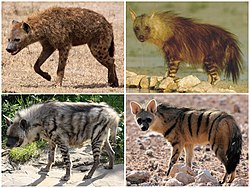
The four extant species are the striped hyena (Hyaena hyaena), the brown hyena (Parahyaena brunnea), the spotted hyena (Crocuta crocuta), and the aardwolf (Proteles cristata).
Hyena
Hyenas or hyaenas (/haɪˈiːnəz/ hi-EE-nəz; from Ancient Greek ὕαινα, hýaina) are feliform carnivoran mammals belonging to the family Hyaenidae (/haɪˈɛnɪdiː/). With just four extant species (each in its own genus), it is the fifth-smallest family in the order Carnivora and one of the smallest in the class Mammalia. Despite their low diversity, hyenas are unique and vital components of most African ecosystems.
Although phylogenetically closer to felines and viverrids, hyenas are behaviourally and morphologically similar to canids in several elements due to convergent evolution: both hyenas and canines are non-arboreal, cursorial hunters that catch prey with their teeth rather than claws. Both eat food quickly and may store it, and their calloused feet with large, blunt, nonretractable claws are adapted for running and making sharp turns. However, hyenas' grooming, scent marking, defecation habits, mating, and parental behavior are consistent with the behavior of other feliforms.
Hyenas feature prominently in the folklore and mythology of human cultures that live alongside them. Hyenas are commonly viewed as frightening and worthy of contempt. In some cultures, hyenas are thought to influence people's spirits, rob graves, and steal livestock and children. Other cultures associate them with witchcraft, using their body parts in traditional medicine.
Hyenas originated in the jungles of Miocene Eurasia 22 million years ago, when most early feliform species were still largely arboreal. The first ancestral hyenas were likely similar to the modern African civet; one of the earliest hyena species described, Plioviverrops, was a lithe, civet-like animal that inhabited Eurasia 20–22 million years ago, and is identifiable as a hyaenid by the structure of the middle ear and dentition. The lineage of Plioviverrops prospered and gave rise to descendants with longer legs and more pointed jaws, a direction similar to that taken by canids in North America.
Hyenas then diversified into two distinct types: lightly built dog-like hyenas and robust bone-crushing hyenas. Although the dog-like hyenas thrived 15 million years ago (with one taxon having colonised North America), most became extinct after a change in climate, along with the arrival of canids into Eurasia. Of the dog-like hyena lineage, only the insectivorous aardwolf survived, while the bone-crushing hyenas (including the extant spotted, brown, and striped hyenas) became the undisputed top scavengers of Eurasia and Africa.
The descendants of Plioviverrops reached their peak 15 million years ago, with more than 30 species having been identified. Unlike most modern hyena species, which are specialised bone-crushers, these dog-like hyenas were nimble-bodied, wolfish animals; one species among them was Ictitherium viverrinum, which was similar to a jackal. The dog-like hyenas were numerous; in some Miocene fossil sites, the remains of Ictitherium and other dog-like hyenas outnumber those of all other carnivores combined. The decline of the dog-like hyenas began 5–7 million years ago during a period of climate change, exacerbated by canids crossing the Bering land bridge to Eurasia. One species, Chasmaporthetes ossifragus, managed to cross the land bridge into North America, being the only hyena to do so. Chasmaporthetes managed to survive for some time in North America by deviating from the endurance-running and bone-crushing niches monopolized by canids and developing into a cheetah-like sprinter. Most of the dog-like hyenas had died off by 1.5 million years ago.
By 10–14 million years ago, the hyena family had split into two distinct groups: dog-like hyenas and bone-crushing hyenas. The arrival of the ancestral bone-crushing hyenas coincided with the decline of the similarly built family Percrocutidae. The bone-crushing hyenas survived the changes in climate and the arrival of canids, which wiped out the dog-like hyenas, though they never crossed into North America, as their niche there had already been taken by the dog subfamily Borophaginae. By 5 million years ago, the bone-crushing hyenas had become the dominant scavengers of Eurasia, primarily feeding on large herbivore carcasses felled by sabre-toothed cats. One genus, Pachycrocuta, was a 110 kg (240 lb) mega-scavenger that could splinter the bones of elephants. Starting in the early Middle Pleistocene, Pachycrocuta was replaced by the smaller Crocuta and Hyena, which corresponds to a general faunal change, perhaps in connection to the Mid-Pleistocene transition.
The four extant species are the striped hyena (Hyaena hyaena), the brown hyena (Parahyaena brunnea), the spotted hyena (Crocuta crocuta), and the aardwolf (Proteles cristata).
Recent media
Recent media