Hubbry Logo
Aridity indexAridity indexMain
Open search
Aridity index
Community hub
Aridity index
logo
7 pages, 0 posts
0 subscribers
Be the first to start a discussion here.
Aridity index
Aridity index
from Wikipedia

An aridity index (AI) is a numerical indicator of the degree of dryness of the climate at a given location. The American Meteorological Society defined it in meteorology and climatology, as "the degree to which a climate lacks effective, life-promoting moisture". Aridity is different from drought because aridity is permanent whereas drought is temporary.[1] A number of aridity indices have been proposed (see below); these indicators serve to identify, locate or delimit regions that suffer from a deficit of available water, a condition that can severely affect the effective use of the land for such activities as agriculture or stock-farming.

Historical background and indices

[edit]

Köppen

[edit]

At the turn of the 20th century, Wladimir Köppen and Rudolf Geiger developed the concept of a climate classification where arid regions were defined as those places where the annual rainfall accumulation (in centimetres) is less than , where:

  • if rainfall occurs mainly in the cold season,
  • if rainfall is evenly distributed throughout the year, and
  • if rainfall occurs mainly in the hot season.

where is the mean annual temperature in Celsius.

This was one of the first attempts at defining an aridity index, one that reflects the effects of the thermal regime and the amount and distribution of precipitation in determining the native vegetation possible in an area. It recognizes the significance of temperature in allowing colder places such as northern Canada to be seen as humid with the same level of precipitation as some tropical deserts because of lower levels of potential evapotranspiration in colder places. In the subtropics, the allowance for the distribution of rainfall between warm and cold seasons recognizes that winter rainfall is more effective for plant growth that can flourish in the winter and go dormant in the summer than the same amount of summer rainfall during a warm-to-hot season. Thus a place like Athens, Greece that gets most of its rainfall in winter can be considered to have a humid climate (as attested in lush foliage) with roughly the same amount of rainfall that imposes semi-desert conditions in Midland, Texas, where rainfall largely occurs in the summer.

Thornthwaite

[edit]

In 1948, C. W. Thornthwaite proposed an AI defined as:
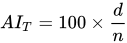
where the water deficiency is calculated as the sum of the monthly differences between precipitation and potential evapotranspiration for those months when the normal precipitation is less than the normal evapotranspiration; and where stands for the sum of monthly values of potential evapotranspiration for the deficient months (after Huschke, 1959). This AI was later used by Meigs (1961) to delineate the arid zones of the world in the context of the UNESCO Arid Zone Research programme.[2]

United Nations Environment Programme

[edit]

In the preparations leading to the 1977 UN Conference on Desertification (UNCOD), the United Nations Environment Programme (UNEP) issued a dryness map based on a different aridity index, proposed originally by Mikhail Ivanovich Budyko (1958)[3] and defined as follows:[4]

where is the mean annual net radiation (also known as the net radiation balance), is the mean annual precipitation, and is the latent heat of vaporization for water. Note that this index is dimensionless and that the variables , and can be expressed in any system of units that is self-consistent.

More recently in 1992, the UNEP has adopted yet another index of aridity, defined as:[5]

Global map of the aridity index, from the CGIAR, following UNEP's definition, AI = P/PET.

where is the potential evapotranspiration and is the average annual precipitation (UNEP, 1992). Here also, and must be expressed in the same units, e.g., in millimetres. In this latter case, the boundaries that define various degrees of aridity and the approximate areas involved are as follows:

Classification Aridity Index Global land area
Hyperarid AI < 0.05 7.5%
Arid 0.05 < AI < 0.20 12.1%
Semi-arid 0.20 < AI < 0.50 17.7%
Dry subhumid 0.50 < AI < 0.65 9.9%

As this index increases with wetter conditions, some hydrologists refer to this as a humidity index.

See also

[edit]

References

[edit]
Revisions and contributorsEdit on WikipediaRead on Wikipedia
from Grokipedia
The aridity index is a dimensionless climatological indicator that quantifies the dryness of a region's by comparing long-term average to evaporative demand, most commonly formulated as the of annual (P) to potential evapotranspiration (PET), where values below 0.20 denote hyper-arid conditions, 0.20–0.50 arid, 0.50–0.65 semi-arid, and above 0.65 increasingly humid regimes. This metric, adopted by organizations such as the for delineating global drylands and assessing desertification vulnerability, integrates empirical data with PET estimates derived from , , and to reflect water availability deficits causally linked to stress and limitations. Alternative formulations, such as the De Martonne index (AI = P / (T + 10), with T as mean annual in °C), simplify computation using as a proxy for evaporative potential and enable regional classification in data-sparse areas, though they may underrepresent -driven in equatorial zones. Global applications reveal stark spatial patterns, with vast hyper-arid extents in the , Atacama, and Australian interior, while projected warming amplifies PET and erodes AI values, exacerbating aridity trends in subtropical belts independent of precipitation shifts alone. These indices underpin causal analyses of ecological thresholds, informing land-use policies without reliance on politicized narratives, as their validity stems from direct hydrological balances validated across peer-reviewed datasets spanning decades.

Definition and Fundamentals

Core Concept and Purpose

The aridity index quantifies the degree of climatic dryness at a location by comparing precipitation availability to atmospheric evaporative demand, serving as a key metric for assessing water balance deficits. Commonly formulated as the ratio of mean annual precipitation (P) to potential evapotranspiration (PET), where AI = P / PET, values below 0.65 indicate dry conditions, with lower ratios denoting increasing aridity. Potential evapotranspiration represents the maximum water loss possible from soil and vegetation under prevailing energy inputs, incorporating effects of temperature, humidity, wind speed, and solar radiation, thus providing a more comprehensive gauge of aridity than precipitation alone. This index embodies the core principle that aridity arises from insufficient moisture relative to evaporative potential, enabling differentiation between humid regimes (AI > 0.65) and progressively drier categories such as semi-arid (0.20–0.50) and arid (<0.20) zones, as standardized by frameworks like the United Nations Environment Programme (UNEP). By integrating PET, which empirically correlates with actual evapotranspiration under non-limiting water conditions, the index accounts for causal drivers of moisture limitation beyond mere rainfall totals. The primary purpose of the aridity index is to delineate global drylands for bioclimatic classification, informing assessments of drought vulnerability, land degradation risks, and ecosystem productivity limits. It supports policy applications in resource management, such as identifying areas susceptible to desertification under the UN Convention to Combat Desertification, and aids in projecting climate change impacts on water availability by highlighting shifts in the precipitation-evapotranspiration imbalance. In hydrological and agricultural contexts, it evaluates long-term suitability for irrigation and crop yields, prioritizing empirical data on water deficits over simplistic rainfall metrics.

Basic Calculation Principles


The aridity index quantifies climatic dryness by comparing mean annual precipitation, typically denoted as PP in millimeters, to potential evapotranspiration PETPET, which represents the maximum possible water loss to the atmosphere under prevailing conditions assuming unlimited soil moisture. The core formula, standardized by UNESCO, is AI=PPETAI = \frac{P}{PET}, yielding a dimensionless value where AI<1AI < 1 indicates a water deficit conducive to aridity. This ratio captures the fundamental balance between water supply from precipitation and atmospheric evaporative demand driven by temperature, radiation, humidity, and wind.
Potential evapotranspiration PETPET is estimated through models that integrate climatic variables; the Penman-Monteith equation, recommended by the Food and Agriculture Organization, combines energy balance with aerodynamic resistance, incorporating net radiation, soil heat flux, temperature, wind speed, and vapor pressure deficit for physical accuracy. Simpler empirical methods, such as the Thornthwaite formula, approximate PETPET using only mean monthly temperature and daylight hours, making it suitable for data-scarce regions but less precise in non-temperate climates due to its neglect of radiation and humidity effects. Calculations generally employ long-term averages (e.g., 30 years) to mitigate interannual variability and reflect climatic norms. Earlier formulations approximated evaporative demand with temperature proxies, such as AI=PT+kAI = \frac{P}{T + k} where TT is mean annual temperature in °C and kk is an empirical constant (e.g., 10 for De Martonne index), assuming a linear relationship between temperature and evaporation rates under wet conditions. These temperature-based indices provide a basic, computationally simple assessment but underestimate aridity in regions with high solar radiation or low humidity, highlighting the superiority of PETPET-based approaches for global applicability. All variants emphasize annual or seasonal aggregation to align with hydrological cycles, ensuring the index reflects sustained dryness rather than episodic events.

Historical Development

Early Formulations in the Early 20th Century

One of the earliest conceptual foundations for quantifying aridity emerged from Albrecht Penck's 1910 work, which defined arid regions as areas where annual evaporation exceeds precipitation, establishing a basic threshold for dryness based on the balance between water supply and atmospheric demand. This qualitative criterion laid groundwork for later numerical indices by emphasizing the primacy of evaporative loss over mere precipitation deficits. In 1920, R. Lang proposed the Rain Factor Index, calculated as the ratio of mean annual precipitation (P, in mm) to mean annual temperature (T, in °C), or R=PTR = \frac{P}{T}, to classify climates from humid to arid based on this simple metric. The index aimed to capture relative moisture availability by inversely relating temperature— a proxy for evaporative potential—to precipitation, though it risked instability in cold regions where T approaches zero. Emmanuel de Martonne advanced this approach in 1926 with his aridity index, I=PT+10I = \frac{P}{T + 10}, where the addition of 10°C to temperature provided a correction for baseline evaporative effects and prevented division by near-zero values in cooler climates. Published in La Météorologie, this formulation enabled broader applicability across temperature regimes and introduced thresholds such as I > 20 for humid conditions and I < 5 for desert aridity, influencing subsequent bioclimatic classifications. These early indices prioritized temperature-precipitation ratios due to limited data on evapotranspiration, reflecting the era's reliance on readily available meteorological observations over complex hydrological modeling.

Mid-20th Century Advances

In 1948, climatologist Charles Warren Thornthwaite introduced a revised global climate classification system that advanced aridity assessment by integrating potential evapotranspiration (PET) into moisture indices, enabling more precise quantification of water deficits in dry regimes. His (Ia) was calculated as Ia = 100 × (annual water deficit / annual PET), where water deficit represents the shortfall between PET and precipitation during periods of insufficient rainfall. This formulation marked a shift from earlier precipitation-temperature ratios by emphasizing evaporative demand, estimated via a temperature-dependent PET formula that required only monthly temperature data and latitude, thus broadening applicability to data-sparse regions. Thornthwaite's approach facilitated bioclimatic zoning, classifying climates from arid (Ia > 100/3) to perhumid based on empirical thresholds derived from U.S. data, influencing subsequent hydrological modeling. By , refinements to his PET equation incorporated daylight hours, improving accuracy for seasonal variations in solar radiation. During the 1950s, hydrologist Mikhail Ivanovich Budyko further propelled aridity index development through his energy balance framework, defining as the ratio of potential evaporation (Ep) to (P), where values exceeding 1 indicate water-limited conditions. In his 1956 The Heat Balance of the Earth's Surface, Budyko derived empirical curves relating actual to this aridity parameter, demonstrating that evaporation approaches precipitation in humid climates ( < 1) and net radiation in arid ones ( > ~3), grounded in global observational data from diverse biomes. This Budyko hypothesis provided a causal link between climatic and hydrological partitioning, validated against measurements and later extended in his 1961 and 1974 works. These mid-century innovations emphasized physical processes over simplistic ratios, laying foundations for process-based forecasting.

Late 20th Century Standardization Efforts

In the 1970s and 1980s, increasing global awareness of prompted international bodies to pursue standardized metrics for assessing aridity, moving beyond disparate regional indices toward a unified framework for cross-national comparisons. The 1977 United Nations Conference on underscored the need for consistent dryness indicators to map vulnerable , influencing subsequent efforts by organizations like the (UNEP). These initiatives emphasized empirical precipitation-evapotranspiration ratios to quantify water deficits causally linked to , prioritizing data-driven thresholds over subjective classifications. A pivotal advancement occurred in 1992 when UNEP formally defined the aridity index (AI) as the ratio of mean annual precipitation (P) to potential evapotranspiration (PET), establishing quantitative thresholds for climatic zones: hyper-arid (AI < 0.05), arid (0.05 ≤ AI < 0.20), semi-arid (0.20 ≤ AI < 0.50), and dry sub-humid (0.50 ≤ AI < 0.65). This formulation, rooted in the Budyko framework's energy-water balance principles, facilitated standardized global mapping by integrating gridded climate data and enabling reproducible assessments of aridity's role in ecological stress. UNEP's approach addressed prior inconsistencies in PET estimation methods, advocating for physically based models like the Penman-Monteith equation to ensure causal accuracy in projections of dryness trends. By the late 1990s, this standardization supported key applications, including the 1997 World Atlas of Desertification, which applied the UNEP AI to delineate 40% of Earth's land surface as drylands requiring monitoring. Empirical validations using station data from 1970–2000 confirmed the index's utility in detecting spatiotemporal aridity shifts, though debates persisted on PET sensitivity to climate model assumptions. These efforts laid groundwork for integrating AI into multilateral environmental agreements, emphasizing verifiable hydrological realism over politicized narratives of land use impacts.

Major Types of Aridity Indices

Precipitation-to-PET Ratios

The precipitation-to-PET ratio, commonly expressed as AI=PPETAI = \frac{P}{PET}, where PP is mean annual precipitation and PETPET is mean annual potential evapotranspiration, quantifies the relative availability of water supply against atmospheric evaporative demand in a given climate.![{\displaystyle AI_{U}={\frac {P}{PET}}}}[center] Values of AI below 1.0 denote aridity, as PET exceeds precipitation, leading to chronic water deficits that constrain vegetation, soil moisture, and hydrological processes; higher values indicate surplus moisture supporting denser biomes. This formulation underpins modern assessments of dryness because PET integrates climatic drivers like temperature, solar radiation, humidity, and wind, providing a more physically grounded metric than precipitation alone. The United Nations Environment Programme (UNEP) standardized thresholds for this ratio in its 1992 World Atlas of Desertification, classifying climates as hyper-arid (AI < 0.05), arid (0.05–0.20), semi-arid (0.20–0.50), dry sub-humid (0.50–0.65), and humid (> 0.65 beyond ). These boundaries align with empirical transitions in , such as shrublands dominating semi-arid zones and steppes in arid ones, derived from long-term observational data across global covering 41% of Earth's land surface. PET estimation varies by method: the temperature-based Thornthwaite formula, PET=16(10TI)aKPET = 16 \left( \frac{10T}{I} \right)^a K, where TT is mean monthly temperature, II is a , a=1.514a = 1.514, and KK adjusts for daylight hours, suits data-sparse regions but underestimates in humid or windy conditions; the Penman-Monteith equation, incorporating net and aerodynamic terms, yields more accurate results where full meteorological data exist, as validated against lysimeter measurements with errors under 10% in diverse climates. Global datasets leverage this ratio for mapping, such as the CGIAR's Global Aridity Index (version 3, 1970–2000 baseline), gridded at 1 km resolution using WorldClim and Hargreaves PET estimates from CRU TS data, revealing that arid and semi-arid zones expanded by 1.2% per decade in some regions due to rising PET from warming. Empirical studies confirm the ratio's utility in predicting thresholds, with shifts occurring sharply below AI = 0.2 in grasslands, though local edaphic factors can buffer extremes. Unlike inverse formulations (PET/P) used in some hydrological models like Budyko's, the P/PET form emphasizes supply limitation directly, facilitating cross-scale comparisons in .

Alternative Formulations

Several alternative formulations of the aridity index rely on ratios of to , serving as proxies for potential evapotranspiration without requiring complex computations of balance or effects. These indices, developed primarily in the early to mid-20th century, approximate using readily available annual or monthly data on (P, in mm) and mean (T, in °C), assuming temperature correlates with evaporative demand. The De Martonne aridity index, proposed in 1926, is calculated as IDM=PT+10I_{DM} = \frac{P}{T + 10}, where P is the annual and T is the mean annual . This formulation adds a constant of 10°C to to account for baseline evaporative conditions in humid . Values greater than 60 indicate humid conditions, 30–60 subhumid, 10–30 semi-arid, 5–10 arid, and below 5 hyper-arid, enabling classification of climate zones based on water availability relative to thermal drivers. The Lang aridity index, introduced in 1920, uses a simpler IL=PTI_L = \frac{P}{T}, directly dividing annual by mean annual without adjustment constants. It yields higher values for wetter climates (e.g., >100 humid, 40–100 semi-arid, <20 arid), but is sensitive to variations and less refined for subtropical regions where the De Martonne adjustment improves correlation with observed dryness. Erinc's aridity index, formulated in 1965, modifies the De Martonne approach as IE=P2(T+10)I_E = \frac{P}{2(T + 10)}, incorporating a factor of 2 to emphasize greater aridity in Mediterranean-like climates by amplifying the temperature denominator. Classification thresholds include >35 humid, 20–35 semi-arid, 10–20 arid, and <10 very arid, making it particularly applicable for regional assessments in temperate where seasonal swings influence water deficits. These -based indices, while computationally efficient, may overestimate aridity in areas with high solar radiation or underestimate it under cloudy conditions, as they omit direct evapotranspiration physics present in P/PET formulations.

Applications in Environmental and Resource Management

Climate and Bioclimatic Classification

The aridity index (AI), typically defined as the ratio of to potential evapotranspiration (P/PET), serves as a primary metric for delineating zones, particularly in identifying dryland extents that influence bioclimatic patterns. The (UNEP) standardizes this into five categories based on annual AI values, providing a quantitative framework for assessing water availability relative to atmospheric demand: hyper-arid (AI < 0.05), arid (0.05 ≤ AI < 0.20), semi-arid (0.20 ≤ AI < 0.50), dry sub-humid (0.50 ≤ AI < 0.65), and humid (AI ≥ 0.65). This scheme, derived from empirical global datasets, covers approximately 40% of Earth's land surface as (AI < 0.65), with hyper-arid and arid zones comprising vast desert regions like the and Australian outback. In bioclimatic classification, AI thresholds correlate directly with vegetation physiognomy and biome distributions, as water deficit constrains plant growth and structure. Hyper-arid and arid zones (AI < 0.20) predominantly support biomes with sparse, succulent-adapted and minimal , such as in the or Atacama Deserts, where annual rarely exceeds 250 mm against high PET driven by temperatures above 20°C. Semi-arid regions (0.20 ≤ AI < 0.50) transition to shrublands, steppes, and open woodlands, exemplified by the or North American , where grasses and drought-tolerant species dominate under seasonal water availability supporting moderate productivity. Dry sub-humid areas (0.50 ≤ AI < 0.65) align with savanna-woodland mosaics, as in parts of the Indian , enabling taller vegetation and higher biodiversity before yielding to humid forest biomes beyond AI = 0.65. These linkages stem from causal relationships between aridity-driven water stress and physiological limits of plant , validated through global gridded datasets like those from the FAO and Thornthwaite-based PET models.
Aridity Index (AI) RangeClimate ZoneTypical Biomes and Vegetation
< 0.05Hyper-aridBare deserts, salt flats; negligible vegetation cover
0.05–0.20AridDeserts with scattered shrubs or dunes; low
0.20–0.50Semi-aridSteppes, shrublands; seasonal grasses and thorny
0.50–0.65Dry sub-humidSavannas, dry forests; mixed woodlands with species
≥ 0.65HumidTropical/subtropical forests; dense canopy and high productivity
This classification extends to systems like , where AI integrates with biotemperature to predict boundaries, emphasizing empirical thresholds over qualitative descriptors for reproducible zoning in ecological modeling. Global mappings using satellite-derived AI data, such as from 1901–2016 reconstructions, reveal these zones' stability in equatorial but expansion risks in mid-latitudes under warming-induced PET increases.

Assessment of Desertification and Land Degradation

The aridity index (AI), defined as the ratio of to potential evapotranspiration (P/PET), serves as a foundational metric in classifying susceptible to , with the Convention to Combat Desertification (UNCCD) delineating categories as hyper-arid (AI < 0.05), arid (0.05–0.20), semi-arid (0.20–0.50), and dry sub-humid (0.50–0.65). These thresholds identify regions where chronic water deficits heighten vulnerability to , defined under UNCCD as persistent reduction in biological productivity due to climatic variability, human activities, or both. AI trends are monitored to detect shifts toward greater , which can signal escalating risk when corroborated by vegetation decline or indicators. Global assessments leverage gridded AI datasets to quantify historical and projected degradation. A 2024 UNCCD analysis of trends from 1990–2020 revealed that 77.6% of terrestrial land experienced drier conditions relative to the prior 30-year baseline, with dryland expansion accelerating in regions like and , where AI declines correlated with observed productivity losses in 40% of monitored sites. Peer-reviewed studies integrate AI with , such as (NDVI), to map degradation hotspots; for instance, in southeast , gridded AI identified 15–20% of semi-arid zones as highly susceptible based on 1980–2010 data, emphasizing climatic drying over land-use change in initial risk stratification. In practice, AI informs composite indices for nuanced evaluation, such as the optimal land degradation index (OLDI) for arid zones, which weights alongside and metrics to score degradation severity on a 0–1 scale, with values exceeding 0.6 indicating critical risk. Regional applications, like Italy's soil-adjusted index, refine standard by incorporating pedological factors, revealing 25% of southern territories at high risk as of 2000–2010 assessments. However, AI alone does not equate degradation, as productivity gains from CO2 fertilization have offset aridity-driven losses in less than 4% of per CMIP6 projections, underscoring the need for multi-factor validation to distinguish climatic from anthropogenic degradation.

Agricultural and Hydrological Planning

Aridity indices guide agricultural planning by identifying regions suitable for specific crops based on water availability relative to demands. In rainfed systems, indices such as the precipitation-to-PET ratio help predict yield reductions; for instance, studies in northeast found that lower aridity index values correlate with higher rainfed crop yields, informing decisions on planting drought-tolerant varieties. Farmers in the U.S. utilize aridity index maps to assess probabilistic risks to corn crops, enabling mid-season adjustments in planting or insurance strategies. In hyper-arid areas like , the index supports scheduling by quantifying moisture deficits, optimizing water application to sustain yields under limited rainfall. For irrigation-dependent agriculture, aridity indices inform water allocation and infrastructure needs. Research in semi-arid employs the index to delineate arid zones dominating areas, facilitating tailored plans that minimize over-extraction while maximizing productivity. Globally, projections of increasing , as derived from indices, provide guidelines for adapting , such as shifting to water-efficient hybrids in regions where the index exceeds thresholds indicating severe dryness (e.g., AI < 0.2). In China's drying northern plains, satellite-derived indices aid in for water-efficient farming, reducing vulnerability to shortfalls. In hydrological planning, aridity indices assess long-term for operations and mitigation. The index's ratio of PET to predicts runoff variability; a Budyko framework analysis across U.S. basins showed as the primary driver of trends, guiding allocation during dry periods. Recent reformulations incorporating and river flows enhance its utility for equitable water distribution, as demonstrated in models forecasting severity and climate-induced availability shifts. In global , indices support integrated management by mapping intensification, informing policies on recharge and inter-basin transfers to avert hydrological crises.

Observed Historical Patterns

Observations from 1965 to 2014 reveal a downward trend in the global aridity index (AI), calculated as the ratio of to potential evapotranspiration, at a rate of -0.032 ± 0.018 mm mm⁻¹ per 50 years, indicating widespread . This trend manifested as drying over 61.2% of global land areas, with pronounced decreases in AI exceeding 0.1 per 50 years in regions including , , and , while scattered wetting occurred in parts of , , and northwest . Analysis of the period 1970–2018 confirms an overall increase in global aridity, with the AI declining at a statistically significant rate of 0.0016 yr⁻¹ (p < 0.01), primarily driven by reductions in and rises in potential evapotranspiration across humid and semi-humid zones. Despite this, wetting trends—attributable to enhanced or reduced potential evapotranspiration—affected slightly less than half of the world's land surface, including notable humidification on the Qinghai-Tibet Plateau. Earlier assessments using the aridity index over 1960–2009 identify a bifurcation in trends, wherein arid zones exhibited slight humidification while humid zones showed modest , accompanied by a reversal in dynamics around 1980 that correlated with accelerating global temperature increases. Regional empirical patterns reinforce these global signals, such as the predominance of slow (negative AI trends) across during the second half of the .

Recent Global Datasets and Mapping

The Global Aridity Index and Potential Evapotranspiration (ET0) Database, Version 3 (Global-AI_PET_v3), released in 2022, provides high-resolution (30 arc-seconds, approximately 1 km) global raster datasets of monthly and annual aridity index (AI) and reference evapotranspiration (ET0) averaged over the 1970–2000 period. This dataset, developed by an international consortium including CGIAR's Consortium for Spatial Information (CSI), utilizes the FAO Penman-Monteith equation for ET0 estimation and WorldClim v2 precipitation data, enabling detailed mapping of aridity zones worldwide. Aridity classes derived from this database delineate hyper-arid (AI < 0.05), arid (0.05–0.20), semi-arid (0.20–0.50), and dry sub-humid (0.50–0.65) regions, covering approximately 41% of global land area as drylands excluding hyper-arid zones. More recent observational datasets extend coverage into the , such as a gridded global AI reconstruction at 0.05° resolution (approximately 5.5 km) spanning 2003–2022, integrating satellite-derived from products like CHIRPS and ERA5 reanalysis for ET0. This dataset facilitates spatiotemporal analysis of aridity trends, revealing increasing dryness in regions like the Mediterranean and over the period. Additionally, ERA5-Land reanalysis datasets, available from 1950 onward at enhanced resolution, support AI computations by providing consistent land surface variables for global mapping, though they rely on model assimilation of observations rather than purely empirical data. Global mapping efforts using these datasets produce visualizations classifying Earth's land into six AI classes for periods like 1991–2020, with semi-arid and dry sub-humid zones comprising the majority of drylands (about 30% of total land). Such maps highlight concentrations of extreme aridity in the , Australian outback, and parts of , informing assessments of land degradation vulnerability. These resources, often distributed via platforms like Figshare and Engine, prioritize non-commercial use under licensing to support research in climate classification and resource management.

Limitations, Criticisms, and Debates

Methodological and Data Uncertainties

The calculation of the aridity index (AI), typically defined as the ratio of (P) to potential evapotranspiration (PET), is sensitive to the choice of PET estimation method, introducing significant methodological uncertainties. Simpler empirical models like the Thornthwaite equation, which rely primarily on temperature data, often yield different AI values compared to physically based approaches such as the Penman-Monteith (PM) equation, which incorporate radiation, , and wind speed; this discrepancy can alter climatic classifications, with regions shifting between semi-arid and arid categories depending on the method used. For instance, the Thornthwaite method tends to underestimate PET in humid regions and overestimate it in arid ones relative to PM, affecting global AI maps and trend analyses. In arid environments specifically, the PM method has been found to overestimate PET due to unadjusted parameters for low and sparse , necessitating site-specific corrections to reduce errors by up to 20-30%. Precipitation data quality further compounds uncertainties, particularly in arid and semi-arid regions where gauge networks are sparse, leading to reliance on or satellite-based estimates that introduce spatial biases. Ground-based precipitation records suffer from undercatch in windy or snowy conditions and inconsistencies in measurement standards across sets, with global gridded products like those from GPCC or CRU exhibiting variances of 10-50 mm/year in due to these gaps. Bias correction techniques applied to raw precipitation can alter AI-derived severity assessments, as demonstrated in studies where corrected inputs shifted trends by 5-15% in regional analyses. Satellite-derived precipitation, while improving coverage, faces validation challenges against in hyper-arid zones, where algorithmic assumptions about cloud properties amplify errors in low-rainfall events. Integrating these components at global scales amplifies uncertainties through mismatches in and input data harmonization; for example, monthly PET estimates from climate reanalyses like ERA5 may not align with annual aggregates, propagating errors into long-term AI trends exceeding 10% in heterogeneous terrains. Peer-reviewed evaluations of global AI datasets highlight that methodological choices, such as geospatial implementation of PM, contribute to inter-dataset variabilities of up to 0.2 in AI units, underscoring the need for standardized protocols to mitigate classification inconsistencies. These issues are particularly pronounced in historical reconstructions spanning 1901-2019, where archival data inhomogeneities exacerbate sensitivity to PET formulations.

Discrepancies in Climate Change Projections

Projections of future (AI) changes under exhibit significant discrepancies across global climate models (GCMs), primarily due to uncertainties in simulating () and potential evapotranspiration (PET). In phase 5 (CMIP5) ensembles under RCP8.5 scenarios, multi-model means indicate a global decline in AI by approximately 5-10% by the end of the , signaling increased , but with intermodel standard deviations exceeding 20% in many regions, particularly the and . These spreads arise from biases in GCMs, where overestimation of PET in dry regions and underestimation of variability amplify projected , while some models show trends in high latitudes due to enhanced moisture convergence. A key methodological discrepancy stems from PET estimation methods, with simpler empirical formulas like Hargreaves overestimating future PET increases by up to 15-20% compared to physically based Penman-Monteith approaches under elevated CO2 and warming conditions, leading to exaggerated AI declines in projections. This is compounded by scenario dependencies: under (SSPs) in CMIP6, low-emission scenarios (e.g., SSP1-2.6) project minimal global AI shifts (less than 2% decline by 2100), whereas high-emission SSP5-8.5 yields 10-15% reductions, but regional projections diverge sharply, with Mediterranean and consistently drying while parts of may humidify. Moreover, near-term projections (2021-2040) show subdued AI changes globally due to internal variability overpowering forced trends, with uncertainties amplified in the tropics where GCMs poorly resolve convective processes. Discrepancies also manifest between AI projections and complementary indicators of land response, such as vegetation dynamics or runoff ratios. While AI often forecasts widespread dryland expansion covering 10-20% of global land by 2100, corresponding ecohydrological models reveal limited desertification (less than 4% of drylands), as vegetation resilience and CO2 fertilization mitigate effective aridity impacts, highlighting overreliance on AI alone for policy inferences. These inconsistencies underscore the need for bias corrections in GCM outputs, which can reduce projected aridification by 20-30% in bias-adjusted simulations, emphasizing that uncorrected model biases systematically overestimate future dryness risks.

Controversies in Desertification Narratives

Narratives surrounding have often emphasized rapid, irreversible expansion of arid conditions driven primarily by anthropogenic and poor , yet empirical data from observations reveal discrepancies, with greening in key regions contradicting predictions of widespread degradation. For instance, the Convention to Combat Desertification (UNCCD), established in 1994, has promoted global alarmism, projecting billions affected by , but assessments using (NDVI) data indicate that actual affects far less than 4% of under future scenarios, despite aridity index shifts. This mismatch arises because aridity index, defined as the ratio of to potential evapotranspiration, primarily captures climatic dryness but fails to account for resilience or human interventions that mitigate degradation. A prominent controversy centers on the in , where 1970s-1980s droughts fueled claims of encroaching , with narratives attributing permanence to and climate shifts, yet post-1980s recovery shows pronounced greening across 1982-2010, linked to increased rainfall and adaptive pastoral practices rather than solely CO2 fertilization. NDVI trends indicate a 20-30% increase in the since the 1980s, challenging earlier UN reports of irreversible loss and highlighting how short observation periods in alarmist studies overlooked rainfall variability as the dominant driver over fixed aridity thresholds. Institutions like the IPCC have acknowledged such empirical reversals but persist in framing as expanding, potentially influenced by policy imperatives that prioritize climate attribution over local causal factors like farmer-managed natural regeneration. Critics argue that desertification discourses suffer from politicization, where scientific evidence of stability or reversal—such as global analyses showing no net increase in degraded from 1982-2015—is downplayed to support funding for international interventions like the Great Green Wall initiative, launched in , which has achieved uneven success amid overstated baselines. Peer-reviewed evaluations reveal that index-based classifications overestimate vulnerability by ignoring soil feedback and species shifts, as grasslands converting to scrublands may enhance resilience without altering metrics. This has led to accusations of "scientism and evasion" in mainstream assessments, eroding credibility when ground-truthing exposes narrative biases toward catastrophic projections over data-driven nuance.

Future Projections and Research Directions

Model-Based Forecasts

Global climate models, particularly those from the Phase 6 (CMIP6), provide the primary basis for forecasting future aridity index (AI) trends by simulating (P) and potential evapotranspiration (PET) under (SSPs). These projections compute AI as P/PET, revealing a consensus toward global dryland expansion due to elevated PET from warming temperatures, even where precipitation increases modestly. For instance, ensemble analyses indicate that dry sub-humid and semi-arid zones will predominate in future distributions, with AI values declining across approximately 60-70% of terrestrial land by mid-century under SSP2-4.5 scenarios. Regional hotspots include the Mediterranean Basin, southern Africa, and southwestern , where AI is projected to drop by 10-20% relative to 1970-2000 baselines by 2041-2060. High-emission pathways like SSP5-8.5 amplify these trends, forecasting dryland coverage to exceed 50% of global land by 2100, up from current levels around 41%, driven by disproportionate PET rises in subtropical highs. However, model ensembles exhibit substantial spread, particularly in projections, leading to in transitional zones; low-emission scenarios (SSP1-2.6) show muted AI declines, with some mid-latitude wetting offsetting drying elsewhere. Datasets derived from 22 CMIP6 models provide gridded AI estimates at 30 arc-second resolution for periods like 2021-2040 and 2041-2060, enabling downscaled applications in assessments. Critically, the AI's reliance on reference PET formulations, such as Penman-Monteith, can overestimate intensification compared to raw GCM outputs, as it amplifies temperature-driven evaporative demand without fully accounting for physiological feedbacks like stomatal closure under elevated CO2. This discrepancy underscores the need for hybrid indices incorporating dynamic vegetation responses, with forecasts remaining sensitive to equilibrium climate sensitivity (ECS) values across models—low-ECS variants project less severe drying than high-ECS ones. Ongoing refinements, including bias-corrected ensembles, aim to narrow these gaps for more robust policy-relevant projections.

Unresolved Challenges and Improvements

One persistent challenge in aridity index projections lies in reconciling discrepancies across models, where estimates of dryland expansion vary significantly due to differences in potential evapotranspiration (PET) parameterization; for instance, traditional Hargreaves-based PET tends to overestimate shifts compared to equilibrium PET (PETe) approaches, leading to projected global dryland increases of up to 11% versus minimal changes when accounting for long-term equilibrium. This discrepancy arises because many models fail to fully capture radiative-convective feedbacks, resulting in overreliance on short-term temperature-driven PET rises that do not align with observed hydrological realities. Furthermore, the standard AI ratio ( over PET) serves as a suboptimal proxy for future dryness under warming scenarios, as it overlooks productivity boosts from elevated CO2 and does not correlate well with actual or runoff declines, potentially inflating risks in projections. Methodological uncertainties compound these issues, particularly in data inputs for PET estimation, where simplistic temperature-only methods like Thornthwaite underestimate in humid regions and overestimate it in cold ones, while more physically based Penman-Monteith formulations reveal greater sensitivity to and changes not uniformly represented in global datasets. limitations in gridded products also hinder accurate local projections, as coarse scales mask topographic influences on aridity gradients, and historical data gaps in arid zones amplify errors in trend extrapolation. Additionally, conventional AI neglects subsurface components like and river baseflows, which buffer surface signals, leading to incomplete assessments of hydrological severity in projections. Proposed improvements include adopting hybrid PETe formulations in CMIP6+ models to better integrate energy balance constraints, enhancing projection consistency across scenarios like SSP2-4.5, where global AI declines by 5-10% by 2100 but with reduced dryland expansion variance. Integrating remote sensing and reanalysis data for finer-resolution AI grids, as in updated global databases, addresses spatiotemporal gaps and improves validation against empirical drought metrics. Redefining AI to incorporate groundwater and fluvial terms—termed the "extended aridity index"—offers a more causal representation of water availability, aiding resource allocation under climate variability, though standardization across indices remains needed to mitigate biases in multi-model ensembles. Future research should prioritize machine learning-augmented hydrological models to refine PET drivers like vapor pressure deficits, ensuring projections align with causal mechanisms over empirical correlations.

References

Add your contribution
Related Hubs
User Avatar
No comments yet.