Recent from talks
All channels
Be the first to start a discussion here.
Welcome to the community hub built to collect knowledge and have discussions related to Iden.
Nothing was collected or created yet.
from Wikipedia

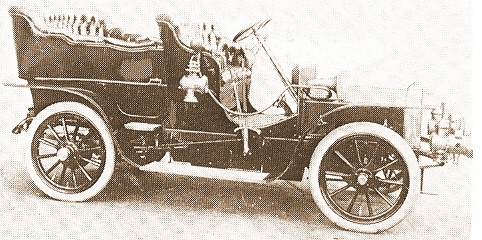
The Iden was an English automobile manufactured from 1904 until 1907. Designed by George Iden, formerly of Daimler, they were based in Coventry. They were four-cylinder 10/17 hp and 25/35 hp shaft-driven cars; each came with "Idens's frictionless radial gearbox".
Iden were wound up in 1906.[1][2] Their Coventry factory was later used by the Deasy Motor Car Company, which became part of Armstrong Siddeley.
See also
[edit]References
[edit]- ^ "No. 27897". The London Gazette. 23 March 1906. p. 2013.
- ^ "No. 28152". The London Gazette. 26 June 1908. p. 4669.
- Burgess-Wise, David. The New Illustrated Encyclopedia of Automobiles. BookSales Inc; Rev Upd edition (May 2000). p. 559. ISBN 0-7858-1106-0.
from Grokipedia
iDEN (Integrated Digital Enhanced Network) is a proprietary mobile telecommunications technology developed by Motorola that combines digital cellular telephony, two-way radio dispatch, alphanumeric paging, and packet-switched data services into a unified wireless system supporting voice, text, and limited broadband communications.[1][2]
Naming and Pronunciation
iDEN is pronounced /aɪˈdɛn/ (EYE-den). Utilizing time-division multiple access (TDMA) with a 25 kHz channel bandwidth, iDEN operates primarily in the 800 MHz and 900 MHz frequency bands, though variants support 1.5 GHz, enabling efficient multiplexing of up to three voice channels and one signaling channel per carrier while prioritizing low-latency push-to-talk (PTT) functionality.[3][4] The technology employs vector sum excited linear prediction (VSELP) vocoding for voice compression and forward error correction to maintain call quality in dispatch scenarios, distinguishing it from contemporary standards like GSM or CDMA by its focus on integrated dispatch and cellular hybridity.[2] The first iDEN handset, Motorola's L3000, was released in 1994, with commercial network deployment by Nextel Communications (formerly Fleet Call) beginning in 1996; iDEN formed the backbone of the first nationwide U.S. digital dispatch network under the Enhanced Specialized Mobile Radio (ESMR) framework, granted FCC approval in 1990 for six major markets.[5][2][6] Nextel's Direct Connect PTT service, powered by iDEN, achieved peak adoption with approximately 20 million subscribers in 2005, serving business, fleet, and public safety users with seamless nationwide roaming free of additional charges.[7][8] Internationally, iDEN networks were deployed in countries including Canada (via TELUS Mike), Colombia, Argentina, El Salvador, Israel, Saudi Arabia, Singapore, and Japan (at 1.5 GHz by the JAMTA consortium), often for specialized dispatch applications in transportation and utilities, though coverage remained more fragmented than in the U.S.[5][9] The 2005 merger of Nextel with Sprint Nextel accelerated iDEN's decline in the U.S., as the carrier shifted focus to CDMA and LTE; the legacy 800 MHz iDEN network was fully decommissioned on June 30, 2013, freeing spectrum for 4G deployment and resulting in the recycling of over 100 million pounds of equipment.[10][11][12] Though largely obsolete, iDEN influenced modern broadband PTT solutions like LTE-based Mission Critical Push-to-Talk (MCPTT), with all major networks decommissioned by the late 2010s.[2][13]
