Hubbry Logo
Intertropical Convergence ZoneIntertropical Convergence ZoneMain
Open search
Intertropical Convergence Zone
Community hub
Intertropical Convergence Zone
logo
8 pages, 0 posts
0 subscribers
Be the first to start a discussion here.
Intertropical Convergence Zone
from Wikipedia
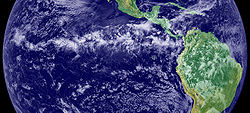
The ITCZ is visible as a band of clouds encircling Earth near the Equator.

The Intertropical Convergence Zone (ITCZ /ɪ/ ITCH, or ICZ),[1] known by sailors as the doldrums[2] or the calms because of its monotonous windless weather, is the area where the northeast and the southeast trade winds converge. It encircles Earth near the thermal equator, though its specific position varies seasonally. When it lies near the geographic equator, it is called the near-equatorial trough. Where the ITCZ is drawn into and merges with a monsoonal circulation, it is sometimes referred to as a monsoon trough (a usage that is more common in Australia and parts of Asia).

Meteorology

[edit]

The ITCZ was originally identified from the 1920s to the 1940s as the Intertropical Front (ITF); however, after the recognition of the significance of wind field convergence in tropical weather production in the 1940s and 1950s, the term Intertropical Convergence Zone (ITCZ) was then applied.[3]

The ITCZ appears as a band of clouds, typically thunderstorms, that encircle the globe near the Equator. In the Northern Hemisphere, the trade winds move in a southwestward direction from the northeast, while in the Southern Hemisphere, they move northwestward from the southeast. When the ITCZ is positioned north or south of the Equator, these directions change according to the Coriolis effect imparted by Earth's rotation. For instance, when the ITCZ is situated north of the Equator, the southeast trade wind changes to a southwest wind as it crosses the Equator. The ITCZ is formed by vertical motion largely appearing as convective activity of thunderstorms driven by solar heating, which effectively draw air in; these are the trade winds.[4] The ITCZ is effectively a tracer of the ascending branch of the Hadley cell and is wet. The dry descending branch is the horse latitudes.

The location of the ITCZ gradually varies with the seasons, roughly corresponding with the location of the thermal equator. As the heat capacity of the oceans is greater than air over land, migration is more prominent over land. Over the oceans, where the convergence zone is better defined, the seasonal cycle is more subtle, as the convection is constrained by the distribution of ocean temperatures.[5] Sometimes, a double ITCZ forms, with one located north and another south of the Equator, one of which is usually stronger than the other. When this occurs, a narrow ridge of high pressure forms between the two convergence zones.

ITCZ over oceans vs. land

[edit]
Seasonal variability of the Intertropical Convergence Zone (ITCZ), Congo air boundary (CAB), tropical rainbelt, and surface winds over Africa (adapted from Dezfuli 2017 with modification). This schematic shows that the ITCZ and the region of maximum rainfall can be decoupled over the continents.[6]

The ITCZ is commonly defined as an equatorial zone where the trade winds converge. Rainfall seasonality is traditionally attributed to the north–south migration of the ITCZ, which follows the sun. Although this is largely valid over the equatorial oceans, the ITCZ and the region of maximum rainfall can be decoupled over the continents.[6][7] The equatorial precipitation over land is not simply a response to just the surface convergence. Rather, it is modulated by a number of regional features such as local atmospheric jets and waves, proximity to the oceans, terrain-induced convective systems, moisture recycling, and spatiotemporal variability of land cover and albedo.[6][8][9]

South Pacific convergence zone

[edit]
Vertical air velocity at 500 hPa, July average. Ascent (negative values) is concentrated close to the solar equator; descent (positive values) is more diffuse

The South Pacific convergence zone (SPCZ) is a reverse-oriented, or west-northwest to east-southeast aligned, trough extending from the west Pacific warm pool southeastwards towards French Polynesia. It lies just south of the equator during the Southern Hemisphere warm season, but can be more extratropical in nature, especially east of the International Date Line. It is considered the largest and most important piece of the ITCZ, and has the least dependence upon heating from a nearby land mass during the summer than any other portion of the monsoon trough.[10] The southern ITCZ in the eastern tropical Pacific and southern tropical Atlantic, known as the SITCZ, occurs during the Southern Hemisphere fall between and 10° south of the equator east of the 140th meridian west longitude during cool or neutral El Niño–Southern Oscillation (ENSO) patterns. When ENSO reaches its warm phase, otherwise known as El Niño, the tongue of lowered sea surface temperatures due to upwelling off the South American continent disappears, which causes this convergence zone to vanish as well.[11]

Effects on weather

[edit]
The ITCZ moves farther away from the equator during the Northern summer than the Southern one due to the North-heavy arrangement of the continents.

Variation in the location of the intertropical convergence zone drastically affects rainfall in many equatorial nations, resulting in the wet and dry seasons of the tropics rather than the cold and warm seasons of higher latitudes. Longer term changes in the intertropical convergence zone can result in severe droughts or flooding in nearby areas.

In some cases, the ITCZ may become narrow, especially when it moves away from the equator; the ITCZ can then be interpreted as a front along the leading edge of the equatorial air.[12] There appears to be a 15 to 25-day cycle in thunderstorm activity along the ITCZ, which is roughly half the wavelength of the Madden–Julian oscillation (MJO).[13]

Within the ITCZ the average winds are slight, unlike the zones north and south of the equator where the trade winds feed. As trans-equator sea voyages became more common, sailors in the eighteenth century named this belt of calm the doldrums because of the calm, stagnant, or inactive winds.

The "doldrums" is a popular nautical term that refers to the belt around the Earth near the equator where sailing ships sometimes get stuck on windless waters.

Role in tropical cyclone formation

[edit]
Hurricanes Celia and Darby in the eastern Pacific and the precursor to Hurricane Alex in the Intertropical Convergence Zone. (2010)

Tropical cyclogenesis depends upon low-level vorticity as one of its six requirements, and the ITCZ fills this role as it is a zone of wind change and speed, otherwise known as horizontal wind shear. As the ITCZ migrates to tropical and subtropical latitudes and even beyond during the respective hemisphere's summer season, increasing Coriolis force makes the formation of tropical cyclones within this zone more possible. Surges of higher pressure from high latitudes can enhance tropical disturbances along its axis.[14] In the tropical north Atlantic and the eastern portion of the tropical north Pacific oceans, tropical waves move along the axis of the ITCZ causing an increase in thunderstorm activity, and clusters of thunderstorms can develop under weak vertical wind shear.[citation needed]

Hazards

[edit]

In the Age of Sail, to find oneself becalmed in this region in a hot and muggy climate could mean death when wind was the only effective way to propel ships across the ocean. Calm periods within the doldrums could strand ships for days or weeks.[15] Even today, leisure and competitive sailors attempt to cross the zone as quickly as possible as the erratic weather and wind patterns may cause unexpected delays.

In 2009, thunderstorms along the Intertropical Convergence Zone played a role in the loss of Air France Flight 447, which crashed while flying from Rio de Janeiro–Galeão International Airport to Charles de Gaulle Airport near Paris.[16] The aircraft crashed with no survivors while flying through a series of large ITCZ thunderstorms, and ice forming rapidly on airspeed sensors was the precipitating cause for a cascade of human errors which ultimately doomed the flight. Most aircraft flying these routes are able to avoid the larger convective cells without incident.

Effects of climate change

[edit]
Line graph showing titanium concentrations over time within Cariaco Basin sediment
Titanium concentrations in sediment within the Cariaco Basin have been used as a paleoclimate proxy to infer shifts in the ITCZ.[17]

Based on paleoclimate proxies, the position and intensity of the ITCZ varied in prehistoric times along with changes in global climate. During Heinrich events within the last 100 ka, a southward shift of the ITCZ coincided with the intensification of the Northern Hemisphere Hadley cell coincident with weakening of the Southern Hemisphere Hadley cell. The ITCZ shifted north during the mid-Holocene but migrated south following changes in insolation during the late-Holocene towards its current position. The ITCZ has also undergone periods of contraction and expansion within the last millennium.[18] A southward shift of the ITCZ commencing after the 1950s and continuing into the 1980s may have been associated with cooling induced by aerosols in the Northern Hemisphere based on results from climate models; a northward rebound began subsequently following forced changes in the gradient in temperature between the Northern and Southern hemispheres. These fluctuations in ITCZ positioning had robust effects on climate; for instance, displacement of the ITCZ may have led to drought in the Sahel in the 1980s.[19][20]

Atmospheric convection may become stronger and more concentrated at the center of the ITCZ in response to a globally warming climate, resulting in sharpened contrasts in precipitation between the ITCZ core (where precipitation would be amplified) and its edges (where precipitation would be suppressed). Atmospheric reanalyses suggest that the ITCZ over the Pacific has narrowed and intensified since at least 1979, in agreement with data collected by satellites and in-situ precipitation measurements. The drier ITCZ fringes are also associated with an increase in outgoing longwave radiation outward of those areas, particularly over land within the mid-latitudes and the subtropics. This change in the ITCZ is also reflected by increasing salinity within the Atlantic and Pacific underlying the ITCZ fringes and decreasing salinity underlying central belt of the ITCZ. The IPCC Sixth Assessment Report indicated "medium agreement" from studies regarding the strengthening and tightening of the ITCZ due to anthropogenic climate change.[20]

Less certain are the regional and global shifts in ITCZ position as a result of climate change, with paleoclimate data and model simulations highlighting contrasts stemming from asymmetries in forcing from aerosols, volcanic activity, and orbital variations, as well as uncertainties associated with changes in monsoons and the Atlantic meridional overturning circulation. The climate simulations run as part of Coupled Model Intercomparison Project Phase 5 (CMIP5) did not show a consistent global displacement of the ITCZ under anthropogenic climate change. In contrast, most of the same simulations show narrowing and intensification under the same prescribed conditions. However, simulations in Coupled Model Intercomparison Project Phase 6 (CMIP6) have shown greater agreement over some regional shifts of the ITCZ in response to anthropogenic climate change, including a northward displacement over the Indian Ocean and eastern Africa and a southward displacement over the eastern Pacific and Atlantic oceans.[20]

In literature

[edit]

The doldrums are notably described in Samuel Taylor Coleridge's poem The Rime of the Ancient Mariner (1798) and also provide a metaphor for the initial state of boredom and indifference of Milo, the child hero of Norton Juster's classic 1961 children's novel The Phantom Tollbooth. It is also cited in the 1939 book Wind, Sand and Stars.

See also

[edit]

References

[edit]
[edit]
Revisions and contributorsEdit on WikipediaRead on Wikipedia
from Grokipedia
The Intertropical Convergence Zone (ITCZ) is a zonally elongated band of atmospheric convergence near the equator where the northeasterly trade winds of the Northern Hemisphere and southeasterly trade winds of the Southern Hemisphere meet, driving upward motion of warm, moist air that produces persistent cloud cover, intense convection, and heavy precipitation in the form of thunderstorms. This feature encircles the globe roughly along the thermal equator but exhibits dynamic variability, including seasonal north-south migrations tied to the apparent movement of the sun and interhemispheric temperature contrasts, which shift its position by several degrees of latitude to follow maximum solar insolation. The ITCZ forms as a consequence of differential solar heating at the equator, where excess energy input relative to higher latitudes generates a thermally direct circulation cell—part of the broader Hadley circulation—characterized by surface inflow, ascent, and divergence aloft, with minimal zonal wind speeds in its core often leading to the historical "doldrums" known for calm conditions hazardous to sailing. Its precipitation belt accounts for a significant portion of global tropical rainfall, exerting causal influence on regional hydroclimates, including the onset and intensity of monsoons in Africa, South Asia, and the Americas, while disruptions in its position or intensity—such as double ITCZ structures or meridional shifts—can alter drought-flood cycles and ecosystem productivity. Observational data from satellites and reanalyses confirm its role in modulating interannual variability, linked to phenomena like El Niño-Southern Oscillation through teleconnections that propagate energy imbalances across the tropics.

Physical Mechanisms

Trade Wind Convergence and Formation

The northeast trade winds of the Northern Hemisphere and southeast trade winds of the Southern Hemisphere, both easterly surface winds typically ranging from 10 to 25 miles per hour (16 to 40 kilometers per hour), originate as equatorward return flows within the Hadley circulation cell but are deflected by the Coriolis effect due to Earth's rotation. In the Northern Hemisphere, the Coriolis force deflects southward-moving air to the right, resulting in northeasterly trades; in the Southern Hemisphere, deflection to the left produces southeasterly trades. This deflection maintains the trades as persistent, moisture-laden winds that transport water vapor evaporated from tropical oceans toward the equator. These trade winds converge near the thermal equator, where the position aligns closely with maximum solar heating, forming the intertropical convergence zone (ITCZ) as a narrow band of enhanced surface inflow. The opposing flows meet and merge, reducing wind speeds in the convergence area and establishing a belt of relatively low atmospheric pressure. Empirical observations confirm this convergence as the primary driver of the ITCZ's location, with the trades' easterly components ensuring east-west continuity across ocean basins. From principles of atmospheric mass conservation, the horizontal influx of air at the surface accumulates mass, generating a local pressure gradient that necessitates vertical divergence to restore balance, thereby initiating upward motion. This ascent occurs as converging air piles up, increasing density near the surface until buoyancy forces it aloft, independent of subsequent convective or latent heat processes. The resulting low-pressure trough persists as long as the trade wind convergence supplies mass, embodying the causal linkage between surface dynamics and vertical structure in tropical circulation.

Vertical Motion and Associated Phenomena

The convergence of surface trade winds within the intertropical convergence zone (ITCZ) forces air parcels upward, initiating vigorous vertical motion that penetrates deep into the troposphere. This ascent promotes the development of cumulonimbus clouds, which often organize into mesoscale convective systems featuring intense thunderstorms and narrow bands of heavy precipitation. Empirical observations from field campaigns, such as GATE, reveal that this deep convection concentrates in cloud clusters with rapid vertical velocities, typically exceeding those in surrounding regions. Additionally, tropical disturbances within the ITCZ can grow via barotropic instability driven by latitudinal variations in zonal wind, which produce horizontal shear that energizes unstable waves; growth rates increase with poleward ITCZ shifts due to enhanced shear from stronger potential vorticity gradients at higher latitudes. The thermodynamic processes driving this convection involve the release of latent heat from water vapor condensation and freezing aloft, which warms the air parcels and reduces their density relative to the environment. This buoyancy-driven amplification sustains and intensifies the upward motion, creating a positive feedback that maintains the ITCZ's convective vigor against radiative cooling. In the tropics, where sea surface temperatures exceed 26.5°C, this latent heat release can elevate cloud tops to 15-18 km, near the level of neutral buoyancy at the tropopause. Satellite and radar data confirm the ITCZ's typical latitudinal width of 200-500 km, within which precipitation rates often surpass 10 mm per hour in active convective cells. These features manifest as persistent cloud bands visible in outgoing longwave radiation minima, underscoring the causal link between low-level convergence and upper-level divergence facilitated by the convective tower structure.

Geographical Variations

Differences Over Oceans and Land

The Intertropical Convergence Zone (ITCZ) exhibits greater stability over oceans than over land, primarily due to the higher heat capacity of seawater, which results in more uniform sea surface temperatures (SSTs) and dampened seasonal temperature fluctuations. Over oceanic regions, the ITCZ tends to closely follow the thermal equator, defined by maximum SSTs, with migrations typically limited to a few degrees latitude annually, as ocean circulation efficiently transports heat across the equator and resists rapid shifts. This stability manifests in a narrower, more zonally continuous band of convection, as observed in satellite-derived precipitation data, where the ITCZ width over tropical oceans averages around 5-7 degrees of latitude. In contrast, over continental surfaces, the ITCZ displays heightened seasonal variability owing to land's lower heat capacity, which allows for rapid surface heating and cooling, driving amplified meridional migrations. During Northern Hemisphere summer, intense continental heating—such as over Africa and Asia—propels the ITCZ northward by up to 20 degrees latitude, reaching positions as far as 25°N over parts of the African Sahel in July and August, fueling monsoon systems. This leads to a broader and more disrupted structure over land, with widths often exceeding 10 degrees latitude and irregular features influenced by topography and surface heterogeneity, as evidenced by reanalysis and satellite observations showing fragmented convective clusters rather than uniform bands. Empirical contrasts from global datasets, including ERA-Interim reanalyses spanning 1979-2010, confirm that oceanic ITCZ convection is more persistent and symmetric about the equator, while land-based features show sharper latitudinal jumps tied to differential heating rates—for instance, land surfaces warm 5-10 times faster than oceans under equivalent insolation. These differences arise from causal thermal contrasts rather than remote dynamical forcings, with land's lower moisture availability further intensifying convective outbreaks during peak heating. Satellite imagery from instruments like TRMM (1998-2015) further reveals narrower precipitation maxima over Pacific and Atlantic oceans compared to the diffuse, monsoon-linked ITCZ over Eurasia and Africa.

South Pacific Convergence Zone

The South Pacific Convergence Zone (SPCZ) constitutes a semi-permanent, diagonally oriented extension of the Intertropical Convergence Zone (ITCZ), stretching southeastward from the equatorial western Pacific, near New Guinea, across the open ocean toward subtropical latitudes around 20°–25°S and 150°–160°W, approaching regions like French Polynesia. This structure arises from the convergence of southeasterly trade winds with northwesterly monsoon flows, modulated by meridional sea surface temperature (SST) gradients in the Pacific, which favor persistent low-level convergence and ascent along the diagonal axis rather than a purely zonal band. Ocean currents, including the southward-flowing equatorial currents and the broader South Pacific gyre, reinforce this by transporting heat and moisture southward, sustaining the zone's convective activity year-round. In contrast to the standard ITCZ, which typically aligns east-west near the equator and undergoes pronounced seasonal latitudinal migrations, the SPCZ maintains greater stationarity, with its core position varying by only a few degrees latitude annually, owing to the fixed SST asymmetry across the Pacific basin. This results in a less symmetric configuration, particularly in the eastern Pacific where the SPCZ often parallels a northern ITCZ branch, forming dual convergence zones separated by a dry subtropical band influenced by South American coastal upwelling. Topographic effects from island chains, such as those in Fiji and Samoa, further localize convergence but do not fundamentally alter the oceanic-driven diagonal tilt. The SPCZ exerts pronounced control over regional hydrology, channeling intense rainfall—often exceeding 200 mm per event during active phases—to southwest Pacific islands, as evidenced by frequent flooding in Fiji's Rewa Province linked to enhanced SPCZ convection. Conversely, its position diverts moisture away from adjacent areas, contributing to persistent aridity in the southeast Pacific dry zone east of 110°W, where annual precipitation drops below 500 mm due to divergence and subsidence. Paleoclimate records from coral Sr/Ca ratios indicate that SPCZ extensions have influenced South Pacific SST and salinity patterns over centuries, with southeastward shifts correlating to fresher, warmer surface waters in the convergence core.

Regional Asymmetries and Double ITCZ Features

The annual mean position of the Intertropical Convergence Zone (ITCZ) is shifted northward of the equator by about 5° to 7° latitude, primarily due to the disproportionate land coverage in the Northern Hemisphere, which generates enhanced heating contrasts and a stronger ascending branch in the Northern Hemisphere Hadley cell compared to its southern counterpart. This asymmetry arises from the thermal response of land surfaces to insolation, amplifying meridional temperature gradients and favoring convergence north of the equator on average, as evidenced by analyses of sea surface temperature (SST) patterns and atmospheric circulation. Oceanic influences further accentuate regional non-uniformity, with cross-equatorial SST gradients in the Pacific and Atlantic sustaining the northward bias through altered surface winds and moisture convergence, independent of purely land-driven effects. Reanalysis products such as ERA5 reveal that this positioning results in the Northern Hemisphere ITCZ accounting for the majority of zonal-mean tropical precipitation, with annual rainfall maxima exceeding southern counterparts by factors of 1.5 to 2 in key sectors. In the eastern Pacific and Atlantic Oceans, double ITCZ configurations occasionally emerge, featuring distinct convective bands in both hemispheres separated by an equatorial suppression zone. These structures, observed particularly during boreal spring, stem from the equatorial cold tongue—a region of cooler SSTs that inhibits upward motion at the equator, enabling southern extensions alongside the primary northern band and yielding bimodal precipitation peaks straddling 5°S to 5°N. ERA5 data confirm these features' episodic nature, with double bands contributing up to 20-30% of local rainfall variability in affected oceanic domains while underscoring the ITCZ's deviation from zonal symmetry.

Variability and Dynamics

Seasonal Migration

The Intertropical Convergence Zone (ITCZ) exhibits seasonal latitudinal migrations driven by the north-south progression of maximum solar insolation, which follows the subsolar point and alters the thermal equator's position. In the Northern Hemisphere summer (June-August), the ITCZ shifts northward to latitudes typically between 5°N and 20°N, depending on the region, such as 5°-15°N over the Atlantic and Pacific Oceans. In contrast, during the Southern Hemisphere summer (December-February), it migrates southward to approximately 5°-10°S over similar basins. These movements result from differential heating that strengthens convergence where trade winds meet under peak insolation. Empirical tracking via satellite-derived precipitation data and surface wind observations verifies annual latitudinal shifts of about 10°-25° from solstice to solstice, with the ITCZ position aligning closely with zones of maximum rainfall and low-level wind convergence. For instance, outgoing longwave radiation minima and enhanced convective activity delineate the ITCZ's path, confirming its equatorward retreat during equinoxes and poleward advance toward summer hemispheres. This seasonal oscillation directly modulates tropical wet and dry seasons by transporting moisture convergence to higher latitudes. In the Sahel region of Africa, the northward migration during boreal summer delivers substantial rainfall, transitioning the area from dry conditions to peak precipitation aligned with the ITCZ's passage. Similarly, southward shifts in austral summer influence wet seasons in the Amazon basin, where the ITCZ's position correlates with enhanced rainfall totals verified through ground station and satellite records. These patterns underscore the ITCZ's role in annual climate cycles without encompassing interannual deviations.

Interannual Fluctuations and ENSO Influence

The intertropical convergence zone (ITCZ) exhibits interannual fluctuations characterized by deviations in its latitudinal position, width, and convective intensity from seasonal norms, often on timescales of months to a few years. These variations arise from interactions with large-scale atmospheric and oceanic oscillations, including the El Niño-Southern Oscillation (ENSO). During El Niño phases, the ITCZ typically undergoes a southward shift in the western Pacific, accompanied by suppressed convection over the equatorial Pacific due to anomalous warming in the eastern Pacific that weakens easterly trade winds and reduces low-level convergence. In contrast, La Niña conditions enhance trade wind strength, promoting a northward shift of the ITCZ in the western Pacific and intensifying convection, with empirical analyses of precipitation data from 1979 onward showing that anomalously wide ITCZ configurations—spanning greater meridional extents—occur predominantly during La Niña events, accounting for 41 of 50 such months when defined by multivariate ENSO index thresholds exceeding ±0.5. The Madden-Julian Oscillation (MJO), a dominant intraseasonal mode with periods of 30-60 days, further modulates ITCZ intensity by propagating eastward through the tropical Indo-Pacific, suppressing or enhancing convective activity within the zone's core. MJO events often initiate near the ITCZ in the western Pacific, where equatorial convergence provides a favorable environment, but the ITCZ's presence alone is neither necessary nor sufficient for MJO onset, as demonstrated by satellite and reanalysis data from the DYNAMO field campaign in 2011-2012. Volcanic eruptions introduce transient perturbations via stratospheric aerosol loading, which cools the troposphere asymmetrically and displaces the ITCZ poleward from the hemisphere of greater aerosol influence; for instance, Southern Hemisphere eruptions like Pinatubo in 1991 shifted the ITCZ southward, inducing La Niña-like responses lasting 1-4 years through altered energy transport and trade wind anomalies. These effects, observed in global precipitation records post-eruption, underscore the ITCZ's sensitivity to radiative forcing imbalances on interannual scales.

Weather and Climate Impacts

Rainfall Patterns and Monsoons

The Intertropical Convergence Zone (ITCZ) generates the majority of equatorial rainfall through the ascent of moist air resulting from trade wind convergence, producing intense convective precipitation bands that can exceed 200 mm per day in peak activity. This zone accounts for approximately 32% of global annual precipitation, with its narrow band concentrating a disproportionate share of tropical rainfall relative to its latitudinal extent. Empirical observations from satellite data indicate that ITCZ-associated rains dominate the annual precipitation totals in equatorial oceans and landmasses, where mean monthly rainfall often surpasses 300 mm during the ITCZ's overhead passage. The seasonal migration of the ITCZ, tracking the thermal equator, establishes distinct rainfall patterns across the tropics, with maximum precipitation occurring where the zone aligns overhead and deficits prevailing in its absence. In regions like the equatorial Pacific and Atlantic, this migration results in bimodal rainfall peaks for areas straddling the equator, while unimodal regimes characterize higher-latitude tropics. Over land, the ITCZ's position amplifies these patterns through interactions with surface heating, leading to prolonged wet seasons when convergence strengthens local updrafts. The ITCZ significantly enhances monsoon rainfall in Asia and Africa by merging with seasonally reversing winds driven by land-ocean thermal contrasts, thereby intensifying moisture influx and convergence. In the African monsoon, the ITCZ's northward advance during boreal summer delivers 600-1000 mm of rain to the Sahel, supplementing local land-sea breeze circulations that draw in Atlantic moisture. Similarly, in South Asia, the ITCZ's poleward shift aligns with the southwest monsoon, boosting precipitation over India through combined large-scale ascent and orographic effects, with totals reaching 2000-3000 mm annually in core monsoon zones. Empirical evidence from the Sahel illustrates the ITCZ's influence on rainfall variability: during the 1970s and 1980s, a persistent southward migration of the ITCZ, linked to anomalous sea surface temperatures, reduced zonal-mean rainfall by over 30% relative to the 1950s wet period, exacerbating droughts across the region. Recovery in Sahel precipitation since the early 1990s correlates with a northward ITCZ repositioning, restoring annual rains to near pre-drought levels in many areas, as documented in gauge and satellite records. These shifts underscore the ITCZ's causal role in modulating monsoon intensity without invoking extraneous teleconnections beyond thermodynamic forcing.

Role in Tropical Cyclone Genesis

The Intertropical Convergence Zone (ITCZ) generates synoptic-scale disturbances, such as tropical easterly waves, that provide the initial vorticity and convective organization essential for tropical cyclone genesis. In the Atlantic basin, African easterly waves propagating westward along the ITCZ axis serve as precursors for approximately 60% of tropical cyclones, with these waves featuring mid-level troughs that foster low-level convergence and potential vorticity anomalies conducive to development. Similar wave trains occur globally within or near the ITCZ, enhancing the likelihood of cyclone formation by concentrating moisture and upward motion in regions of weak vertical wind shear. The latitudinal position of the ITCZ modulates tropical cyclone genesis through its influence on the Coriolis parameter, with poleward shifts placing disturbances at higher absolute latitudes where the parameter's magnitude (2Ω sinφ) is greater, thereby promoting rotational organization and intensification over the minimal values near the equator. Observational data reveal a robust interannual positive correlation between ITCZ latitude and cyclone genesis frequency in the North Atlantic, where northward displacements align the convergence zone with warmer sea surface temperatures, higher relative humidity, and reduced wind shear, resulting in elevated activity during seasons when the ITCZ exceeds approximately 5°N. Volcanic eruptions exemplify this positional sensitivity, as stratospheric aerosol injections induce hemispheric cooling asymmetries that drive southward ITCZ migrations, suppressing Northern Hemisphere cyclone genesis for 2–4 years post-eruption by diminishing the genesis potential index through altered thermodynamics and vorticity availability. For instance, the 1991 Mount Pinatubo eruption correlated with a pronounced ITCZ southward shift and reduced Atlantic tropical cyclone counts in subsequent seasons, consistent with statistical analyses of historical eruptions.

Hazards and Risks

Meteorological Dangers

The Intertropical Convergence Zone (ITCZ) generates intense convective activity, producing cumulonimbus (CB) clouds with tops frequently exceeding 40,000 feet (12 km), driven by strong updrafts from converging trade winds and high tropical moisture. These storms embed hazards including severe turbulence from interactions between updrafts and downdrafts, hail, lightning strikes, and icing conditions, particularly in regions of weak trade winds where isolated CB cells dominate. Wind shear within these systems, arising from rapid changes in wind speed and direction near storm cores, poses risks to aircraft stability and low-level shipping, with vertical shear gradients often exceeding 10 m/s per km. Squall lines embedded in ITCZ convection deliver gust fronts with winds up to 50 knots (93 km/h), exacerbating turbulence and low-visibility conditions for trans-equatorial flights. Heavy precipitation rates, commonly surpassing 50 mm per hour in active cells, contribute to microburst downdrafts and associated wind shears hazardous to aviation approaches and maritime operations. Pilots routinely plan ITCZ crossings during periods of minimal activity, using satellite imagery and radar to circumvent clusters, as direct penetration can result in structural stress from clear air turbulence extending tens of miles from visible convection. Meteorological records document recurrent encounters, such as routine deviations in equatorial Atlantic routes where ITCZ bands force altitude changes or rerouting to mitigate hail ingestion and engine icing risks.

Socioeconomic and Environmental Consequences

The intertropical convergence zone (ITCZ) drives monsoon rainfall critical for tropical agriculture, supporting crops like millet and sorghum in West Africa, where over 70% of the population depends on rain-fed farming for livelihoods. Aberrations in ITCZ positioning, however, trigger droughts that devastate yields; the southward withdrawal of the ITCZ from the 1960s to 1980s desiccated the Sahel region, contributing to famines between 1970 and 1984 that killed approximately 100,000 people and displaced millions, with rainfall deficits exceeding 200 mm annually in core areas. Environmentally, ITCZ precipitation exceeding 2,000 mm per year sustains biodiversity hotspots in equatorial rainforests, enabling complex ecosystems with over 10% of global species in regions like the Congo Basin. Shifts in ITCZ location induce drought stress, reducing lowland rainforest cover and altering biome distributions through threshold effects on vegetation. In oceanic realms, ITCZ dynamics modulate trade wind strength, influencing coastal upwelling; northward ITCZ migrations weaken upwelling off eastern boundaries like the Pacific, diminishing nutrient fluxes that underpin fisheries producing up to 20% of global catch, thereby threatening protein sources for coastal populations. Conversely, the ITCZ's equatorial persistence stabilizes discharge in major rivers such as the Congo, with year-round variability under 20%, ensuring perennial water availability for riparian ecosystems and human settlements.

Historical Development

Early Observations and Conceptualization

![Historical depiction of the doldrums][float-right] Mariners have long recognized the equatorial region of light and variable winds, referred to as the doldrums, which posed significant challenges to sailing vessels by causing prolonged periods of immobility. These calms were noted in accounts dating back to the Age of Sail, with sailors experiencing the belt of low pressure near the equator where trade winds converged weakly, leading to unpredictable weather and stalled progress. The term "doldrums" emerged in the early 19th century among sailors marooned in these windless zones, highlighting the frustration of ships becalmed for days or weeks. Systematic documentation appeared in 18th- and 19th-century ship logs, which recorded observations of equatorial convergence through entries on wind directions, speeds, and storm occurrences. Analyses of digitized logs from over 7 million journal entries reveal concentrated ship traffic and delays in the doldrums, underscoring the convergence of northeast and southeast trade winds into areas of rising air and frequent squalls. In the 1920s to 1940s, meteorologists conceptualized the phenomenon as the Intertropical Front (ITF), depicting it on weather maps as a discontinuity between moist equatorial air and drier trade wind regimes, akin to extratropical fronts. This frontal model was applied particularly in regions like , where it marked the boundary between the and flows. Post-World War II, wartime advancements in upper-air observations revealed the ITCZ's character as a zone of dynamic mass convergence rather than a static boundary, prompting the shift to the term Intertropical Convergence Zone to emphasize the inflow of trade winds and associated vertical motion.

Advancements in Understanding

The introduction of geostationary and polar-orbiting satellites in the 1970s marked a pivotal advancement in ITCZ research, enabling global visualization of its convective structure and migratory patterns. Observations from satellites during the Global Atmospheric Research Program (GARP) era, including data spanning 1967–1971, quantified interannual variations in convective activity over regions like the GATE area, revealing organized cloud clusters and their propagation speeds. These datasets supplanted sparse ship-based measurements, providing empirical evidence of the ITCZ's zonal asymmetry and links to large-scale circulation. Reanalysis products developed from the 1990s onward further refined quantification of ITCZ variability by assimilating satellite and in-situ data into consistent atmospheric states. Datasets such as ERA5 and the 20th Century Reanalysis (20CR) have delineated decadal shifts and regional intensities, with ERA5 capturing ITCZ position fluctuations from 1998–2018 across global and oceanic domains. These tools have isolated convective versus large-scale precipitation trends within the ITCZ, attributing boreal summer changes to thermodynamic influences. Theoretically, Jule Charney's 1969 analysis of large-scale tropical motions established key principles for ITCZ dynamics, highlighting conditional instability of the second kind (CISK) as a mechanism for wave amplification and convergence. Building on this, post-2010 frameworks emphasized energy balance constraints, positing that ITCZ latitude aligns with the atmospheric energy flux equator to balance hemispheric radiative imbalances via meridional transport. In recent years, investigations into salinity feedbacks and community structures have nuanced these dynamics. A 2024 study applied network analysis to precipitation data, identifying seven tropical communities defined by ITCZ spatio-temporal coherence, underscoring regional autonomy in convective organization. Concurrently, analyses of mid-20th-century Atlantic freshening linked salinity gradients to ITCZ southward shifts via sea surface temperature perturbations, integrating ocean-atmosphere coupling into positional theories. These empirical and theoretical strides, grounded in verifiable datasets, continue to resolve longstanding ambiguities in ITCZ predictability.

Climate Change Perspectives

Empirical Observations of Changes

In the Atlantic sector during the mid-20th century, observations indicate a southward migration of the ITCZ linked to sea-surface freshening and weakened SST gradients, contributing to reduced rainfall in the Sahel region. However, zonal-mean analyses of precipitation and circulation data reveal no robust latitudinal shift in ITCZ position over the full 20th century, with variations primarily driven by interhemispheric SST contrasts on multidecadal timescales rather than a persistent trend. Satellite and reanalysis data from 1998 to 2018, extended through recent decades up to the early 2020s, show minimal net latitudinal changes in the global ITCZ position, with interannual fluctuations dominated by natural modes such as ENSO, which modulate ITCZ intensity and regional precipitation without evidence of a sustained directional shift. Long-term trends in ITCZ strength exhibit weak variations, often within 3° latitude, tied to thermodynamic adjustments rather than dynamical reorganization. ENSO events, for instance, induce temporary northward or southward displacements of up to several degrees in specific basins, but these revert with phase changes, underscoring variability over trend. Proxy records from the mid-Holocene (approximately 6,000 years ago) contrast with modern stability, documenting expansions of ITCZ influence and northward migrations of up to 1° latitude in regions like the Indo-Pacific, inferred from speleothem oxygen isotopes and enhanced monsoon precipitation signals. These paleoclimate shifts, driven by orbital precession amplifying seasonal insolation, resulted in broader zonal rainfall bands and intensified convective activity compared to 20th- and 21st-century observations, where such extremes are absent in instrumental records.

Model-Based Projections

Climate models participating in the Coupled Model Intercomparison Project Phase 6 (CMIP6) generally project a narrowing of the Intertropical Convergence Zone (ITCZ) under global warming scenarios, with the zonal extent of ascent weakening and contracting equatorward. This narrowing is linked to alterations in the moist static energy budget, where enhanced gross moist stability reduces the meridional scale of convection. Multimodel ensembles under scenarios like SSP3-7.0 indicate a median ITCZ width reduction of approximately 0.14° latitude per Kelvin of warming, primarily through a northward displacement of the southern ITCZ edge by about 0.8° latitude in the multimodel mean. Projections for ITCZ position exhibit zonally asymmetric shifts, with robust northward migration over eastern Africa and the Indian Ocean, contrasted by southward shifts over the eastern Pacific and Atlantic basins by the end of the 21st century. These patterns arise from projected sea surface temperature (SST) gradients and interhemispheric energy imbalances, where relatively faster Northern Hemisphere warming drives poleward (northward) ITCZ displacement to restore radiative equilibrium via cross-equatorial energy transport. In Northern Hemisphere summer, models anticipate an equatorward contraction alongside intensified precipitation in the core ITCZ position, exceeding 3 mm/day in some eastern tropical Pacific projections. A potential slowdown of the Atlantic Meridional Overturning Circulation (AMOC), simulated in some CMIP6 models under high-emissions pathways, introduces southward ITCZ shifts, particularly in the tropical Atlantic, by cooling Northern Hemisphere SSTs and altering Hadley cell extent. This effect scales with AMOC weakening magnitude, with reductions of around 10 Sv linked to enhanced Southern Hemisphere precipitation and Northern Hemisphere drying. Certain scenarios also feature an enhanced double-ITCZ structure, where symmetric northern and southern precipitation bands intensify, though model ensembles vary in the degree of this asymmetry. Ensemble means from CMIP6 under SSP3-7.0 project poleward ITCZ migrations on the order of 0.5° to 1° latitude by 2100 in Northern Hemisphere-focused analyses, contingent on assumed SST patterns and ocean heat uptake. These outputs assume continued anthropogenic forcing with hemispheric warming differentials, but rely on parameterizations of convection and cloud feedbacks that introduce uncertainties in energy flux representations. Projections emphasize the ITCZ's sensitivity to extratropical influences, underscoring the need for improved simulation of meridional energy transport in driving long-term positioning.

Discrepancies and Scientific Debates

Climate models frequently exhibit a double-ITCZ bias, characterized by spurious precipitation maxima in the Southern Hemisphere tropics, which persists across CMIP3, CMIP5, and CMIP6 ensembles despite model improvements. This bias, often exceeding 2-3 mm/day in mean precipitation errors south of the equator, overestimates Southern Hemisphere convective features and amplifies projected ITCZ responses to warming, including exaggerated southward shifts or enhanced dual convergence zones under future scenarios. Such systematic errors stem from deficiencies in simulating ocean-atmosphere coupling and cloud processes, leading to inflated estimates of tropical precipitation sensitivity to radiative forcings. Observed ITCZ trends diverge from many model projections, with satellite and reanalysis data indicating a narrowing and strengthening of the precipitation band over recent decades, contrary to predictions of weakening or poleward expansion in some greenhouse-gas-forced simulations. For instance, global ITCZ intensity has increased from cooler to warmer historical periods, with latitudinal shifts confined within 3° and no consistent equatorward migration as forecasted in uniform warming scenarios. These discrepancies highlight limitations in models' representation of tropical sea surface temperature patterns, which drive observed versus projected ITCZ dynamics. Attribution debates center on the relative roles of volcanic versus anthropogenic forcings, with aerosols from both sources implicated in twentieth-century ITCZ migrations, though models struggle to disentangle their effects due to uncertainties in radiative forcing estimates. Volcanic eruptions, such as those in the Pinatubo event of 1991, have induced rapid, transient southward shifts via hemispheric cooling, overshadowing gradual anthropogenic signals in short-term records. Critics argue that overreliance on anthropogenic greenhouse gas dominance ignores natural aerosol variability, as paleoclimate proxies reveal ITCZ position excursions of several degrees over millennia—far exceeding modern changes—driven by solar irradiance, orbital cycles, and hemispheric temperature contrasts without elevated CO2 levels. Paleoclimate evidence from sediment records, such as titanium proxies in the Cariaco Basin indicating upwelling tied to ITCZ latitude, underscores dominant natural variability, with millennial-scale shifts linked to interhemispheric energy imbalances rather than radiative forcing alone. This supports skepticism toward projections exaggerating CO2-driven ITCZ alterations, as internal variability and unmodeled forcings like volcanic episodes account for a larger fraction of historical fluctuations than consensus model attributions suggest.

References

Add your contribution
Related Hubs
User Avatar
No comments yet.