Hubbry Logo
WentletrapWentletrapMain
Open search
Wentletrap
Community hub
Wentletrap
logo
8 pages, 0 posts
0 subscribers
Be the first to start a discussion here.
Wentletrap
Wentletrap
from Wikipedia

Wentletrap
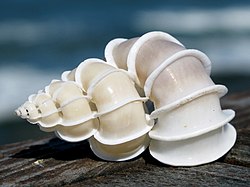
A shell of Epitonium scalare
Scientific classification Edit this classification
Kingdom: Animalia
Phylum: Mollusca
Class: Gastropoda
Subclass: Caenogastropoda
Superfamily: Epitonioidea
Family: Epitoniidae
Berry, 1910 (1812)
Genera

See text

Synonyms[1]
  • Acirsinae Cossmann, 1912
  • Acrillinae Jousseaume, 1912
  • Cirsotrematinae Jousseaume, 1912
  • Clathroscalinae Cossmann, 1912
  • Epitoniinae Berry, 1910 (1812)
  • Gyroscalinae Jousseaume, 1912
  • Ianthinidae ( 19th century authors used indifferently the spellings Janthina / Ianthina and Janthinidae / Ianthinidae. The nomenclaturally valid name is Janthinidae, but the spelling Ianthinidae has remained sporadically in use throughout the 20th century.)
  • Iodeidae Leach, 1847 (unavailable name)
  • Janthinidae Lamarck, 1822
  • Lioatlantinae B. Dybowski & Grochmalicki, 1920
  • Nystiellidae Clench & R. D. Turner, 1952
  • Opaliinae Cossmann, 1912
  • Papyriscalinae Jousseaume, 1912
  • Recluziidae Iredale & McMichael, 1962 (nomen nudum)
  • Scalariidae Lamarck, 1812
  • Scalidae H. Adams & A. Adams, 1853 (synonym)
  • Stenacmidae Pilsbry, 1945

Wentletraps are small, often white, very high-spired, predatory or ectoparasitic sea snails, marine gastropod mollusks in the family Epitoniidae.[1]

The word wentletrap originated in Dutch (wenteltrap), and it means spiral staircase. These snails are sometimes also called "staircase shells", and "ladder shells".

The family Epitoniidae belongs to the superfamily Epitonioidea. Since 2017 this family also includes the former families Janthinidae (the pelagic purple snails) and Nystiellidae, all part of the informal group Ptenoglossa.[2]

Epitoniidae is a rather large family, with an estimated number of species about 630.[3]

Distribution

[edit]

Wentletraps inhabit all seas and oceans worldwide, from the tropical zones to the Arctic and Antarctic zones.

Shell description

[edit]

Most species of wentletrap are white, and have a porcelain-like appearance. They are notable for their intricately geometric shell architecture, and the shells of the larger species are prized by collectors.

The more or less turret-shaped shell consists of tightly-wound (sometimes loosely coiled), convex whorls, which create a high, conical spiral. Fine or microscopic spiral sculpture (also called "striae") is present in many species. The shells sometimes feature an umbilicus. Wentletrap shells have a roundish or oval aperture, but its inner lip is often reduced to strip of callus. The round and horny operculum is paucispiral and fits the aperture tightly. Most of the species in the family are small to minute, although some are larger, and overall the adult shell length in the family varies between 0.6 and 11.7 cm.[4]

Within the genus Epitonium, the type genus of the family, the shell has predominantly axial sculpture of high, sharply ribbed "costae". These costae may offer some protection against other predatory snails, which would find it difficult or impossible to bore a hole in a shell with such obstructions.

Ecology

[edit]

Wentletraps are usually found on sandy bottoms near sea anemones or corals, which serve as a food source for them. Some species are foragers and search for anemones.

Little is known about the biology of most wentletraps. Keen (1958) is most often cited. He observed that many wentletraps reveal a hint of purple body color, suggestive of carnivorous feeding. The animal can exude through its salivary gland a pink or purplish dye that may have an anaesthetic effect on its prey.[5][6]

Keen also cited direct observation of a wentletrap feeding by insertion of its proboscis into a sea anemone.

A sequence of a wentletrap feeding on an anemone has been published.[7] These snails also prey on corals and other coelenterates.

Female wentletraps lay egg capsules that are bound together with a supple string. The young emerge from these capsules as free-swimming larvae.[7]

Genera

[edit]

Genera within the family Epitoniidae include:[1]

Synonyms

[edit]
  • Acrilla H. Adams, 1860: synonym of Amaea H. Adams & A. Adams, 1853
  • Acutiscala de Boury, 1909 : synonym of Epitonium Röding, 1798
  • Amiciscala Jousseaume 1912  : synonym of Epitonium Röding, 1798
  • Asperiscala de Boury, 1909: synonym of Epitonium Röding, 1798
  • Cinctiscala de Boury 1909  : synonym of Asperiscala de Boury, 1909
  • Cirratiscala de Boury, 1909  : synonym of Epitonium Röding, 1798
  • Clathroscala de Boury 1889  : synonym of Amaea H. Adams & A. Adams, 1853
  • Clathrus Oken 1815  : synonym of Epitonium Röding, 1798
  • Compressiscala Masahito (Prince) & Habe 1976 : synonym of Gregorioiscala Cossmann, 1912
  • Dannevigena Iredale 1936  : synonym of Cirsotrema Mörch, 1852
  • Depressiscala de Boury 1909 : synonym of Epitonium Röding, 1798
  • Foliaceiscala de Boury 1912  : synonym of Epitonium Röding, 1798
  • Fragiliscala Azuma 1962  : synonym of Amaea H. Adams & A. Adams, 1853
  • FragilopaliaAzuma 1972  : synonym of Amaea H. Adams & A. Adams, 1853
  • Glabriscala de Boury 1909  : synonym of Epitonium Röding, 1798
  • Lampropalia Kuroda & Ito, 1961  : synonym of Cylindriscala de Boury, 1909
  • Mazescala Iredale 1936  : synonym of Epitonium Röding, 1798
  • Nipponoscala Masahito (Prince) & Habe 1973  : synonym of Epitonium Röding, 1798
  • Nodiscala de Boury 1889 : synonym of Opalia H. Adams & A. Adams, 1853
  • Nystiella Clench & Turner, 1952  : synonym of Opaliopsis Thiele, 1928
  • Plastiscala Iredale, 1936 : synonym of Acirsa Mörch, 1857 (junior subjective synonym)
  • Problitora Iredale, 1931 : synonym of Alexania Strand, 1928 (uncertain synonym)
  • Sagamiscala Masahito, Kuroda & Habe, 1971 : synonym of Globiscala de Boury, 1909
  • Scala Mörch, 1852 : synonym of Epitonium Röding, 1798
  • Scalina Conrad, 1865  : synonym of Amaea H. Adams & A. Adams, 1853
  • Spiniscala de Boury, 1909  : synonym of Epitonium Röding, 1798
  • Turbiniscala de Boury 1909  : synonym of Epitonium Röding, 1798
  • Viciniscala de Boury 1909  : synonym of Epitonium Röding, 1798

References

[edit]

Further reading

[edit]
[edit]
Revisions and contributorsEdit on WikipediaRead on Wikipedia
from Grokipedia
A wentletrap is a small to medium-sized marine gastropod in the Epitoniidae, distinguished by its high-spired, turreted shell that is usually or porcelain-like in texture and adorned with prominent axial ribs that form a spiral pattern around the whorls. The term "wentletrap" originates from the Dutch wenteltrap, meaning "spiral staircase" or "winding staircase," a reference to the shell's distinctive architecture. The family Epitoniidae is cosmopolitan, with species distributed across all oceans and occurring from the lower intertidal zone to abyssal depths on a variety of substrata, including sandy bottoms and coral reefs. These snails are primarily carnivorous micropredators or ectoparasites, feeding on cnidarians such as sea anemones and corals by inserting their proboscis to bite and extract small pieces of host tissue, with some species showing specificity to particular hosts. Comprising a large and diverse group with over 1,000 described across more than 70 genera, wentletraps play a notable role in marine ecosystems as specialized consumers of sessile , though many remain poorly studied due to their often cryptic habits and deep-sea occurrences. Their shells, prized by collectors for their intricate beauty, also appear in the fossil record, highlighting the family's ancient lineage within the .

Taxonomy

Etymology and history

The name "wentletrap" derives from the Dutch term wenteltrap, meaning "spiral staircase," a reference to the high-spired, turreted structure of the shells in this group of marine gastropods. Wentletraps attracted significant interest among European shell collectors in the 18th century, with species like the precious wentletrap (Epitonium scalare) fetching extraordinarily high prices due to their rarity and aesthetic appeal, sometimes equivalent to hundreds of pounds at auctions. Notable early specimens include the Humphrey wentletrap (Epitonium humphreysii), first described by Paul Louis Dauthier Kiener in as Scalaria humphreysii, which highlighted the growing fascination with these ornate shells. The family was first formally described as Scalariidae by in 1812, though subsequent taxonomic revisions led to its current designation as Epitoniidae, established by Samuel Stillman Berry in 1910. Key 19th-century works advanced the understanding of wentletrap diversity, including Kiener's Général et raisonné des coquilles (1834–1840), which detailed numerous species, and George Brettingham Sowerby's Conchological Illustrations (1844), which contributed to early delineations such as Epitonium and Scalaria. In a 2013 taxonomic update, the family incorporated the former Janthinidae, reflecting phylogenetic revisions.

Classification

The family Epitoniidae is classified within the superfamily Epitonioidea, order Littorinimorpha, subclass , class , and phylum , comprising exclusively marine caenogastropod snails. This placement reflects their position among the diverse hypsogastropods, distinguished by a combination of morphological features such as turreted shells with axial costae and a corneous operculum. A significant taxonomic revision occurred in 2013, when the family Janthinidae (including the violet snails of genus Janthina) was incorporated into Epitoniidae based on detailed morphological analysis of shell and soft-part , corroborated by prior molecular demonstrating close phylogenetic affinity. Similarly, molecular phylogenetic studies in 2014 revealed Nystiellidae to be nested within Epitoniidae, rendering the former paraphyletic and justifying its synonymization, supported by shared traits in radular structure and protoconch morphology. These revisions align with broader caenogastropod phylogenies emphasizing integrated molecular and data. The family has several junior synonyms, including Scalidae (established 1853), which was suppressed under (ICZN) priority rules favoring the earlier Epitoniidae (1812); Janthinidae (1822), conserved but subordinated due to prevailing usage of Epitoniidae (ICZN Opinion 2368, 2012); and Nystiellidae (1952), relegated following phylogenetic evidence. Other proposed names like Aciculidae and Epitoniadae have been similarly rejected as non-priority or misapplied. Within Epitoniidae, subfamilies include Epitoniinae and Nystiellinae. Epitoniinae, the nominotypical subfamily, is diagnosed by a smooth or finely spirally ornamented protoconch and predominantly shallow-water with prominent axial on the teleoconch. Nystiellinae, in contrast, features an axially ribbed protoconch and deeper-water taxa with more subdued axial sculpture, reflecting adaptations to bathyal environments.

Morphology

Shell characteristics

The shells of wentletraps (family Epitoniidae) exhibit a distinctive turreted, high-spired morphology, characterized by numerous convex whorls that create a "staircase-like" appearance due to the separation or partial disconnection between whorls, often bridged by prominent axial elements. This elongate-conical to slender shape is fragile and lightweight, with teleoconch whorls typically numbering 7–12 or more, and a protoconch of about 3¼–3½ whorls. Adult shell heights generally range from 0.6 cm to 11.7 cm, though most are smaller, with the largest recorded in Epitonium scalare reaching up to 7–11 cm. The surface features strong axial (costae) on all whorls, which are low and lamellar, varying from sharp and blade-like to rounded and low-profile, with numbers increasing progressively (e.g., 13–93 per whorl across ) and sometimes aligned vertically or coronate (spine-like) on later whorls. Coloration is typically porcelain-like white or creamy, often with a glossy finish, though some display faint brown bands or yellowish tones; the interior is similarly pale and shiny. The is narrow and ovate to subcircular, with a simple, thin outer lip and an inner lip often reduced to a narrow strip; an umbilicus may be present but is typically narrow or closed. The operculum is thin, corneous (horny), and paucispiral, serving to seal the with a multispiral structure featuring fine wavy threads. Variations include species with more pronounced spines on ribs or colored spiral bands, enhancing or in their marine environments.

Soft body anatomy

The soft body of wentletraps (family Epitoniidae) is adapted for a predatory lifestyle on cnidarians, featuring an elongated, acrembolic that can extend up to 1.5 times the shell length to reach and manipulate prey such as tentacles. This houses a ptenoglossan lacking a central rachidian , with lateral teeth that are slender, hooked, or pointed, enabling piercing and severing of soft tissues. In like Nitidiscala tincta, the teeth vary in form, supporting the extraction of prey fragments into the digestive tract. Glandular structures in the soft body include paired salivary — an outer pair that is thick and rough, and an inner pair that is thin and coiled— which connect to stylet bulbs and may secrete to aid in prey handling. A prominent hypobranchial , often in coloration, occupies much of the mantle cavity and produces a dye-like released when the animal is disturbed, potentially serving to deter predators or subdue cnidarian prey alongside possible anaesthetic from salivary . In Epitonium hartogi, a pigmented mantle organ similarly releases purplish , observed during collection. The foot is broad, rectangular, and muscular, facilitating slow crawling over soft substrates like surfaces, with secretions of sticky threads for secure attachment. The mantle edge is simple, lacking siphons, and encloses a gill with triangular lamellae for respiration. In Epitonium dendrophylliae, the foot appears golden yellow with white spots and features a deep transverse groove at the anterior margin, enhancing mobility on polyp tissues. Sensory organs include a pair of cephalic tentacles bearing eyes at their bases for basic vision, as seen in both larval and stages of N. tincta. A triple-ridged in the mantle cavity provides chemosensory detection of environmental cues, such as prey odors. The follows the typical streptoneurous pattern of caenogastropods, with a nerve ring posterior to the tentacles and buccal ganglia associated with the salivary glands. A short propodial on the foot's anterior edge may serve additional sensory functions during locomotion. The radula's harpoon-like teeth are deployed via the to pierce and extract cnidarian tissues during predation.

Distribution and habitat

Global distribution

Wentletraps, belonging to the family Epitoniidae, exhibit a across all major ocean basins, including the Atlantic, Indian, Pacific, , and waters. This widespread occurrence spans from tropical to polar latitudes, reflecting the family's adaptability to diverse marine environments. The group is found from intertidal zones down to bathyal depths of up to 2,000 meters, with some species extending into abyssal regions. While many species inhabit shallow coastal areas, deep-sea forms are documented in continental slopes and basins, contributing to the family's broad vertical range. Highest is concentrated in the Indo-Pacific tropics, particularly the Coral Triangle region, far exceeding numbers in other provinces. Regional is evident in certain areas, such as the (e.g., Epitonium clathrus) and the , home to endemics including Epitonium multistriatum. These patterns arise partly from dispersal limitations in isolated basins. Planktonic veliger larvae facilitate long-distance dispersal for many species, enabling broad geographic ranges across ocean currents; however, some deep-sea wentletraps remain confined to specific basins due to reduced larval mobility or specificity.

Habitat preferences

Wentletraps (family Epitoniidae) primarily inhabit benthic marine environments characterized by subtidal soft sediments or rocky substrates, where they maintain close associations with cnidarian prey such as sea anemones and scleractinian corals. These preferences facilitate access to their ectoparasitic or predatory interactions with hosts, often in areas of low host density to reduce competition during larval settlement. For instance, many Indo-West Pacific favor flat sandy or muddy bottoms over burrowed or crevice-ridden substrates, as evidenced by significantly higher rates on corals in open sediment areas (χ² = 14.9, p < 0.001). Depth ranges vary widely across the family, with most species occurring in shallow coastal waters from 5 to 50 meters, though some extend to mesophotic (30–40 m) or deeper bathyal zones (200–600 m), and a few reach abyssal depths exceeding 1,000 m. This distribution reflects adaptations to diverse hydrostatic pressures and oxygen levels, with shallower species often on wave-exposed reef slopes and deeper ones trawled from continental slopes in sandy habitats. Temperature tolerances span polar to tropical regimes, enabling global occurrence from Arctic intertidal zones to equatorial deep seas, though optimal conditions align with the thermal ranges of their cnidarian hosts. Wentletraps frequently associate with biogenic structures, including aggregations of sea anemones, coral reefs, and occasionally the floating bubble rafts of violet snails (Janthina spp.), which provide neustonic microhabitats for certain pelagic or semi-pelagic members of the family. Slender shell morphologies (height/width ratio >2.0) in many enhance mobility and allow burial in soft sediments beneath hosts for , while broader shells suit attachment to exposed coral surfaces. However, these adaptations render them vulnerable to sediment disturbance, such as wave action or bioturbation, which can overturn hosts and expose snails to predation; for example, epitoniids on corals are often consumed when hosts are dislodged.

Ecology

Feeding mechanisms

Wentletraps in the family Epitoniidae are predominantly carnivorous, preying upon or parasitizing sessile cnidarians including sea anemones (Actiniaria), scleractinian corals, and hydroids. All benthic species studied to date exhibit this diet, with no records of herbivory or alternative feeding strategies. They typically target polyps, tentacles, and associated tissues, which provide nutrient-rich, soft material suitable for their specialized anatomy. For instance, species such as Epitonium hartogi consume coral tissue from bubble corals in the genus Plerogyra (Euphyllidae), residing within polyp mouths or septae to access prey directly. Feeding involves a stealthy approach to avoid detection by the cnidarian's stinging cells, often occurring at night or when the host is distracted, such as during its own feeding. The snail extends a highly elongate —sometimes exceeding shell length—to contact or penetrate the prey. In ectoparasitic cases, like Epitonium clathratulum on the anemone Bunodosoma biscayensis, the is inserted through the host's slit into the gastrovascular cavity, allowing the snail to siphon predigested food particles and for approximately 30 minutes per session. Direct tissue consumption occurs via attachment of the to the prey's oral disc or cenosarc, where the ptenoglossan —lacking a central rachidian and featuring slender, multi-cusped denticles—is deployed to and ingest minute fragments of polyps or tentacles. Species such as Epitonium dendrophylliae demonstrate this by biting off small pieces from the coral Astroides calycularis, aided by secretion of a thin, resistant mucous filament for during feeding. Many epitoniids also release a purplish from mantle organs, potentially aiding in prey immobilization, though its role remains observational. Dietary specificity is common within the genus Epitonium, where species preferentially associate with and feed on particular cnidarian genera, enhancing energy efficiency in their low-mobility . For example, E. dendrophylliae restricts its predation to Astroides corals, yielding slow growth rates of about 0.008 mm per day from tissue fragments, while E. clathratulum exploits the anemone's digestive processes for larger, nutrient-dense meals at infrequent intervals. This strategy aligns with their benthic, often infaunal habits, where extended periods of inactivity in or crevices conserve energy between opportunistic feeds on immobile prey. Jaws flanking the assist in manipulating ingested material, ensuring effective processing without excessive movement.

Reproduction and life cycle

Wentletraps in the family Epitoniidae exhibit , with individuals functioning first as males and later transitioning to females, a process known as protandry. In species such as Epitonium tinctum, smaller individuals (shell lengths of 2–8 mm) produce , while larger ones (7–13 mm) develop ovaries and deposit eggs. Fertilization is internal, achieved through the transfer of spermatozeugmata—bundles comprising one large with numerous smaller ones attached—via respiratory currents, where males position themselves near females using their tentacles to direct the structures. Females deposit eggs in sand-encrusted capsules attached to hard substrates by an elastic thread or filament. These capsules are typically small (0.7–1.9 mm in diameter), pyramidal or disc-shaped, and contain 17–221 eggs per capsule, with numbers varying by female size and environmental factors like sand grain size. For example, in Epitonium georgettinum, egg masses consist of 120–238 capsules strung together, each holding an average of 153 uncleaved measuring 73–78 μm in diameter. Development occurs within the capsules through spiral cleavage, passing a brief trochophore stage before as planktotrophic veliger larvae. In E. tinctum, veligers (approximately 77 μm wide) emerge after about 7 days of incubation at 11°C and remain planktonic for over a month in conditions, facilitating wide dispersal. in other , such as E. georgettinum, produces active veligers that likely persist planktonically for more than 26 days, based on comparisons with related taxa. Settlement and occur near cnidarian hosts, though specific chemical cues remain unconfirmed in studied . The overall life cycle is annual in E. tinctum, with veliger settlement from to , summer growth, and peak production in fall, followed by after spawning. Growth is slow, and adults live 1–2 years in observed populations, though lifespans may extend to 5 years in other based on shell growth patterns. Knowledge gaps persist due to the difficulty of maintaining wentletraps in aquaria and their rarity in natural collections, limiting observations of full developmental sequences across the family.

Diversity

Genera

The family Epitoniidae encompasses 52 genera and 787 accepted species worldwide. Among these, Epitonium stands out as the most diverse genus, containing 382 species, many of which are shallow-water predators associated with cnidarian hosts. Species in Epitonium typically feature shells with regular, evenly spaced axial costae that extend across whorls, contributing to their characteristic turreted, porcelain-like appearance. This genus exhibits a , occurring in tropical to temperate marine environments across all major oceans. Other notable genera include Acirsa, characterized by shells that often display tuberculate or spiny projections along the axial ribs, particularly near the sutures, enhancing their defensive or structural adaptations. Acirsa species are predominantly deep-sea dwellers, found from bathyal to abyssal depths in the Atlantic, Pacific, and Indian Oceans. Nystiella (now often synonymized with Opaliopsis) is distinguished by irregular, variable sculpture on the shell surface, including uneven costae and spiral threads, reflecting adaptations to diverse substrates. This genus is primarily distributed in the Atlantic, with some extensions into the . Several genera show restricted distributions, such as Africanella, which is endemic to the region, particularly and adjacent waters, where its exhibit finely sculptured, elongated shells suited to habitats. The genus Janthina, comprising pelagic violet snails with thin, glossy shells and a characteristic float made from bubble rafts, was formerly classified in the separate family Janthinidae but has been integrated into Epitoniidae following molecular and morphological revisions. Janthina are widespread in open ocean surfaces globally, preying on floating hydrozoans. Following the 2017 taxonomic merger of Janthinidae into Epitoniidae, additional genera such as Recluzia—featuring slender, neustonic shells with reduced sculpture—were reclassified within the family, expanding its recognized diversity to include more pelagic forms. This revision underscores the family's based on shared anatomical traits like the epitoniid and operculum. Overall, genera within Epitoniidae vary in shell ornamentation from smooth to heavily costate or spiny, reflecting ecological specializations from intertidal zones to the .

Notable species

One of the most prominent species in the family Epitoniidae is Epitonium scalare, commonly known as the precious wentletrap or ladder wentletrap, recognized for its striking shell adorned with prominent, ladder-like axial ribs that give it a distinctive, elegant appearance. This species is among the larger wentletraps, with adult shells reaching a maximum length of 7.0 cm. It inhabits subtidal sandy environments at depths from 0 to 91 m and is distributed across the , including the , (along and ), and southwestern Pacific regions such as . Due to its aesthetic appeal, E. scalare has long been a prized item among shell collectors, historically leading to the production of counterfeits using materials like rice paper to meet demand. In the western Atlantic, Epitonium humphreysii, or Humphrey's wentletrap, stands out for its ornate shell sculpture featuring large, blade-like axial costae on nine to ten whorls, often with a dark, nearly black . This small species, typically measuring 12–24 mm in length, occurs from southward through , the , the , and to , inhabiting shallow coastal waters including sandy and areas. Like other wentletraps, it has been valued in the historical shell trade for its intricate design, contributing to its status as a sought-after collectible. The violet sea snail, Janthina janthina, represents a unique pelagic member of the Epitoniidae, now firmly classified within the family alongside traditional wentletraps. Its thin, iridescent violet shell, reaching 30–40 mm, floats at the ocean surface supported by a raft of mucus bubbles that also traps prey like jellyfish and Portuguese man o' war. This holoplanktonic species inhabits warm tropical and temperate waters worldwide, particularly in offshore surface layers just beneath the sea-air interface. Historically, J. janthina was exploited for its purple mucus, which yields a durable dye similar to Tyrian purple, making it culturally significant in ancient Mediterranean societies. Among rare and deep-sea examples, species in genera like Acirsa exemplify the family's extension into abyssal depths, where they act as predators or ectoparasites on cnidarians such as anemones. For instance, Epitonium vaillanti has been documented in deep Mediterranean waters, highlighting the group's adaptation to extreme environments beyond shallow . Many epitoniids associated with scleractinian corals face conservation concerns due to habitat loss from and decline, which disrupts their specialized feeding relationships and reduces population viability in reef ecosystems. The Epitoniidae encompasses 787 accepted species globally as of 2025, with over 1,000 described species including synonyms; ongoing discoveries, particularly in the , continue to expand knowledge of its biodiversity, such as a 2003 survey that described 19 new species.

References

Add your contribution
Related Hubs
User Avatar
No comments yet.