
Recent from talks
Ibn Jurayj
Knowledge base stats:
Talk channels stats:
Members stats:
Ibn Jurayj
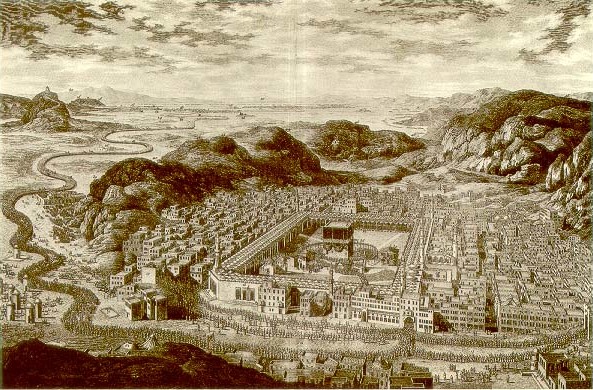
ʿAbd al-Malik ibn ʿAbd al-ʿAzīz ibn Jurayj al-Rūmī al-Umawī al-Qurashī al-Makkī (Arabic: عبد الملك بن عبد العزيز بن جريج الرومي الأموي القرشي المكي, 80 AH/699 CE - 150 AH/767 CE) commonly known as Ibn Jurayj ([/ʔibn ʒuˈrajʒ/]) was an eighth-century tabi'i faqīh, exegete and transmitter of hadith.
A student of early Meccan jurist Ata ibn Abi Rabah, Ibn Jurayj became a scholar in his own right and served as the mufti of Mecca under the Umayyads. He composed works on Quranic exegesis and the rites of pilgrimage, and his compilation of hadith, Kitab al-Sunan, was a founding work of the musannaf genre. Though lost, much of the latter was preserved in the musannaf of his student Abd al-Razzaq al-San'ani, who cites Ibn Jurayj as an informant in approximately one-third of the traditions transmitted.
Ibn Jurayj was born in Mecca in the year 80 AH / 699 CE. Jurayj is an Arabicized form of the Greek name Grēgórios. His grandfather Jurayj was of Byzantine origin and had been a slave owned by Umm Habib bint Jubayr, a Meccan woman from the Umayyad clan of Quraysh. His father 'Abd al-'Azīz was a faqīh and according to a report, was a slave of Fāṭimah bint Jubayr ibn Muṭʿim, the daughter of Jubayr ibn Muṭʿim. His father was set free, and thus Ibn Jurayj became a client (mawlā) of the Umayyads, specifically of Umayyah ibn Khālid ibn Asīd. Ibn Jurayj would sometimes affiliate himself with Banu Nawfal (the family of his mother), and other times with the Banu Umayyah, who were the 'iṣbah (agnatic kin) of his clientage.
Ibn Jurayj had two kunyas: Abū Khālid and Abū al-Walīd. His residence was located on the side of Mount Marwa, and was constructed entirely from white gypsum; reportedly built by the Umayyad caliph Mu'awiya I (r. 661–680).
At the age of fourteen, he was accepted to the study circle of Meccan jurist Ata ibn Rabah (d. 115/733) after previously being rejected twice due to lacking knowledge on Quran and Islamic inheritance laws with whom he studied for eighteen to nineteen years.
After Ata's death, he attached himself to his second teacher, Amr ibn Dinar (d. 126/743-4), under whom he studied under for approximately 7 years.
Ibn Jurayj spent most of his life within the Hejaz, where he may have visited the Prophet's Mosque in Medina. He did not travel beyond the region until 143 AH / 760 CE, when, at over sixty-five years of age, he embarked on a journey to Yemen and subsequently to Iraq.
He initially travelled to Yemen to meet the governor Ma'n ibn Za'ida al-Shaybani. According to reports, Ibn Jurayj came to him as a delegate due to a debt he had incurred. He remained with Yemen until the 10th of Dhu al-Qadah. Upon seeing people preparing for Hajj, he requested Ma'n to be sent back to Mecca. Ma'n hired guides for him, gave him 500 dinars, and handed him an additional 1,500. He also gifted him fifteen mules loaded with Yemeni goods, bundles of cloth, silver coins, and various types of provisions. He returned to Mecca, arriving just in time for the Day of Arafah. During his time in Yemen, he was heard by the scholars of Sanaa, including Abd al-Razzaq al-San'ani.
Hub AI
Ibn Jurayj AI simulator
(@Ibn Jurayj_simulator)
Ibn Jurayj
ʿAbd al-Malik ibn ʿAbd al-ʿAzīz ibn Jurayj al-Rūmī al-Umawī al-Qurashī al-Makkī (Arabic: عبد الملك بن عبد العزيز بن جريج الرومي الأموي القرشي المكي, 80 AH/699 CE - 150 AH/767 CE) commonly known as Ibn Jurayj ([/ʔibn ʒuˈrajʒ/]) was an eighth-century tabi'i faqīh, exegete and transmitter of hadith.
A student of early Meccan jurist Ata ibn Abi Rabah, Ibn Jurayj became a scholar in his own right and served as the mufti of Mecca under the Umayyads. He composed works on Quranic exegesis and the rites of pilgrimage, and his compilation of hadith, Kitab al-Sunan, was a founding work of the musannaf genre. Though lost, much of the latter was preserved in the musannaf of his student Abd al-Razzaq al-San'ani, who cites Ibn Jurayj as an informant in approximately one-third of the traditions transmitted.
Ibn Jurayj was born in Mecca in the year 80 AH / 699 CE. Jurayj is an Arabicized form of the Greek name Grēgórios. His grandfather Jurayj was of Byzantine origin and had been a slave owned by Umm Habib bint Jubayr, a Meccan woman from the Umayyad clan of Quraysh. His father 'Abd al-'Azīz was a faqīh and according to a report, was a slave of Fāṭimah bint Jubayr ibn Muṭʿim, the daughter of Jubayr ibn Muṭʿim. His father was set free, and thus Ibn Jurayj became a client (mawlā) of the Umayyads, specifically of Umayyah ibn Khālid ibn Asīd. Ibn Jurayj would sometimes affiliate himself with Banu Nawfal (the family of his mother), and other times with the Banu Umayyah, who were the 'iṣbah (agnatic kin) of his clientage.
Ibn Jurayj had two kunyas: Abū Khālid and Abū al-Walīd. His residence was located on the side of Mount Marwa, and was constructed entirely from white gypsum; reportedly built by the Umayyad caliph Mu'awiya I (r. 661–680).
At the age of fourteen, he was accepted to the study circle of Meccan jurist Ata ibn Rabah (d. 115/733) after previously being rejected twice due to lacking knowledge on Quran and Islamic inheritance laws with whom he studied for eighteen to nineteen years.
After Ata's death, he attached himself to his second teacher, Amr ibn Dinar (d. 126/743-4), under whom he studied under for approximately 7 years.
Ibn Jurayj spent most of his life within the Hejaz, where he may have visited the Prophet's Mosque in Medina. He did not travel beyond the region until 143 AH / 760 CE, when, at over sixty-five years of age, he embarked on a journey to Yemen and subsequently to Iraq.
He initially travelled to Yemen to meet the governor Ma'n ibn Za'ida al-Shaybani. According to reports, Ibn Jurayj came to him as a delegate due to a debt he had incurred. He remained with Yemen until the 10th of Dhu al-Qadah. Upon seeing people preparing for Hajj, he requested Ma'n to be sent back to Mecca. Ma'n hired guides for him, gave him 500 dinars, and handed him an additional 1,500. He also gifted him fifteen mules loaded with Yemeni goods, bundles of cloth, silver coins, and various types of provisions. He returned to Mecca, arriving just in time for the Day of Arafah. During his time in Yemen, he was heard by the scholars of Sanaa, including Abd al-Razzaq al-San'ani.
Recent media