Hubbry Logo
Inertia couplingInertia couplingMain
Open search
Inertia coupling
Community hub
Inertia coupling
logo
7 pages, 0 posts
0 subscribers
Be the first to start a discussion here.
Inertia coupling
Inertia coupling
from Wikipedia

In aeronautics, inertia coupling,[1] also referred to as inertial coupling[2] and inertial roll coupling,[3] is a potentially catastrophic phenomenon of high-speed flight in a long, thin aircraft, in which an intentional rotation of the aircraft about one axis prevents the aircraft's design from inhibiting other unintended rotations.[2] The problem became apparent in the 1950s, when the first supersonic jet fighter aircraft and research aircraft were developed with narrow wingspans, and caused the loss of aircraft and pilots before the design features to counter it (e.g. a big enough fin) were understood.[4]

The term "inertia/inertial coupling" has been criticized as misleading, because the phenomenon is not solely an instability of inertial movement, like the Janibekov effect. Instead, the phenomenon arises because aerodynamic forces react too slowly to track an aircraft's orientation.[4][5] At low speeds and thick air, aerodynamic forces match aircraft translational velocity to orientation, avoiding the dangerous dynamical regime. But at high speeds or thin air, the wing and empennage may not generate sufficient forces and moments to stabilize the aircraft.[4]

Description

[edit]

Inertia coupling tends to occur in aircraft with a long, slender, high-density fuselage. A simple, yet accurate mental model describing the aircraft's mass distribution is a rhombus of point masses: one large mass fore and aft, and a small one on each wing. The inertia tensor that this distribution generates has a large yaw component and small pitch and roll components, with the pitch component slightly larger.[6]

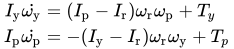
Euler's equations govern the rotation of an aircraft. When ωr, the angular rate of roll, is controlled by the aircraft, then the other rotations must satisfy where y, p, and r indicate yaw, pitch, and roll; I is the moment of inertia along an axis; T the external torque from aerodynamic forces along an axis; and dots indicate time derivatives.[7][8] When aerodynamic forces are absent, this 2‑variable system is the equation of a simple harmonic oscillator with frequency (1-Ir/Ip)(1-Ir/Iy)ω2
r
: a rolling Space Shuttle will naturally undergo small oscillations in pitch and yaw.
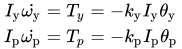
Conversely, when the craft does not roll at all (ωr=0), the only terms on the right-hand side are the aerodynamic torques, which are (at small angles) proportional to the craft's angular orientation θ to the freestream air. That is: there are natural constants k such that an unrolling aircraft experiences[7][9]
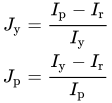
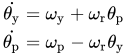
In the full case of a rolling aircraft, the connection between orientation and angular velocity is not entirely straightforward, because the aircraft is a rotating reference frame. The roll inherently exchanges yaw for pitch and vice-versa: Assuming nonzero roll, time can always be rescaled so that ωr=1. The full equations of the body are then of two damped, coupled harmonic oscillators: where But if kJ in either axis, then the damping is eliminated and the system is unstable.[10][11]
In dimensional terms (that is, unscaled time), instability requires kr. Since Ir is small, In particular, one J is at least 1. In thick air, k are too large to matter. But in thin air and supersonic speeds, they decrease, and may become comparable to ωr during a rapid roll.[12]

Techniques to prevent inertial roll coupling include increased directional stability (k) and reduced roll rate (ωr). Alternatively, the unstable aircraft dynamics may be mitigated: the unstable modes require time to grow, and a sufficiently short-duration roll at limited angle of attack may allow recovery to a controlled state post-roll.[13]

Early history

[edit]

In 1948, William Phillips described inertial roll coupling in the context of missiles in an NACA report.[12] However, his predictions appeared primarily theoretical in the case of planes.[14] The violent motions he predicted were first seen in the X-series research aircraft and Century-series fighter aircraft in the early 1950s. Before this time, aircraft tended to have greater width than length, and their mass was generally distributed closer to the center of mass. This was especially true for propeller aircraft, but equally true for early jet fighters as well. The effect became obvious only when aircraft began to sacrifice aerodynamic surface area to reduce drag, and use longer fineness ratios to reduce supersonic drag. Such aircraft were generally much more fuselage-heavy, allowing gyroscopic effects to overwhelm the small control surfaces.

The roll coupling study of the X-3 Stiletto, first flown in 1952, was extremely short but produced valuable data. Abrupt aileron rolls were conducted at Mach 0.92 and 1.05 and produced "disturbing" motions and excessive accelerations and loads.[15]

In 1953, inertial roll coupling nearly killed Chuck Yeager in the X-1A.[16]

Inertial roll coupling was one of three distinct coupling modes that followed one another as the rocket-powered Bell X-2 hit Mach 3.2 during a flight on 27 September 1956, killing pilot Captain Mel Apt. Although simulators had predicted that Apt's maneuvers would produce an uncontrollable flight regime, at the time most pilots did not believe that the simulators accurately modeled the plane's flight characteristics.[17]

The first two production aircraft to experience inertial roll coupling were the F-100 Super Sabre and F-102 Delta Dagger (both first flown in 1953). The F-100 was modified with a larger vertical tail to increase its directional stability.[18] The F-102 was modified to increase wing and tail areas and was fitted with an augmented control system. To enable pilot control during dynamic motion maneuvers the tail area of the F-102A was increased 40%.

In the case of the F-101 Voodoo (first flown in 1954), a stability augmentation system was retrofitted to the A models to help combat this problem.

The Douglas Skyray was not able to incorporate any design changes to control inertial roll coupling and instead had restricted maneuver limits at which coupling effects did not cause problems.[19]

The Lockheed F-104 Starfighter (first flown in 1956) had its stabilator (horizontal tail surface) mounted atop its vertical fin to reduce inertia coupling.

See also

[edit]

References

[edit]
Revisions and contributorsEdit on WikipediaRead on Wikipedia
from Grokipedia
Inertia coupling, also referred to as inertial roll coupling, is a dynamic in where rapid rolling motion about the longitudinal axis induces resonant divergences in pitch or yaw attitudes, occurring when the roll rate equals or approximates the natural of the lower pitch or yaw mode. This phenomenon arises from the products of in the aircraft's mass distribution, particularly in slender, high-performance designs where the principal axes of inertia deviate from the body-fixed axes, leading to cross-coupling of rotational motions. The concept was first theoretically analyzed by William H. Phillips in a 1948 NACA technical note, which examined how steady rolling introduces inertia forces that misalign the with the flight path, potentially destabilizing longitudinal and directional motions if the roll exceeds the respective frequencies. Phillips' work highlighted that such effects are negligible in conventional low-speed but become critical in high-altitude, high-speed configurations where inertial forces dominate over aerodynamic damping. Subsequent studies in the early refined these insights, identifying two primary modes: pitch divergence from roll-yaw coupling and yaw divergence from roll-pitch coupling, both exacerbated by reduced stability derivatives at and supersonic speeds. Inertia coupling gained prominence during the development of post-World War II experimental , with notable incidents underscoring its dangers. For instance, the research experienced violent inertial coupling in 1956, resulting in the loss of the vehicle and the pilot's life when sequential pitch and yaw divergences overwhelmed control inputs at a roll rate of approximately 1.35 rad/sec. Similar issues afflicted the in 1954, where Mach 1.05 rolls produced accelerations up to ±7g, and the North American F-100A Super Sabre, which encountered uncontrollable yaw divergences at Mach 0.7 with sideslip angles reaching -26°. These events prompted rapid advancements in mitigation strategies, including enlarged vertical tail surfaces to enhance —as implemented in the F-100A with a 27.5% tail area increase—and the use of stability augmentation systems to limit roll rates during maneuvers. Modern design continues to address coupling through rigorous simulation and wind-tunnel testing, ensuring that products of inertia (such as IxzI_{xz}) are minimized and natural frequencies are detuned from anticipated roll rates. The phenomenon remains relevant for high-agility fighters and unmanned aerial vehicles operating near critical angles of attack, where nonlinear inertial terms can amplify control challenges.

Fundamentals

Definition

Inertia coupling, also known as inertial roll coupling, is a potentially catastrophic inertial in where rapid rolling motion about a non-principal axis induces unstable pitching or yawing oscillations due to the interaction of the aircraft's principal moments of . This phenomenon arises when the roll rate resonates with the aircraft's lower pitch or yaw , leading to a divergent amplification of angular motions across multiple axes. Key characteristics include violent, uncontrollable oscillations that can result in structural failure if not mitigated, primarily triggered during high-speed maneuvers such as rudder-fixed rolls. It occurs in exhibiting low ratios of roll to pitch or yaw , often exacerbated by concentrated distributions like heavily loaded fuselages. Unlike control coupling, which involves static pilot-induced interactions between roll and directional controls leading to untrimmability or control reversal, coupling is a dynamic inertial independent of control inputs. It also differs from aeroelastic coupling, which stems from structural flexibility interacting with aerodynamic forces rather than rigid-body inertial effects. The scope of inertia coupling primarily encompasses supersonic and high-performance aircraft, where roll rates can approach or exceed pitch and yaw frequencies, making resonant conditions more likely.

Underlying Physics

Inertia coupling, also known as inertial roll coupling, fundamentally arises from inertial cross-coupling effects in an aircraft's rigid body dynamics. This phenomenon occurs due to non-zero products of inertia, such as IxzI_{xz}, which stem from asymmetries in the aircraft's mass distribution, for instance, from the placement of heavy components like engines or vertical stabilizers relative to the principal axes. When an aircraft undergoes a rapid roll maneuver, the roll rate pp about the longitudinal axis interacts with these products of inertia, generating unwanted torques in the pitch (qq) and yaw (rr) axes through gyroscopic precession and centrifugal forces. The role of the principal moments of inertia is central to this , particularly the disparity between the roll moment of inertia IxI_x and the pitch IyI_y or yaw IzI_z moments. In high-performance , such as slender fighters, IxI_x is typically much smaller than IyI_y or IzI_z because is concentrated along the length, resulting in low resistance to rolling but high resistance to pitching or yawing. This imbalance allows from the commanded roll to transfer rapidly to the pitch and yaw via the cross-coupling terms, potentially leading to oscillatory divergences if the roll rate approaches the natural frequencies of those modes. The gyroscopic nature of this energy transfer means that the 's tends to align with its intermediate principal axis of , often causing severe attitude excursions. Unlike aerodynamic coupling, which relies on stability derivatives and fluid forces to influence motion, inertia coupling is predominantly driven by rigid-body inertial effects that act instantaneously and independently of the surrounding . Aerodynamic forces, while capable of or amplifying the resulting motions, respond more slowly and cannot fully counteract the inertial torques during high-rate maneuvers, especially at high altitudes where air density is low. This distinction underscores that inertia coupling is a purely kinematic consequence of the aircraft's properties, manifesting even in vacuum-like conditions.

Historical Development

Early Recognition

The theoretical foundations of inertia coupling emerged in the 1940s from studies in rigid-body dynamics, where engineers at the (NACA) extended Euler's equations for rotating bodies to analyze aircraft motion under combined roll, pitch, and yaw rates. These equations revealed how mismatches in the principal moments of inertia could induce unwanted cross-coupling torques during rolling maneuvers, particularly in elongated fuselages typical of high-speed designs. A seminal contribution came from NACA engineer William H. Phillips, whose 1948 technical note provided the first systematic theoretical description of inertial roll coupling as a stability issue in swept-wing airplanes. In this report, Phillips derived the effects of steady rolling on longitudinal and , demonstrating how roll rates could generate destabilizing pitch and yaw moments due to inertial imbalances. This work built on broader NACA investigations into stability derivatives during the late , highlighting the need to account for such couplings in design criteria. Initial awareness of inertia coupling traces back to limitations observed in World War II-era propeller-driven aircraft, where high roll rates occasionally produced minor cross-coupling effects, though these were mitigated by lower speeds and power constraints. However, the phenomenon gained urgency with the advent of in the late , as engines enabled roll rates exceeding 200 degrees per second, amplifying the risks identified in theoretical models. Early experimental validation occurred through NACA and ground-based tests on high-speed scale models in the late , which confirmed roll-pitch interactions predicted by Phillips' analysis, particularly in configurations with high aspect-ratio wings. These tests, conducted at Langley Memorial Aeronautical Laboratory, used dynamically similar rigs to measure inertial torques without full-scale flight risks, establishing quantitative boundaries for stable rolling motion. Phillips' efforts, recognized as pioneering by contemporaries, laid the groundwork for integrating inertia coupling considerations into NACA stability guidelines.

Notable Incidents

One of the earliest documented encounters with inertia coupling occurred during a test flight of the Bell X-1A on December 12, 1953, when U.S. Air Force pilot Major reached Mach 2.435 at approximately 74,700 feet. Following engine shutdown, the aircraft experienced severe inertial roll coupling, causing it to tumble divergently across all three axes while descending about 50,000 feet in 70 seconds, subjecting Yeager to extreme g-forces ranging from +8 to -1.5 g. Yeager regained control at around 30,000 feet by inducing an inverted spin and executed an at , highlighting the phenomenon's potential for violent oscillations due to roll-yaw interactions in high-speed, low-inertia designs. A more fatal manifestation unfolded on September 27, 1956, during the Bell X-2's thirteenth powered flight, piloted by U.S. Air Force Captain Milburn G. "Mel" Apt. Apt accelerated to Mach 3.196 at 65,589 feet, the first piloted to exceed Mach 3, but deviated from the planned profile by initiating a high-speed turn at Mach 3 rather than decelerating. Approximately 20 seconds after engine burnout, sequential coupling modes—inertia roll coupling followed by an inverted spin—overtook the , imposing ±6 g accelerations on Apt and rendering it uncontrollable. Apt separated the escape capsule at low altitude but perished upon impact in the Kramer Hills near , with the X-2 suffering minimal damage in its subsequent crash. The North American F-100 Super Sabre encountered persistent inertia coupling challenges throughout the mid-1950s, resulting in multiple accidents during high-speed maneuvers. Early flight tests revealed the aircraft's susceptibility to violent "Sabre dance" oscillations, particularly during rudder-fixed aileron rolls at speeds around Mach 0.7 and altitudes of 32,000 feet, where sideslip angles reached -26° and normal accelerations exceeded -4.4 g—50% beyond design limits. Notable fatalities included North American Aviation chief test pilot George S. Welch on October 12, 1954, when his F-100A disintegrated mid-air during a 7.3 g pullout from a Mach 1.55 dive due to roll-yaw divergence; Welch ejected but succumbed to injuries en route to medical care. Another incident involved pilot George Smith, who survived a supersonic bailout after similar coupling-induced structural failure, while test pilot Scott Crossfield endured severe physical strain, including a cracked vertebra, across 45 evaluation flights. These events prompted joint U.S. Air Force and NACA investigations, utilizing analog simulators and stability analyses to confirm low directional stability as the root cause, leading to progressive vertical tail enlargements—Tail B (11.3% larger) and Tail C (27.5% larger than the original)—along with yaw dampers retrofitted to early models starting with the 146th F-100C. The X-1A, X-2, and F-100 incidents collectively accelerated research into inertia coupling modes, with NACA reports and simulator studies from 1954 onward emphasizing mass distribution, derivatives, and gyroscopic effects to prevent divergence. These lessons directly informed the design of later high-performance fighters, such as the , which incorporated a low roll -to-pitch (0.40), a mounted atop the vertical fin to decouple yaw-roll interactions, restricted rates, and an added ventral fin for enhanced supersonic .

Mathematical Formulation

Equations of Motion

The equations of motion for a rigid aircraft undergoing inertia coupling are derived from the conservation of angular momentum in a body-fixed reference frame. The angular momentum vector h\mathbf{h} about the center of gravity is given by h=Iω\mathbf{h} = \mathbf{I} \boldsymbol{\omega}, where I\mathbf{I} is the inertia tensor and ω=[p,q,r]T\boldsymbol{\omega} = [p, q, r]^T represents the angular velocity components (roll rate pp, pitch rate qq, yaw rate rr). Euler's second law states that the rate of change of angular momentum equals the applied torque: h˙+ω×h=M\dot{\mathbf{h}} + \boldsymbol{\omega} \times \mathbf{h} = \mathbf{M}, where M=[L,M,N]T\mathbf{M} = [L, M, N]^T are the external moments. For a rigid body, the inertia tensor is constant in body-fixed axes, leading to the rotational equations of motion. The body-fixed coordinate system originates at the 's center of gravity, with the xx-axis aligned along the (positive forward), yy-axis to the right, and zz-axis downward in the plane of . This system assumes left-right , setting products of Ixy=Iyz=0I_{xy} = I_{yz} = 0, but retains Ixz0I_{xz} \neq 0 due to typical configurations where distribution (e.g., placement) couples roll and yaw. The full six-degree-of-freedom (6-DOF) equations also include translational motion, but coupling primarily manifests in the rotational dynamics. These equations can be transformed to stability axes (rotated by the angle of attack) for analysis in perturbed flight conditions, though the body-fixed form directly highlights inertial cross-coupling. The assumption neglects structural flexibility, treating the as undeformable. The resulting Euler's equations in body-fixed axes, including products of inertia, are: L=Ixp˙+(IzIy)qrIxz(r˙+pq),M=Iyq˙+(IxIz)rp+Ixz(r2p2),N=Izr˙+(IyIx)pqIxzp˙+Ixzqr.\begin{align} L &= I_x \dot{p} + (I_z - I_y) q r - I_{xz} (\dot{r} + p q), \\ M &= I_y \dot{q} + (I_x - I_z) r p + I_{xz} (r^2 - p^2), \\ N &= I_z \dot{r} + (I_y - I_x) p q - I_{xz} \dot{p} + I_{xz} q r. \end{align} Here, Ix,Iy,IzI_x, I_y, I_z are the principal moments of about the xx, yy, and zz axes, respectively, and IxzI_{xz} is the roll-yaw product of (typically negative for conventional ). These equations equate external moments to the inertial torques, with dots denoting time derivatives. The coupling terms arise from the ω×h\boldsymbol{\omega} \times \mathbf{h} cross-product and the off-diagonal IxzI_{xz} elements. For instance, the term Ixzpq-I_{xz} p q in the roll equation and Ixz(r2p2)I_{xz} (r^2 - p^2) in the pitch equation demonstrate how a sustained roll rate pp induces pitch and yaw moments through inertial imbalance, particularly when Ixz|I_{xz}| is significant relative to the principal moments. Similarly, (IzIy)qr(I_z - I_y) q r couples pitch and yaw rates into the roll equation. In high-roll-rate maneuvers, these terms dominate, transferring angular momentum between axes and potentially leading to divergent motions if unmitigated.

Stability Analysis

Stability analysis of inertia coupling involves linearizing the coupled around a steady rolling equilibrium to assess dynamic stability. Small perturbation approximations are applied to the angular rates and attitudes, yielding a where the system matrices exhibit off-diagonal terms due to the products of , such as IxzI_{xz}, that couple roll with pitch and yaw modes. These linearized equations form a quartic whose roots determine the system's eigenvalues, revealing potential instabilities. The natural frequencies play a central role in identifying coupling risks. The roll subsidence frequency is approximated as ωrLp/Ix\omega_r \approx \sqrt{L_p / I_x}
Add your contribution
Related Hubs
User Avatar
No comments yet.