Hubbry Logo
Infinitary logicInfinitary logicMain
Open search
Infinitary logic
Community hub
Infinitary logic
logo
7 pages, 0 posts
0 subscribers
Be the first to start a discussion here.
Infinitary logic
Infinitary logic
from Wikipedia

An infinitary logic is a logic that allows infinitely long statements and/or infinitely long proofs.[1] The concept was introduced by Zermelo in the 1930s.[2]

Some infinitary logics may have different properties from those of standard first-order logic. In particular, infinitary logics may fail to be compact or complete. Notions of compactness and completeness that are equivalent in finitary logic sometimes are not so in infinitary logics. Therefore for infinitary logics, notions of strong compactness and strong completeness are defined. This article addresses Hilbert-type infinitary logics, as these have been extensively studied and constitute the most straightforward extensions of finitary logic. These are not, however, the only infinitary logics that have been formulated or studied.

Considering whether a certain infinitary logic named Ω-logic is complete promises to throw light on the continuum hypothesis.[3]

A word on notation and the axiom of choice

[edit]

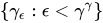
As a language with infinitely long formulae is being presented, it is not possible to write such formulae down explicitly. To get around this problem a number of notational conveniences, which, strictly speaking, are not part of the formal language, are used. is used to point out an expression that is infinitely long. Where it is unclear, the length of the sequence is noted afterwards. Where this notation becomes ambiguous or confusing, suffixes such as are used to indicate an infinite disjunction over a set of formulae of cardinality . The same notation may be applied to quantifiers, for example . This is meant to represent an infinite sequence of quantifiers: a quantifier for each where .

All usage of suffixes and are not part of formal infinitary languages.

The axiom of choice is assumed (as is often done when discussing infinitary logic) as this is necessary to have sensible distributivity laws.

Formal languages

[edit]

A first-order infinitary language , regular, or , has the same set of symbols as a finitary logic and may use all the rules for formation of formulae of a finitary logic together with some additional ones:[4]

  • Given a set of formulae with then and are formulae. (In each case the sequence has length .)
  • Given a set of variables with and a formula then and are formulae. (In each case the sequence of quantifiers has length .)

The language may also have function, relation, and predicate symbols of finite arity.[5] Karp also defined languages with an infinite cardinal and some more complicated restrictions on that allow for function and predicate symbols of infinite arity, with controlling the maximum arity of a function symbol and controlling predicate symbols.[6]

The concepts of free and bound variables apply in the same manner to infinite formulae. Just as in finitary logic, a formula all of whose variables are bound is referred to as a sentence.

Definition of Hilbert-type infinitary logics

[edit]

A theory in infinitary language is a set of sentences in the logic. A proof in infinitary logic from a theory is a (possibly infinite) sequence of statements that obeys the following conditions: Each statement is either a logical axiom, an element of , or is deduced from previous statements using a rule of inference. As before, all rules of inference in finitary logic can be used, together with an additional one:

  • Given a set of statements that have occurred previously in the proof then the statement can be inferred.[7]

If , forming universal closures may not always be possible, however extra constant symbols may be added for each variable with the resulting satisfiability relation remaining the same.[8] To avoid this, some authors use a different definition of the language forbidding formulas from having more than free variables.[9]

The logical axiom schemata specific to infinitary logic are presented below. Global schemata variables: and such that .

  • For each ,
  • Chang's distributivity laws (for each ): , where or , and
  • For , , where is a well ordering of

The last two axiom schemata require the axiom of choice because certain sets must be well orderable. The last axiom schema is strictly speaking unnecessary, as Chang's distributivity laws imply it,[10] however it is included as a natural way to allow natural weakenings to the logic.

Completeness, compactness, and strong completeness

[edit]

A theory is any set of sentences. The truth of statements in models are defined by recursion and will agree with the definition for finitary logic where both are defined. Given a theory T a sentence is said to be valid for the theory T if it is true in all models of T.

A logic in the language is complete if for every sentence S valid in every model there exists a proof of S. It is strongly complete if for any theory T for every sentence S valid in T there is a proof of S from T. An infinitary logic can be complete without being strongly complete.

A cardinal is weakly compact when for every theory T in containing at most many formulas, if every S T of cardinality less than has a model, then T has a model. A cardinal is strongly compact when for every theory T in , without restriction on size, if every S T of cardinality less than has a model, then T has a model.

Concepts expressible in infinitary logic

[edit]

In the language of set theory the following statement expresses foundation:

Unlike the axiom of foundation, this statement admits no non-standard interpretations. The concept of well-foundedness can only be expressed in a logic that allows infinitely many quantifiers in an individual statement. As a consequence many theories, including Peano arithmetic, which cannot be properly axiomatised in finitary logic, can be in a suitable infinitary logic. Other examples include the theories of non-archimedean fields and torsion-free groups.[citation needed] These three theories can be defined without the use of infinite quantification; only infinite junctions[11] are needed.

Truth predicates for countable languages are definable in .[12]

Complete infinitary logics

[edit]

Two infinitary logics stand out in their completeness. These are the logics of and . The former is standard finitary first-order logic and the latter is an infinitary logic that only allows statements of countable size.

The logic of is also strongly complete, compact and strongly compact.

The logic of fails to be compact, but it is complete (under the axioms given above). Moreover, it satisfies a variant of the Craig interpolation property.

If the logic of is strongly complete (under the axioms given above) then is strongly compact (because proofs in these logics cannot use or more of the given axioms).

References

[edit]

Sources

[edit]
Revisions and contributorsEdit on WikipediaRead on Wikipedia
from Grokipedia
Infinitary logic is a branch of that extends classical by permitting formulas of transfinite length, most notably through infinite conjunctions and disjunctions, while typically restricting quantifiers to finite sequences in its primary variants. This allows for greater expressive power, enabling the formulation of concepts that are inexpressible in standard , such as the characterization of specific uncountable structures up to isomorphism. The syntax of infinitary logics, such as Lκ,ωL_{\kappa,\omega}, is built from a set of variables indexed by ordinals less than a cardinal κ\kappa, predicate and function symbols, and logical connectives including , finite conjunctions and disjunctions, infinite conjunctions (\bigwedge) and disjunctions (\bigvee) over sets of formulas of less than κ\kappa, and quantifiers (\forall, \exists) applied to finitely many variables. Semantics are defined via the standard Tarskian satisfaction relation, extended inductively to handle infinite connectives, where a satisfies an infinite conjunction if it satisfies every conjunct, and similarly for disjunctions. Notable variants include L,ωL_{\infty,\omega}, which allows arbitrary infinite lengths for connectives but finite quantifiers, and Lω1,ωL_{\omega_1,\omega}, which confines infinite operations to countable , making it particularly useful for studying countable models. Unlike , infinitary logics generally lack the , as there exist theories with all finite subsets satisfiable but the entire theory inconsistent. However, they retain a form of the downward Löwenheim-Skolem theorem: for any M and infinitary fragment F (with formulas having finitely many free variables), there exists an elementary submodel N \prec M with |N| \leq |F| + \aleph_0. A landmark result is Scott's theorem, which states that every countable structure is definable up to isomorphism by a sentence in Lω1,ωL_{\omega_1,\omega}. These logics occupy an intermediate position between and , offering tools to analyze categoricity, stability, and homogeneity in without invoking full set-theoretic quantification. Infinitary logic was introduced by and in 1958. The development of infinitary logic gained momentum in the mid-20th century, with seminal contributions from H. J. Keisler's 1971 monograph Model Theory for Infinitary Logic, which systematized the of logics with countable conjunctions and finite quantifiers, and J. Barwise's 1975 work Admissible Sets and Structures, which connected infinitary logic to admissible ordinals and recursion theory. Subsequent research has explored applications in descriptive set theory, generalized quantifiers, and the boundaries of logical expressiveness, highlighting infinitary logic's role in bridging and .

Introduction

Overview and Motivation

Infinitary logic extends classical by permitting formulas of transfinite length, including infinite conjunctions and disjunctions, and in certain variants, infinite sequences of quantifiers. This generalization, first formalized for propositional calculi with infinite expressions, allows for the construction of languages Lκ,λL_{\kappa,\lambda} where conjunctions and disjunctions have length less than cardinal κ\kappa and quantifier blocks have length less than λ\lambda. Unlike standard , which restricts all syntactic operations to finite lengths, infinitary logics enhance expressive power to capture properties that require infinitely many conditions simultaneously. The primary motivation for infinitary logic arises from the expressive limitations of finitary first-order logic Lω,ωL_{\omega,\omega}, which cannot adequately describe certain structural properties in uncountable models or infinite axiom systems. For instance, first-order logic fails to express well-foundedness in linear orders or to achieve categoricity for structures of uncountable cardinality without additional infinitary mechanisms. Infinitary variants like L,ωL_{\infty,\omega} address this by allowing arbitrary infinite conjunctions and disjunctions while keeping quantifiers finite, thus enabling the concise formulation of infinite axiomatizations—such as the infinite set of axioms defining the real numbers as the unique complete ordered field—within a single sentence. This extension preserves some desirable semantic properties while overcoming the inability of finitary logic to handle such global features. In model theory, infinitary logic facilitates deeper analysis of stability and classification, such as through Scott sentences that characterize countable structures up to using countable conjunctions. In set theory, it plays a crucial role in characterizing large cardinals; for example, the for Lκ,κL_{\kappa,\kappa} holds if and only if κ\kappa is a strongly compact cardinal, linking logical properties to foundational assumptions like the . These applications highlight infinitary logic's utility in bridging syntax and semantics for infinite structures, where finitary methods fall short.

Historical Development

The origins of infinitary logic can be traced to Ernst Zermelo's work in , where he introduced infinite conjunctions and disjunctions as tools for formalizing proofs in , aiming to capture the "logic of the infinite" beyond finitary restrictions. In his 1930 paper, Zermelo proposed a hierarchical system of expressions using infinite logical operations to axiomatize , emphasizing maximality principles that relied heavily on the to handle transfinite constructions without collapsing to finitary methods. This approach marked an early departure from traditional , influenced by Zermelo's commitment to the as essential for infinitary reasoning, though it remained somewhat informal and tied to set-theoretic foundations. The prehistory of infinitary logic from 1885 to 1955 involved scattered contributions that laid groundwork through generalized quantifiers and extensions of systems, notably by Leopold Löwenheim, , and . Löwenheim's 1915 theorem implicitly allowed for generalized quantifiers in restricting models, while Skolem's 1920 work on relativization further explored non-standard interpretations that anticipated infinitary expressiveness. Tarski, building on these, developed ideas in for logics with infinite operations, including quantifiers over uncountable domains, which influenced the semantic foundations of infinitary systems without fully formalizing them as a distinct logic. Post-1950 developments formalized infinitary logic as a robust extension of , beginning with Dana Scott's seminal 1965 paper introducing the language Lω1,ωL_{\omega_1,\omega}, which permits countable conjunctions and disjunctions but finite quantifier strings, enabling precise characterizations of countable structures up to via Scott sentences. H.J. Keisler's 1971 monograph Model Theory for Infinitary Logic systematized the for logics with countable conjunctions and finite quantifiers, while J. Barwise's 1975 work Admissible Sets and Structures connected infinitary logic to admissible ordinals and recursion theory. Around the same time, Michael Morley and Robert Vaught advanced compactness results for infinitary logics in their 1962 work on homogeneous models, showing that certain theories admitting models of specific cardinalities also admit saturated ones, bridging and infinitary expressiveness. These efforts revealed deep connections to large cardinals, as the compactness of logics like Lκ,κL_{\kappa,\kappa} characterizes strongly compact cardinals, a link first explored by William Hanf and Scott in the . Recent advancements up to 2023 have explored connections between inner and forcing, particularly in addressing the . W. Hugh Woodin's 2011 results on the ultimate LL conjecture use forcing extensions and inner models to argue that large cardinals cannot refute the in canonical inner models, providing evidence for its consistency relative to stronger axioms. This work highlights infinitary logic's foundational role in calibrating the boundaries between forcing and descriptive inner models, influencing ongoing debates on the continuum's value.

Preliminaries

Notation and the

In infinitary logic, standard notation employs ellipses (⋯) for informal representations of infinite expressions, while formal indexed notations such as γ<δAγ\bigvee_{\gamma < \delta} A_\gamma for infinite disjunctions and γ<δAγ\bigwedge_{\gamma < \delta} A_\gamma for infinite conjunctions are used to denote operations over indexed families of formulas {Aγ:γ<δ}\{A_\gamma : \gamma < \delta\}, where δ\delta is an ordinal. These symbols extend the finite connectives \vee and \wedge to infinitary settings, allowing the construction of formulas that capture properties requiring infinitely many conditions simultaneously. For instance, an infinite conjunction of atomic formulas might be written as n<ωP(xn)\bigwedge_{n < \omega} P(x_n), expressing that a sequence satisfies a predicate at every finite stage. Cardinality parameters play a central role in defining the scope of infinitary operations: κ\kappa bounds the length of conjunctions and disjunctions, while λ\lambda limits the size of blocks of quantifiers, typically with infinite cardinals λκ\lambda \leq \kappa. This leads to languages like Lκ,λ\mathcal{L}_{\kappa,\lambda}, where formulas permit conjunctions or disjunctions over fewer than κ\kappa subformulas and quantifier prefixes of length less than λ\lambda. For example, in Lω1,ω\mathcal{L}_{\omega_1,\omega}, countable infinite conjunctions are allowed, but quantifiers remain finite, enabling the expression of properties requiring infinitely many simultaneous conditions, such as the standard model of arithmetic via m,n<ω(sm0+sn0=sm+n0)\bigwedge_{m,n < \omega} (s^m 0 + s^n 0 = s^{m+n} 0). Many foundational results in infinitary logic rely on the axiom of choice (AC), particularly for ensuring distributivity properties over infinite operations and the existence of well-orderings in proofs involving transfinite inductions or model constructions. For instance, AC facilitates the well-ordering of index sets in infinite disjunctions, allowing proofs of completeness theorems by selecting canonical representatives from equivalence classes of models. Without AC, certain existential quantifier eliminations or compactness arguments may fail, as they require choosing elements from uncountably many nonempty sets. Choice-free alternatives, such as those employing filter methods like Q-filters in place of direct selection, have been developed for specific subsystems, particularly in countable infinitary epistemic logics, but they often limit applicability to languages with restricted cardinalities or fail to achieve full completeness without additional assumptions. These approaches highlight the foundational trade-offs, where avoiding AC preserves constructivity but restricts the expressive power and generality of theorems compared to ZFC-based developments.

Signature and Formal Languages

In infinitary logic, the foundational structure is provided by a signature, which specifies the non-logical symbols available for constructing terms and formulas. A signature σ consists of disjoint sets of constant symbols C, function symbols F, and relation symbols R, together with an arity function a: F ∪ R → ℕ that assigns to each function symbol in F a finite positive arity (the number of arguments it takes) and to each relation symbol in R a finite positive arity (including 0 for constants, though constants are separately listed in C). This setup mirrors the signatures used in but serves as the basis for extending to infinitary constructions. The formal language over a signature σ incorporates an alphabet comprising the symbols from σ along with logical symbols. These logical symbols include the equality predicate = (binary), negation ¬, implication → (or equivalently, infinite conjunctions ∧_I and disjunctions ∨_I for index sets I of cardinality less than κ), universal quantifiers ∀x (and infinite blocks ∀{x_i : i ∈ I} for |I| < λ), existential quantifiers ∃x (and infinite blocks ∃{x_i : i ∈ I} for |I| < λ), a set of variables of cardinality κ {v_α : α < κ}, and parentheses for grouping. The infinitary nature emerges in the allowance of infinite conjunctions and disjunctions, as well as infinite quantifier blocks, while maintaining finite arities for non-logical symbols. Terms in the language are formed finitarily via recursive rules, ensuring no infinite constructions within them. Specifically, every variable is a term; every constant symbol c ∈ C is a term; and if f ∈ F has arity n and t_1, ..., t_n are terms, then f(t_1, ..., t_n) is a term. No further compositions are permitted, distinguishing terms from the potentially infinitary formulas built upon them. This finitary restriction on terms preserves the standard algebraic structure while allowing infinitary expressiveness in the propositional and quantificational aspects of formulas. For example, a simple signature for arithmetic might include constants 0 and 1 (arity 0), binary function symbols + and × (arity 2), and no relation symbols beyond equality. Similarly, for set theory, the signature could consist solely of the binary relation symbol ∈ (arity 2), with no constants or functions, enabling the expression of foundational axioms through infinitary means. These examples illustrate how signatures tailor the language to specific mathematical domains without altering the underlying infinitary logical framework.

Syntax and Semantics

Infinitary Languages L_{\kappa,\lambda}

Infinitary languages Lκ,λL_{\kappa,\lambda} extend first-order logic by permitting conjunctions and disjunctions of cardinality less than a cardinal κ\kappa and quantifier prefixes of length less than a cardinal λ\lambda, where κ\kappa and λ\lambda are typically infinite cardinals greater than or equal to 0\aleph_0. These languages are constructed over a fixed first-order signature consisting of relation symbols, function symbols, and constants, with variables ranging over a set of cardinality at most κ\kappa. The syntax begins with atomic formulas, which are equations t=st = s or atomic relations R(t1,,tn)R(t_1, \dots, t_n) where t,s,tit, s, t_i are terms built from variables, constants, and function applications in the standard finite way. Formulas in Lκ,λL_{\kappa,\lambda} are defined recursively as follows: atomic formulas are in Lκ,λL_{\kappa,\lambda}; if ϕ\phi is a formula, then ¬ϕ\neg \phi is a formula; if ϕ\phi and ψ\psi are formulas, then ϕψ\phi \land \psi and ϕψ\phi \lor \psi are formulas; if {ϕii<μ}\{\phi_i \mid i < \mu\} is a set of formulas with μ<κ\mu < \kappa, then i<μϕi\bigwedge_{i < \mu} \phi_i and i<μϕi\bigvee_{i < \mu} \phi_i are formulas; and if ϕ\phi is a formula and ν<λ\nu < \lambda, then for any sequence of distinct variables x1,,xνx_1, \dots, x_\nu (possibly infinite), x1xνϕ\forall x_1 \dots x_\nu \phi and x1xνϕ\exists x_1 \dots x_\nu \phi are formulas, where the quantifiers bind any free occurrences of the xix_i in ϕ\phi. This construction ensures that every formula has fewer than λ\lambda free variables, and sentences are those with no free variables. A representative example of an infinitary formula is the infinite quantifier alternation x1y1x2y2ϕ(x1,y1,x2,y2,)\forall x_1 \exists y_1 \forall x_2 \exists y_2 \cdots \phi(x_1, y_1, x_2, y_2, \dots), where the quantifier string has length ω\omega and ϕ\phi is a ; this is admissible in Lκ,λL_{\kappa,\lambda} for λ>ω\lambda > \omega. Such formulas capture properties requiring unbounded alternation, beyond the finite depth of . The semantics of Lκ,λL_{\kappa,\lambda} follows a Tarski-style satisfaction relation extended to infinitary cases, defined for structures M\mathcal{M} over the (with universe MM and interpretations of symbols) and assignments ss mapping free variables to elements of MM. For atomic formulas, satisfaction is standard; M,s¬ϕ\mathcal{M}, s \models \neg \phi if M,s⊭ϕ\mathcal{M}, s \not\models \phi; M,sϕψ\mathcal{M}, s \models \phi \land \psi (or Φ\bigwedge \Phi) if M,sϕ\mathcal{M}, s \models \phi and M,sψ\mathcal{M}, s \models \psi (or all ψΦ\psi \in \Phi); and M,sx1xνϕ\mathcal{M}, s \models \exists x_1 \dots x_\nu \phi if there exists a sequence a1,,aνMa_1, \dots, a_\nu \in M such that M,s[xiai]ϕ\mathcal{M}, s[x_i \mapsto a_i] \models \phi, with the universal quantifier defined dually via negation. For infinite conjunctions, satisfaction requires every component to hold, often relying on the for uniformizing witnesses in existential cases, though direct suffices for the . Truth in a model M\mathcal{M} for a sentence ϕ\phi is Mϕ\mathcal{M} \models \phi (with empty assignment), and validity holds if true in all models. Key parameters distinguish variants: in Lω1,ωL_{\omega_1, \omega}, conjunctions and disjunctions may have cardinality less than 1\aleph_1 (at most countable), but quantifier strings are finite, enabling expressions like countable conjunctions of atomic properties to define Scott sentences for countable structures. In contrast, L,ωL_{\infty, \omega} allows arbitrary (possibly uncountable) conjunctions and disjunctions but restricts quantifiers to finite lengths, emphasizing infinitary combinations over quantification. For Lκ,κL_{\kappa, \kappa}, both operations extend to cardinality less than κ\kappa, balancing expressive power in connectives and quantifiers, as formalized in early treatments of predicate infinitary logics.

Hilbert-Type Deductive Systems

In infinitary logic, a Hilbert-type deductive system provides a syntactic framework for deriving theorems from axioms using inference rules, extending the classical first-order Hilbert system to accommodate infinite conjunctions and disjunctions in the language Lκ,λL_{\kappa,\lambda}. The system consists of a set of axiom schemata and a collection of inference rules, where proofs are typically transfinite sequences of formulas of length less than κ\kappa. The axioms include all standard first-order logical axiom schemata, such as those for propositional connectives (extended to finite combinations), equality, and quantifiers (e.g., x(ϕψ)(xϕxψ)\forall x (\phi \to \psi) \to (\forall x \phi \to \forall x \psi) for appropriate ϕ,ψ\phi, \psi), as well as infinitary-specific schemata to handle infinite connectives. For infinite conjunctions, key axioms are i<μϕiϕj\bigwedge_{i < \mu} \phi_i \to \phi_j for each j<μ<κj < \mu < \kappa and any formulas {ϕii<μ}\{\phi_i \mid i < \mu\}, and similarly for disjunctions, ϕji<μϕi\phi_j \to \bigvee_{i < \mu} \phi_i. Additional infinitary axioms incorporate distributivity laws, such as Chang's laws for the distribution of infinite conjunctions over finite disjunctions (e.g., i<κ(ϕiψ)(i<κϕi)ψ\bigwedge_{i < \kappa} (\phi_i \vee \psi) \to (\bigwedge_{i < \kappa} \phi_i) \vee \psi) and their duals, ensuring compatibility with the semantics of infinitary formulas. Generalization axioms extend to infinite blocks in certain variants, allowing \forall-introduction over infinitary subformulas, though quantifiers remain finite in the standard setup. Inference rules preserve the logical structure across infinite expressions. Modus ponens allows derivation of ψ\psi from ϕ\phi and ϕψ\phi \to \psi. Universal generalization permits inferring xϕ\forall x \phi from ϕ\phi, applicable even when ϕ\phi involves infinite connectives. Infinitary rules include conjunction introduction, where from the premises {ϕii<μ<κ}\{\phi_i \mid i < \mu < \kappa\} (each previously derived), one infers i<μϕi\bigwedge_{i < \mu} \phi_i, and the dual disjunction elimination rule. These rules enable handling infinite premises directly in proofs. Proofs are defined as sequences σαα<ν<κ\langle \sigma_\alpha \mid \alpha < \nu < \kappa \rangle where each σα\sigma_\alpha is either an axiom or obtained by applying an inference rule to earlier elements in the sequence, allowing transfinite inductions for derivations involving infinite steps. A formula σ\sigma is a theorem if it appears in some proof, denoted σ\vdash \sigma. Theories in this context are sets TT of sentences closed under logical consequence, meaning if ΔT\Delta \subseteq T with Δ<κ|\Delta| < \kappa and Δσ\Delta \vdash \sigma, then σT\sigma \in T; such closure ensures consistency with the deductive system. As an example, consider deriving the infinitary theorem n<ωx(P(x,n)Q(x))xn<ω(P(x,n)Q(x))\bigwedge_{n < \omega} \forall x (P(x,n) \to Q(x)) \to \forall x \bigwedge_{n < \omega} (P(x,n) \to Q(x)) in Lω1,ωL_{\omega_1, \omega}. Start with the premises {x(P(x,n)Q(x))n<ω}\{\forall x (P(x,n) \to Q(x)) \mid n < \omega\} via conjunction introduction to obtain n<ωx(P(x,n)Q(x))\bigwedge_{n < \omega} \forall x (P(x,n) \to Q(x)). Apply the first-order axiom schema x(ϕψ)(ϕxψ)\forall x (\phi \to \psi) \to (\phi \to \forall x \psi) (with free variable adjustment) iteratively for each nn, then use infinite conjunction axioms and modus ponens to distribute the universal quantifier inward, yielding the consequent after generalization. This deduction relies on the infinitary rules to manage the countable conjunction.

Key Properties

Completeness Theorems

In infinitary logic Lκ,λL_{\kappa,\lambda}, the weak completeness theorem asserts that a sentence ϕ\phi is semantically valid if and only if it is provable in the associated Hilbert-type deductive system, where proofs may involve conjunctions and disjunctions of length less than κ\kappa. This holds provided that κ\kappa is a regular cardinal, ensuring that the language remains closed under the operations used in the proof system. The theorem generalizes the classical Gödel completeness result for first-order logic to infinitary settings. The proof proceeds via a Henkin-style construction adapted for infinite languages. Starting from a consistent set of sentences, one expands the language by adding Skolem constants for each infinitary quantifier prefix in the formulas, indexed by sequences of length less than λ\lambda. The regularity of κ\kappa guarantees that the expanded language has cardinality at most κ\kappa, allowing a maximal consistent theory to be obtained through transfinite recursion of length κ\kappa. A model is then built by interpreting the constants as elements satisfying the witness conditions, with the axiom of choice used to select these Skolem functions and ensure the existence of the required sequences. Strong completeness, which states that for any theory Γ\Gamma, Γϕ\Gamma \vdash \phi if and only if ϕ\phi holds in every model of Γ\Gamma (or equivalently, every consistent theory has a model), fails for most infinitary logics without additional assumptions. For Lκ,λL_{\kappa,\lambda}, it holds relative to theories of cardinality less than κ\kappa when κ\kappa is regular, but counterexamples exist for larger theories; for instance, in Lω1,ωL_{\omega_1,\omega}, there are uncountable consistent sets whose countable subsets are satisfiable but the whole set is not. These proofs also rely on the ; without it, the Henkin construction may fail for L,ωL_{\infty,\omega}, as selecting witnesses for infinite conjunctions of existential formulas requires non-constructive choices, leading to consistent theories without models in ZF alone. The completeness theorems in infinitary settings imply generalized Löwenheim-Skolem results: if a theory in Lκ,ωL_{\kappa,\omega} with κ\kappa regular is consistent, it has a model of cardinality at most κ\kappa, providing a downward size bound analogous to the first-order case but scaled to the infinitary cardinality.

Compactness and Strong Compactness

In first-order logic, the compactness theorem asserts that a theory is satisfiable if and only if every finite subset of it is satisfiable. This result carries over to the finitary infinitary logic Lω,ωL_{\omega,\omega}, where sentences involve only finite conjunctions, disjunctions, and quantifiers. However, the theorem fails for infinitary extensions such as Lω1,ωL_{\omega_1,\omega}, which permits countable conjunctions and disjunctions but only finite strings of quantifiers. The failure arises because infinite connectives allow expressions that capture global properties not approximable by finite subsets. A canonical example demonstrating this failure in Lω1,ωL_{\omega_1,\omega} involves a language with countably many constants cic_i for i<ωi < \omega and an additional constant dd. Consider the theory TT consisting of the sentences ¬(ci=cj)\neg (c_i = c_j) for all ij<ωi \neq j < \omega, ¬(d=ci)\neg (d = c_i) for each i<ωi < \omega, together with the infinitary sentence vi<ω(v=ci)\forall v \bigvee_{i < \omega} (v = c_i), which asserts that every element is equal to one of the cic_i. Every finite subset of TT is satisfiable: if the infinitary sentence is included, the finitely many distinctness and inequality sentences can be satisfied by interpreting the relevant cic_i distinctly and assigning dd to the interpretation of some unexcluded cjc_j, with the domain being {cii<ω}\{c_i \mid i < \omega\}; without it, add dd as a distinct element. Yet TT as a whole is unsatisfiable, as the infinitary sentence confines the domain to {cii<ω}\{c_i \mid i < \omega\}, while the inequalities require dd to differ from all cic_i, leaving no possible interpretation for dd. This highlights how countable disjunctions enable the expression of countability, leading to inconsistencies not detectable finitely. Another illustration of compactness failure involves uncountable collections in Lω1,ωL_{\omega_1,\omega}, such as a theory enforcing distinctness via an uncountable set of pairwise inequalities over constants cαc_\alpha for α<ω1\alpha < \omega_1. While each finite subset is satisfiable in a finite domain, combining this with mechanisms to bound the domain size (via countable approximations) can render the full theory unsatisfiable, underscoring the breakdown beyond finite approximations. In broader infinitary logics like L,ωL_{\infty,\omega}, which allow arbitrary-length conjunctions but finite quantifiers, compactness fails similarly for theories relying on non-compact cardinals, as finite or small subsets may admit models while the entire theory does not due to the inability to "glue" uncountably many constraints consistently. To address such limitations, infinitary logics admit generalized compactness notions tied to large cardinals. For an uncountable cardinal κ\kappa, the logic Lκ,κL_{\kappa,\kappa} is κ\kappa-compact if a theory is satisfiable precisely when every subtheory of cardinality less than κ\kappa is satisfiable. This property holds for Lκ,κL_{\kappa,\kappa} if and only if κ\kappa is a , a large cardinal notion originally motivated by logical considerations. Strongly compact cardinals exceed measurables in strength and imply the existence of many weakly compacts below them. The equivalence between κ\kappa-compactness of Lκ,κL_{\kappa,\kappa} and strong compactness of κ\kappa relies on set-theoretic constructions. One direction uses the defining feature of strong compactness: every κ\kappa-complete filter on any set can be extended to a κ\kappa-complete ultrafilter. This enables building models via generalized ultraproducts, where a κ\kappa-satisfiable theory yields a satisfying ultraproduct by averaging models over the ultrafilter, preserving infinitary formulas up to length κ\kappa. The converse proceeds by considering specific theories in Lκ,κL_{\kappa,\kappa} whose satisfiability encodes filter extension problems; if the logic is κ\kappa-compact, such theories force the ultrafilter existence, yielding the cardinal property. These proofs highlight the interplay between logical semantics and ultrafilter techniques. In logics like L,ωL_{\infty,\omega}, compactness fails at non-strongly compact cardinals, as one can construct theories (e.g., involving uncountable families of almost-disjoint sets or type-omission requirements) that are <κ<\kappa-satisfiable for some regular κ\kappa but globally unsatisfiable without fine-measure extensions. Such failures have applications to omitting types in infinitary logic: if a theory in Lκ,λL_{\kappa,\lambda} is κ\kappa-satisfiable and a type is omitted in every model of subtheories of size <κ<\kappa, then compactness ensures the type can be omitted in a full model, facilitating constructions in descriptive set theory and homogeneity results. Strong compactness in infinitary contexts differs from weak compactness, which characterizes indescribability or tree properties rather than full filter extensions. For instance, while strong compactness ensures κ\kappa-compactness for Lκ,κL_{\kappa,\kappa} with arbitrary infinitary connectives, weak compactness aligns with compactness-like properties for restricted fragments like Lκ,ωL_{\kappa,\omega} (allowing only finite quantifiers but κ\kappa-length connectives), often requiring only weak inaccessibility for basic versions, though full weak κ\kappa-compactness demands the stronger cardinal. This distinction underscores how quantifier complexity modulates the set-theoretic strength needed for logical compactness.

Expressive Power

Concepts Expressible in Infinitary Logic

Infinitary logic extends the expressive power of first-order logic by allowing infinite conjunctions and disjunctions, enabling the formulation of concepts that cannot be captured finitely. One such concept is well-foundedness of a binary relation \prec on a structure, which asserts the absence of infinite descending chains. First-order approximations, consisting of axioms forbidding descending chains of each finite length nn, are consistent but, by the compactness theorem, admit models with infinite descending chains. Full well-foundedness cannot be axiomatized in Lω1,ωL_{\omega_1,\omega}, requiring logics with infinite quantifier blocks such as Lω1,ω1L_{\omega_1,\omega_1}. This limitation is illustrated by Ehrenfeucht-Mostowski models, which construct structures with long sequences of indiscernibles that mimic well-founded relations in first-order theories but admit non-well-founded extensions, such as infinite descending chains. For instance, a first-order theory implying well-foundedness for countable models will, by compactness, have uncountable models violating it unless stronger logical resources are used. Such failures highlight why infinitary logic is essential for precise control over foundational properties in relations. In set theory, the axiom of foundation, which ensures the membership relation \in is well-founded, is expressed first-order as every non-empty set having an \in-minimal element; this equivalently rules out infinite descending \in-chains. While infinitary logics can express well-foundedness for general relations using stronger variants, the first-order formulation suffices in standard set theory. Infinitary logic also achieves categoricity for uncountable structures that first-order logic cannot. For algebraically closed fields of fixed characteristic and countable transcendence degree, the theory in Lω1,ωL_{\omega_1,\omega} includes the first-order axioms plus infinitary sentences asserting the existence of countably many algebraically independent elements and dependence beyond that. For uncountable transcendence degree κ\kappa, extensions using generalized quantifiers in Lω1,ω(Q)L_{\omega_1,\omega}(Q) ensure κ\kappa-categoricity. These infinitary conditions ensure the theory is κ\kappa-categorical, as any two models of cardinality κ\kappa are isomorphic, determined uniquely by the fixed parameters. First-order logic fails here, producing non-isomorphic models of varying transcendence degrees via Ehrenfeucht-Mostowski constructions with indiscernible sequences. Other structures benefit similarly. The class of torsion-free abelian groups of finite rank is axiomatizable in Lω1,ωL_{\omega_1,\omega} by the first-order axioms excluding torsion (i.e., x(nx=0x=0)\forall x (nx = 0 \to x = 0) for each finite nn) conjoined with the infinite disjunction n<ωϕn\bigvee_{n < \omega} \phi_n, where each ϕn\phi_n is a first-order sentence expressing exact rank nn via the existence of nn Z\mathbb{Z}-independent elements and dependence of any n+1n+1. This captures all finite ranks compactly, whereas first-order logic cannot axiomatize the entire class, as "finite rank" requires excluding infinite-dimensional cases, which compactness prevents. For non-Archimedean ordered fields, infinitary conjunctions axiomatize the theory by combining first-order ordered field axioms with conditions for infinitesimals, such as ϵ>0n<ωnϵ<1\exists \epsilon > 0 \bigwedge_{n < \omega} n\epsilon < 1, ensuring non-Archimedeanness without finite approximations sufficing alone in broader extensions. Finally, infinitary logic plays a key role in extensions of Peano arithmetic (PA). The standard model N\mathbb{N} of PA is fully characterized up to by a theory in Lω1,ωL_{\omega_1,\omega}, using countable conjunctions to express the addition and multiplication tables exhaustively, such as m<ωn<ωsm0+sn0=sm+n0\bigwedge_{m < \omega} \bigwedge_{n < \omega} s^m 0 + s^n 0 = s^{m+n} 0, alongside induction axioms. This provides a complete, categorical extension of PA, resolving incompletenesses in formulations like Gödel's theorems, and enables consistency proofs via infinitary cut-elimination on these extended systems. Such extensions maintain conservativity over PA for Π11\Pi_1^1 sentences while incorporating infinite schemas directly.

Applications in Model Theory

Infinitary logic plays a pivotal role in by enabling the formulation of theorems that extend classical results to more expressive settings, particularly for uncountable structures. The omitting types theorem for Lω1,ωL_{\omega_1,\omega} states that for a countable fragment Δ\Delta of Lω1,ω(τ)L_{\omega_1,\omega}(\tau), a satisfiable theory TΔT \subset \Delta, and families of Δ\Delta-formulas {Θn(vn):n<ω}\{\Theta_n(\mathbf{v}_n) : n < \omega\}, if for every Δ\Delta-formula ψ(v)\psi(\mathbf{v}) with Tvψ(v)T \vdash \exists \mathbf{v} \psi(\mathbf{v}) there exists θΘn\theta \in \Theta_n such that Tv(ψ(v)θ(v))T \vdash \exists \mathbf{v} (\psi(\mathbf{v}) \wedge \theta(\mathbf{v})) for some nn, then T{vθΘnθ(v):n<ω}T \cup \{\forall \mathbf{v} \bigvee_{\theta \in \Theta_n} \theta(\mathbf{v}) : n < \omega\} is satisfiable, provided the theory is consistent and the types are non-realized under countability assumptions on the models. This result generalizes the omitting types theorem and facilitates the construction of models avoiding certain types, crucial for studying properties like homogeneity and end extensions in uncountable cardinalities. A landmark application is the classification of theories via Scott's isomorphism theorem, which leverages Lω1,ωL_{\omega_1,\omega}-sentences to characterize countable models up to . Specifically, for any countable τ\tau-structure MM, there exists an Lω1,ωL_{\omega_1,\omega}-sentence ΦM\Phi_M such that for any countable τ\tau-structure NN, NΦMN \models \Phi_M if and only if NMN \cong M, where ΦM\Phi_M is constructed as the Scott sentence capturing the back-and-forth relations and atomic diagrams of MM. This theorem provides a syntactic characterization of isomorphism types for countable structures, enabling precise classification in contexts where is insufficient, such as recursive or admissible structures. In Shelah's classification theory, infinitary logic underpins the analysis of stability and saturation by expressing forking independence through non-splitting extensions in abstract elementary classes (AECs) defined via Lω1,ωL_{\omega_1,\omega}. Forking independence, approximated by non-splitting, satisfies properties like monotonicity, transitivity, and symmetry over stationary types in stable AECs, where categoricity in a regular cardinal λ\lambda implies σ\sigma-stability for LS(K)σ<λLS(K) \leq \sigma < \lambda and the existence of λ\lambda-Galois saturated models. This framework classifies theories into stability hierarchies, with ω\omega-stability characterized by primary models over countable parameter sets and unique non-splitting extensions, facilitating the study of saturated models and type-definability in excellent classes. Infinitary logic connects to generalized quantifiers and continuous model theory by extending frameworks like Lω1,ω(Q)L_{\omega_1,\omega}(Q), where QQ denotes quantifiers such as the existential second-order quantifier, to capture categoricity in AECs and continuous structures via ultraproducts and elementary chains. In continuous logic, analogous to Lω1,ωL_{\omega_1,\omega}, infinitary variants express metric properties and support omitting types for [0,1]-valued logics, linking to Shelah's stability spectrum. Examples include infinitary axiomatizations of 1\aleph_1-free abelian groups, where equivalence in L,ωL_{\infty,\omega} implies freeness, and topological spaces, axiomatized in Lω1,ωL_{\omega_1,\omega} to define closure operators and separation axioms via infinite conjunctions of conditions.

Advanced Topics

Complete Infinitary Logics

In infinitary logic, a complete logic is one in which every semantically valid sentence is provable. The property, ensuring models for arbitrary consistent theories (where every subset of size less than some cardinal is consistent), extends foundational results but generally fails in ZFC for infinitary logics. Seminal work established these notions through Hilbert-style deductive systems augmented with infinitary rules for conjunctions, disjunctions, and quantifiers. The prototypical example of a complete infinitary logic is Lω,ωL_{\omega,\omega}, the standard , where guarantees that every consistent theory has a model. This result relies on the finiteness of proofs and formulas, but it serves as the baseline for infinitary extensions. For Lω1,ωL_{\omega_1,\omega}, which permits countable conjunctions and disjunctions, completeness holds under the (AC), as proved by Karp using a deductive system with infinitary axioms for quantifier exchange and distributivity. However, the requires large cardinal assumptions; for instance, partial implies the of measurable cardinals, while full for Lω1,ωL_{\omega_1,\omega} is equivalent to the of an ω1\omega_1-strongly compact cardinal. More generally, for Lκ,λL_{\kappa,\lambda} with strongly inaccessible cardinal κ\kappa, Vopěnka and Hájek established completeness within a Hilbert-type system, allowing proofs of infinitary sentences up to length less than κ\kappa. In contrast, when κ\kappa is singular, counterexamples exist showing that no such complete deductive system can be formulated, due to issues preventing the construction of maximal consistent sets. These failures highlight the sensitivity of infinitary logics to the regularity of index cardinals. The completeness of these logics has profound implications for , enabling the formalization of infinite deductions that capture model-theoretic properties like elementary equivalence in uncountable structures. In , complete infinitary systems facilitate algorithmic checks for consistency in infinite-domain problems, such as those in descriptive set theory, though computational limits arise beyond countable fragments.

Variants and Extensions

One prominent variant of infinitary logic extends the standard Lκ,λL_{\kappa,\lambda} framework by incorporating generalized quantifiers, which allow quantification over classes of sets rather than just existential or universal forms, enhancing expressive power for properties like or linear order in infinite structures. These extensions, such as Lκ,λ(Q)L_{\kappa,\lambda}(Q) where QQ denotes a generalized quantifier, preserve many model-theoretic properties like Łoś's theorem while enabling definitions of abstract elementary classes that capture stability-like behaviors beyond . In parallel, infinitary logics often employ partial systems in Ehrenfeucht-Fraïssé games, where back-and-forth relations involve partial embeddings of less than κ\kappa, providing a game-theoretic characterization of elementary equivalence for structures up to quantifier rank λ\lambda. Continuous logics represent another key extension, adapting infinitary frameworks to metric structures by valuing formulas in [0,1][0,1] with continuous connectives and quantifiers defined as suprema and infima, thus handling approximate satisfaction in non-discrete settings like Banach spaces. The infinitary variant, analogous to Lω1,ωL_{\omega_1,\omega}, permits countable conjunctions and disjunctions of continuous formulas, allowing expression of analytic concepts such as the existence of a Schauder basis or non-reflexivity of operators, which finitary continuous logic cannot capture due to its finite syntactic restrictions. This logic supports an omitting types theorem for countable fragments via topological , facilitating applications in for separable metric spaces. Polyadic and cylindric algebras serve as algebraic counterparts to these infinitary logics, providing Boolean algebra-based semantics that model infinite substitutions and cylindrifications for higher-dimensional relations. In infinite-dimensional settings (dimension αω\alpha \geq \omega), quasi-polyadic equality algebras (QPEAα_\alpha) and cylindric algebras (CAα_\alpha) address representation problems through neat reducts and ultraproducts, solving infinitary versions of Tarski's cylindric algebra problems like non-finite axiomatizability of representable classes. These structures enable algebraic proofs of interpolation and amalgamation for infinitary theories, linking syntactic transformations to semantic embeddings in polyadic MV-algebras for infinite α\alpha. Connections to higher-order logics arise through categorical interpretations of infinitary languages Lμ,κ,λL_{\mu,\kappa,\lambda}, where formulas are modeled as functors in Heyting categories or topoi, bridging to type-theoretic semantics in systems like (HoTT). Recent categorical work integrates infinitary with HoTT's univalent , using internal logics of (,1)(\infty,1)-categories to formalize generic models and completeness for infinitary fragments. In set theory, infinitary logics extend beyond strong compactness via characterizations of larger cardinals, such as measurable and supercompact ones, using compactness for omitting types in Lκ,κL^{\kappa,\kappa}. For instance, κ\kappa is λ\lambda-supercompact if Lκ,λL^{\kappa,\lambda} has the λ\lambda-omitting types property, while huge cardinals correspond to type omission in stronger fragments like Lκ,κL^{\kappa,\kappa} over extender models. These logics interact with forcing by preserving large cardinal properties under certain posets, as seen in preservations of extendible cardinals during iterated forcing extensions.

References

Add your contribution
Related Hubs
User Avatar
No comments yet.