Hubbry Logo
search
logo
1983987

Inkerman

logo
Community Hub0 Subscribers
Read side by side
from Wikipedia

Inkerman (Russian: Инкерман; Ukrainian: Інкерман; Crimean Tatar: İnkerman) is a city in the Crimean peninsula. It is de jure located within the Autonomous Republic of Crimea of Ukraine, but de facto within the federal city of Sevastopol, which is administered as part of the Russian Federation. It lies 5 kilometres (3 miles) east of Sevastopol, at the mouth of the Chernaya River which flows into Sevastopol Inlet (also called the North Inlet). Administratively, Inkerman was subordinate to the municipality of Sevastopol, but since September 2023 it de jure became a part of Bakhchysarai Raion of AR Crimea.[1] The city's population is 10,348 (2014 Census).[2]

Key Information

The name Inkerman is said to mean 'cave fortress' in Turkish.[3] During the Soviet era, the area was known between 1976 and 1991 as Bilokamiansk (Ukrainian: Білокам'янськ) or Belokamensk (Russian: Белокаменск), which literally means 'white stone city', in reference to the soft white stone quarried in the area and commonly used for construction. In 1991 the Ukrainian authorities restored the pre-1976 name.

History

[edit]

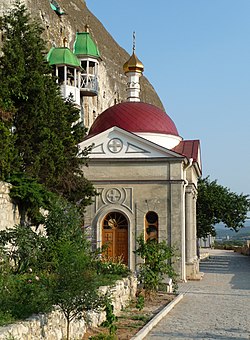
The area has been inhabited since ancient times. The cave monastery of St. Clement was founded near Inkerman in the 8th century by Byzantine icon-venerators fleeing persecution in their homeland. The monastery was closed during the Soviet era and several of its churches destroyed but is now in restoration and brought back into use.

The city was called Kalamita (Greek: Καλαμίτα) and was a medieval fortress built in the 8th-9th century on a strategic cliff overlooking the estuary and later expanded in the 14th century. In 1475 Kalamita, along with the rest of the Principality of Theodoro, was taken by the Turks, and Kalamita would be renamed Inkerman. After the Treaty of Küçük Kaynarca in 1774 the fortress was abandoned and fell into ruin, but a small settlement at the base of the cliff remained.

Martin Bronevski who visited Inkerman in 1578 saw several Greek inscriptions.[4]

The town became the centre of worldwide attention in 1854 during the Crimean War, when Inkerman was the scene of the Battle of Inkerman and the Battle of Chernaya River, both victorious for the French and the British troops.

During the Soviet times, a large underground ammunition warehouse of the Black Sea Fleet was situated under rocky cliffs in the Inkerman area. The storage was abandoned in the 1970s after an explosion that damaged the facility but did not detonate all its stockpiles. However, no efforts to secure the site were made until the 1990s when local residents began salvaging explosives which led to a number of deaths. Ukrainian Army engineer corps started extracting and decommissioning outdated ammunition in 2000 under a special government program.

Inkerman has since largely returned to its pre-war obscurity, serving as a suburb of Sevastopol linked to the downtown core by commuter ferries. One of the major Crimean wineries featuring the Inkerman label is located in the adjacent area. A popular hiking trail leading into Crimean Mountains begins just east of the town.

A horse in the Household Cavalry Blues and Royals has been named after the town and battle.

The left flank company of the 1st Battalion Grenadier Guards, which holds the traditions of the disbanded 3rd Battalion (which played a large part of the battle) is named after the town and battle. Now known as the Inkerman Company, or by its nickname "The Ribs".

Demographics

[edit]

As of the 2001 Ukrainian census, Inkerman had a population of 10,456 inhabitants. The majority of the population are ethnic Russians, followed by a large Ukrainian minority, as well as smaller Belarusian and Crimean Tatar communities. Linguistically, the population is overwhelingly Russophone, while a share of native Ukrainian speakers just exceeds 5%. The exact ethnic and linguistic composition was as follows:[5][6]

Ethnic groups in Inkerman
percent
Russians
73.00%
Ukrainians
20.71%
Belarusians
1.29%
Tatars
0.41%
Moldovans
0.30%
Crimean Tatars
0.27%
Armenians
0.16%
Azerbaijanis
0.14%
Poles
0.12%
others
3.60%
First languages in Inkerman
percent
Russian
91.2%
Ukrainian
5.2%
Crimean Tatar
0.2%
Belarusian
0.1%
Armenian
0.1%
Romanian
0.1%
others
0.6%
[edit]

See also

[edit]

References

[edit]
[edit]
Revisions and contributorsEdit on WikipediaRead on Wikipedia
from Grokipedia
Inkerman is a town in Sevastopol on the Crimean Peninsula, positioned approximately 5 kilometers east of Sevastopol at the mouth of the Chorna River where it meets Sevastopol Inlet.[1] The settlement derives its name from the Turkic term for "cave fortress," reflecting its historical fortifications carved into the limestone cliffs and extensive cave systems formed by quarrying activities.[2] Historically, Inkerman served as the site of the medieval Genoese fortress of Kalamita, constructed to defend against invasions, which fell to Ottoman forces in 1475 and was subsequently renamed.[3][2] The Inkerman Cave Monastery of St. Clement, one of the region's earliest monastic complexes, originated in the 8th to 11th centuries amid these rock formations, with legends linking it to the relics of early Christian figures like St. Clement, though the present structure dates to a 19th-century revival on Byzantine foundations.[4] The town gained further prominence during the Crimean War as the setting for the Battle of Inkerman on 5 November 1854, where outnumbered British and French forces repelled a Russian assault in dense fog through intense close-quarters combat, earning it the moniker "the soldiers' battle" for the decisive role of individual infantry actions.[5][6] Inkerman's strategic position overlooking Sevastopol has underscored its military significance across eras, from ancient defenses to 19th-century sieges, while its geological features continue to define local industry and cultural heritage amid the ongoing territorial dispute over Crimea.[5][2]

Geography

Location and terrain

Inkerman lies approximately 5 kilometers east of Sevastopol in the southwestern part of the Crimean Peninsula, positioned at the mouth of the Chernaya River as it discharges into the northern inlet of Sevastopol Bay.[7][8] The settlement's coordinates place it at roughly 44°37′N 33°49′E, within a region characterized by its proximity to the Black Sea coast and the transitional terrain between the Crimean Mountains and the coastal plain.[9] The terrain of Inkerman is defined by the narrow Inkerman Valley, hemmed in by abrupt limestone cliffs rising sharply from the riverbanks, which create a dramatic, enclosed landscape conducive to natural cave formation.[10][11] These cliffs, part of the broader plateau formations in the area, exhibit karst features including numerous interconnected caves and hollows eroded into the rock faces over geological timescales.[4] The valley floor, following the river's course, gradually widens near the bay, blending low-lying alluvial deposits with elevated rocky outcrops that dominate the eastern approaches to Sevastopol.[12] Geologically, the area consists primarily of Eocene-age oolitic and bryozoan limestones, forming the distinctive white rock layers exposed in the cliffs and quarried historically as "Inkerman stone" for its durability and fine grain.[13][14] These formations result from ancient marine depositional environments, contributing to the region's structural integrity and the prevalence of cliffside cavities.[15] The limestone's softness in certain strata has facilitated natural erosion, while harder layers provide stable overhangs, shaping the rugged topography that distinguishes Inkerman from surrounding coastal flats.[16]

Climate

Inkerman experiences a humid subtropical climate (Köppen classification Cfa), featuring mild winters, warm to hot summers, and moderate precipitation concentrated in the cooler months, consistent with the Black Sea coastal zone of the Crimean Peninsula.[17][18] Average annual temperatures hover around 13 °C (55 °F), with July and August peaks of 24–28 °C (75–82 °F) during the day and January lows of about 4 °C (39 °F), rarely dropping below freezing due to maritime influences.[19][17] Precipitation totals approximately 300–400 mm per year, with 60–70% occurring from October to March in the form of rain, while summers remain predominantly dry with infrequent thunderstorms.[20][17] These conditions support local economic activities: the extended dry season minimizes disruptions to quarrying operations in the limestone-rich terrain, and the mild winters combined with ample summer warmth enable viticulture, a key agricultural sector yielding grape varieties suited to the region's 2,000+ annual sunshine hours.[17] Autumnal fog, prevalent in November due to temperature inversions over the Chorna River valley, enhances humidity but can limit visibility, historically impacting navigation and military maneuvers in the area.[17] Recent data indicate stable patterns with no significant deviations from long-term averages, though broader Crimean trends show slight warming of 0.5–1 °C per decade, potentially stressing water resources for agriculture amid dry summers.[19][21]

History

Ancient origins and medieval development

The karst cave systems and elevated terrain along the Chorna River valley in Inkerman provided natural defensibility and shelter, enabling human occupation from the Late Paleolithic era, as evidenced by stratified archaeological layers in excavated grottoes revealing tools, hearths, and faunal remains indicative of prolonged habitation.[22] This continuity persisted into the Bronze-Iron Age transition circa 1000 BCE, where settlements in the valley supported cereal agriculture, with findings of storage pits, grinding tools, and carbonized grains demonstrating systematic cultivation of emmer wheat, barley, and millet adapted to the local microclimate and soil.[23] The toponym "Inkerman" originates from Crimean Tatar İnkerman, translating to "cave fortress," a designation reflecting the site's inherent strategic value for defense and resource exploitation, as the caves offered protection from weather, predators, and raiders while facilitating control over river access and quarrying of soft limestone.[10] Ancient Greek influence is attested by inscriptions observed in 1578 by Polish diplomat Martin Bronevski during his travels through the region, which he linked to remnants of Hellenic settlements proximate to the Chersonesos colony established in the 5th century BCE, suggesting episodic use by Greek traders or colonists for maritime oversight.[24] By the 6th century CE, Byzantine authorities fortified the plateau atop Monastyrskaya Skala as the Kalamita outpost, garrisoning it with local populations to secure the southwestern Crimean frontier against barbarian incursions, leveraging the cliffs' sheer drops and cave networks for surveillance and refuge.[2] These cave complexes evolved into early Orthodox monastic enclaves by the early medieval period, serving as ascetic retreats amid recurrent threats from steppe nomads, with rock-hewn chapels and cells embodying a resilient tradition of eremitic Christianity that endured Tatar raids in the 13th-14th centuries and Ottoman conquest in 1475, after which the site retained its fortified nomenclature under Muslim rule.[2][10]

Crimean War: Battle of Inkerman

The Battle of Inkerman occurred on 5 November 1854, when Russian forces under General Pyotr Dannenberg launched a surprise dawn attack against British and French positions on the Inkerman Heights, east of Sevastopol, aiming to disrupt the Allied siege lines.[6][25] Dense fog limited visibility to 40 yards, reducing the effectiveness of Allied artillery and forcing reliance on infantry bayonet charges in close-quarters combat, earning the engagement the moniker "Soldiers' Battle."[6] Russian troops, initially numbering around 33,000 with reinforcements bringing totals to over 40,000, advanced in dense columns up the ravines toward Shell Hill and Home Hill, initially overwhelming isolated British units like the 20th Regiment and 77th Regiment.[6][5] Allied defenders, totaling about 12,000 British and 7,000 French troops at the outset, with further reinforcements arriving piecemeal, held through tenacious counterattacks by the Guards Brigade and French divisions under General Pierre Bosquet.[6] British commander Lord Raglan directed ad hoc responses amid communication breakdowns, while French artillery and infantry stabilized the flanks after initial British setbacks, including the near-collapse of the Second Division.[26] By midday, as fog lifted, Allied naval gunfire and concentrated rifle volleys repulsed Russian assaults, forcing a withdrawal; the Russians failed to sever the Allied supply lines or relieve Sevastopol.[6] Casualties reflected the battle's ferocity and imbalance in numbers:
SideKilledWoundedTotal
British5971,8602,357
French143786929
Russian~3,000~8,00010,000–12,000
[6][5] Russian estimates acknowledge around 11,000 total losses including prisoners, though Western accounts emphasize higher figures due to ineffective columnar tactics against rifled muskets.[6][27] Tactically, the Allied victory preserved the Sevastopol investment but exposed logistical strains, including ammunition shortages and uncoordinated commands, prolonging the campaign into winter; for the Russians, it demonstrated the limitations of mass assaults without adequate reconnaissance or artillery support in obscured terrain.[25][26]

Imperial Russian, Soviet, and early post-Soviet periods

Following the Crimean War (1853–1856), Inkerman was fully integrated into the Russian Empire's Taurida Governorate as a settlement subordinate to Sevastopol. The area's extensive limestone quarries, producing the durable Inkerman stone, expanded operations to supply materials for Sevastopol's reconstruction after its near-total destruction during the siege. This stone, prized for its strength and workability, was quarried intensively from the mid-19th century onward, supporting imperial building projects and local economic activity centered on extraction and transport.[13] After the Russian Civil War and the formation of the Soviet Union in 1922, Inkerman fell within the Crimean Autonomous Soviet Socialist Republic (ASSR), later reorganized under the Russian SFSR until the 1954 transfer of Crimea to the Ukrainian SSR. Administrative focus shifted toward collectivization and light industrialization, with quarries nationalized to feed Soviet construction demands across the peninsula. The settlement's cave systems, abundant due to millennia of quarrying, were repurposed for utilitarian storage—housing grain, wine, and military supplies—and small-scale operations like tool workshops, adapting natural geology to centralized planning needs without major urban development. In 1976, Soviet authorities renamed it Belokamensk (Russian) or Bilokamiansk (Ukrainian), literally "white stone city," to emphasize its quarrying heritage and align with ideological naming conventions; this persisted until the USSR's collapse.[4] Upon Ukraine's independence in 1991, Inkerman reverted to its pre-1976 name by local decree and operated as an urban-type settlement within Sevastopol's administrative jurisdiction, which held special federal status under the Ukrainian constitution. Governance transitioned smoothly to Kyiv oversight, with the Russian-speaking majority—comprising over 90% of residents—maintaining cultural and linguistic continuity amid economic stagnation inherited from Soviet decay. No significant separatist agitation emerged in the settlement through the 1990s and early 2000s, as federal subsidies and naval base presence stabilized social structures, though ammunition decommissioning efforts by Ukrainian military engineers began around 2000 to address Soviet-era stockpiles in local caves.[4]

Russian annexation and contemporary status

In March 2014, following the deployment of Russian forces in Crimea amid Ukraine's Euromaidan Revolution, a referendum was held on March 16 in Sevastopol, which encompasses Inkerman as a suburban district. Official results reported that 95.5% of voters in Sevastopol favored reunification with Russia, with a turnout of approximately 89%.[28] [29] These figures aligned with broader Crimean trends, where ethnic Russian majorities and historical ties to Russia, including the Black Sea Fleet's basing in Sevastopol, contributed to strong local support for separation from Ukraine, though the vote faced Ukrainian protests and boycotts by pro-Ukrainian groups.[30] On March 18, Russian President Vladimir Putin signed a treaty incorporating Crimea and Sevastopol, including Inkerman, into the Russian Federation as a federal city, effective from that date.[31] The annexation prompted immediate administrative integration of Inkerman into Sevastopol's municipal structure, with local governance aligned under Russian federal laws, including the adoption of Russian rubles, passports, and educational curricula by mid-2014. Internationally, the move drew widespread non-recognition, with the United Nations General Assembly affirming Ukraine's territorial integrity and deeming the referendum invalid due to the coercive context of military presence.[32] Despite this, de facto Russian control solidified, with Inkerman's quarries and residential areas incorporated into Sevastopol's urban planning, facilitating resource extraction tied to military and civilian needs.[33] Under Russian administration from 2014 onward, investments targeted Sevastopol's infrastructure, including road expansions and utility upgrades extending to Inkerman's vicinity, as part of broader Crimean federal programs exceeding 1 trillion rubles by 2021 for transport and energy connectivity, such as the Kerch Strait Bridge completed in 2018.[34] These developments aimed to resolve pre-annexation deficits in water supply and power grids, with reported growth in construction output averaging 10-15% annually in the region through 2020. However, independent assessments have questioned the sustainability amid sanctions, noting reliance on mainland Russia for materials and labor migration of over 200,000 personnel to Crimea by 2021.[35] The 2022 escalation of the Russia-Ukraine conflict intensified Inkerman's strategic role within Sevastopol, a primary Black Sea Fleet hub, leading to heightened militarization with deployments of naval assets, air defenses, and fortification projects around coastal and cave terrains by 2023.[33] Ukrainian strikes on Sevastopol, including drone and missile attacks documented from 2022-2025, have prompted restricted civilian access to peripheral areas like Inkerman, with checkpoints and evacuation protocols enforced during alerts, contributing to population outflows estimated at 10-20% in frontline zones.[36] Russian authorities maintain operational control, framing enhancements as defensive necessities against perceived NATO threats, while empirical data from satellite imagery confirms expanded military infrastructure integration with local geology.[37] As of 2025, Inkerman remains under de facto Russian governance, with daily administration focused on wartime resilience amid ongoing hostilities.[38]

Economy

Quarrying and construction materials

The Inkerman quarries, among Crimea's largest and oldest, have extracted high-quality white limestone since antiquity, with the site first documented in 93 BC.[39] This durable stone, prized for its ease of dressing, wear resistance, and thermal properties, supported ancient regional architecture and was reportedly exported to Rome.[13][40] By the early 20th century, the underground workings extended approximately 30 kilometers, forming an extensive network of adits and caves from selective cave mining techniques that preserved structural integrity while yielding large blocks.[39][41] In the Soviet period, quarrying reached peak output to supply reconstruction efforts, particularly Sevastopol's post-World War II rebuilding, where Inkerman limestone clad buildings and lined avenues due to its aesthetic and functional qualities.[13][42] Extraction relied on mechanized methods, including drilling and blasting within the cave systems, which maximized yield from the Sarmatian-age deposits while minimizing surface disruption.[13] Contemporary operations, managed under Sevastopol's administration, maintain production using specialized equipment such as SM-89A and KM-3 series machines for block extraction and processing, supporting local construction, exports, and employment for hundreds in the region.[13] The quarries' output continues to feature in architectural applications, though structural instability from historical over-extraction has led to safety restrictions, including closures to visitors following incidents like the 1942 explosion that caused significant casualties.[39] Environmental concerns, including dust emissions and habitat alteration, have prompted limited critiques, but the site's geological value sustains ongoing activity.[13]

Wine production and agriculture

The Inkerman Valley, characterized by its limestone karst formations and proximity to the Black Sea, features a microclimate conducive to viticulture, with mountain barriers moderating temperatures and diverse soils enabling grape cultivation in the Sevastopol region.[43] The Inkerman Vintage Wine Factory, founded in 1961 under Soviet administration, operates as a major secondary winemaking facility, focusing on aging natural dry and fortified wines in oak barrels before bottling.[44] [45] Its extensive underground cellars, excavated within local caves, provide consistent humidity and temperature for long-term storage, a practice leveraging the area's natural geology.[46] Production emphasizes sparkling and fortified varieties, alongside still wines from grapes sourced regionally, including local hybrids like Cabernet Kachinsky and Aligote Crimean, as well as Cabernet Sauvignon and Riesling adapted to nearby valleys such as Kachin.[47] [48] Following the 2014 Russian annexation of Crimea, the facility divided operations, with the Sevastopol-based segment reorienting toward the Russian market, where brands like Inkerman and Pearl of Inkerman expanded distribution amid state investments in Crimean winemaking exceeding $800 million by 2016.[49] [50] Beyond viticulture, Inkerman's agriculture incorporates fruit orchards and grain cultivation, reflecting broader Crimean patterns of mixed farming historically including cereals.[23] These activities have faced disruptions from post-2014 water scarcity, triggered by Ukraine's closure of the North Crimean Canal, which supplied up to 85% of the peninsula's freshwater and reduced irrigated land from 140,000 hectares in 2013 to 11,000 hectares by 2015, limiting crop yields and intensifying drought effects on both vineyards and field crops.[51] [52] Ongoing military conflict since 2022 has further strained resources, contributing to variable agricultural output despite regional grain harvests reaching 2 million tonnes in 2022.[53]

Modern economic challenges

Following Russia's 2014 annexation of Crimea, Western sanctions by the United States and European Union prohibited imports of goods originating from the peninsula, including construction materials like Inkerman's limestone quarried for export, thereby curtailing access to pre-annexation European markets and contributing to a reported 10% decline in agricultural and related trade flows between sanctioning countries and affected regions.[54] Crimean wine production, including from Inkerman's vineyards tied to Sevastopol's viticultural sector, faced similar export barriers to the EU and US, prompting redirection toward Russian domestic consumption, where state promotion of "patriotic wines" has supported sales growth amid broader import restrictions on Western varieties.[55] These measures have limited foreign investment in Crimea's extractive industries, with EU rules explicitly banning services linked to infrastructure projects in Crimea, including those potentially involving quarried stone.[56] To offset sanction-induced losses, Russia has channeled annual subsidies to Crimea ranging from $1 billion to $2.7 billion since 2014, comprising up to two-thirds of the regional budget by 2024 and sustaining operations in subsidized sectors like quarrying and agriculture, though this has fostered economic dependence on federal transfers rather than self-sufficiency.[57] [58] Inkerman's proximity to Sevastopol has tied its service economy—encompassing logistics, retail, and administrative functions—to the larger city's infrastructure, amplifying vulnerabilities from regional supply chain disruptions.[59] The 2022 escalation of the Russia-Ukraine conflict further strained Inkerman's growth prospects, with tourism to historical sites like the Inkerman Cave Monastery declining sharply due to safety concerns, logistical barriers from Black Sea restrictions, and a one-third drop in Crimean visitor numbers that year, followed by additional reductions in 2023 amid counteroffensive risks.[60] Efforts at diversification have shifted toward military-related contracting in Sevastopol's defense hub, leveraging Russia's Black Sea Fleet presence, but persistent geopolitical isolation has hindered broader private investment and export recovery.[61]

Landmarks and cultural heritage

Inkerman Cave Monastery

The Inkerman Cave Monastery, dedicated to St. Clement, traces its origins to the 8th–11th centuries, when Orthodox monks carved churches into natural limestone caves overlooking the Chorna River valley near Inkerman.[62] These early structures formed part of a Byzantine-era monastic complex, potentially housing relics of St. Clement, the third pope and early Christian martyr exiled to the region under Trajan around 100 AD, according to Orthodox tradition linking the site to apostolic foundations via St. Andrew.[10] The monastery endured as a center of Orthodox Christian practice through medieval invasions, with expansions continuing into the 15th century, including rock-cut basilicas that integrated natural hollows for worship and shelter.[63] Subject to repeated destruction—from Tatar raids in the 15th century to Ottoman occupation—the site saw major revival after Crimea's incorporation into the Russian Empire in 1783, with formal reconstruction beginning in 1850–1852 under Archimandrite Avraamy (Aloshin), who cleared debris from three primary cave churches and restored ancient frescoes.[64] This effort was interrupted by the Crimean War (1853–1856), yet resumed, yielding by 1910 a complex with eight churches, residential cells, and utility spaces hewn into cliffs up to 50 meters high.[65] Soviet authorities closed the monastery in 1926–1931, liquidating it amid anti-religious campaigns, with further damage from the 1927 Crimean earthquakes collapsing several structures; it remained shuttered until 1991.[10][66] Architecturally, the monastery exemplifies cave monasticism with multi-level cliffside churches, such as the main St. Clement temple featuring a rock-cut basilica with semicircular vaulted naves, plastered walls bearing faded ornamental and biblical frescoes from Byzantine and post-Byzantine eras, and an adjacent necropolis of ancient rock tombs used for monastic burials over centuries.[4][63] Secondary chapels, including those to St. John the Baptist and the Holy Apostles, incorporate narrow tunnels and hermit cells, while external granite retaining walls and terraced gardens enhance defensibility, historically providing refuge during conflicts.[10] A reliquary in the St. Clement church holds a particle of the saint's relics, transferred in the 19th century, underscoring its role in Orthodox veneration.[64] Today, the monastery functions as an active men's lavra under the Russian Orthodox Church, with ongoing restorations preserving its cave architecture and drawing pilgrims for services, relics veneration, and hikes through the cliff complex.[62] Its survival across Ottoman, imperial Russian, Soviet, and wartime upheavals highlights the persistence of Orthodox monastic traditions in the face of geopolitical shifts, maintaining continuous liturgical use where feasible despite periods of desecration.[65] Archaeological evidence from the caves, including pre-Christian quarries adapted for Christian purposes, supports its layered historical authenticity as a site of enduring religious significance.[4]

Military history sites and memorials

The Inkerman battlefield preserves key topographical features from the November 5, 1854, engagement, including Shell Hill, a elevated position held by Russian artillery that supported infantry advances against Allied ridges during the foggy morning assault.[27] Remnants of British and French trenches, initially constructed for defensive positions overlooking the Chernaya River valley, remain discernible in the landscape, marking sites of hand-to-hand combat where Allied forces repelled Russian columns despite surprise and numerical disadvantage.[67] These earthworks, totaling several miles across the heights, exemplify early industrialized warfare entrenchments, with Allied casualties exceeding 4,000 killed, wounded, or missing against Russian losses of around 5,500 from an attacking force of approximately 35,000.[6] A multinational memorial near Sevastopol commemorates the combined British, French, and Russian fatalities from the battle, serving as a neutral acknowledgment of the multinational toll in the fog-shrouded "Soldiers' Battle."[68] In contrast, Russian-focused monuments emphasize the defensive tenacity and participant sacrifices of Imperial forces, such as the Monument to Russian Soldiers - Participants of the Inkerman Battle, which honors the troops under General Pyotr Dannenberg who inflicted disproportionate casualties while attempting to disrupt the Sevastopol siege.[69] An original Russian memorial to Inkerman casualties, erected post-war, was demolished during World War II bombings but underscores pre-1940s commemorative efforts prioritizing national military heritage.[70] Under Russian administration since 2014, these sites contribute to military tourism in the Sevastopol region, drawing visitors to explore the terrain via guided paths that highlight Russian artillery positions on Shell Hill and the strategic failure of Allied overextension, though empirical accounts confirm the battle's tactical draw with Allied retention of the heights.[69] Preservation focuses on physical markers like obelisks and interpretive signage, avoiding reconstruction of destroyed elements, and aligns with narratives of Crimean resilience against Western incursions, as evidenced by ongoing site maintenance amid regional geopolitical disputes. Soviet-era plaques, integrated into later monuments, further commemorate aggregate war dead without distinguishing battle-specific claims.[71]

Demographics

According to the 2014 census conducted following the Russian annexation, Inkerman's urban population was 10,348, with 4,774 males and 5,574 females.[72] This figure rose to 13,858 by the 2021 census, comprising 6,638 males and 7,220 females, indicating a growth rate of approximately 1.8% annually from 2014 to 2021. Russian estimates as of January 1, 2024, place the total at 13,643.[73] Prior to 2014, Ukrainian estimates hovered around 10,000–11,000, reflecting relative stability with minor fluctuations tied to broader Sevastopol-area demographics.[74] Ethnic composition data specific to Inkerman is not separately enumerated in available censuses, but mirrors Sevastopol municipality patterns, where Russians have long formed the majority. In the 2001 Ukrainian census for Sevastopol city council, ethnic Russians accounted for 71.6% (270,000 individuals), Ukrainians 22.4%, and smaller shares for Belarusians, Tatars, and others.[75] Subsequent Russian censuses report a higher proportion of ethnic Russians in Sevastopol at 90.11% (2020 data), with Ukrainians at 5.56% and Crimean Tatars comprising a minor fraction alongside Belarusians and Armenians.[76] The population remains predominantly Russian-speaking, with over 90% native Russian speakers in recent Sevastopol aggregates.[76] These trends indicate ethnic stability dominated by Russians, with limited shifts in minority representation post-2014.

Political status and controversies

Disputed sovereignty post-2014

Following Russia's military intervention in February 2014 and the subsequent annexation treaty signed on March 18, 2014, Inkerman was de facto integrated into the Russian Federation as part of Sevastopol, designated a federal city with special status equivalent to a federal subject.[77] Inkerman operates administratively as a microdistrict within Sevastopol's Balaklava raion, subject to Russian federal and municipal laws, including local self-government structures aligned with the Russian Constitution. Residents have been systematically offered and many have obtained Russian citizenship and passports, with passportization efforts accelerating post-annexation to formalize de facto control.[36] De jure, Ukraine maintains that Inkerman, as part of Crimea and Sevastopol, remains sovereign Ukrainian territory under temporary occupation, invoking violations of the 1994 Budapest Memorandum on security assurances. This position is supported by most United Nations member states, as reflected in UN General Assembly Resolution 68/262 adopted on March 27, 2014, which affirmed Ukraine's territorial integrity and rejected the March 16 referendum. Annual UNGA resolutions since 2014, including those condemning militarization and human rights issues, have upheld non-recognition of the annexation, with recent reaffirmations in 2025 emphasizing sovereignty over Crimea and Sevastopol.[78][79] The shift in control stemmed from acute local dynamics, including widespread pro-Russian orientation in Sevastopol, where a 2014 exit poll indicated 95.5% support for joining Russia in the disputed referendum. Post-annexation surveys, such as a 2015 Washington Post poll, found over 80% of Crimean residents, including in Sevastopol areas, reporting preference for Russian governance over Ukrainian, attributing this to perceived economic stability and cultural affinity despite international sanctions. Geostrategic imperatives, particularly Sevastopol's role as the Black Sea Fleet's primary base since the 18th century, amplified Russia's incentives, while the Euromaidan Revolution—viewed locally as an anti-Russian coup—intensified separatist momentum amid fears of naval base lease revocation.[29][80][81]

Russian, Ukrainian, and international viewpoints

Russian officials maintain that the 2014 referendum in Crimea, encompassing Sevastopol and Inkerman, demonstrated the populace's free exercise of self-determination, with 83% turnout and 97% approval for reunification with Russia, correcting the 1954 transfer from the Russian SFSR and affirming deep historical, ethnic, and linguistic bonds.[82][83] They frame opposition narratives of "occupation" as NATO-driven disinformation intended to encroach on Russian security interests rather than reflecting local empirical preferences.[84] Ukrainian leadership deems the events an unlawful seizure contravening the 1994 Budapest Memorandum and Ukraine's constitution, insisting on full restoration of sovereignty over Crimea—including Inkerman—through de-occupation and demilitarization, while underscoring the post-referendum suppression and displacement of Crimean Tatars as evidence of coercive Russification.[85][86] Most Western governments, led by the US and EU, withhold recognition of Russia's control, enacting sanctions targeting officials and sectors to enforce non-acceptance of altered borders, as affirmed in UN General Assembly resolutions urging states to avoid legitimizing the status quo.[87][88] However, select non-Western states pursue pragmatic economic ties without formal endorsement, and analysts critique selective application of self-determination norms—contrasting Crimea's polled outcomes with NATO-backed Kosovo's unilateral secession sans referendum—as exposing inconsistencies in upholding territorial integrity only when aligned with geopolitical aims.[89][90]

References

User Avatar
No comments yet.