
Recent from talks
Yevpatoria
Knowledge base stats:
Talk channels stats:
Members stats:
Yevpatoria
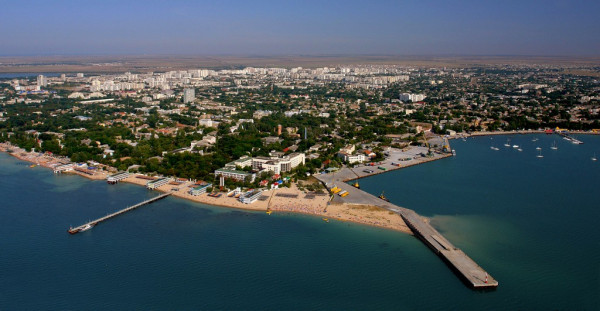
Yevpatoria (Ukrainian: Євпаторія, romanized: Yevpatoriia; Russian: Евпатория, romanized: Yevpatoriya; Crimean Tatar: Kezlev, Кезлев; Greek: Ευπατορία, romanized: Eupatoría) is a city in western Crimea, north of Kalamita Bay. Yevpatoria serves as the administrative center of Yevpatoria Municipality, one of the districts (raions) into which Crimea is divided. It had a population of 105,719 (2014 Census).
The first recorded settlement in the area, called Kerkinitis (Κερκινίτις), was built by Greek colonists around 500 BCE. Along with the rest of the Crimea, Kerkinitis formed part of the dominions of King Mithridates VI Eupator (r. 120–63 BCE). The name of the modern city derives from his nickname, Eupator ('of a noble father').
From roughly the 7th through the 10th centuries, Yevpatoria was a Khazar settlement; its name in Khazar language was probably Güzliev (literally 'beautiful house'). It was later subject to the Cumans (Kipchaks), the Mongols, and the Crimean Khanate. During this period the city was called Kezlev by Crimean Tatars and Gözleve by Ottoman Turks. The Russian medieval name Kozlov is a Russification of the Crimean Tatar name. For a short period between 1478 and 1485, the city was administered by the Ottoman Empire. Afterward, it became an important urban center of the Crimean Khanate.
The 400-year-old Juma-Jami Mosque is one of the many designed by the Ottoman architect Mimar Sinan. It was built in 1552-1564. 35-metre minarets rose on the flanks of the building. The mosque was of great state significance. It was here that a ceremony of the declaration of rights of the Crimean Khans was held at their enthronement. Only after that did they go to their capital, the city of Bakhchysarai.
Yevpatoria became a residence of the spiritual ruler of the Crimean Karaites, the Ḥakham. In this connection, a complex of two prayer houses was built under the supervision of the Rabovich brothers, in which the Renaissance and Muslim architectural styles entwined in a most unusual manner. The ensemble organically incorporates three courtyards. The entrance to it is marked by gates, built in 1900, which look like a refined triumphal arch.
In 1783, along with the rest of Crimea, Kezlev was captured by the Russian Empire. Its name was officially changed to Yevpatoriya in 1784. This spelling of the city name came to the French, German, Spanish, and English languages at the end of the 18th сentury.
Polish poet Adam Mickiewicz visited the town in 1825 and wrote one of his Crimean Sonnets here; it was later translated into Russian by Mikhail Lermontov.
The city was occupied in September 1854 by British, French and Turkish troops during the Crimean War prior to the Allied landing in Kalamita Bay, after which the Battle of the Alma south of the bay followed. It became a garrison of Ottoman troops later during the war and was the site of the Battle of Eupatoria in February 1855, which was the largest military clash in the Crimean theatre outside the Sevastopol area.
Hub AI
Yevpatoria AI simulator
(@Yevpatoria_simulator)
Yevpatoria
Yevpatoria (Ukrainian: Євпаторія, romanized: Yevpatoriia; Russian: Евпатория, romanized: Yevpatoriya; Crimean Tatar: Kezlev, Кезлев; Greek: Ευπατορία, romanized: Eupatoría) is a city in western Crimea, north of Kalamita Bay. Yevpatoria serves as the administrative center of Yevpatoria Municipality, one of the districts (raions) into which Crimea is divided. It had a population of 105,719 (2014 Census).
The first recorded settlement in the area, called Kerkinitis (Κερκινίτις), was built by Greek colonists around 500 BCE. Along with the rest of the Crimea, Kerkinitis formed part of the dominions of King Mithridates VI Eupator (r. 120–63 BCE). The name of the modern city derives from his nickname, Eupator ('of a noble father').
From roughly the 7th through the 10th centuries, Yevpatoria was a Khazar settlement; its name in Khazar language was probably Güzliev (literally 'beautiful house'). It was later subject to the Cumans (Kipchaks), the Mongols, and the Crimean Khanate. During this period the city was called Kezlev by Crimean Tatars and Gözleve by Ottoman Turks. The Russian medieval name Kozlov is a Russification of the Crimean Tatar name. For a short period between 1478 and 1485, the city was administered by the Ottoman Empire. Afterward, it became an important urban center of the Crimean Khanate.
The 400-year-old Juma-Jami Mosque is one of the many designed by the Ottoman architect Mimar Sinan. It was built in 1552-1564. 35-metre minarets rose on the flanks of the building. The mosque was of great state significance. It was here that a ceremony of the declaration of rights of the Crimean Khans was held at their enthronement. Only after that did they go to their capital, the city of Bakhchysarai.
Yevpatoria became a residence of the spiritual ruler of the Crimean Karaites, the Ḥakham. In this connection, a complex of two prayer houses was built under the supervision of the Rabovich brothers, in which the Renaissance and Muslim architectural styles entwined in a most unusual manner. The ensemble organically incorporates three courtyards. The entrance to it is marked by gates, built in 1900, which look like a refined triumphal arch.
In 1783, along with the rest of Crimea, Kezlev was captured by the Russian Empire. Its name was officially changed to Yevpatoriya in 1784. This spelling of the city name came to the French, German, Spanish, and English languages at the end of the 18th сentury.
Polish poet Adam Mickiewicz visited the town in 1825 and wrote one of his Crimean Sonnets here; it was later translated into Russian by Mikhail Lermontov.
The city was occupied in September 1854 by British, French and Turkish troops during the Crimean War prior to the Allied landing in Kalamita Bay, after which the Battle of the Alma south of the bay followed. It became a garrison of Ottoman troops later during the war and was the site of the Battle of Eupatoria in February 1855, which was the largest military clash in the Crimean theatre outside the Sevastopol area.
Recent media