Hubbry Logo
Interthalamic adhesionInterthalamic adhesionMain
Open search
Interthalamic adhesion
Community hub
Interthalamic adhesion
logo
8 pages, 0 posts
0 subscribers
Be the first to start a discussion here.
Interthalamic adhesion
from Wikipedia
Interthalamic adhesion
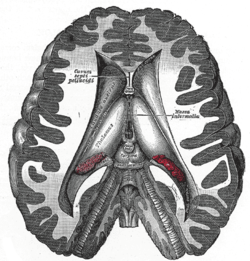
Dissection showing the ventricles of the brain. (Interthalamic adhesion labeled as Massa Intermedia at center right.)
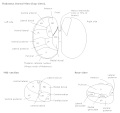
Coronal section of brain through intermediate mass of third ventricle.
Details
Part ofThalamus
Identifiers
Latinadhaesio interthalamica
NeuroNames301
NeuroLex IDnlx_144100
TA98A14.1.08.103
TA25778
FMA74869
Anatomical terms of neuroanatomy

The interthalamic adhesion (also known as the massa intermedia, intermediate mass or middle commissure) is a flattened band of tissue that connects both parts of the thalamus at their medial surfaces. The medial surfaces form the upper part of the lateral wall to the third ventricle.

In humans, it is only about one centimeter long – though in females, it is about 50% larger on average.[1] Sometimes, it is in two parts – and 20% of the time, it is absent.[2] In other mammals, it is larger.

In 1889, a Portuguese anatomist by the name of Macedo examined 215 brains, showing that male humans are approximately twice as likely to lack an interthalamic adhesion as are female humans. He also reported its absence, still reported today in about 20% of humans. Its absence is seen to be of no consequence.[2]

The interthalamic adhesion contains nerve cells and nerve fibers; a few of the latter may cross the middle line, making it a commissure in at least a portion of people, but many fibers pass toward the middle line and then curve laterally on the same side.[3]

The interthalamic adhesion is notably enlarged in patients with the type II Arnold–Chiari malformation.[4]

Additional images

[edit]

References

[edit]
[edit]
Revisions and contributorsEdit on WikipediaRead on Wikipedia
from Grokipedia
The interthalamic adhesion, also known as the massa intermedia, is a midline neural structure consisting of a rod-like bridge of nervous tissue with commissural fibers and elements from thalamic gray matter nuclei that connects the medial surfaces of the two thalami across the third ventricle in the human diencephalon. This inconstant anatomical feature, first described by Giovanni Battista Morgagni in the 18th century, typically appears as an oval or flattened band of tissue located horizontally in the median plane, often in the anterosuperior quadrant of the third ventricle's lateral wall. Prevalence studies indicate that the interthalamic is present in approximately 70–87% of , with absence noted in 13–30% of cases, showing higher incidence in females and pediatric individuals across multiple populations. Morphological variations include single adhesions (most common), double bridges (about 2%), and shapes such as oval, circular, or triangular, with average dimensions of 4.6 horizontally and 3.1 vertically in adults. Its and can differ, influencing on like MRI. Histologically, the structure is composed primarily of glial cells and axons rather than neuronal cell bodies, classifying it as a white matter commissure rather than a true gray commissure, though it may incorporate elements from thalamic nuclei such as the nucleus reuniens and rhomboideus. Fiber tract analysis reveals connections to regions including the nucleus accumbens, caudate nucleus, fronto-orbital cortex, lateral habenula, and posterior commissure, but its precise functional role remains unclear. Clinically, the interthalamic adhesion holds significance in neurosurgery, particularly procedures involving the third ventricle such as endoscopic ventriculostomy, where its variable presence requires careful preoperative assessment to avoid complications. It has been loosely associated with conditions like schizophrenia (approximately twice as likely absent, particularly in affected males) and hydrocephalus, though causal links are not established, and further research is needed to elucidate any correlations with cognitive function or psychotic disorders.

Overview

Definition

The interthalamic adhesion, also known as the massa intermedia, is a midline bridge of gray matter that interconnects the medial surfaces of the bilateral thalami, traversing the third ventricle. This structure consists primarily of thalamic gray matter with ipsilateral neurons and fibers, though it lacks true commissural connections between hemispheres and is bordered by hypothalamic tissue; however, while some studies describe it as lacking true interhemispheric commissural fibers and consisting primarily of ipsilateral connections, others identify crossing axons classifying it as a white matter commissure. It forms a variable anatomical fusion rather than a distinct commissure, with histological studies confirming the presence of neuronal elements amid glial components. In typical adults, the interthalamic adhesion exhibits an anteroposterior length of approximately 1 cm, with dimensions varying widely from 1 × 2 mm to 1 × 2 cm depending on individual morphology. Its cross-sectional area averages around 19–30 mm², reflecting its compact, ovoid shape. Evolutionarily, the interthalamic adhesion represents a partial fusion of thalamic medial surfaces observed in most mammals, including humans and many primates, though it is absent or rudimentary in certain non-primate species and variably present in up to 30% of human brains.

Historical nomenclature

Italian anatomist Giovanni Battista Morgagni first described the structure as a midline bridge of gray matter connecting the medial surfaces of the thalami across the third ventricle in his 1719 work Adversaria anatomica, using the term "transversa lamina cinereal." Earlier depictions of the structure appeared in the engravings of Bartolomeo Eustachi from the late 16th century, published posthumously in 1728, though without specific nomenclature. During the 17th century, French anatomist Raymond Vieussens illustrated the thalami in detail in his 1684 treatise Neurographia universalis, highlighting their connectivity but not yet applying a dedicated term to the adhesion itself; his work contributed to the foundational understanding that paved the way for Morgagni's description. The term "massa intermedia," meaning "intermediate mass" in Latin, was coined later by French anatomist Alexandre Jamain in 1861. Synonyms such as adhesio interthalamica emerged in subsequent Latin anatomical descriptions, emphasizing the adhesive fusion rather than a distinct mass. In modern nomenclature, the preferred term "" reflects the structure's developmental and histological character as a variable of gray rather than a true commissure of fibers, a shift adopted in authoritative texts like the 41st edition of Gray's Anatomy (2016) to align with contemporary neuroanatomical precision. This evolution underscores a broader trend in neuroanatomy toward descriptive terminology that avoids implying unverified functional roles, such as interhemispheric communication.

Anatomy

Gross structure

The interthalamic adhesion, also known as the massa intermedia, is a midline bridge of nervous tissue that connects the medial surfaces of the left and right thalami within the third ventricle of the brain. It is situated in the central portion of the ventricle, spanning the narrow space between the thalami at the level of the hypothalamic sulcus, a shallow groove that demarcates the boundary between the thalamus superiorly and the hypothalamus inferiorly along the lateral walls. This positioning allows the adhesion to protrude into the ventricular cavity, effectively narrowing the midline lumen without completely obstructing cerebrospinal fluid flow. In terms of its relations to adjacent structures, the interthalamic adhesion lies anterior to the habenular commissure, which forms part of the posterior wall of the third ventricle above the pineal recess. Superiorly, it is positioned inferior to the body of the fornix, which contributes to the roof of the ventricle along with the tela choroidea. Inferiorly, the adhesion is situated above the hypothalamic nuclei that form the floor and ventral aspects of the third ventricle, separated by the hypothalamic sulcus. These spatial relationships highlight its role as a central connector in the diencephalic region, embedded within the ependymal lining that covers the ventricular walls and facilitates interactions with surrounding cerebrospinal fluid dynamics. The gross appearance of the interthalamic adhesion exhibits considerable variability in shape and dimensions among individuals, often presenting as an oval, rectangular, or fusiform mass measuring approximately 5–12 mm in length and 3–8 mm in width. It is typically covered by a thin layer of ependyma, integrating seamlessly with the ventricle's epithelial lining while consisting of axonal fibers and glial cells that link homologous thalamic regions. This variability in morphology underscores its inconstant presence, observed in about 70–90% of human brains, with shapes influenced by individual anatomical differences rather than consistent patterns.

Microscopic composition

The interthalamic adhesion, also known as the massa intermedia, is histologically composed primarily of gray matter containing scattered neurons and a predominance of glial cells. Pyramidal neurons are present laterally within the structure, while the median part lacks neuronal somata, contributing to its classification as an axonal rather than a gray commissure. Microglia represent the most abundant glial cell type, exhibiting higher density in the adhesion compared to adjacent periventricular regions, with random cytoarchitecture observed across samples. Myelinated commissural fibers traverse the adhesion, forming reciprocal projections that connect homologous thalamic nuclei, such as the dorsomedial thalamus and nucleus reuniens. These fibers create a network transitioning between the two thalami, with some extending to associated structures including the nucleus accumbens, caudate nucleus, and fronto-orbital region. Histological staining with anti-neurofilament antibodies confirms the presence of these axonal fibers, which are embedded in a fine meshwork largely ipsilateral in origin but including crossing elements. The ventricular-facing aspects of the interthalamic adhesion are lined by a convoluted ependymal layer, characteristic of the third ventricle's interface. This ependyma functions as a permeable partial barrier between cerebrospinal fluid and brain parenchyma, lacking the tight junctions of the blood-brain barrier and thus permitting greater macromolecular exchange. Blood vessels, including arteries and veins, run horizontally through the structure, supporting its vascular integration without specific barrier modifications noted.

Development

Embryonic formation

The interthalamic adhesion originates during the second trimester of human embryonic development, specifically forming around 13–14 weeks of gestation within the diencephalon. This structure emerges as the thalami differentiate from the diencephalic prosomeres, particularly prosomere 2, which gives rise to the core thalamic territories. The process is linked to the subdivision of the prosencephalon into telencephalic and diencephalic components, where the diencephalic walls expand to form the lateral boundaries of the prospective third ventricle. The initial appearance of the interthalamic adhesion occurs as a cellular bridge spanning the midline between the developing thalami, resulting from the apposition and partial fusion of their medial surfaces. This bridge arises concurrently with thalamic evagination and growth, driven by the partitioning of the prosencephalic vesicle into the third ventricle, which creates the space the adhesion traverses. As the thalami mature from diencephalic progenitors (as described in the gross structure section), the cellular bridge provides a conduit for early interhemispheric integration. Histological studies debate the cellular composition, with some evidence suggesting incorporation of neuronal precursors that may contribute to a heterogeneous makeup, though mature analyses often find primarily glial and axonal elements. Initial fiber outgrowth follows, with commissural axons extending across the bridge to link contralateral thalamic regions, establishing rudimentary connectivity that persists into later development. This outgrowth is part of broader thalamic afferent and efferent patterning but remains limited at the embryonic stage.

Postnatal changes

Following birth, the interthalamic adhesion, also known as the massa intermedia, exhibits continued maturation of its commissural fibers, building upon embryonic precursors formed around mid-gestation. This process involves progressive integration, enabling enhanced interhemispheric connectivity as the structure matures. Myelination of the commissural fibers within the interthalamic adhesion aligns with the broader postnatal development of thalamic white matter, which advances rapidly during early childhood to facilitate efficient signal transmission. Qualitative imaging studies indicate that thalamic myelination becomes evident by around 3 months postnatal, progressing to well-defined tracts by 9 months, with continued refinement into adolescence. This myelination enhances the adhesion's structural integrity and functional efficacy, though fiber presence varies across individuals and is not universally consistent. In later life, the interthalamic adhesion undergoes age-related atrophy, manifesting as significant size reduction linked to overall thalamic volume loss. Measurements from cadaveric studies reveal that horizontal and vertical diameters decrease with advancing age, showing weak-to-moderate negative correlations (r = -0.31 for horizontal, r = -0.338 for vertical; P < 0.002), particularly noticeable after age 50. This involution may contribute to diminished visibility or even disappearance in some elderly individuals, potentially exacerbated by third ventricle enlargement and neurodegenerative processes.

Variations

Prevalence and absence

The interthalamic adhesion is present in the majority of human brains, with a meta-analysis of healthy individuals reporting an overall prevalence of approximately 84.7% and an absence rate of 15.3% (95% CI: 0.13–0.18). Earlier reviews have estimated prevalence at around 87.3% across multiple studies, though rates vary widely from 70% to 90% depending on the cohort and methodology. Detection methods influence reported prevalence, with cadaveric dissections showing higher absence rates of 21.2% (95% CI: 0.18–0.25) compared to 10.5% (95% CI: 0.09–0.12) in MRI-based studies, likely due to differences in resolution and sample preparation. For instance, a large cadaveric analysis of 921 brains found absence in 31.7% of cases, while smaller MRI cohorts report lower rates around 12–14%. Absence rates also differ by population, with elevated incidences in South American groups (34.6%, 95% CI: 0.12–0.67) and Europeans (17.4%, 95% CI: 0.16–0.19) compared to Asians (10.4%, 95% CI: 0.08–0.13). In cases of absence, or agenesis, of the interthalamic adhesion, no bridging tissue forms between the medial surfaces of the thalami, resulting in their complete separation across the third ventricle without the typical midline connection. This variation is considered a normal anatomical diversity and does not lead to gross structural deficits in the thalamic architecture in most individuals.

Size differences by age and sex

The interthalamic adhesion (ITA), also known as the massa intermedia, displays measurable size variations associated with sex and age, as determined through neuroimaging and cadaveric analyses. In females, the ITA tends to be larger than in males, with MRI-based measurements revealing a mean cross-sectional area of 142 mm² (SD 36) in females compared to 125 mm² (SD 46) in males, indicating approximately a 14% greater size. Similarly, cadaveric studies report significantly larger surface areas in females (17.56 ± 5.26 mm²) versus males (13.62 ± 5.22 mm²), up to about 29% larger on average. These differences persist even when controlling for overall brain size, though horizontal and vertical diameters show less consistent sexual dimorphism. Age-related trends in ITA size follow a pattern of growth peaking in young adulthood followed by decline. MRI volumetry indicates nonlinear changes, with peak sizes occurring around age 23 in females and 15 in males, after which dimensions stabilize before gradually decreasing. In adults, significant negative correlations exist between ITA size and age, particularly after 50 years, where horizontal and vertical diameters are significantly smaller (e.g., greater in individuals <50 years versus ≥50 years) and linked to cumulative neurodegenerative effects such as thalamic atrophy. These size metrics are commonly assessed using MRI volumetry techniques, which allow precise quantification of ITA area and volume in relation to surrounding structures. Such measurements reveal positive correlations between ITA size and thalamic volume, especially in females (r = 0.30, p = 0.003), where larger ITA aligns with expanded thalamic anatomy and lower mean diffusivity in the anterior thalamic radiation, suggesting integrated structural connectivity.

Function

Sensory and cognitive roles

The interthalamic adhesion facilitates interhemispheric communication by serving as a midline bridge that allows neural fibers to cross between the two thalami, enabling the integration of sensory information from contralateral sources before relay to the cerebral cortex. This structure contributes to the thalamus's role as a sensory relay station, particularly through connections such as those to the pericalcarine cortex, which support bilateral visual processing and broader sensory synthesis. Composed primarily of glial cells and axons as a white matter commissure, it permits efficient transmission across the third ventricle without relying solely on other commissural pathways. In cognitive domains, the interthalamic adhesion is hypothesized to support processes like attention and memory consolidation through its fiber connections to prefrontal and hippocampal regions. For instance, variations in its size have been associated with performance on attention-related tasks, suggesting a modulatory role in sustaining focus via thalamo-prefrontal projections. Additionally, its connectivity to the hippocampus, potentially involving the embedded nucleus reuniens, has been implicated in working memory and consolidation by coordinating hippocampal-prefrontal interactions, though evidence is primarily from animal studies. Hypotheses further propose involvement of the interthalamic adhesion in limbic system functions, particularly emotional processing, due to its connectivity with structures like the amygdala, hippocampus, and insula. These pathways may enable the integration of emotional context into sensory and cognitive operations. However, the precise functional role of the interthalamic adhesion remains unclear, with current understanding largely inferred from its structural connectivity.

Evidence from neuroimaging

Recent structural magnetic resonance imaging (MRI) studies in healthy adults have explored the interthalamic adhesion (IA) and its associations with brain morphology and cognition. In a large cohort of 591 participants aged 22–35 years, the absence of IA (observed in 12.7% of subjects) was significantly correlated with enlarged third ventricle volumes (Bayes factor >100) and reduced bilateral thalamic volumes, alongside cortical thinning in parietal, frontal, and temporal regions (p < 0.05, generalized linear model with false discovery rate correction). However, no significant correlations were found between IA presence or size and cognitive performance on standardized tests, including the NIH Toolbox Cognition Battery measures of memory, attention, and executive function (p > 0.1, independent t-tests). Diffusion tensor imaging (DTI) has provided insights into the IA's microstructural composition, revealing it as a conduit for crossing white matter fibers. Probabilistic DTI analyses have identified stria medullaris fibers traversing the IA in approximately 70% of subjects with IA, connecting prefrontal regions to the habenula and supporting interthalamic communication. These findings indicate that the IA facilitates direct thalamic integration, though variations in fiber density do not appear to strongly influence cognitive outcomes in healthy populations. The absence of IA has been associated with structural changes potentially impacting interhemispheric connectivity, such as reduced corpus callosum volume, which may lead to subtle delays in interhemispheric signal transmission during bilateral tasks. While direct functional MRI (fMRI) evidence for IA activation during sensory processing remains limited, the observed fiber tracts suggest a role in modulating thalamic relay for sensory integration, with absent IA linked to compensatory reliance on callosal pathways. Genetic investigations from recent cohort studies highlight moderate heritability of IA presence (34%) and morphological variants (50%), with near-perfect concordance (96%) among monozygotic twins compared to dizygotic twins (79%, χ² = 28, p < 0.001). These genetic factors correlate with thalamic volume differences, where IA absence is tied to smaller thalamic sizes, though no direct genetic links to cognitive variations were established in healthy adults. A 2025 study in Scientific Reports emphasized these associations, underscoring the IA's polygenic basis and its subtle influence on thalamic architecture.

Clinical significance

Pathological cases

Enlarged interthalamic adhesions (IAs), also known as massa intermedia, can rarely obstruct the third ventricle, leading to hydrocephalus. In a 2010 cadaveric study, an unusually large IA measuring approximately 3 cm in cross-sectional diameter was observed, filling most of the third ventricle and potentially capable of causing obstructive hydrocephalus if present in a living individual. A confirmed clinical case occurred in a 3-year-old child in 2023, where an enlarged massa intermedia caused obstructive hydrocephalus, necessitating endoscopic third ventriculostomy for treatment; postoperative imaging showed resolution of ventricular dilation. The interthalamic adhesion is enlarged in Chiari II malformation. Its absence has been associated with schizophrenia, particularly in affected males, though causal links are not established. Presence of the IA has been associated with better functional recovery in cases of thalamic lesions. In patients with thalamic stroke, the presence of an IA may facilitate functional recovery by providing compensatory connectivity across the midline, as evidenced by cognitive assessments showing preserved performance in memory and executive function tasks compared to those without an IA. This suggests that the IA could limit the extent of cognitive impairment in unilateral lesions. Rare malformations originating from IA tissue include neuroepithelial cysts in the third ventricle. A 1998 case report described a 47-year-old woman with a third ventricular neuroepithelial cyst arising directly from the massa intermedia, presenting with progressive emotional disturbances; surgical excision via the transcortical approach confirmed the cyst's attachment to the IA without recurrence on follow-up. Such cysts are exceptionally uncommon and typically benign, though they may mimic tumors on imaging due to their midline location.

Diagnostic relevance

The interthalamic adhesion (IA), also known as the massa intermedia, is visible on magnetic resonance imaging (MRI) as a small, oval-shaped band of gray matter bridging the medial surfaces of the thalami across the third ventricle. Due to its consistent midline position when present, the IA serves as an anatomical landmark in neuroimaging for evaluating diencephalic pathologies, such as hydrocephalus or vascular lesions, helping to localize abnormalities within the third ventricle and adjacent structures. In neurosurgical procedures, particularly endoscopic third ventriculostomy (ETV) for obstructive hydrocephalus, the IA's variable size and location necessitate careful preoperative imaging assessment to avoid inadvertent injury. Surgeons must navigate around a prominent IA to access the ventricular floor without complications, as injury to the structure may lead to intraoperative bleeding or disruption of thalamic connectivity. For differential diagnosis, the absence of the IA—a normal variant in 14–30% of individuals—must be distinguished from pathological midline processes like tumors (e.g., gliomas) or atrophy-induced ventricular enlargement through multiplanar MRI views, signal characteristics, and absence of mass effect or enhancement in true IA variants. Conversely, an enlarged IA may mimic a midline diencephalic tumor, requiring correlation with clinical history and advanced sequences like diffusion-weighted imaging to confirm its benign nature. Pathological enlargements of the IA, as seen in certain malformations, can further complicate this distinction but are typically identifiable by their gray matter signal without neoplastic features.

References

Add your contribution
Related Hubs
User Avatar
No comments yet.