Hubbry Logo
HabenulaHabenulaMain
Open search
Habenula
Community hub
Habenula
logo
8 pages, 0 posts
0 subscribers
Be the first to start a discussion here.
Habenula
Habenula
from Wikipedia
Habenula
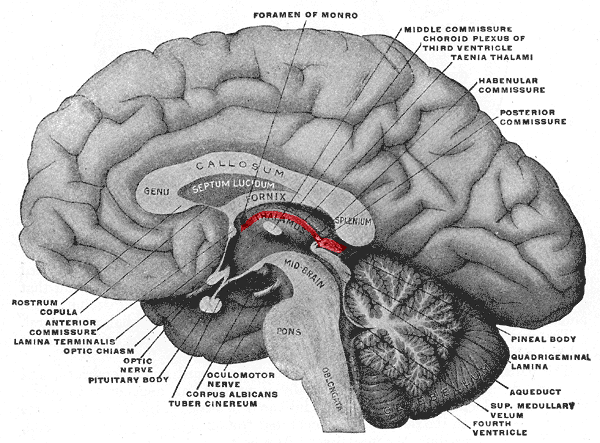
Medial aspect of human brain showing location of the habenula in front of the pineal gland or body in the epithalamus shown in red The habenular commissure is labelled shown connecting the habenula.
Habenula shown in blue just in front of the pineal gland shown in red
Identifiers
MeSHD019262
NeuroNames294
NeuroLex IDbirnlex_1611
TA98A14.1.08.003
TA25662
FMA62032
Anatomical terms of neuroanatomy

The habenula (diminutive of Latin habena, meaning "rein") is a small bilateral neuronal structure in the brain of vertebrates, that has also been called a microstructure since it is no bigger than a pea. The naming as "little rein" describes its elongated shape in the epithalamus, where it borders the third ventricle, and lies in front of the pineal gland.[1]

Although it is a microstructure each habenular nucleus is divided into two distinct regions of nuclei, a medial habenula (MHb), and a lateral habenula (LHb) both having different neuronal populations, inputs, and outputs.[2][3] The medial habenula can be subdivided into five subnuclei, the lateral habenula into four subnuclei.[4] Research has shown morphological complexity in the MHb and LHb. Different inputs to the MHb are discriminated between the different subnuclei.[5] In the two regions of nuclei there is a difference in gene expression giving different functions to each.[6]

The habenula is a conserved structure across vertebrates. In mammals it is highly symmetric, and in fish, amphibians and reptiles it is highly asymmetric in size, molecular composition, and connections.[1] The habenular nuclei are a major component in the limbic system pathways.[1] The fasciculus retroflexus pathway between the habenula and the interpeduncular nucleus is one of the first major nerve tracts to form in the developing brain.[1]

The habenula is a central structure that connects forebrain regions to midbrain regions, and acts as a hub or node for the integration of emotional and sensory processing.[2] It integrates information from the limbic system, sensory and basal ganglia to guide appropriate and effective responses.[5] The habenula is involved in the regulation of monoamine neurotransmitters notably dopamine and serotonin.[2][3] Both of these neurotransmitters are strongly associated with anxiety disorders, and avoidance behaviours.[2] The functions of the habenula are also involved in motivation, emotion, learning, and pain.[2] The MHb plays an important role in depression, stress, memory, and nicotine withdrawal, as well as a role in cocaine, methamphetamine and alcohol addiction.[6] The MHb shows a high level of nicotinic acetylcholine receptors (nAChRs), that are involved in many forms of addiction. Previously their expression was only noted in other structures associated with addiction. Their expression in the MHb has become a later focus of research.[6]

Anatomy

[edit]

Each habenular nucleus has two divisions, a medial habenular nucleus (MHb), and a lateral habenular nucleus (LHb). Studies have shown that the medial habenula can be subdivided into five subnuclei, and the lateral habenula into four subnuclei.[4] The right and left habenular nuclei are connected to each other by the habenular commissure. The pineal gland is attached to the brain in this region.[7] The medial habenula (MHb) receives connections from posterior septum pellucidum and diagonal band of Broca; the lateral habenula receives afferents from the lateral hypothalamus, nucleus accumbens, internal globus pallidus, ventral pallidum, and diagonal band of Broca.[8] As a whole, this complexly interconnected region is part of the dorsal diencephalic conduction system (DDCS), responsible for relaying information from the limbic system to the midbrain, hindbrain, and medial forebrain.[9][10]

Lateral habenula

[edit]

The primary input regions to the lateral habenula (LHb) are the lateral preoptic area (bringing input from the hippocampus and lateral septum), the ventral pallidum (bringing input from the nucleus accumbens and mediodorsal nucleus of the thalamus), the lateral hypothalamus, the medial habenula, and the internal segment of the globus pallidus (bringing input from other basal ganglia structures).[8]

Neurons in the lateral habenula are 'reward-negative' as they are activated by stimuli associated with unpleasant events, the absence of the reward or the presence of punishment especially when this is unpredictable.[11] Reward information to the lateral habenula comes from the internal part of the globus pallidus.[12]

The outputs of the lateral habenula target dopaminergic regions (substantia nigra pars compacta and the ventral tegmental area), serotonergic regions (median raphe and dorsal raphe nuclei), and a cholinergic region (the laterodorsal tegmental nucleus).[8] This output inhibits dopamine neurons in substantia nigra pars compacta and the ventral tegmental area, with activation in the lateral habenula linking to deactivation in them, and vice versa, deactivation in the lateral habenula with their activation.[13] The lateral habenula functions to oppose the action of the laterodorsal tegmental nucleus in the acquisition of avoidance responses but not the processing of avoidance later on when it is a memory, motivation or its execution.[14] Research suggests that lateral habenula may play a crucial role in decision making.[15]

There has also shown to be an association with aberrant LHb activity and depression.[16]

Medial habenula

[edit]

The medial habenula (MHb) receives connections from the posterior septum pellucidum and diagonal band of Broca.[8] Input to the medial habenula comes from a variety of regions and carries a number of different chemicals. Most neuronal projections to the MHb come from the septal area.[5] Input regions include septal nuclei (the nucleus fimbrialis septi and the nucleus triangularis septi); dopaminergic inputs from the interfascicular nucleus of the ventral tegmental area, noradrenergic inputs from the locus ceruleus, and GABAergic inputs from the diagonal band of Broca. The medial habenula sends outputs of glutamate, substance P and acetylcholine to the periaqueductal gray via the interpeduncular nucleus as well as to the pineal gland.[17][18]

Asymmetry

[edit]

Asymmetry in the habenula was first noted in 1883 by Nikolaus Goronowitsch.[7] Various species exhibit left-right asymmetric differentiation of habenular neurons. In many fishes and amphibians, the habenula on one side is significantly larger and better organized into distinct nuclei in the dorsal diencephalon than its smaller pair. The sidedness of such differentiation (whether the left or the right is more developed) varies with the species. In birds and mammals, however, both habenulae are more symmetrical (although not entirely) and consist of a medial and a lateral nucleus on each side which is in fish and amphibians equivalent to dorsal habenula and the ventral habenula, respectively.[19][8][20]

Olfactory coding

[edit]

In some fish (lampreys and teleosts), mitral cell (principal olfactory neurons) axons project exclusively to the right hemisphere of the habenula in an asymmetric manner. It is reported that the dorsal habenula (DHb) are functionally asymmetric with predominantly odor responses in the right hemisphere. It was also shown that DHb neurons are spontaneously active even in the absence of olfactory stimulation. These spontaneously-active DHb neurons are organized into functional clusters which were proposed to govern olfactory responses.[21]

Functions

[edit]

These nuclei are hypothesized to be involved in regulation of monoamines, such as dopamine and serotonin.[22][23]

The habenular nuclei are involved in fear memory,[24][25] pain processing,[26] reproductive behavior, nutrition, sleep-wake cycles, stress responses, and learning. Recent demonstrations using fMRI[27] and single unit electrophysiology[13] have closely linked the function of the lateral habenula with reward processing, in particular with regard to encoding negative feedback or negative rewards. Matsumoto and Hikosaka suggested in 2007 that this reward and reward-negative information in the brain might "be elaborated through the interplay among the lateral habenula, the basal ganglia, and monoaminergic (dopaminergic and serotonergic) systems" and that the lateral habenula may play a pivotal role in this "integrative function".[13] Then, Bromberg-Martin et al. (2011) highlighted that neurons in the lateral habenula signal positive and negative information-prediction errors in addition to positive and negative reward-prediction errors.[28]

Depression

[edit]

Both the medial and lateral habenula show reduced volume in those with depression. Neuron cell numbers were also reduced on the right side.[29] Such changes are not seen in those with schizophrenia.[29] Deep brain stimulation of the major afferent bundle (i.e., stria medullaris thalami) of the lateral habenula has been used for treatment of depression where it is severe, protracted and therapy-resistant.[30][31]

N-Methyl-D-aspartate (NMDA) receptor-dependent burst firing in the lateral habenula has been associated with depression in animal studies,[32] and it has been shown that the general anesthetic ketamine blocks this firing by acting as a receptor antagonist.[33] Ketamine has been the subject of numerous studies after having shown fast-acting antidepressant effects in humans (in a 0.5 mg/bw kg dose).[34]

Motivation and addiction

[edit]

Recent exploration of the habenular nuclei has begun to associate the structure with an organism's current mood, feeling of motivation, and reward recognition.[35] Previously, the LHb has been identified as an "anti-reward" signal, but recent research suggests that the LHb helps identify preference, helping the brain to discriminate between potential actions and subsequent motivation decisions.[36] In a study using a Pavlovian conditioning model, results showed an increase in the habenula response.[37] This increase coincided with conditioned stimuli associated with more aversive punishments (i.e. electric shock).[37] Therefore, researchers speculate that inhibition or damage to the LHb resulting in a failure to process such information may lead to random motivation behavior.[36][37]

LHb is especially important in understanding the reward and motivation relationship as it relates to addictive behaviors.[35] The LHb inhibits dopaminergic neurons, decreasing the release of dopamine.[38] It was determined by several animal studies that receiving a reward coincided with elevated dopamine levels, but once the learned association was learned by the animal, dopamine levels remain elevated, only decreasing when the reward is removed.[20][23][35][38] Therefore, dopamine levels only increase with unpredicted rewards and with a "positive prediction error".[20] Moreover, it was determined that removal of an anticipated award activated LHb, inhibited dopamine levels.[20] This finding helps explain why addictive drugs are associated with elevated dopamine levels.[20]

Nicotine and nAChRs

[edit]

Despite common misconceptions regarding the relaxing effects of tobacco and nicotine use, behavioral testing in animals has demonstrated nicotine to have an anxiogenic effect.[39] Nicotinic acetylcholine receptors (nAChRs) have been identified as the primary site for nicotine activity and regulate consequent cellular polarization.[40] nAChRs are made up a number of α and β subunits and are found in both the LHb and MHb, where research suggests they may play a key role in addiction and withdrawal behaviors.[40][41]

History

[edit]

The habenular is a well conserved structure that appeared in vertebrates more than 360 million years ago.[4] The habenular commissure was described for the first time in 1555 by Andreas Vesalius[42] and the habenula nuclei in 1872 by Theodor Hermann Meynert.[43]

References

[edit]
[edit]
Revisions and contributorsEdit on WikipediaRead on Wikipedia
from Grokipedia
The habenula is a small, bilateral nucleus located in the of the , adjacent to the third ventricle and near the , consisting of medial (MHb) and lateral (LHb) divisions that together form an evolutionarily conserved structure present across vertebrates. In humans, the habenula measures approximately 5–9 mm in diameter with a volume of 30–36 mm³, while in it is proportionally smaller at about 0.8 mm in height and width; the LHb constitutes roughly 95% of the total volume in humans and 60% in . The two divisions are connected by the habenular commissure and exhibit distinct subnuclei, with the MHb containing and peptidergic neurons and the LHb primarily ones. The habenula functions as a critical neuroanatomical hub, receiving afferents primarily via the stria medullaris from limbic regions such as the , , and , and sending efferents through the fasciculus retroflexus to brainstem monoaminergic centers including the (VTA), , , and interpeduncular nucleus (IPN). This connectivity positions the habenula to modulate diverse processes, including reward and aversion signaling, motivational states, stress responses, sleep-wake cycles, and ; notably, the LHb encodes negative reward prediction errors by inhibiting activity in the VTA, while the MHb contributes to aversive memory and nicotine-related behaviors via projections to the IPN. Dysfunction in the habenula has been implicated in several psychiatric conditions, particularly , where LHb hyperactivity and hyperconnectivity with limbic regions correlate with and treatment-resistant symptoms, as well as anxiety, (e.g., to and opioids), and pain processing. Emerging therapeutic approaches, such as targeting the LHb, show promise for alleviating symptoms in refractory depression by normalizing its activity.

Anatomy

Location and gross structure

The habenula is a pair of small, bilateral nuclei situated within the , a dorsal subdivision of the . It lies medial to the , dorsal to its posterior extent, and superior to the , forming part of the habenular trigone along the dorsomedial aspect of the upper brainstem. The nuclei straddle the midline, bordering the posterior wall of the third ventricle and protruding slightly into it, while being positioned immediately anterior to the and its stalk. In humans, each habenula measures approximately 5–9 mm in anteroposterior diameter, with a shape that is broadest caudally and narrows rostrally, yielding a total bilateral volume of around 30–36 mm³. The structure is connected across the midline by the habenular commissure, a thin fiber tract that traverses the superior aspect of the pineal stalk, facilitating interhemispheric communication between the left and right nuclei. Dorsally, the habenula is bordered by the stria medullaris, a bundle of fibers that sweeps over its convex surface to deliver major afferent inputs from limbic regions. Histologically, the habenula comprises a heterogeneous population of neurons organized into distinct medial and lateral divisions, with the medial habenula featuring tightly packed, small neurons and the lateral habenula containing more loosely arranged, larger neurons. These neuronal clusters are embedded in a matrix of myelinated fibers and exhibit a high density of local circuitry, reflecting the nucleus's role as a compact hub. The overall is conserved across mammals, underscoring its evolutionary significance in brain organization.

Medial habenula

The medial habenula (MHb) exhibits a distinct cellular composition and internal organization that sets it apart from the lateral habenula, featuring a dense aggregation of small, tightly packed neurons primarily in the epithalamus. It is subdivided into five main subnuclei—dorsolateral (also termed superior), dorsomedial (dorsal), ventrolateral, ventrocentral, and ventromedial—delineated based on variations in cholinergic and peptidergic neuron populations, as well as topographic and connectional properties. These subnuclei display differential expression patterns, with dorsal regions enriched in peptidergic cells and ventral areas dominated by cholinergic ones, reflecting a modular architecture that supports specialized intrinsic connectivity. Cholinergic neurons, identified by choline acetyltransferase (ChAT) immunoreactivity, predominate throughout the MHb and constitute its core neuronal population, comprising over 90% of cells in ventral subnuclei. These neurons primarily release as their output , with some co-expressing in the dorsomedial and dorsolateral subnuclei, and enkephalins in select ventral compartments such as the ventromedial subnucleus. Intrinsic projections within the MHb connect these subnuclei, facilitating local circuit integration, while the fasciculus retroflexus bundles the major efferent axons from neurons toward the interpeduncular nucleus. The MHb's high density of nicotinic receptors (nAChRs), including α3, β4, and α5 subunits, is particularly prominent on both presynaptic terminals and postsynaptic targets, providing an anatomical basis for its sensitivity to .

Lateral habenula

The lateral habenula (LHb) is a key epithalamic structure that can be subdivided into distinct subnuclei, including medial (mLHb), central (cLHb), ventromedial (vmLHb), and lateral (lLHb) divisions, each characterized by unique cytoarchitectonic features and connectivity patterns that facilitate its integration of limbic and signals. These subregions exhibit differential neuronal morphology and firing properties, with burst-firing neurons in the LHb prominently expressing hyperpolarization-activated cyclic nucleotide-gated (HCN) channels, which generate a sag potential that promotes rebound bursts following hyperpolarization and contributes to the nucleus's role in signaling unexpected outcomes. HCN channel expression is particularly enriched in LHb projection neurons targeting monoaminergic nuclei, enabling rhythmic activity patterns essential for modulating emotional and motivational processing. The LHb comprises a heterogeneous population of neurons, predominantly glutamatergic projection cells interspersed with a smaller contingent of GABAergic interneurons that provide local inhibition. Subpopulations within these include neurons expressing cocaine- and amphetamine-regulated transcript (CART) peptides, which are derived from pro-CART processing and localize to specific LHb compartments, potentially modulating reward-related signaling. Although melanin-concentrating hormone (MCH) is not directly expressed by LHb neurons, related neuropeptidergic influences via MCH receptors co-localize in the structure, supporting its integration of hypothalamic inputs. This GABAergic-glutamatergic balance underpins the LHb's intrinsic circuitry, where excitatory outputs dominate long-range projections while inhibitory elements fine-tune local excitability. In humans, the LHb displays notable anatomical , with the left LHb exhibiting a larger volume and higher density compared to the right, a feature that underscores its expanded role in vertebrates and may influence hemispheric specialization in emotional processing (further detailed in the asymmetry and lateralization section). As a connectivity hub, the LHb receives convergent inputs from structures and limbic areas, positioning it as an anatomical nexus for relaying signals to effectors without delving into specific pathways here.

Asymmetry and lateralization

The habenula displays notable structural and cellular between its left and right sides, with differences in and density reported across species. In humans, imaging studies reveal heterogeneity in these asymmetries, with some evidence indicating a larger left lateral habenula, though meta-analyses across multiple datasets show no overall significant left-right difference (mean difference of 0.41 mm³). In , such as mice and rats, asymmetries are subtler; for instance, the medial habenula in albino rats is slightly larger on the left by about 5%, while lateral habenula differences remain inconsistent but suggest minor bilateral variations in count. These structural disparities highlight the habenula's role in hemispheric specialization, particularly within its lateral subregions that dominate overall size. Developmentally, habenular asymmetry arises prenatally through asymmetric epithalamic patterning, primarily driven by the Nodal signaling pathway, a conserved TGF-β superfamily mechanism that establishes left-right axial determination in the . In model organisms like , Nodal signaling biases and density in the left habenula, leading to differential growth and connectivity; disruptions in this pathway abolish , confirming its causal role. This prenatal establishment is evolutionarily conserved, influencing habenular lateralization from basal vertebrates to mammals, including humans and . Comparatively, habenular lateralization is prominent in and birds, underscoring its evolutionary conservation for functions like visuospatial . In , the dorsal habenula exhibits pronounced , with the left side showing greater density and distinct afferent inputs from sensory regions, supporting lateralized processing of visual cues. Similar patterns occur in birds, where habenular aligns with broader hemispheric biases in and , as seen in visual lateralization studies. These findings suggest the habenula's asymmetric architecture has been maintained across vertebrates to facilitate adaptive sensory integration.

Neural connections

Afferent inputs

The medial habenula (MHb) primarily receives afferent inputs from limbic structures, including the septal nuclei (such as the triangular septal nucleus, septofimbrial nucleus, and medial septum) and the (including the diagonal band nucleus and of Meynert). These projections travel predominantly via the stria medullaris thalami and utilize , with additional contributions from , glutamate, GABA, and ATP. In contrast, the lateral habenula (LHb) receives inputs from basal ganglia-related structures and cortical areas, including GABAergic projections from the ventral pallidum that convey reward-related signals, glutamatergic inputs from the entopeduncular nucleus (the rodent homolog of the globus pallidus interna), and excitatory projections from layer 5 pyramidal cells in the (such as the prelimbic and infralimbic regions). These pathways often route through the stria medullaris, with the and entopeduncular nucleus providing segregated inputs to LHb subregions like the lateral and medial divisions. Both the MHb and LHb are modulated by ascending brainstem projections, including serotonergic inputs from the (primarily the median raphe) that influence glutamatergic transmission and affective signaling, and noradrenergic inputs from the that regulate arousal and stress responses via norepinephrine release.

Efferent outputs

The medial habenula (MHb) primarily projects to the interpeduncular nucleus (IPN) through the fasciculus retroflexus, a prominent fiber tract that bundles efferent axons from the habenula complex and descends through the . These projections originate from neurons in the MHb, which release as the primary , with co-release of observed in specific subpopulations, particularly from the dorsal MHb. Additionally, MHb neurons co-release glutamate alongside , enabling dual modes of synaptic transmission at IPN targets. The lateral habenula (LHb) sends and projections to several and targets, including the (VTA), rostromedial tegmental nucleus (RMTg), (DR), and the (SN). These efferents travel primarily via the fasciculus retroflexus and adjacent pathways, with LHb neurons exciting interneurons in the RMTg and directly modulating neurons in the VTA, DR, and SN, thereby inhibiting release in the VTA and SN and serotonin release in the DR. Projections to the VTA are relatively sparse and arise mainly from the lateral LHb, while denser inputs target the RMTg from lateral and caudal subregions. Commissural connections within the habenula complex facilitate inter-hemispheric communication, with fibers crossing via the habenular commissure to link contralateral MHb and LHb nuclei. These commissural projections are topographic, connecting homologous subregions between hemispheres, and include both intra-habenular links and extensions to midline structures like the IPN. The density and topography of habenular efferents exhibit organized mapping, where the medial-lateral axis of the MHb and LHb corresponds to specific targets; for instance, medial LHb regions project preferentially to the median raphe and DR, while lateral LHb areas target the VTA and RMTg. This spatial organization ensures precise routing of signals, with the fasciculus retroflexus serving as a structured conduit that preserves subnuclear specificity along its descent.

Functions

Reward and aversion processing

The lateral habenula (LHb) serves as a key structure in encoding negative reward prediction errors (RPEs), which arise when anticipated rewards are withheld or unexpected punishments occur, thereby signaling motivational discrepancies to guide behavioral adjustments. Neurons within the LHb exhibit robust activation in response to these negative RPEs, such as the omission of expected rewards or the delivery of aversive stimuli, contrasting with the ventral tegmental area's (VTA) encoding of positive RPEs. This LHb signaling facilitates the suppression of reward-seeking actions and promotes avoidance, contributing to an in valuation learning. The LHb exerts its influence through a disynaptic circuit involving the rostromedial tegmental nucleus (RMTg), where LHb projections excite RMTg neurons that, in turn, inhibit dopaminergic neurons in the VTA. This pathway suppresses release, reducing of actions associated with poor outcomes and thereby reinforcing avoidance behaviors. The LHb also sends direct projections to the VTA, but the indirect route via the RMTg provides the primary mechanism for negative valence transmission in this context. Electrophysiologically, LHb neurons respond to negative RPEs with phasic firing patterns, including bursts that encode the salience of mismatches like omitted rewards. These bursts, typically ranging from 20-50 Hz, heighten the signal's impact on downstream targets, distinguishing salient aversive events from neutral ones. Integration with the occurs via a hyperdirect-like pathway from the globus pallidus interna (GPi) to the LHb, where GPi neurons convey "no-go" signals by exciting LHb activity during unrewarded or low-value conditions. This input allows the LHb to incorporate -derived action selection information, relaying inhibitory cues that align with avoidance when rewards fail to materialize.

Olfactory and sensory integration

The medial habenula (MHb) relays olfactory signals from the , integrating them with limbic inputs to modulate behavioral responses to s. In vertebrates, the MHb receives direct afferent projections from the , enabling the processing of chemosensory information. These projections target specific subnuclei, where they contribute to odor valence coding by distinguishing aversive from neutral or attractive scents. For instance, in , an asymmetric pathway from the innervates a subset of MHb neurons that encode repulsive odor cues, driving innate avoidance behaviors. In mammals, olfactory information reaches the MHb via the stria medullaris from septal nuclei, which in turn receive inputs from the , allowing for the contextual evaluation of odor signals. Cholinergic neurons in the MHb, which comprise a major output pathway to the interpeduncular nucleus (IPN), enhance discrimination and associative through feedback mechanisms. These neurons co-release and glutamate, activating nicotinic receptors in the IPN to sharpen sensory representations and facilitate odor-reward or odor-aversion associations. Disruption of this system impairs the ability to form long-term memories of contexts, underscoring its role in sensory refinement. The MHb supports multisensory convergence by combining olfactory inputs with gustatory and nociceptive signals, particularly in the of flavor-aversion learning. Afferents from visceral sensory areas, including those conveying and information, in the MHb, enabling the association of flavors with negative outcomes like . This integration occurs via MHb-IPN circuits, where activation strengthens conditioned aversions to specific odor-taste combinations, as demonstrated in models of taste aversion conditioning. Lesion studies in and reveal the MHb's necessity for -guided avoidance behaviors. Electrolytic or excitotoxic lesions of the MHb disrupt the ability to avoid aversive , resulting in reduced escape responses and impaired away from odor sources in behavioral assays. For example, in , MHb lesions attenuate repulsion to cadaverine-like odors, shifting exploratory patterns toward the stimulus, while in rats, such lesions lead to deficits in conditioned avoidance tasks without affecting general locomotion. These findings highlight the MHb's selective role in translating integrated sensory cues into adaptive avoidance.

Sleep and circadian regulation

The medial habenula maintains anatomical connections to the through direct neural projections, which indirectly modulate release as part of broader epithalamic circuitry. These projections, identified in models, facilitate communication between the habenula and pinealocytes, where habenular activity influences the rhythmic synthesis and secretion of , a key regulator of onset. The habenular commissure further supports bilateral coordination of these signals, ensuring synchronized influence on pineal function across hemispheres. Lateral habenula hyperactivity, observed in rodent models of early-life stress such as , is associated with insomnia-like sleep disturbances through enhanced neuronal excitability. This hyperexcitability arises from disrupted inhibition, leading to increased tonic and burst firing that promotes and fragments architecture. Specifically, outputs from the lateral habenula to the modulate serotonergic tone, suppressing sleep-promoting pathways and sustaining wakefulness during stress. These efferent projections to the raphe, as detailed in connectivity studies, underscore the lateral habenula's role in stress-induced regulation. Circadian firing patterns in lateral habenula neurons exhibit peaks during the late day to early night transition in nocturnal rodents, aligning with the onset of their active phase. This rhythmicity is synchronized by inputs from the , the master circadian pacemaker, which conveys photic and temporal cues via neuropeptides like prokineticin 2 to phase-delay habenular activity relative to the nucleus's midday peak. In vivo recordings from and models confirm this diurnal modulation, with spontaneous firing rates reaching maxima in brain slices isolated from suprachiasmatic influences, indicating intrinsic oscillatory properties reinforced by extrinsic entrainment. Experimental manipulations, such as optogenetic activation of REM sleep-active neurons in the lateral habenula, disrupt homeostasis by increasing REM duration at the expense of non-REM sleep, altering overall sleep architecture in . This intervention elevates the percentage of REM episodes, mimicking patterns seen in stress or mood-related disruptions and highlighting the lateral habenula's contribution to REM . Such findings from targeted photostimulation studies suggest that habenular overactivation impairs the balance between sleep stages, supporting its involvement in maintaining circadian-aligned .

Clinical significance

Depression and mood disorders

The lateral habenula (LHb) exhibits hyperactivity in (MDD), as evidenced by elevated glucose metabolism and blood-oxygen-level-dependent (BOLD) signals in studies of affected patients. These alterations correlate with the severity of , a core symptom of MDD characterized by diminished interest or pleasure in activities, suggesting that LHb overactivity contributes to negative mood processing and motivational deficits. In the context of normal aversion signaling, this hyperactivity may amplify perceived negative outcomes beyond adaptive levels, exacerbating depressive states. A 2024 systematic review of human and preclinical studies reported mixed findings on habenula volume in MDD, with some evidence of reductions (particularly in females and post-mortem cases) but inconsistent across studies; limited data suggest possible links to treatment-resistant cases without clear consistency. These volumetric changes show sex-specific patterns, with greater reductions observed in females, potentially mediated by in the LHb, as demonstrated in 2025 research linking ERβ expression to responses in hormone-withdrawal models of . Such findings highlight the role of hormonal influences in LHb structural integrity and therapeutic outcomes for women with . Deep brain stimulation (DBS) targeting the LHb has emerged as a promising intervention for , with 2023-2025 (fMRI) studies showing rapid antidepressant effects by reducing pathological burst firing in LHb neurons. Long-term case reports from 2025 indicate substantial symptom remission in patients, with sustained improvements in depressive severity, anxiety, and following chronic LHb-DBS, though broader response rates remain under evaluation in ongoing trials. Recent findings from 2024-2025 elucidate the role of astroglial modulation in the LHb, where glial cells enhance the efficacy of antidepressants through interactions with serotonin (5-HT) pathways, promoting and mood stabilization. In preclinical models, LHb astroglia facilitate 5-HT , amplifying the behavioral effects of selective serotonin reuptake inhibitors and supporting their use in intractable depression.

Addiction and motivational deficits

The medial habenula plays a critical role in addiction through its nicotinic receptors (nAChRs), particularly those containing the α5 subunit, which mediate aversion to high doses of the drug. activates these α5-containing nAChRs in the medial habenula, leading to excitatory signaling that projects to the interpeduncular nucleus and triggers an inhibitory motivational signal, thereby limiting excessive intake. This pathway drives the aversive effects observed at higher concentrations, as evidenced by studies showing that α5 subunit mice exhibit reduced aversion and increased consumption of high-dose . Dysregulation of this habenulo-interpeduncular circuit contributes to , where chronic exposure weakens the aversive response, promoting higher intake and reinforcing addictive behaviors. In and addiction, the lateral habenula exhibits hyperactivity during withdrawal, which suppresses release in regions and induces dysphoric states that drive relapse. This hyperactivity involves synaptic adaptations in lateral habenula neurons, enhancing inputs and leading to overexcitation that inhibits neurons, thereby exacerbating negative affective symptoms like and . Such changes are prominent in psychostimulant withdrawal, where lateral habenula bursting activity correlates with the emergence of motivational deficits and compulsive drug-seeking to alleviate . Habenula lesions impair goal-directed in operant tasks, reducing to exert effort for rewards and highlighting the structure's role in motivational processing. For instance, disruption of lateral habenula outputs decreases break points in progressive ratio schedules, indicating diminished willingness to work for or other reinforcers. Recent 2024 studies further demonstrate that lateral habenula manipulations regulate prosocial behaviors, such as maternal caregiving and social affiliation; lesions prevent pup retrieval and nest building in , while pathway-specific activations modulate social play and novelty preference. Circuit-specific optogenetic studies from 2023 to 2025 reveal that the lateral habenula-rostromedial tegmental nucleus (LHb-RMTg) pathway is pivotal in , where inhibiting this circuit prevents drug-seeking reinstatement. Optogenetic activation of the LHb-RMTg pathway enhances aversive signaling during exposure, but inhibition during withdrawal attenuates hyperactivity and reduces cocaine-induced molecular changes in reward circuits, thereby suppressing relapse-like behaviors in . Similarly, chemogenetic silencing of lateral habenula inputs or the RMTg projections to the reverses psychostimulant-induced suppression, offering a potential therapeutic target for preventing motivational deficits in . The lateral habenula (LHb) exhibits hyperactivity in models of , contributing to the amplification of aversive components through inhibition of (VTA) dopaminergic signaling. In spared models, induces a approximately 2.5-fold increase in LHb burst-firing neurons projecting indirectly to the VTA via the rostromedial tegmental nucleus (RMTg), leading to enhanced nociceptive, emotional, and cognitive deficits without direct LHb-VTA activation. Optogenetic and chemogenetic manipulations targeting this indirect pathway in mice demonstrate that inhibiting LHb activity alleviates long-term -related aversion and impairments, highlighting its role in sustaining pain chronification. Prenatal stress exposure disrupts habenula-insular cortex (Hb-IC) functional connectivity, predisposing to anxiety-like behaviors in adulthood. Preclinical studies in rats subjected to restraint stress during days 14-21 reveal that vulnerable individuals display altered transcriptomic profiles in the Hb and IC, including upregulated and pathways in males and downregulated serotonin signaling in females, which drive reduced social interaction as a marker of anxiety. These sex-specific Hb-IC interactions underlie heightened stress vulnerability, persisting into postnatal day 84 without overt volumetric changes. Chronic stress triggers synaptic plasticity in the LHb, involving astroglial mechanisms that contribute to the persistence of and stress-related states. Repeated stress remodels LHb neuronal activity and synaptic transmission, with astrocytes mediating a feedback loop via glutamate, ATP/ release, and norepinephrine signaling from the , amplifying second-wave neuronal activation. Astrocytic in the LHb facilitates stress-induced behavioral alterations, and its inhibition prevents such outcomes, suggesting astroglial involvement in the transition to chronic pain-like through maladaptive plasticity. Radiomics analysis of habenula clusters via high-resolution MRI holds diagnostic potential for predicting by identifying subtle structural features. In a 2025 study using MRI with 0.8 mm³ resolution on 94 participants, clustering-based models extracted 1,427 features from manually segmented habenula subregions, achieving an area under the curve (AUC) of 0.844 for distinguishing first-episode depression—a stress-linked condition—from healthy controls, with 75% sensitivity and 87.5% specificity. This approach outperforms traditional volumetric metrics, indicating habenula as a for early stress disorder detection.

History and research

Early anatomical descriptions

The term "habenula" originates from the Latin habena, meaning "little rein" or "small strap," alluding to the structure's elongated, strap-like appearance in the . This nomenclature was first applied to the structure in by Austrian neuropathologist Theodor Meynert in 1872, who identified a small mass of gray matter along the posterior edge of the stria medullaris thalami, designating it "das Ganglion der Habenula" through macroscopic examination; he also delineated its primary efferent pathway, the fasciculus retroflexus (now known as the habenulointerpeduncular tract). In the late 19th century, comparative neuroanatomy further solidified the habenula's evolutionary conservation. American anatomist Oliver S. Strong, in his 1895 monograph The Anatomy of the Central Nervous System of Man and of Vertebrates, examined the structure across species ranging from fish to mammals, highlighting its consistent bilateral placement in the epithalamus and similarities in nuclear arrangement, thereby establishing its fundamental role as a diencephalic landmark preserved throughout vertebrate phylogeny.

Key functional discoveries

In the mid-20th century, pioneering studies laid the groundwork for understanding the habenula's role in emotional and motivational processing. Experiments by Brady demonstrated that bilateral of the habenular nuclei in albino rats resulted in altered emotional responses, including reduced aversion to noxious stimuli and impaired acquisition of avoidance behaviors, contrasting with the more pronounced hyperemotionality seen after septal lesions. These findings, extended in subsequent , highlighted the lateral habenula's specific involvement in mediating aversion deficits, as rats with lateral habenula lesions exhibited persistent difficulties in one-way active avoidance tasks, often freezing in response to conditioned aversive cues rather than escaping. Advancing into the 1970s, neurochemical investigations revealed the habenula's rich profile, particularly its components. Autoradiographic techniques applied to brains identified dense (ACh) projections originating from the medial habenula to the interpeduncular nucleus, confirming the habenulo-interpeduncular tract as a major pathway in the mammalian brain. These studies, building on biochemical assays showing high activity in the tract, established the medial habenula as a key source of ACh innervation, influencing downstream regions involved in autonomic and behavioral . By the 1980s, electrophysiological research linked the lateral habenula to systems, elucidating its inhibitory influence on reward processing. Stimulation of lateral habenula neurons was shown to orthodromically suppress activity in dopamine-containing cells of the pars compacta and via the rostromedial tegmental nucleus, particularly in paradigms where expected rewards were omitted. This inhibition underscored the lateral habenula's role as an anti-reward signal hub, modulating output to encode negative motivational valence during behavioral tasks. In the and , investigations into 's effects pinpointed the medial habenula's nicotinic receptors (nAChRs) as critical for aversion during withdrawal. Research identified high expression of α5 nAChR subunits in medial habenula neurons projecting to the interpeduncular nucleus, where their contributes to the somatic and affective components of , such as anxiety-like behaviors and reduced reward sensitivity in models. These subunits, enriched in this pathway, were found to mediate the aversive signaling that discourages nicotine cessation, highlighting the medial habenula's involvement in addiction-related motivational conflicts.

Recent molecular and clinical advances

Recent advances in have elucidated the cellular diversity within the human , identifying 7 distinct neuron subtypes in the lateral habenula (LHb) and 3 in the medial habenula (MHb) through high-resolution sequencing analyses of postmortem tissue conducted in 2025. These studies revealed subtype-specific profiles linked to systems and stress responses, providing a molecular map that extends prior animal models. Notably, estrogen receptor beta (ERβ) expression was prominently featured in LHb neurons and , where it modulates mood regulation by influencing astrocyte-neuron interactions and responses in hormone-withdrawal models. In human neuroimaging, 2025 radiomics approaches have enabled the extraction of quantitative features from high-resolution MRI scans of the habenula, demonstrating diagnostic utility for first-episode depression through cluster-based analysis of microstructural variations. These radiomic signatures, derived from texture and shape metrics, achieved high accuracy in distinguishing depressive states from controls by highlighting habenular volume and connectivity alterations. Complementary fMRI studies in the same year showed aberrant activation in the bilateral LHb during aversive learning tasks among individuals with remitted major depressive disorder (MDD), with heightened temporal difference signals persisting post-recovery and correlating with residual negative bias. Therapeutic innovations targeting the LHb have progressed significantly, with case reports from 2025 showing substantial symptom improvement in (TRD) and patients following long-term (DBS) of the bilateral LHb, including near-complete remission in individual cases after 24 months. These outcomes were linked to normalized LHb oscillatory biomarkers, offering a predictive tool for patient selection and stimulation optimization. Concurrently, astroglia-targeted interventions have emerged, including pharmacological modulation of LHb that enhances the efficacy of conventional s by restoring neuron-astrocyte coupling disrupted in depressive states. Such approaches, tested in preclinical models and early human pilots, potentiate rapid effects via bright light stimulation synergies. Emerging research from 2024-2025 highlights the LHb's role in prosocial behaviors, where optogenetic manipulation of LHb circuits in revealed its integration of to modulate and helping responses, as seen in basal forebrain-LHb projections during pain transmission tasks. Human correlates suggest LHb hyperactivity impairs prosocial in mood disorders. Additionally, studies on early-life stress have uncovered altered LHb connectivity patterns, with prenatal stress models showing disrupted functional links to the that predispose to vulnerability in adulthood, as evidenced by reduced coherence in resting-state networks. These findings underscore the LHb's developmental sensitivity to adversity.

References

Add your contribution
Related Hubs
User Avatar
No comments yet.