Hubbry Logo
Iraq Body Count projectIraq Body Count projectMain
Open search
Iraq Body Count project
Community hub
Iraq Body Count project
logo
8 pages, 0 posts
0 subscribers
Be the first to start a discussion here.
Iraq Body Count project
from Wikipedia

Iraq Body Count project (IBC) is a web-based effort to record civilian deaths resulting from the US-led 2003 invasion of Iraq. Included are deaths attributable to coalition and insurgent military action, sectarian violence and criminal violence, which refers to excess civilian deaths caused by criminal action resulting from the breakdown in law and order which followed the coalition invasion. As of February 2019, the IBC has recorded 183,249 – 205,785 civilian deaths.[2] The IBC has a media-centered approach to counting and documenting the deaths. Other sources have provided differing estimates of deaths, some much higher. See Casualties of the Iraq War.

Key Information

The project uses reports from English-language news media (including Arabic media translated into English), NGO-based reports, and official records that have been released into the public sphere to compile a running total.[3] On its database page the IBC states: "Gaps in recording and reporting suggest that even our highest totals to date may be missing many civilian deaths from violence."[2] The group is staffed by volunteers consisting mainly of academics and activists based in the UK and the US. The project was founded by John Sloboda and Hamit Dardagan.

According to Jonathan Steele, writing in The Guardian, IBC "is widely considered as the most reliable database of Iraqi civilian deaths".[4] But some researchers regard it at best as a floor, or baseline for mortality, and that it underestimates actual mortality by potentially several factors.[5]

Project statement

[edit]

The IBC overview page states:

"This is an ongoing human security project which maintains and updates the world's only independent and comprehensive public database of media-reported civilian deaths in Iraq that have resulted from the 2003 military intervention by the USA and its allies. The count includes civilian deaths caused by coalition military action and by military or paramilitary responses to the coalition presence (e.g. insurgent and terrorist attacks). It also includes excess civilian deaths caused by criminal action resulting from the breakdown in law and order which followed the coalition invasion."[1]

The project quotes the top US general in Iraq, Tommy Franks, as saying "We don't do body counts". Franks gave this terse answer ("You know we don't do body counts") at Bagram Air Base in answer to journalists' questions on counting casualties during Operation Anaconda in Afghanistan.[6][7]

Method

[edit]

The IBC overview page states: "Deaths in the database are derived from a comprehensive survey of commercial media and NGO-based reports, along with official records that have been released into the public sphere. Reports range from specific, incident based accounts to figures from hospitals, morgues, and other documentary data-gathering agencies."[8]

Project volunteers sample news stories to extract minimum and maximum numbers of civilian casualties. Each incident reported at least by two independent news sources is included in the Iraq Body Count database. In December 2007, IBC announced that they would begin to include deaths reported by one source, and that the number of deaths provided by such reports would be openly tracked on its database page.[9] Between 3.3 and 3.5 percent of deaths recorded by IBC are currently[when?] listed on the database page as derived from a single source.

IBC is purely a civilian count. IBC defines civilian to exclude Iraqi soldiers, insurgents, suicide bombers or any others directly engaged in war-related violence. A "min" and "max" figure are used where reports differ on the numbers killed, or where the civilian status of the dead is uncertain.

IBC is not an "estimate" of total civilian deaths based on projections or other forms of extrapolation. It is a compilation of documented deaths, as reported by English-language media worldwide. See the sources section farther down for more info on the media and their sources.

Some[who?] have suggested bias of sources could affect the count. If a number is quoted from an anti-coalition source, and the Allies fail to give a sufficiently specific[vague] alternate number, the anti-coalition figure is entered into IBC's database as both a maximum and a minimum. The same works vice versa. The project argues that these potential over- and undercounts by different media sources would tend to balance out.[citation needed]

IBC's online database shows the newspaper, magazine or website where each number is reported, and the date on which it was reported. However, this has been criticized[by whom?] as insufficient because it typically does not list the original sources for the information: that is, the NGO, journalist or government responsible for the number presented. Hence, any inherent bias due to the lack of reliable reports from independent or Allied sources is not readily available to the reader.

Sources

[edit]

The IBC overview page states that its sources include "public domain newsgathering agencies with web access". They include sources that are from sites updated at least once a day, are "separately archived on the site, with a unique URL", are "widely cited or referenced by other sources", are in English, and have "fully public (preferably free) web-access"[1]

Primary sources used by the media are listed in the 2003 to 2005 IBC report. The sources are followed by the number of deaths reported from that source.

  • Mortuaries. 8,913
  • Medics. 4,846
  • Iraqi officials. 4,376
  • Eyewitnesses. 3,794
  • Police. 3,588
  • Relatives. 2,780
  • US-Coalition. 2,423
  • Journalists. 1,976
  • NGOs. 732
  • Friends/Associates. 596
  • Other. 196

Web counters

[edit]

The IBC overview page states: "Results and totals are continually updated and made immediately available here and on various IBC web counters which may be freely displayed on any website or homepage, where they are automatically updated without further intervention."[1]

Body counts change over time

[edit]

Civilian deaths in the Iraq war (cumulative):

Date Min Max
9 April 2003 996 1,174
10 August 2003 6,087 7,798
25 April 2004 8,918 10,769
12 September 2004 11,797 13,806
12 March 2005 16,231 18,510
6 December 2005 27,354 30,863
28 June 2006 38,725 43,140
2 October 2006 43,546 48,343
1 March 2007 57,482 63,421
5 August 2007 68,347 74,753
2 May 2008 83,336 90,897
24 October 2010 98,585 107,594
12 January 2012 104,594 114,260
1 January 2018 180,093 201,873
1 January 2019 182,769 205,191
1 January 2020 184,776 207,645
1 January 2021 185,497 208,547

The figures above are those that appeared in real time on the IBC counters on or around those dates. However, those in the first line were increased radically in the following days and weeks. IBC's current Max figure for the entire invasion phase, up to 30 April 2003, now stands at 7,299. Because IBC performs analyses (e.g., accounts for multiple reports, eliminates overlaps, etc.), there is always a delay between the date on which incidents occur and the addition of their numbers to the IBC database. Another factor is that some reports emerge weeks or even months later – for instance the emergence of Baghdad city morgue reports for 2005 in early 2006. The 6 December line above was taken from the IBC total as it stood on 6 December 2005, but the emergence of the morgue figures later increased IBC's figures for that period to 31,818–35,747. The majority of civilians death from 2003 to 2011 were attributed to unknown actors.[2]

Cumulative updated body counts table

[edit]

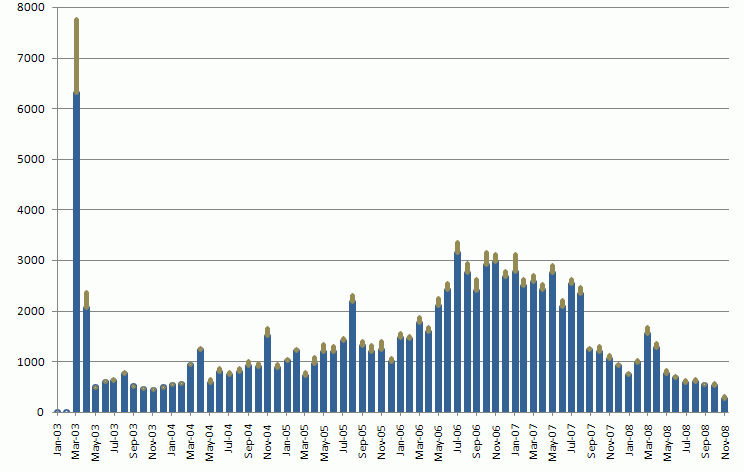
Following are the yearly IBC Project violent civilian death totals, broken down by month from the beginning of 2003. Table below is copied irregularly from the source page, and is soon out-of-date as data is continually updated at the source. As of 12 June 2023 the top of the IBC database page with the table says 186,901 – 210,296 "Documented civilian deaths from violence". That page also says: "Gaps in recording and reporting suggest that even our highest totals to date may be missing many civilian deaths from violence."[2]

Monthly civilian deaths from violence, 2003 onwards[2]
Jan Feb Mar Apr May Jun Jul Aug Sep Oct Nov Dec Yearly
totals
2003 3 2 3986 3448 545 597 646 833 566 515 487 524 12,152
2004 610 663 1004 1303 655 910 834 878 1042 1033 1676 1129 11,737
2005 1222 1297 905 1145 1396 1347 1536 2352 1444 1311 1487 1141 16,583
2006 1546 1579 1957 1805 2279 2594 3298 2865 2567 3041 3095 2900 29,526
2007 3035 2680 2728 2573 2854 2219 2702 2483 1391 1326 1124 997 26,112
2008 861 1093 1669 1317 915 755 640 704 612 594 540 586 10,286
2009 372 409 438 590 428 564 431 653 352 441 226 478 5,382
2010 267 305 336 385 387 385 488 520 254 315 307 218 4,167
2011 389 254 311 289 381 386 308 401 397 366 288 392 4,162
2012 531 356 377 392 304 529 469 422 400 290 253 299 4,622
2013 357 360 403 545 888 659 1145 1013 1306 1180 870 1126 9,852
2014 1097 972 1029 1037 1100 4088 1580 3340 1474 1738 1436 1327 20,218
2015 1490 1625 1105 2013 1295 1355 1845 1991 1445 1297 1021 1096 17,578
2016 1374 1258 1459 1192 1276 1405 1280 1375 935 1970 1738 1131 16,393
2017 1119 982 1918 1816 1871 1858 1498 597 490 397 346 291 13,183
2018 474 410 402 303 229 209 230 201 241 305 160 155 3,319
2019 323 271 123 140 167 130 145 93 151 361 274 215 2,393
2020 114 148 73 52 74 64 49 82 54 70 74 54 908
2021 64 56 49 66 49 46 87 60 41 65 23 63 669
2022 62 46 42 31 82 44 67 80 68 63 65 90 740
2023 56 52 76 85 45 314

2006

[edit]

The Iraq Body Count project states for the week ending 31 December 2006:[10][11] "It was a truly violent year, as around 24,000 civilians lost their lives in Iraq. This was a massive rise in violence: 14,000 had been killed in 2005, 10,500 in 2004 and just under 12,000 in 2003 (7,000 of them killed during the actual war, while only 5,000 killed during the 'peace' that followed in May 2003). In December 2006 alone around 2,800 civilians were reported killed. This week there were over 560 civilian deaths reported."

From the above quote here are IBC yearly death totals (not counting the initial 7000 invasion deaths):

  • 2003: 5,000
  • 2004: 10,500
  • 2005: 14,000
  • 2006: 24,000

March 2003 to March 2005 report

[edit]

The IBC released a report detailing the civilian deaths it had recorded between 20 March 2003 and 19 March 2005.[12] From page 26: "The analyses in this dossier cover the first two years of the military intervention in Iraq from 20 March 2003 to 19 March 2005, and are based on data which was available by 14 June 2005."

The report says the US and its allies were responsible for the largest share (37%) of the 24,865 deaths. The remaining deaths were attributed to anti-occupation forces (9%), crime (36%), and unknown agents (11%).

Who did the killing?

  • 37%. US-led forces killed 37% of civilian victims.
  • 9%. Anti-occupation forces/insurgents killed 9% of civilian victims.
  • 36%. Post-invasion criminal violence accounted for 36% of all deaths.
  • 11%. Unknown agents (11%).
Killings by anti-occupation forces, crime and unknown agents have shown a steady rise over the entire period.

Who was killed?

  • 24,865 civilians were reported killed in the first two years.
  • Men accounted for over 80% of all civilian deaths.
  • Baghdad alone recorded almost half of all deaths.

When did they die?

  • 30% of civilian deaths occurred during the invasion phase before 1 May 2003.
  • Post-invasion, the number of civilians killed was almost twice as high in year two (11,351) as in year one (6,215).

What was the most lethal weaponry?

  • Over half (53%) of all civilian deaths involved explosive devices.
  • Air strikes caused most (64%) of the explosives deaths.
  • Children were disproportionately affected by all explosive devices but most severely by air strikes and unexploded ordnance (including cluster bomblets).

How many were injured?

  • At least 42,500 civilians were reported wounded.
  • The invasion phase caused 41% of all reported injuries.
  • Explosive weaponry caused a higher ratio of injuries to deaths than small arms.
  • The highest wounded-to-death ratio incidents occurred during the invasion phase.

Iraq War Logs

[edit]

In October 2010, the group WikiLeaks released the Iraq War Logs, a set of nearly 400,000 classified US military documents on the Iraq war. IBC was among several media organizations and NGO's given pre-release access to the documents, and IBC co-founder John Sloboda delivered a speech at the press conference for the release by WikiLeaks.[13]

IBC published three pieces on their website detailing their analysis of the war logs.[14][15][16] Among the main findings were that the war logs, "contain an estimated 15,000 previously unknown civilian deaths," and that addition of the new material would suggest that, "over 150,000 violent deaths have been recorded since March 2003, with more than 122,000 (80%) of them civilian."

Academic publications

[edit]

Between 2009 and 2011, IBC published three papers in peer reviewed academic journals, co-authored with researchers from King's College London and Royal Holloway, University of London. Each paper uses IBC data to evaluate different aspects of civilian casualties during the war.

The first paper, published in the New England Journal of Medicine in April 2009, analyses civilian deaths between 2003 and 2008 according to weapon types used. Among the findings were that, "execution after abduction or capture was the single most common form of death overall," and that, "events involving air attacks and mortar fire were the most dangerous" to Iraqi females and children.[17]

The second paper, published in PLoS Medicine in February 2011, analyses civilian deaths between 2003 and 2008 according to perpetrator, weapon, time, and location. The paper found that most deaths during the period were, "inflicted by unknown perpetrators, primarily through extrajudicial executions." The paper also utilized what the authors refer to as the "Dirty War Index" which evaluates the behavior of different perpetrators or weapon types in terms of the proportion of women and children killed, with higher DWI ratios suggesting tactics or weapons that are more indiscriminate toward civilians. The study found that unknown perpetrators firing mortars had the highest DWI ratio, followed by Coalition Forces air attacks, leading the authors to advise that such weapons should not be used in populated areas.[18]

The third paper, published in September, 2011, in a special edition of The Lancet for the 10 year anniversary of the September 11 attacks of 2001, focused on casualties of both civilians and Coalition soldiers specifically by suicide bomb attacks in Iraq between 2003 and 2010. This paper found that there had been at least 12,284 Iraqi civilians and 200 Coalition soldiers killed in at least 1,003 suicide bombings during the period. The study also found that these bombings had "injured no fewer than 30,644 Iraqi civilians," and that, "children are less likely to survive their suicide bomb injuries than adults."[19]

Criticisms and counter-criticisms

[edit]

The IBC has received criticism from multiple sides. Some critics have focused on potential bias of sources. Others have raised concerns about the difficulty of distinguishing civilians from combatants. Others have criticized it for over or undercounting.

Some critics, often on the political right, claimed that the IBC numbers were an overcount, and that the numbers were suspect due to the antiwar bias of the IBC members. For example; 26 July 2005 National Review article, "Bad Counts. An unquestioning media."[20]

Others, often on the political left, criticized media and government willingness to quote IBC figures more approvingly than the much higher estimate coming from the Lancet study[21] that came out in October 2004.

Journalists included Lila Guterman,[22][23] John Pilger, and George Monbiot.[24]

In a 27 January 2005 article in The Chronicle of Higher Education Lila Guterman wrote:

The Lancet released the paper on 29 October, the Friday before the election, when many reporters were busy with political coverage. That day, the Los Angeles Times and the Chicago Tribune each dedicated only about 400 words to the study and placed the articles inside their front sections, on Pages A4 and A11, respectively. (The news media in Europe gave the study much more play; many newspapers put articles about it on their front pages.) In a short article about the study on Page A8, The New York Times noted that the Iraq Body Count, a project to tally civilian deaths reported in the news media, had put the maximum death toll at around 17,000. The new study, the article said, 'is certain to generate intense controversy.' But the Times has not published any further news articles about the paper.

This view of IBC was based on the belief that IBC figures are extremely low due to pro-US media bias and inadequate reporting due to its heavy (though not exclusive) reliance on Western media sources, which has led some of these critics to claim IBC should be called the "Iraq Western Media Body Count". These biases and inadequacies, they claim, mean IBC's count is low by up to a factor of 10, and that it specifically minimizes the proportion of deaths caused by US forces.

Stephen Soldz wrote a 5 February 2006 article titled "When Promoting Truth Obscures the Truth: More on Iraqi Body Count and Iraqi Deaths".[25] It stated: "Of course, in conditions of active rebellion, the safer areas accessible to Western reporters are likely to be those under US/Coalition control, where deaths are, in turn, likely to be due to insurgent attacks. Areas of insurgent control, which are likely to be subject to US and Iraqi government attack, for example most of Anbar province, are simply off-limits to these reporters. Thus, the realities of reporting imply that reporters will be witness to a larger fraction of deaths due to insurgents and a lesser proportion of deaths due to US and Iraqi government forces."

A further claim has been that IBC does little or nothing to correct misuse of their figures by public officials or media organizations. It is claimed that the media often misuse IBC's estimate of the total number dead. It is also claimed that the media use the IBC's estimate in order to ignore or downplay the October 2004 excess mortality study published in the Lancet Medical Journal, which estimated a far higher figure. Critics of IBC argue that the Lancet study is the most accurate estimate so far and is more reliable than IBC's estimate.

Other criticism of various kinds came from journalists Stephen Soldz,[25] Dahr Jamail,[26] and Jeff Pflueger.[26]

In April 2006, IBC published a lengthy response to their critics entitled "Speculation is no substitute: a defence of Iraq Body Count".[27] In their reply, IBC argues that their critics have several key facts wrong. IBC argues that while their estimate is likely to be below the full toll, their critics' errors have led the critics to exaggerate the likely extent of such an undercount. Finally, IBC argues, the available evidence does not support their critics' claims of a pro-US bias infecting the IBC database.

English-language versus Arabic-language media sources

[edit]

The IBC report for March 2003 to March 2005[12] states: "We have not made use of Arabic or other non-English language sources, except where these have been published in English. The reasons are pragmatic. We consider fluency in the language of the published report to be a key requirement for accurate analysis, and English is the only language in which all team members are fluent. It is possible that our count has excluded some victims as a result."

Stephen Soldz, who runs the website "Iraq Occupation and Resistance Report", writes in a 5 February 2006 ZNet article[25] (in reference to the 2003-2005 IBC report[12]): "Given, as indicated in that report, that ten media outlets provided over half the IBC reports and three agencies [Associated Press, Agence France Presse, and Reuters] provided over a third of the reports, there is simply no reason to believe that even a large fraction of Iraqi civilian combat-related deaths are ever reported in the Western media, much less, have the two independent reports necessary to be recorded in the IBC database. Do these few agencies really have enough Iraqi reporters on retainer to cover the country? Are these reporters really able comprehensively to cover deaths in insurgent-held parts of Iraq? How likely is it that two reporters from distinct media outlets are going to be present at a given site where deaths occur? How many of the thousands of US bombings have been investigated by any reporter, Western or Iraqi? Simply to state these questions is to emphasize the fragmentary nature of the reporting that occurs and thus the limitations of the IBC database."

In a 28 April 2006 BBC Newsnight interview[28] the IBC project's co-founder John Sloboda, in response to these and similar arguments, has said: "we have never had over the entire three years, anyone show us an Arabic source that reports deaths that we haven't already got. In three years. In thousands of incidents. There are organisations that translate Arabic reports into English, and we see their data."

IBC monitors multiple Arabic sources that either publish in English as well as Arabic, or are translated by other sources. Some of these include:

Al Arabiya TV, Al-Furat, Al-Ittihad, Al Jazeera (Web), Al Jazeera TV, Al Sharqiyah TV, Al-Taakhi, Al-Bawaba, Arab News, Arabic News, Asharq Al Awsat, As-Sabah, Arab Times, Bahrain News Agency, Bahrain Times.[29]

Undercounting

[edit]

The IBC acknowledges on its website that its count is bound to be low due to limitations in reporting stating; "many if not most civilian casualties will go unreported by the media. That is the sad nature of war." IBC's critics claim, though, that the IBC does not do enough to indicate what they believe is the full extent of the undercounting.[25][26] IBC has directly disputed these claims in a lengthy document on its website.[27]

One criticism of IBC's method, from MIT's John Tirman, a principal research scientist, is that the "surveillance instrument" – the news media – is changing all the time: media organizations add or (more likely) subtract reporters from the field, which was happening in Iraq; reporters were largely confined to Baghdad during the worst violence; and reporters tended to write about spectacular events, like car bombs, when much of the violence was in the form of revenge killings throughout Iraq. "As a result, this technique of totaling up the dead is incapable of accounting for the deaths that were not being recorded, whether by the English-language news media or the chaotic health care system." IBC itself radically changed its method in the middle of the war, switching from two references to one reference in the news media.[30]

The October 2006 Lancet study states: "Aside from Bosnia, we can find no conflict situation where passive surveillance recorded more than 20% of the deaths measured by population-based methods."[31][32]

In an April 2006 article the IBC had described an example comparing itself to the 2004 United Nations Development Programme Iraq Living Conditions Survey (ILCS).[33][34] The Lancet report uses the population estimates drawn from the ILCS study, while not mentioning its estimate of war-related deaths. IBC contends that ILCS is a more reliable indicator of violent deaths than the Lancet study, and suggests a much lower number than the Lancet study.

However, a supplement to the Lancet study published separately by its authors, as well as subsequent interviews with one of Lancet's authors have disputed the methodology and results of the ILCS study. On the other hand, Jon Pedersen, author of the ILCS study, has disputed the methodology and results of the Lancet study. For more info on this controversy see the sections titled "Criticisms" and "UNDP ILCS study compared to Lancet study" in Lancet surveys of Iraq War casualties.

The 2006 Lancet study[31] also states: "In several outbreaks, disease and death recorded by facility-based methods underestimated events by a factor of ten or more when compared with population-based estimates. Between 1960 and 1990, newspaper accounts of political deaths in Guatemala correctly reported over 50% of deaths in years of low violence but less than 5% in years of highest violence."

The Lancet reference used is to Patrick Ball, Paul Kobrak, and Herbert F. Spirer and their 1999 book, State Violence in Guatemala, 1960-1996: A Quantitative Reflection.[35] From the introduction: "The CIIDH database consists of cases culled from direct testimonies and documentary and press sources."

Chapter 10[36] elaborates, saying that "In the CIIDH project, participating popular organizations collected many of the testimonies long after the time of the killings, when people were less clear about details, especially the identities of all the victims." And says, "Typically, during the collection of testimonies, a surviving witness might provide the names of one or two victims, perhaps close relatives, while estimating the number of other neighbors in the community without giving their names."

They report in chapter 7:[37]

Figure 7.1 shows that in the CIIDH database, most of the information for human rights violations prior to 1977 comes from press sources. ... Approximately 10,890 cases were coded from the newspapers. Sixty-three percent of the press cases were taken from Prensa Libre, 10 percent from El Gráfico, 8 percent from La Hora and El Impacto respectively, and 6 percent from El Imparcial. The remaining 5 percent is made up by eight other newspapers.

But also in chapter 7 they reported that in later, more violent years:

When the level of violence increased dramatically in the late 1970s and early 1980s, numbers of reported violations in the press stayed very low. In 1981, one of the worst years of state violence, the numbers fall towards zero. The press reported almost none of the rural violence.

There is a list[38] of figures, tables, and charts in the book that can be used to calculate what percentage of their cases of killings by state forces were reported by 13 Guatemalan newspapers for each year when compared to the testimonies of witnesses (as previously described from chapter 10[36]).

In a 7 November 2004 press release[39] concerning the October 2004 Lancet study[21] the IBC states: "We have always been quite explicit that our own total is certain to be an underestimate of the true position, because of gaps in reporting or recording".

One of the sources used by the media is morgues. Only the central Baghdad area morgue has released figures consistently. While that is the largest morgue in Iraq and in what is often claimed to be the most consistently violent area, the absence of comprehensive morgue figures elsewhere leads to undercounting. IBC makes it clear that, due to these issues, its count will almost certainly be below the full toll in its 'Quick FAQ' on its homepage.

Quote from an IBC note:[40] "The Iraq Body Count (IBC) estimate for x350, like that for x334, was made possible by examination of the detailed data supplied to the Associated Press (AP) by the morgues surveyed in AP's 23 May 2004 survey of Iraqi morgues."

That 23 May 2004 Associated Press article[41] points out the lack of morgue data from multiple areas of Iraq. Also, it states: "The [Baghdad] figure does not include most people killed in big terrorist bombings, Hassan said. The cause of death in such cases is obvious so bodies are usually not taken to the morgue, but given directly to victims' families. Also, the bodies of killed fighters from groups like the al-Mahdi Army are rarely taken to morgues."

See also

[edit]

References

[edit]
[edit]
Revisions and contributorsEdit on WikipediaRead on Wikipedia
from Grokipedia
The Iraq Body Count (IBC) project is an independent, volunteer-led initiative founded in January 2003 by citizens of the and to document and publicly archive violent civilian deaths in stemming from the US-led military intervention and ensuing conflict. Administered by the non-profit Conflict Casualties Monitor, IBC maintains the world's largest open database of such fatalities, focusing exclusively on verified incidents rather than statistical extrapolations or surveys. Its core rationale emphasizes accountability by recording the human cost of war through rigorous aggregation of primary reports, enabling detailed analysis of patterns in violence, weaponry, and perpetrators. IBC's methodology involves cross-verifying data from media dispatches, official Iraqi records, hospital and morgue logs, and NGO observations to establish conservative minimum and maximum counts per event, prioritizing non-combatant victims killed by direct violence post-invasion. This approach has yielded incident-level granularity—such as dates, locations, and causes—for thousands of cases, facilitating peer-reviewed studies on conflict dynamics while critiquing less verifiable high-end estimates from cluster sampling methods, which IBC argues inflate totals through unrepresentative assumptions. By design, the database captures only reported deaths, likely underrepresenting smaller or remote incidents due to media coverage gaps and security constraints, a limitation acknowledged in analyses of event-size bias in passive surveillance systems. Despite these constraints, IBC's emphasis on empirical documentation has made it a benchmark for conservative casualty tracking, with ongoing updates revealing persistent low-level violence, including 537 civilian killings in 2023 attributed to insurgents, tribal clashes, and state operations. The project's transparency and avoidance of aggregation biases have distinguished it amid broader debates on Iraq's toll, where alternative methodologies—often from academic or sources—produce figures orders of magnitude higher but face scrutiny for methodological opacity and sampling errors. Funded primarily by donations and grants, IBC continues to evolve, incorporating digital memorials and residual war monitoring, underscoring the protracted nature of post-2003 instability.

Origins and Objectives

Founding and Initial Scope

The Iraq Body Count (IBC) project was established in January 2003 by Hamit Dardagan, a researcher specializing in conflict casualties, and John Sloboda, a professor of at the University of Keele, as a collaborative effort among concerned citizens from the and . The initiative emerged in anticipation of the impending US-UK-led military invasion of , grounded in four core convictions: the near-certainty of military action, the moral imperative for citizens of the invading nations to document resulting Iraqi deaths, the feasibility of compiling such records through existing media and official channels, and the potential for these records to inform policy, legal accountability, and public awareness. Initially, the project's scope was limited to tallying violent civilian deaths in attributable to the 2003 invasion and its aftermath, excluding combatant fatalities and non-violent causes such as disease or indirect war effects. commenced from January 1, 2003, but concentrated on incidents from the invasion's start on March 20, 2003, onward, with an emphasis on direct deaths from armed violence. Founders positioned IBC as a public, transparent database to counter perceived official underreporting, issuing its first on February 12, 2003, to highlight pre-invasion risks and call for systematic casualty tracking. The foundational relied on passive via comprehensive monitoring of English-language media reports, supplemented by NGO and official sources, requiring at least two independent confirmations for each recorded death to ensure reliability. This approach aimed to produce a minimum verifiable count rather than a comprehensive total, acknowledging inherent limitations in media coverage during conflict zones. By the end of 2003, IBC had documented between 7,724 and 9,456 civilian deaths, primarily from coalition airstrikes, ground operations, and emerging insurgent attacks.

Evolution of Project Goals

The Iraq Body Count (IBC) project was established in January 2003 by a group of volunteers from the and the , with the primary objective of creating an independent public record of civilian deaths resulting from the anticipated U.S.-led military intervention in . This initial focus emphasized documenting the human costs of the invasion through verifiable reports, anticipating that official sources might underreport or obscure civilian casualties amid the conflict. Following the invasion on March 20, 2003, the project's goals expanded to support continuous real-time monitoring and updating of a comprehensive database, shifting from pre-war preparation to active tallying of violent civilian deaths across Iraq. As the conflict transitioned from conventional warfare to insurgency and sectarian violence, IBC adapted by prioritizing detailed incident analysis, including attributes such as location, timing, weapons used, and perpetrator attribution where data permitted, to enable pattern recognition in casualty trends. This evolution reflected a commitment to not only quantify minimum verifiable deaths but also to facilitate broader understanding of violence dynamics, while maintaining reliance on cross-checked media and official records to ensure empirical rigor over speculative estimates. By the mid-2000s, amid escalating instability, the project's scope broadened to incorporate supplementary data streams, such as and confirmations, and later integrations like the 2010 Logs from , which added previously unreported incidents to the tally. Goals further evolved to include tracking of combatant deaths and injuries as distinct categories, providing a more holistic view of war-related violence beyond initial civilian-only focus, with cumulative figures reaching 112,017–122,438 deaths by March 2013. This progression underscored a sustained emphasis on evidence-based documentation, extending coverage into post-U.S. withdrawal periods to capture residual conflict effects, such as anti-government insurgencies, while critiquing higher extrapolative studies for lacking direct verification. In subsequent years, IBC's objectives incorporated enhanced victim identification efforts and annual reporting on grave violations, adapting to diminished media access in high-risk areas by intensifying archival and analytical outputs to inform inquiries and historical accountability. Despite these developments, core goals remained anchored in conservative, undercount-prone passive surveillance to prioritize verifiable truths over comprehensive totals, acknowledging inherent limitations in coverage during peak violence phases like 2006–2007.

Data Collection and Methodology

Sources and Media Monitoring

The Iraq Body Count (IBC) project relies primarily on a comprehensive, proactive surveillance of commercial news media for documenting civilian deaths from post-invasion violence in Iraq. This involves monitoring web-accessible reports from outlets under editorial control, prioritizing those with English-language availability, though including select non-English sources. Key agencies encompass wire services such as Associated Press (AP), Reuters, and Agence France-Presse (AFP); newspapers including The Guardian, New York Times, and Los Angeles Times; and broadcasters like BBC, CNN, and Al Jazeera TV. Arabic and Kurdish outlets, such as Al-Sumaria TV, Shafaq News, and Gali Kurdistan, supplement coverage to capture local reporting. Media monitoring assumes the professional rigor of these organizations, which typically verify eyewitness accounts, confidential sources, and on-scene details before publication. Reports are collected daily, with full texts archived offline for verification; each incident undergoes extraction of standardized points, including date, , victim count, and weaponry, by at least two independent reviewers to minimize errors and double-counting. Inclusion in the formal database requires corroboration from a minimum of two independent sources, establishing minimum and maximum death ranges based on consistent reporting; provisional entries from single sources are flagged separately. Supplementary data draws from non-governmental organizations (NGOs) and primary witnesses—such as survivors, medics, police, or officials—typically filtered through media channels, with rare direct NGO inputs (e.g., Iraqi Red Crescent) if unreported elsewhere. Official cumulative figures from Iraqi entities like the Ministry of Health or medico-legal institutes are integrated only when assignable to specific dates and locations, cross-checked against media to avoid inflation. This multi-source approach prioritizes documented incidents over estimates, yielding a conservative tally confined to verifiable violence-induced civilian fatalities. The media-centric method, while rigorous in cross-verification, inherits limitations of passive surveillance: unreported events, especially low-casualty or remote incidents, evade capture due to journalistic access constraints in conflict zones. Predominantly Western-sourced reporting may underemphasize certain perpetrator attributions or locales, though diversification via outlets like Al Jazeera mitigates some gaps; IBC explicitly eschews , positioning its figures as a documented minimum rather than comprehensive total.

Verification and Confirmation Criteria

The Iraq Body Count (IBC) project employs a conservative verification process requiring each documented incident of deaths to be corroborated by at least two independent sources before inclusion in its database. These sources encompass commercial , reports, official records from hospitals or morgues, and primary accounts such as eyewitness testimonies, police statements, or medical personnel reports, with credibility assessed based on the source's physical proximity to the event. Provisional entries relying on a single source are rare and explicitly tagged as such, ensuring the vast majority of data meets this dual-source threshold to minimize errors from unverified claims. To handle discrepancies in reported death tolls, IBC establishes a range for each incident: the minimum count reflects the lowest figure confirmed by two sources (potentially zero if explicitly verified as such), while the maximum draws from the highest figure supported by at least two independent sources. This range-based approach accommodates reporting variances without inflating totals, with overlaps between incidents resolved conservatively by adjusting only the minimum count if evidence supports it, leaving maximums unaltered amid uncertainty. Each new entry undergoes review and sign-off by at least two additional volunteer data checkers, standardizing data across 18 fields including date, location, weapons used, and civilian status, while resolving conflicts—such as disputed civilian casualties—by incorporating them into the upper range only. Ongoing quality controls include exhaustive cross-referencing against an offline of original sources, tagged with unique IBC codes, and continuous review of past entries for updates from emerging reports. This methodology prioritizes verifiable details to guard against misreporting or double-counting, functioning as an check through comprehensive incident analysis rather than speculative adjustments. By design, the process favors undercounting over speculation, aligning with IBC's emphasis on documented, attributable violent civilian deaths.

Limitations Inherent to Passive Surveillance

Passive surveillance, the core methodological approach of the Iraq Body Count (IBC) , relies on aggregating publicly available reports of deaths from media outlets, humanitarian organizations, official statements, and other secondary sources, without conducting independent field investigations or household surveys. This event-based system captures only those violent incidents that generate sufficient documentation to meet IBC's verification criteria, typically requiring corroboration from at least two independent sources. Consequently, it systematically undercounts total fatalities, as the itself acknowledges that "IBC has not recorded all deaths, therefore its total is an undercount." Such undercounting arises from the inherent selectivity of reporting in conflict zones, where many deaths—estimated by IBC to include "many if not most casualties"—occur without media access, witness testimony, or official notification. A primary limitation stems from restricted media coverage and access. In Iraq's post-2003 environment, characterized by , insurgent control over territories, and targeted killings of over 300 journalists between 2003 and 2020, reporting gaps widened in rural, unsecured, or urban battlegrounds like or during peak ISIS periods. Events in these areas often evaded documentation due to dangers faced by reporters, leading to incomplete event capture; for example, passive systems like IBC's documented fewer than half of verified incidents in comparative analyses with leaked military logs. Moreover, reliance on English-language and major wire services (e.g., , ) privileges urban, high-profile attacks over dispersed rural or low-visibility killings, introducing geographic and temporal biases that favor sensational bombings over routine executions or disappearances. Verification protocols exacerbate undercounting by excluding solitary or unconfirmed reports, even when plausible. IBC's requirement for multiple-source cross-checking ensures reliability but filters out isolated incidents, such as small-scale militia reprisals or deaths in inaccessible regions, where single local accounts predominate. This conservative threshold, while minimizing false positives, aligns with broader critiques of passive surveillance as "incomplete" and "selective," particularly during escalations like the 2006-2008 sectarian surge, when daily death rates exceeded 100 but media saturation could not cover all. Delays in reporting further compound issues, as retrospective accounts from morgues or families often surface months later, evading real-time aggregation. In peer-reviewed assessments, such methods yield counts 5-20 times lower than active surveillance estimates, underscoring the causal gap between documented events and actual incidence driven by underreporting incentives in fearful populations. Additional inherent constraints include the exclusion of indirect deaths and non-violent causes, though passive surveillance's focus on direct violence amplifies misses in hybrid scenarios like airstrikes with unreported . The method's dependence on source credibility—often from biased or state-influenced outlets—necessitates subjective filtering, yet even rigorous checks cannot compensate for systemic omissions in propaganda-heavy environments. Empirical integrations, such as IBC's 2010 incorporation of 60,000+ Logs entries, retroactively boosted counts by 20-30% for prior years, illustrating how passive baselines lag behind fuller records once accessible. Overall, these limitations position IBC's figures as a verified minimum rather than comprehensive total, useful for tracked trends but insufficient for absolute mortality assessment without supplementation.

Cumulative Civilian Death Counts

The Iraq Body Count project documents civilian deaths from violence in ranging from 187,499 to 211,046 as of the latest database updates, covering the period from the U.S.-led invasion on March 19, 2003, to ongoing monthly reporting into 2024. This range accounts for a minimum tally verified by at least two independent sources and a maximum incorporating single-source reports, with approximately 20% of entries currently based on single sources subject to potential revision. The figures exclude non-violent deaths and combatants, focusing solely on civilians killed by direct armed violence, including gunfire, bombings, and executions. Early accumulation was rapid: in the invasion's first two years (March 2003 to March 2005), 24,865 deaths were recorded, with over 80% of victims being adult males and nearly half occurring in . By the end of 2006, the peak year of documented violence with 29,526 fatalities, the cumulative total approached 60,000. Integration of ' Logs in 2010 added 15,000 previously unreported deaths, elevating the count to over 150,000 by that point. By December 2011, the documented toll exceeded 114,000, reflecting sustained and sectarian conflict. Subsequent years saw fluctuations, with 2014 recording 20,218 civilian deaths amid the rise of , contributing to the mid-range cumulative exceeding 170,000 by then. Post-2017 residual violence has added incrementally, with 537 deaths in 2023 and 419 through early 2024, pushing totals toward the upper end of the current range. These figures represent a conservative minimum due to reliance on media and official reports, potentially undercounting unverified incidents in remote or chaotic areas.

Temporal Patterns and Peak Periods

Iraq Body Count records reveal pronounced temporal variations in civilian deaths from violence since the March 2003 , with distinct phases marked by surges in , sectarian conflict, and later jihadist resurgence. The initial period saw an acute peak, with 3,962 deaths documented in March 2003 alone, tapering to lower monthly figures by mid-year as major combat operations concluded. Annual totals for 2003 reached 12,153, reflecting the chaos of regime collapse and early looting. Insurgent violence and sectarian strife drove the primary peak between 2006 and 2007, when annual civilian deaths climbed to 29,526 in —peaking at 3,298 in July—and 22,586–24,159 in , with January recording 3,035 fatalities. The most intense 12-month span, from July to June , amassed 29,625–31,852 deaths, concentrated amid escalating bombings, executions, and inter-communal clashes, particularly outside after March . The U.S. troop surge initiated in early 2007 correlated with a sharp downturn; monthly tolls halved from averages exceeding 2,500 in early to around 1,000 by year's end, extending into a nadir by 2009–2013 with annual figures as low as 4,167 in 2010. A resurgence occurred in amid ISIS territorial gains, yielding 20,218 annual deaths—the highest since —with June peaking at 4,088 amid the group's offensive onset, followed by sustained highs like 2,534 that month per detailed reports. accounted for over 4,000 of 2014's fatalities, exacerbating violence through mass executions and battles. Post-2017, following ISIS's military defeat, deaths plummeted to residual levels, with 537 recorded in 2023—peaking at 86 in April—indicating persistent but diminished insurgent and militia activity against a backdrop of stabilized governance.

Breakdown by Perpetrators and Locations

The Iraq Body Count (IBC) database attributes civilian deaths to perpetrators where media reports or other sources provide sufficient evidence, though a substantial portion remains classified as unknown due to the challenges of passive surveillance in conflict zones. An analysis of 92,614 civilian deaths from March 2003 to December 2008 revealed that unknown perpetrators were responsible for 74% (68,396 deaths), primarily through extrajudicial executions, suicide bombings, vehicle bombs, and mortar attacks. Coalition forces accounted for 12% (11,516 deaths), with a notable emphasis on aerial attacks contributing to higher indiscriminate impacts on non-combatants, as measured by the Dirty War Index (DWI) of 69 for such incidents. Anti-coalition forces were linked to 11% (9,954 deaths), often via suicide and vehicle bombs, while crossfire involving multiple actors caused 2% (2,227 deaths). In earlier phases (2003–2005), a separate IBC dossier indicated US-led forces responsible for 37% of civilian victims, anti-occupation insurgents for 9%, and post-invasion criminal elements for the remainder, reflecting a period of intense urban combat and looting amid regime collapse. By contrast, post-2006 surges in sectarian violence shifted attributions toward unknown actors executing targeted killings, with insurgents comprising a growing share in Sunni-majority areas. During the ISIS era (2014–2017), identifiable perpetrators increasingly included the group itself, responsible for 88% of known adult male deaths in 2016 through executions and bombings, underscoring how attribution gaps persist but patterns align with media-verified insurgent claims. Recent residual violence (post-2017) shows government and militia forces as primary actors in some years, such as 2019, where state-associated killings predominated amid protests. Geographically, IBC data indicate civilian deaths concentrated in urban and sectarian flashpoints, with Baghdad province consistently recording the highest tolls across phases. From 2003–2008, Baghdad alone saw 27,050 deaths, 43% via executions, while provinces like Wassit experienced elevated execution rates (57% of 1,503 deaths). In 2012, 43% of incidents occurred in and provinces, reflecting persistent insurgent activity in . The 2014 ISIS offensive drove spikes in Anbar (over 3,600 deaths) and other western provinces, with Baghdad still leading at 4,767. Overall trends highlight Sunni Arab governorates (Anbar, , Salah ad-Din, Diyala) as hotspots for bombings and executions, comprising disproportionate shares relative to , while southern Shiite areas saw fewer but targeted militia-related killings.

Extensions and Updates Beyond Initial War Phase

Integration of Iraq War Logs

In October 2010, WikiLeaks released the Iraq War Logs, a collection of approximately 391,832 military field reports (Significant Activities, or SIGACTs) documenting incidents from January 2004 to December 2009. Iraq Body Count (IBC) promptly analyzed these documents to assess their compatibility with its existing database, which relies on corroborated media and official reports for civilian death verification. The logs provided granular details on violent events, including timestamps, locations, casualty descriptions, and perpetrator attributions, but IBC applied its standard criteria—requiring multi-source confirmation or consistent evidentiary details—to integrate only reliable entries, avoiding unverified or single-source claims inherent to military summaries. IBC's review identified an initial central estimate of 15,114 and comparable "host nation" deaths in the logs that were previously undocumented in public sources, primarily from low-profile incidents involving one to three victims, such as executions or small-arms fire not widely covered by media. These additions addressed gaps in passive surveillance, where minor events often escaped journalistic attention due to access constraints in conflict zones. By cross-referencing log entries against its records, IBC found that about 60-70% of log-reported deaths overlapped with existing database incidents, allowing for refinements like increased victim counts (e.g., logs revealing multiple bodies in aggregated "found" reports) or corrected attributions. The process yielded over 4,100 exclusively new incidents by 2011, encompassing roughly 5,400 fatalities, with further updates adding details to thousands of prior entries. This integration elevated IBC's cumulative civilian death tally from 107,369 (as of October 2010) by incorporating log-derived confirmations, though IBC emphasized that the documents' military origin introduced potential biases, such as underclassification of civilians (e.g., initial combatant labels revised upon evidence review) or omissions from unreported operations. Despite these limitations, the logs' structured data enabled IBC to quantify patterns like the prevalence of "unknown" perpetrators in 2006-2007 sectarian violence, enhancing analytical depth without altering core methodology. Ongoing refinements continued into 2012-2013, with public listings of added incidents (e.g., via IBC's database filters for War Logs sources) ensuring transparency and auditability.

Coverage of ISIS Conflict and Aftermath

The Iraq Body Count (IBC) project extended its passive surveillance methodology to document civilian deaths during the offensive beginning in June 2014, when ISIS seized and rapidly expanded control over significant Iraqi territory. This period saw a sharp escalation in recorded fatalities, with IBC attributing over 23,000 civilian deaths directly to ISIS actions, including executions, suicide bombings, and indiscriminate attacks on populated areas. In 2015 alone, IBC recorded 16,115 civilian deaths—the highest annual toll since 2007—primarily from ISIS assaults and the ensuing counteroffensives by Iraqi forces and the U.S.-led coalition, with major spikes during battles for (March–April 2015) and (May 2015). Attribution analysis distinguished ISIS-perpetrated violence, such as mass killings in (August 2014, over 1,000 documented) and public executions, from collateral deaths in airstrikes, where IBC noted 1,748 civilians killed by Iraqi military actions in early phases. Coverage intensified for urban sieges like (May–June 2016), where IBC documented 1,200 civilian deaths under ISIS control (2014–2016) versus 1,627 by Iraqi forces from 2012–June 2016, highlighting patterns of sniper fire, booby traps, and restricted evacuations. The Battle of Mosul (October 2016–July 2017) represented the conflict's climax, with IBC cross-referencing media reports, hospital data, and eyewitness accounts to log thousands of deaths amid intense urban combat, though full verification remained constrained by access limitations and ISIS media blackouts. Overall, the ISIS phase (2014–2017) contributed substantially to IBC's cumulative tally, emphasizing perpetrator breakdowns: ISIS responsible for the majority via targeted , while airstrikes accounted for disputed but documented collateral incidents. Following ISIS's territorial defeat in December 2017, IBC tracked the aftermath through residual low-intensity violence, including sleeper cell attacks, revenge killings, and tribal clashes in formerly held areas. Annual civilian deaths dropped precipitously—to 3,319 in 2017, then 740 in 2022 and 537 in 2023—with ISIS remnants linked to 216 fatalities in 2023 via bombings and assassinations, often in Diyala and provinces. Documentation relied on consistent media monitoring and official releases, revealing shifts toward non-ISIS perpetrators like tribal militias (170 deaths in 2023) and , alongside persistent airstrikes against insurgents. This phase underscored IBC's role in chronicling protracted instability, with over 500 ISIS fighters killed in 2022 alone amid heightened arrests, yet civilian exposure to persisted in rural and regions.

Recent Residual Violence (Post-2017)

Following the territorial defeat of the (ISIS) in December 2017, Iraq Body Count (IBC) documented a marked decline in civilian deaths from , reflecting reduced large-scale combat but ongoing low-intensity conflicts. In 2018, IBC recorded 3,319 civilian deaths, primarily amid residual anti-ISIS operations in areas like Anbar and the . This fell to 2,393 in 2019 as major battles concluded, with subsequent years showing annual totals below 1,000: 908 in 2020, 669 in 2021, 740 in 2022, and 537 in 2023. Through September 2024, 419 deaths were provisionally tallied, indicating sustained but diminished residual threats. Residual violence post-2017 has shifted from 's conventional warfare to asymmetric tactics by its remnants, including roadside bombs, assassinations, and suicide attacks, alongside intra-communal clashes and state security actions. IBC attributes much of the post-2019 toll to "terrorist elements" linked to , which claimed responsibility for attacks like the August 2019 wedding bombing in killing 11 civilians. Clan and tribal disputes, often involving killings in southern provinces, accounted for notable shares, such as 125 of 2022's deaths. Unknown actors dumping tortured bodies—159 cases in 2022—suggest extrajudicial executions by militias or security forces. Iraqi state actors, including military and affiliated paramilitaries, were responsible for 118 civilian deaths in 2022, frequently in counter-terrorism raids or protests. These patterns perpetuate insecurity, with 2022 seeing 353 incidents averaging nearly one daily, despite over 1,300 arrests and 500 militant killings by Iraqi forces. Violence spiked in December 2022 with 23 clan disputes, mostly in , highlighting governance failures in reconciling Shiite factions and tribal groups. While totals remain far below peak years (e.g., 16,000+ in 2016), IBC notes provisional figures may rise with verification, underscoring persistent cycles of retaliation amid weak .

Comparisons with Alternative Mortality Estimates

Contrasts with Household Survey Methods

The Iraq Body Count (IBC) project employs passive surveillance, compiling documented civilian deaths from media reports, official records, hospital data, and NGO accounts, focusing exclusively on violent deaths verified through multiple sources where possible. In contrast, household survey methods, as used in studies like the 2004 and 2006 Lancet publications, involve of households across , retrospective reporting of deaths by family members, of causes (e.g., versus other), and to national totals using statistical multipliers to account for underreporting.17727-5/fulltext)69491-9/fulltext) These surveys aim to capture both direct violent deaths and indirect (e.g., from infrastructure collapse or disease spikes) beyond a pre-invasion baseline, yielding estimates such as 98,000 excess deaths (95% CI: 8,000–194,000) for 2003–2004 in the first Lancet study and 654,965 (95% CI: 392,979–942,636) by mid-2006 in the second.17727-5/fulltext)69491-9/fulltext) Methodological contrasts highlight trade-offs in precision versus breadth: IBC's approach yields lower-bound figures—e.g., approximately 50,000 documented violent deaths by mid-2006—prioritizing verifiability and specificity to incidents, perpetrators, and locations, but inherently undercounting unreported deaths in inaccessible or chaotic areas like insurgent-held zones during peak violence (2006–2007). Household surveys seek comprehensiveness by design, incorporating self-reported data to estimate hidden casualties, yet face challenges including (e.g., telescoping events across time), sampling skewed toward urban or accessible clusters amid security constraints, and unverifiable cause attributions, which can inflate violent death tallies by including combatants or non-war-related fatalities as "excess." For instance, critiques of the 2006 Lancet survey note its reliance on a low pre-invasion death rate baseline (potentially understating natural mortality trends) and disproportionate weighting of high-mortality clusters, leading to estimates diverging sharply from contemporaneous or data. Reliability debates underscore causal inference gaps: IBC data enable granular analysis of documented violence patterns but exclude indirect deaths, aligning closely with administrative records (e.g., Iraq Ministry of Health figures) during verifiable periods, whereas surveys' broader "excess" framing risks conflating war-attributable causes with baseline variations or emigration effects, as evidenced by the 2013 study's 405,000–461,000 war-related deaths (2003–2011) incorporating multiple survey inputs yet exceeding IBC's ~120,000 civilian violent deaths over the same span by factors attributable to indirect inclusions. Independent analyses, such as those by Michael Spagat and colleagues, identify issues in Lancet surveys, including inconsistent household reporting and ethical lapses in consent documentation, arguing that passive methods like IBC provide a more robust foundation for cross-validation against leaked records (e.g., Logs). Proponents of surveys counter that passive surveillance systematically misses 5–20 times more deaths in conflict settings, per epidemiological precedents, though this multiplier lacks Iraq-specific empirical anchoring beyond modeled assumptions. Ultimately, these methods complement rather than reconcile, with IBC emphasizing empirical documentation over probabilistic inference, revealing tensions in quantifying amid incomplete ecosystems.

Specific Debates Involving Lancet Studies

The 2006 Lancet study, led by Les Roberts and Gilbert Burnham and published on October 11, estimated 654,965 excess Iraqi deaths from March 2003 to June 2006, with approximately 601,027 attributed to violence, based on a cluster household survey of 1,849 households across 47 clusters.69491-9/abstract) In contrast, Body Count (IBC) documented 48,868 civilian deaths from violence in the same period through media and official reports, representing about 8% of the Lancet's violent death figure. IBC researchers, including John Sloboda, argued that the Lancet estimate implied an implausibly high level of underreporting, as it suggested over 90% of violent deaths—averaging more than 1,000 per day in early 2006—escaped media detection despite IBC's comprehensive daily monitoring of multiple international and Arabic-language sources. They contended this scenario strained credulity, given evidence from hospital records and morgue data in indicating that IBC captured the majority of reportable fatalities in urban areas where media access was feasible. A prior 2004 Lancet study, also involving Roberts, estimated around 100,000 excess deaths by September 2004, predominantly violent, using a similar method across 33 clusters. IBC's count at that time stood at approximately 14,000 documented civilian violent deaths, prompting IBC to reject survey-based projections in favor of verifiable , emphasizing that extrapolations risked amplifying sampling errors in a conflict zone with uneven violence distribution and respondent . Critics aligned with IBC, such as Michael Spagat and colleagues, later analyzed the 2006 study's , identifying anomalies like improbable clustering of reported deaths and inconsistencies in death certificate verification—where only about 80% of claimed certificates were produced or described despite assertions of high reliability—which raised concerns of or ethical lapses in survey conduct under dangerous conditions. These issues, published in Defence and Peace Economics in 2010, underscored methodological vulnerabilities, including non-random cluster selection biased toward high-conflict governorates and potential overestimation from unverified self-reports. Proponents of the Lancet studies, including Burnham, defended the surveys' use of pre-war baseline mortality rates and multiplier adjustments for underreporting, arguing that IBC's passive surveillance inherently missed unreported rural or sectarian killings amid collapsing state infrastructure. However, IBC countered that subsequent empirical checks, such as comparisons with Iraq Living Conditions Survey data and hospital validations, supported their lower bounds, with the Lancet figures emerging as outliers against aggregated estimates from multiple sources averaging under 200,000 violent deaths by 2006. The debate highlighted tensions between documented evidence and probabilistic modeling, with IBC maintaining that the former provides a verifiable minimum for policy analysis, while acknowledging surveys' potential to capture hidden tolls but critiquing the 2006 Lancet's opacity in raw data release, which hindered independent replication until partial disclosures years later. Independent reviews, like those in the Journal of Health Care Law, noted alignment between Lancet-reported gender disparities in violent deaths (predominantly male) and IBC patterns but questioned the surveys' scaling factors given discrepancies with official Iraqi data.

Academic and Analytical Contributions

Peer-Reviewed Publications and Analyses

The Iraq Body Count (IBC) project has informed multiple peer-reviewed studies leveraging its media-sourced, incident-verified database of civilian violent deaths in Iraq. A key publication by IBC contributors, including Madelyn Hicks, Hamit Dardagan, John Sloboda, and Michael Spagat, appeared in PLoS Medicine in February 2011, analyzing 92,614 documented civilian deaths from March 2003 to December 2008. The study attributed 31% of these deaths to unknown perpetrators, 24% to anti-coalition forces via executions, and 11% to coalition forces, primarily through airstrikes; it highlighted peaks in 2006–2007 corresponding to sectarian violence escalation, with small arms (56%) and suicide bombs (12%) as dominant weapons. In a 2024 PLOS ONE article, Michael Spagat synthesized IBC records with household surveys and official data to estimate 205,000–226,000 violent deaths from 2003 to 2023, critiquing higher survey-based figures for methodological flaws like non-representative sampling and ; the analysis affirmed IBC's undercount as a lower-bound benchmark, documenting over 185,000 civilian violent deaths by cross-verifying media reports against and ministry records. IBC-associated researchers have also produced peer-reviewed critiques of competing estimates. Spagat co-authored a 2008 paper in Defence and Peace Economics scrutinizing the second Lancet-Iraq survey, identifying ethical lapses such as undisclosed data exclusions and implausible extrapolations yielding 600,000 excess deaths; the authors argued that IBC's transparent, falsifiable tallies—capped at around 100,000 by 2008—better align with verifiable incident reports than opaque cluster methods prone to overestimation. Further analyses include a 2013 by , Dardagan, Spagat, and Hicks in academic literature on conflict data, illustrating IBC's incident-based approach as a scalable tool for perpetrator attribution and temporal modeling, with applications in econometric models of dynamics; this work underscored the dataset's value for despite acknowledged underreporting of unmedia-covered events.

Utility in Empirical Research

The Iraq Body Count (IBC) database, with its incident-based compilation of over 92,000 documented civilian deaths from armed violence between 2003 and 2008 alone, has facilitated granular empirical analyses of violence dynamics in Iraq, enabling researchers to examine temporal trends, perpetrator attributions, and spatial distributions that aggregate survey methods often obscure. This approach allows for time-series modeling of monthly or daily casualty rates, revealing peaks in sectarian violence during 2006–2007 and declines post-2008 surge operations, which econometric studies have linked to factors like U.S. troop deployments and militia activities. For instance, researchers have aggregated IBC attack reports to quantify insurgent violence responses to civilian casualties, supporting causal inferences on how coalition airstrikes correlated with subsequent spikes in anti-occupation attacks. IBC's detailed coding—distinguishing deaths by actors such as coalition forces (11%), insurgents (36%), or unknown perpetrators (28%) in early analyses—has proven valuable for perpetrator-specific regressions, allowing tests of hypotheses on and deterrence effects without relying on potentially biased self-reports from combatants. Peer-reviewed work has leveraged this to assess the proportion of deaths attributable to different groups, finding that post-invasion criminal accounted for 36% of incidents, informing models of state fragility and governance failure. Such granularity contrasts with surveys, which excel in total estimates but lack IBC's verifiable sourcing from multiple media and official records, making IBC preferable for hypothesis-testing on drivers like ethnic targeting in . In broader empirical applications, IBC data has served as a benchmark for validating or adjusting other datasets, such as imputing missing clusters in WHO surveys or cross-referencing logs to identify underreporting biases in real-time casualty aggregation. Its transparency in —requiring at least two independent sources per incident—enhances replicability in statistical models, with over 332,000 scholarly citations underscoring its role in studies of conflict intensity and protection policies, despite acknowledged undercounts from unreported rural deaths. This utility persists in post-2011 analyses of ISIS-era violence, where IBC's extensions tracked shifts to vehicle-borne IEDs, aiding quantitative evaluations of efficacy.

Controversies and Critiques

Claims of Systematic Undercounting

Critics of the Iraq Body Count (IBC) project argue that its , which relies exclusively on documented reports from media outlets, NGOs, and official sources, leads to a systematic undercount of deaths by excluding incidents not covered in these channels, particularly those in remote, insecure, or ethnically divided areas where reporting was sparse or suppressed during peak violence from 2006 to 2008. This passive surveillance approach, while providing verified minimum figures, is said to miss a substantial portion of fatalities—potentially by factors of 3 or more—because media coverage prioritized urban centers and high-profile events, leaving rural or insurgent-controlled regions underrepresented. Evidence for this undercount emerged prominently in October 2010 when released the Logs, a of over 390,000 military field reports from 2004 to 2009, which documented 66,081 civilian deaths compared to IBC's contemporaneous tally of around 51,000; IBC subsequently incorporated approximately 15,000 previously unrecorded civilian fatalities from the logs, acknowledging gaps in prior media-based verification. Independent analyses of the logs corroborated that military records captured events overlooked by public sources, with civilian deaths comprising about 60% of total violent fatalities (109,032 overall), highlighting how IBC's dependence on secondary reporting systematically excluded classified or unreported military-incident data. Further substantiation comes from comparisons with active surveillance methods, such as hospital-based registries in from 2003 to 2014, which recorded 2,400 intentional injury deaths but estimated that passive systems like IBC captured only one-third of these, attributing the discrepancy to incomplete reporting from overwhelmed health facilities and understaffed morgues amid sectarian chaos. Critics, including researchers, contend this pattern reflects not random omission but a structural in IBC's design, as it privileges confirmable cases over comprehensive enumeration, potentially understating the war's toll by hundreds of thousands when extrapolated against survey extrapolations that adjust for unreported deaths. Such claims underscore broader concerns about the reliability of media-dependent tallies in conflict zones, where access restrictions and journalist safety issues compounded underreporting, though proponents of IBC counter that unverified estimates risk inflation without empirical anchoring.

Responses and Counterarguments from IBC

The Iraq Body Count (IBC) project has consistently maintained that its database records only verified deaths from multiple independent sources, providing a conservative minimum estimate rather than speculative projections, and acknowledges an undercount due to incomplete reporting but rejects claims of systematic or grossly disproportionate underestimation. In response to assertions that IBC misses large-scale incidents, particularly those with multiple fatalities, IBC analyzed over 15,000 media reports from July 2006 to March 2007 covering nearly 4,000 incidents, finding a strong positive between the number of civilian deaths in an event and the volume of reporting it receives, which counters the notion that high-fatality events like bombings go largely unreported. This pattern, IBC argues, indicates that undercounting is more likely to affect isolated or low-visibility deaths rather than inflating totals by factors of 5–10 times as some critics suggest. Addressing critiques tied to household surveys like the study estimating around 100,000 excess deaths, IBC emphasized methodological distinctions on November 7, , noting that its approach relies on direct from media, hospitals, and official records without probabilistic extrapolations, whereas the Lancet figure derives from a cluster sample of 988 households projecting broader trends that include unverified military casualties and lack civilian specificity. IBC refuted implications that its counts depend solely on on-site by highlighting diverse sourcing, including Iraqi Health Ministry and local reports, and argued that survey-based estimates risk overstatement through assumptions about unreported violence without cross-verification against documented events. While recognizing the Lancet's value in highlighting post-invasion violence spikes, IBC positioned its tally as a reliable baseline for empirical analysis, urging authoritative bodies to conduct comprehensive audits rather than relying on projections. In countering polls like the 2007 Opinion Research Business (ORB) survey claiming over 1 million violent deaths, IBC, through peer-reviewed analysis by affiliates, identified flaws such as inconsistent reporting across household types, vague questioning, and failure to handle non-responses adequately, rendering the figure incompatible with corroborated data from sources like the World Health Organization's 151,000 estimate up to mid-2006. IBC contended that such exaggerated claims undermine verifiable documentation and distract from refining passive surveillance methods, estimating that true totals might approximate double their recorded figures based on evidence of reporting gaps, not orders of magnitude higher. Critics' arithmetic errors and speculative multipliers, IBC has argued in broader defenses, fail to account for the project's transparency and per-entry rigor, where individual deaths are rarely disputed upon scrutiny.

Broader Implications for Casualty Reporting Reliability

The Iraq Body Count (IBC) project's methodology exemplifies the strengths and limitations of passive surveillance in tallying casualties during armed conflicts, providing a rigorously verified minimum of approximately 186,000–211,000 deaths from violence in between 2003 and 2023, drawn exclusively from cross-checked media, NGO, and official reports. This approach ensures high reliability for documented incidents through source triangulation and auditability, minimizing risks of duplication or fabrication, but inherently undercounts unreported deaths—those in inaccessible regions, during peak (e.g., 2006–2007), or involving low-profile executions—due to gaps in journalistic access, security constraints, and selective coverage favoring spectacular events over routine ones. Comparisons with declassified data, such as ' Logs, reveal IBC captured about 77% of logged deaths where details overlapped, affirming its accuracy for reported cases while underscoring persistent incompleteness, as even comprehensive leaks missed an estimated 90% of potential incidents lacking any record. These patterns expose systemic vulnerabilities in casualty reporting, including media biases toward urban or coalition-involved incidents (e.g., underreporting insurgent-on-insurgent killings, which comprised up to 40% of IBC's tallied deaths by ) and the politicization of aggregates, where passive tallies are often misconstrued as comprehensive totals despite their conservative nature. Household surveys, such as the 2006 Lancet study estimating 654,965 excess deaths (including indirect causes), have produced higher figures but encountered methodological critiques for small cluster sizes (47 clusters), potential respondent exaggeration amid trauma, and reliance on unverified extrapolations from baselines distorted by pre-war sanctions and Saddam-era underregistration—issues compounded by the study's timing during escalated , yielding ratios of survey-to-passive deaths exceeding 10:1, far above patterns in other conflicts like Bosnia. IBC's defense highlights that such extrapolations risk overestimation without ground corroboration, as evidenced by post-publication audits showing inconsistencies in survey rates (e.g., 13.3% attack versus near-zero in contemporaneous passive data for sampled areas). Broader implications emphasize the imperative for methodological pluralism in conflict zones lacking functional civil registries, advocating of passive databases like IBC with targeted surveys, satellite-verified incident mapping, and administrative cross-checks to bound —rather than privileging one approach, as passive systems excel in precision but falter on coverage, while surveys offer scale at the cost of verifiability. This duality informs and by cautioning against inflated claims that amplify humanitarian narratives without empirical anchoring, particularly given incentives in advocacy-oriented institutions to favor higher estimates; IBC's open database, enabling spatiotemporal disaggregation (e.g., peak monthly deaths of 3,180 in May 2007), supports of violence drivers like ethno-sectarian purging, promoting reliable baselines for evaluating interventions over speculative totals. Sustained undercounting debates, unresolved by any gold-standard metric, underscore the need for international standards prioritizing documented evidence, as seen in IBC's influence on subsequent projects like the Costs of War initiative, which adopts its figures as a floor while noting probable multipliers of 2–5x for total violent deaths based on partial survey convergences.

References

Add your contribution
Related Hubs
User Avatar
No comments yet.