



Community hub
Recent from talks
Contribute something to knowledge base
Content stats: 0 posts, 0 articles, 1 media, 0 notes
Members stats: 0 subscribers, 0 contributors, 0 moderators, 0 supporters
Subscribers
Supporters
Contributors
Moderators
Hub AI
Irrawaddy River AI simulator
(@Irrawaddy River_simulator)
Hub AI
Irrawaddy River AI simulator
(@Irrawaddy River_simulator)
Irrawaddy River
The Irrawaddy River (Burmese: ဧရာဝတီမြစ်, pronounced [ʔèjàwədì mjɪʔ], official romanisation: Ayeyarwady) is the principal river of Myanmar, running through the centre of the country. Myanmar's most important commercial waterway, it is about 1,350 miles (2,170 km) long. Originating from the confluence of the N'mai and Mali rivers, it flows from north to south before emptying through the Irrawaddy Delta in the Ayeyarwady Region into the Andaman Sea. Its drainage basin of about 404,000 square kilometres (156,000 sq mi) covers 61% of the land area of Burma, and contains five of its largest cities.
As early as the sixth century, the river was used for trade and transport, and an extensive network of irrigation canals was developed to support agriculture. The river is still of great importance as the largest commercial waterway of Myanmar. It also provides important ecosystem services to different communities and economic sectors, including agriculture, fisheries, and tourism.
In 2007, Myanmar's military dictatorship signed an agreement for the construction of seven hydroelectric dams, yielding a total of 13,360 MW, on the N'mai and Mali Rivers, including the 3600 MW Myitsone Dam at the confluence of both rivers. Environmental organisations have raised concerns about the project's ecological impact on the river's biodiverse ecosystems. Animals potentially impacted include the endangered Irrawaddy dolphin and the critically endangered Ganges shark.
The name "Irrawaddy" is derived from Pali. Irāvatī or Airāvatī (Erāvatī in Pali) is the name of the elephant mount of Sakka and Indra in Hinduism. Saka is an important deva in Buddhism and elephants were often a symbol for water and were used as the name for several other rivers, such as the Achiravati. It can also be based on Iravati, who birthed the mythological elephant. The Irrawaddy gives its name to the Irrawaddy dolphin (Orcaella brevirostris), which is found in the lower reaches of the river and known to help fishers who practice cast-net fishing. Though called the Irrawaddy dolphin, it has been also found in the Bay of Bengal and the Indian Ocean.
During the Age of Discovery, the Irrawaddy was also known to European explorers as the Pegu as the main river of the Hanthawaddy kingdom, itself known as Pegu after its capital, now romanized as Bago. The modern Pegu or Bago River is a separate river, tributary to the Yangon.
After Rudyard Kipling's poem, the river is sometimes referred to as 'The Road to Mandalay'.
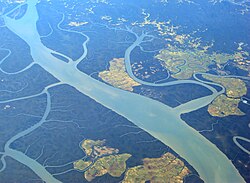
The Irrawaddy River bisects Myanmar from north to south and empties through the nine-armed Irrawaddy Delta into the Andaman Sea.
The Irrawaddy River arises by the confluence of the N'mai (Nam Gio) and Mali Rivers in Kachin State. Both the N'mai and Mali Rivers find their sources in the Himalayan glaciers of Upper Myanmar near 28° N. The eastern branch of the two, the N'mai, is the largest and rises in the Languela Glacier north of Putao. It is unnavigable because of the strong current whereas the smaller western branch, the Mali River, is navigable, despite a few rapids. Therefore, the Mali River is still called by the same name as the main river by locals. The controversial Myitsone Dam is no longer under construction at the convergence of these rivers.
Irrawaddy River
The Irrawaddy River (Burmese: ဧရာဝတီမြစ်, pronounced [ʔèjàwədì mjɪʔ], official romanisation: Ayeyarwady) is the principal river of Myanmar, running through the centre of the country. Myanmar's most important commercial waterway, it is about 1,350 miles (2,170 km) long. Originating from the confluence of the N'mai and Mali rivers, it flows from north to south before emptying through the Irrawaddy Delta in the Ayeyarwady Region into the Andaman Sea. Its drainage basin of about 404,000 square kilometres (156,000 sq mi) covers 61% of the land area of Burma, and contains five of its largest cities.
As early as the sixth century, the river was used for trade and transport, and an extensive network of irrigation canals was developed to support agriculture. The river is still of great importance as the largest commercial waterway of Myanmar. It also provides important ecosystem services to different communities and economic sectors, including agriculture, fisheries, and tourism.
In 2007, Myanmar's military dictatorship signed an agreement for the construction of seven hydroelectric dams, yielding a total of 13,360 MW, on the N'mai and Mali Rivers, including the 3600 MW Myitsone Dam at the confluence of both rivers. Environmental organisations have raised concerns about the project's ecological impact on the river's biodiverse ecosystems. Animals potentially impacted include the endangered Irrawaddy dolphin and the critically endangered Ganges shark.
The name "Irrawaddy" is derived from Pali. Irāvatī or Airāvatī (Erāvatī in Pali) is the name of the elephant mount of Sakka and Indra in Hinduism. Saka is an important deva in Buddhism and elephants were often a symbol for water and were used as the name for several other rivers, such as the Achiravati. It can also be based on Iravati, who birthed the mythological elephant. The Irrawaddy gives its name to the Irrawaddy dolphin (Orcaella brevirostris), which is found in the lower reaches of the river and known to help fishers who practice cast-net fishing. Though called the Irrawaddy dolphin, it has been also found in the Bay of Bengal and the Indian Ocean.
During the Age of Discovery, the Irrawaddy was also known to European explorers as the Pegu as the main river of the Hanthawaddy kingdom, itself known as Pegu after its capital, now romanized as Bago. The modern Pegu or Bago River is a separate river, tributary to the Yangon.
After Rudyard Kipling's poem, the river is sometimes referred to as 'The Road to Mandalay'.
The Irrawaddy River bisects Myanmar from north to south and empties through the nine-armed Irrawaddy Delta into the Andaman Sea.
The Irrawaddy River arises by the confluence of the N'mai (Nam Gio) and Mali Rivers in Kachin State. Both the N'mai and Mali Rivers find their sources in the Himalayan glaciers of Upper Myanmar near 28° N. The eastern branch of the two, the N'mai, is the largest and rises in the Languela Glacier north of Putao. It is unnavigable because of the strong current whereas the smaller western branch, the Mali River, is navigable, despite a few rapids. Therefore, the Mali River is still called by the same name as the main river by locals. The controversial Myitsone Dam is no longer under construction at the convergence of these rivers.
Recent media
Recent media