Hubbry Logo
Common Burying Ground and Island CemeteryCommon Burying Ground and Island CemeteryMain
Open search
Common Burying Ground and Island Cemetery
Community hub
Common Burying Ground and Island Cemetery
logo
8 pages, 0 posts
0 subscribers
Be the first to start a discussion here.
Common Burying Ground and Island Cemetery
from Wikipedia

Common Burying Ground and Island Cemetery
Common Burying Ground and Island Cemetery is located in Rhode Island
Common Burying Ground and Island Cemetery
Common Burying Ground and Island Cemetery is located in the United States
Common Burying Ground and Island Cemetery
LocationNewport, Rhode Island, U.S.
Area31 acres (13 ha)
Built1665
Architectural styleBeaux Arts, Romanesque
Websitewww.islandcemeterynewport.com
NRHP reference No.74000044[1]
Added to NRHPMay 1, 1974

The Common Burying Ground and Island Cemetery are a pair of separate cemeteries on Farewell and Warner Street in Newport, Rhode Island. Together they contain over 5,000 graves, including a colonial-era slave cemetery and Jewish graves. The pair of cemeteries was added to the National Register of Historic Places as a single listing in 1974.[1]

History

[edit]
God's Little Acre

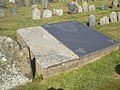
The Common Burial Ground was established in 1665 on land given to city of Newport by John Clarke.[2] It features what is probably the largest number of colonial era headstones in a single cemetery, including the largest number of colonial African American headstones in the United States. The predominantly African-American northern section of the cemetery is commonly referred to by local African-Americans as "God's Little Acre".

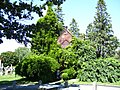
The Island Cemetery was established by the city in 1836, and transferred to the private Island Cemetery Corporation in 1848.[2] Many members of Newport's most prominent families have been buried there over the years. Notable people buried there include Medal of Honor recipient Hazard Stevens, Commodore Oliver Hazard Perry, Commodore Matthew C. Perry and financier August Belmont.

Grave markers returned

[edit]

In 2016, three gravestones were discovered which had been lost for years. One stone, found in Pennsylvania, was a 12 x 24 marker for a 1-year-old child. The others were 1835 stones for a Newport woman, which were found in a Newport yard during a renovation. The recovered stones were reset in the Common Burying Ground in 2016 by the Newport Historic Cemetery Advisory Commission.[3]

In 2017, two more burial stones found in Pennsylvania, those of Violet and Duchess Quamino, were returned and restored.[4] Duchess Quamino, a free Black woman formerly enslaved to William Ellery Channing, had been an active member of Newport's African community.[4]

Notable burials

[edit]

Prominent people buried in the Common Burial Ground

[edit]

Prominent people buried in the Island Cemetery

[edit]

Images

[edit]

Common Burial Ground

[edit]

Island Cemetery

[edit]

See also

[edit]

References

[edit]
[edit]
Revisions and contributorsEdit on WikipediaRead on Wikipedia
from Grokipedia
The Common Burying Ground and Island Cemetery constitute Newport, Rhode Island's principal historic public burial grounds, spanning approximately 31 acres along Farewell and Warner Streets and accommodating over 20,000 interments from the colonial period onward. The Common Burying Ground, Newport's oldest such site, originated in 1640 with land gifted by Reverend John Clarke and evolved into a non-denominational repository for residents of all social strata, including a segregated section known as God's Little Acre that preserves the nation's largest concentration of 18th-century African American gravestones. Adjacent Island Cemetery, formally established in 1836 through municipal acquisition, adopted a Victorian park-like layout with grid paths, mature plantings, and structures such as the Belmont Memorial Chapel, reflecting 19th-century funerary design trends. These cemeteries house exceptional examples of early American stone carving, including slate markers by the Stevens family and Mumford workshops, alongside ledger stones and vaults that document Newport's maritime, political, and architectural heritage. Prominent burials in the Common Burying Ground encompass William Ellery, signer of the Declaration of Independence; Governor Samuel Cranston, Rhode Island's longest-serving colonial executive; and lighthouse keeper Ida Lewis, renowned for maritime rescues. Island Cemetery features naval heroes Oliver Hazard Perry and Matthew Calbraith Perry, as well as architect Richard Morris Hunt, whose designs shaped Gilded Age aesthetics. Jointly designated on the National Register of Historic Places in 1974, the sites exemplify enduring civic burial practices and material culture, with the Common Burying Ground alone retaining over 3,000 monuments—800 predating 1800—amid 10.2 acres of terrain.

History

Establishment and Early Use of the Common Burying Ground

The land comprising the Common Burying Ground was donated to the town of Newport by Dr. John Clarke, a founder of the settlement and physician, in 1640, providing a dedicated public space for burials amid the colony's early growth following Newport's founding in 1639. The cemetery was formally established as the Common Burying Ground in 1665, encompassing about 10.2 acres at the intersection of Farewell and Warner Streets, to serve as Newport's primary public burial site. From its inception, the ground was designated for interments across Newport's diverse populace, including residents of varying religious backgrounds, which distinguished it from more sectarian colonial graveyards and aligned with Rhode Island's tradition of religious tolerance established under the 1663 charter. Early use reflected the town's maritime economy and social structure, with burials encompassing free whites, indentured servants, and enslaved Africans, the latter concentrated in a section later known as God's Little Acre; records indicate over 1,000 African-descent interments from the 17th and 18th centuries, underscoring the cemetery's role in documenting colonial demographics. Initial grave markers were rudimentary, often fieldstones or imported slate from Boston adorned with Puritan death's head motifs and skeletal imagery symbolizing mortality, as local stonecutting expertise, such as that of the John Stevens Shop, did not emerge until 1705. These early stones, numbering in the thousands over time, provided the first systematic documentation of Newport's mortality patterns, including epidemics and shipwrecks that claimed lives in the harbor town. The site's non-denominational accessibility facilitated its expansion in use through the late 17th century, laying the foundation for its status as one of colonial America's largest public cemeteries.

Founding and Expansion of the Island Cemetery

The town of Newport purchased a tract of land on Warner Street on May 18, 1836, establishing the basis for what would become Island Cemetery, adjacent to the older Common Burying Ground. In 1839, a portion of this land was surveyed and divided into 136 lots, each measuring one rod square, for sale to the public; Henry Bull and William W. Freeborn were appointed that year to oversee its design as a park-like cemetery featuring trees, shrubbery, and a perimeter fence costing $831.33. By 1848, reflecting the emerging American garden cemetery movement—which emphasized landscaped, rural-style burial grounds as serene public parks—the Island Cemetery Company was incorporated as a private entity. The town conveyed the grounds to the company's trustees, who were authorized to manage the property, conduct burials, and raise funds for its maintenance; this shift allowed for professional oversight amid growing demand for expanded burial space in Newport's urbanizing landscape. Subsequent expansions included several additions to the original plot over the ensuing decades, incorporating adjacent areas such as Willow Cemetery to enhance accessibility and capacity, resulting in a total site that supports over 12,000 burials as of 2024. Key infrastructural developments encompassed a receiving vault designed by Edwin Wilbar in 1894 (later demolished in 1985), the August Belmont Memorial Chapel commissioned in 1886 and deeded to the cemetery in 1888, and an office building designed in 1902 that opened in 1921 under Herbert Wilson. These enhancements, including the avenues laid out in the 1830s, transformed the cemetery into a more formalized, picturesque repository aligned with 19th-century ideals of memorial landscapes.

Notable Historical Events and Developments

The Common Burying Ground was established in 1665 when Dr. John Clarke donated a 10.2-acre parcel to the Town of Newport, creating the city's first public cemetery open to residents of all religious denominations. This development addressed the need for a centralized, non-sectarian burial site amid Newport's growing colonial population, with early graves marked by wooden planks or imported stones featuring Puritan iconography. Within the Common Burying Ground, the northern section designated as God's Little Acre emerged around 1705 as a dedicated area for burials of free and enslaved African Americans, eventually encompassing 499 marked graves and representing the largest intact colonial-era African burial ground in the United States. Local stonecarving advanced in 1705 with the founding of the John Stevens Shop, which produced slate markers with distinctive colonial motifs for generations of burials across the site. As interments increased with 19th-century population growth tied to industrialization, the Town of Newport acquired surrounding higher terrain on May 18, 1836, to expand burial capacity; this land was surveyed into 136 one-rod-square lots by 1839 and formally transferred to the Island Cemetery Company in 1848 for ongoing management. Key infrastructural additions followed, including the Belmont Chapel, constructed between 1886 and 1888 under the patronage of banker August Belmont to serve as a receiving and service facility. In 1974, the adjacent cemeteries were jointly inscribed on the National Register of Historic Places under a single entry, affirming their value as repositories of colonial stonework, diverse demographic history, and 19th-century landscape design. This recognition spurred preservation efforts, including documentation of over 7,986 named burials in the Common Burying Ground alone.

Physical Characteristics and Layout

Features of the Common Burying Ground

The Common Burying Ground encompasses approximately 10.2 acres and contains the remains of over 8,000 individuals, with 7,986 named burials recorded on surviving gravestones dating back to 1665. Its layout consists of a crowded, haphazard arrangement of interments divided by a road into a southern section for freemen and a northern section historically designated for enslaved individuals. The terrain features undulating ground overgrown with brush, evoking the irregular colonial-era burial practices without the formalized grid patterns seen in later cemeteries. The cemetery holds roughly 3,000 memorial monuments, including about 800 predating 1800, predominantly modest low headstones crafted from slate, marble, or granite. Early markers from the 1660s often comprise blue slate slabs adorned with family crests or Puritan iconography, such as those carved by William Mumford, while post-1700 examples include ledger stones by local artisans like John Stevens II and uniform slate designs with consistent winged-death motifs and inscriptions. Rare deviations feature taller forms, such as a marble column erected in 1870 for Joseph Anthony. No major structures like chapels are integral to the Common Burying Ground itself, distinguishing it from the adjacent Island Cemetery's Victorian-era buildings, though an entrance structure marks access from Farewell Street. The site's physical integrity has been impacted by historical neglect, vandalism, and stone displacement, prompting preservation efforts to stabilize and document the monuments.

Features of the Island Cemetery

The Island Cemetery, established in 1836 as part of the rural cemetery movement, occupies a hilly terrain overlooking Newport Harbor and the city's Point section to the west, providing scenic vistas integrated into its design. Its layout features avenues laid out in the 1830s in a regular grid aligned with adjacent boundaries, with later northern and eastern expansions incorporating a parallel grid and four landscaped circles to enhance aesthetic appeal. Drawing inspiration from Boston's Mount Auburn Cemetery, the grounds include curvilinear roads, specimen tree plantings, and open spaces characteristic of 19th-century garden cemeteries. Monuments exhibit diverse designs and materials, ranging from early slate ledger and tablet headstones to later marble obelisks, granite sarcophagi, religious statues, and crosses, reflecting Victorian-era commemorative practices. Notable examples include the 1826 obelisk honoring Oliver Hazard Perry and the 1891 exedra, statue, and sarcophagus for August Belmont designed by Richard Morris Hunt, alongside an 1884 angel sculpture by Augustus Saint-Gaudens. A 20th-century northern section behind the chapel features uniform stone sizing and spacing for modern burials. Central structures include the Belmont Memorial Chapel, built from 1886 to 1888 in Gothic style by George C. Mason & Son using reddish-brown sandstone from Carlisle quarries, a yellow pine roof, dark blue slate covering, and copper elements; its double walls incorporate an air chamber for insulation, while interiors feature stained glass windows by artists including Tiffany & Co., a mosaic tile floor, and a Caen stone altar with onyx columns. An office building erected in 1901–1902 by Herbert Wilson and a receiving vault constructed in 1894 (demolished in 1985) further define the site's built environment.

Special Demographic Sections

African American Burials and God's Little Acre

God's Little Acre designates the northern section of Newport's Common Burying Ground, established as a segregated burial area for individuals of African descent during the colonial era. This portion, dating to the late 17th century, served enslaved and free Africans and African Americans until the early 19th century, reflecting the racial hierarchies of Newport's slave-based economy, which at its peak in the 1760s held over 1,000 enslaved people in a town of about 11,000 residents. The site's name evokes a biblical allusion to a modest plot of divine ground, a term historically applied to churchyards but here specifically denoting this African-designated space, as referenced by local African American communities. The burial ground preserves the largest and oldest intact collection of 18th-century gravestones for people of African heritage in North America, with 499 documented marked graves attributed to free and enslaved individuals. These markers, often featuring carved motifs like cherubs, hourglasses, and soul effigies, provide rare epigraphic evidence of African lives, including names, ages, and epitaphs such as those for Quamino, an enslaved man whose stone notes his service and death in 1775. Estimates suggest over 1,000 total interments, many unmarked due to economic constraints or deliberate oversight, underscoring the marginalization of these burials compared to European sections. The first recorded burial is Sam Butcher in 1720, while the last was Ethel Peer in 1825, bookending a period of intensive documentation by historians like John Sterling, whose 2009 compilation catalogs these graves using primary records from church and town ledgers. Archaeological and historical analyses, including ground-penetrating radar surveys by Brown University teams in collaboration with local preservationists, have confirmed undisturbed subsurface remains and highlighted the site's integrity despite 20th-century neglect. Unlike many erased African burial grounds elsewhere, God's Little Acre's survival stems from its public establishment within the 1640 town land grant and sustained community advocacy, though early segregation stemmed from exclusionary practices viewing Africans as partial community members. These burials illuminate Newport's role in the transatlantic slave trade, with stones occasionally referencing owners or maritime ties, offering causal links to the economic forces that imported and commodified human labor for rum distillation and shipping. Preservation efforts since the 1980s, including National Register inclusion in 2015 as part of the broader cemetery, prioritize empirical documentation over interpretive narratives, revealing patterns like higher infant mortality rates inferred from clustered child graves.

Jewish and Other Minority Graves

The Common Burying Ground accommodated burials from Newport's diverse population, including Jewish individuals whose primary cemetery was the separate Colonial Jewish Burial Ground established in 1677 by Congregation Jeshuat Israel. Historical records indicate additional Jewish graves within or immediately adjacent to the Common Burying Ground, reflecting the site's non-denominational character. Congregation Jeshuat Israel maintained a small fenced burial area near the cemetery entrance, established around 1761, where only three gravestones survive, inscribed with dates of 1803, 1809, and 1810. Other minority religious groups represented include Moravians, a small Protestant denomination active in colonial Newport. Remains from a Moravian congregation's earlier burying ground were exhumed and relocated to the Common Burying Ground in the mid-19th century, with documented transfers including multiple Greene family members reinterred in July 1867; specific plots encompass areas marked #256–260, #296–298, #339–340, #346–349, and #351. Connections between minority communities appear in cases like Elizabeth Leandrew (#398), a free woman of color linked to Touro Synagogue and its Jewish congregants, who died in 1760 and was buried in the Common Burying Ground. Similarly, figures such as Duchess Quamino (#8), an influential free Black woman involved in early African mutual aid societies, were interred here, underscoring inter-community ties outside designated ethnic sections; she died in 1804. No significant non-Christian or minority graves are documented in the adjacent Island Cemetery, which primarily served 19th-century Protestant families of means following its founding in 1846.

Notable Burials

Prominent Figures in the Common Burying Ground

The Common Burying Ground inters numerous colonial-era leaders and later notable residents, reflecting Newport's role in early American governance and maritime history. Among the most prominent is William Ellery (1727–1820), a Harvard-educated attorney, Son of Liberty, and signer of the Declaration of Independence on August 2, 1776, representing Rhode Island. Ellery later served as a Continental Congress delegate, chief justice of the Rhode Island Supreme Court from 1780 to 1785, and U.S. District Judge for Rhode Island from 1790 until his death on March 15, 1820. His enclosed family plot, marked by a brick vault and inscription detailing his public service, underscores his contributions to the American Revolution and federal judiciary. Colonial governors buried here include John Cranston (c. 1626–1680), a physician, merchant, and deputy governor who served as Rhode Island's governor from 1676 to 1678 and again in 1680 until his death on September 30, 1680. His original grave slab, alongside a later one shared with his son Samuel Cranston (1659–1727), highlights the site's continuity of elite burials; Samuel succeeded as governor, holding the office longer than any other from 1689 to 1727, overseeing colonial expansion and defense against external threats. Similarly, Richard Ward (1689–1763), merchant and governor from 1741 to 1743 and 1748 to 1749, shares a brick vault with his son Samuel Ward (1725–1776), who governed Rhode Island from 1762 to 1767 and opposed British policies leading to the Revolution. In the 19th century, Ida Lewis (1842–1911), renowned as one of America's most celebrated lighthouse keepers, was laid to rest here after her death on October 24, 1911. Beginning unofficial duties at Lime Rock Light in 1857 and formally appointed in 1879, Lewis rescued at least 18 lives, earning international acclaim and a rare gold Congressional Lifesaving Medal in 1869 for her feats, including rowing through storms to save men from drowning. Her monument, visible from Farewell Street, commemorates her as "The Bravest Woman in America," symbolizing Newport's maritime heroism.

Prominent Figures in the Island Cemetery

The Island Cemetery inters several prominent naval figures from the early American republic, most notably the brothers Oliver Hazard Perry and Matthew C. Perry. Oliver Hazard Perry (1785–1819), a commodore in the U.S. Navy, achieved fame for his decisive victory at the Battle of Lake Erie on September 10, 1813, during the War of 1812, which secured American control of the Great Lakes and earned him the title "Hero of Lake Erie." His remains were reinterred in Newport's Island Cemetery in 1820 following his death from yellow fever while serving in the Gulf of Mexico. Matthew Calbraith Perry (1794–1858), Oliver's younger brother and also a commodore, is buried alongside him after leading the 1853–1854 expedition that compelled Japan to end its sakoku isolation policy through the Convention of Kanagawa, signed on March 31, 1854, marking a pivotal moment in U.S.-Asia relations. Perry's naval career spanned the War of 1812 and the Mexican-American War, where he commanded the USS Mississippi, and his Japan mission involved four U.S. Navy ships with over 500 personnel. Other notable burials include Theodore M. Davis (1838–1904), a financier and amateur Egyptologist who funded excavations in the Valley of the Kings from 1903 to 1914, uncovering tombs such as KV43 (Thutmose IV) and KV2 (Ramesses IV), though many artifacts he acquired entered private collections rather than public museums. George T. Downing (1819–1903), an African American abolitionist, restaurateur, and civil rights advocate born free in New York City, operated a successful catering business and lobbied for desegregation of Rhode Island schools in the 1860s, influencing state policy through petitions and alliances with figures like Frederick Douglass. The cemetery also holds World War I-era figures, such as Thomas Eadie (1887–1974), a U.S. Navy chief gunner's mate awarded the Medal of Honor for extraordinary heroism on December 18, 1927, during diving operations connected with the sinking of the USS S-4 off Provincetown, Massachusetts, where he descended to rescue a fouled diver at a depth of 102 feet under extremely hazardous conditions. These burials reflect Newport's maritime heritage and connections to broader American military and exploratory endeavors.

Historical Significance and Preservation

Contributions to Newport's Colonial and Maritime History

The Common Burying Ground preserves the graves of several colonial governors who governed Rhode Island during Newport's emergence as a major Atlantic trading port in the 17th and 18th centuries. Samuel Cranston, interred there after serving as governor for approximately 30 years from 1698 to 1727, oversaw expansions in trade infrastructure and colonial administration amid growing maritime commerce in rum, molasses, and other goods. Similarly, Richard Ward (governor 1741-1743) and Samuel Ward (governor 1762-1763 and 1765-1767) contributed to policies supporting Newport's shipbuilding and export economy, with Samuel Ward also delegating to the Continental Congress before dying of smallpox in 1776. These burials document the leadership that facilitated Newport's position as one of colonial America's busiest ports, handling over 100 voyages annually by the mid-18th century through merchant networks. Merchants and sea captains buried in the Common Burying Ground further illustrate Newport's maritime prowess, as the port dominated the triangular trade routes involving Europe, Africa, and the Caribbean. William Ellery (1727-1820), a Harvard-educated merchant turned lawyer and signer of the Declaration of Independence, engaged in shipping and customs oversight that bolstered colonial commerce before the Revolution. Christopher Champlin (c.1731-1805), a prominent ship owner and trader including in enslaved Africans, amassed wealth through voyages that underscored Newport's role in the slave trade, which accounted for significant portions of Rhode Island's economy until the 1807 federal ban. Sea captains like John Trevett (c.1747-1823), who commanded Continental Navy vessels and captured 12 British ships during the Revolutionary War, exemplified the privateering and naval operations that protected trade lanes. The adjacent Island Cemetery extends this maritime legacy into the 19th century with burials of naval officers tied to Newport's strategic harbor. Oliver Hazard Perry (1785-1819), reinterred there in 1843, achieved fame for his "We have met the enemy and they are ours" victory at the Battle of Lake Erie in 1813, enhancing U.S. naval prestige and indirectly supporting Newport's role as a naval training and repair hub. In the Common Burying Ground, Ida Lewis (1842-1911), unofficial Lime Rock Lighthouse keeper from 1857, performed over 18 documented rescues in Newport Harbor's hazardous waters, earning the 1881 Gold Lifesaving Medal and symbolizing the endurance required for the port's safe navigation amid frequent storms and fog. Collectively, these sites encapsulate the human elements—governance, commerce, and heroism—that propelled Newport from colonial outpost to enduring maritime center.

National Register Designation and Recognition

The Common Burying Ground and Island Cemetery in Newport, Rhode Island, were jointly listed on the National Register of Historic Places (NRHP) as a single entry on May 1, 1974, under reference number 74000044. This designation recognizes their significance under Criterion C for architecture/engineering, highlighting the cemeteries' collection of over 3,000 memorial monuments in the Common Burying Ground alone, with approximately 800 predating 1800, and the Island Cemetery's 19th-century rural layout featuring curvilinear avenues established in the 1830s. The nomination emphasized the sites' role as repositories of colonial-era stonework, including rare African and Jewish burial markers, underscoring their contribution to understanding Newport's social and architectural history without relying on interpretive bias in contemporary accounts. The NRHP listing followed a nomination process initiated by the Rhode Island Historical Preservation Commission, which documented the cemeteries' integrity despite some 20th-century alterations, such as the Island Cemetery's entrance structures. This federal recognition provides eligibility for preservation grants and tax incentives under the National Historic Preservation Act of 1966, though actual funding depends on subsequent applications and has supported ongoing cataloging efforts for the gravestones. No additional national designations, such as National Historic Landmark status, have been conferred, reflecting the site's primary value in local and regional historical contexts rather than broader national events.

Modern Restoration and Maintenance Efforts

The Historic Cemetery Advisory Commission (HCAC) of Newport oversees preservation efforts for the Common Burying Ground, coordinating treatments for gravestones and monuments, volunteer cleanings, and interpretive enhancements. In 2024, under the GLA Preservation Plan, two cherry trees were planted between the Common Burying Ground and Island Cemetery to improve the landscape, while 11 slate stones in God's Little Acre received conservation treatment. Broader stonework initiatives that year included treating 20 slate and 12 marble stones specifically in the Common Burying Ground, contributing to a total of 102 stones, one monument, and six box tombs across Newport sites. Volunteer groups, including Embrace Home Mortgage participants in their fifth annual effort, cleaned marble gravestones and ledger stones, while five additional volunteers painted rusted ironwork and maintained stones on Saturdays. Interpretive signage, funded by Discover Newport and informed by the Rhode Island Black Heritage Society, was installed in October and November 2024 to aid public understanding of burial demographics. Earlier, a 2019 $50,000 grant from the Preservation Society of Newport County supported conservation of 30 slate stones in God's Little Acre. The Friends of the Common Burying Ground has pursued grants since at least 2016 to conserve fragile slate tombstones threatened by weathering. For the adjacent Island Cemetery, restoration accelerated with the 2014 launch of the Belmont Chapel project, completed by 2017 through community donations, local foundations, and state funding, transforming the 1886 structure from disrepair to a preserved focal point. The chapel earned the 2024 Doris Duke Historic Preservation Award on September 6 and the Rhody Award on October 20, recognizing structural and architectural rehabilitation. The cemetery's Board of Trustees adopted a strategic plan to guide overall restoration and development, including targeted monument repairs on "Millionaires’ Row," such as repointing the August Belmont marble monument and restoring crumbling walls in the Griswold and Kane lots. The George Norman column and angel statue, exceeding 30 feet in height, were fully restored by summer 2023 with Prince Foundation support. Horticultural maintenance advanced via partnership with the Newport Tree Conservancy, achieving arboretum accreditation in 2023 and emphasizing erosion control, sustainable watering, and pruning; the "Plant a Tree" program added species like eight red maples in spring 2023 and five hawthorns in 2022, often as memorials with bronze plaques. The Friends of Island Cemetery and Belmont Chapel, incorporated as a 501(c)(3) in January 2025, now drives ongoing conservation fundraising. These initiatives reflect collaborative public-private efforts to combat environmental degradation and vandalism risks, prioritizing slate and marble stabilization alongside landscape enhancements for long-term viability.

Incidents and Challenges

Vandalism and Desecration Events

In May 2011, vandals overturned approximately 260 headstones in the Island Cemetery, an act that began as a small party with a campfire in the adjacent Common Burying Ground before escalating to desecration in the Island section. Newport police arrested three men—Ramon Fulvi, 23; Andrew Fowler; and Richard Brett Mounts, 36—all locals, charging them with grave desecration; Fulvi was released on $1,000 bail. The incident provoked widespread community outrage, with Mayor Stephen Waluk noting personal family connections to affected graves, and prompted volunteer efforts, including firefighters and forklift operators, to upright the toppled stones. Charges against two of the accused were later dismissed by a judge. The Common Burying Ground has experienced ongoing losses of gravestones due to theft and vandalism over time, contributing to the disappearance of many markers, particularly in sections like God's Little Acre. No specific dated desecration events beyond general historical attrition have been documented in available records for this cemetery.

Preservation Controversies and Responses

In the mid-1970s, the Belmont Chapel at Island Cemetery began a prolonged period of decline, exacerbated by vandalism, water damage, and lack of maintenance after the cemetery company assumed responsibility following August Belmont's death in 1890. By the 2010s, the structure exhibited severe disrepair, including overgrown vines, roof holes allowing raccoon infestations, broken windows, and interior vandalism, raising concerns among preservationists about the cemetery's overall management and the risk to its Gilded Age monuments. A 2017 management dispute between cemetery operators and stakeholders further highlighted funding shortages and authority over upkeep, contributing to visible decay such as unkempt grounds and unaddressed structural issues. Responses to these challenges included the 2014 formation of the Belmont Chapel Foundation by local preservationists, including Harry Eudenbach, which leased the chapel from the Island Cemetery Company for 99 years to undertake restoration. The multi-year project, costing approximately $2.5 million, involved securing grants from the McBean Charitable Trust and Rhode Island Historic Preservation, along with private donations, to repair plaster, repaint surfaces, and stabilize the Neo-Gothic structure, culminating in substantial completion by 2024. The chapel's temporary use as an art gallery in 2020 during partial restoration underscored adaptive reuse strategies to fund ongoing preservation. At the adjacent Common Burying Ground, public access controversies emerged from pet-related damage, with reports in 2022 of dogs causing erosion to gravesites and monuments through unrestrained activity and waste, prompting the Historic Cemetery Commission to propose a dog ban to protect the site's 85% share of Newport's colonial burials. Commission chair Lewis Keen described the issue as "out of hand," citing irresponsible ownership as a causal factor in accelerating wear on fragile 17th- and 18th-century markers, including those in God's Little Acre. Preservation advocates responded by advocating stricter etiquette enforcement and self-guided tours emphasizing respect for the grounds, while the return and resetting of three missing colonial gravestones—dating to 1690—in October 2016 demonstrated collaborative recovery efforts between historians and municipal authorities to address historical losses from theft or displacement. These measures reflect broader reliance on nonprofit initiatives and grants to counter resource constraints in maintaining publicly accessible historic sites.

References

Add your contribution
Related Hubs
User Avatar
No comments yet.