Hubbry Logo
William ElleryWilliam ElleryMain
Open search
William Ellery
Community hub
William Ellery
logo
8 pages, 0 posts
0 subscribers
Be the first to start a discussion here.
William Ellery
William Ellery
from Wikipedia

William Ellery (December 22, 1727 – February 15, 1820)[1] was a Founding Father of the United States, one of the 56 signers of the United States Declaration of Independence,[2][3] and a signer of the Articles of Confederation as a representative of Rhode Island.[4]

Key Information

In 1764, the Baptists consulted with Ellery and Congregationalist Reverend Ezra Stiles on writing a charter for the college that became Brown University. Ellery and Stiles attempted to give control of the college to the Congregationalists, but the Baptists withdrew the petition until it was rewritten to assure Baptist control. Neither Ellery nor Stiles accepted appointment to the reserved Congregationalist seats on the board of trustees.[5]

Biography

[edit]

Ellery was born in Rhode Island on December 22, 1727,[2] the second son of William Ellery Sr. and Elizabeth Almy, a descendant of Thomas Cornell. He received his early education from his father, a merchant and Harvard College graduate. He graduated from Harvard College in 1747, where he excelled in Greek and Latin. He then returned to Newport where he worked first as a merchant, next as a customs collector, and then as clerk of the Rhode Island General Assembly. He started practicing law in 1770 at age 43 and became active in the Rhode Island Sons of Liberty.

Statesman Samuel Ward died in 1776, and Ellery replaced him in the Continental Congress. He was a signer of the Articles of Confederation and one of the 56 signers of the Declaration of Independence in 1776. The size of his signature on the Declaration is second only to John Hancock's famous signature.

Ellery also served as an associate justice of the Supreme Court of Rhode Island from May 1780 to May 1781, and chief justice from June 1785 to May 1786.[6] He had become an abolitionist by 1785. He was the first customs collector of the port of Newport under the Constitution, serving there until his death, and he worshipped at the Second Congregational Church of Newport.[7][8]

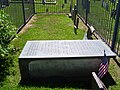
Ellery died on February 15, 1820, at age 92 and was buried in Common Burial Ground in Newport.[9] The Rhode Island Society of the Sons of the Revolution and the William Ellery Chapter of the Daughters of the American Revolution make an annual commemoration at his grave on Independence Day.

Family and legacy

[edit]
Coat of Arms of William Ellery

Ellery married Ann Remington of Cambridge, Massachusetts, in 1750. She was the daughter of Judge Jonathan Remington. She died in 1764 in Cambridge and was buried there, and he married Abigail Cary in 1767. He had 19 children, and his descendants include Ellery Channing, Washington Allston, William Ellery Channing, Richard Henry Dana Sr., Edie Sedgwick, Paulita Sedgwick, Kyra Sedgwick and Andra Akers.[10] Francis Dana married his daughter Elizabeth. His great-great-grandnephew, Major Elbert Ellery Anderson (1833–1903), took his middle name from him.[11]

Ellery left a humorous record of his travels (on a mount he refers to as "my Jenny") from Massachusetts to Philadelphia in 1778 and 1779 that was published in serial form in the Pennsylvania Magazine of History and Biography of the Historical Society of Pennsylvania (1887).[12]

William Ellery is the namesake of the town of Ellery, New York,[13] and Ellery Avenue in Middletown, Rhode Island, is named in his honor

Images

[edit]

See also

[edit]

References

[edit]
[edit]
Revisions and contributorsEdit on WikipediaRead on Wikipedia
from Grokipedia

William Ellery (December 22, 1727 – February 15, 1820) was an American Founding Father, lawyer, and merchant from , best known as one of the 56 signers of the Declaration of Independence as a delegate to the . Born to a prominent family, Ellery graduated from in 1747, studied law, and was admitted to the bar the following year before engaging in mercantile pursuits and public service. He opposed British colonial policies, serving as of Newport from 1768 to 1770 and as a deputy to the from 1772 to 1775, while also participating in the council of safety during the lead-up to independence.
Ellery's tenure in the Continental Congress from 1776 to 1781 and again from 1783 to 1785 included signing the Declaration on August 2, 1776, and contributing to wartime efforts, particularly in naval affairs as a member of the Board of Admiralty in 1779. Post-war, he held judicial roles as justice of the Rhode Island superior court from 1780 to 1785 and later served as collector of the port of Newport from 1790 until his death, a position under five successive U.S. presidents that underscored his enduring commitment to federal administration. Despite personal losses, including the destruction of his property by British forces during the Revolution, Ellery outlived many contemporaries, fathering numerous children and leaving a legacy tied to Rhode Island's revolutionary heritage.

Early Life and Education

Birth and Family Origins

William Ellery was born on December 22, 1727, in Newport, Colony. He was the second son of William Ellery Sr. (1701–1764), a successful engaged in who had graduated from in 1722, and Elizabeth Almy (1703–1783). The elder Ellery, originally from , provided his son with early private instruction before formal schooling. The Ellery family traced its roots to English immigrants who settled in during the early colonial period, with the senior William Ellery representing a merchant class prominent in Newport's burgeoning port economy centered on shipping and commerce. Elizabeth Almy descended from established families; her grandfather, Christopher Almy, had emigrated from around 1635 at age three aboard the ship , establishing ties to early Puritan and Quaker-influenced communities in and Newport. This lineage positioned the family within Newport's mercantile elite, though without notable political prominence at the time of Ellery's birth.

Academic Training and Early Influences

William Ellery was born on December 22, 1727, in , to William Ellery Sr., a prosperous merchant and graduate of , and Elizabeth Almy, whose family traced descent from early settlers. His father's position as a deputy governor and active involvement in colonial commerce provided a stable, affluent environment that emphasized education and public duty from an early age. Ellery received his initial schooling through private tutors, with his father taking a direct role in overseeing instruction in foundational subjects such as reading, writing, and classical languages. At age 16, in 1743, Ellery enrolled at , following in his father's footsteps as a legacy student. He graduated in 1747, having distinguished himself particularly in Greek and Latin studies, which reflected the rigorous classical curriculum of the institution at the time. Harvard's emphasis on moral philosophy, rhetoric, and Enlightenment , drawn from faculty influenced by Newtonian and Protestant , likely reinforced Ellery's developing worldview grounded in reason and . Early influences extended beyond formal academics to Newport's vibrant mercantile culture and his father's example of blending trade with , fostering in Ellery a pragmatic appreciation for empirical knowledge over abstract theory. This familial and local milieu, centered on shipping and , instilled values of industriousness and toward overreaching , evident in his later political writings. Upon returning to Newport post-graduation, Ellery briefly assisted in the , bridging scholarly pursuits with practical application before pursuing through self-study and mentorship.

Pre-Revolutionary Career

Entry into Commerce and Law

After graduating from in 1747, Ellery returned to Newport and joined his father's mercantile enterprise, engaging in the shipping and trade activities central to the port city's economy. His father, William Ellery Sr., operated a successful import-export business involving goods such as , , and other commodities typical of Rhode Island's networks. Ellery managed aspects of this , including vessel operations and financial dealings, which provided him with practical experience in amid Newport's bustling maritime environment. In 1750, Ellery received an appointment as Clerk of the Newport County Court of Common Pleas, a position that immersed him in legal procedures and composition while supplementing his commercial pursuits. This role, held under colonial judicial structures, allowed him to observe courtroom practices and draft documents, laying groundwork for formal legal training without immediate abandonment of mercantile interests. Following his father's death in 1764, Ellery inherited substantial business assets, including shares in trading vessels and warehouses, which he maintained alongside emerging legal ambitions. By the late 1760s, Ellery shifted emphasis from trade toward , studying independently and reducing mercantile operations to focus on professional qualifications. He was admitted to the bar in 1770 at age 43, establishing a practice in Newport that quickly gained traction through his prior clerical experience and reputation for diligence. This transition reflected broader colonial patterns where merchants diversified into amid rising political tensions, enabling Ellery to blend commercial acumen with advocacy in disputes over , contracts, and maritime claims.

Civic Engagement in Colonial Rhode Island

Ellery held the position of clerk for the during the 1760s, managing legislative records and proceedings amid growing colonial tensions with Britain. As a naval officer and customs collector in Newport, he enforced port regulations while navigating the economic impacts of British trade policies, including duties that fueled local discontent. Ellery emerged as an early opponent of the of 1765, participating in organized resistance efforts such as a demonstrative march through Providence to protest the tax on legal documents and printed materials, which he viewed as an infringement on colonial rights. By the mid-1760s, he aligned with the Newport Sons of , a group advocating non-importation agreements and public agitation against parliamentary overreach, reflecting his shift toward active political dissent rooted in mercantile interests threatened by imperial controls. His civic roles extended to local governance, including service on the Newport Town Council, where he contributed to community decisions on and defense amid escalating transatlantic disputes. These engagements positioned Ellery as a bridge between Newport's commercial elite and broader revolutionary sentiments, emphasizing legal and economic arguments against taxation without representation.

Role in the American Revolution

Political Opposition to British Rule

Ellery began voicing opposition to British colonial policies in the mid-1760s, amid growing colonial resentment toward parliamentary taxation without representation. In , following Parliament's passage of the on March 22, which imposed direct taxes on printed materials and legal documents, Ellery helped lead a riotous march of Rhode Islanders through Providence to protest the measure and demonstrate local resistance. This action aligned with widespread colonial defiance, including the forced resignation of stamp distributors across the colonies, though the Act was repealed in 1766. As tensions escalated, Ellery affiliated with the , a network of colonial activists formed to coordinate resistance against British encroachments, joining the Newport chapter in the mid-1760s. He supported protests against subsequent impositions, such as the of 1767, which taxed imports like tea and glass, and expressed preference for governance by Sons of Liberty affiliates over British loyalists. By 1770, after commencing his legal practice, Ellery intensified his political engagement, contributing to Rhode Island's defiance of British authority, including opposition to the enforcement of customs duties that fueled and local economies. Ellery's stance hardened against the Coercive Acts of 1774, Parliament's punitive response to the , which closed Boston's port and altered ' charter; he viewed these as intolerable assertions of dominance over colonial self-governance. In the lead-up to open conflict, following the on April 19, 1775, Ellery urged vigorous resistance, advocating that colonial forces prioritize over accommodation with Tories. Appointed to Rhode Island's Committee of Safety in 1775, he helped organize defenses and coordinate inter-colonial efforts against British military advances.

Service in the Continental Congress

Ellery was selected by the as a delegate to the on April 2, 1776, to succeed Samuel Ward, who had died in March of that year. He arrived in , presented his credentials, and took his seat on May 16, 1776. His initial term aligned with the escalating crisis of colonial independence, during which he participated in debates and votes pivotal to the revolutionary effort. Ellery's service extended from 1776 to 1781 and resumed from 1783 to 1785, with absences in 1780 and 1782 attributed to state obligations and personal matters. Throughout, he demonstrated diligence in attendance and committee work, contributing to over a dozen assignments, including those on , , and procurement. His focus sharpened on naval matters amid Britain's maritime dominance; by 1779, he joined the Continental , advocating for ship , privateering regulations, and supply coordination to bolster American sea power against blockades. Ellery remained active through the Congress's relocation to multiple sites, including and , amid British advances. He supported the adoption of the in 1781, emphasizing unified governance for wartime exigencies, and later endorsed fiscal reforms to stabilize confederation finances strained by inflation and debt. His tenure reflected Rhode Island's mercantile priorities, prioritizing trade protections and retaliatory measures against British .

Signing the Declaration of Independence

William Ellery joined the Second as a delegate from on May 4, 1776, replacing Samuel Ward who had died the previous March. This election coincided with 's assembly finally instructing its delegates to pursue , marking the last colony to do so. Ellery, a Newport merchant and lawyer with growing revolutionary sympathies, arrived in prepared to support separation from Britain. During congressional debates, Ellery voted affirmatively for Richard Henry Lee's resolution declaring independence on July 2, 1776. The following day, approved the Declaration drafted primarily by , formally adopting it on July 4. Signing of the engrossed parchment began immediately with a few delegates, including and , but most, including Ellery, added their signatures on August 2, 1776, when the document was ready for formal attestation. As Rhode Island's junior signer alongside Stephen Hopkins, Ellery's bold script appeared in the third column of the parchment, affirming the pledge of "our Lives, our Fortunes and our sacred Honor." His participation underscored Rhode Island's commitment despite its initial reluctance, reflecting Ellery's own evolution from moderate patriot to resolute supporter of sovereignty. No contemporary accounts detail personal remarks from Ellery at the signing, but his later service in highlighted sustained dedication to the revolutionary cause.

Post-Independence Public Service

Continued Congressional Duties

Following his signing of the Declaration of Independence on August 2, 1776, Ellery continued as a delegate to the Continental Congress, which evolved into the Confederation Congress after formal independence. He served continuously from 1776 until 1786, with brief absences in 1780 and 1782 due to state duties and health concerns, demonstrating steadfast commitment amid wartime demands such as funding the Continental Army and coordinating alliances. Ellery contributed significantly to naval policy, reflecting Rhode Island's maritime interests. Appointed to the Marine Committee shortly after arriving in Congress, he later served on the established in 1779, where he helped oversee operations, prize courts, and shipbuilding efforts critical to disrupting British supply lines. His work included resolving admiralty disputes and advocating for expanded naval resources, as evidenced by committee reports on captured vessels and fleet readiness during the Revolutionary War. In legislative matters, Ellery affixed Rhode Island's ratification to the on July 9, 1778, supporting the framework for postwar governance despite its weaknesses in central authority. He participated in key committees addressing postal routes, military , and , including deliberations on treaties with and the that bolstered American credit abroad. Postwar, amid economic strains under the Articles, Ellery backed measures for debt assumption and interstate commerce regulation, though Rhode Island's assembly often instructed delegates conservatively on taxation. Ellery's congressional tenure ended in early 1786 when he accepted appointment as commissioner of the Continental Loan Office for , shifting focus to managing federal loans and state finances amid mounting debts.

Judicial Positions in Rhode Island

In 1785, William Ellery was appointed Chief Justice of the , a position he held during a pivotal era of state judicial reorganization following independence. This role placed him at the helm of the state's highest tribunal, responsible for adjudicating appeals, interpreting colonial-era laws in a republican context, and addressing disputes arising from wartime economic disruptions and land claims in Newport and surrounding counties. His appointment came shortly after his tenure as commissioner of the Continental Loan Office, reflecting 's reliance on experienced revolutionaries for stabilizing institutions. Ellery's service as lasted until 1790, when he transitioned to the federal role of collector for the port of Newport. During his five-year tenure, the court navigated challenges such as enforcing state statutes on and property amid Rhode Island's initial resistance to the federal , which it ratified only on May 29, 1790. No major landmark cases directly attributed to Ellery's personal rulings are prominently recorded in primary accounts, but his oversight contributed to the continuity of English traditions adapted to American sovereignty, with an emphasis on procedural fairness derived from his prior experience as a practicing attorney admitted to the bar in 1770. Contemporaries noted his judicious temperament, informed by decades in mercantile and legislative affairs, though specific opinions from his bench are sparse in preserved records. Ellery's judicial contributions aligned with broader post-revolutionary efforts to embed anti-slavery sentiments into legal practice; as , he supported initiatives questioning the institution's compatibility with natural rights principles, foreshadowing his later abolitionist advocacy. This period underscored his evolution from colonial officeholder—where he had earlier served as a on the Newport County Court of Common Pleas—to a key figure in Rhode Island's early republican judiciary, bridging revolutionary ideals with practical state administration.

Federal Administrative Roles

In 1790, President appointed William Ellery as the first collector of for the district of , a federal position established under the newly ratified U.S. Constitution to enforce tariff laws and generate revenue from imports. This role involved supervising the inspection of incoming vessels, assessing duties on cargoes such as , , and other goods central to Newport's maritime economy, and remitting funds to the federal , which relied heavily on duties for approximately 90% of its early income. Ellery retained the customs collectorship for 30 years, serving continuously through the administrations of Washington (two terms), , (two terms), (two terms), and —spanning eight administrations and five presidents—until his death in 1820. In this capacity, he navigated challenges including smuggling attempts, enforcement of the , and the economic disruptions of the , while maintaining detailed records of port activities that contributed to federal fiscal stability. His long tenure reflected trust in his administrative reliability and familiarity with Rhode Island's trade networks, though it also drew occasional criticism for perceived leniency toward local merchants amid fluctuating federal trade policies.

Economic Activities and Views on Slavery

Mercantile Interests in Newport's Trade

William Ellery entered the family mercantile business in Newport shortly after graduating from in 1747, assisting his father, William Ellery Sr., a prominent local trader whose operations centered on shipping goods across colonial networks. This involvement provided Ellery with practical knowledge of maritime commerce, including vessel management and overseas exchanges typical of Newport's economy, which by the mid-18th century ranked as one of North America's busiest ports. He continued in this capacity for roughly two decades, during which Newport's merchants, including the Ellery family, facilitated the export of commodities such as distilled from imported molasses, barrel staves, and livestock to destinations in the and southern Europe. Ellery's mercantile pursuits were intertwined with his early public roles, such as serving as a colonial naval officer for , a position that entailed inspecting ships and enforcing trade regulations in Newport Harbor, thereby deepening his expertise in port operations and procedures. These activities aligned with the port's reliance on transatlantic and voyages, where smaller, agile vessels—often under 100 tons—dominated local shipping to evade risks and maximize profits from high-value cargoes like candles and ironware imports. While specific vessels owned solely by Ellery remain undocumented in primary records, his apprenticeship under his father positioned him within Newport's interconnected merchant networks, where family firms pooled resources for joint ventures in bulk goods transport. By the late 1760s, amid rising political tensions, Ellery scaled back his commercial engagements to pursue legal studies, gaining admission to the bar in 1770; however, his foundational experience in trade informed subsequent appointments, such as his service on the Continental Congress's Marine Committee in 1776, where he applied shipping acumen to naval procurement. This shift marked the decline of his direct mercantile role, though Newport's trade infrastructure—bolstered by over 100 wharves and annual clearances exceeding 300 vessels in the —continued to shape the region's elite, including Ellery's cohort.

Participation in the Slave Trade Context

William Ellery, operating as a and in —a port city central to the colonial —participated indirectly in an economy sustained by the importation and exportation of enslaved Africans. Newport merchants collectively financed over 900 slaving voyages between 1709 and 1807, transporting approximately 100,000 enslaved people, with Rhode Island vessels accounting for about 10% of all American slave trade departures by the mid-18th century. While Ellery's father, William Ellery Sr., directly engaged in slave trading as a merchant, records do not indicate that the younger Ellery owned or captained slave ships himself prior to the Revolution. His mercantile activities, however, occurred within this framework, where profits from slave-carried goods like and funded local commerce. Following the Constitution's ratification, President appointed Ellery as customs collector for Newport in 1790, a position he held until his death in 1820. In this official capacity, Ellery processed clearances and duties for vessels involved in the still-legal transatlantic slave trade, including the brig Happy Return, which departed Newport on May 5, 1792, for a slaving voyage to the , and the sloop Good Intent, both documented in his signed customs records from 1794. These duties generated revenue from slave imports, which remained permissible under until the 1808 ban, despite Ellery's emerging abolitionist views that positioned him against prominent traders like the . His enforcement of customs laws thus facilitated ongoing slave traffic, even as he advocated for restrictions, such as opposing new customs districts that would aid Bristol's slaving interests. Ellery's role highlights the tension between personal convictions and institutional duties in a slave-dependent ; by the , he actively combated illegal aspects of the , including searches of suspected vessels under federal authority, though legal imports continued under his oversight until national prohibition. This participation, while not entrepreneurial like that of dedicated slavers, embedded him in the mechanisms sustaining slavery's commerce in post-independence .

Evolution Toward Abolitionism

In the mid-1780s, William Ellery transitioned to a public stance against slavery, becoming a vocal advocate for its abolition amid Rhode Island's own moves toward gradual emancipation enacted in February 1784, which freed children born to enslaved mothers after March 1, 1784, at ages 18 for females and 21 for males. By 1785, he supported national efforts to eradicate the institution, backing Massachusetts delegate Rufus King's proposals in the Confederation Congress to restrict slavery's expansion and promote its overall end. This marked a departure from the mercantile norms of Newport, where the slave trade had flourished, reflecting Ellery's alignment with emerging post-Revolutionary ideals of liberty applied universally. Ellery's anti-slavery position persisted into his federal roles. Appointed customs collector for Newport in 1790—a position overseeing port activities including illicit slave voyages—he enforced federal laws but repeatedly urged stronger suppression of the trade. In correspondence with Treasury officials, such as Secretary during the early 1800s, Ellery advocated deploying naval forces to waters specifically to intercept slave ships, citing the port's vulnerability to and the to halt . These actions underscored his commitment to practical enforcement against an industry had once dominated, contributing to the 1807 federal ban on the international slave trade, though domestic lingered until the 13th Amendment. His evolution influenced local as chief justice of the from 1785 to 1790, where rulings under his tenure aligned with state emancipation laws, though no direct opinions on from Ellery survive in court records. Ellery's shift paralleled broader Northern trends away from post-1776, driven by ideological consistency with principles rather than economic rupture, as Newport's trade pivoted toward other commodities by the 1790s.

Family, Personal Life, and Character

Marriages and Offspring

William Ellery first married Ann Remington, daughter of Jonathan Remington and Lucy Bradstreet, on October 11, 1750, in . The couple had seven children: Elizabeth (born 1751, married Richard Henry Dana), Lucy Remington (born 1752, married , parents of theologian ), Ann (born 1755), William (born 1757, died 1759), Almy (born 1759, married Christopher Stedman), William (born 1761), and Edmund Trowbridge (born circa 1763). Ann Remington Ellery died in 1764. Ellery remarried on June 28, 1767, to Abigail Cary, daughter of Cary and Elizabeth Wanton Cary, his second cousin. They had ten children, though eight died young or without issue, with only two—Christopher Rhodes Ellery and William Henry Ellery—surviving to adulthood and producing descendants. Abigail Cary Ellery died on July 27, 1793. In total, Ellery fathered seventeen children across his two marriages.

Personal Habits and Intellectual Pursuits

Ellery exhibited personal habits marked by prudence and simplicity, declining unnecessary expenditures such as additional wine stocks amid the uncertainties of the , reflecting financial caution in his correspondence with grandson George G. Channing on July 18, 1814. His longevity to age 92 suggests disciplined living, consistent with contemporaries' observations of his old-fashioned demeanor in dress and conversation, which contrasted with adaptations to modern social norms. Intellectually, Ellery pursued classical studies and throughout life, having entered in 1743 and demonstrating proficiency in Latin and Greek by annotating volumes of Virgil's Aeneid and Cicero's works, the latter of which he read during his final month before death on February 15, 1820. He maintained a personal library of such texts, encouraging among his children and grandchildren, and collaborated with friend on meteorological observations and chemical experiments involving rum . These pursuits underscored a commitment to empirical inquiry and humanistic scholarship, extending his early legal training into broader scientific and literary endeavors.

Death and Enduring Legacy

Later Years and Retirement

Ellery maintained his position as collector of customs for the Newport district, appointed by President in 1790 and serving continuously for thirty years across five presidents and eight administrations. This federal role entailed supervising imports, exports, and collections at Rhode Island's key port, reflecting his enduring expertise in maritime commerce. Financially secure in his advanced years, Ellery devoted substantial time to scholarly endeavors, including prolific correspondence on historical and philosophical topics. He sustained involvement in Newport's public affairs, leveraging his stature as a Founding Father to influence local civic discourse without assuming new elective offices. Ellery exhibited no formal from duties, continuing active service into his nineties and outliving most contemporaries from the revolutionary era. His persistence in public roles underscored a commitment to federal stability, even as he observed the young nation's expansion and internal debates.

Assessments of Contributions and Criticisms

William Ellery's signature on the Declaration of Independence on August 2, 1776, exemplified his commitment to American independence, as he observed the "undaunted resolution" among delegates despite British threats to hang signers. His service as a delegate to the Continental from 1776 to 1785 (with brief interruptions) included key roles on committees addressing commercial, naval, and foreign affairs, contributing to wartime maritime strategy through the Marine Committee and . He also signed the in 1777, reinforcing the confederation's framework during the Revolution. In his later career, Ellery served as chief justice of the in 1785 and as collector of for the of Newport from 1790 until his death in 1820, a tenure spanning five presidents and eight administrations that ensured federal revenue collection amid political changes. By 1785, he emerged as a vocal for the abolition of , aligning with broader post-Revolutionary shifts toward reform in , a state with deep mercantile ties to the Atlantic trade. This evolution reflected his growing emphasis on moral and legal principles, though it occurred after Newport's peak as a slave-trading hub where merchants like Ellery had operated. Historians assess Ellery as a steadfast patriot whose sacrifices, including the British burning of his Newport home in 1778, underscored his opposition to colonial oppression, yet his national influence remained limited compared to more prominent founders. His long lifespan to age 92 allowed him to outlive nearly all other signers, symbolizing endurance, while his family legacy—producing figures like theologian —extended his impact indirectly. Criticisms are minimal but center on his comparatively modest achievements and relative obscurity beyond , with no major scandals or policy failures noted in primary evaluations. His pre-1785 mercantile activities in a slavery-dependent economy invite scrutiny for potential complicity in the trade, though contemporary accounts emphasize his later principled stance without dwelling on earlier inconsistencies.

References

Add your contribution
Related Hubs
User Avatar
No comments yet.