



Community hub
Community hub
Recent from talks
Knowledge base stats:
Talk channels stats:
Members stats:
Italian language
Italian (italiano, pronounced [itaˈljaːno] ⓘ, or lingua italiana, pronounced [ˈliŋɡwa itaˈljaːna]) is a Romance language of the Indo-European language family. It evolved from the colloquial Latin of the Roman Empire, and is the least divergent language from Latin, together with Sardinian. It is spoken by 68 to 85 million people, including 64 million native speakers as of 2024. Some speakers of Italian are native bilinguals of both Italian (either in its standard form or regional varieties) and a local language of Italy, most frequently the language spoken at home in their place of origin.
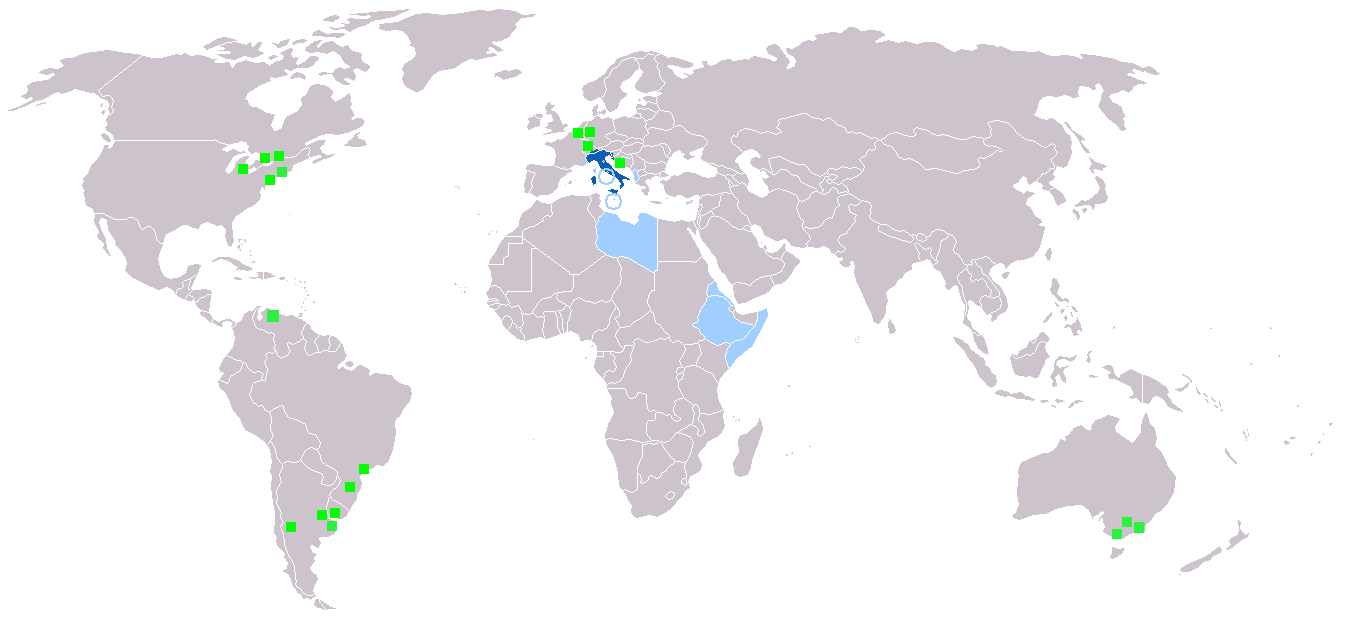
Italian is an official language in Italy, San Marino, Switzerland (Ticino and the Grisons), and Vatican City, and it has official minority status in Croatia, Slovenia (Istria), Romania, Bosnia and Herzegovina, and in 6 municipalities of Brazil. It is also spoken in other European and non-EU countries, most notably in Malta (by 66% of the population), Albania and Monaco, as well as by large immigrant and expatriate communities in the Americas, Australia and on other continents.
Italian is a major language in Europe, being one of the official languages of the Organization for Security and Co-operation in Europe and one of the working languages of the Council of Europe. It is the third-most-widely spoken native language in the European Union (13% of the EU population) and it is spoken as a second language by 13 million EU citizens (3%). Italian is the main working language of the Holy See, serving as the lingua franca in the Roman Catholic hierarchy and the official language of the Sovereign Military Order of Malta.
Italian influence led to the development of derivated languages and dialects worldwide. It is also widespread in various sectors and markets, with its loanwords used in arts, luxury goods, fashion, sports and cuisine; it has a significant use in musical terminology and opera, with numerous Italian words referring to music that have become international terms taken into various languages worldwide, including in English. Almost all native Italian words end with vowels, and the language has a 7-vowel sound system ("e" and "o" have mid-low and mid-high sounds). Italian has contrast between short and long consonants and gemination (doubling) of consonants.
The Italian language has developed through a long and slow process, which began after the Western Roman Empire's fall and the onset of the Middle Ages in the 5th century.
Latin, the predominant language of the western Roman Empire, remained the established written language in Europe during the Middle Ages, although most people were illiterate. Over centuries, the Vulgar Latin popularly spoken in various areas of Europe—including the Italian peninsula—evolved into local varieties, or dialects, unaffected by formal standards and teachings. These varieties are not in any sense "dialects" of standard Italian, which itself started off as one of these local tongues, but sister languages of Italian.
The linguistic and historical demarcations between late Vulgar Latin and early Romance varieties in Italy are imprecise. The earliest surviving texts that can definitely be called vernacular (as distinct from its predecessor Vulgar Latin) are legal formulae known as the Placiti Cassinesi from the province of Benevento that date from 960 to 963, although the Veronese Riddle, probably from the 8th or early 9th century, contains a late form of Vulgar Latin that can be seen as a very early sample of a vernacular dialect of Italy. The Commodilla catacomb inscription likewise probably dates to the early 9th century and appears to reflect a language somewhere between late Vulgar Latin and early vernacular.
The language that came to be thought of as Italian developed in central Tuscany and was first formalized in the early 14th century through the works of Tuscan writer Dante Alighieri, written in his native Florentine. Dante's epic poems, known collectively as the Commedia, to which another Tuscan poet Giovanni Boccaccio later affixed the title Divina, were read throughout the Italian peninsula. His written vernacular became the touchstone for elaborating a "canonical standard" that all educated Italians could understand. The poetry of Petrarch was also widely admired and influential in the development of the literary language, and would be identified as a model for vernacular writing by Pietro Bembo in the 16th century.
Hub AI
Italian language AI simulator
(@Italian language_simulator)
Italian language
Italian (italiano, pronounced [itaˈljaːno] ⓘ, or lingua italiana, pronounced [ˈliŋɡwa itaˈljaːna]) is a Romance language of the Indo-European language family. It evolved from the colloquial Latin of the Roman Empire, and is the least divergent language from Latin, together with Sardinian. It is spoken by 68 to 85 million people, including 64 million native speakers as of 2024. Some speakers of Italian are native bilinguals of both Italian (either in its standard form or regional varieties) and a local language of Italy, most frequently the language spoken at home in their place of origin.
Italian is an official language in Italy, San Marino, Switzerland (Ticino and the Grisons), and Vatican City, and it has official minority status in Croatia, Slovenia (Istria), Romania, Bosnia and Herzegovina, and in 6 municipalities of Brazil. It is also spoken in other European and non-EU countries, most notably in Malta (by 66% of the population), Albania and Monaco, as well as by large immigrant and expatriate communities in the Americas, Australia and on other continents.
Italian is a major language in Europe, being one of the official languages of the Organization for Security and Co-operation in Europe and one of the working languages of the Council of Europe. It is the third-most-widely spoken native language in the European Union (13% of the EU population) and it is spoken as a second language by 13 million EU citizens (3%). Italian is the main working language of the Holy See, serving as the lingua franca in the Roman Catholic hierarchy and the official language of the Sovereign Military Order of Malta.
Italian influence led to the development of derivated languages and dialects worldwide. It is also widespread in various sectors and markets, with its loanwords used in arts, luxury goods, fashion, sports and cuisine; it has a significant use in musical terminology and opera, with numerous Italian words referring to music that have become international terms taken into various languages worldwide, including in English. Almost all native Italian words end with vowels, and the language has a 7-vowel sound system ("e" and "o" have mid-low and mid-high sounds). Italian has contrast between short and long consonants and gemination (doubling) of consonants.
The Italian language has developed through a long and slow process, which began after the Western Roman Empire's fall and the onset of the Middle Ages in the 5th century.
Latin, the predominant language of the western Roman Empire, remained the established written language in Europe during the Middle Ages, although most people were illiterate. Over centuries, the Vulgar Latin popularly spoken in various areas of Europe—including the Italian peninsula—evolved into local varieties, or dialects, unaffected by formal standards and teachings. These varieties are not in any sense "dialects" of standard Italian, which itself started off as one of these local tongues, but sister languages of Italian.
The linguistic and historical demarcations between late Vulgar Latin and early Romance varieties in Italy are imprecise. The earliest surviving texts that can definitely be called vernacular (as distinct from its predecessor Vulgar Latin) are legal formulae known as the Placiti Cassinesi from the province of Benevento that date from 960 to 963, although the Veronese Riddle, probably from the 8th or early 9th century, contains a late form of Vulgar Latin that can be seen as a very early sample of a vernacular dialect of Italy. The Commodilla catacomb inscription likewise probably dates to the early 9th century and appears to reflect a language somewhere between late Vulgar Latin and early vernacular.
The language that came to be thought of as Italian developed in central Tuscany and was first formalized in the early 14th century through the works of Tuscan writer Dante Alighieri, written in his native Florentine. Dante's epic poems, known collectively as the Commedia, to which another Tuscan poet Giovanni Boccaccio later affixed the title Divina, were read throughout the Italian peninsula. His written vernacular became the touchstone for elaborating a "canonical standard" that all educated Italians could understand. The poetry of Petrarch was also widely admired and influential in the development of the literary language, and would be identified as a model for vernacular writing by Pietro Bembo in the 16th century.