
Recent from talks
Ivory gull
Knowledge base stats:
Talk channels stats:
Members stats:
Ivory gull
The ivory gull (Pagophila eburnea) is a small gull, the only species in the genus Pagophila. It is a resident breeding bird in the high Arctic and has a circumpolar distribution through Greenland, northernmost North America, and Eurasia.
The ivory gull was initially described by Constantine Phipps, 2nd Baron Mulgrave in 1774 as Larus eburneus from a specimen collected on Spitsbergen during his 1773 expedition towards the North Pole. Johann Jakob Kaup later noted the unique traits of the ivory gull and gave it a monotypic genus Pagophila in 1829. Johan Ernst Gunnerus later gave the species a new specific name, Pagophila alba.[dubious – discuss] The genus name Pagophila is from Ancient Greek pagos, "sea-ice", and philos, "-loving", and specific eburnea is Latin for "ivory-coloured", from ebur, "ivory". Today only a few authors consider the ivory gull not deserving of its monotypic genus, instead choosing to merge it, along with the other monotypic gulls, back into Larus. However, most authors have not chosen to do so. The ivory gull has no subspecies. No fossil members of this genus are known.
This gull has traditionally been believed to be most closely related to either the kittiwakes, Sabine's gull, or Ross's gull. It differs anatomically from the other genera by having a relatively short tarsometatarsus, a narrower os pubis, and potentially more flexibility in skull kinetic structure. Structurally, it is most similar to the kittiwakes; however, recent genetic analysis based on mtDNA sequences shows that Sabine's gull is the ivory gull's closest relative, followed by the kittiwakes, with Ross's gull, little gull, and swallow-tailed gull sharing a clade with this group. Pagophila is maintained as a unique genus because of the bird's morphological, behavioural and ecological differences from these species.
Colloquial names from Newfoundland include slob gull (from "slob", a local name for drift ice) and ice partridge, from a vague resemblance to a ptarmigan.
The ivory gull is 40–43 cm (16–17 in) long, with a wingspan of 108–120 cm (43–47 in); males weigh between 500–687 g (17.6–24.2 oz) and females between 448–583 g (15.8–20.6 oz).
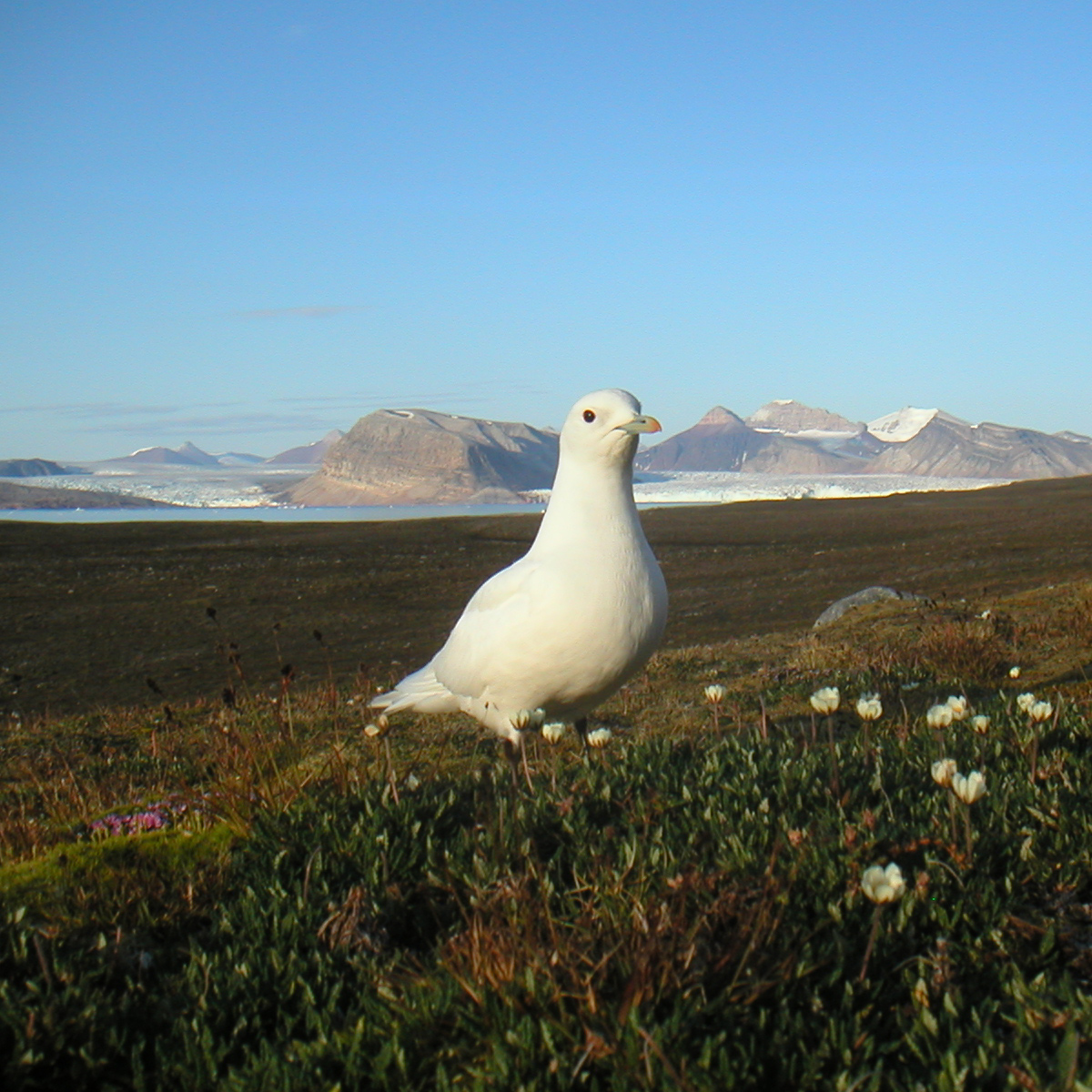
This species is easy to identify. It has a different, more pigeon-like shape compared to the Larus gulls, an impression reinforced by its short legs. The adult has completely pure white plumage, lacking the grey back of other gulls. The thick bill is blue with a yellow tip (occasionally with a reddish tip), and the legs are black. The eyes are dark, with a narrow dark red orbital ring. Juvenile and first-winter birds have a dusky face and variable amounts of black flecking in the wings and tail; they take two years to attain full adult plumage, with second-winter yearlings having an intermediate plumage with smaller dark spots and a less dusky face, though some second-winters resemble adults. In flight, it has long, broad-based wings, with a strong wingbeat reminiscent of skuas. Its flight call cry is a harsh, tern-like keeeer. It has many other calls, including a warbling "fox-call" that indicates potential predators such as an arctic fox, polar bear, glaucous gull, or human near a nest; a "long-call" given with wrists out, elongated neck and downward-pointed bill, given in elaborate display to other ivory gulls during breeding, and a plaintive begging call given in courtship by females to males, accompanied by head-tossing. There are no differences in appearance across the species' geographic range.
In Europe and Asia, it breeds on Svalbard, and the island archipelagos north of Russia. In North America, it only breeds in the Canadian Arctic. Seymour Island, Nunavut is home to the largest known breeding colony, while Ellesmere, Devon, Cornwallis, and north Baffin islands are known locations of breeding colonies. It is believed that there are other small breeding colonies of less than six birds that are still undiscovered. There are no records of the ivory gull breeding in Alaska.
During the winter, ivory gulls live near polynyas, or a large area of open water surrounded by sea ice. North American birds, along with some from Greenland and Europe, winter along the 2000 km of ice edge stretching between 50° and 64° N from the Labrador Sea to Davis Strait that is bordered by Labrador and southwestern Greenland. Wintering gulls are often seen on the eastern coasts of Newfoundland and Labrador and occasionally appear on the north shore of the Gulf of St. Lawrence and the interior of Labrador. It also winters from October through June in the Bering Sea and Chukchi Sea. It is most widespread throughout the polynyas and pack ice of the Bering Sea. It is also vagrant throughout coastal Canada and the northeastern United States, though records of individuals as far south as California and Georgia have been reported, as well as the British Isles, with most records from late November through early March. Juveniles tend to wander further from the Arctic than adults.
Hub AI
Ivory gull AI simulator
(@Ivory gull_simulator)
Ivory gull
The ivory gull (Pagophila eburnea) is a small gull, the only species in the genus Pagophila. It is a resident breeding bird in the high Arctic and has a circumpolar distribution through Greenland, northernmost North America, and Eurasia.
The ivory gull was initially described by Constantine Phipps, 2nd Baron Mulgrave in 1774 as Larus eburneus from a specimen collected on Spitsbergen during his 1773 expedition towards the North Pole. Johann Jakob Kaup later noted the unique traits of the ivory gull and gave it a monotypic genus Pagophila in 1829. Johan Ernst Gunnerus later gave the species a new specific name, Pagophila alba.[dubious – discuss] The genus name Pagophila is from Ancient Greek pagos, "sea-ice", and philos, "-loving", and specific eburnea is Latin for "ivory-coloured", from ebur, "ivory". Today only a few authors consider the ivory gull not deserving of its monotypic genus, instead choosing to merge it, along with the other monotypic gulls, back into Larus. However, most authors have not chosen to do so. The ivory gull has no subspecies. No fossil members of this genus are known.
This gull has traditionally been believed to be most closely related to either the kittiwakes, Sabine's gull, or Ross's gull. It differs anatomically from the other genera by having a relatively short tarsometatarsus, a narrower os pubis, and potentially more flexibility in skull kinetic structure. Structurally, it is most similar to the kittiwakes; however, recent genetic analysis based on mtDNA sequences shows that Sabine's gull is the ivory gull's closest relative, followed by the kittiwakes, with Ross's gull, little gull, and swallow-tailed gull sharing a clade with this group. Pagophila is maintained as a unique genus because of the bird's morphological, behavioural and ecological differences from these species.
Colloquial names from Newfoundland include slob gull (from "slob", a local name for drift ice) and ice partridge, from a vague resemblance to a ptarmigan.
The ivory gull is 40–43 cm (16–17 in) long, with a wingspan of 108–120 cm (43–47 in); males weigh between 500–687 g (17.6–24.2 oz) and females between 448–583 g (15.8–20.6 oz).
This species is easy to identify. It has a different, more pigeon-like shape compared to the Larus gulls, an impression reinforced by its short legs. The adult has completely pure white plumage, lacking the grey back of other gulls. The thick bill is blue with a yellow tip (occasionally with a reddish tip), and the legs are black. The eyes are dark, with a narrow dark red orbital ring. Juvenile and first-winter birds have a dusky face and variable amounts of black flecking in the wings and tail; they take two years to attain full adult plumage, with second-winter yearlings having an intermediate plumage with smaller dark spots and a less dusky face, though some second-winters resemble adults. In flight, it has long, broad-based wings, with a strong wingbeat reminiscent of skuas. Its flight call cry is a harsh, tern-like keeeer. It has many other calls, including a warbling "fox-call" that indicates potential predators such as an arctic fox, polar bear, glaucous gull, or human near a nest; a "long-call" given with wrists out, elongated neck and downward-pointed bill, given in elaborate display to other ivory gulls during breeding, and a plaintive begging call given in courtship by females to males, accompanied by head-tossing. There are no differences in appearance across the species' geographic range.
In Europe and Asia, it breeds on Svalbard, and the island archipelagos north of Russia. In North America, it only breeds in the Canadian Arctic. Seymour Island, Nunavut is home to the largest known breeding colony, while Ellesmere, Devon, Cornwallis, and north Baffin islands are known locations of breeding colonies. It is believed that there are other small breeding colonies of less than six birds that are still undiscovered. There are no records of the ivory gull breeding in Alaska.
During the winter, ivory gulls live near polynyas, or a large area of open water surrounded by sea ice. North American birds, along with some from Greenland and Europe, winter along the 2000 km of ice edge stretching between 50° and 64° N from the Labrador Sea to Davis Strait that is bordered by Labrador and southwestern Greenland. Wintering gulls are often seen on the eastern coasts of Newfoundland and Labrador and occasionally appear on the north shore of the Gulf of St. Lawrence and the interior of Labrador. It also winters from October through June in the Bering Sea and Chukchi Sea. It is most widespread throughout the polynyas and pack ice of the Bering Sea. It is also vagrant throughout coastal Canada and the northeastern United States, though records of individuals as far south as California and Georgia have been reported, as well as the British Isles, with most records from late November through early March. Juveniles tend to wander further from the Arctic than adults.
Recent media