Hubbry Logo
Jack DyerJack DyerMain
Open search
Jack Dyer
Community hub
Jack Dyer
logo
8 pages, 0 posts
0 subscribers
Be the first to start a discussion here.
Jack Dyer
Jack Dyer
from Wikipedia

Jim Park of Carlton, Dyer (age 24), and Phonse Kyne of Collingwood, at the Adelaide Oval, before the 1938 interstate match against South Australia

Key Information

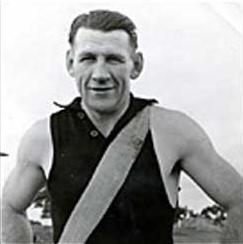
John Raymond Dyer Sr. OAM (15 November 1913[1] – 23 August 2003), nicknamed Captain Blood, was an Australian rules footballer who played for the Richmond Football Club in the Victorian Football League (VFL) between 1931 and 1949. One of the game's most prominent players, he was one of 12 inaugural "Legends" inducted into the Australian Football Hall of Fame. He later turned to coaching and work in the media as a popular broadcaster and journalist.

Early life

[edit]

Dyer was born in Oakleigh, now a south-eastern suburb of Melbourne, but grew up in the small farming hamlet of Yarra Junction on the Yarra River, approximately 60 kilometres (37 mi) east of the city. His parents, Ben and Nellie, were of Irish descent. The second of three children, Dyer had an elder brother, Vin, and a younger sister, Eileen. Dyer first played football at the Yarra Junction primary school. For his secondary education, Dyer was sent by his parents to St Ignatius in Richmond. He boarded in the city with an aunt. One of the brothers running the school offered Dyer a sporting scholarship to De La Salle College, Malvern. After leaving school with several sporting trophies, Dyer played with St Ignatius on Saturdays and with Richmond Hill Old Boys in a mid-week competition. Dyer's desire was to play for Richmond in the VFL as he admired one of the Tigers' players, George Rudolph.

Sporting career

[edit]

In 1930, Dyer won the Metropolitan League's award for the best player at the age of 16. Richmond officials had not yet attempted to sign him, and Dyer applied for a clearance to play with the Tigers' main rival, Collingwood. The Richmond officials wanted to see him in action before any decision was made and Dyer was in training with Richmond for the start of the 1931 season. Richmond's coach 'Checker' Hughes pitting Dyer against veteran Joe Murdoch in a practice session. Dyer hardly touched the ball and was disheartened about his prospects until Hughes consoled him by explaining the pairing with Murdoch was a trial of courage, not skill.

Hughes selected him for his debut in just the second game of the season, against North Melbourne. Dyer was made a reserve while the team achieved a VFL record score of 30.19 (199) in one of the biggest wins in VFL/AFL history. Hughes left Dyer on the bench. It was the height of the Great Depression and the going rate for the players was 3 pounds per match, but Richmond only paid half that for unused reserves, so Hughes saved the club thirty shillings on the day. Dyer got another couple of chances and showed some form, but by mid-season found himself in the seconds team, with players who were not quite league standard, but wanted to stay on at the club and earn an extra few shillings per week to support their families.

At one point, Dyer walked away from Richmond for a few weeks and returned to suburban football. Club secretary Percy Page persuaded him back by promising to clear any recalcitrant players. In the run up to the finals, with Richmond sitting second on the ladder, ruckman Percy Bentley went down with an injury that ended his season. Hughes included Dyer in the Tigers' team for the second semi final against Geelong. Playing mainly up forward, the unknown Dyer played a successful game, kicking three goals. In the Grand Final a fortnight later, again against Geelong, Geelong used their player and coach "Bull" Coghlan playing on Dyer. Coghlan played roughly against Dyer; Dyer had only four touches for the day and admitted many years later to being intimidated.

In 1932, partnering Bentley in the ruck, Dyer played successfully in the first half of the season before suffering a serious knee injury that put him out for the rest of the year. In ten matches, Dyer received 12 Brownlow medal votes[2] for four best afield performances. He was chosen for Victoria after fewer than a dozen league matches. On Grand Final day, Dyer was back in reserve as his teammates won Richmond's third premiership after several finals failures.

Dyer did reappear in 1933, wearing a dirty knee bandage. In his own phrase, Dyer was unable to "turn off" or "pull up" and he sometimes collected a teammate if his timing was out. In the Grand Final against South Melbourne, Richmond lost by eight goals, but Dyer achieved thirty touches. In the following year's Grand Final, the Tigers won in a rematch with the Swans. Richmond's successfully used a ruck combination of Bentley, Dyer and rover Ray Martin.

Captain Blood

[edit]
An oft-reproduced 1949 photograph of Dyer appearing to "decapitate" St Kilda's Tom Meehan

The number of on-field incidents grew, and, after a particularly difficult game during 1935, newspaper cartoonist John Ludlow in The Age drew a picture of Dyer as a pirate, while a journalist nicknamed him Captain Blood after the Errol Flynn film Captain Blood. Initially, Dyer was angry at the connotation and the implied slur on his sportsmanship. Dyer preferred the hip-and-shoulder method of meeting an opponent rather than grabbing him in a tackle. The force of being hit by the athletic, 89 kg frame of Dyer was often enough to leave a player prostrate and not wanting to re-enter the fray for a while. Occasionally, the hip and shoulder could go awry and Dyer's forearm would come into play, which was a reportable offence. In a nineteen-year career, he was reported five times and suspended once.

Dyer was keen to take on a coaching role, and he had reportedly been promised the position of playing coach by the Richmond committee at the end of 1939 before it reneged and re-appointed Percy Bentley. As a consequence, Dyer announced that he would not play for Richmond in 1940.[3] He received a lucrative offer to become captain-coach of the Yarraville Football Club in the Victorian Football Association (which, at the time, was aggressively recruiting VFL stars to play under its new throw-pass rules), and he lodged a request with Richmond for a clearance to the VFA club.[4] Richmond rejected the clearance, and Dyer was unwilling to transfer without a clearance (even though one was not required at the time).[5] Dyer ultimately decided to remain with Richmond as a player in 1940, and he was appointed captain-coach in 1941.

He went on to play 312 games for Richmond, being voted the club's best and fairest player in 1937, 1938, 1939, 1940, and 1946. He played in seven Grand Finals for two premierships in 1934 and 1943, one as captain and playing coach of the side.

Dyer was a ruckman; and, at 6 ft 1 in (185 cm), was not particularly tall for that position. Possessed of great strength, he was adept at punching the ball out of a pack contesting a mark, often sending the ball more than 40 yards.[6]

In 1947, Dyer crashed into Melbourne's Frank Hanna in round 15. The umpire cleared him for rough conduct, though Hanna was knocked unconscious. Don Cordner checked his pulse and Hanna was covered with a blanket, including his head, and was carried off on a stretcher. Dyer thought he had killed Hanna. By three-quarter time, he still believed he had killed him until he asked a Demon player about Hanna's condition, and Hanna had recovered.

He was selected as an interchange player in the AFL's 1996 Team of the Century". He gradually played less as a ruckman and more as a forward later in his career. He invented the drop punt, a kicking style that gradually gained popularity over the intervening decades and is now almost universal, and has now spread to Rugby union, rugby league and American football. He kicked 443 goals, fifth on Richmond's list of all-time goalkickers.

In 2009, The Australian nominated Dyer as one of the 25 greatest footballers never to win a Brownlow medal.[7]

The "Jack Dyer Medal" is awarded each season to the winner of the Richmond Football Club's best and fairest count. Since the 2000s, the Richmond captain has automatically switched to wearing guernsey number 17, the number worn by Dyer throughout his career. But when Trent Cotchin took over the captaincy of the Tigers in 2013, he continued wearing his number 9.

Rescindment of Dyer's 1932 best and fairest award

[edit]

Following a 19-year investigation undertaken by members of the Historical Committee, no evidence was found to have any winner of a "Best and Fairest Award" for Richmond in 18 of the seasons between 1911 and 1936. It is thought that the awards in question were retrospectively added in 1988 and 1991 in error. As a consequence, he now shares his Richmond best and fairest tally record of 5 with fellow AFL Legend Kevin Bartlett.

Personal life

[edit]
External images
image icon Caricature of Jack Dyer by Alex Gurney.
Source: The Australian Cartoon Museum.
image icon Jack Dyer's Milk Bar,
394 Church Street, Richmond.

Source: The Richmond Library.

He married Sybil Margaret McCasker, the cousin of Keith "Bluey" Truscott,[8] on 25 November 1939 at St Ignatius' Church, Richmond.[9]

After an assortment of jobs in his early adulthood, Dyer joined the police force in July 1935. Dyer served in the police for nine years, before he resigned to conduct a milk bar, The Tiger Milk Bar and Newsagency at 394 Church Street, Richmond.[10] In 1949 he became the publican at the Foresters' Arms Hotel in Port Melbourne,[11] and in 1952, the publican at the Post Office Hotel in Prahran.[12]

On 8 March 1940, Richmond announced that they had refused the recently married Dyer a clearance to coach VFA club Yarraville; and Dyer stated that he would not cross to Yarraville without a clearance.[13]

He and his wife Sybil had two children, Jack Jr (Jackie, born 15 December 1940) and Jill (married name Devine). Jackie had a brief career at Punt Road from 1959 to 1961, playing three games, but retired from all football aged just 23.

Following Sybil's sudden death in 1968,[14] Dyer met Dorothy Eskell, with whom he spent 25 years. Dorothy supported him in his media career, and they lived together in Frankston. In his final years, Dyer lived in a nursing home.

Media career

[edit]

After retiring from coaching, Dyer turned to the media, where he became a commentator and football media personality. He contributed to two sports/comedy offerings on Melbourne television: World of Sport, a Sunday morning panel show; and, later, League Teams, a Thursday-night variant which later inspired AFL Footy Show. He also had a regular column which went under the name "Dyer 'ere" (a pun on diarrhoea) in Melbourne's Truth newspaper.

His media work began after resigning from the coaching position at Richmond. Dyer, along with former Collingwood captain Lou Richards, became an early television commentator on Australian football after the medium was introduced to Australia in 1956.

Dyer also was a radio broadcaster – for many years, he and Ian Major called football matches for radio station 3KZ (KZ-FM after the station converted to FM in 1990) as The Captain and The Major.

"Dyerisms"

[edit]

According to various historical articles, videos, quotes on the official Richmond website, and press obituaries, Dyer was responsible for many malapropisms, witticisms, and comical gaffes, including:

  • "Yes, we had an enjoyable time on the French Riverina" (the Riverina is a highly productive agricultural region of south-western New South Wales), and he described the problems with younger players by saying that "All they want to do is sit around and smoke marinara".

Other memorable quotes include:[15][16]

  • "I won't say anything in case I say something."
  • "Bartlett's older than he's ever been before."
  • "Johnston missed one from the 10-yard square – it was impossible to miss that."
  • "The only way to tackle Justin Madden is... I don't know."
  • "That's the beauty of being small – your hands are close to your feet."
  • "Bamblett made a great debut last week, and an even better one today."
  • "The ball goes to Marceesie ... Marcheson ... McKann, er ..." before co-commentator Ian Major interjected: "Actually, Jack, I don't think Marchesani was in that passage of play."
  • "Mark Lee's long arms reaching up like giant testicles."
  • "It's as dark out there as the Black Hole of Dakota."
  • "The goal posts are moving so fast I can't keep up with the play."
  • And on World of Sport, Dyer declared that Fitzroy had "copulated to the opposition"
  • “He keeps getting where the ball ain't.”
  • Henshaw passes the ball to Kelly, and Kelly gives a Henshaw to Glendinning.”
  • “There weren’t too many best mans on the ground.”
  • If you don't mind, umpire, please!
  • “He’s tuckled strongly by Tack.”
  • During his coaching career at Richmond, Jack once instructed his players in a training session to “pair off in threes”.
  • He once said that he hated Collingwood so much, he couldn't even watch black-and-white TV.

Retirement

[edit]

Retiring from the media in the early 1990s, when KZ-FM stopped broadcasting football, Dyer successfully led opposition to an AFL proposed merger of his old club with St Kilda in 1989.[17]

Photograph from 1944 Essendon match

[edit]
The iconic photograph
A statue based on the photograph, located at Punt Road Oval

A photograph was taken of Richmond captain-coach Dyer, aged 30 and playing his 222nd game, wearing white strapping on his left thumb and a dirty knee bandage on his left knee, breaking away from the pack, with his eyes fixed on the lake-end goals (Dyer went on to kick a goal) in the last quarter of the 1944 Preliminary Final, held at the Junction Oval on Saturday 23 September 1944, in which Richmond defeated Essendon, primarily due to Dyer's nine goals.

Led by a four-goal burst by Dyer, who was playing at full-forward,[18] Richmond scored 8.2 (50) to 0.5 (5) in the first quarter (kicking against the wind); and, although Essendon outscored Richmond in the last three quarters, Richmond won the match 16.12 (108) to 12.15 (87).[19]

Dyer's performance that day was one of the best individual performances by a Richmond player in the club's history.[20] A match reporter for The Argus, in an article titled "Dyer's Grand First Quarter", wrote:[21]

Rarely has a higher standard of play been seen in a first quarter in second-round games. Clapping on the pace, and with the ball the objective all through, Richmond played a strong, concerted game. With Dyer the spearhead after the first few minutes, the strong captain-coach played one of the finest games in his career to kick four of the eight goals scored [in that quarter] and take a hand in at least three others. He showed dash, cleverness, anticipation, and good marking to outwit the opposition, and, with [Leo] Merrett darting in and out of the packs to lead attacks from the wing, and the rucks functioning well, the bombardment was so intense that Essendon wilted.

The photograph, which also appeared on the cover of the Australian Post's $4.50 booklet of ten "Richmond Tigers" postage stamps issued in 1996 as part of the "centenary of the AFL" celebrations,[22] has also been the basis for:

  • The logo of The Footy Show,
  • Mitch Mitchell's statue of Dyer at Punt Road Oval,[23][24]
  • A set of four paintings by John Balmain of Ron Todd, Jack Dyer, John Coleman, and Alex Jesaulenko, issued in 1996 to celebrate the VFL/AFL centenary. All were taken from photographs; Dyer's was taken from the photograph of his break to score his ninth goal. It was also painted by Darcy Doyle,[25] which was also used on the front cover of Brian Hansen's 1996 book.[26]

Order of Australia Medal (OAM)

[edit]

John Raymond Dyer was awarded the Medal of the Order of Australia in the General Division (OAM), in the 1990 Queen's Birthday Honours List, "for service to Australian Rules Football".[27]

See also

[edit]

References

[edit]

Bibliography

[edit]
[edit]
Revisions and contributorsEdit on WikipediaRead on Wikipedia
from Grokipedia
John Raymond Dyer OAM (15 November 1913 – 23 August 2003), better known as Jack Dyer and nicknamed "Captain Blood" for his fearless and aggressive playing style, was an Australian rules footballer, coach, and media personality renowned for his contributions to the sport in Victoria. He played 311 games and kicked 443 goals for the in the (VFL) from 1931 to 1949, establishing himself as one of the game's toughest and most influential players. Dyer also popularized the drop punt kick, a technique that became the standard method for long-distance kicking in . Born in , Dyer moved to Yarra Junction as a child and developed his skills in junior leagues, earning scholarships to De La Salle College and St Ignatius College through his football prowess. He debuted for Richmond in 1931 after seeking a clearance from Collingwood and quickly rose to prominence, winning five club awards (1937–1940, 1946; the 1932 award was rescinded in 2019) and captaining the team from 1941 to 1949. As captain-coach from 1941 to 1949, he played in Richmond's 1934 premiership victory and led the team to the 1943 flag, and he represented Victoria 16 times, captaining the state side in 1941 and 1949. Dyer was reported five times for rough play during his career but was suspended only once for four weeks, reflecting his hard-nosed reputation earned from early days with the "Richmond Hill Mob" junior team. After retiring as a player in 1949—with his final kick scoring a goal against —Dyer continued coaching Richmond until 1952, achieving 134 wins in 222 games. He later served on the club's committee in the 1950s and 1960s, contributing to recruiting efforts, and pursued diverse occupations including policeman, proprietor, and hotelier. In media, Dyer became a prominent commentator on radio stations like 3UZ and 3KZ from 1953 to 1991 and as a panellist on World of Sport, while also authoring The Wild Men of Football and unsuccessfully running for the Australian Labor Party in the 1966 . Dyer's legacy endures through numerous honors: he was named captain of Richmond's , included in the AFL Team of the Century in 1996, and inducted as a in the Australian Football Hall of Fame. He received the Medal (OAM) in 1990 for services to football and was enshrined in the Sport Australia Hall of Fame in 1992, cementing his status as an immortal of the game.

Early life

Family background and childhood

John Raymond Dyer was born on 13 November 1913 in Oakleigh, a suburb of , Victoria, to parents Ben and Nellie Dyer, with his father of Irish descent. He was the second of three children, with an elder brother named Vin and a younger sister, Eileen, who was born after the family's relocation. As a young child, the family moved to a small in Yarra Junction, approximately 80 kilometers east of , seeking opportunities in the rural setting. This shift immersed the young Dyer in the rhythms of 1920s rural life in the Yarra Valley, a region known for its timber resources and agricultural communities, where family bonds and local interactions fostered resilience amid modest circumstances. The family returned to the city, settling in the working-class area of Richmond, in 1927. Dyer's early education took place at Yarra Junction Primary School, where he first engaged with school-based activities, including physical pursuits that introduced him to organized play. Upon returning to , he earned scholarships to both St Ignatius College and De La Salle College in Richmond due to his football ability, attending St Ignatius where he left formal schooling at age 14 in 1927 due to the onset of the but continued to play for the school's team. These formative years in both rural and urban environments provided initial exposure to a range of sports through school and community settings, beyond his later specialization in . This background transitioned into his adolescent involvement in organized football.

Introduction to Australian rules football

Jack Dyer's introduction to Australian rules football occurred during his childhood in the rural town of Yarra Junction, where he first played the game at the local in 1926, often in bare feet on makeshift grounds. This early exposure laid the foundation for his passion for the sport, though opportunities were limited in the remote timber country. In 1927, Dyer's family relocated from Yarra Junction back to the area, providing greater access to organized football through urban schools and leagues. He attended St Ignatius College in Richmond, where he honed his skills in the school's team from 1927 to 1930, contributing to premiership victories in 1927 and 1930 while earning the Metropolitan League award in his final year. These standout junior performances caught the attention of scouts, leading to his recruitment and invitation to try out with the club in 1930. Transitioning to senior-level preparation, Dyer impressed in Richmond's reserves team in the VFL seconds competition, playing 12 games and kicking 7 goals in , though observers noted his raw talent required refinement in kicking accuracy. At the age of 17 upon his impending debut, he stood at 185 cm tall and weighed approximately 89 kg, positioning him ideally as a powerful ruckman with the physical presence to dominate contests.

Football career

Playing career with Richmond

Jack Dyer made his Victorian Football League (VFL) debut for Richmond in Round 2 of the 1931 season against at , at the age of 17. He played six games that year, marking the beginning of a remarkable tenure with the Tigers that spanned 19 seasons from 1931 to 1949. Over this period, Dyer appeared in 311 games and kicked 443 goals, establishing himself as one of the club's most enduring figures. Throughout his career, Dyer demonstrated exceptional positional versatility, excelling as a ruckman, ruck-rover, and forward. His ability to adapt across these roles was pivotal in Richmond's 1934 premiership victory, where he contributed significantly in the ruck and forward lines during the grand final win over . This success highlighted his early impact, as he helped drive the team's dominant midfield and attacking play. Additionally, his tough playing style, which later earned him the moniker "Captain Blood," was evident from his debut years, underscoring his fearless approach on the field. Dyer's consistency was reflected in his statistical highlights, including five club best and fairest awards in 1937, 1938, 1939, 1940, and 1946. He also represented Victoria in 16 interstate matches, showcasing his elite status beyond club level. These accolades underscored his dominance, particularly in the ruck where his height of 185 cm and physicality set him apart. The era brought challenges to the VFL, with seasons interrupted by reduced rounds, fewer teams, and player enlistments affecting competition depth from 1942 to 1945. Dyer continued playing through these years, maintaining his form despite the disruptions, and returned strongly in 1945 as the league resumed fuller operations post-war. His resilience during this period, playing in 18 games that season alone, helped stabilize Richmond's lineup amid broader football uncertainties. Dyer retired at the end of the 1949 season, concluding a career defined by longevity and versatility.

Coaching role and premierships

Dyer was appointed as captain-coach of the in 1941, a role he took on after the club declined to increase the salary of previous coach Percy Bentley, leading to his own salary reduction from £10 to £7 per week. As captain-coach, he combined leadership on and off the field, drawing on his established reputation as a formidable ruckman to guide the team through the challenges of . Over his coaching tenure from 1941 to 1952, Dyer led Richmond in 222 games, securing 134 wins, 86 losses, and 2 draws. This period included five finals appearances, with the team reaching grand finals in three consecutive years from 1942 to 1944. After retiring as a player at the end of the 1949 season, he continued as non-playing coach through 1952, focusing on rebuilding the squad amid post-war transitions, though the Tigers finished sixth in both 1950 and 1951 before placing ninth in 1952, leading to his dismissal. The pinnacle of Dyer's coaching success came in 1943, when he guided Richmond to the VFL premiership as captain-coach, defeating Essendon by 5 points in a tightly contested at the . This victory, Richmond's first flag in nine years, was achieved under wartime pressures, including managing player absences due to ; a notable example was ruckman Jack Broadstock, who went AWOL from duties but returned after the win with Dyer's intervention to avoid severe penalties. The 1943 triumph highlighted Dyer's tactical acumen, such as deploying Max Oppy to neutralize Essendon's star , contributing to the Tigers' resurgence. Dyer's coaching philosophy centered on instilling toughness and team discipline, reflecting his own fearless and aggressive playing style that earned him the nickname "Captain Blood." During the wartime era, he emphasized player development by fostering resilience and among a depleted roster, inspiring teammates to perform at elevated levels despite constraints like enlistments and limited training resources. Contemporaries, including Melbourne's , credited Dyer's leadership for lifting Richmond players to "unbelievable heights," underscoring his ability to build a cohesive unit through motivation and strategic preparation.

Notable achievements and controversies

Dyer's most notable individual achievement was winning Richmond's award on five occasions: 1937, 1938, 1939, 1940, and 1946. These victories, including four consecutive from 1937 to 1940, underscored his exceptional consistency and established him as tied with Kevin Bartlett for the most in club history—a record that highlighted his pivotal role in elevating Richmond's standards during a competitive era in VFL football. A significant point of contention in Dyer's accolades involves the award. Long attributed to him in historical accounts and club lore, a comprehensive investigation by Richmond's and Tradition Committee found no contemporary evidence—such as annual reports, media coverage, or memorabilia—to confirm it was ever awarded, leading to its removal from official records. Dyer's family expressed strong disagreement, vowing to challenge the decision and emphasizing his documented performance that season despite missing games due to injury. At the time of his in , Dyer held Richmond's record for most senior games played with 311, a benchmark that symbolized his extraordinary longevity and reliability over nearly two decades. He also made substantial contributions to interstate football, representing Victoria in 16 matches and captaining the side in 1941 and . Notably, he played a key role in Victoria's victory at the 1937 Perth Carnival, defeating in the final before a crowd of 40,000. Dyer's aggressive playing style drew frequent scrutiny from umpires and the during , reflecting the era's tensions over physicality in the game. In 1933, for instance, he was charged with kicking and striking an opponent during a match against Hawthorn but was cleared after a tribunal hearing. Such incidents, often resulting in reports but seldom suspensions, fueled perceptions of targeted officiating against his hard-hitting approach, though they also affirmed his reputation for operating within the rough boundaries of 1930s VFL play.

Nickname and playing style

Origin of "Captain Blood"

The nickname "Captain Blood" was coined in 1935 by John Ludlow, the cartoonist for newspaper, following a particularly aggressive performance by Jack Dyer in a match against Fitzroy at . Inspired by the recently released Errol Flynn Captain Blood, which portrayed a swashbuckling pirate, the moniker captured Dyer's fearless and bruising style of play, evoking images of relentless combat on the field. The cartoon appeared just two days after the game, depicting Dyer with a in his mouth, marking the first public association of the name with the Richmond ruckman. Early adoption of the appeared in media coverage, where it highlighted Dyer's involvement in robust incidents such as high tackles and contested marking contests that exemplified his intimidating presence. By , The Age explicitly referenced Dyer as "Captain Blood" in articles, solidifying its use beyond the initial cartoon. During the , the epithet evolved to become emblematic of Richmond's hard-edged, no-compromise team style, with Dyer's reputation for toughness amplifying the club's fearsome aura in VFL competitions. In later reflections, Dyer embraced the nickname as a reflection of his unyielding commitment to victory. He often leaned into the persona during his media career, transforming it from a descriptor of his on-field ferocity into a celebrated part of his enduring legacy in .

Reputation, toughness, and innovations

Jack Dyer was renowned for his aggressive style of play, particularly in ruck contests where he dominated with powerful tapping to advantage his rovers, often overpowering opponents through sheer physicality and strategic positioning. His strong marking ability, described as brilliant by contemporaries, allowed him to secure possessions in contested situations, combining height and timing to outmaneuver taller rivals. These traits contributed to his reputation as an intimidating force, with observers noting that Dyer "mowed down the opposition" and protected his teammates fiercely, earning both respect and fear across the VFL. Dyer's toughness solidified his status as one of the VFL's hardest players during a rugged era, where he endured and inflicted physical confrontations without hesitation. Anecdotes highlight his resilience, such as an incident where he charged down a Footscray opponent with a while bouncing the , demonstrating his fearlessness under pressure. He faced intense umpiring scrutiny for his robust tactics, yet his bravery in ruck duels and willingness to "run through walls" inspired teammates and intimidated rivals, with one player recalling the terrifying sight of Dyer charging at full speed. His nickname "Captain Blood" further reinforced this image of unrelenting aggression and durability. Dyer's most notable innovation was perfecting the drop punt kick in the 1930s and 1940s, transforming it from a rudimentary short-pass technique used by Collingwood's Collier brothers into a precise, long-range tool for set shots and general play. By dropping the ball and striking it with the instep to induce back-spin, he achieved greater accuracy over distances up to 40 yards, addressing the limitations of the traditional punt 's inconsistency through the narrow 21-foot goalposts. In his 1965 autobiography, Dyer emphasized practicing this method extensively in paddocks to build confidence, noting, "There is no excuse for missing a from 40 yards with the correct use of the drop punt," which he first employed as a set . This advancement enhanced goal-kicking reliability and passing precision, influencing the evolution of by establishing the drop punt as the game's standard kicking style.

Personal life

Marriage and family

Jack Dyer married Sybil Marguerite McCasker on 25 November 1939 at St Ignatius' Church in . The couple's marriage lasted nearly three decades until Sybil's death on 22 May 1968 in . They had two children: son John Raymond "Jack" Dyer Jr., born on 14 December 1940, who briefly followed in his father's footsteps by playing three senior games for Richmond in the during the 1960 season; and daughter Jill, who later married and became known as Jill Devine. The Dyer family resided in Melbourne's inner suburbs, initially in Richmond where Jack had grown up, before later managing a hotel in and a with Sybil to supplement their income amid the demands of his football career. Sybil provided steadfast support during Dyer's extensive travels for matches and training, maintaining the household while he balanced professional commitments with family responsibilities. The children also engaged with football, with Jack Jr.'s brief VFL stint reflecting the sport's influence on family life. Following Sybil's passing, Dyer formed a long-term companionship with Dorothy Eskell, with whom he shared 25 years until his death in 2003. This relationship offered continued personal stability amid his later media engagements and public life in Melbourne.

Other occupations and interests

Before his prominent football career took hold, Dyer worked as a police officer for the Victoria Police Force for approximately 10 years, starting in the mid-1930s, where his physical fitness from sport aided his duties in stations including Russell Street and the Footscray Bicycle Unit. Following and his resignation from the police, Dyer transitioned into business ownership to support his family and leverage his local fame in Richmond. He opened and operated and Newsagency at 394 Church Street in Richmond, serving as a community hub where he personally attended to customers, including offering ice creams to children. Later, in the and , he expanded into other ventures, including running a flower shop and working as a publican, managing a that contributed to his financial stability after football. These enterprises marked a shift from his athletic earnings to entrepreneurial pursuits, allowing him greater flexibility amid his growing media commitments. Dyer's personal interests extended beyond football to other sports and leisure activities, reflecting his competitive nature; he was a district tennis champion, a skilled snooker player (though it occasionally irked his father), and an accomplished cricketer as an opening batsman who once scored 200 not out against a side. He also maintained strong community ties, serving on the committee during the 1950s and 1960s, assisting with recruiting efforts, and later advocating for the club's stability, and support for the 1990 "Save Our Skins" campaign. After concluding his coaching tenure with Richmond in 1952, Dyer deliberately avoided full-time roles, preferring to focus on , family, and emerging media opportunities that aligned with his post-playing lifestyle.

Media career

Broadcasting roles in radio and television

After retiring from coaching in 1952, Jack Dyer transitioned into broadcasting, beginning his radio career in 1953 with stations 3UZ and 3KZ in , where he provided live commentary on (VFL) matches alongside Ian Major on 3KZ, forming the popular duo known as "The Captain and the Major." This role allowed Dyer to cover games from across the league, bringing his firsthand experience as a player to vivid play-by-play descriptions that captivated listeners during an era when radio was a primary medium for sports coverage. Dyer's television presence became prominent in the 1960s through HSV-7, where he served as a long-term panelist on the Sunday morning program World of Sport, which ran from 1959 to 1987 and featured discussions on VFL games, player performances, and league news. He also contributed to the League Teams panel show on the same network during the 1960s and 1970s, alongside former players and Bob Davis, offering post-match analysis and previews in a format that blended expert insights with lively debate. These roles solidified his status as a staple of sports television, reaching wide audiences through HSV-7's broadcasts. As a , Dyer's style emphasized straightforward analysis of tactics and player abilities, often infused with his evident loyalty to Richmond, while his avuncular and humorous delivery engaged younger viewers by making complex game elements accessible and entertaining. He frequently referenced his "Captain Blood" in broadcasts to add personality to his commentary. Spanning over 40 years until the early 1990s, Dyer's media tenure significantly shaped public perceptions of , enhancing its popularity through his authentic voice and enduring connection to the . In addition to , Dyer co-authored The Wild Men of Football with Brian Hansen in 1968, contributing to football literature through anecdotes and insights from his career.

Famous "Dyerisms" and public persona

Jack Dyer was renowned for his collection of memorable phrases, known as "Dyerisms," which emerged from his decades-long career in radio and television commentary. These sayings often featured humorous malapropisms, blunt critiques, or colorful exaggerations that captured the intensity of matches. Originating primarily during his live broadcasts on stations like 3KZ and Channel Seven's World of Sport, Dyerisms reflected his straightforward, no-nonsense style, endearing him to fans despite occasional confusion or criticism. For instance, he once described a player's positioning as "He keeps getting where the ball ‘aint," highlighting poor in a way that became instantly quotable. Other classic examples included "Bartlett’s older than he’s ever been before," a wry comment on aging Kevin Bartlett, and "An Essendon supporter is a Collingwood supporter who can read and write," a pointed jab at rival fans that showcased his tribal loyalty to Richmond. Dyer's phrases like "I won't in case I say something" demonstrated his self-deprecating humor during tense moments, while more vivid ones, such as "Mark Lee’s long arms reaching up like giant testicles," added a layer of earthy, unfiltered commentary that fans adored for its authenticity. These originated in the heat of live calls, where Dyer's gravelly voice and quick wit turned ordinary observations into enduring football , often drawing laughter from audiences even as they critiqued performances. Dyer's public persona contrasted his on-field "Captain Blood" reputation for toughness with a warm, approachable demeanor off the field, masking a gruff exterior with genuine kindness and loyalty. He frequently appeared at events, delivering inspiring talks to players and engaging with supporters, as seen in his visits to where he connected personally with emerging talents like Roger Dean. Though specific charity involvements were less documented, Dyer's community presence extended to club fundraisers and fan gatherings, reinforcing his role as a beloved elder statesman of the sport. His personality—described by peers as gentle, encouraging, and devoid of conceit—further solidified this image, making him a figure who bridged the fierce competitiveness of the game with everyday humility. The cultural impact of Dyerisms has been profound, with many phrases entering the broader AFL lexicon as shorthand for witty or critical commentary. They have been compiled in books like Tony Hardy's Finding Jack Dyer: The Remarkable Story of a Football Legend, which excerpts numerous examples and explores their role in immortalizing Dyer's voice in fan lore. These sayings continue to be celebrated in Richmond club publications and supporter discussions, symbolizing the humor and passion that defined Australian football culture during and after Dyer's era.

Later years and legacy

Retirement activities and honors

Following his retirement as coach of the at the end of the 1952 season, Jack Dyer remained actively involved with the club in advisory capacities. He served as vice-president from 1956 to 1963, providing guidance during a challenging period for the team. Dyer also sustained a prominent media career well into his later years, working as a radio commentator until 1992 and subsequently as a newspaper columnist through the 1990s. His contributions to broadcasting extended over three decades, cementing his role as a beloved voice in . In recognition of his lifelong service to the sport, Dyer was awarded the Medal of the (OAM) in the 1990 Queen's Birthday Honours for services to . He was inducted into the Australia Hall of Fame in 1992, honoring his broader impact on Australian . Further accolades followed in 1996, when he became one of the inaugural Legends inducted into the Australian Football Hall of Fame. The pays ongoing tribute to Dyer through the Jack Dyer Medal, which has been awarded annually since to the club's player.

Death and immediate tributes

John Raymond Dyer, widely known as Jack "Captain Blood" Dyer, passed away on 23 August 2003 at the age of 89 in Box Hill Hospital, , following a long illness that culminated in . He had been transferred from a in after falling ill earlier that week. His son, Jack Dyer Jr., stated that his father died peacefully without pain, noting that doctors had indicated the pneumonia was a battle he could not win. Dyer's funeral was held on 27 August 2003 at St Ignatius Catholic Church in Richmond, , drawing more than 1,000 mourners including family, friends, fans, and AFL dignitaries. Eulogies delivered by former Richmond champion Kevin Bartlett and ex-Geelong player Bob Davis highlighted Dyer's enduring legacy as a formidable player, innovative coach, and beloved media personality who bridged generations in Australian football. The current Richmond team formed a outside the church, while a public tribute at featured the release of 312 balloons—symbolizing each VFL game Dyer played—and a rendition of the club's theme song by supporters. In immediate response, honored Dyer with a minute's silence before their round 22 match against Hawthorn on 30 August 2003, as players from both teams stood arm-in-arm on the field. Media outlets, including radio station 3KZ—where Dyer had long commentated matches—and television network HSV-7, aired special segments and retrospectives celebrating his career and contributions to the sport. Family members maintained a private period of mourning following the public ceremonies, with Dyer buried at alongside his wife, Sybil.

Memorials, awards, and enduring recognition

In 2003, shortly after Jack Dyer's death, a three-metre bronze statue of him was unveiled at , Richmond's headquarters, depicting the iconic mark he took during the 1944 VFL preliminary final against Essendon, where he kicked nine goals. The sculpture, created by artist and commissioned by the , stands as a permanent tribute to Dyer's physical prowess and leadership on the field. Dyer's image appeared on a 1996 Australia Post stamp booklet issued for the AFL centenary, featuring the Richmond Tigers and highlighting his legendary status with a photograph from one of his goal-scoring moments. The club has continued annual tributes to mark anniversaries of his passing, such as the 10th anniversary commemoration in 2013, where Richmond published reflections on his enduring impact as the club's greatest player. These remembrances extend his legacy through club media and events, reinforcing his role in Richmond's history. Richmond briefly honored Dyer with a in the late where captains wore number 17, his lifelong number, to symbolize and toughness; this practice ended in 2013. Fans reference his "Captain Blood" nickname in chants and supporter culture, evoking his fearless style, while documentaries like "Footy's Wild Men" ( series re-aired post-2003) explore his career and the moniker derived from his bruising physicality. His influence on AFL physicality persists, with Dyer credited for popularizing aggressive tactics like bone-jarring shirt-fronts that shaped the game's intensity. Posthumous biographies, such as Tony Hardy's "Finding Jack Dyer" (2013), delve into his life and contributions, drawing on archives to examine his innovations and cultural significance beyond the field. These works, along with club-maintained archives, ensure Dyer's story remains a of AFL heritage, inspiring ongoing discussions of resilience in the . In August 2025, the Jack Dyer Stand at was demolished as part of a project to build new facilities, while preserving his legacy through other tributes.

References

Add your contribution
Related Hubs
User Avatar
No comments yet.