Hubbry Logo
James EverardJames EverardMain
Open search
James Everard
Community hub
James Everard
logo
8 pages, 0 posts
0 subscribers
Be the first to start a discussion here.
James Everard
James Everard
from Wikipedia

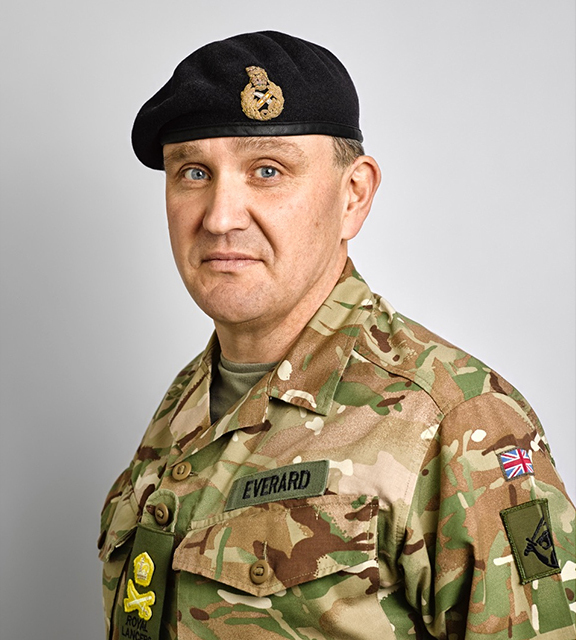
General Sir James Rupert Everard, KCB, CBE (born 23 September 1962) is a retired senior British Army officer who served as NATO's Deputy Supreme Allied Commander Europe.

Key Information

Career

[edit]

Educated at Uppingham School,[1] Everard was commissioned into the 17th/21st Lancers in June 1983.[2] In 1995, as Chief of Staff, 4th Armoured Brigade, he was deployed to the United Nations Protection Force HQ, Sector South-West, and subsequently as part of the leading UK element of the NATO Implementation Force (IFOR) in Bosnia.[1] Then in 1999 he became Military Assistant to the Commander of the Kosovo Force (KFOR).[1] He became Commanding Officer of the Queen's Royal Lancers in September 2000 and deployed as part of the United Nations Peacekeeping Force in Cyprus.[1]

In December 2005 he became Commander of 20th Armoured Brigade[3] in which capacity he was deployed to Basra in Iraq where he made an attempt to target corruption.[3] The brigade left Basra in November 2006[4] and returned to their home of Paderborn in Germany.[5] He was appointed Director Commitments at Land Command in 2007,[6] General Officer Commanding 3rd (UK) Division in 2009[7] and Assistant Chief of the General Staff in April 2011.[8] He went on to be Deputy Chief of the Defence Staff (Military Strategy and Operations) in March 2013[9] and became Commander Land Forces in September 2014 (post renamed Commander Field Army in November 2015).[10] In March 2017 he was appointed as NATO's Deputy Supreme Allied Commander Europe (DSACEUR) and was promoted to the rank of general.[11] Everard served as Patron of the Army LGBT Forum from 2010.[12]

Everard retired from the British Army on 23 September 2020.[13]

He was appointed Colonel of The Royal Lancers (Queen Elizabeth's Own) on 31 December 2024.[14]

Personal life

[edit]

He is married to Caroline and has three children.[1]

Honours

[edit]

Everard was awarded a Queen's Commendation for Valuable Service in November 1996,[15] appointed Officer of the Order of the British Empire (OBE) in April 2000[16] and Commander of the Order of the British Empire (CBE) in June 2005,[17] and awarded a second Queen's Commendation for Valuable Service in July 2007 for his work commanding 20th Armoured Brigade during Operation Telic 8 in Iraq.[18] He was appointed Knight Commander of the Order of the Bath (KCB) in the 2016 New Year Honours.[19]

References

[edit]
Revisions and contributorsEdit on WikipediaRead on Wikipedia
from Grokipedia
General Sir James Rupert Everard, KCB, CBE, is a retired senior British Army officer who served as Deputy Supreme Allied Commander Europe (DSACEUR) at NATO from 2017 to 2020, the most senior British military position within the alliance. Commissioned into the 17th/21st Lancers in 1983 after training at the Royal Military Academy Sandhurst, Everard commanded The Queen's Royal Lancers, the 20th Armoured Brigade, and the 3rd (UK) Division, later serving as Commander of the Field Army and Assistant Chief of the General Staff. His operational experience spans over 20 years overseas, including deployments to Bosnia-Herzegovina, Kosovo, Iraq, and Afghanistan, where he contributed to armoured operations and joint planning. In his NATO role, Everard advanced collective defense initiatives, including the alliance's Crisis Response System, Readiness Initiative, and adaptations to threats, while emphasizing deterrence against and other adversaries. Following retirement in 2020, he has acted as Lead Senior Mentor for 's , advising on command and control, and has publicly urged the to reverse defense spending cuts amid escalating geopolitical risks.

Early life and education

Schooling and commissioning

Everard received his secondary education at , an independent boarding school in , . Following school, he entered the Royal Military Academy Sandhurst in 1982 for officer training. He was commissioned as a into the , a regiment specializing in , on 11 June 1983. His early commissioning emphasized doctrine, with initial exposure to the Chieftain and subsequent familiarization with the Challenger tank during regimental duties in the .

Military career

Early service and initial deployments

Everard was commissioned into the in 1983 following his training at the Royal Military Academy Sandhurst. His initial service focused on armoured operations in the (BAOR), where he operated Chieftain and later Challenger main battle tanks amid heightened readiness against potential Soviet incursions during the late period. These years emphasized tactical manoeuvre warfare, live-fire exercises, and forward defence postures along the , honing skills in tank gunnery, crew coordination, and brigade-level armoured integration. In 1994, Everard returned to Germany as Chief of Staff of the 4th Armoured Brigade, overseeing logistical planning, training cycles, and operational readiness for Challenger-equipped units. The following year, in 1995, he deployed with the brigade to the (UNPROFOR) headquarters in Sector South-West, Bosnia-Herzegovina, contributing to stabilization efforts amid ethnic conflicts by coordinating armoured patrols, supply convoys, and force protection measures. This transitioned into support for the subsequent NATO-led (IFOR), where his staff role involved tactical planning to enforce the ceasefires and monitor heavy weapons sites. By 1999, Everard served as Military Assistant to the Commander of the (KFOR), aiding the implementation of Operation Joint Guardian to secure post-conflict stability after 's intervention. In this capacity, he facilitated command decisions on troop dispositions, civilian protection, and demilitarization zones, drawing on prior BAOR experience to address hybrid threats from irregular militias and displaced populations. These deployments marked his shift from peacetime armoured proficiency to operational application in multinational , emphasizing de-escalation tactics and interoperability under volatile conditions.

Command appointments

Everard commanded The , an , from September 2000 to 2002. In this role, he directed regimental training programs focused on maintaining tactical proficiency with Challenger tanks and ensuring readiness for expeditionary operations. He subsequently led the 20th Armoured Brigade from 2005 to 2006, overseeing a formation equipped for mechanized warfare that included tanks, infantry fighting vehicles, and supporting artillery. Under his command, the brigade emphasized exercises in maneuvers and rapid deployment drills, such as those conducted in training areas like , to bolster operational tempo and interoperability. Everard was appointed General Officer Commanding the 3rd (UK) Division in 2009, serving until 2011. This deployable division integrated armoured brigades with mechanized infantry, and Everard focused on enhancing its capacity for high-intensity operations through structured training and force modernization efforts.

Senior operational and staff roles

Everard served as Assistant Chief of the General Staff from 2011 to 2013, contributing to the British Army's force development, capability integration, and doctrinal evolution amid post-Afghanistan restructuring. In this capacity, he oversaw aspects of operational readiness and modernization, emphasizing the need for versatile forces capable of addressing both conventional armoured engagements and emerging threats. From March 2013 to September 2014, he acted as Deputy Chief of the Defence Staff (Military Strategy and Operations), advising on high-level and strategic policy within the , including responses to ongoing contingencies. Everard then commanded the from September 2014 to November 2015, directing the generation, training, and deployment of land forces, with a focus on maintaining for potential high-intensity conflicts and rapid reaction tasks. These roles built on his prior operational commands, including leading the 20th Armoured Brigade in , , from late 2005, where forces under his command executed targeted counter-insurgency missions against militant networks amid urban . In , he commanded elements confronting entrenched insurgencies, experiences that underscored the empirical difficulties of achieving enduring stability through counter-insurgency, as adaptive threats often outpaced tactical gains despite substantial allied efforts.

NATO and strategic leadership

Lieutenant General Sir James Everard was appointed 's Deputy Supreme Allied Commander Europe (DSACEUR) on 22 July 2016, with promotion to the rank of general, succeeding General Sir Adrian Bradshaw. In this role, he deputized for the , overseeing military planning, policy development, and force generation across the alliance, while contributing to strategic responses to emerging threats. Everard served in this position until 2020, during a period of heightened tensions following Russia's 2014 annexation of and ongoing tactics. As DSACEUR, Everard played a pivotal role in coordinating NATO's enhanced deterrence posture against Russian aggression, including the implementation of reassurance measures for Eastern flank allies such as the and . He contributed to the development of the Readiness Initiative, the adapted , and strategies addressing hybrid threats, emphasizing rapid power projection capabilities grounded in assessments of adversary intentions and alliance vulnerabilities. In September 2017, Everard conducted a tour of the and to bolster multinational battlegroups under the Enhanced Forward Presence, underscoring NATO's commitment to collective defense amid critiques of pre-2014 underinvestment in conventional forces that had eroded deterrence credibility. Everard's leadership focused on alliance-wide exercises and force posture adjustments to counter existential threats, advocating for sustained investment to restore robust conventional capabilities diminished by post-Cold War reductions. These efforts aligned with NATO's 2014 Wales Summit decisions, including the 2% GDP defense spending guideline, which addressed prior deficiencies in readiness and deployability exposed by Russian actions in . His tenure emphasized causal linkages between underpreparedness and vulnerability, prioritizing empirical evaluations of force structures over optimistic assumptions of perpetual peace dividends.

Post-retirement activities

Advisory and consulting roles

Following his retirement from active in , Everard took on the role of Lead Senior Mentor for NATO's , advising on operational readiness, crisis response, and multi-domain strategies to enhance alliance effectiveness against evolving threats. In 2022, he joined WithYouWithMe as a strategic advisor, focusing on , talent pipelines, and skills training tailored to defence and sectors, including support for transitioning into technology-driven roles. Everard has also contributed to The Alphen Group's strategic analyses, co-authoring their February 2022 Shadow Strategic Concept, which critiqued alliance priorities and proposed enhancements for deterrence against state adversaries. In advisory commentary, Everard has urged adoption of a approach in the , highlighting the army's record-low troop levels of approximately 72,500 in 2024 and calling for public engagement to counter complacency toward Russian aggression and non-state . He has emphasized empirical evaluations of past operational shortcomings, such as readiness gaps exposed in exercises, over politically influenced narratives. Through speaking engagements and s, including the Sibylline Insight episode in March 2025 and NATO C2COE discussions, Everard dissects causal factors in defence failures—like underinvestment leading to capability erosion—and advocates data-driven reforms for resilience against hybrid threats.

Charitable and regimental involvements

Everard assumed the presidency of the Army Benevolent Fund (ABF) in April 2020, succeeding in the role after his military retirement to lead an organization dedicated to providing targeted financial, emotional, and practical support to serving soldiers, veterans, and their families based on individual needs identified through assessments. Under his leadership, the ABF has emphasized direct aid for welfare challenges such as injury recovery and family hardship, distributing over £20 million annually in grants as of 2023, prioritizing empirical evaluation of beneficiary requirements over generalized initiatives. In December 2024, Everard was appointed Colonel of The Royal Lancers (Queen Elizabeth's Own), a ceremonial position effective from 31 December 2024, tasked with upholding the regiment's traditions and heritage amid ongoing restructuring that has reduced formations. This role involves fostering connections among current and former members through the Regimental Association, which maintains historical records, supports museums preserving lancer artifacts, and organizes events to sustain unit identity and morale grounded in factual regimental history. Everard's regimental engagements extend to public commemorations, including laying a at on 2024 on behalf of the ABF, reinforcing ties between military welfare efforts and veteran remembrance activities.

Personal life

Family and relationships

Everard is married to Caroline Everard. The couple has three grown children, one of whom, Sam Everard, serves as a in The Royal Lancers.

Honours and awards

Decorations and appointments

Everard was appointed Officer of the (OBE) in the 2005 Queen's Birthday Honours for services with the . He subsequently received the Commander of the (CBE), which he held at the time of his promotion to Knight Commander of the (KCB) in the 2016 for distinguished military service. In honorary appointments, Everard served in roles listed among British Army honorary colonels from 23 April 2013 to 23 April 2018. He was appointed Colonel of The Royal Lancers (Queen Elizabeth's Own) effective 31 December 2024.

References

Add your contribution
Related Hubs
User Avatar
No comments yet.