


Community hub
Recent from talks
Contribute something
Nothing was collected or created yet.
Jess Willard
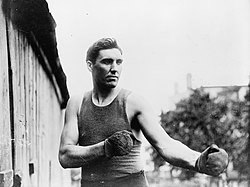
View on WikipediaJess Myron Willard (December 29, 1881 – December 15, 1968) was an American world heavyweight boxing champion billed as the Pottawatomie Giant.[2][4] He won the world heavyweight title in 1915 by knocking out Jack Johnson.
Key Information


Willard was known for size rather than skill, and though he held the championship for more than four years, he rarely defended it. In 1919, when he was 37 years old, he lost the title in an extremely one-sided loss by declining to come out for the fourth round against Jack Dempsey, who became a more celebrated champion. Soon after the bout, Willard began accusing Dempsey of using something with the effect of a knuckle duster. Dempsey did not grant Willard a return match, and at 42 years old he was KO'd, following which he retired from boxing, although for the rest of his life he continued to claim Dempsey had cheated. Ferdie Pacheco expressed the opinion in a book that the surviving photographs of Willard's face during the Dempsey fight indicate fractures to Willard's facial bones suggesting a metal implement, and show he was bleeding heavily.[5] The matter has never been resolved, with contemporaneous ringside sports journalist reporting in The New York Times that Willard spat out at least one tooth and was "a fountain of blood" increasingly discounted in favor of a view that he had only a cut lip and a little bruising.[citation needed]
Early life
[edit]Jess Myron Willard was born on 29 December 1881 in Saint Clere, Kansas. In his teenage years and twenties he worked as a cowboy.[2] He was of mostly English ancestry, which had been in North America since the colonial era. The first member of the Willard family arrived in Virginia in the 1630s.[6]
Boxing career
[edit]A powerfully built 6 ft 6+1⁄2 in (1.99 m) and 245 lb (111 kg), Willard did not begin boxing until the age of 27, but proved successful, defeating top-ranked opponents to earn a chance to fight for the Championship. He said he started boxing because he did not have much of an education, but thought his size and strength could earn him a good living. He was a gentle and friendly person and did not enjoy boxing or hurting people, so often waited until his opponent attacked him before punching back, which made him feel at ease as if he were defending himself. He was often maligned as an uncoordinated oaf rather than a skilled boxer, but his counter-punching style, coupled with his enormous strength and stamina, proved successful against top fighters. His physical strength was so great that he was reputed to be able to kill a man with a single punch. In a fight with Jack "Bull" Young in 1913, during the ninth round Young collapsed and died from a punch to the head. Willard was charged with second-degree murder, but was successfully defended by lawyer Earl Rogers.


Jack Johnson fight
[edit]On April 5, 1915, in front of a huge crowd at the new Oriental Park Racetrack in Havana, Cuba, he knocked out champion Jack Johnson in the 26th round to win the world heavyweight boxing championship. Johnson later said he had intentionally lost the fight, despite the fact there is evidence of Willard winning fairly, which can be seen clearly in the recorded footage, as well as the comments Johnson made to his cornermen between rounds and immediately after the fight, and that he bet $2500 on himself to win.[7][page needed][8][page needed][9] Willard said, "If he was going to throw the fight, I wish he'd done it sooner. It was hotter than hell out there." Johnson later acknowledged lying about throwing the fight after footage of the fight was made widely available in the United States. Shortly after the fight, Jack Johnson had actually accepted defeat gracefully saying, "Willard was too much for me, I just didn't have it."[10][page needed]
Johnson found that he could not knock out the giant Willard, who fought as a counterpuncher, making Johnson do all the leading. Johnson began to tire after the 20th round, and was visibly hurt by heavy body punches from Willard in rounds preceding the 26th-round knockout. Johnson's claim of a "dive" gained momentum because most fans only saw a still photo of Johnson lying on the canvas shading his eyes from the broiling Cuban sun. No films of the fight were allowed to be shown in the United States because of an inter-state ban on the trafficking of fight films that was in effect at the time. Most boxing fans saw the film of the Johnson–Willard fight only when a copy was found in 1967.
Willard fought several times over the next four years, but made only one official title defense prior to 1919, defeating Frank Moran on March 25, 1916, at Madison Square Garden.

Jack Dempsey fight
[edit]_(cropped).jpg)
At age 37, Willard lost his title to Dempsey on July 4, 1919, in Toledo. Dempsey knocked Willard down for the first time in his career with a left hook in the first round. Dempsey knocked Willard down seven times in the first round—although it should be remembered that rules at the time permitted standing almost over a knocked-down opponent and hitting him again as soon as both gloves had left the canvas. At one point Dempsey left the ring mistakenly thinking the fight was over, and under the rules could have been disqualified, but Willard had economised by not employing professional cornermen and they failed to insist on application of the regulations. Dempsey won the title when Willard was unable to continue after the third round. In the fight, Willard was later reputed to have suffered a broken jaw, cheekbone, and ribs, as well as losing several teeth. His attempt to fight to the finish, ending when he was unable to come out for the fourth round, is considered one of the most courageous performances in boxing history. However, the extent of Willard's injuries has been highly disputed and is now unclear since multiple independent reports only a few days after the fight said that there were no traces of any damage other than a couple of bruises:

To take only one representative account, according to a reporter for the Topeka Daily Capital, July 16, 1919, p. 8, who interviewed Jess when he got back to Lawrence, "The ex-champion didn't have any black eye, nor any signs that he was injured in any way."[11]

- Concealed metal object theory
When interviewed by Harry Carpenter of the BBC Sport in the 1960s at his house in California, Willard said to the reporter, "I'll show you, how I was beaten." He then drew a metal bolt from a cardbox, saying that Dempsey held the bolt in his hand, not within the glove but at the palm of it, attached to the thumb sideways, and used the bolt rather for cutting-and-slicing-like moves to inflict blood-spilling cuts and pain, relinquishing it just as the bout was stopped, and according to Willard, the bolt was found on the floor of the ring at the end of the fight and he kept it. Mike Tyson, who studied the case in-depth and very thoroughly, later joined Carpenter to discuss the subject. Tyson, a great admirer of Dempsey's, admitted that "he just did whatever Jack Kearns told him to do" and "in those days anything could have happened", for that there was no agency or other legal authority at the time that was officially empowered to oversee and protect fighters from violations of such kind. However, footage before the fight shows Dempsey putting on his gloves with no additional objects and in full view of Willard, his team and the crowd.[12]
Comeback
[edit]After losing his title fight with Dempsey, Willard went into semiretirement from the ring, fighting only exhibition bouts for the next four years.[2] On May 12, 1923, promoter Tex Rickard arranged for Willard to make a comeback, fighting Floyd Johnson as part of the first line-up of boxing matches at the newly opened Yankee Stadium in New York City.[13] 63,000 spectators attended the match, which the 41-year-old Willard was widely expected to lose.[13] However, after Willard took a beating for several rounds, he came back to knock down Johnson in the 9th and 11th rounds, and Willard earned a TKO victory. Damon Runyon wrote afterward: "Youth, take off your hat and bow low and respectfully to age. For days and days, the sole topic of conversation in the world of sport will be Willard's astonishing comeback."[13]
Willard followed up this victory by facing contender Luis Ángel Firpo on July 12, 1923.[13] The fight was held at Boyle's Thirty Acres in New Jersey, in front of more than 75,000 spectators. Willard was knocked out in the eighth round, and then permanently retired from boxing.
Later life
[edit]_-_Ad_4.jpg)
Willard parlayed his boxing fame into an acting career of a sort. He acted in a vaudeville show, had a role in Buffalo Bill's Wild West show, and starred in a 1919 feature film The Challenge of Chance.[14] In 1933, he appeared in a bit part in a boxing movie, The Prizefighter and the Lady, with Max Baer and Myrna Loy.[14]
Death
[edit]Willard died on 15 December 1968, in Los Angeles, California, from congestive heart failure. He had been admitted to a hospital a week earlier for a heart condition, but left against a doctor's advice. He returned again after suffering a stroke and died 12 hours later.[15]
Having died at age 86, Willard was the longest-lived heavyweight champion in history until he was surpassed by his old rival Jack Dempsey (who died in 1983, aged 87), then by Jack Sharkey (who died in 1994, aged 91), and finally by Max Schmeling (who died in 2005 at the age of 99).
Willard's body was buried at Forest Lawn, Hollywood Hills Cemetery, in Los Angeles.
Tributes
[edit]In 2003 he was inducted posthumously into the International Boxing Hall of Fame.[4]
Cultural references
[edit]Willard and a dispute he had with Harry Houdini is the topic of Andy Duncan's Nebula Award nominated novella The Pottawatomie Giant.[16] In 2020, a television program Antiques Roadshow – Crocker Art Museum (Season 24, Episode 8, Part 2), showed a photograph from his 5 April 1915 championship winning match, and the commemorative pocket watch Willard carried which was valued at between $15,000 and $50,000.
Professional boxing record
[edit]Official record
[edit]| 34 fights | 22 wins | 5 losses |
|---|---|---|
| By knockout | 20 | 3 |
| By decision | 2 | 1 |
| By disqualification | 0 | 1 |
| Draws | 1 | |
| Newspaper decisions/draws | 6 | |
All newspaper decisions are officially regarded as “no decision” bouts and are not counted in the win/loss/draw column.
| No. | Result | Record | Opponent | Type | Round, time | Date | Location | Notes |
|---|---|---|---|---|---|---|---|---|
| 34 | Loss | 22–5–1 (6) | Luis Angel Firpo | KO | 8 (12), 1:55 | 12 Jul 1923 | Boyle's Thirty Acres, Jersey City, New Jersey, U.S. | |
| 33 | Win | 22–4–1 (6) | Floyd Johnson | TKO | 11 (15) | 12 May 1923 | Yankee Stadium, Bronx, New York, U.S. | |
| 32 | Loss | 21–4–1 (6) | Jack Dempsey | RTD | 3 (12) | 4 Jul 1919 | Bay View Park Arena, Toledo, Ohio, U.S. | Lost world heavyweight title |
| 31 | Win | 21–3–1 (6) | Frank Moran | NWS | 10 | 25 Mar 1916 | Madison Square Garden, New York City, New York, U.S. | World heavyweight title at stake; (via KO only) |
| 30 | Win | 21–3–1 (5) | Jack Johnson | KO | 26 (45), 1:26 | 5 Apr 1915 | Oriental Park, Havana, Cuba | Won world heavyweight title |
| 29 | Win | 20–3–1 (5) | George Rodel | KO | 6 (10) | 28 Apr 1914 | Orpheum Theater, Atlanta, Georgia, U.S. | |
| 28 | Win | 19–3–1 (5) | Dan Dailey | KO | 9 (10) | 13 Apr 1914 | Broadway Auditorium, Buffalo, New York, U.S. | |
| 27 | Loss | 18–3–1 (5) | Tom McMahon | NWS | 12 | 27 Mar 1914 | Grand Opera House, Youngstown, Ohio, U.S. | |
| 26 | Win | 18–3–1 (4) | George Rodel | KO | 9 (20) | 29 Dec 1913 | Casino, New Haven, Connecticut, U.S. | |
| 25 | Win | 17–3–1 (4) | George Davis | KO | 2 (10) | 12 Dec 1913 | Broadway Auditorium, Buffalo, New York, U.S. | |
| 24 | Win | 16–3–1 (4) | Carl Morris | NWS | 10 | 3 Dec 1913 | Madison Square Garden, New York City, New York, U.S. | |
| 23 | Win | 16–3–1 (3) | Jack Reed | TKO | 2 (10) | 24 Nov 1913 | Princess Rink, Fort Wayne, Indiana, U.S. | |
| 22 | Loss | 15–3–1 (3) | George Rodel | NWS | 10 | 17 Nov 1913 | Elite Rink, Milwaukee, Wisconsin, U.S. | |
| 21 | Win | 15–3–1 (2) | Bull Young | KO | 11 (20) | 22 Aug 1913 | Pacific A.C., Vernon, California, U.S. | Young died of injuries sustained from the fight.[17] |
| 20 | Win | 14–3–1 (2) | Al Williams | TKO | 8 (10) | 4 Jul 1913 | Moana Springs Arena, Reno, Nevada, U.S. | |
| 19 | Draw | 13–3–1 (2) | Charley Miller | PTS | 4 | 27 Jun 1913 | Dreamland Rink, San Francisco, California, U.S. | |
| 18 | Loss | 13–3 (2) | Gunboat Smith | PTS | 20 | 20 May 1913 | Eighth Street Arena, San Francisco, California, U.S. | |
| 17 | Win | 13–2 (2) | Jack Leon | KO | 4 (10) | 5 Mar 1913 | Princess Rink, Fort Wayne, Indiana, U.S. | |
| 16 | Win | 12–2 (2) | Frank Bauer | TKO | 5 (10), 1:50 | 22 Jan 1913 | Princess Rink, Fort Wayne, Indiana, U.S. | |
| 15 | Win | 11–2 (2) | Soldier Kearns | KO | 8 (10) | 27 Dec 1912 | Madison Square Garden, New York City, New York, U.S. | |
| 14 | Win | 10–2 (2) | Sailor White | KO | 1 (10) | 2 Dec 1912 | Miller's Hall, Buffalo, New York, U.S. | |
| 13 | Draw | 9–2 (2) | Luther McCarty | NWS | 10 | 19 Aug 1912 | Madison Square Garden, New York City, New York, U.S. | |
| 12 | Win | 9–2 (1) | Arthur Pelkey | NWS | 10 | 29 Jul 1912 | Madison Square Garden, New York City, New York, U.S. | |
| 11 | Win | 9–2 | Bull Young | KO | 5 | 2 Jul 1912 | South Chicago, Chicago, U.S. | |
| 10 | Win | 8–2 | Frank Bauer | TKO | 3 (6) | 29 May 1912 | Irwin Hall, St. Charles, Missouri, U.S. | |
| 9 | Win | 7–2 | Bull Young | KO | 6 (10) | 22 May 1912 | Princess Rink, Fort Wayne, Indiana, U.S. | |
| 8 | Loss | 6–2 | Joe Cox | TKO | 5 (10) | 9 Oct 1911 | Landers Theatre, Springfield, Missouri, U.S. | |
| 7 | Win | 6–1 | Mike McKimminsky | PTS | 10 | 10 Aug 1911 | Hammon, Oklahoma, U.S. | |
| 6 | Win | 5–1 | Frank Lyons | PTS | 10 | 4 Jul 1911 | Elk City, Oklahoma, U.S. | |
| 5 | Win | 4–1 | William Schiller | KO | 4 (15) | 15 May 1911 | Maize Theatre, Oklahoma City, Oklahoma, U.S. | |
| 4 | Win | 3–1 | Al Mandino | PTS | 4 (10) | 14 Apr 1911 | Benevolent A.A., Oklahoma City, Oklahoma, U.S. | |
| 3 | Win | 2–1 | Lewis Fink | KO | 3 (15), 1:13 | 24 Mar 1911 | Benevolent A.A., Oklahoma City, Oklahoma, U.S. | |
| 2 | Win | 1–1 | Ed Burke | KO | 3 (10) | 7 Mar 1911 | Jackson's Pavilion, El Reno, Oklahoma, U.S. | |
| 1 | Loss | 0–1 | Lewis Fink | DQ | 10 (15), 0:45 | 15 Feb 1911 | Sapulpa Air Dome, Sapulpa, Oklahoma, U.S. |
Unofficial record
[edit]| 34 fights | 25 wins | 7 losses |
|---|---|---|
| By knockout | 20 | 3 |
| By decision | 5 | 3 |
| By disqualification | 0 | 1 |
| Draws | 2 | |
Record with the inclusion of newspaper decisions to the win/loss/draw column.
| No. | Result | Record | Opponent | Type | Round, time | Date | Location | Notes |
|---|---|---|---|---|---|---|---|---|
| 34 | Loss | 25–7–2 | Luis Angel Firpo | KO | 8 (12), 1:55 | 12 Jul 1923 | Boyle's Thirty Acres, Jersey City, New Jersey, U.S. | |
| 33 | Win | 25–6–2 | Floyd Johnson | TKO | 11 (15) | 12 May 1923 | Yankee Stadium, Bronx, New York, U.S. | |
| 32 | Loss | 24–6–2 | Jack Dempsey | RTD | 3 (12) | 4 Jul 1919 | Bay View Park Arena, Toledo, Ohio, U.S. | Lost world heavyweight title |
| 31 | Win | 24–5–2 | Frank Moran | NWS | 10 | 25 Mar 1916 | Madison Square Garden, New York City, New York, U.S. | World heavyweight title at stake; (via KO only) |
| 30 | Win | 23–5–2 | Jack Johnson | KO | 26 (45), 1:26 | 5 Apr 1915 | Oriental Park, Havana, Cuba | Won world heavyweight title |
| 29 | Win | 22–5–2 | George Rodel | KO | 6 (10) | 28 Apr 1914 | Orpheum Theater, Atlanta, Georgia, U.S. | |
| 28 | Win | 21–5–2 | Dan Dailey | KO | 9 (10) | 13 Apr 1914 | Broadway Auditorium, Buffalo, New York, U.S. | |
| 27 | Loss | 20–5–2 | Tom McMahon | NWS | 12 | 27 Mar 1914 | Grand Opera House, Youngstown, Ohio, U.S. | |
| 26 | Win | 20–4–2 | George Rodel | KO | 9 (20) | 29 Dec 1913 | Casino, New Haven, Connecticut, U.S. | |
| 25 | Win | 19–4–2 | George Davis | KO | 2 (10) | 12 Dec 1913 | Broadway Auditorium, Buffalo, New York, U.S. | |
| 24 | Win | 18–4–2 | Carl Morris | NWS | 10 | 3 Dec 1913 | Madison Square Garden, New York City, New York, U.S. | |
| 23 | Win | 17–4–2 | Jack Reed | TKO | 2 (10) | 24 Nov 1913 | Princess Rink, Fort Wayne, Indiana, U.S. | |
| 22 | Loss | 16–4–2 | George Rodel | NWS | 10 | 17 Nov 1913 | Elite Rink, Milwaukee, Wisconsin, U.S. | |
| 21 | Win | 16–3–2 | Bull Young | KO | 11 (20) | 22 Aug 1913 | Pacific A.C., Vernon, California, U.S. | Young died of injuries sustained from the fight.[17] |
| 20 | Win | 15–3–2 | Al Williams | TKO | 8 (10) | 4 Jul 1913 | Moana Springs Arena, Reno, Nevada, U.S. | |
| 19 | Draw | 14–3–2 | Charley Miller | PTS | 4 | 27 Jun 1913 | Dreamland Rink, San Francisco, California, U.S. | |
| 18 | Loss | 14–3–1 | Gunboat Smith | PTS | 20 | 20 May 1913 | Eighth Street Arena, San Francisco, California, U.S. | |
| 17 | Win | 14–2–1 | Jack Leon | KO | 4 (10) | 5 Mar 1913 | Princess Rink, Fort Wayne, Indiana, U.S. | |
| 16 | Win | 13–2–1 | Frank Bauer | TKO | 5 (10), 1:50 | 22 Jan 1913 | Princess Rink, Fort Wayne, Indiana, U.S. | |
| 15 | Win | 12–2–1 | Soldier Kearns | KO | 8 (10) | 27 Dec 1912 | Madison Square Garden, New York City, New York, U.S. | |
| 14 | Win | 11–2–1 | Sailor White | KO | 1 (10) | 2 Dec 1912 | Miller's Hall, Buffalo, New York, U.S. | |
| 13 | Draw | 10–2–1 | Luther McCarty | NWS | 10 | 19 Aug 1912 | Madison Square Garden, New York City, New York, U.S. | |
| 12 | Win | 10–2 | Arthur Pelkey | NWS | 10 | 29 Jul 1912 | Madison Square Garden, New York City, New York, U.S. | |
| 11 | Win | 9–2 | Bull Young | KO | 5 | 2 Jul 1912 | South Chicago, Chicago, U.S. | |
| 10 | Win | 8–2 | Frank Bauer | TKO | 3 (6) | 29 May 1912 | Irwin Hall, St. Charles, Missouri, U.S. | |
| 9 | Win | 7–2 | Bull Young | KO | 6 (10) | 22 May 1912 | Princess Rink, Fort Wayne, Indiana, U.S. | |
| 8 | Loss | 6–2 | Joe Cox | TKO | 5 (10) | 9 Oct 1911 | Landers Theatre, Springfield, Missouri, U.S. | |
| 7 | Win | 6–1 | Mike McKimminsky | PTS | 10 | 10 Aug 1911 | Hammon, Oklahoma, U.S. | |
| 6 | Win | 5–1 | Frank Lyons | PTS | 10 | 4 Jul 1911 | Elk City, Oklahoma, U.S. | |
| 5 | Win | 4–1 | William Schiller | KO | 4 (15) | 15 May 1911 | Maize Theatre, Oklahoma City, Oklahoma, U.S. | |
| 4 | Win | 3–1 | Al Mandino | PTS | 4 (10) | 14 Apr 1911 | Benevolent A.A., Oklahoma City, Oklahoma, U.S. | |
| 3 | Win | 2–1 | Lewis Fink | KO | 3 (15), 1:13 | 24 Mar 1911 | Benevolent A.A., Oklahoma City, Oklahoma, U.S. | |
| 2 | Win | 1–1 | Ed Burke | KO | 3 (10) | 7 Mar 1911 | Jackson's Pavilion, El Reno, Oklahoma, U.S. | |
| 1 | Loss | 0–1 | Lewis Fink | DQ | 10 (15), 0:45 | 15 Feb 1911 | Sapulpa Air Dome, Sapulpa, Oklahoma, U.S. |
Family
[edit]Jess Willard was a 6th great-grandson (9th generation descendant) of the Massachusetts colonist Simon Willard (1605–1676).
(1605–1676)
See also
[edit]References
[edit]- ^ "'Great White Hope' Jess Willard Succumbs". Ocala Star-Banner. December 16, 1968. Retrieved 2010-04-14.
- ^ a b c d "Jess Willard Biography". cyberboxingzone.com. Retrieved 2010-04-14.
- ^ "BoxRec: Jess Willard". boxrec.com. BoxRec.
- ^ a b "HOF Website". International Boxing Hall of Fame. Retrieved 2010-04-14.
- ^ Pacheco 2004, pp. 17–18.
- ^ Mace 1980, p. 2.
- ^ Baker 1988.
- ^ Aycock & Scott 2014.
- ^ Fleischer 1958, pp. 88–89.
- ^ Kent 2005.
- ^ Cox, Monte D.; Bardelli, John A.; Caico, Bob; Cox, Jeff; Cuoc, Dan; Johnston, Chuck; Moyle, Clay; Stallone, Frank; Ugarkovich, Miles (December 1, 2004). "Were Dempsey's Gloves Loaded? You Decide!". Retrieved July 11, 2012.
- ^ Mike Tyson presents the Heavyweights (Television production).
- ^ a b c d "Willard Helped Raise the Roof at Yankee Stadium". ESPN.com. 21 September 2008. Retrieved 2010-04-14.
- ^ a b "Jess Willard IMDb Entry". IMDb. Retrieved 2010-04-14.
- ^ Kahn, Alex (December 16, 1968). "Jess Willard Dies, Ex-Boxing Champ". The Norwalk Hour. Retrieved 2 May 2021 – via Google News.
- ^ Duncan, Andy (2012). The Pottawatomie Giant and Other Stories. Hornsea, UK: PS Publishing. p. 308. ISBN 9781848633094.
- ^ a b "List of dead boxers" (PDF). Retrieved 2024-06-22.
Works cited
[edit]- Aycock, Colleen; Scott, Mark (2014). Tex Rickard: Boxing's Greatest Promoter. McFarland. ISBN 978-0-7864-9017-2.
- Baker, William Joseph (1988). Sports in the Western World. University of Illinois Press. ISBN 978-0-252-06042-7.
- Fleischer, Nat (1958). 50 Years At Ringside. Pickle Partners Publishing. ISBN 978-1-78720-476-8.
{{cite book}}: ISBN / Date incompatibility (help) - Kent, Graeme (2005). Great White Hopes: The Quest to Defeat Jack Johnson. The History Press. ISBN 978-0-7524-9615-3.
- Mace, Jim (1980). Life Story of Heavyweight Champion Jess Willard. J. Mace.
- Pacheco, Ferdie (2004). The 12 Greatest Rounds of Boxing: The Untold Stories. Pavilion Books. ISBN 978-1-86105-805-8.
Further reading
[edit]- Allen, Arly (2017). Jess Willard: Heavyweight Champion of the World (1915-1919). McFarland & Company, Jefferson, NC. ISBN 9781476664446.
External links
[edit]
- Boxing record for Jess Willard from BoxRec (registration required)
- Jess Willard's Boxing Gear at Kansas Museum of History
- Willard v. Dempsey on YouTube
- Jess Willard – CBZ Profile
- Boxing Hall of Fame
- ESPN.com
| International | |
|---|---|
| National | |
| Other | |

Jess Willard
View on GrokipediaEarly Life
Birth and Family Background
Jess Myron Willard was born on December 29, 1881, in the rural community of Saint Clere, Pottawatomie County, Kansas.[7] He was the youngest of four brothers to parents Myron Bacon Willard (1844–1881) and Margaret B. "Maggie" Bailey (born circa 1850).[8][7][9] Willard's father, a farmer, died in 1881, the same year as his son's birth, leaving the family under his mother's care in the agrarian Pottawatomie County region.[9][7]Pre-Boxing Occupations
Before pursuing professional boxing, Jess Willard engaged in various manual labor roles in rural Kansas and Oklahoma, reflecting the agrarian and ranching economy of the early 20th century American Midwest. In his youth, he worked as a cowboy, handling livestock and performing tasks typical of frontier herding life in Pottawatomie County, Kansas.[10][11] Willard's early employment centered on equestrian and ranching activities, including breaking, training, selling, and trading horses, as well as serving as a cattle puncher and handler of horses and mules.[12][1] These jobs demanded physical strength and endurance, skills that later contributed to his imposing presence in the ring, though Willard did not enter professional boxing until age 29 in 1911. He relocated to Elk City, Oklahoma, during this period, continuing such work amid sparse opportunities in the region.[1] Additionally, Willard participated as a rodeo performer, leveraging his horsemanship in competitive exhibitions that showcased his size—standing nearly 6 feet 7 inches—and agility with animals.[11] These pre-boxing pursuits provided modest sustenance for Willard and his family, including his wife and children, prior to his transition to prizefighting.[12]Boxing Career
Early Professional Fights
Willard made his professional boxing debut on February 15, 1911, at age 29, losing by third-round disqualification to Lewis Fink in Sapulpa, Oklahoma, after fouling his opponent.[13] He quickly rebounded with victories in his next three bouts, all in Oklahoma venues: defeating Ed Burke on March 11 in El Reno, Lewis Fink on March 11 in Oklahoma City, and Al Mandino on April 11 in Oklahoma City.[13] These early fights, along with technical knockouts of William Schiller in May and wins over Frank Lyons in July and Mike McKimminsky in August, established a pattern of local dominance in Oklahoma clubs, where Willard honed his skills against lesser opposition before venturing further afield.[13][1] By October 1911, Willard suffered his second loss, quitting in the fifth round against Joe Cox in Springfield, Missouri, amid reports of inadequate conditioning.[13] In 1912, he relocated to the Midwest and East Coast, securing wins over John Bull Young (twice), Frank Bauer, and Arthur Pelkey via 10-round decision at Madison Square Garden, though he drew with Luther McCarty in another 10-round affair there.[13] Notable knockouts included Sailor White in December, bolstering his reputation for power despite a modest overall record.[13] Willard's 1913 campaign featured a mix of successes and setbacks, including a 10-round decision loss to Gunboat Smith in San Francisco and a draw with Charlie Miller, but punctuated by knockouts that drew attention: John Bull Young in August at Vernon, California, and George Rodel in December via 10th-round stoppage in New Haven, Connecticut.[13] He closed the year with a 10-round decision over highly regarded Carl Morris at Madison Square Garden, a victory that elevated his contender status among "white hopes" seeking to challenge champion Jack Johnson.[13] A loss to George Rodel by decision in November highlighted inconsistencies, yet Willard rebounded to knock out Rodel later that month.[13] Into 1914, Willard faced Tom McMahon, losing a 10-round decision in Youngstown, Ohio, but his physical stature—standing over 6 feet 6 inches—and knockout prowess in prior bouts against durable opponents like Young and Rodel positioned him for heavyweight contention, culminating in title pursuit by 1915.[13] These early fights, often under newspaper decision rules, revealed a fighter reliant on size and sporadic power rather than speed or volume punching, with a record of approximately 13 wins (several by knockout), 5 losses, and 2 draws through mid-1914.[13]Challenge for the Heavyweight Title
Jess Willard entered professional boxing in 1911, compiling a record of 10 wins, including several knockouts, against regional opponents before gaining broader recognition. His physical stature—standing 6 feet 7 inches tall and weighing around 235 pounds—drew attention as a potential heavyweight contender.[4] In 1913, Willard secured notable victories that elevated his status, defeating Jack "Bull" Young—a fighter who had previously challenged for the heavyweight title—first by disqualification in March and then by ninth-round knockout in August.[14] These wins, combined with his imposing size and knockout power demonstrated in earlier bouts against opponents like George "KO" Rodel or Frank Bauer, positioned him as a viable challenger amid ongoing searches for contenders to face champion Jack Johnson.[15] Promoters viewed Willard as a "legitimate challenger" capable of drawing crowds, particularly given Johnson's exile from the United States due to legal issues under the Mann Act, which necessitated fights abroad.[16] Negotiations for the title bout began in 1914, led by promoter Jack Curley in partnership with Harry Frazee, who secured Johnson's agreement for a match offering substantial financial incentives.[14] The fight was scheduled for April 5, 1915, at Oriental Park Racetrack in Havana, Cuba, over 45 rounds to accommodate the era's endurance-style bouts.[3] Johnson received a $30,000 guarantee plus one-third of film rights, while Willard was entitled to 25 percent of gross receipts plus one-third of film revenue, reflecting the event's commercial stakes including motion picture documentation.[3][17] Willard prepared rigorously, arriving in Cuba months early to acclimate to the tropical climate and conduct extensive training, unlike Johnson, who had been less disciplined in prior years.[18] Weighing in at 239 pounds against Johnson's 225, Willard entered as a 7-5 underdog based on betting odds, with skeptics citing his limited experience against elite competition despite his 12-1 record entering the fight.[4] The matchup was billed as a test of Willard's raw power and durability against Johnson's superior speed and ringcraft, setting the stage for one of boxing's longest title fights.[19]Victory over Jack Johnson
On April 5, 1915, Jess Willard challenged Jack Johnson for the world heavyweight boxing championship at Oriental Park Racetrack in Havana, Cuba, as Johnson could not defend his title in the United States due to his status as a fugitive under the Mann Act.[19] The bout was scheduled for 45 rounds under Marquis of Queensberry rules, drawing a crowd estimated at over 20,000 spectators to the open-air venue under intense tropical heat.[4] Johnson, weighing 225 pounds, entered as the defending champion and favorite, leveraging his superior speed and ringcraft to dominate the early rounds by outboxing the taller, heavier Willard, who tipped the scales at 239 pounds.[3] Willard, standing at 6 feet 7 inches, absorbed punishment while employing a defensive strategy, biding his time as the fight extended beyond 20 rounds.[4] Johnson's conditioning reportedly faltered in the sweltering conditions, compounded by allegations of inadequate training and possible distractions from personal legal troubles, allowing Willard to gain momentum with heavier punches.[20] In the 26th round, at 1:26 elapsed time, Willard landed a powerful right hand to Johnson's jaw, dropping the champion to the canvas where he was counted out, securing Willard's victory by knockout.[3] [20] This upset ended Johnson's seven-year reign, marking Willard as the new heavyweight champion at age 32.[19] Speculation persists that Johnson may have intentionally lost the fight to negotiate leniency upon returning to the United States, given his impending legal issues, though Willard maintained the knockout was genuine and Johnson's early aggression contradicted claims of a premeditated dive.[15] No conclusive evidence supports the fix theory, with the fight's duration and Johnson's visible fatigue aligning with a legitimate attrition-based defeat influenced by environmental factors and preparation disparities.[15]Reign as Champion and Defenses
Willard captured the world heavyweight championship on April 5, 1915, by knocking out Jack Johnson in the 26th round in Havana, Cuba, beginning a reign that lasted until July 4, 1920.[11] During this period, marked by World War I restrictions on professional boxing in the United States, Willard conducted few competitive bouts.[21] He made only one official title defense, against Frank Moran on March 25, 1916, at Madison Square Garden in New York.[2] [12] The Willard-Moran bout was scheduled for 10 rounds under no-decision rules, common for the era to avoid mandatory outcomes in shorter fights, though it was recognized as a championship defense.[22] Willard, weighing 259 pounds, outpointed the 211-pound Moran via newspaper decision, with judges favoring the champion's effective jab and reach advantage despite Moran's aggressive pressure.[22] Promoted by Tex Rickard in his New York debut, the event drew significant attention but ended without a knockout, highlighting Willard's defensive style over offensive dominance.[23] Willard earned a guaranteed $47,500 purse, while Moran received $23,750, reflecting the commercial draw of the matchup.[24] Following the Moran fight, Willard fought no further title defenses for over four years, amid wartime curtailments that limited heavyweight contests and his own reported injuries, including a lingering hand issue from the Johnson bout.[25] This inactivity fueled criticism that Willard avoided worthy challengers, such as Harry Wills, though no sanctioned opportunities materialized until Jack Dempsey's challenge.[25] Willard's professional record during his championship years included 1 win (the Moran defense) and no losses in sanctioned title fights, underscoring a tenure defined more by retention than activity.[13]Loss to Jack Dempsey
The heavyweight championship bout between defending champion Jess Willard and challenger Jack Dempsey occurred on July 4, 1919, at Bay View Park Arena in Toledo, Ohio, under Marquis of Queensberry rules with a scheduled limit of 12 rounds.[5] Willard, aged 37 and weighing 245 pounds, entered the ring after a period of relative inactivity marked by injuries from his 1915 title win and service in World War I, during which he promoted boxing exhibitions for the military.[1] Dempsey, at 24 years old and 187 pounds, was a rising contender known for his knockout power, having won 15 consecutive fights by stoppage prior to the match.[5] From the opening bell, Dempsey unleashed a ferocious assault, flooring Willard seven times in the first round alone, with six of those knockdowns occurring in the final minute amid temperatures exceeding 100 degrees Fahrenheit that exacerbated the physical toll.[26] Willard, towering at 6 feet 7 inches compared to Dempsey's 6 feet 1 inch frame, struggled to utilize his size advantage as Dempsey targeted the body and head with rapid combinations, causing Willard to bleed profusely from cuts and suffer what were later confirmed as a broken jaw, fractured ribs, and lost teeth.[27] Despite the champion's attempts to clinch and weather the storm, Dempsey's relentless pressure continued into the second and third rounds, leaving Willard unable to effectively defend or counter.[28] At the conclusion of the third round, Willard's handlers signaled his retirement, resulting in a technical knockout victory for Dempsey, who thereby claimed the world heavyweight title in a display of superior speed, conditioning, and punching power against an aging and underprepared opponent.[5] The mismatch highlighted Dempsey's aggressive, swarm-like style rooted in rough-and-tumble western mining camp brawls, contrasting Willard's more deliberate, power-reliant approach that had succeeded against a similarly declining Jack Johnson but faltered against youthful ferocity.[29] Post-fight medical examinations substantiated the extent of Willard's injuries, undermining his immediate claims of minimal damage and attributing the outcome to genuine physical disparity rather than external factors.[30]Later Fights and Comebacks
Following his crushing defeat to Jack Dempsey on July 4, 1919, Willard, then aged 37, suffered severe injuries including a broken jaw and multiple facial fractures, leading him to announce retirement from professional boxing.[1] He participated in several exhibition bouts over the subsequent four years to maintain fitness and income, but these were non-competitive matches against lesser opponents.[25] Willard mounted a professional comeback at age 41 in 1923, beginning with a bout against Floyd Johnson on May 12, 1923, at Yankee Stadium in New York City—the first boxing event held at the venue.[31] Despite his long layoff and advancing age, Willard secured a technical knockout victory in the eleventh round after Johnson sustained cuts and refused to continue, demonstrating residual power in his punches though the fight was described as sluggish and lacking Willard’s former sharpness.[32] Less than two months later, on July 12, 1923, Willard faced Luis Ángel Firpo, dubbed the "Wild Bull of the Pampas," in a scheduled 12-round heavyweight bout at Boyle's Thirty Acres in Jersey City, New Jersey, before a crowd estimated at 100,000.[33] Firpo, younger and more aggressive, dominated the later rounds, knocking Willard out in the eighth with a series of body and head shots that left the former champion unable to rise, marking Willard's final professional fight.[34] This loss prompted his permanent retirement from the ring, as he cited diminished stamina and the risks of continued competition at his age.[1] Both comeback bouts drew massive attendance, reflecting enduring public interest in the "Pottawatomie Giant," but they underscored his physical decline post-Dempsey.[35]Fighting Style and Abilities
Physical Attributes
Jess Willard possessed an extraordinary physical presence that defined his boxing career, standing at 6 feet 6½ inches (199 cm) tall with an 83-inch (211 cm) reach.[13] These measurements positioned him as the tallest heavyweight champion up to that point, contributing to his nickname "Pottawatomie Giant."[1] His height and limb length allowed for effective range management, enabling him to keep opponents at bay while setting up his potent right hand.[2] Willard typically competed at weights ranging from 235 to 245 pounds (107-111 kg), reflecting a massive yet relatively lean frame for the heavyweight division of the early 20th century.[36] For instance, he weighed 239 pounds in his title-winning fight against Jack Johnson on April 5, 1915, and 235 pounds when defending against Jack Dempsey on July 4, 1919.[3] [37] This build, developed through pre-boxing labors as a cowboy and day laborer, endowed him with remarkable durability and raw power, capable of absorbing heavy punishment while delivering devastating force.[11]Techniques and Strengths
Willard stood at 6 feet 6½ inches tall and weighed around 245 pounds during his prime, giving him a significant physical advantage over most opponents.[20] His reach measured 83 inches, allowing him to control distance effectively with extended jabs.[2] These attributes contributed to his reputation as the "Pottawatomie Giant," emphasizing raw size as a core strength rather than finesse.[38] His punching power was formidable, evidenced by knockouts in fights and a fatal blow delivered to opponent Frank Brannigan on August 23, 1913, which underscored his capacity for devastating force.[38] Willard possessed exceptional stamina, enabling him to maintain pressure over long bouts, as demonstrated in his 26-round victory over Jack Johnson on April 5, 1915.[20] He also exhibited a strong chin and durability, absorbing heavy punishment without collapsing easily, which prolonged his effectiveness in the ring.[38] Technically, Willard relied on a stiff, effective left jab to keep adversaries at bay, leveraging his reach to disrupt advances.[2] His counterpunching approach capitalized on opponents' aggression, turning their momentum into openings for powerful returns.[38] Despite perceptions of awkwardness, he moved with surprising speed for his frame, using upright posture to maximize leverage in exchanges.[2] These elements, combined with innate toughness, allowed him to secure the heavyweight title despite limited defensive footwork.[20]Criticisms of Performance
Jess Willard's fighting style drew criticism for its pronounced passivity and reliance on defensive absorption rather than proactive engagement, often allowing opponents to dictate the pace until fatigue set in. Historians and contemporaries noted that Willard preferred to stand firm, using his immense size and reach to jab and clinch, exhausting foes through attrition rather than delivering sustained offensive pressure. This approach, while effective against aging or less durable opponents like Jack Johnson in their April 5, 1915, bout where Willard capitalized on a single powerful right hand in the 26th round after Johnson had dominated earlier exchanges, exposed vulnerabilities against faster, more aggressive fighters.[15][39] A key weakness was Willard's hesitance to pursue knockouts aggressively, stemming from a reported aversion to facial punches and preference for body work, which limited his ability to finish fights decisively. Boxing analysts have pointed out his lack of killer instinct and imagination in the ring, traits that contrasted sharply with predecessors like Johnson, who taunted Willard for his perceived deficiencies in speed and skill during their title fight. In his sole formal defense against Frank Moran on March 25, 1916, Willard won by majority decision over 10 rounds but failed to impress, clinching excessively and landing few clean shots, leading observers to question his dominance as champion.[40][15] These flaws culminated in his July 4, 1920, defeat to Jack Dempsey, where Willard's sluggish start and inadequate defensive mobility allowed the challenger to floor him seven times in the first round alone, inflicting extensive damage including broken ribs, jaw, and multiple teeth lost. Despite Willard's durability—standing up after each knockdown—his inability to mount a counteroffensive or protect himself effectively highlighted technical shortcomings, such as poor head movement and over-reliance on static positioning. Post-fight analyses emphasized that Willard's style, suited to outlasting methodical opponents, crumbled under Dempsey's relentless swarming, underscoring a fundamental mismatch in ring generalship and adaptability.[41][6]Racial and Social Context
The Great White Hope Narrative
The "Great White Hope" narrative emerged in the wake of Jack Johnson's ascension to the heavyweight championship on December 26, 1908, when he defeated Tommy Burns in Sydney, Australia, prompting widespread calls among white audiences and promoters for a white boxer capable of reclaiming the title amid prevailing racial hierarchies in early 20th-century America.[42] [43] This phenomenon was fueled by Johnson's status as the first Black heavyweight champion and his personal choices, including interracial relationships, which defied Jim Crow-era norms and intensified white resentment, leading to a frenzied search for contenders like James Jeffries, who failed spectacularly against Johnson on July 4, 1910, sparking deadly race riots across the U.S.[44] [45] Subsequent white challengers, including Fireman Jim Flynn and others dubbed "Great White Hopes," were systematically defeated, sustaining the narrative of racial redemption through boxing victory.[46] Jess Willard, a 6-foot-7-inch, 235-pound Kansas farmer and former cowboy born December 29, 1881, entered this discourse as an unlikely but physically imposing candidate, lacking Johnson's ringcraft but leveraging his size and reach in a sport where such attributes could compensate for technique against an aging champion.[14] Promoters, aware of Johnson's legal troubles under the Mann Act—which had driven him into exile—arranged the bout in Havana, Cuba, on April 5, 1915, under neutral conditions to maximize attendance and revenue, drawing over 25,000 spectators despite the tropical heat.[4] Willard, then 33 and relatively untested at the elite level, absorbed punishment through 25 rounds before Johnson, aged 37 and fighting with a reportedly injured arm, collapsed from a right hand to the jaw in the 26th, yielding the title without rising by the count of 10.[47] Willard's triumph was immediately framed as the culmination of the Great White Hope quest, celebrated in U.S. newspapers as a restoration of white dominance in the "manly art," with headlines emphasizing racial vindication over the upset nature of the result against a superior technician.[14] [4] This portrayal overlooked Willard's defensive style—relying on clinching and stalling—and Johnson's fatigue, instead amplifying mythic elements of his "Pottawatomie Giant" persona to symbolize broader societal relief from Johnson's seven-year reign.[46] The narrative persisted in cultural memory, influencing later depictions like Howard Sackler's 1968 play The Great White Hope, though historical analyses note its roots in unexamined racial anxieties rather than Willard's purported invincibility.[48]Johnson's Defeat and Societal Reactions
On April 5, 1915, in Havana, Cuba, under intense tropical heat, Jess Willard knocked out Jack Johnson in the 26th round of their heavyweight title fight with a powerful right hand to the jaw, sending the 37-year-old champion crashing through the ropes; Johnson failed to rise before the count of ten, ending his seven-year reign as the first African American to hold the title.[4][47] Johnson, who had dominated the early rounds but tired markedly after the 20th due to age, exile-related inactivity, and inadequate preparation as a fugitive from U.S. Mann Act charges, later claimed the bout was fixed in exchange for leniency upon his return, though contemporary accounts and subsequent historical analysis indicate a legitimate defeat with no substantiating evidence for a dive.[4][47] News of Willard's victory spread rapidly across the United States via telegraph, triggering widespread public celebrations, particularly among white audiences who had long viewed Johnson's championship—marked by his defeats of white contenders and personal life defying racial taboos—as a direct affront to prevailing social order.[45] In St. Louis, the Times reported "thousands and thousands" of people flooding the streets, behaving "like crazy people" in jubilation at the title's return to a white fighter.[49] Similar scenes unfolded in Milwaukee, where the city "went fight mad," with crowds cheering the outcome as a restoration of racial equilibrium in boxing.[50] A Saturday Evening Post editorial on May 8, 1915, acknowledged the event's "high importance to the white race," though it critiqued deriving racial pride from besting a physically dissipated Johnson, highlighting how the defeat assuaged white anxieties over Johnson's symbolic challenge to supremacy despite his diminished state.[49] Among African Americans, reactions were marked by dismay and a sense of lost symbolism, as Johnson had embodied defiance against systemic barriers, with his 1910 victory over James J. Jeffries sparking black pride amid nationwide race riots; his dethroning signaled a setback, contributing to the absence of another black heavyweight champion until Joe Louis in 1937.[45][47] Overall, the fight's resolution reinforced entrenched racial hierarchies in American society and sport, where Johnson's tenure had provoked a national quest for a "Great White Hope" and intensified scrutiny of interracial dynamics, underscoring boxing's role as a proxy for broader cultural tensions.[45][47]Controversies
Dempsey Fight Allegations
Following Jack Dempsey's technical knockout victory over Jess Willard in the third round of their July 4, 1919, heavyweight title fight in Toledo, Ohio, persistent allegations emerged regarding the legitimacy of the outcome, primarily focusing on purported irregularities in Dempsey's hand wrappings and Willard's performance. Willard repeatedly claimed post-fight that he was not severely injured and could have continued, asserting that referee Oliver Standish prematurely stopped the bout after Willard spat blood, despite Willard insisting he was "not even groggy" from the punishment.[51][27] These statements fueled speculation of either referee bias or Willard's reluctance to engage fully, though contemporary ringside accounts described Willard as overwhelmed by Dempsey's aggressive swarming style, with seven knockdowns in the final round alone.[6] The most prominent allegation involved claims that Dempsey's gloves were "loaded" with plaster of Paris mixed into the hand wraps by his manager, Jack "Doc" Kearns, to harden upon absorbing sweat and amplify impact, causing Willard's extensive facial damage—including a reported broken jaw, displaced nose, and multiple fractures.[27][52] Willard propagated this theory in subsequent interviews, attributing his rapid defeat to the tampering rather than Dempsey's superior speed and power. Kearns himself confessed to the tactic decades later, around 1955, in promotional writings and a book excerpt titled "He Didn't Know the Gloves Were Loaded," claiming it as a strategic edge without Dempsey's knowledge.[52][53] Counterarguments and evidence have largely discredited the loaded-gloves claim. Dempsey's hands were wrapped publicly inside the ring under scrutiny from officials and Willard's camp, with photographic documentation confirming standard procedure and no visible anomalies.[54] Dempsey exhibited no hand injuries post-fight, inconsistent with the fractures expected from punching against hardened plaster, and manufacturers of the material affirmed it would not solidify quickly enough during a brief bout to produce such effects.[55] Boxing historians note Dempsey's natural knockout power—evident in prior fights—and attribute Willard's condition to legitimate blows, dismissing the rumor as sour grapes from the aging champion, who entered at 37 years old and 245 pounds against the 24-year-old Dempsey's 187 pounds.[55][56] Fringe theories of a fixed outcome, suggesting Willard intentionally "dived" for financial gain amid betting irregularities, surfaced in later discussions but lack primary evidence and are rejected by most accounts, given the fight's gate receipts exceeding $100,000 (over $1.8 million in 2023 dollars) and Willard's immediate protests against the stoppage.[57][58] Dempsey's reputation as an infighter prone to rough tactics, including low blows in other bouts, contributed to skepticism but does not substantiate tampering here, as no rules violations were lodged contemporaneously by Willard or his handlers.[59] Overall, while allegations persist in popular lore, empirical review favors Dempsey's dominance as the decisive factor, with Willard's claims reflecting personal grievance rather than verified foul play.[55][52]Claims of Fixed Outcomes and Dirty Tactics
In the aftermath of his loss to Jess Willard on April 5, 1915, in Havana, Cuba, former heavyweight champion Jack Johnson publicly claimed that he had intentionally quit the fight by agreement, alleging it was fixed to allow Willard to claim the title.[60] Johnson reiterated this assertion in 1919, stating the bout was predetermined and demanding a rematch, though no evidence of such an arrangement emerged and contemporary accounts described Willard's knockout punch in the 26th round as legitimate, landing cleanly on Johnson's jaw after a series of exchanges.[60] [4] Recovered footage from the fight, unavailable for decades after its occurrence, depicts a competitive match with Willard gradually wearing down a fading Johnson through sustained body work and pressure, contradicting notions of a staged dive and aligning with Johnson's documented decline in stamina and legal pressures at the time.[4] Regarding Willard's 1919 title defense against Jack Dempsey in Toledo, Ohio, on July 4, Willard later alleged that Dempsey employed dirty tactics, including the use of loaded gloves enhanced with plaster of Paris or similar substances on his bandages to amplify punching power, citing the unprecedented facial damage he sustained—such as a shattered jaw in multiple places, broken cheekbone, and nose—as implausible without augmentation.[25] These charges gained renewed attention in 1964 when promoter Jack Hurley accused Dempsey of such tampering, a claim Willard endorsed in statements supporting the investigation into the fight's gloves and wrappings.[61] Dempsey vehemently denied the allegations, attributing the injuries to his natural ferocity and Willard's age-related vulnerability at 37, with no forensic evidence or official ruling ever substantiating the loading claims despite post-fight inspections by referees and physicians.[61] Conspiracy theories persist in boxing lore, often pointing to the rapid, bloody destruction in the first three rounds, but Dempsey's documented punching power against other opponents and the era's lax glove regulations undermine assertions of foul play beyond standard roughhouse tactics.[57] No verified claims of Willard himself engaging in dirty tactics or fixing outcomes surfaced in his career, with contemporaries noting his preference for clean, body-focused punching over headhunting or rule-bending, distinguishing him from fighters like Primo Carnera who faced substantiated rigging scandals.[25] Willard's post-fight resentments toward perceived slights, such as unfulfilled purse shares from promoters, fueled some speculation of motivational lapses but lacked evidence of deliberate throws or illicit agreements in any bout.[25]Later Life
Post-Retirement Activities
Following his technical knockout loss to Floyd Johnson on September 15, 1923, in New York, Willard retired from professional boxing at age 41.[12] Willard returned to his wheat farm in Pottawatomie County, Kansas, where he had roots from his early life as a farmer and horse breaker, expressing contentment with his post-boxing finances in a frequently quoted remark: "I have $100,000 and a farm in Kansas."[62][1] He invested his ring earnings in real estate, amassing holdings valued at approximately $750,000 by 1927, according to family accounts.[19] These investments, alongside farming, provided financial stability without the physical demands of fighting, aligning with Willard's aversion to boxing's rigors despite his tolerance for publicity-driven income.[12] Willard supplemented his ventures through entertainment appearances, including vaudeville acts at venues like the Victoria Theatre in New York and tours with Wild West shows modeled after Buffalo Bill's, capitalizing on his fame as the "Pottawatomie Giant."[12] He also participated in a traveling rodeo business, extending his involvement in western-themed spectacles.[11] In later years, Willard relocated to Glendale, California, residing on Blanchard Drive for an extended period while maintaining a low-profile lifestyle focused on family and business oversight.[63]Family Matters
Willard married Harriet Bailey Evans, known as Hattie, on March 13, 1908, in Leavenworth, Kansas.[7] [64] The couple remained together for over 60 years until Willard's death in 1968, during which time Hattie managed family affairs amid his boxing career and travels.[63] The marriage produced five children: daughters Zella M. (born 1909), Frances Edith (born 1911), and Enid Adelaide (born 1914); and sons Jesse Evans Willard Jr. (born 1913) and Alan Ward (born 1916).[7] Willard was photographed with four of his children—Enid, Alan, Zella, and Frances—outside the family home in the early 1920s, reflecting a stable domestic life post-championship.[65] Hattie frequently traveled to support Willard during fights but prioritized returning to care for the children, as noted during his 1915 title defense preparations when she visited Topeka before heading home.[66] In retirement, Willard invested in real estate and farming, providing for his family through these ventures alongside occasional exhibition bouts.[67] The family resided primarily in California, where Willard focused on domestic stability after the physical toll of boxing.[63] Hattie outlived Willard, passing away in 1970.[7]Death and Legacy
Final Years and Health Decline
Following his unsuccessful comeback attempts in 1923 against Floyd Johnson and Tom Gibbons, Willard permanently retired from professional boxing at age 41.[12] He relocated to California, where he lived a reclusive life, eschewing the sport and public engagements tied to his championship past. By 1966, at nearly 85, Willard expressed a bittersweet detachment from boxing, preferring solitude over reminiscence.[68] Willard's post-retirement finances deteriorated due to lavish spending during his title reign and subsequent poor investments, leading to modest circumstances in his later decades.[11] Despite occasional exhibitions earlier in retirement, he avoided physical exertion as age advanced, with no documented major illnesses until his 80s. In his final months, Willard suffered cardiovascular deterioration, requiring hospitalization in early December 1968 for a heart condition. He succumbed to a heart attack on December 15, 1968, in Los Angeles, California, at age 86.[19] He was interred at Forest Lawn Memorial Park in Hollywood Hills.[9]Historical Evaluations and Impact
Historical evaluations of Jess Willard's career emphasize his reliance on physical advantages over refined technique, portraying him as a durable but plodding heavyweight whose 6-foot-7-inch frame, 83-inch reach, and conditioning allowed him to wear down opponents through defensive positioning and opportunistic counters rather than sustained aggression.[39] His knockout of Jack Johnson in the 26th round on April 5, 1915, in Havana, Cuba—after Johnson absorbed punishment under extreme heat and following years of exile—demonstrated resilience and punching power, yet analysts critique Willard's overall skill set as rudimentary, lacking the killer instinct or mobility to dominate elite competition.[11] This was starkly exposed in his July 4, 1919, loss to Jack Dempsey in Toledo, Ohio, where Willard, aged 37, took devastating punishment, including a broken jaw and multiple rib fractures, before his corner halted the bout after three rounds despite his initial refusal to yield.[11][1] Willard's four-year championship reign (1915–1919) is frequently assessed as lackluster due to minimal activity, with only one defense—a 10-round unanimous decision over Frank Moran on May 25, 1916—amid demands for bouts against rising contenders like Dempsey, whom he repeatedly sidestepped.[11] Historians view him as a transitional figure, maintaining the title during World War I disruptions but failing to generate excitement, thus paving the way for Dempsey's era of high-volume, fan-engaging fights that revitalized heavyweight boxing's popularity.[11] While some contemporary accounts praised his "indestructible chin" and gentlemanly demeanor, later analyses underscore limitations in adapting to faster, harder-hitting styles, positioning Willard below champions like Johnson or Dempsey in all-time rankings.[39][11] The broader impact of Willard's career lies in his embodiment of the "Great White Hope" archetype, as his dethroning of Johnson—a Black champion whose interracial relationships and flamboyance had fueled white resentment—restored the title to a white holder and eased associated social frictions in the United States.[1] This outcome, achieved legitimately through endurance despite Johnson's disputed claims of quitting prematurely, temporarily stabilized boxing's heavyweight division amid racial controversies but did little to advance the sport's technical evolution.[19] Willard's legacy endures as a symbol of era-specific cultural shifts, though his post-title obscurity and single notable win have relegated him to a footnote compared to more influential heavyweights.[11]Professional Record
Official Record Summary
Jess Willard's professional boxing record, as documented by BoxRec, consists of 22 wins (20 by knockout), 5 losses, and 1 draw across 28 bouts from his debut on February 15, 1911, to his final fight in 1923, totaling 200 rounds fought.[13] His knockout rate among victories was approximately 90.9%.[13] Variations exist in other records, such as the International Boxing Hall of Fame citing 24-6-1 with 21 knockouts and 5 no-decision bouts, reflecting historical inclusion of newspaper decisions and exhibitions common in early 20th-century heavyweight boxing.[2] As world heavyweight champion from April 5, 1915, to July 4, 1919, Willard captured the title via a 26th-round knockout of Jack Johnson in Havana, Cuba, on April 5, 1915.[13] He made one official defense, securing a 10-round newspaper decision over Frank Moran on March 25, 1916, in New York City.[13] The championship ended with a third-round knockout loss to Jack Dempsey in Toledo, Ohio, on July 4, 1919, after which Willard retired briefly before attempting comebacks marred by injuries, including a reported broken hand and arm issues.[13] No further title defenses occurred during his reign, partly due to World War I enlistment and inactivity.[13]Key Matches and Outcomes
Willard's ascent to the heavyweight championship culminated in his victory over reigning champion Jack Johnson on April 5, 1915, at Oriental Park in Havana, Cuba, where he secured a knockout in the 26th round of a scheduled 45-round bout, ending Johnson's seven-year reign.[3] Weighing 239 pounds to Johnson's 225, Willard capitalized on Johnson's fatigue under the tropical sun, landing a decisive right hand that floored the champion, who failed to rise before the count of ten.[3] This fight, attended by over 25,000 spectators, marked Willard as the new lineal heavyweight titleholder and fulfilled the "Great White Hope" narrative amid racial tensions of the era.[4] In his sole successful title defense, Willard faced Frank Moran on March 25, 1916, at Madison Square Garden in New York City, winning by disqualification in the 10th round after Moran repeatedly struck him below the belt. Willard, entering at 235 pounds, dominated much of the fight but absorbed fouls that prompted referee Eddie Hanlon to halt the contest, preserving Willard's title amid World War I disruptions that limited further defenses. Willard lost the heavyweight title to Jack Dempsey on July 4, 1919, at Bay View Park Arena in Toledo, Ohio, suffering a third-round technical knockout after being knocked down multiple times, including seven times in the first round alone.[5] At 245 pounds against Dempsey's 187, Willard absorbed severe punishment, including a broken jaw, several shattered ribs, and loss of hearing in one ear, before his corner threw in the towel; he later claimed resilience but conceded the defeat.[5] [6] In a 1923 comeback attempt at age 41, Willard defeated Floyd Johnson by majority decision over 12 rounds on May 12 in New York City, showcasing improved conditioning despite visible age effects. However, he was stopped in the 11th round by Luis Ángel Firpo on July 12, 1923, at the Polo Grounds in New York, marking his final professional bout and underscoring diminished durability.[69]| Opponent | Date | Location | Outcome | Rounds |
|---|---|---|---|---|
| Jack Johnson | April 5, 1915 | Havana, Cuba | KO (win) | 26 |
| Frank Moran | March 25, 1916 | New York City, NY | DQ (win) | 10 |
| Jack Dempsey | July 4, 1919 | Toledo, OH | TKO (loss) | 3 |
| Floyd Johnson | May 12, 1923 | New York City, NY | MD (win) | 12 |
| Luis Ángel Firpo | July 12, 1923 | New York City, NY | TKO (loss) | 11 |