Hubbry Logo
Max SchmelingMax SchmelingMain
Open search
Max Schmeling
Community hub
Max Schmeling
logo
8 pages, 0 posts
0 subscribers
Be the first to start a discussion here.
Max Schmeling
Max Schmeling
from Wikipedia

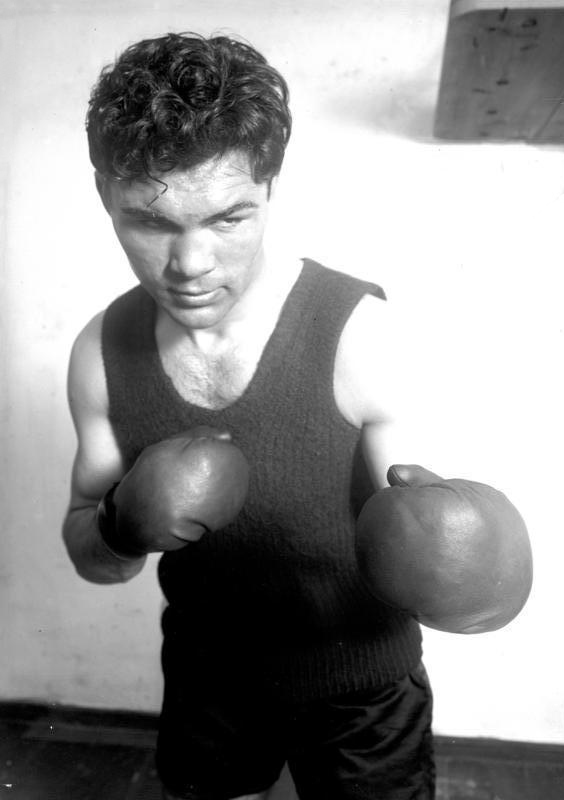
Maximilian Adolph Otto Siegfried Schmeling (German pronunciation: [maks ˈʃmeːlɪŋ], audio; 28 September 1905 – 2 February 2005) was a German boxer who was heavyweight champion of the world between 1930 and 1932. His two fights with Joe Louis in 1936 and 1938 were worldwide cultural events because of their national associations. Schmeling is the only boxer to win the world heavyweight championship on a foul.

Key Information

Starting his professional career in 1924, Schmeling went to the United States in 1928 and, after a ninth-round technical knockout of Johnny Risko, became a sensation. He became the first to win the heavyweight championship (at that time vacant) by disqualification in 1930, after opponent Jack Sharkey knocked him down with a low blow in the fourth round. Schmeling retained his crown successfully in 1931 by a technical knockout victory over Young Stribling. A rematch in 1932 with Sharkey saw the American gaining the title from Schmeling by a controversial fifteen-round split decision. In 1933, Schmeling lost to Max Baer by a tenth-round technical knockout. The loss left people believing that Schmeling was past his prime. Meanwhile, Adolf Hitler and the Nazi Party took over control in Germany, but Schmeling never joined the Party. The same year, he married Czech film actress Anny Ondra.

In 1936, in their first fight, Schmeling knocked out American rising star Joe Louis, placing him as the number one contender for Jim Braddock's title, but Louis got the fight and knocked Braddock out to win the championship in 1937. Schmeling finally got a chance to regain his title in 1938 in the rematch, but Louis won by technical knockout in the first round. During World War II, Schmeling served with the German Air Force (Luftwaffe) as a paratrooper (Fallschirmjäger).[5] After the war, Schmeling mounted a comeback, but retired permanently in 1948. After retiring from boxing, Schmeling worked for The Coca-Cola Company. Schmeling became friends with Louis, and their friendship lasted until the latter's death in 1981. Schmeling died in 2005 aged 99, a sporting hero in his native Germany. Long after the Second World War, it was revealed that Schmeling had risked his life to save the lives of two Jewish children in 1938.[6] At the age of 99, Schmeling was the longest living heavyweight boxing champion in history.

In 2003, Schmeling was ranked 55 on The Ring magazine's list of 100 greatest punchers of all time.[7]

Biography

[edit]

Early years

[edit]

Max Schmeling Jr. was born in Klein Luckow, in the Prussian Province of Brandenburg, the son of Max Sr. and Amanda (née Fuchs) Schmeling. He had an older brother, Rudolf, born in 1902 and a younger sister, Edith, born in 1913.[8] He first became acquainted with boxing as a teenager, when his father took him to watch film of the heavyweight championship match between Jack Dempsey and Georges Carpentier. Impressed with Dempsey's performance in that fight, young Schmeling became determined to imitate his new hero. He began boxing in amateur competitions and, by 1924, won Germany's national amateur title in the light heavyweight division. Shortly thereafter, he turned professional. Ironically, though he idolised the raging, brawling Dempsey, Schmeling developed a careful, scientific style of fighting that lent itself more to counterpunching. Using this style, he won seventeen of his first twenty-three bouts, thirteen by knockout. In 1925, he got into the ring with Dempsey, who was then still heavyweight champion of the world and was touring Europe. Dempsey boxed for two rounds with the then-unknown German and, according to a story later told by Schmeling, was greatly impressed. He proved Dempsey's praises correct on 24 August 1926, when picking up the German light heavyweight championship with a first-round knockout of rival Max Diekmann, who had previously beaten Schmeling.[9] The next year, Schmeling won the European championship by stopping Fernand Delarge in the first boxing match broadcast live in Germany. After defending both titles against Hein Domgoergen the same year and, in 1928, the European Title with a first-round knockout of Michele Bonaglia, he secured the German heavyweight championship with a points victory against Franz Diener and decided to chase bigger fights and bigger purses in the United States.

Max Schmeling on the cover of TIME Magazine. June 24, 1929

Arriving in New York City for the first time in 1928, Schmeling was hardly noticed by the American fight circles. Considered a stiff European fighter who had padded his record against German and European unknowns, he was given few opportunities to prove himself until he hooked up with American manager Joe Jacobs. Schmeling's debut in America took place at Madison Square Garden with an eighth-round knockout of Joe Monte, who was not a top-flight heavyweight but nonetheless had been in with some tough competition. Two more victories led to a fight with Johnny Risko, one of the biggest names in the division, though somewhat beyond his prime. On 1 February 1929, Schmeling floored Risko four times with his right hand before the referee halted the contest in the ninth round, handing Risko his only loss by TKO. The surprised crowd in attendance roared with appreciation and The Ring magazine subsequently recognized the win as its 'Fight of the Year.'

The "Low Blow Champion"

[edit]
Max Schmeling with his mother Amanda Schmeling (née Fuchs) in 1931

When he defeated the highly regarded Spaniard Paulino Uzcudun with a fifteen-round decision at Yankee Stadium later that year, Schmeling was regarded as the foremost young contender in the division. With the World Heavyweight Champion Gene Tunney having recently retired, promoters arranged a matchup between the German and veteran contender Jack Sharkey to fill the vacancy. On 12 June 1930, at Yankee Stadium, in a fight billed as the 'Battle of the Continents,' Schmeling, known as a slow starter, fell slightly behind on points going into the fourth round. He was trying to corner his opponent when Sharkey let loose with a very fast, clear hit to the groin. Schmeling fell to the canvas, claiming to have been fouled. When manager Jacobs ran into the ring, prompting chaos, the referee disqualified Sharkey and declared Schmeling the victor and the first man to win the world heavyweight championship on a foul. The New York State Athletic Commission (NYSAC), reviewing the call, agreed.

The first European-born boxer to win the heavyweight championship in thirty-three years, Schmeling was also the first from Germany to hold the distinction. Still, the way in which he won the title proved an embarrassment. Called the 'low blow champion,' he was disparaged in both America and Europe as an unproven titleholder. When he initially refused to face Sharkey in a rematch, the NYSAC officially stripped him of their recognition as world champion, but he remained recognised by both the National Boxing Association (NBA) and The Ring magazine. Most of the criticism faded after Schmeling's first defence, a fifteen-round TKO over Young Stribling, a future hall-of-famer with 239 wins to his credit by 1931. In order to solidify his title as undisputed, Schmeling signed a contract to face the "Boston Gob" once more. On 21 June 1932, the championship picture became even more muddled when Sharkey won a highly controversial split decision, taking the championship. Many in attendance, including former heavyweight champion Gene Tunney and the mayor of New York, felt that Schmeling had proven himself the better man and was robbed. In losing the championship, the German had elevated his reputation in the minds of boxing fans.

Walker and Baer

[edit]

When Schmeling faced Mickey Walker, the future hall-of-famer who had recently held Sharkey to a draw that many felt Walker deserved, it was thought that this fight was for the real heavyweight championship. Walker, a former welterweight, was a popular slugger who had won championships in two divisions but was at a considerable size disadvantage against the European. Though Walker took the lead on points, Schmeling dealt out a beating as the fight progressed. After eight rounds, Walker's corner threw in the towel, confirming Schmeling's status as the leading heavyweight in the world.

Wedding of Schmeling and Czech actress Anny Ondra in 1933. The couple remained married until Ondra's death in 1987.

With the coming of 1933, however, Schmeling's image in America began to take a decided turn. In 1932, the Nazi Party became the most powerful political force in Germany, and its ideologies, voiced by party leader Adolf Hitler, overflowed with anti-Semitic tendencies. Major American cities such as New York had large Jewish populations, who worried over what the party could mean for people of their religion in the future. Schmeling, because he was German, was viewed as an extension of Hitler's plans for world domination. When he was slated to fight heavy-hitting contender Max Baer on 8 June 1933, he immediately became the 'bad guy' in the eyes of fans. Baer, who did not practice the Jewish religion but had a Jewish father, came into the ring wearing the Star of David on his shorts. Promoter Jack Dempsey played up this angle and suddenly the fight was viewed as Baer defending his faith against the prejudice of the Nazis, represented reluctantly by Schmeling. Thrown off of his game in part by the bad publicity but also because of Baer's wild, brawling style and frequent fouls (including backhand punches and rabbit punches), Schmeling was thrashed after ten rounds before nearly 60,000 onlookers at Yankee Stadium. When the German took a battering against the ropes in the tenth, the referee leapt in to stop the fight. The fight, combined with a follow-up loss to contender Steve Hamas early the next year, left many wondering if Schmeling was still a world top-class fighter.

Versus Joe Louis

[edit]
Louis vs. Schmeling, 1936

Returning to his native Germany, Schmeling won three of his next four fights, with one draw, including knockout wins over first Walter Neusel, then another avenging his previous loss to Steve Hamas. However, many among the American press and fans remained unmoved on the idea of rooting for Schmeling in light of the Nazi Party's behavior. Articles continued to be published declaring the German "washed up", a "has been", or a "Nazi puppet". When he was matched with undefeated boxing sensation Joe Louis in 1936 for the German's first fight on American soil in more than two years, he was clearly the betting underdog, considered a name opponent for Louis to roll over on his route to the title. Nevertheless, he was the number two contender for the title behind Louis. Prior to the match, Schmeling carefully studied films of Louis's prior fights, dissecting apparent flaws in the Detroit fighter's technique. Among the weaknesses he noticed was the fact that Louis lowered his left hand after throwing a left jab. In the ring, Schmeling exploited this subtle flaw to his own advantage, countering nearly every Louis jab with his best punch, the right cross. The fight proved to be a competitive, hard-hitting affair for the first three rounds, but, in the fourth, a counter right from the German dropped Louis for the first time in his career. Though Louis rose, he was badly dazed for the remainder of the fight. For a further eight rounds, Schmeling battered Louis, often standing toe-to-toe with the vaunted puncher and landing that same right hand to the jaw repeatedly. In the twelfth, he sent the American tumbling to the floor once more, and this time Louis could not recover. He was counted out on the floor, and Schmeling had scored the most talked-about sports upset of the year.

Now the unexpected number one contender for the heavyweight crown held by Jim Braddock, Schmeling looked forward to his chance to become the first fighter to regain the world heavyweight title by winning the fight with Braddock that had been scheduled for that September. The fight was postponed, however, when Braddock injured his hand in training. Rumors existed that the fight's organizers were stalling, afraid of the negative publicity that would be generated over a perceived Nazi getting a shot at the world's title. When it was confirmed that Braddock's managers were in talks with the Louis camp, the New York Commission officially released an order for Braddock to fight Schmeling for the title. Any other fight, with Louis or otherwise, would not be recognized by New York as being for the championship. The Madison Square Garden Corporation, the largest promotional company in the sport at the time, even attempted to get a legal injunction against a Braddock–Louis fight (Louis was not on their roster). Nonetheless, in February 1937, Schmeling received the news that the champion had indeed signed to defend his championship against Louis. A furious Schmeling protested, but to no avail, and he was forced to watch from ringside as Louis knocked Braddock out and gained the championship. Sorely disappointed and convinced that he would never receive his chance at redemption, Schmeling fought just once more in America, an eighth-round knockout of future contender Harry Thomas, before returning to Germany. In his native land, Schmeling was regarded as a hero and promoted by the Nazi propaganda machine as a perfect example of German supremacy over the rest of the world by virtue of his defeat of the current champion, Louis. The government ordered parades and rallies in his honor. He became a friend to Hitler and other powerful figures in the government and also a popular subject of newspaper articles and films. He continued to press for a chance at a rematch with Louis and in the meantime padded his record against overmatched fighters Ben Foord and Steve Dudas.

"Battle of the Century"

[edit]

In 1938, champion Joe Louis announced that he would face Schmeling for the title. The rematch became an instant international sensation. Many clamored impatiently for its happening, but others, afraid of international tensions and the possibility of Hitler taking over the championship, protested. The controversy and ballyhoo led to the event becoming the most anticipated boxing match since the rematch between Dempsey and Gene Tunney, or possibly earlier. Louis, with his poor, lower-class roots, was adopted by American fans as the symbol of America as a land of opportunity. In contrast, Americans perceived Schmeling and his ties to Hitler as an obvious threat to those opportunities and ideals. When the German walked to the ring at Yankee Stadium on 22 June 1938, he did so under a hail of garbage thrown from the stands. Louis came out blazing in the first round and Schmeling tried to counter-punch as he had in the first bout, but to no avail. Driven into the ropes and battered with a fusillade of short, crisp blows from every angle, Schmeling turned his back to his opponent and clutched onto the ropes, letting out a scream that even years later, many spectators could recall vividly. Schmeling later said that he screamed because he had been hit with a blow to the kidneys. Schmeling's knees buckled under the punishment, and referee Arthur Donovan pushed Louis away, beginning a count on Schmeling. Schmeling reluctantly stepped away from the ropes, and Donovan allowed him to continue. A few punches later, Schmeling was knocked down again. From then on, he was helpless. He rose but fell moments later, and Donovan stopped the fight.

Many years later, in 1975, Schmeling said, "Looking back, I'm almost happy I lost that fight. Just imagine if I would have come back to Germany with a victory. I had nothing to do with the Nazis, but they would have given me a medal. After the war I might have been considered a war criminal."[10]

Schmeling in his later years

[edit]
Joe Louis and Max Schmeling in 1971

When he returned to Germany after his defeat by Joe Louis, Schmeling was now shunned by the Nazis. He won both the German and European heavyweight championships on the same night, with a first-round knockout of Adolf Heuser. During the Nazi purge of Jews from Berlin, he personally saved the lives of two Jewish children by hiding them in his Excelsior hotel room in Berlin. He claimed he was sick and permitted no one to enter.[11] It was not the first time that Schmeling defied the Nazi regime's hatred for Jews. As the story goes, Hitler let it be known through the Reich Ministry of Sports that he was very displeased at Schmeling's relationship with Joe Jacobs, his Jewish fight promoter, and wanted it terminated, but Schmeling refused to bow even to Hitler.[12] During the war, Schmeling was drafted, where he served with the Luftwaffe and was trained as a paratrooper.[13] He participated in the Battle of Crete in May 1941, where he was wounded in his right knee by mortar fire shrapnel during the first day of the battle. After recovering, he was dismissed from active service after being deemed medically unfit for duty because of his injury. Nevertheless, in July 1944 a rumor that he had been killed in action made world news.[14] He later visited American POW camps in Germany and occasionally tried to improve conditions for the prisoners. By early 1945, he was spending his time giving exhibition bouts against British Free Corps member Eric Pleasants in German officers' messes.[15]

After the war, Schmeling settled in Hamburg where in 1947, strapped for money, he embarked upon a moderately successful comeback in boxing, winning three of his five bouts with two point-defeats before re-entering retirement for good in October 1948.

Schmeling became a successful mink, chicken, and tobacco farmer in the early 1950s. Towards the end of the decade, after multiple meetings with The Coca-Cola Company's offices in Germany, Schmeling became the face of 'Cocacolonization' and Coca-Cola's reentry into Germany. Before long, he owned his own bottling plant and held an executive's position within the company. Schmeling helped bring vending machines into use in Germany.[16]

He became friends with Joe Louis and he assisted his former rival financially in his later years, eventually financing his funeral in 1981.[17]

During a LA times interview in the 1980s rising tennis star Steffi Graf asked Schmeling how he maintained his popularity. Schmeling replied, stating that ‘I told her that a smile doesn’t cost anything and your fans won’t forget it. And, most important, to keep both feet on the ground.’[18]

In 1996 a stadium was opened in Berlin which was named in Schmeling’s honor titled the Max-Schmeling-Halle arena the opening ceremony took place on December 14, 1996 with Schmeling in attendance for the event.

His wife of 54 years, the Czech-born actress Anny Ondra, died in 1987. In 1992, he was inducted into the International Boxing Hall of Fame. His autobiography, Max Schmeling: An Autobiography, was published in 1994. He lived his remaining years as a wealthy man and avid boxing fan, dying on 2 February 2005, at the age of 99.[19] There was a memorial held in Schmeling’s honor following his death which was attended by many important German figures.[20][21]

There is a memorial stone located in front of the house where Schmeling was born in Klein Luckow.[22]

In 2010, a bronze statue of Schmeling was erected in Hollenstedt.[23]

Honours

[edit]

Cultural references

[edit]

Honorary residencies

[edit]
  • Honorary Resident of the City of Los Angeles
  • Honorary Resident of Las Vegas
  • Honorary Resident of Klein-Luckow (his hometown)
  • Honorary Member of the Austrian Boxing Federation

Professional boxing record

[edit]
70 fights 56 wins 10 losses
By knockout 40 5
By decision 13 5
By disqualification 3 0
Draws 4
No. Result Record Opponent Type Round, time Date Location Notes
70 Loss 56–10–4 Richard Vogt PTS 10 31 Oct 1948 VFB Platz, Kiel, Germany
69 Win 56–9–4 Hans Joachim Draegestein TKO 9 (10) 2 Oct 1948 VFB Platz, Kiel, Germany
68 Loss 55–9–4 Walter Neusel PTS 10 23 May 1948 Platz in Hamburg-Altona, Hamburg, Germany
67 Win 55–8–4 Hans Joachim Draegestein PTS 10 7 Dec 1947 Omnibushalle, Hamburg, Germany
66 Win 54–8–4 Werner Vollmer KO 7 (10) 28 Sep 1947 Waldstadion, Frankfurt, Germany
65 Win 53–8–4 Adolf Heuser KO 1 (15) 2 Jul 1939 Adolf-Hitler-Kampfbahn, Stuttgart, Nazi Germany Won European and German BDB heavyweight titles
64 Loss 52–8–4 Joe Louis TKO 1 (15), 2:04 22 Jun 1938 Yankee Stadium, Bronx, U.S. For NYSAC, NBA, and The Ring heavyweight titles
63 Win 52–7–4 Steve Dudas KO 5 (15) 16 Apr 1938 Hanseatenhalle, Hamburg, Nazi Germany
62 Win 51–7–4 Ben Foord PTS 12 30 Jan 1938 Hanseatenhalle, Hamburg, Nazi Germany
61 Win 50–7–4 Harry Thomas TKO 8 (15) 13 Dec 1937 Madison Square Garden, New York City, New York, U.S.
60 Win 49–7–4 Joe Louis KO 12 (15), 2:29 19 Jun 1936 Yankee Stadium, Bronx, U.S.
59 Win 48–7–4 Paulino Uzcudun PTS 12 7 Jul 1935 Poststadion, Berlin, Nazi Germany
58 Win 47–7–4 Steve Hamas KO 9 (12) 10 Mar 1935 Hanseatenhalle, Hamburg, Nazi Germany
57 Win 46–7–4 Walter Neusel TKO 9 (12) 26 Aug 1934 Sandbahn Lokstedt, Hamburg, Nazi Germany
56 Draw 45–7–4 Paulino Uzcudun MD 12 13 May 1934 Estadio Olímpico de Montjuïc, Barcelona, Spain
55 Loss 45–7–3 Steve Hamas UD 12 13 Feb 1934 Philadelphia Convention Hall, Philadelphia, Pennsylvania, U.S.
54 Loss 45–6–3 Max Baer TKO 10 (15), 1:51 8 Jun 1933 Yankee Stadium, Bronx, New York, U.S.
53 Win 45–5–3 Mickey Walker TKO 8 (15) 26 Sep 1932 Madison Square Garden Bowl, Queens, New York, U.S.
52 Loss 44–5–3 Jack Sharkey SD 15 21 Jun 1932 Madison Square Garden Bowl, Queens, New York, U.S. Lost NYSAC, NBA, and The Ring heavyweight titles
51 Win 44–4–3 Young Stribling TKO 15 (15), 2:46 3 Jul 1931 Municipal Stadium, Cleveland, Ohio, U.S. Retained NBA and The Ring heavyweight titles
50 Win 43–4–3 Jack Sharkey DQ 4 (15), 2:55 12 Jun 1930 Yankee Stadium, Bronx, New York, U.S. Won vacant NYSAC, NBA, and The Ring heavyweight titles
49 Win 42–4–3 Paulino Uzcudun PTS 15 27 Jun 1929 Yankee Stadium, Bronx, New York, U.S.
48 Win 41–4–3 Johnny Risko TKO 9 (15) 1 Feb 1929 Madison Square Garden, New York City, New York, U.S.
47 Win 40–4–3 Pietro Corri KO 1 (10) 21 Jan 1929 Laurel Garden, Newark, New Jersey, U.S.
46 Win 39–4–3 Joe Sekyra PTS 10 4 Jan 1929 Madison Square Garden, New York City, New York, U.S.
45 Win 38–4–3 Joe Monte KO 8 (10) 23 Nov 1928 Madison Square Garden, New York City, New York, U.S.
44 Win 37–4–3 Franz Diener PTS 15 4 Apr 1928 Berlin Sportpalast, Berlin, Germany Won vacant German BDB heavyweight title
43 Win 36–4–3 Ted Moore PTS 10 11 Mar 1928 Westfalenhallen, Dortmund, Germany
42 Loss 35–4–3 Gipsy Daniels KO 1 (10) 25 Feb 1928 Festhalle Frankfurt, Frankfurt, Germany
41 Win 35–3–3 Michele Bonaglia KO 1 (15), 2:31 6 Jan 1928 Berlin Sportpalast, Berlin, Germany Retained European light-heavyweight title
40 Win 34–3–3 Gipsy Daniels PTS 10 2 Dec 1927 Berlin Sportpalast, Berlin, Germany
39 Win 33–3–3 Hein Domgoergen KO 7 (15) 6 Nov 1927 Achilleion, Leipzig, Germany Retained European and German BDB light-heavyweight titles
38 Win 32–3–3 Louis Clement TKO 6 (10) 2 Oct 1927 Westfalenhallen, Dortmund, Germany
37 Win 31–3–3 Robert Larsen TKO 3 (10) 2 Sep 1927 Berlin Sportpalast, Berlin, Germany
36 Win 30–3–3 Willem Westbroek KO 3 (10) 7 Aug 1927 Radrennbahn, Essen, Germany
35 Win 29–3–3 Jack Taylor PTS 10 1 Aug 1927 Sagebiel, Hamburg, Germany
34 Win 28–3–3 Fernand Delarge KO 14 (15) 19 Jun 1927 Westfalenhallen, Dortmund, Germany Won European light-heavyweight title
33 Win 27–3–3 Raoul Paillaux KO 3 (10) 17 May 1927 Sagebiel, Hamburg, Germany
32 Win 26–3–3 Robert Larsen PTS 10 8 May 1927 Stadion Radrennbah, Frankfurt, Germany
31 Win 25–3–3 Stanley Glen KO 1 (10) 26 Apr 1927 Berlin Sportpalast, Berlin, Germany
30 Win 24–3–3 Francois Charles TKO 8 (10) 8 Apr 1927 Berlin Sportpalast, Berlin, Germany
29 Win 23–3–3 Leon Sebilo KO 2 (10) 12 Mar 1927 Westfalenhallen, Dortmund, Germany
28 Win 22–3–3 Joe Mehling TKO 3 (10) 4 Feb 1927 Zirkus Sarassani, Dresden, Germany
27 Win 21–3–3 Louis Wilms TKO 8 (10) 23 Jan 1927 Jahrhunderthalle, Breslau, Germany (now Wrocław, Poland)
26 Win 20–3–3 Jack Stanley KO 8 (10) 7 Jan 1927 Berlin Sportpalast, Berlin, Germany
25 Win 19–3–3 Herman van 't Hof DQ 8 (10) 1 Oct 1926 Berlin Sportpalast, Berlin, Germany
24 Win 18–3–3 Max Diekmann KO 1 (15), 0:30 24 Aug 1926 Luna Park, Berlin, Germany Won vacant German BDB light-heavyweight title
23 Win 17–3–3 Aug Vongehr TKO 1 (4) 13 Jul 1926 Luna Park, Berlin, Germany
22 Win 16–3–3 Willy Louis KO 1 (6) 19 Mar 1926 Hochhaus-Sportschule, Cologne, Germany
21 Draw 15–3–3 Max Diekmann PTS 8 12 Feb 1926 Kaiserdamm Arena, Berlin, Germany
20 Win 15–3–2 René Compère PTS 8 8 Nov 1925 Bickendorfer Festhalle, Cologne, Germany
19 Loss 14–3–2 Larry Gains TKO 2 (10) 28 Aug 1925 Kristallpalast, Cologne, Germany
18 Draw 14–2–2 Leon Randol PTS 10 9 May 1925 Brussels, Belgium
17 Loss 14–2–1 Jack Taylor PTS 10 9 May 1925 Messehalle, Cologne, Germany
16 Win 14–1–1 Fred Hammer PTS 10 28 Apr 1925 Beethovenhalle, Bonn, Germany
15 Draw 13–1–1 Jimmy Lyggett Sr PTS 8 3 Apr 1925 Berlin Sportpalast, Berlin, Germany
14 Win 13–1 Alfred Baker KO 8 (8) 15 Mar 1925 Schauburgring, Cologne, Germany
13 Win 12–1 Leon Randol KO 4 (8) 1 Mar 1925 Schauburgring, Cologne, Germany
12 Win 11–1 Joe Mehling PTS 6 20 Jan 1925 Kriegervereinshaus, Berlin, Germany
11 Win 10–1 Johnny Cludts KO 2 (8) 18 Jan 1925 Schauburgring, Cologne, Germany
10 Win 9–1 Jimmy Lyggett Sr KO 4 (10) 26 Dec 1924 Bickendorfer Festhalle, Cologne, Germany
9 Win 8–1 Richard Hartig KO 1 (10) 17 Dec 1924 Saalbau Friedrichshain, Berlin, Germany
8 Win 7–1 Battling Mathar KO 3 (10) 7 Dec 1924 Tonhalle Düsseldorf, Düsseldorf, Germany
7 Win 6–1 Hans Breuer KO 2 (10) 4 Dec 1924 Colonia-Haus, Cologne, Germany
6 Win 5–1 Fred Hammer KO 3 31 Oct 1924 Bickendorfer Festhalle, Cologne, Germany
5 Loss 4–1 Max Diekmann RTD 4 (6) 10 Oct 1924 Berlin Sportpalast, Berlin, Germany
4 Win 4–0 Rocky Knight PTS 8 4 Oct 1924 Bickendorfer Festhalle, Cologne, Germany
3 Win 3–0 Willy Louis KO 1 20 Sep 1924 Duisburg, Germany
2 Win 2–0 Henri van der Vyver KO 3 (8) 19 Sep 1924 Bickendorfer Festhalle, Cologne, Germany
1 Win 1–0 Hans Czapp KO 6 2 Aug 1924 Tonhalle Düsseldorf, Düsseldorf, Germany

Titles in boxing

[edit]

Major world titles

[edit]

The Ring magazine titles

[edit]

Regional/International titles

[edit]

Undisputed titles

[edit]

Literature and media

[edit]
  • Kluge, Volker:Max Schmeling. Aufbau, Berlin 2004, ISBN 3-351-02570-X.
  • Krauß, Martin: Schmeling. Die Karriere eines Jahrhundertdeutschen. Die Werkstatt, Göttingen 2005, ISBN 3-89533-472-3.
  • David Margolick: Beyond Glory. Joe Louis Vs. Max Schmeling, and a World on the Brink. Knopf, New York 2005, ISBN 978-0-375-41192-2.[32]
  • Pfeifer, David: Max Schmeling – Berufsboxer, Propagandafigur. Unternehmer. Die Geschichte eines deutschen Idols. Campus, Frankfurt am Main 2005, ISBN 3-593-37546-X.
  • Max Schmeling erzählt aus seinem Leben. Berührung. Hörbuch. Unterlauf & Zschiedrich Hörbuchverlag Berlin 2003, ISBN 978-3-934384-28-6.
  • David Pfeifer (2007). "Schmeling, Max Siegfried Adolph Otto". Neue Deutsche Biographie (in German). Vol. 23. Berlin: Duncker & Humblot. pp. 125–126. (full text online).

Films

[edit]
  • Joe & Max. Fernsehfilm, USA, Deutschland, 2002, 109 Min., Regie: Steve, u.a. mit Til Schweiger als Max Schmeling
  • ARD-Legenden: Max Schmeling. Dokumentation, ARD 2003, 45 Min., Regie: Michael Wulfes
  • Der Kampf des Jahrhunderts. Max Schmeling gegen Joe Louis. Dokumentation, USA, 2004, 87 Min., Regie: Barak Goodman, Inhaltsangabe at the Wayback Machine (archived 30 June 2008) von Phoenix
  • Max Schmeling. Kinofilm, Bundesrepublik Deutschland, 2010, 123 min., Regie: Uwe Boll, mit Henry Maske als Max Schmeling, Susanne Wuest als Anny Ondra, Vladimir Weigl als Joe Jacobs, u.v.a.

See also

[edit]

Notes and references

[edit]
[edit]
Revisions and contributorsEdit on WikipediaRead on Wikipedia
from Grokipedia
Maximillian Adolph Otto Siegfried (28 September 1905 – 2 February 2005) was a German professional boxer who held the championship from 1930 to 1932, becoming the first European to claim the vacant title by defeating via disqualification in the fourth round. Schmeling achieved international prominence through his two bouts against American , securing an upset twelfth-round victory in 1936 that halted Louis's undefeated streak, followed by a first-round defeat in the 1938 rematch amid heightened global tensions. These contests were exploited by Nazi propaganda as emblematic of superiority despite Schmeling's refusal to join the and his personal opposition to its ideology, evidenced by his sheltering of two Jewish teenagers in his hotel during the 1938 . During , Schmeling served as a with the , sustaining shrapnel wounds during the 1941 that ended his active combat role. Postwar, he attempted a brief comeback before retiring to a prosperous career in business, maintaining a lifelong friendship with Louis and living to age 99 as a respected figure in .

Early Life and Amateur Career

Childhood and Introduction to Boxing

Maximilian Adolph Otto Siegfried Schmeling was born on September 28, 1905, in Klein Luckow, a rural village in Brandenburg, Prussia (now ), to parents of modest circumstances; his father served as a for the Hamburg-America . The family soon relocated to , where Schmeling spent his formative years in the city's working-class districts amid the economic hardships following and the . Boxing remained an obscure and often stigmatized sport in early 20th-century , with limited infrastructure and cultural acceptance compared to its popularity . As a teenager in around 1919–1920, Schmeling discovered the sport through exposure to American boxing films and newsreels featuring champions like , which inspired him to train at local gyms and enter amateur competitions. His early training emphasized technical skill and endurance, reflecting the self-taught nature of boxing in at the time. By 1924, at age 18, Schmeling had advanced sufficiently to claim the German national amateur championship in the light division, a feat that highlighted his rapid progress and potential despite the sport's nascent status in his homeland. This achievement not only boosted his confidence but also positioned him for a debut later that year, marking the transition from youthful pursuit to serious athletic endeavor.

Amateur Successes and Relocation to the United States

Schmeling commenced his amateur boxing career in 1919 during his teenage years, initially competing in regional tournaments across after relocating from his rural hometown to industrial areas in search of training opportunities and like-minded competitors. His early bouts demonstrated a developing prowess, particularly with his right hand, though his record remained modest until national contention. In 1924, at age 18, he secured the German national championship, marking his most notable achievement in the ranks before transitioning to later that year. This victory elevated Schmeling's profile domestically but highlighted the limitations of European competition for aspiring heavyweights, where the sport's premier talent and financial incentives concentrated in the United States. Seeking to challenge elite opponents and capitalize on larger purses, Schmeling departed for America in 1928, arriving in New York City as the epicenter of global boxing. Initially overlooked by American promoters as a rigid European stylist lacking flair, he persisted, securing his U.S. debut on November 23, 1928, at Madison Square Garden against Joe Monte, whom he defeated by eighth-round stoppage. This relocation proved pivotal, enabling confrontations with top contenders like Paulino Uzcudun and laying groundwork for his ascent in the heavyweight division.

Professional Rise to Heavyweight Champion

Debut and European Victories

Schmeling made his professional boxing debut on August 2, 1924, in , , defeating Hans Czapp by knockout in the sixth round at the age of 18. Over the following years, he competed primarily in and surrounding European countries, compiling a series of victories that established his reputation as a formidable light heavyweight contender, including stoppages against opponents such as Willy Louis and Erich Richter. In 1926, Schmeling captured the German light heavyweight title, solidifying his domestic dominance in the division through consistent performances marked by his technical precision and powerful right hand. The following year, on June 19, 1927, he won the European light heavyweight championship by defeating Belgian champion Fernand Delarge over 15 rounds in , , becoming the first German to claim that continental title and marking the first match broadcast live in . This victory elevated his profile across , drawing attention from promoters seeking bigger opportunities. Transitioning to the division, Schmeling secured the German heavyweight title in 1928, further demonstrating his adaptability and against larger foes. These European triumphs, achieved through a record of predominantly knockouts in regional bouts, positioned him for international challenges, prompting his relocation to the later that year to pursue heavyweight contention.

Capturing the World Heavyweight Title

Following victories over prominent contenders such as Paolino Uzcudun in 1929, Max Schmeling secured a bout for the vacant world heavyweight title against , arranged after Tunney's retirement in 1928 left the crown unoccupied. The matchup occurred on June 12, 1930, at in , drawing a crowd of approximately 80,000 spectators. Sharkey, the favored fighter at 6 feet 1 inch and around 195 pounds, controlled the first three rounds with aggressive pressure and effective punching, while Schmeling, at 6 feet and 188 pounds, adopted a defensive stance emphasizing counterpunching and . In the fourth round, however, Sharkey delivered a low blow to Schmeling's groin, causing visible pain and prompting Schmeling to collapse; after examination, Jimmy Crowley disqualified Sharkey, awarding the victory and title to Schmeling by technical knockout via foul. This marked the first instance in heavyweight history where a champion was crowned solely by disqualification, bypassing a points decision despite Schmeling trailing on most judges' scorecards up to that point. Schmeling thus became the first German and first European since to claim the world championship, recognized by major sanctioning bodies including the . The outcome sparked immediate , with American press and fans decrying it as undeserved given Schmeling's apparent disadvantage before the foul, and some German observers initially viewing him as an unproven "paper champion" lacking a victory. Despite doubts, Schmeling's technical proficiency and prior record— including 41 knockouts in 56 professional fights—affirmed his credentials as a legitimate contender elevated by the disqualification.

Title Defenses Against Walker and Baer

Schmeling faced former and champion Mickey Walker on September 26, 1932, at Bowl in , , New York, in a non-title bout following Schmeling's loss of the crown to earlier that year. Walker, weighing around 174 pounds and known for his aggressive infighting style, sought to reestablish himself at , but Schmeling, at 190 pounds, controlled the pace with precise counterpunching and superior reach. In the first round alone, Schmeling floored Walker twice with left hooks to the head, and he continued to dominate, leading to a technical knockout in the eighth round after Walker absorbed heavy punishment and could no longer defend effectively. The victory, witnessed by approximately 35,000 spectators, demonstrated Schmeling's technical prowess despite the absence of the title on the line, though it did not restore his championship status. Nine months later, on June 8, 1933, Schmeling met Max Baer at in , New York, in a scheduled 15-round title eliminator sanctioned by the National Boxing Association, with over 56,000 fans in attendance and a gate exceeding $205,000. Baer, standing 6 feet 2.5 inches and weighing 203 pounds, leveraged his height, reach, and devastating right hand—"the Lion's Roar"—against the 6-foot Schmeling, who entered at 189 pounds with a reputation for defensive mastery and straight-right counters. Early rounds saw Schmeling landing jabs and occasional rights, but Baer absorbed them and ramped up pressure from the fifth, battering Schmeling with hooks and uppercuts that opened cuts and swelled his eyes. By the tenth round, a barrage of punches left Schmeling staggering and defenseless in a neutral corner, prompting referee Arthur Donovan to halt the fight at 1:51, awarding Baer a technical knockout victory. The loss, Schmeling's second in three fights since surrendering the title, positioned Baer as the leading contender, though Schmeling disputed the stoppage privately, citing exhaustion from Baer's relentless volume.

Landmark Fights with

The 1936 Upset Victory

entered the bout with an undefeated professional record of 24 wins, all by or stoppage, establishing him as a rising sensation at age 22. Max Schmeling, the 30-year-old former world champion, carried a record of 47 wins against 7 losses and 4 draws, but was viewed as faded and a mere tune-up opponent for Louis. Betting odds heavily favored Louis at 10-to-1, reflecting widespread expectations of a quick domination by the American. The fight occurred on June 19, 1936, at in before a crowd of approximately 46,000 spectators. Schmeling's preparation proved decisive; he meticulously analyzed film footage of Louis's previous bouts, identifying a technical flaw where Louis dropped his left hand low after jabbing, leaving his right side exposed to counters. In contrast, Louis approached training with overconfidence, sparring minimally and underestimating his opponent, which allowed Schmeling to exploit the vulnerability throughout the match. From the opening rounds, Schmeling employed a defensive , slipping Louis's punches and landing precise right-hand counters to the body and head, gradually wearing down the younger fighter. Louis dominated early with volume punching but failed to capitalize due to Schmeling's resilience and tactical precision. In the 12th round, Schmeling delivered a devastating right to Louis's body followed by a crushing right to the head, knocking him out for the first time in his career and securing the upset victory. This triumph marked Schmeling's 48th professional win and revived his contention status, while inflicting Louis's sole defeat until his title-winning phase began. The outcome stunned the world, highlighting Schmeling's analytical edge over raw power and foreshadowing the rivalry's deeper cultural resonance, though primarily underscoring a rare instance of veteran savvy overturning prodigious talent in history.

The 1938 Rematch and "Battle of the Century"

The rematch between and Max Schmeling occurred on June 22, 1938, precisely one year after Louis defeated to claim the world heavyweight championship. Promoter Mike Jacobs arranged the bout at in , New York, where a sellout crowd of 70,253 spectators gathered, generating a live gate of over $1 million and reaching an estimated 55 million radio listeners globally. Promoted as the "Battle of the Century," the fight was laden with geopolitical symbolism as war loomed in , with Nazi propaganda portraying Schmeling's 1936 upset as proof of superiority despite his personal disavowal of the regime and lack of party membership. reportedly followed the bout closely from , viewing it as a proxy contest between National Socialism and American democracy, though U.S. media amplified this narrative while Schmeling emphasized the purely sporting rivalry. Louis, entering at 24 years old with a record of 35 wins and 1 loss, sought to erase his sole defeat, while the 33-year-old Schmeling arrived with 52 wins, 7 losses, and 4 draws, relying on tactical preparation from film study of Louis's prior fights. From the opening bell, Schmeling pressed forward aggressively, landing a left hook that briefly staggered Louis, but the champion quickly recovered and unleashed a devastating combination of rights and hooks. Louis floored Schmeling three times within the first two minutes—once with a right to the jaw, again with a left hook, and finally with a series of body shots—before referee Arthur Donovan intervened at 2 minutes and 4 seconds to deliver a technical knockout, as Schmeling could not rise. Schmeling absorbed over 30 unanswered punches in the sequence, sustaining severe injuries including fractured vertebrae, kidney damage, and lacerations that required weeks of hospitalization and contributed to thereafter. The swift victory cemented Louis's dominance, extending his unbeaten streak as champion and boosting national morale amid economic recovery and international strife, with President Franklin D. Roosevelt among those who praised it as a triumph over fascism's shadow. For Schmeling, the loss ended his immediate heavyweight title aspirations in America, prompting a return to European bouts, though he later attributed part of his diminished performance to age and rigorous training rather than verified pre-fight impairments, claims unsubstantiated by contemporary medical reports. The event underscored Louis's superior power and speed at peak condition against Schmeling's strategic but aging style, marking one of boxing's most decisive heavyweight rematches.

Interactions with the Nazi Regime

Nazi Exploitation of Schmeling's Fame

The Nazi regime, upon seizing power in , increasingly co-opted Schmeling's established fame as a former world heavyweight champion to bolster its narrative of German—and by extension, Aryan—athletic and racial superiority, portraying him in as an exemplar of disciplined Teutonic prowess despite his lack of formal affiliation. This exploitation intensified following his June 19, 1936, twelfth-round knockout victory over at in , which German propaganda outlets framed as empirical validation of , emphasizing Schmeling's strategic exploitation of Louis's defensive flaws as evidence of superior Germanic intellect and physicality over perceived American racial degeneracy. Joseph Goebbels, the Reich Minister of Propaganda, personally hailed the upset as a "triumph for and Hitlerism," directing the regime's press apparatus to amplify the result through newspapers, radio broadcasts, and films that contrasted Schmeling's victory with the Olympics' mixed outcomes, using it to counter international skepticism about Nazi racial ideology. The official Nazi publication explicitly declared the win a vindication of supremacy, while , who followed the fight via radio updates, dispatched a congratulatory telegram to Schmeling and hosted him upon his return to on June 25, , where crowds of over 100,000 greeted him amid orchestrated celebrations. Schmeling's image appeared prominently in propaganda materials, including posters and newsreels produced by the Deutsche Wochenschau, which depicted him performing the in the ring—a gesture he adopted publicly post-victory to align with regime expectations—and leveraged his persona to recruit support for Nazi sports initiatives, such as the Hitler Youth's physical training programs. This strategic promotion extended to Schmeling's pre-1936 career highlights, like his 1932 disputed win over to claim the heavyweight title, but the Louis bout provided the regime's most potent symbolic ammunition, with state-controlled outlets claiming it disproved theories of black athletic dominance and reinforced the pseudoscientific basis of Rassenkunde doctrines. Such efforts persisted until his 1938 rematch loss to Louis, after which Nazi favor waned, though the earlier exploitation had already cemented his utility in domestic morale-building and signaling.

Personal Opposition and Aid to Persecuted Individuals

Schmeling never joined the despite repeated pressures from regime officials, maintaining his independence from political affiliation throughout the 1930s. He also refused demands to dismiss his Jewish-American manager, Jacob Jacobs, initially resisting Nazi propaganda minister in a personal appeal to retain the professional relationship, though Jacobs was eventually sidelined under duress. Schmeling's marriage to Czech actress , whose heritage drew Nazi scrutiny, further underscored his defiance, as he rejected calls to divorce her. On the night of November 9, 1938, during the , Schmeling sheltered two young Jewish brothers, Henry and Werner Lewin—sons of a family friend—in his apartment for four days to protect them from marauding Nazi mobs destroying synagogues and Jewish properties. The brothers, aged approximately 17 and 15, were hidden at significant personal risk, as discovery could have resulted in severe reprisals against Schmeling himself; he later ensured their safe departure from the country. This act exemplified Schmeling's quiet assistance to Jewish acquaintances, whom he continued to support privately amid escalating , including financial aid and efforts to facilitate .

Resulting Controversies and Historical Mischaracterizations

Schmeling's 1936 upset victory over was immediately seized upon by Nazi propagandists, including , as validation of Aryan racial superiority, framing the bout as a triumph over American despite Schmeling's explicit disavowal of any political motivation beyond sport. This exploitation fueled international controversies, particularly in the United States, where Schmeling was cast as a proxy for Nazi in the lead-up to the rematch, with President personally urging Louis to defeat him as a symbolic blow against . Schmeling's occasional public gestures, such as the at events, further blurred perceptions of his stance, though contemporaries and later accounts confirm he never endorsed the regime's and maintained professional ties without ideological alignment. Post-1938, after his defeat by Louis, Nazi officials distanced themselves from Schmeling, refusing to grant him the promised National Prize for Sport—a honor he had already declined from Hitler following the first fight—leading to retaliatory measures like his into the paratroops, which some interpret as punishment for his independence. Controversies persisted over his manager Joe Jacobs, an American Jew, whom Schmeling refused to dismiss despite pressure, resulting in professional isolation and financial strain, as the Nazis viewed Jacobs as incompatible with their racial policies. These tensions highlighted Schmeling's navigation of a regime that alternately courted and coerced him, with no evidence of voluntary collaboration beyond unavoidable public appearances. Historical mischaracterizations have enduringly portrayed Schmeling as a willing Nazi symbol or sympathizer, a narrative amplified in American media during the fights and perpetuated in some postwar accounts that overlook his private defiance amid the era's polarized lens on Germany. In reality, Schmeling repeatedly refused Nazi Party membership, even under direct pressure from Hitler, who expressed personal chagrin at the rejection. A pivotal counterexample emerged from his actions during Kristallnacht on November 9-10, 1938, when he sheltered two Jewish teenagers, Henry and Werner Lewin—sons of his acquaintance David Lewin—in his suite at Berlin's Hotel Excelsior for several days, providing them food and protection from pogroms while risking arrest or worse. The Lewin brothers' postwar testimonies, corroborated by Schmeling's own admissions, underscore this as deliberate humanitarian intervention, not mere opportunism, directly contradicting sympathizer claims. Such mischaracterizations often stem from selective emphasis on Nazi propaganda's appropriation of his image—evident in hailing him as an "Aryan ideal" after —while downplaying verifiable opposition, including his retention of Jewish business associates and aid to persecuted individuals amid rising . Reappraisals, particularly after the Lewin story surfaced publicly in the via survivor interviews, have shifted scholarly and biographical views toward recognizing Schmeling's quiet resistance, though popular depictions in films and articles occasionally retain the outdated "Nazi boxer" trope without engaging primary evidence. This persistence reflects broader challenges in disentangling athletes from state narratives in authoritarian contexts, where superficial associations eclipse documented nonconformity.

Military Service During World War II

Paratrooper Enlistment and Training

In 1940, Max Schmeling, then aged 35, was drafted into the amid Germany's expanding wartime mobilization. His assignment to the Luftwaffe's —elite paratrooper units—capitalized on his robust physique honed by years of , despite the physical demands typically favoring younger recruits. Schmeling's training commenced shortly after induction and emphasized airborne operations essential for rapid deployment. This included packing and inspecting parachutes, donning full jump gear, and executing practice leaps from transport aircraft like the , with instructors overseeing form to ensure safe descents and landings. Nazi outlets avidly covered his progress, framing it as a symbol of resilience to inspire public support for the . The program was abbreviated—characterized as cursory amid the Fallschirmjäger's swift buildup for offensive campaigns—prioritizing over extended conditioning. By spring 1941, Schmeling had qualified for operational jumps, positioning him for frontline deployment despite his non-traditional military background.

Deployment to Crete and Resulting Injuries

Schmeling participated in Operation Mercury, the German airborne invasion of , as a with the Luftwaffe's units, commencing on May 20, 1941. Holding the rank of , he parachuted onto the island during the initial assault wave, amid fierce resistance from Allied forces including British, Greek, and Commonwealth troops. The operation, which ultimately secured for Axis control after heavy casualties on both sides, marked one of the largest drops in history, with German forces suffering approximately 4,000 dead or missing out of 22,000 airborne troops deployed. Immediately after landing, Schmeling sustained shrapnel wounds to his right knee from mortar fire on the first day of the battle. British reports initially claimed he had been , prompting erroneous obituaries in American newspapers, though he survived and was evacuated for treatment. In a statement following the battle, Schmeling described the fighting as exceptionally brutal, noting heavy losses in his unit and crediting determined advances for overcoming initial setbacks. The knee injury, compounded by subsequent health issues including , rendered Schmeling physically unfit for further combat duty, leading to his discharge from active service later in 1941. He was hospitalized in , , for recovery, after which he transitioned to non-combat roles, such as training recruits and performing duties, until the war's end. These wounds effectively concluded his frontline military involvement, preserving his life amid the high attrition rates of operations.

Post-War Life and Business Success

Immediate Post-War Hardships and Failed Boxing Return

Following Germany's defeat in , Max Schmeling encountered acute financial distress amid the economic devastation and food shortages plaguing the country. Settling in with his wife , the couple resorted to subsistence farming—cultivating vegetables and fruits on available land—to eke out a living in an environment of widespread privation and reliance. Desperate for income, Schmeling, then aged 42 and hampered by chronic back injuries from his 1941 fall during the , mounted a comeback in 1947. He secured victories in his initial bouts, defeating Werner Reinhardt on September 29, 1947, in , and another opponent in December of that year. The attempt yielded mixed results across five fights in , with Schmeling winning three but losing two, including a defeat to Richard Vogt on October 31, 1948, his final bout. Unable to reclaim competitive form due to diminished physical capacity and the passage of time since his last ring appearance in 1939, he retired permanently at age 43, marking the end of his professional career.

Coca-Cola Franchise and Financial Recovery

Following his permanent retirement from in 1948 after a series of unprofitable comeback bouts amid Germany's post-war economic ruin, Schmeling initially sustained himself through modest farming ventures alongside his wife, actress , but these efforts yielded little financial stability. In late 1948, leveraging pre-war American acquaintances, Schmeling secured the exclusive franchise to bottle and distribute Coca-Cola in the Hamburg region—the first such operation reestablished in occupied Germany as the company resumed operations under Allied oversight. This opportunity stemmed from a former New York State boxing commissioner, who had transitioned to a senior role at Coca-Cola and viewed Schmeling's non-Nazi stance as aligning with the brand's reentry strategy in West Germany. The franchise rapidly expanded into a full bottling plant under Schmeling's management in Hamburg's Bramfeld district, where he served as president of the Max Schmeling Bottling Company. By the mid-1950s, as West Germany's economic boom accelerated consumer demand for American imports, the operation generated substantial profits, transforming Schmeling into a multimillionaire and providing enduring financial security through dividends and equity growth. This business success contrasted sharply with his earlier athletic earnings, which had been eroded by wartime destruction and , and it underscored the role of international corporate networks in individual post-war recoveries.

Reconciliation with Joe Louis and Later Philanthropy

After their professional boxing encounters concluded, Max Schmeling and developed a profound personal friendship that overcame the political tensions surrounding their 1936 and 1938 bouts. Schmeling initiated contact with Louis in the post-World War II era, and by the 1950s, he extended financial assistance to the former heavyweight champion, who faced severe debts owed to the due to poor and issues. This support continued intermittently, reflecting Schmeling's admiration for Louis's character beyond the ring. The two men maintained regular communication and public appearances together, symbolizing amid Cold War-era reflections on their shared history. Their bond persisted until Louis's death, with Schmeling attending the funeral on April 12, 1981, in , where he served as a , a gesture underscoring mutual respect forged through adversity. Schmeling later described embracing Louis outside the context as more meaningful than any potential third fight, highlighting the depth of their post-career rapport. Schmeling's actions contrasted with narratives portraying him solely as a Nazi-era figure, instead evidencing personal integrity in aiding a former adversary who had symbolized American resistance against . In his later years, Schmeling channeled his wealth from a successful bottling franchise, acquired in 1957 in Hamburg-Wandsbek, into extensive , emerging as one of Germany's most generous benefactors. He established the Max Schmeling Foundation, which focused on charitable initiatives supporting disadvantaged children and youth programs, driven partly by the personal loss of his , a son who died at seven months old in the 1940s. These efforts included donations to orphanages and educational causes, prioritizing aid to those in need without political fanfare. Schmeling's avoided self-promotion, aligning with his understated approach to public life after retiring from and .

Death and Enduring Legacy

Final Years and Passing

Following the death of his wife, , in 1987, Schmeling lived quietly in retirement at his home in Hollenstedt, near , , eschewing publicity and media interviews due to persistent focus on his earlier career. With no children, he maintained a private existence, supported by his successful business ventures, and remained an avid follower of into advanced age. Schmeling channeled resources into via the Max Schmeling Foundation, which he established to support charitable causes, donating hundreds of thousands of dollars to assist the elderly and impoverished. In later reflections, he expressed contentment with his life, remarking, "I had a happy marriage and a nice wife... I accomplished everything you can. What more can you want?" Schmeling died on February 2, 2005, at his Hollenstedt residence at the age of 99. The cause was not disclosed publicly, and his foundation announced the passing.

Reappraisals of Character Amid Political Myths

In the decades following , Max Schmeling's public image was initially overshadowed by myths portraying him as a willing propagandist for the Nazi regime, largely due to the German government's exploitation of his 1936 knockout victory over as evidence of Aryan supremacy. American press accounts and popular narratives framed the Louis-Schmeling bouts as a symbolic clash between and , casting Schmeling as Hitler's proxy despite his apolitical stance and focus on . However, archival evidence and survivor testimonies have since substantiated that Schmeling actively resisted Nazi pressures, refusing membership in the National Socialist German Workers' Party (NSDAP) despite personal invitations from and Hermann Göring. A pivotal reappraisal centers on Schmeling's actions during the of November 9–10, 1938, when he sheltered the two teenage sons of his Jewish acquaintance David Lewin—Henry and Werner—in his suite at Berlin's Hotel Excelsior for several days amid anti-Jewish violence. Schmeling, leveraging his celebrity status, deceived hotel staff and agents by claiming the boys were his sons, then arranged their safe passage to via contacts in the shipping industry; the brothers later credited him explicitly with saving their lives in post-war accounts. This episode, undisclosed by Schmeling during his lifetime out of modesty, contradicts portrayals of him as ideologically aligned with and highlights his prioritization of personal ethics over regime loyalty. Further correcting the myths, Schmeling retained his Jewish-American manager and promoter Joe Jacobs well into the 1930s, rebuffing Nazi demands to dismiss him and even appealing directly to on Jacobs' behalf, which incurred official disfavor. The regime's retaliation included drafting him into the paratroopers in 1940—deploying him to the high-casualty invasion—ostensibly to burnish his image as a heroic figure, though contemporaries interpreted it as an attempt to eliminate a non-compliant . Postwar scholarship, drawing from declassified documents and Schmeling's 1977 autobiography An Autobiography, portrays him not as a fascist enthusiast but as a pragmatic individualist who navigated authoritarian through quiet defiance, fostering unlikely postwar bonds such as his financial support for the destitute and serving as a pallbearer at Louis' 1981 funeral. These reappraisals, amplified in historical analyses since the , underscore how early War-era depictions in —often amplified by —oversimplified Schmeling's non-conformity amid , while primary sources reveal a character defined by selective resistance rather than endorsement of racial ideology. In 2005, upon his death at age 99, obituaries from outlets like explicitly reframed him as "caught in the middle" of Nazi propaganda, crediting his humanitarian acts as evidence against the enduring caricature of him as a regime stooge.

Boxing Achievements and Record

Professional Fight Statistics

Max Schmeling's career, spanning from his debut on August 2, 1924, to his final bout in October 1948, comprised 70 fights, resulting in 56 wins (39 by or technical knockout), 10 losses, and 4 draws. This yielded a knockout percentage of 69.64% among his victories. Across these contests, Schmeling boxed for a total of 479 rounds in the heavyweight division. Early in his career, Schmeling secured the German title and later transitioned to , building a record that included victories over notable opponents before challenging for the world championship. His losses were concentrated against top-tier competition, including two defeats to , while draws occurred in non-title bouts against evenly matched fighters. Schmeling's , particularly his right hand, contributed to his high rate, with 39 stoppages demonstrating consistent finishing ability against varied opposition.

Major Titles and Posthumous Honors

Schmeling secured the German light heavyweight championship on October 16, 1926, by defeating Max Diekmann via knockout in the third round. He subsequently claimed the European light heavyweight title and the German heavyweight crown before challenging for global recognition. On June 29, 1930, in New York City, he won the vacant National Boxing Association (NBA) world heavyweight title against Jack Sharkey by technical knockout in the fourth round after Sharkey was disqualified for an alleged low blow, a decision that sparked controversy but was upheld. Schmeling defended the title successfully against Young Stribling on July 3, 1931, via unanimous decision over 15 rounds, solidifying his status as the first European boxer to hold a version of the world heavyweight championship. His reign ended on June 21, 1932, when he lost a rematch to Sharkey by split decision amid disputes over the prior foul. Following his death on February 2, 2005, Schmeling received formal commemorations in , including a bust monument unveiled in Hollenstedt in 2006, featuring masks of notable heavyweight champions like to symbolize his enduring influence on the sport. His legacy as a world champion was further affirmed through prior but lasting institutional recognitions, such as induction into the in 1992, where he was honored alongside figures like and for his technical prowess and 56-10-4 professional record with 39 knockouts. These honors reflect appraisals of his skill in outboxing opponents through superior footwork and counterpunching, rather than political associations often overstated in retrospective narratives.

References

Add your contribution
Related Hubs
User Avatar
No comments yet.