Hubbry Logo
Jesse ChisholmJesse ChisholmMain
Open search
Jesse Chisholm
Community hub
Jesse Chisholm
logo
8 pages, 0 posts
0 subscribers
Be the first to start a discussion here.
Jesse Chisholm
Jesse Chisholm
from Wikipedia
Jesse Chisholm

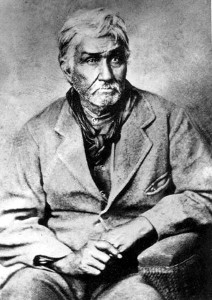
Jesse Chisholm (c. 1805 – March 4, 1868) was a Scotch-Cherokee fur trader and merchant in the American West. Chisholm is known for having scouted and developed what became known as the Chisholm Trail, later used to drive cattle from Texas to railheads in Kansas in the second half of the 19th century.

Chisholm used this trail to supply his trading posts among the Native American tribes in Indian Territory (present-day Oklahoma). He worked with Black Beaver, a Lenape guide, to develop the route. Chisholm died before the peak period of the cattle drives, but he was essential to numerous events in Texas and Oklahoma history. Chisholm served as an interpreter for the Republic of Texas and the United States government in treaty-making with Native American tribes.

Early life and education

[edit]

Chisholm's father, Ignatius, was of Scottish descent and probably also a trader, and his mother Martha (née Rogers) was a Cherokee from the region of Great Hiwassee in eastern Tennessee. As the Cherokee had matrilineal kinship, Jesse was considered to belong to his mother's people. Chisholm moved with his mother to the Indian Territory during the early period when some Cherokee migrated there voluntarily from the Southeast, and grew up in Cherokee culture.

Career

[edit]

In 1826, Chisholm became involved in working for a gold-seeking party, who blazed a trail and explored the region to present-day Wichita, Kansas. In 1830, Chisholm helped blaze a trail from Fort Gibson to Fort Towson. In 1834, Chisholm was a member of the Dodge-Leavenworth Expedition, who first contacted the southern Plains Indians on behalf of the United States federal government.[1]

In 1836, Chisholm married Eliza Edwards. They resided in the area of her father's trading post on the Little River near its confluence with the Canadian River in Indian Territory. Chisholm worked as a trader.

Monument to Jesse Chisholm in Bandera, Texas

Fluent in thirteen Native American languages and Spanish, Chisholm served as an interpreter and general aid in several treaties between the Republic of Texas and local Indian tribes and between the United States federal government and various tribes after Texas was admitted to the Union. This diplomatic work spanned 20 years between 1838 and 1858.[2] During this period, Chisholm also continued in the Indian trade, trading manufactured goods for peltry and cattle.

He mostly remained neutral during the American Civil War. Many residents of the Indian Territory feared they might be massacred, either intentionally or as an accident of war, if either side attempted to contend for control of the territory. Chisholm led a band of refugees to the western part of the territory. For some time, they suffered privation, as trade had also dried up during the war.

At the war's end, Chisholm settled permanently near present-day Kingfisher, Oklahoma, and again began to trade in the Indian Territory. Chisholm built up what had previously been a military and Indian trail into a road capable of carrying heavy wagons for his goods. This road later became known as Chisholm's Trail. When the Texas-to-Kansas cattle drives started, the users of the trail renamed it the Chisholm Trail.[3]

Death and legacy

[edit]

Chisholm died on March 4, 1868, at his last camp near Left Hand Spring (now Oklahoma), due to food poisoning. Chisholm was buried there.[4]

In 1974, Chisholm was inducted into the Hall of Great Westerners.[5] His grave site in Blaine County, Oklahoma is listed on the National Register of Historic Places.

References

[edit]

Further reading

[edit]
Revisions and contributorsEdit on WikipediaRead on Wikipedia
from Grokipedia

Jesse Chisholm (c. 1806 – 1868) was a frontiersman of Scottish and Cherokee descent who served as a trader, guide, and interpreter on the southern Great Plains. Born in the Hiwassee region of Tennessee to a Scottish merchant father and Cherokee mother, he relocated to Indian Territory in the 1820s as part of the Cherokee Old Settlers. Chisholm gained renown among Plains tribes such as the Comanche and Wichita for his honesty in trade dealings and his role in facilitating negotiations. In 1864, he established a trading post near the confluence of the Little Arkansas and Arkansas rivers in present-day Kansas, from which he transported goods southward. Following the American Civil War, Chisholm's 1866 wagon expedition hauling buffalo hides from this post to the North Canadian River in Indian Territory marked out a route that cattle drovers soon adopted for herding longhorn cattle northward to railheads, dubbing it the Chisholm Trail in his honor. Though not a cattleman himself, his established path enabled the post-war Texas cattle industry by providing a reliable corridor through challenging terrain and tribal lands. Chisholm died in April 1868 at his trading post on the North Canadian River, leaving a legacy tied to early frontier commerce rather than ranching.

Early Life

Birth and Ancestry

Jesse Chisholm was born circa 1805 in the Hiwassee region of eastern , within territory. The exact date remains undocumented in primary records, with estimates varying slightly between 1805 and 1806 based on later biographical accounts and approximations. Chisholm's father, Ignatius Chisholm, was a and slave trader of Scottish descent who operated in the Knoxville area during the before marrying into the community. His mother was a woman, identified in some genealogical records as Martha Rogers, though her precise lineage and any chiefly connections lack corroboration from contemporaneous documents. As the eldest of three sons from this mixed union, Chisholm inherited a bicultural heritage that positioned him as a bridge between European-American traders and Native American tribes, influencing his later roles in frontier commerce and diplomacy.

Relocation to Indian Territory

In the late 1820s, Jesse Chisholm relocated from to the in , settling near in present-day eastern Oklahoma. This move occurred during a period of voluntary Cherokee migrations westward, preceding the coerced removals of the in 1838–1839, as some tribal members sought to evade increasing white settlement pressures in the Southeast. Chisholm, considered by matrilineal kinship through his mother, accompanied family members in this shift to lands ceded by treaty for tribal relocation. Fort Gibson, established by the U.S. Army in 1824, served as a frontier outpost to regulate intertribal conflicts and support trade among relocated tribes, providing a strategic base for Chisholm's early activities. Upon arrival, he cultivated corn on a adjacent to the fort and supplied provisions to military personnel, leveraging the demand from federal installations amid sparse local agriculture. His proficiency in English and multiple Native dialects, acquired through mission schooling, facilitated integration into the multicultural trading environment of . This relocation positioned Chisholm amid diverse tribes including , Creek, and Plains groups, setting the stage for his expansion into prairie trade routes while navigating U.S. government policies aimed at confining tribes to designated territories. By the early 1830s, he had begun venturing westward from his base, establishing initial contacts with nomadic Plains tribes for fur and goods exchange.

Professional Activities

Trading and Mercantile Ventures

Chisholm commenced his trading operations following his marriage to Eliza Edwards in 1836, utilizing her father James Edwards's established post in , as a base for transporting merchandise westward and southward into the territories inhabited by Plains Indian tribes. These ventures involved exchanging European-manufactured items for indigenous products, establishing him as a key intermediary in . The goods Chisholm traded included staples such as cloth, buttons, sugar, and flour, which he bartered primarily for furs and hides with tribes including the , , and Wichita. His mercantile activities extended to operating from multiple outposts, with one located near present-day Asher along the , facilitating direct access to tribal networks in central . In 1863, Chisholm founded Wichita's inaugural commercial enterprise, comprising a trading post, several cabins, and a corral situated west of the modern intersection of Interstate 135 and 18th Street in Kansas, where he conducted exchanges with local American Indians via established routes to the North Canadian River. He expanded operations by constructing a secondary post near the site of the present Twin Lakes Shopping Center and, in 1865, partnered with James R. Mead to establish another at Council Grove along the North Canadian River, near contemporary western Oklahoma City, sourcing wagons laden with trade items from Fort Leavenworth. Additional posts were maintained near Lexington in Cleveland County and adjacent to Overholser Lake Dam, underscoring his networked approach to Plains trade. Chisholm's ventures persisted through the Civil War, during which he aligned with Confederate trading interests, and evolved to incorporate by 1866, when he led a of goods augmented by 250 head of along his routes. The Wichita installation remained active for approximately five years until his death in 1868, reflecting sustained mercantile engagement amid frontier expansion.

Role as Interpreter and Guide

Chisholm's multilingual abilities, encompassing and up to twelve additional Native American languages alongside Spanish, enabled him to serve as a vital interpreter in . These skills arose from his upbringing among communities and extensive interactions with Plains tribes, allowing precise translation during negotiations where mutual comprehension was essential for averting conflicts. In the early 1840s, Chisholm guided and interpreted for tribal delegations attending councils convened by the and later the . He escorted leaders from groups such as the , Wichita, and to treaty discussions, translating terms and intent to foster agreements on land use and peace. At the Tehuacana Creek councils commencing in spring 1843 near the in present-day , Chisholm played a central role as guide and interpreter, persuading reluctant to participate and relaying propositions from Texas officials like . His efforts contributed to temporary pacts, though long-term adherence varied due to territorial pressures. Beyond councils, Chisholm guided military and exploratory expeditions through , leveraging his terrain knowledge and tribal rapport. In one instance, he accompanied Delaware guide on a U.S. Army survey led by Colonel in the late 1840s, navigating uncharted routes while interpreting for encountered bands. During the Civil War, he alternately provided interpretive services and trading support to Confederate and Union agents negotiating with tribes, switching allegiances around 1862 amid shifting frontier dynamics. These roles underscored his pragmatic neutrality, prioritizing access to goods and safe passage over ideological commitment.

Diplomatic Engagements with Tribes

Chisholm's proficiency in multiple Native American languages, including dialects of Plains tribes such as and , positioned him as a key interpreter and mediator in negotiations between tribes and Anglo-American authorities during the 1840s. His established trading relationships with tribal leaders facilitated trust, enabling him to guide delegations and resolve disputes, often rescuing captives during these efforts. In spring 1843, he played a major role as guide and interpreter at the first Tehuacana Creek council near present-day , persuading wary Plains tribes, including , to participate in talks with officials under President . Subsequent councils underscored his influence. On October 7, 1844, Chisholm convinced Comanche representatives to attend another Tehuacana Creek meeting, advancing peace and trade agreements. He repeated this facilitation on May 12, 1846, escorting Comanches to the Treaty of Comanche Peak in Hood County, Texas, after which he interpreted for a tribal delegation visiting President James K. Polk in Washington, D.C. By December 10, 1850, he had assembled leaders from seven tribes for a council on the San Saba River, further demonstrating his ability to convene diverse groups amid rising frontier tensions. Following the Civil War, Chisholm resumed mediation amid displaced eastern tribes clashing with Plains groups in and . In 1865, he organized an attempted council at Little Arkansas, though some tribes declined participation, highlighting persistent hostilities. His most notable post-war effort came in 1867, when, collaborating with Delaware guide , he persuaded reluctant Plains tribes—including , , and —to attend the councils in , where he served as interpreter for U.S. commissioners seeking to confine tribes to reservations. These engagements, while yielding short-term accords, often reflected U.S. expansionist pressures rather than equitable resolutions, as later violations of the Medicine Lodge terms ignited renewed conflicts.

Trade Routes and Infrastructure

Establishment of Trading Posts

Jesse Chisholm established trading posts in and during the mid-19th century to facilitate commerce with Native American tribes, drawing on his fluency in multiple indigenous languages and established relationships. Prior to the Civil War, around 1860, he built a post in what is now western , serving as a base for fur trading and mercantile exchanges with Plains tribes. Following relocation westward along the Canadian River, Chisholm set up an early near present-day Asher, , to access trade routes and tribal networks in the region. Later, he expanded operations to Council Grove along the , where in 1865 he collaborated with James R. Mead to establish a more permanent outpost by freighting wagons loaded with goods from , ; this site became a key node for post-war trade caravans into central . In , Chisholm opened a in 1863 near Wichita, west of the modern intersection of and 18th Street, comprising several cabins and a mercantile operation that catered to local and indigenous traders. These posts enabled efficient wagon transport of goods southward into Plains , underscoring Chisholm's role in bridging Anglo-American and Native economies amid frontier expansion.

Blazing the Chisholm Trail Route

In 1865, Jesse Chisholm partnered with trader James R. Mead to haul a loaded with trade goods from , , southward through to the , thereby blazing a suitable for heavy freight. This route, initially an adaptation of preexisting Indian trails, connected Chisholm's near the confluence of the Little and Big Wichita Rivers (in present-day ) to a new outpost he established at Council Grove, spanning roughly 160 miles. The heavy wagons, burdened with merchandise and furs, carved deep ruts into the prairie soil, defining the path's alignment and earning it recognition for durability under load. Chisholm's motivation stemmed from expanding his mercantile operations amid postwar opportunities, transporting goods to barter with Plains tribes like the and at the Wichita Agency near Anadarko. Unlike the later cattle drives, this initial blazing prioritized two-way freight traffic—northbound hides, buffalo robes, and pelts exchanged for southbound tools, cloth, and ammunition—reflecting Chisholm's established role as an intermediary between settlers and indigenous groups. By avoiding rugged terrain and following water sources such as the and Canadian Rivers, the route minimized risks from weather and raids, a pragmatic choice informed by Chisholm's decades of frontier navigation. The trail's northern segment, formalized by Chisholm's 1865 expedition, extended southward from Caldwell, Kansas, crossing into via relatively flat grasslands, which facilitated wagon passage but later proved ideal for large herds. Contemporary accounts note Chisholm's fluency in tribal languages and diplomatic ties enabled safe passage, as he negotiated protections with local chiefs during the haul. This infrastructure predated the Civil War's end and the 1867 influx of Texas drovers, who adapted it for longhorn cattle shipments to railheads, though Chisholm himself never participated in beef exports.

Personal Life and Character

Family and Relationships

Chisholm, of mixed Scottish and parentage, married Eliza Edwards, the daughter of Creek trader James Edwards, in 1836. The couple settled near her father's on the Little River (close to its confluence with the Canadian River in present-day ), where Chisholm established his own trading operations. They had several children, including son William Edward Chisholm. Eliza Edwards Chisholm died in 1846, after which Chisholm married Sah-kah-kee (also spelled Suh-kah-kee or Sari) McQueen, a woman of Creek descent. This union strengthened his personal and commercial ties within the Creek Nation, as he relocated westward along the Canadian River with his second wife and children from both marriages, including and reportedly Frank Chisholm. Genealogical records vary on the full number of offspring, with some listing up to a dozen across his marriages, though primary accounts confirm at least these named sons. Chisholm's marriages reflected his intercultural position, bridging Anglo-American traders and southeastern tribes through family alliances that facilitated trust in his roles as interpreter and negotiator. No records indicate additional spouses or significant extramarital relationships beyond these unions.

Reputation for Integrity

Jesse Chisholm earned a widespread reputation for integrity through his consistent honesty in trading and mediation, particularly among Plains Indian tribes and white authorities, where his fairness and neutrality were deemed essential for resolving conflicts. Indigenous accounts described him as speaking "with a straight tongue," an expression signifying unyielding truthfulness, which fourteen tribes acknowledged by welcoming him as a brother in councils. This trustworthiness stemmed from his early career as a "square shooter" and honest trader, enabling him to serve as a reliable interpreter at events like the 1844 Treaty Council on Tehuacana Creek, where his decade of fair dealings with Comanches secured their confidence. His integrity manifested in ethical business practices and humanitarian actions, such as purchasing captives from Comanches—including seven in 1853 and a boy in 1839 for $150, whom he treated and sold equitably—without records of exploitation. Chisholm adhered to a personal creed of generosity, ensuring no visitor left his camps or wigwams hungry, cold, or naked, a principle he upheld during the exodus when he guided hundreds of Indians to safety as a "truthful, honest, and wise" leader despite personal losses from the Civil War. He frequently mediated intratribal disputes and advocated for humane treatment by rescuing and adopting captive children, rearing them alongside his own family during tribal removals to and . In diplomatic roles, Chisholm's sterling reputation for wisdom and integrity made him invaluable, as biographers note he refused to favor whites or Indians, positioning him as an "ambassador of the Plains" who negotiated treaties like the 1865 Little Arkansas and 1867 Medicine Lodge agreements. Near his death on March 4, 1868, he affirmed to trader , "I have never wronged anyone in my life. I have been a peacemaker among my brethren. No man ever went from my camp hungry or naked," encapsulating a lifetime free of documented misconduct across four decades of frontier activities.

Death

Circumstances and Location

Jesse Chisholm died on March 4, 1868, while encamped at the site of Left Hand Spring in what is now , , during a visit to the encampment of his friend, Chief Left Hand. The location, near the present-day town of Geary along the , served as a known watering and trading stop on routes he had frequented for commerce with Plains tribes. Contemporary and historical accounts attribute his death to food poisoning incurred from consuming rancid or tainted bear prepared at the camp, which led to rapid deterioration of his health despite his robust constitution as a frontiersman. He was interred nearby at Left Hand Spring, with no formal marker initially, though the site's proximity to his trading paths underscores the hazards of frontier provisioning and travel in the post-Civil War era. While some reports speculate on underlying ailments like exacerbated by the poisoning, primary attributions center on the acute effects of the contaminated , reflecting the era's limited medical interventions in remote Indian territories.

Legacy

Economic Impact on the Cattle Industry

The Chisholm Trail, initially blazed by Jesse Chisholm in the mid-1860s to connect his trading posts between present-day Wichita, Kansas, and central Texas, became the primary artery for post-Civil War cattle drives, enabling the efficient transport of Texas longhorns to northern railheads. This route, leveraging Chisholm's prior negotiations with Native American tribes for safe passage, reduced logistical barriers and tribal hostilities that plagued alternative paths, thereby lowering drive costs and risks for ranchers. From 1867 to the early 1880s, when rail expansion and barbed wire diminished its use, the trail supported the movement of an estimated 4 to 6 million cattle northward, with some accounts citing up to 10 million head departing Texas overall during the era. Economically, the trail catalyzed the Texas cattle industry's shift from a subsistence-based surplus—where longhorns fetched as little as $4 per head locally in 1866 amid wartime devastation—to a commercial powerhouse supplying eastern urban markets amid rising beef demand. Northern buyers paid $30 to $40 per head upon arrival in , yielding profit margins that funded ranch expansions, hired labor (including ), and infrastructure like stockyards. Peak activity around 1871 saw drives transport hundreds of thousands of annually, injecting millions into the economy through sales, while stimulating ancillary sectors such as freighting, goods, and town development in railheads like Abilene and Wichita. This exodus not only alleviated overstocking in , preventing widespread starvation among ranchers, but also integrated the region into national markets, foreshadowing the beef industry's industrialization. By 1870, the U.S. population neared 15 million head, with drives contributing substantially to this growth and the Midwest's emergence as a hub. The trail's legacy persisted until and refrigerated railcars ended open-range drives by the mid-1880s, but its facilitation of mass marketing laid foundational for modern ranching.

Historical Assessments and Commemorations

Historians regard Jesse Chisholm as a pivotal frontier figure whose wagon road from the South Canadian River in Indian Territory to the Arkansas River near Wichita, Kansas—blazed in 1865–1866 for trading purposes—provided the foundational route for the Chisholm Trail cattle drives, though he participated minimally in herding cattle himself. Of Scottish-Cherokee ancestry, Chisholm's reputation for integrity and multilingual skills as a trader and interpreter facilitated cross-cultural exchanges, including at treaty councils, but his direct legacy stems from the durable wagon ruts he left, which Texas drovers adapted post-Civil War for northward cattle shipments to railheads. Scholars note that while the trail's name honors him by at least 1870, debates persist over its precise path variations and Chisholm's limited role in the cattle era, as he focused on commerce with Plains tribes rather than ranching. Commemorations of Chisholm emphasize his trailblazing contributions to Western expansion. A bronze statue of him, sculpted by local artist John Gooden, stands at the intersection of U.S. Highway 81 and State Highway 33 in , dedicated in recognition of his trading legacy. His gravesite near Geary, , features a marker noting his : "No one left his home cold or hungry," underscoring his reputed generosity. Over 100 historical markers trace the across , , and , installed by state commissions to highlight its economic role, with alone designating segments via the Texas Historical Commission. The conducted feasibility studies in 2009 and 2012 for designating the a National Historic Trail, evaluating routes from , northward to affirm its national significance in cattle industry .

References

Add your contribution
Related Hubs
User Avatar
No comments yet.