Recent from talks
Nothing was collected or created yet.
Jim Calhoun
View on Wikipedia
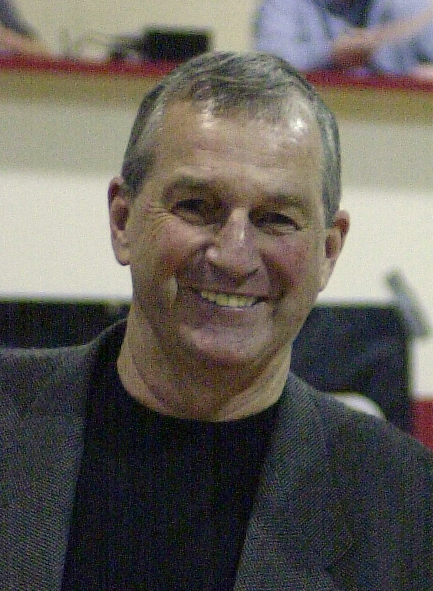
James A. Calhoun (born May 10, 1942)[1] is an American former college basketball coach. He is best known for his tenure as head coach of the University of Connecticut (UConn) men's basketball team. His teams won three NCAA national championships (1999, 2004, 2011), played in four Final Fours, won the 1988 NIT title, and won seventeen Big East Championships, which include 7 Big East tournament championships (1990, 1996, 1998, 1999, 2002, 2004, 2011) and 10 Big East regular season (1990, 1994–1996, 1998, 1999, 2002, 2003, 2005, 2006). With his team's 2011 NCAA title win, the 68-year-old Calhoun became the oldest coach to win a Division I men's basketball title.[2] He won his 800th game in 2009 and finished his NCAA Division I career with 873 victories, ranking 11th all time as of February 2019. From 2018 to 2021, he served as head coach of the University of Saint Joseph men's basketball team. Calhoun is one of only six coaches in NCAA Division I history to win three or more championships, and he is widely considered one of the greatest coaches of all time.[3][4] In 2005, he was inducted into the Basketball Hall of Fame.
Key Information
Early life and education
[edit]A self-described Irish Catholic,[5] Calhoun was born and raised in Braintree, Massachusetts, where he was a standout on the basketball, football, and baseball teams at Braintree High School. After his father died of a heart attack when Calhoun was 15, he was left to watch over his large family that included five siblings.[citation needed] Although he received a basketball scholarship to Lowell State, he only attended the school for three months after which he returned home to help support his mother and siblings. He worked as a granite cutter, headstone engraver, scrapyard worker, shampoo factory worker, and gravedigger.
After a 20-month leave from higher education, Calhoun returned to college, this time at American International College in Springfield, Massachusetts, where he was given another basketball scholarship. He was the leading scorer on the team his junior and senior seasons, and captained the team in his final year, during which AIC advanced to the Division II playoffs. At the time he graduated, he was ranked as the fourth all-time scorer at AIC. Calhoun graduated in 1968 with a bachelor's degree in sociology.[6]
Coaching career
[edit]High school
[edit]Calhoun began his coaching career at Lyme-Old Lyme High School in Old Lyme, Connecticut in the 1968–69 season after accepting a sixth grade teaching position in that town over the summer. After finishing 1–17 that season, Calhoun returned to Massachusetts after deciding not to complete the necessary certification paperwork to renew his teaching contract (he was certified in Massachusetts and working in Conn. only on a temporary certificate). He then coached one season at Westport (Massachusetts) High.[citation needed] In 1970, Calhoun accepted a position at Dedham High School as a history / social studies teacher.[7] In addition to teaching, he was the school's varsity basketball coach and the assistant freshman football coach.[7] In the two years before Calhoun began coaching, the basketball team had only won five games in the previous two seasons.[7] During his first season, the Dedham Marauders went 6–12.[7]
After his first season, Calhoun began a summer basketball league that played five nights a week.[7] The next year, during the 1971–72 season, the team had an undefeated 18–0 season.[7] This was only the second time in Bay State Conference history that a team went undefeated.[7] During the Bay State Conference championship game, there were two seconds left on the clock when the Marauders were playing Needham High School.[8][9] Charlie Baker inbounded the ball.[9][8] A Dedham player, Jeff Dillion, stole the ball, laid it up, and Dedham won the game by one point.[8][9] The team entered the TECH Tournament as the number one seed but lost to North Quincy High School in the semifinals at the Boston Garden.[7]
Calhoun was the guest speaker at the 1995 Dedham High School boys basketball championship banquet, the graduation speaker for Dedham High School's class of 2011, and a member of the 2023 class of inductees to the Dedham High School Athletic Hall of Fame.[7]
Northeastern
[edit]Calhoun was recruited by Northeastern University in Boston to serve as their new head coach. He took the position in October 1972. He transitioned the team from Division II to Division I in 1979.[citation needed]
The Huskies advanced to the Division I tournament 4 times under Calhoun. During his final three seasons, Northeastern achieved automatic bids to the NCAA tournament and had a 72–19 record. He received six regional Coach of the Year accolades at Northeastern and remains the institution's all-time winningest coach (245–138).
Former Boston Celtics captain Reggie Lewis, who played for Calhoun at Northeastern, was a first-round pick in the 1987 NBA draft.[citation needed]
UConn
[edit]On May 14, 1986, Calhoun was named the head coach at UConn. After completing his first season just 9–19, Calhoun led the Huskies to a 20–14 record in 1988 and a bid to National Invitation Tournament, where they defeated Ohio State to win the NIT championship. In 1990, Calhoun was named the consensus National Coach of the Year after leading the Huskies to their first Big East Conference championship, the NCAA tournament Elite Eight, and a 29–6 record in only his fourth year at the helm.
Calhoun won his first NCAA national championship in 1999, as he led UConn to its first Final Four, ultimately defeating Duke in the championship game in St. Petersburg, Florida. Future NBA standout Richard "Rip" Hamilton led the team to a 77–74 victory. Earlier that year, Calhoun had passed Hugh Greer to become the winningest coach in UConn history.
Calhoun led the Huskies to another national championship in 2004, at the conclusion of a season that saw UConn start and complete the year as the number one team in the nation. UConn standouts Emeka Okafor and Ben Gordon were selected No. 2 and No. 3 in the NBA draft, respectively. Calhoun now holds a 35–12 record with UConn in NCAA tournament play including 3–1 in the Final Four. They lost in the first round for the first time on March 21, 2008, in overtime to San Diego.
During the Jim Calhoun era, the Huskies did well in the Big East Conference with an impressive 220–112 record (.665 winning percentage). The Huskies won or shared conference titles in 1990, 1994–1996, 1998–1999, 2002, 2003 and 2005–2006. UConn also won seven Big East men's basketball tournament championships in 1990, 1996, 1998, 1999, 2002, 2004, and 2011.
On March 2, 2005, he achieved his 700th win at Gampel Pavilion over the Georgetown Hoyas. His friend and Big East rival coach Jim Boeheim also won his 700th game during the previous week. Later in 2005, Coach Calhoun was honored by induction into the Naismith Memorial Basketball Hall of Fame, fittingly, along with Boeheim. On February 25, 2009, he achieved his 800th win at the Bradley Center over Marquette.
Calhoun was the first coach in NCAA history to have won at least 240 games at two different Division I schools.[10] Eddie Sutton later achieved this same feat.
Calhoun also coached 23 UConn players who have moved on to professional ranks.[11]
Calhoun signed a five-year, $16 million contract until 2014.[12]
On April 4, 2011, Calhoun won his third NCAA title as the Huskies defeated Butler 53–41. The victory over Butler made Calhoun, at 68, the oldest coach to win an NCAA Division I men's basketball title. With the win, Calhoun joined John Wooden, Adolph Rupp, Bob Knight, and Mike Krzyzewski as the only coaches to win at least 3 national championships.
On September 13, 2012, Calhoun announced his retirement and the head coaching position was given to assistant coach Kevin Ollie, who eventually was named the permanent head coach.
Sanctions
[edit]In March 2009, the NCAA investigated potential violations in UConn's recruitment of Nate Miles (a scholarship recipient expelled without playing a single game for the Huskies).[13] The NCAA eventually determined that a former UConn team manager, who was attempting to become an NBA agent, helped guide Miles to UConn by giving him lodging, transportation and meals. The former team manager, Josh Nochimson, was deemed a UConn representative under NCAA rules and his actions were therefore ascribed to UConn. As a result, in February 2011, Calhoun was cited by the NCAA for failing to create an atmosphere of compliance and suspended for the first three Big East games of 2011–2012 season. The NCAA's chairman of the Committee on Infractions stated, after the penalty was announced, that "the head coach should be aware, but, also in the same frame, the head coach obviously cannot be aware of everything that goes on within the program. However, the head coach bears that responsibility."[14] The school admitted that it had committed major NCAA violations.[15]
Health problems
[edit]On February 3, 2003, Calhoun announced that he had been diagnosed with prostate cancer. He took an immediate leave of absence from the team and underwent surgery three days later to have his prostate removed. He was released from the hospital on February 9 and within days was once again involved in the day-to-day operation of the program. On February 22 Jim Calhoun returned to the sidelines for the team's matchup with St. John's at Gampel Pavilion, only 16 days after the surgery.
On May 30, 2008, UConn announced that Calhoun was undergoing treatment for squamous cell carcinoma.[16]
On June 13, 2009, Calhoun fell during a charity bike event and broke five ribs.[17]
On January 19, 2010, Calhoun took a leave of absence from the team again for health reasons. Calhoun had a "serious" condition that he wanted to discuss with his family.[18] Calhoun returned to the court to coach the Huskies on February 13.
On February 3, 2012, Calhoun took a medical leave of absence from coaching as a result of spinal stenosis.[19] He returned on March 3, 2012, less than a week after having back surgery, to coach the team to a win over Pittsburgh in the final game of the regular season.[20]
After a left hip fracture, he received while bike riding on August 4, 2012, Calhoun had surgery that same day.[21]
During E:60's Calhoun Project documentary, it was revealed that Calhoun had beat Stage 4 stomach cancer at the beginning of his first season at the University of Saint Joseph, a cancer he had for two years.[22]
Retirement
[edit]Calhoun retired as Connecticut's basketball coach on September 13, 2012, closing a 26-year career at UConn.[23]
Comeback in Division III
[edit]On September 18, 2018, Calhoun was named the first head coach of the men's basketball team at the University of Saint Joseph (USJ), an NCAA Division III program in West Hartford, Connecticut. He told the school website: "Whether it's Division I or Division III, the kids are the kids, and the game is the game and I'm looking forward to getting back out on the court and teaching these young men each and every day. I really missed being a part of a team." Glen Miller became his assistant at USJ.[24] Calhoun's 2019–20 team at USJ had a 25-game winning streak before losing in the first round of the Division III postseason tournament.[25]
On November 18, 2021, Calhoun announced he would step down as head coach at St. Joseph, effective immediately.[26] He retired with a career head coaching record of 920–397.[27]
Personal life
[edit]Calhoun and his wife, Pat, live in Pomfret, Connecticut, have been married since 1967, and have two sons and six grandchildren. They previously also had a home on Long Island Sound in Madison, Connecticut and sold it in 2016.[citation needed]
Awards and honors
[edit]- 1998 – The Franciscan Sisters dedicate an outdoor basketball area, "Calhoun's Court" at the Franciscan Life Center in Meriden, Connecticut
- 2004 – Calhoun is the first recipient of an award by the Swim Across The Sound Prostate Cancer Institute
- 2005 – "Honorary Alumni Award" from the University of Connecticut Alumni Association
- 2005 – Inducted into the Basketball Hall of Fame, Springfield, Massachusetts
- 2019 – Received the Best Coach award at the 2019 ESPYs in Los Angeles, California
- 2023 - Dedham High School Athletic Hall of Fame
Head coaching record
[edit]College
[edit]| Season | Team | Overall | Conference | Standing | Postseason | ||||
|---|---|---|---|---|---|---|---|---|---|
| Northeastern Huskies (Unknown/ECAC North/North Atlantic Conference) (1972–1986) | |||||||||
| 1972–73 | Northeastern | 19–7 | |||||||
| 1973–74 | Northeastern | 12–11 | |||||||
| 1974–75 | Northeastern | 12–12 | |||||||
| 1975–76 | Northeastern | 12–13 | |||||||
| 1976–77 | Northeastern | 12–14 | |||||||
| 1977–78 | Northeastern | 14–12 | |||||||
| 1978–79 | Northeastern | 13–13 | |||||||
| 1979–80 | Northeastern | 19–8 | 19–7 | T–1st | |||||
| 1980–81 | Northeastern | 24–6 | 6–0 | 1st | NCAA Division I Second Round | ||||
| 1981–82 | Northeastern | 23–7 | 8–1 | 1st | NCAA Division I Second Round | ||||
| 1982–83 | Northeastern | 13–15 | 4–6 | 6th | |||||
| 1983–84 | Northeastern | 27–5 | 14–0 | 1st | NCAA Division I First Round | ||||
| 1984–85 | Northeastern | 22–9 | 13–3 | T–1st | NCAA Division I First Round | ||||
| 1985–86 | Northeastern | 26–5 | 16–2 | 1st | NCAA Division I First Round | ||||
| Northeastern: | 248–137 (.644) | 95–24 (.798) | |||||||
| Connecticut Huskies (Big East Conference) (1986–2012) | |||||||||
| 1986–87 | Connecticut | 9–19 | 3–13 | T–8th | |||||
| 1987–88 | Connecticut | 20–14 | 4–12 | 9th | NIT champion | ||||
| 1988–89 | Connecticut | 18–13 | 6–10 | T–7th | NIT Quarterfinal | ||||
| 1989–90 | Connecticut | 31–6 | 12–4 | T–1st | NCAA Division I Elite Eight | ||||
| 1990–91 | Connecticut | 20–11 | 9–7 | 3rd | NCAA Division I Sweet 16 | ||||
| 1991–92 | Connecticut | 20–10 | 10–8 | T–3rd | NCAA Division I Second Round | ||||
| 1992–93 | Connecticut | 15–13 | 9–9 | T–4th | NIT First Round | ||||
| 1993–94 | Connecticut | 29–5 | 16–2 | 1st | NCAA Division I Sweet 16 | ||||
| 1994–95 | Connecticut | 28–5 | 16–2 | 1st | NCAA Division I Elite Eight | ||||
| 1995–96 | Connecticut | 30–2 | 17–1 | 1st (BE 6) | NCAA Division I Sweet 16* | ||||
| 1996–97 | Connecticut | 18–15 | 7–11 | 6th (BE 6) | NIT Third Place | ||||
| 1997–98 | Connecticut | 32–5 | 15–3 | 1st (BE 6) | NCAA Division I Elite Eight | ||||
| 1998–99 | Connecticut | 34–2 | 16–2 | 1st | NCAA Division I Champion | ||||
| 1999–00 | Connecticut | 25–10 | 10–6 | T–3rd | NCAA Division I Second Round | ||||
| 2000–01 | Connecticut | 20–12 | 8–8 | T–3rd (East) | NIT Second Round | ||||
| 2001–02 | Connecticut | 27–7 | 13–3 | 1st (East) | NCAA Division I Elite Eight | ||||
| 2002–03 | Connecticut | 23–10 | 10–6 | T–1st (East) | NCAA Division I Sweet 16 | ||||
| 2003–04 | Connecticut | 33–6 | 12–4 | 2nd | NCAA Division I Champion | ||||
| 2004–05 | Connecticut | 23–8 | 13–3 | T–1st | NCAA Division I Second Round | ||||
| 2005–06 | Connecticut | 30–4 | 14–2 | T–1st | NCAA Division I Elite Eight | ||||
| 2006–07 | Connecticut | 17–14 | 6–10 | 8th | |||||
| 2007–08 | Connecticut | 24–9 | 13–5 | 3rd | NCAA Division I First Round | ||||
| 2008–09 | Connecticut | 31–5 | 15–3 | 2nd | NCAA Division I Final Four | ||||
| 2009–10 | Connecticut | 18–16 | 7–11 | T–11th | NIT Second Round | ||||
| 2010–11 | Connecticut | 32–9 | 9–9 | 9th | NCAA Division I Champion | ||||
| 2011–12 | Connecticut | 18–13 (20–14)[28] | 6–9 (8–10)[28] | 9th | NCAA Division I First Round | ||||
| Connecticut: | 625–243 (.720) | 276–163 (.629) | |||||||
| Saint Joseph Blue Jays (Great Northeast Athletic Conference) (2018–present) | |||||||||
| 2018–19 | Saint Joseph | 16–12 | 5–6 | 7th | |||||
| 2019–20 | Saint Joseph | 26–3 | 11–0 | 1st | NCAA Division III First Round | ||||
| 2020–21 | Saint Joseph | 2–2 | 0–0 | ||||||
| 2021–22 | Saint Joseph | 3–0[a] | 0–0 | ||||||
| Saint Joseph: | 47–17 (.734) | 16–6 (.727) | |||||||
| Total: | 920–397 (.699) | ||||||||
|
National champion
Postseason invitational champion
| |||||||||
* Connecticut had its 2–1 record in the 1996 NCAA tournament and Sweet 16 appearance vacated after two players were ruled ineligible.
As of April 5, 2013, Calhoun has a 50–19 (.725) record in the NCAA tournament, going 2–5 (.286) at Northeastern and 48–14 (.774) at Connecticut.
Due to COVID-19 complications, the 2020–21 season was shortened and the team finished with a 3–2 record. Calhoun wasn't able to be on the sidelines for a game that year due to an injury he suffered right before the season.
See also
[edit]Further reading
[edit]- Calhoun, Jim. Dare To Dream: Connecticut Basketball's Remarkable March to the National Championship ISBN 0-7679-0475-3
- Calhoun, Jim. A passion to lead: seven leadership secrets for success in business, sports, and life ISBN 0-312-36271-4
Notes
[edit]References
[edit]- ^ "Calhoun, Jim". Current Biography Yearbook 2011. Ipswich, Massachusetts: H.W. Wilson. 2011. pp. 106–109. ISBN 9780824211219.
- ^ Wise, Mike (April 5, 2011). "Connecticut Coach Jim Calhoun just won't go away". The Washington Post. Retrieved April 5, 2011.
- ^ "Basketball". Archived from the original on February 25, 2014. Retrieved February 20, 2014.
- ^ "10 Greatest Coaches in NCAA Basketball History". Bleacher Report.
- ^ "A Life Spent Coaching | The Official Website of Coach Jim Calhoun". www.CoachJimCalhoun.com. Retrieved August 4, 2012.
- ^ [1] Archived March 12, 2009, at the Wayback Machine
- ^ a b c d e f g h i "DHS Athletic Hall of Fame Induction Ceremony, November 19, 2023, Continued". Dedham High School Alumni Association News (Spring 2004): 5.
- ^ a b c Kyle Scott Clauss (November 13, 2015). "WGBH Caller Recounts How Gov. Baker Blew the Bay State Championship Game". Boston. Archived from the original on September 1, 2017. Retrieved July 7, 2016.
- ^ a b c Jim Braude, Margery Eagan, Charlie Baker (November 12, 2015). In Response To Bella Bond Investigation, Baker Expects To Roll Out New DCF Policies By Thanksgiving. WGBH radio. Event occurs at 38:20. Retrieved November 12, 2015.
- ^ CNNSI.com, March 23, 1999 "Calhoun riding an emotional wave to St. Pete"
- ^ "UConn Huskies Calhoun bio". Archived from the original on October 11, 2008. Retrieved November 15, 2008.
- ^ LeAnne Gendreau (May 7, 2010). "Calhoun, UConn Agree to Contract Until 2014". NBC Connecticut. Retrieved August 4, 2012.
- ^ "NCAA committee bans Jim Calhoun of Connecticut Huskies from three Big East games – ESPN". espn.com. February 23, 2011. Retrieved August 4, 2012.
- ^ "NCAA bars Calhoun for 3 future Big East games". February 22, 2011.
- ^ "UConn admits to violations but defends Calhoun". October 8, 2010. Retrieved May 5, 2023.
- ^ "Calhoun being treated for skin cancer, wants to continue coaching". ESPN. May 30, 2008. Retrieved May 5, 2023.
- ^ Anthony, Mike (June 13, 2009). "Calhoun Breaks 5 Ribs, Collapses At Charity Bike Event". The Hartford Courant. Retrieved June 13, 2009.[permanent dead link]
- ^ "UConn hoops coach Calhoun taking medical leave". Associated Press. Retrieved January 19, 2010.
- ^ ESPN News Services (February 3, 2012). "Jim Calhoun on indefinite medical leave". ESPN. Retrieved May 5, 2023.
- ^ ESPN News Services (March 3, 2012). "Jim Calhoun returns to coach UConn". ESPN. Retrieved May 5, 2023.
- ^ "Calhoun's Hip Surgery Likely Won't Stop Him From A Return To Coaching". CBS News New York. August 6, 2012. Retrieved August 6, 2012.
- ^ Olivieri, Anthony (March 10, 2019). "Calhoun on cancer battle: 'You got to attack it'". ESPN. Retrieved November 21, 2024.
- ^ Eaton-Robb, Pat. "UConn men's basketball coach Jim Calhoun retires". Yahoo! News. Archived from the original on November 1, 2012. Retrieved September 13, 2012.
- ^ "Jim Calhoun Officially Named Head Men's Basketball Coach". Saint Joseph CT. September 18, 2018. Retrieved October 18, 2018.
- ^ Sullivan, Tara (March 6, 2020). "Jim Calhoun finds winners everywhere". The Boston Globe. Retrieved March 7, 2020.
- ^ Amore, Dom (November 19, 2021). "Hall of Famer Jim Calhoun stepping down as men's basketball coach at Saint Joseph". Courant.com. Tribune Interactive. Retrieved November 18, 2021.
- ^ We-Ha (November 19, 2021). "Legendary Coach Jim Calhoun Steps Down as Coach of USJ Men's Basketball Team". We-Ha | West Hartford News. Retrieved April 5, 2024.
- ^ a b * As a result of the 2011 NCAA sanctions imposed on Calhoun for recruiting violations, the 2–1 record compiled by Connecticut while Calhoun served his three game suspension was credited to assistant coach George Blaney.AP (January 5, 2012). "Jim Calhoun not credited with wins". ESPN. Retrieved May 5, 2023.
- ^ "Hall of Fame men's basketball coach Jim Calhoun retires from D-III Saint Joseph". ESPN.com. Associated Press. November 18, 2021. Retrieved November 19, 2021.
External links
[edit]Jim Calhoun
View on GrokipediaEarly life and education
Early life
James A. Calhoun was born on May 10, 1942, in Braintree, Massachusetts.[1] He was the son of James Calhoun, a gregarious merchant marine, and grew up in a large Irish Catholic family with five siblings.[10] The family's working-class background in the Boston-area suburb shaped his early years, emphasizing resilience and community ties common to Irish Catholic households in post-World War II New England.[11] Calhoun's childhood in Braintree was marked by tragedy when his father died of a heart attack in 1957, at a time when Calhoun was just 15 years old.[10] As the eldest son, he assumed responsibility for supporting his mother and siblings, forgoing immediate college plans to work and help sustain the household, an experience that instilled a strong work ethic and sense of duty.[11] This socioeconomic hardship amid Braintree's modest, blue-collar environment fueled his determination, while the region's vibrant sports culture—particularly the popularity of high school basketball in Massachusetts—sparked his passion for the game.[12] At Braintree High School, Calhoun first immersed himself in organized basketball, emerging as a standout athlete across three sports: basketball, football, and baseball.[13] His involvement in school teams honed his competitive drive and introduced him to the camaraderie of team sports, setting the foundation for his future in athletics before transitioning to higher education.[12]Education
Calhoun pursued higher education at American International College (AIC) in Springfield, Massachusetts, after a brief hiatus from schooling following high school.[14] He earned a bachelor's degree in sociology in 1968.[14] His time at AIC built on a childhood interest in basketball that had taken root during his youth in Braintree, Massachusetts.[1] During his college years, Calhoun played as a guard for the AIC Yellow Jackets, where he emerged as a key contributor to the team's performance.[14] Standing at 6 feet 5 inches, he served as the team's leading scorer, averaging over 20 points per game in his senior year, and earned recognition as a Little All-American and All-New England selection.[15] His efforts helped guide the Yellow Jackets to their first-ever NCAA Tournament appearance in 1966, providing him with early exposure to competitive play that informed his understanding of team dynamics and strategy.[14] While a student-athlete, Calhoun also gained practical coaching experience as an assistant under head coach Bill Stein from 1966 to 1968, an opportunity that deepened his appreciation for instructional techniques and player development.[16] The mentorship from Stein and other faculty at AIC profoundly shaped Calhoun's emerging coaching philosophy, emphasizing discipline, resilience, and a holistic approach to athlete growth that blended academic and athletic pursuits.[14] This foundation proved instrumental as Calhoun transitioned from player to educator shortly after graduation. In 1968, he obtained teaching certification and accepted his first professional role in the Old Lyme, Connecticut, school system, where he taught sixth grade while assisting with youth basketball programs.[17] This position allowed him to apply his educational training in a practical setting, fostering skills in motivation and leadership that would later define his career.[12]Coaching career
High school and early roles
Jim Calhoun launched his head coaching career in high school basketball immediately after graduating from American International College in 1968. His inaugural season came at Lyme-Old Lyme High School in Connecticut during 1968–69, where he guided a struggling program to a 3–16 record amid limited resources and a rebuilding effort.[5] Seeking new opportunities, Calhoun moved to Westport High School in Massachusetts for the 1969–70 season. There, he inherited a team with minimal experience, resulting in a challenging 1–17 mark, though the squad showed early promise with a narrow season-opening victory over Bristol Agricultural. This tenure tested his adaptability in motivating young players and managing expectations in a small-town setting.[17] Calhoun's breakthrough occurred at Dedham High School in Massachusetts from 1970 to 1972, where he transformed a previously underperforming program. In his first year (1970–71), the team posted a 12–6 record, followed by an impressive 21–1 finish in 1971–72, which included a league championship and advancement to the Massachusetts state tournament semifinals. Over these two seasons, Calhoun's overall record stood at 33–7, emphasizing disciplined play, local recruiting, and innovative strategies to maximize talent despite budgetary constraints. These experiences sharpened his coaching philosophy, focusing on player development and resilience, which became hallmarks of his later career.[12][17]Northeastern University
In 1972, at the age of 30, Jim Calhoun was named head coach of the Northeastern University men's basketball team, taking over a program that had recently transitioned from Division II to Division I and was struggling amid the challenges of urban Boston.[1] Over his 14-year tenure from 1972 to 1986, Calhoun revitalized the Huskies, compiling an overall record of 248–137 (.644) and establishing them as a dominant force in the ECAC North conference.[4] His leadership elevated Northeastern from a middling squad to a consistent contender, with five NCAA Tournament appearances and a focus on building a resilient team identity in a competitive urban environment. Calhoun's achievements included multiple 20-win seasons, highlighting the program's turnaround, and key conference successes such as ECAC North regular-season titles in 1981, 1982, and 1984, along with the 1984 conference tournament championship.[4] His recruiting prowess brought in standout talents like Reggie Lewis, a Boston native who starred for the Huskies from 1983 to 1987 and later became an NBA All-Star, helping to foster a strong local connection and elevate the team's profile.[18] Calhoun emphasized a gritty defensive style and team-oriented culture, drawing on his high school coaching roots to instill discipline and toughness that made Northeastern a tough opponent.[19] By 1986, with rising expectations for further national contention, Calhoun departed Northeastern for the head coaching position at the University of Connecticut, seeking greater resources unavailable at his alma mater, including improved facilities to support the program's growth.[20] His legacy at Northeastern endures as the winningest coach in school history, with over 250 victories and a foundation that propelled the Huskies into sustained Division I relevance.[19]University of Connecticut
Jim Calhoun was hired as the head coach of the University of Connecticut men's basketball team on May 15, 1986, succeeding Dom Perno after a 9-19 record in his debut season marked initial struggles for the program, which had not reached the NCAA Tournament since 1976.[21][4] Under Calhoun's guidance, the Huskies won the National Invitation Tournament (NIT) championship in 1988 by defeating Ohio State 72-67 in the final, providing an early postseason success and momentum.[22] The team achieved its first deep NCAA Tournament run in 1990, reaching the Elite Eight with a memorable buzzer-beater by Tate George against Clemson in the Sweet 16, before losing to Duke, establishing Calhoun's foundation for elevating UConn from a regional program to national prominence.[23][24] Calhoun built UConn into an elite program, securing three NCAA Championships: in 1999 with a 34-2 record, defeating Duke 77-74 behind Richard Hamilton's 27 points; in 2004 with a 33-6 mark, beating Georgia Tech 82-73 led by Emeka Okafor's 24 points; and in 2011 with a 32-9 finish, overcoming Butler 53-41 during Kemba Walker's iconic tournament run.[25][26][27][28][29][30] His overall record at UConn was 625-243 (.720 winning percentage) over 26 seasons, including 10 Big East regular-season titles and 7 conference tournament championships, with appearances in four Final Fours (1999, 2004, 2009, 2011).[4][9][1] Calhoun emphasized recruiting Connecticut's local talent pipeline, coaching NBA stars like Ray Allen, Richard Hamilton, and Kemba Walker, who became central to the program's identity and success.[31][32] The tenure faced challenges, including 2008 NCAA sanctions for recruiting violations involving improper benefits and contacts during the recruitment of Nate Miles, resulting in vacated wins from the 2007-08 season, three years' probation, scholarship reductions, and a three-game suspension for Calhoun in 2011.[33][34] Health issues also impacted his later years, with Calhoun undergoing surgery for skin cancer in 2008 and taking medical leaves in 2010 for stress-related concerns and in 2012 for spinal stenosis, missing a combined 15 games across those seasons.[35][36] He announced his retirement on September 13, 2012, after 26 seasons, leaving a legacy of transforming UConn from a mid-major into a perennial national contender with sustained excellence in the Big East and beyond.[2][37]University of Saint Joseph
In 2018, at the age of 75, Jim Calhoun was named the inaugural head coach of the men's basketball team at the University of Saint Joseph (USJ), a Division III Catholic institution in West Hartford, Connecticut, which had recently begun admitting male undergraduates and was transitioning its longstanding women's program into a coed athletic offering.[38][39] Calhoun's involvement began earlier as a consultant in September 2017, where he helped lay the groundwork for the new program, but he signed a full-time contract as head coach in September 2018.[40][41] Calhoun's decision to return to the sidelines was driven by his passion for mentoring young athletes, the opportunity to build a program from scratch, and his deep ties to the Hartford area, where he had spent much of his career at nearby UConn.[42][43] He described the role as a chance to give back to Connecticut basketball and foster growth in a smaller, community-oriented setting, emphasizing personal development over high-stakes competition.[44][45] During his tenure from 2018 to 2021, Calhoun guided the Blue Jays to an overall record of 47–17 (.734), establishing a foundation for sustained success in the Great Northeast Athletic Conference (GNAC).[46] The 2019–20 season marked the program's first winning campaign, culminating in a GNAC championship and an appearance in the NCAA Division III Tournament, where USJ advanced to the second round before the event was canceled due to the COVID-19 pandemic.[47][48] The following 2020–21 season faced significant disruptions from the ongoing pandemic, including limited scheduling and health protocols, yet the team remained competitive within the conference.[9] Calhoun prioritized player fundamentals, team cohesion, and community involvement, drawing on his experience to instill discipline and resilience in the young roster.[49] Calhoun retired in November 2021 after three-plus seasons, stepping down immediately after the team's 3–0 start to the 2021–22 campaign to focus on family priorities and personal interests, while affirming that his health and that of his wife, Pat, were not factors.[49][46] He remained involved with USJ in an advisory capacity, contributing to the program's ongoing stability.[50]Personal life
Family
Jim Calhoun married his wife, Patricia "Pat" Calhoun, in 1966, forging an enduring partnership that spanned his entire coaching career and involved several relocations, including the move to Boston for his role at Northeastern University in 1972 and later to Storrs, Connecticut, for the University of Connecticut in 1986.[37] Pat provided steadfast support through these transitions, prioritizing family stability amid the demands of Calhoun's professional life.[51] The couple has two sons: Jeffrey, born in 1968, and James, born in 1971. Jeffrey Calhoun, who briefly played as a walk-on for the UConn Huskies in the early 1990s, pursued a career in coaching, serving as an assistant under his father at the University of Saint Joseph.[52] James resides in Massachusetts with his wife, Jennifer, and has maintained a close family connection. The Calhoun sons grew up navigating their father's high-profile career, often accompanying the family during moves and offering personal encouragement during challenging periods. The family, including grandchildren—Emily, Katie, Sam, Avery, Reese, and Peyton—has remained a pillar for Calhoun through career highs, such as national successes, and lows, including health struggles and professional setbacks.[16] Their collective role in relocation decisions underscored a shared commitment to unity, with Pat and the sons influencing choices to ensure minimal disruption to family life.[53]Philanthropy and community involvement
Jim Calhoun has been a significant supporter of educational opportunities for underprivileged students through donations to the University of Connecticut Foundation's General Scholarship Fund, including a contractual commitment to contribute $100,000 annually if the men's basketball program's Academic Progress Rate fell below standards, aimed at aiding student-athletes and broader campus needs.[54] In 2022, following his tenure at the University of Saint Joseph, Calhoun established the Calhoun Legacy Fund there to provide financial assistance to underserved students beyond tuition, room, and board, emphasizing access to higher education for those in need.[55] Calhoun and his wife, Pat, have made substantial contributions to health initiatives, particularly the Pat and Jim Calhoun Cardiology Center at UConn Health, which they helped establish and continue to support through personal advocacy and fundraising events that have raised millions for cardiovascular research and care.[56] Their efforts earned them the UConn Foundation's inaugural Philanthropy Award in 2011, recognizing their humanitarian work in advancing medical programs.[56] In April 2025, Calhoun was appointed as a special advisor to UConn Health's Department of Neurosurgery, leveraging his leadership to support advancements in medical care.[57] As a three-time cancer survivor, Calhoun has been deeply involved in cancer research and awareness, founding the annual Jim Calhoun Ride and Walk in 2007 to benefit the Neag Comprehensive Cancer Center at UConn Health, events that have drawn hundreds of participants and generated significant funds for treatment and research.[58] His personal experiences with the disease, including battles with prostate and skin cancer, inspired this commitment, and he has participated in national initiatives like Coaches vs. Cancer, earning honors from the American Cancer Society in 2018 for his fundraising and advocacy.[59][60] In community involvement, Calhoun has focused on youth development in Hartford, notably partnering with local leaders in 2015 to distribute hundreds of basketballs to inner-city children through community-based organizations, promoting access to sports as a positive outlet.[61] He has also run basketball camps for boys aged 9-17 at UConn and other venues, emphasizing skill-building and life lessons to enhance youth sports participation in Connecticut.[62]Awards and honors
Championships and major achievements
During his tenure at the University of Connecticut, Jim Calhoun led the Huskies to three NCAA Division I Men's Basketball Championships, capturing national titles in 1999, 2004, and 2011.[4] These victories marked UConn's emergence as a dominant force in college basketball, with the 1999 championship featuring an undefeated run through the tournament after a 34-2 regular season, the 2004 title showcasing a 33-5 team's resilience in overcoming injuries, and the 2011 win highlighting a gritty 32-5 squad's improbable six-game tournament streak to claim the crown.[1][13] In Big East Conference play, Calhoun's teams amassed 10 regular-season championships in the years 1990, 1994, 1995, 1996, 1998, 1999, 2002, 2003, 2006, and 2009, establishing UConn as a perennial contender within the league.[63] Complementing these were seven Big East Tournament titles in 1990, 1996, 1998, 1999, 2002, 2004, and 2011, often serving as springboards to deep NCAA runs.[64] Earlier in his UConn career, the program secured the 1988 National Invitation Tournament (NIT) Championship, a pivotal early success that signaled the program's upward trajectory under Calhoun's guidance.[1] Calhoun's impact extended to consistent excellence, with his Huskies posting eight 30-win seasons in 1995 (30-5), 1996 (32-4), 1998 (30-5), 1999 (34-2), 2004 (33-5), 2006 (32-5), and 2011 (32-5), underscoring the sustained high performance of his teams.[4] He transformed UConn into a fixture in the postseason, guiding the program to 11 consecutive NCAA Tournament appearances from 1998 through 2008, a streak that solidified its elite status.[8] Overall, Calhoun's UConn squads achieved the highest winning percentage in Big East history at .629 (311-183), reflecting his enduring influence on conference dominance.[13]Individual awards
Jim Calhoun was recognized with several prestigious individual awards during his coaching career, underscoring his leadership in transforming the University of Connecticut men's basketball program into a national powerhouse. These honors were often tied to breakthrough seasons and championship runs, reflecting his strategic prowess and ability to develop talent. In 1990, Calhoun earned consensus National Coach of the Year honors, including the Associated Press Coach of the Year award, after guiding UConn to its first Big East regular season title and an Elite Eight appearance in the NCAA Tournament, a remarkable turnaround from the program's previous struggles. He also received the NABC Coach of the Year award that year for the same achievement.[65][66] Calhoun was named Big East Coach of the Year four times (1990, 1994, 1996, 1998), the first coach to achieve this in conference history, for consistently leading UConn to conference dominance and deep postseason runs. For example, in 1990, he was honored for the Huskies' first-ever Big East regular season championship, while in 1996, the award came after a 32-4 season that included a share of the regular season title.[67][68][12] Following UConn's national championships, Calhoun was selected as Naismith College Coach of the Year in 1999, 2004, and 2011, joining an elite group of coaches recognized for guiding their teams to NCAA titles. These accolades emphasized his role in building a dynasty, with the 2011 honor particularly noting his perseverance amid health challenges and program sanctions. He also received the NABC Coach of the Year award in 1999 and 2004 for those championship seasons.[69][13] Calhoun was honored as USBWA District I Coach of the Year multiple times, including in 2008 and 2009, for leading UConn to strong regular seasons and Big East success during periods of roster transition.[70][71] His career milestones were also celebrated with special recognitions, such as his 400th win at UConn in 2003 against Yale, his 500th career win on December 30, 1997, against Fairfield, the 500th win at UConn in 2007 against Syracuse, and his 600th win at UConn in 2011 against Syracuse. These achievements marked his longevity and consistency, with the 600th win coming during a season that led to another Final Four appearance.[21][72][16][73][74]| Award | Years |
|---|---|
| Naismith College Coach of the Year | 1999, 2004, 2011 |
| AP Coach of the Year | 1990 |
| NABC Coach of the Year | 1990, 1999, 2004 |
| Big East Coach of the Year | 1990, 1994, 1996, 1998 |
| USBWA District I Coach of the Year | 2008, 2009 |
Hall of Fame induction
Jim Calhoun was inducted into the Naismith Memorial Basketball Hall of Fame in 2005, recognizing his transformative impact on college basketball, particularly his elevation of the University of Connecticut program to national prominence with national championships in 1999 and 2004.[1] During the enshrinement ceremony in Springfield, Massachusetts, Calhoun delivered a speech expressing profound gratitude for the game's role in his life, highlighting how it had "consumed" and "blessed" him while crediting mentors, family, and players for his success.[75] He emphasized perseverance, noting the journey from his early coaching days to building elite programs at Northeastern and UConn.[76] Calhoun's Hall of Fame recognitions extended to other institutions and regional honors. He was inducted into the Northeastern University Varsity Club Hall of Fame in 1985 for his 14 seasons as head coach, during which he led the Huskies to five NCAA Tournament appearances and upgraded the program from Division II to a consistent Division I contender.[19] At his alma mater, American International College in Springfield, Massachusetts, Calhoun entered the athletic Hall of Fame in 2005, honoring his playing career and early coaching roots there from 1968 to 1971.[14] In 2007, he was enshrined in UConn's Huskies of Honor, the program's highest individual athletic tribute, celebrating his 26-year tenure that produced three national titles.[8] Post-retirement accolades further cemented Calhoun's legacy. He joined the founding class of the National Collegiate Basketball Hall of Fame in 2006, with formal induction ceremonies held in 2022 alongside former UConn player Rip Hamilton, acknowledging his overall contributions to the sport.[32] In 2013, Calhoun was inducted into the Connecticut Sports Hall of Fame, joining UConn women's coach Geno Auriemma in recognizing their shared impact on state basketball.[77] That same year, UConn honored him with a tribute event at Gampel Pavilion, where Stadium Road was renamed "Jim Calhoun Way," the fourth such naming distinction in university history; discussions around a potential statue or court dedication have surfaced periodically but remain unrealized.[78] In his 2022 College Hall speech, Calhoun reiterated themes of mentorship, crediting the development of young athletes as central to his coaching philosophy.[32]Head coaching record
Overall summary
Jim Calhoun compiled a distinguished 44-year collegiate head coaching career, amassing an overall record of 920 wins and 397 losses for a .699 winning percentage across Northeastern University, the University of Connecticut, and the University of Saint Joseph.[6][9] This total places him among the top 10 all-time leaders in NCAA men's basketball coaching victories at the Division I level, where his 873 wins ranked eighth as of 2012.[79] His winning percentages varied by institution, reflecting the escalating competitive levels he navigated: .644 (248-137) over 14 seasons at Northeastern from 1972 to 1986, .720 (625-243) across 26 seasons at UConn from 1986 to 2012, and .734 (47-17) in three-plus seasons at Saint Joseph from 2018 to 2021.[4][80][49] These figures underscore Calhoun's adaptability, from building a mid-major program to dominating a power conference and revitalizing a Division III startup. Key career benchmarks highlight his sustained excellence, including eight seasons with 30 or more wins—primarily during his UConn tenure—and 23 NCAA Division I Tournament appearances, yielding 51 tournament victories.[13][4] He guided teams to four Final Four berths (1999, 2004, 2009, 2011), securing three national championships, which cemented his legacy as one of the premier architects of championship programs.[4]High school coaching records
Jim Calhoun began his coaching career in high school basketball, compiling an aggregated record of 65–28 across his tenures at Dedham High School in Massachusetts and Weston High School in Connecticut. At Dedham, he coached for two seasons from 1970 to 1972, achieving 33–7 overall, including an undefeated 21–1 league record in his final year that advanced the team to the state semifinals.[81][5] At Weston, from 1968 to 1970, his teams posted 32–21, marking his early development as a coach in New England high school ranks.[82]Northeastern (1972–1986)
Calhoun served as head coach at Northeastern University for 14 seasons, transforming the program from Division II to a consistent NCAA Division I contender with five tournament appearances. His overall record was 248–137 (.644 winning percentage), including six seasons with 20 or more wins and no losing seasons after 1975. The program competed as an independent during his tenure, with conference records not applicable until later affiliations. The following table details his season-by-season results:| Season | Overall | Conf. | Finish | Postseason |
|---|---|---|---|---|
| 1972–73 | 19–7 | — | — | — |
| 1973–74 | 12–12 | — | — | — |
| 1974–75 | 12–12 | — | — | — |
| 1975–76 | 12–13 | — | — | — |
| 1976–77 | 12–14 | — | — | — |
| 1977–78 | 14–12 | — | — | — |
| 1978–79 | 13–13 | — | — | — |
| 1979–80 | 19–8 | — | — | — |
| 1980–81 | 24–6 | — | — | — |
| 1981–82 | 23–7 | — | NCAA Division I First Round (L, 58–71 vs. Arkansas) | |
| 1982–83 | 13–15 | — | — | — |
| 1983–84 | 27–5 | — | — | NCAA Division I First Round (L, 61–63 vs. Maryland) |
| 1984–85 | 20–11 | — | — | NCAA Division I First Round (L, 73–76 vs. Louisiana Tech) |
| 1985–86 | 26–5 | — | — | NCAA Division I First Round (L, 66–78 vs. Villanova) |
UConn (1986–2012)
At the University of Connecticut, Calhoun coached for 26 seasons, leading the Huskies to three NCAA championships (1999, 2004, 2011) and establishing the program as a national power in the Big East Conference. His overall record was 625–243 (.720 winning percentage), with 16 regular-season conference titles and 18 NCAA Tournament appearances, including 11 Sweet 16 or better runs. The team also won the 1988 NIT championship. The following table summarizes his season-by-season performance, highlighting championship years:| Season | Overall | Big East | Finish | Postseason |
|---|---|---|---|---|
| 1986–87 | 9–19 | 3–13 | 8th | — |
| 1987–88 | 20–14 | 7–9 | 6th | NIT Champions |
| 1988–89 | 18–13 | 9–7 | 5th | NIT Quarterfinals |
| 1989–90 | 31–6 | 14–2 | 2nd | NCAA Division I Elite Eight |
| 1990–91 | 21–10 | 11–5 | 3rd | NCAA Division I Second Round |
| 1991–92 | 20–12 | 10–6 | 5th | NCAA Division I Second Round |
| 1992–93 | 18–11 | 10–6 | 4th | NIT Second Round |
| 1993–94 | 29–5 | 14–2 | 1st | NCAA Division I Elite Eight |
| 1994–95 | 31–4 | 15–1 | 1st | NCAA Division I Elite Eight |
| 1995–96 | 32–4 | 14–2 | 1st | NCAA Division I Sweet 16 |
| 1996–97 | 18–15 | 6–10 | 8th | NIT Champions Runner-up |
| 1997–98 | 26–6 | 13–3 | 2nd | NCAA Division I Elite Eight |
| 1998–99 | 34–2 | 16–0 | 1st | NCAA Division I Champions |
| 1999–00 | 25–10 | 12–4 | 2nd | NCAA Division I Sweet 16 |
| 2000–01 | 19–12 | 9–7 | 5th | NCAA Division I Second Round |
| 2001–02 | 27–6 | 11–5 | T–2nd | NCAA Division I Sweet 16 |
| 2002–03 | 23–10 | 10–6 | 4th | NCAA Division I Second Round |
| 2003–04 | 33–5 | 13–3 | 2nd | NCAA Division I Champions |
| 2004–05 | 25–8 | 11–5 | 3rd | NCAA Division I Sweet 16 |
| 2005–06 | 32–6 | 13–3 | 2nd | NCAA Division I Elite Eight |
| 2006–07 | 17–14 | 7–9 | 8th | NIT Second Round |
| 2007–08 | 24–12 | 9–9 | 7th | NCAA Division I Second Round |
| 2008–09 | 31–5 | 15–3 | 1st | NCAA Division I Sweet 16 |
| 2009–10 | 29–8 | 13–5 | 2nd | NCAA Division I Sweet 16 |
| 2010–11 | 32–5 | 9–9 | T–5th | NCAA Division I Champions |
| 2011–12 | 20–14 | 7–11 | 10th | — |
University of Saint Joseph (2018–2021)
Calhoun returned to coaching at the NCAA Division III level with the University of Saint Joseph Blue Jays from 2018 to 2021, posting a 47–17 record (.734 winning percentage) in the Great Northeast Athletic Conference (GNAC). The program had no postseason in 2018–19, reached the GNAC tournament in 2019–20 before an NCAA first-round loss, and played a shortened 2020–21 schedule due to COVID-19. The following table outlines the seasons:| Season | Overall | GNAC | Finish | Postseason |
|---|---|---|---|---|
| 2018–19 | 17–12 | 10–6 | 4th | — |
| 2019–20 | 26–3 | 11–0 | 1st | NCAA Division III First Round (L, 71–85 vs. Endicott) |
| 2020–21 | 4–2 | 4–2 | T–1st | — (shortened season) |
