Recent from talks
Nothing was collected or created yet.
Jim Pollard
View on Wikipedia
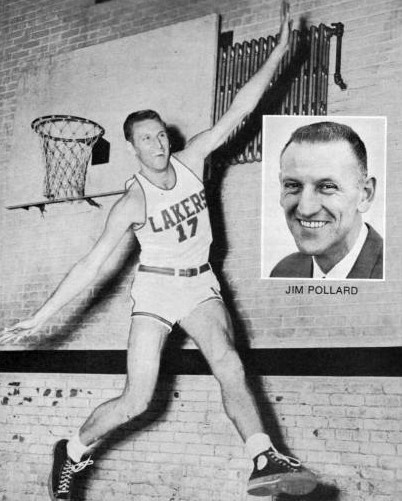
James Clifford Pollard (July 9, 1922 – January 22, 1993) was an American professional basketball player and coach. As a player in the National Basketball Association (NBA), Pollard was considered one of the best forwards in the 1950s and was known for his leaping ability,[1] earning him the nickname "The Kangaroo Kid". A five-time NBA champion and four-time NBA All-Star, Pollard spent his entire eight-year professional career with the Minneapolis Lakers.
Key Information
Pollard was inducted into the Naismith Memorial Basketball Hall of Fame in 1978.[2] He has also been inducted into the Bay Area Hall of Fame, Stanford Hall of Fame, and Pac-12 Hall of Honor.
Early life
[edit]Pollard attended Oakland Technical High School in his hometown of Oakland, California. He led the school's basketball team to three consecutive conference titles from 1937–38 to 1939–40. He averaged 19.8 points per game in his senior year, setting a school record.[3]
College career and military service
[edit]Pollard was recruited to Stanford University by former Stanford star and future Hall of Famer, Hank Luisetti.[4] Pollard played for the Stanford Indians for two seasons, under head coach Everett Dean. During his sophomore season, he was a key member of the team's 1942 national championship team, but, due to illness, he did not play in the championship game.[3] At Stanford, Pollard joined the Sigma Rho chapter of Delta Kappa Epsilon fraternity.
Pollard's college career was ended early due to World War II, and he served with the United States Coast Guard from 1942 to 1946. During his service, he starred with the Coast Guard basketball team in Alameda, winning a Northern California title in 1943 and the Service League championship in 1946.[3]
Pollard went on to graduate from the University of Minnesota in 1954.[4]
Amateur career
[edit]After World War II, Pollard played amateur basketball for one season with the San Diego Dons of the Amateur Athletic Union. The following season, he played for the Oakland Bittners in the same league. He led the AAU in scoring and earned Most Valuable Player honors both years. His teams were runners-up in the national AAU tournament both seasons.[3]
Pollard also played amateur baseball for Jordan, Minnesota's Town Team baseball club, during his NBA career. He was reputed to be "a good pitcher and a powerful hitter." It was there that Pollard famously "hit a ball that didn't stop until it got to Chicago", because it landed in a gondola car in a freight train passing by the ballpark.[5]
Professional career
[edit]Pollard began his professional basketball career in 1947 after signing with the Minneapolis Lakers while the team was a part of the National Basketball League. On the team, Pollard was a member of a future Hall of Fame frontcourt alongside center George Mikan and power forward Vern Mikkelsen, as well as fellow Hall of Famer Slater Martin at shooting guard. Led by coach John Kundla, this core group of players have been called the "first legacy in the history of professional basketball".[3] The Lakers won the NBL championship in 1948, the BAA championship in 1949, and four NBA championships in 1950, 1952, 1953 and 1954. Pollard was a four-time NBA All-Star, and was named to the All-NBA First Team in 1949 and 1950, and Second Team in 1952 and 1954.
Pollard was renowned for his tremendous leaping ability, and subsequently earned the nickname "The Kangaroo Kid". He could reportedly touch the top of the backboard and dunk from the foul line,[2] being one of the few players in his era who was capable of dunking a basketball.[4] Pollard was also known for his corner jumpshot,[3] and was a respected player and teammate.[2] In 1952, the Basketball Association of America selected Pollard as the best player of the era.[2]
Pollard retired from playing basketball after eight seasons, and finished with career averages of 13.2 points, 7.8 rebounds and 3.2 assists per game.[6]
Coaching career
[edit]Pollard immediately moved into coaching after retiring, taking the head coach position at La Salle University for the Explorers men's basketball team in 1955. Over three seasons with the team, Pollard compiled a record of 48–28.[3]
Pollard was named interim head coach of the Lakers midway through the 1959–60 NBA season on January 2, 1960,[6] and recorded a 14–25 record.[7] He was named the head coach of the newly established Chicago Packers in 1961, and managed an 18–62 record in the team's first NBA season.[7]
He moved to the American Basketball Association for the league's inaugural season in 1967, and coached the Minnesota Muskies, which relocated to Miami and became the Miami Floridians the following season. He was fired by the team midway through the 1969–70 season.[7]
BAA/NBA career statistics
[edit]| GP | Games played | GS | Games started | MPG | Minutes per game |
| FG% | Field goal percentage | 3P% | 3-point field goal percentage | FT% | Free throw percentage |
| RPG | Rebounds per game | APG | Assists per game | SPG | Steals per game |
| BPG | Blocks per game | PPG | Points per game | Bold | Career high |
| † | Won an NBA championship |
Regular season
[edit]| Year | Team | GP | MPG | FG% | FT% | RPG | APG | PPG |
|---|---|---|---|---|---|---|---|---|
| 1948–49† | Minneapolis | 53 | – | .396 | .687 | – | 2.7 | 14.8 |
| 1949–50† | Minneapolis | 66 | – | .346 | .764 | – | 3.8 | 14.7 |
| 1950–51 | Minneapolis | 54 | – | .352 | .750 | 9.0 | 3.4 | 11.6 |
| 1951–52† | Minneapolis | 65 | 39.2 | .356 | .704 | 9.1 | 3.6 | 15.5 |
| 1952–53† | Minneapolis | 66 | 36.4 | .357 | .769 | 6.8 | 3.5 | 13.0 |
| 1953–54† | Minneapolis | 71 | 35.0 | .370 | .778 | 7.0 | 3.0 | 11.7 |
| 1954–55 | Minneapolis | 63 | 31.1 | .354 | .812 | 7.3 | 2.5 | 10.8 |
| Career | 438 | 35.4 | .360 | .750 | 7.8 | 3.2 | 13.2 | |
| All-Star | 4 | 24.3 | .304 | .750 | 5.5 | 3.3 | 12.0 | |
Playoffs
[edit]| Year | Team | GP | MPG | FG% | FT% | RPG | APG | PPG |
|---|---|---|---|---|---|---|---|---|
| 1949† | Minneapolis | 10 | – | .293 | .710 | – | 3.9 | 13.0 |
| 1950† | Minneapolis | 12 | – | .286 | .710 | – | 4.7 | 12.0 |
| 1951 | Minneapolis | 7 | – | .324 | .833 | 8.9 | 3.9 | 13.6 |
| 1952† | Minneapolis | 11 | 42.6 | .405 | .740 | 6.3 | 3.0 | 16.1 |
| 1953† | Minneapolis | 12 | 37.9 | .371 | .774 | 7.2 | 4.1 | 14.3 |
| 1954† | Minneapolis | 13 | 41.8 | .361 | .800 | 8.5 | 3.2 | 12.3 |
| 1955 | Minneapolis | 7 | 36.7 | .317 | .717 | 11.1 | 2.0 | 14.1 |
| Career | 72 | 40.1 | .339 | .750 | 8.1 | 3.6 | 13.6 | |
Head coaching record
[edit]| Regular season | G | Games coached | W | Games won | L | Games lost | W–L % | Win–loss % |
| Playoffs | PG | Playoff games | PW | Playoff wins | PL | Playoff losses | PW–L % | Playoff win–loss % |
| Team | Year | G | W | L | W–L% | Finish | PG | PW | PL | PW–L% | Result |
|---|---|---|---|---|---|---|---|---|---|---|---|
| Minneapolis | 1959–60 | 39 | 14 | 25 | .359 | 3rd in Western | 9 | 5 | 4 | .556 | Lost in Conference finals |
| Chicago | 1961–62 | 80 | 18 | 62 | .225 | 5th in Western | — | — | — | — | Missed Playoffs |
| Minnesota | 1967–68 | 78 | 50 | 28 | .641 | 2nd in ABA Eastern Division | 10 | 4 | 6 | .400 | Lost in Conference finals |
| Miami | 1968–69 | 78 | 43 | 35 | .551 | 2nd in ABA Eastern Division | 12 | 5 | 7 | .417 | Lost in Conference finals |
| Miami | 1969–70 | 20 | 5 | 15 | .250 | (fired) | — | — | — | — | — |
| Total | 295 | 130 | 165 | .441 | 31 | 14 | 17 | .452 |
See also
[edit]References
[edit]- ^ Krentzman, Jackie (February 12, 1996). "Jam boree – basketball's dunk shot; includes related articles". The Sporting News. Archived from the original on June 29, 2012.
- ^ a b c d "The Naismith Memorial Basketball Hall of Fame :: Jim Pollard". Accessed on June 10, 2017.
- ^ a b c d e f g Sutton, Jeff. "NBA Hall of Famer Jim Pollard was ahead of his time". Lodi News-Sentinel. June 3, 2002. Accessed on June 10, 2017.
- ^ a b c "Jim Pollard, a Star In N.B.A. in 50's; Ex-Laker Was 70". The New York Times. January 25, 1993. Accessed on June 10, 2017.
- ^ Town Ball, the Glory Days of Minnesota Amateur Baseball, Armand Peterson and Tom Tomashek, University of Minnesota Press, Minneapolis and London, page x (introduction), ISBN 0-8166-4675-9
- ^ a b "Jim Pollard Stats". Basketball Reference. Accessed on June 10, 2017.
- ^ a b c Galluzzo, Steve. "Jim Pollard". Los Angeles Times. February 12, 2011. Accessed on June 11, 2017.
External links
[edit]Jim Pollard
View on GrokipediaEarly life and high school
Early life
James Clifford Pollard was born on July 9, 1922, in Oakland, California.[2] He was the youngest of four children in a family where his father, Gus Pollard, had roots in New York and his mother was born in Kansas.[6] Pollard stood out as the only athletic sibling among his brothers and sisters.[6] Growing up in Oakland during the 1920s and 1930s, Pollard developed an early interest in sports, initially favoring baseball over other activities. His introduction to basketball came at Lafayette Elementary School, where he first tried out for the team and began honing his skills on local courts. This exposure laid the groundwork for his later pursuits in the sport. Prior to high school, Pollard attended various local schools in the Oakland area, immersing himself in the community's athletic environment.[6]High school career
Jim Pollard attended Oakland Technical High School in Oakland, California, from 1937 to 1940. At Oakland Tech, Pollard quickly emerged as a standout player, leading the Bulldogs to three consecutive conference championships from 1937 to 1940.[7] As a senior in the 1939–40 season, he averaged 19.8 points per game across seven contests, shattering the school's scoring record with 139 total points and earning All-Northern California honors.[7] His performance also included All-City and All-County recognition as the team's center for two years, highlighting his dominance in the paint.[8] During his high school years, Pollard honed his athletic skills, displaying early signs of the exceptional leaping ability that would define his career and earn him the nickname "The Kangaroo Kid."[2] This physical prowess, combined with his versatility on the court, set the stage for his future success in basketball.[7]College and military service
College career
Jim Pollard enrolled at Stanford University in 1940 after a standout high school career in Oakland, California, where his skills drew recruitment interest from the program, including assistance from Stanford alumnus and basketball pioneer Hank Luisetti.[9] As a freshman during the 1940–41 season, Pollard competed on the freshman squad, honing his abilities ahead of varsity play.[10] In his sophomore year of 1941–42, he emerged as a starting forward for the Stanford Indians under head coach Everett Dean, leading the team in scoring with 10.5 points per game across 23 contests.[11][10] Pollard's contributions were pivotal to Stanford's successful campaign, which finished with a 28–4 record and clinched the program's only NCAA men's basketball championship.[12] In the NCAA Tournament, he ranked among the event's top scorers, amassing 43 points over two games: 26 against Rice in the West Regional semifinal (a 53–47 victory) and 17 versus Colorado in the national semifinal (a 46–35 win).[13][14] Although illness sidelined him for the championship final—a 53–38 triumph over Dartmouth—Pollard earned All-Tournament honors and First-Team All-American recognition for his tournament and season impact.[10][8]Military service
Pollard enlisted in the United States Coast Guard in 1942, interrupting his college basketball career at Stanford University.[9] He served from 1942 to 1946 during World War II, contributing to the Coast Guard's wartime operations, which included maritime security, search and rescue, and support for naval efforts along the Pacific coast.[8] Stationed in Alameda, California, Pollard balanced his military duties with basketball, starring for the Coast Guard's team known as the Sealions.[7] In 1943, he helped the team win the Northern California championship, showcasing his athletic prowess in high-stakes service competitions. By 1946, Pollard led the Sealions to the Service League championship, further establishing his reputation as a dominant forward in military leagues.[15] His Coast Guard service honed Pollard's skills and physical conditioning amid the rigors of wartime demands, facilitating a seamless return to competitive basketball upon discharge in 1946.[8] This period not only preserved his passion for the sport but also prepared him for professional success in the post-war era.Amateur career
San Diego Dons
Following his discharge from military service in 1946, Jim Pollard transitioned to civilian amateur basketball by joining the San Diego Dons of the Amateur Athletic Union (AAU).[16][7] During the 1945–46 season, Pollard emerged as the Dons' leading scorer and a dominant force at forward, averaging high outputs that propelled the team through regional play.[17] For his contributions, Pollard earned AAU Most Valuable Player honors that year and was named an AAU All-American, recognizing his role in elevating the Dons to national prominence.[7][2] In the AAU national tournament held in Denver, the Dons advanced to the championship game but fell to the Phillips 66ers, 45–34, with Pollard's athleticism and rebounding unable to overcome the Oilers' defensive stand.[18] This runner-up finish highlighted Pollard's immediate impact on the amateur circuit, where his leaping ability and versatility foreshadowed his professional success.Oakland Bittners
Following his successful tenure with the San Diego Dons, Jim Pollard joined the Oakland Bittners of the Amateur Athletic Union (AAU) for the 1946–47 season, returning to a Bay Area-based team.[16] With the Bittners, Pollard replicated his scoring dominance from the prior year, leading the AAU's National Industrial Basketball League in points with an average of 16.0 per game.[7][6] His versatile forward play, including sharp shooting and rebounding, made him a standout on the roster, contributing to the team's competitive run despite falling short in the championship game.[8] Pollard was awarded the AAU Most Valuable Player honor for the second straight season, recognizing his pivotal role in elevating the Bittners' offense.[7] He also earned selection to the AAU All-American team, underscoring his elite status among amateur players.[7] These accomplishments with the Bittners honed Pollard's professional readiness, as his consistent high-level production and athleticism drew attention from basketball scouts, paving the way for his pro debut.[6]Professional playing career
Minneapolis Lakers tenure
Pollard signed with the Minneapolis Lakers of the National Basketball League (NBL) in 1947, following his standout performances in amateur basketball with teams like the San Diego Dons and Oakland Bittners.[2] As a versatile forward, he formed a formidable frontcourt alongside center George Mikan and power forward Vern Mikkelsen, contributing to the team's dominance through his scoring, rebounding, and playmaking abilities. Nicknamed "The Kangaroo Kid" for his exceptional leaping prowess—which allowed him to touch the top of the backboard and execute dunks from the foul line—Pollard brought athleticism and finesse to the Lakers' lineup, complementing Mikan's post presence with dynamic drives and jump shots.[2] In the 1947–48 NBL season, Pollard's rookie year, he averaged 12.9 points per game while helping the Lakers establish themselves as contenders with a balanced attack led by Mikan's interior scoring and Pollard's perimeter threats.[1] The following 1948–49 season marked the Lakers' transition to the Basketball Association of America (BAA), where Pollard elevated his production to 14.8 points per game, adapting to the league's evolving style by facilitating plays for his teammates amid the merger's challenges.[1] Entering the newly formed National Basketball Association (NBA) in 1949–50, he maintained a scoring average of 14.7 points per game, showcasing his leaping ability in key matchups, such as a 32-point performance against the Baltimore Bullets. Throughout the early 1950s NBA seasons, Pollard's role evolved as a reliable secondary option, averaging 11.6 points per game in 1950–51, a career-high 15.5 in 1951–52, 13.0 in 1952–53, and 11.7 in 1953–54, while grabbing 7–9 rebounds and dishing around 3 assists per contest to support the Lakers' fast-break opportunities and defensive rotations.[1] His career totals reflected this consistent impact, with overall averages of 13.2 points, 5.7 rebounds (partially tracked from 1950–51 onward), and 3.2 assists per game over 438 BAA/NBA appearances, emphasizing team-oriented play in an era defined by physicality and strategic depth.[1] Pollard retired after the 1954–55 season, concluding his eight professional seasons with the Lakers.Championships and accolades
During his professional career with the Minneapolis Lakers, Jim Pollard contributed to six league championships, spanning the transition from the National Basketball League (NBL) to the Basketball Association of America (BAA) and the early National Basketball Association (NBA). The Lakers captured the 1948 NBL title, followed by the 1949 BAA championship, and then NBA crowns in 1950, 1952, 1953, and 1954.[1][19] Pollard was named to the All-NBL Second Team in 1948 and the All-BAA First Team in 1949. He earned four NBA All-Star selections in 1951, 1952, 1954, and 1955, showcasing his versatility as a forward. He was also honored with All-NBA First Team recognition in 1950 and Second Team placements in 1952 and 1954. As the team's inaugural captain, Pollard provided leadership on the court during these successful years.[1][20][21] In 1952, Pollard was named the best player of the era by the BAA/NBA, reflecting his impact amid the league's evolution. His dynamic partnership with center George Mikan was instrumental in building the Lakers' dynasty, forming a formidable frontcourt that complemented Mikan's dominance with Pollard's rebounding, passing, and athleticism—highlighted by his renowned leaping ability in key games.[2][22]Career statistics
Regular season
Pollard's regular-season career spanned the National Basketball League (NBL), Basketball Association of America (BAA), and National Basketball Association (NBA), where he established himself as a versatile forward for the Minneapolis Lakers from 1947 to 1955. Over 438 games in the BAA and NBA, he amassed 5,762 points at an average of 13.2 points per game, 2,487 rebounds at 7.8 per game, and 1,417 assists at 3.2 per game.[1] His performance evolved with the league's growing emphasis on rebounding after official tracking began in the 1950–51 season, reflecting the era's focus on physical play and fast breaks in the early NBA. Pollard's consistent double-digit scoring and rebounding contributed to the Lakers' strong regular-season records during his tenure.[1]Regular Season Statistics
| Season | Tm | Lg | G | PTS | TRB | AST | PTS/G | TRB/G | AST/G |
|---|---|---|---|---|---|---|---|---|---|
| 1947-48 | MNN | NBL | 59 | 760 | 12.9 | ||||
| 1948-49 | MNL | BAA | 53 | 784 | 142 | 14.8 | 2.7 | ||
| 1949-50 | MNL | NBA | 66 | 973 | 252 | 14.7 | 3.8 | ||
| 1950-51 | MNL | NBA | 54 | 629 | 484 | 184 | 11.6 | 9.0 | 3.4 |
| 1951-52 | MNL | NBA | 65 | 1005 | 593 | 234 | 15.5 | 9.1 | 3.6 |
| 1952-53 | MNL | NBA | 66 | 859 | 452 | 231 | 13.0 | 6.8 | 3.5 |
| 1953-54 | MNL | NBA | 71 | 831 | 500 | 214 | 11.7 | 7.0 | 3.0 |
| 1954-55 | MNL | NBA | 63 | 681 | 458 | 160 | 10.8 | 7.3 | 2.5 |
| Career | 497 | 6,522 | 2,487 | 1,417 | 13.1 | 7.8 | 3.2 |
Breakdown by League
- NBL (1947–48): Pollard appeared in 59 games for the Minneapolis Lakers, scoring 760 points at 12.9 per game, showcasing his early scoring prowess in a league with lower scoring norms.[23]
- BAA (1948–49): In 53 games, he averaged 14.8 points and 2.7 assists, adapting quickly to the professional level with efficient playmaking.[1]
- NBA (1949–55): Across 385 games over six seasons, Pollard totaled 4,978 points (12.9 PPG), 2,487 rebounds (7.8 RPG in tracked years), and 1,275 assists (3.3 APG), with his peak scoring in 1951–52 at 15.5 points per game highlighting his all-around impact.[1]
Playoffs
Jim Pollard appeared in the playoffs in all eight of his professional seasons with the Minneapolis Lakers, contributing to five NBA championships in 1949, 1950, 1952, 1953, and 1954, plus the 1948 NBL championship. Over 72 NBA/BAA postseason games, he totaled 977 points (13.6 per game), 407 rebounds (8.1 per game in 50 tracked games starting 1950–51), and 259 assists (3.6 per game), demonstrating reliability in high-stakes matchups.[1] In the 1947–48 NBL playoffs (10 games), he averaged 12.3 points.[23] Pollard's performance elevated in several championship series, particularly the 1952 NBA Finals against the New York Knicks, where he averaged 16.4 points and 6.4 rebounds over the five games he played in the seven-game series. In the 1949 BAA Finals versus the Washington Capitols (six games), he posted 12.7 points per game; the 1950 NBA Finals against the Syracuse Nationals (six games) saw 13.7 points and 3.0 assists; the 1953 Finals against the Knicks (five games) featured 14.4 points; and the 1954 Finals rematch with the Nationals (seven games) included 10.9 points and 7.0 rebounds, highlighting his rebounding prowess late in his career. These efforts exemplified his consistency under pressure, often complementing George Mikan's dominance while providing scoring and playmaking support.[1]| Season | Team | G | MP | FG | FGA | FG% | FT | FTA | FT% | TRB | AST | PTS |
|---|---|---|---|---|---|---|---|---|---|---|---|---|
| 1948-49 | MNL | 10 | 4.3 | 14.7 | .293 | 4.4 | 6.2 | .710 | 3.9 | 13.0 | ||
| 1949-50 | MNL | 12 | 4.2 | 14.6 | .286 | 3.7 | 5.2 | .710 | 4.7 | 12.0 | ||
| 1950-51 | MNL | 7 | 5.0 | 15.4 | .324 | 3.6 | 4.3 | .833 | 8.9 | 3.9 | 13.6 | |
| 1951-52 | MNL | 11 | 42.6 | 6.4 | 15.7 | .405 | 3.4 | 4.5 | .740 | 6.5 | 3.0 | 16.1 |
| 1952-53 | MNL | 12 | 37.9 | 5.2 | 13.9 | .371 | 4.0 | 5.2 | .774 | 7.2 | 4.1 | 14.3 |
| 1953-54 | MNL | 13 | 41.8 | 4.3 | 11.9 | .361 | 3.7 | 4.6 | .800 | 8.5 | 3.2 | 12.3 |
| 1954-55 | MNL | 7 | 36.7 | 4.7 | 14.9 | .317 | 4.7 | 6.6 | .717 | 11.1 | 2.0 | 14.1 |
| Career | 72 | 4.8 | 14.3 | .338 | 3.9 | 5.3 | .745 | 8.1 | 3.6 | 13.6 |
Coaching career
College coaching
Upon retiring from his playing career with the Minneapolis Lakers in 1955, Jim Pollard assumed the role of head coach for the La Salle Explorers men's basketball team.[4] Pollard's tenure at La Salle spanned three seasons from 1955 to 1958, during which he compiled an overall record of 48–28, achieving a winning percentage of .632.[4] In his inaugural 1955–56 campaign, the Explorers, competing as an independent program, posted a 15–10 record, marking a solid start with an average of 68.2 points scored and 63.7 allowed per game.[24] The team showed improvement in 1956–57, finishing 17–9 while increasing their offensive output to 75.8 points per game, reflecting Pollard's emphasis on balanced play and player growth in a rebuilding phase.[25] The 1957–58 season saw the Explorers maintain momentum with a 16–9 mark, scoring 74.0 points per game and demonstrating defensive resilience by holding opponents to 72.1 points on average.[26] Although the program did not qualify for postseason play during Pollard's time, his leadership fostered consistent above-.500 finishes, contributing to the development of young talent in Philadelphia's competitive basketball landscape, including participation in local rivalries like the Big 5 series. Pollard left La Salle after the 1957–58 season to pursue opportunities in professional basketball coaching.[9]Professional coaching
Pollard's professional coaching career began in the NBA when he was appointed interim head coach of the Minneapolis Lakers on January 2, 1960, replacing John Castellani midway through the 1959–60 season.[27] Under Pollard, the Lakers finished the regular season with a 14–25 record, contributing to the team's overall 25–50 mark and third-place finish in the Western Division.[28] In the playoffs, his squad advanced to the division finals but lost to the St. Louis Hawks 4–3, with Pollard posting a 5–4 postseason record.[28] In 1961, Pollard was hired as the first head coach of the Chicago Packers, the NBA's newest expansion franchise following the league's 1961 expansion draft.[29] The team struggled in its inaugural season, compiling an 18–62 record and finishing fifth in the Western Division amid challenges typical of an expansion team, including a roster built from limited draft picks and facing established opponents like the Philadelphia Warriors led by Wilt Chamberlain.[30] Pollard was fired at the end of the season on June 12, 1962.[27] Pollard returned to coaching in 1967 as the inaugural head coach of the Minnesota Muskies, one of the 11 charter franchises in the newly formed American Basketball Association (ABA).[31] The Muskies enjoyed a strong debut under Pollard, finishing the 1967–68 season with a 50–28 record and second place in the Eastern Division, though they fell to the Pittsburgh Pipers in the division finals 1–4 after defeating the Indiana Pacers 4–1 in the semifinals.[31] The franchise relocated to Miami and rebranded as the Miami Floridians prior to the 1968–69 season due to financial difficulties in Minnesota, where the team had folded after one year. Pollard continued as coach, leading the Floridians to a 43–35 record and another second-place Eastern Division finish, advancing to the division finals before losing to the Pacers 2–4. However, the 1969–70 season started poorly at 5–15, prompting the Floridians to fire Pollard on November 29, 1969, amid ongoing league and team transition issues in the upstart ABA.[32]Head coaching record
Jim Pollard's head coaching career spanned college and professional basketball, with tenures in the NCAA at La Salle University and in the NBA with the Minneapolis Lakers and Chicago Packers, as well as the ABA with the Minnesota Muskies and Miami Floridians.[4][27] His overall regular-season record was 178–193 (.480) across 371 games.[4][27]College Coaching Record (NCAA)
Pollard's college record at La Salle University from 1955 to 1958 in the independent conference was 48–28 (.632) over 76 games.[4]| Season | Team | League | G | W | L | W-L% | Notes |
|---|---|---|---|---|---|---|---|
| 1955-56 | La Salle | Ind. | 25 | 15 | 10 | .600 | |
| 1956-57 | La Salle | Ind. | 26 | 17 | 9 | .654 | |
| 1957-58 | La Salle | Ind. | 25 | 16 | 9 | .640 |
NBA Regular Season and Playoff Record
In the NBA, Pollard coached 119 regular-season games with a 32–87 (.269) record and appeared in 9 playoff games with a 5–4 (.556) mark.[27]| Season | Team | G | W | L | W-L% | Finish | Playoffs (G-W-L) |
|---|---|---|---|---|---|---|---|
| 1959-60 | Minneapolis Lakers | 39 | 14 | 25 | .359 | 3rd of 8 (Western) | 9–5–4 (Western Division playoffs) |
| 1961-62 | Chicago Packers | 80 | 18 | 62 | .225 | 5th of 5 (Western) | Did not qualify |
ABA Regular Season and Playoff Record
In the ABA, Pollard coached 176 regular-season games with a 98–78 (.557) record and 22 playoff games with a 11–12 (.478) mark.[27]| Season | Team | G | W | L | W-L% | Finish | Playoffs (G-W-L) |
|---|---|---|---|---|---|---|---|
| 1967-68 | Minnesota Muskies | 78 | 50 | 28 | .641 | 2nd of 4 (Eastern) | 10–5–5 (Division Finals) |
| 1968-69 | Miami Floridians | 78 | 43 | 35 | .551 | 2nd of 5 (Eastern) | 13–6–7 (Division Finals) |
| 1969-70 | Miami Floridians | 20 | 5 | 15 | .250 | (Fired November 29) | Did not qualify |
