Hubbry Logo
John L. Allen Jr.John L. Allen Jr.Main
Open search
John L. Allen Jr.
Community hub
John L. Allen Jr.
logo
8 pages, 0 posts
0 subscribers
Be the first to start a discussion here.
John L. Allen Jr.
John L. Allen Jr.
from Wikipedia

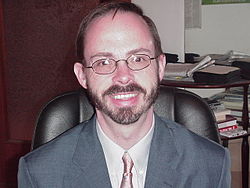
John Lewis Allen Jr. (January 20, 1965 – January 22, 2026) was an American journalist and author who served as editor of the Catholic news website Crux, formerly hosted by The Boston Globe and now independently funded.

Key Information

Before moving to The Boston Globe when Crux was established in 2014, Allen worked for 17 years in Rome as a Vatican watcher, covering the Holy See and the Pope for the National Catholic Reporter. He also served as a Senior Vatican Analyst for CNN, and featured in broadcast coverage of the conclaves of 2005 and 2013. Allen was the St. Francis de Sales Fellow of Communication and Media at the Word on Fire Institute founded by Bishop Robert Barron. Allen was the author of numerous books about the Catholic Church. He wrote two biographies of Pope Benedict XVI.

Early life and education

[edit]

John Lewis Allen Jr. was born on January 20, 1965, in Hays, Kansas.[1][2][3] He graduated from Capuchin-founded[4] Thomas More Prep-Marian High School in 1983.[5] He received a bachelor's degree in philosophy from Fort Hays State University and a master's degree in religious studies from the University of Kansas. From 1993 until 1997, Allen taught journalism and oversaw the student-run newspaper, The Knight, at Notre Dame High School in Sherman Oaks, California.[1]

Career

[edit]

During the coverage of the death of Pope John Paul II, Allen frequently appeared on CNN. He then became the Senior Vatican Analyst for CNN. He also delivered lectures discussing Vatican issues and his latest works.

In 2014, Allen took up a position as associate editor with The Boston Globe and helped to launch its website, Crux.[6] In 2016, the Globe transferred ownership of the Crux website and its intellectual property to Allen. It now operates on the basis of advertising income, syndication and licensing as well as support from benefactors. Allen and his wife, Elise, who also serves as a Senior Correspondent for Crux, lived in Rome.

In an interview quoted in the Vatican's 2020 McCarrick Report, Allen stated he did not report rumours because, "If I tried to interview every one of these guys [bishops] every time I heard something salacious, that is all I'd be doing and I'd be out of business in a heartbeat."[7]

Allen received a number of honorary doctorates from universities:

Personal life and death

[edit]

Allen firstly married Shannon Levitt.[12]

Allen married fellow journalist Elise Ann Harris in Key West, Florida, in about 2020.[13]

Allen suffered with stomach cancer for three years prior to his death in Rome, on January 22, 2026, at the age of 61.[14][15]

Publications

[edit]
Allen with Pope Benedict XVI

In addition to a column and occasional other pieces for NCR, Allen's work as a journalist appeared in The New York Times, The Washington Post, The Wall Street Journal, CNN, NPR, The Tablet, Jesus, Second Opinion, The Nation, the Miami Herald, Die Furche, and the Irish Examiner.[citation needed]

Allen wrote, among other books, two biographies of Pope Benedict XVI. The first was written before then-Cardinal Joseph Ratzinger became pope, the other after his election to the papacy. In 2000, Allen published Cardinal Ratzinger: The Vatican's Enforcer of the Faith, the first biography of Ratzinger in English.[16] Several reviewers criticized it as being biased against Ratzinger. Joseph Komonchak called it "Manichaean journalism".[17] After some examination, Allen concluded that this criticism was valid.[18] In his next biography of Ratzinger, The Rise of Benedict XVI: The Inside Story of How the Pope Was Elected and Where He Will Take the Catholic Church (2005), Allen tried to be fair to all sides and viewpoints. Allen acknowledged that his first book was "unbalanced" because it was his first book and was written, he wrote, "before I arrived in Rome and before I really knew a lot about the universal church". In that acknowledgement he said the first biography "gives prominent voice to criticisms of Ratzinger; it does not give equally prominent voice to how he himself would see some of these issues".[19]

In 2005 he published a book about Opus Dei, Opus Dei: An Objective Look Behind the Myths and Reality of the Most Controversial Force in the Catholic Church. Allen said that one of his reasons for writing his study of Opus Dei was that he felt that liberal and conservative Catholics were too often shouting at each other, and he hoped that a book that tried to be fair to all sides would lead to civilized discussion. According to John Romanowsky of Godspy, Allen's ability to report objectively, without revealing his personal opinion, has been called "maddening".[20]

Kenneth L. Woodward, former religion editor for Newsweek, wrote in 2005: "Outside of the North Korean government in Pyongyang, no bureaucracy is harder for a journalist to crack than the Vatican's. And no one does it better than John L. Allen Jr. ... In just three years, Allen has become the journalist other reporters—and not a few cardinals—look to for the inside story on how all the pope's men direct the world's largest church."[21]

Allen was critical of how the Vatican communicated the decision to lift the excommunications of the bishops of the Society of Saint Pius X.[22]

Books

[edit]
  • Cardinal Ratzinger: The Vatican's Enforcer of the Faith. New York, NY: Continuum, 2000.
    • Reprinted in 2005 as Pope Benedict XVI: A Biography of Joseph Ratzinger.
  • Conclave: The Politics, Personalities, and Process of the Next Papal Election. New York, NY: Image Books, 2002.
  • All the Pope's Men: The Inside Story of How the Vatican Really Thinks. New York, NY: Image Books, 2004.
  • The Rise of Benedict XVI: The Inside Story of How the Pope Was Elected and Where He Will Take the Catholic Church. New York, NY: Image Books, 2006.
  • Opus Dei: An Objective Look Behind the Myths and Reality of the Most Controversial Force in the Catholic Church. New York, NY: Image Books, 2007.
  • The Future Church: How Ten Trends are Revolutionizing the Catholic Church. New York, NY: Image Books, 2009.
  • The Catholic Church: What Everyone Needs to Know. Oxford: Oxford University Press, 2013.
  • The Global War on Christians: Dispatches from the Front Lines of Anti-Christian Persecution. New York, NY: Image Books, 2013.
  • The Francis Miracle: Inside the Transformation of the Pope and the Church. New York, NY: TIME Books, 2015.
  • Shahbaz Bhatti: Martyr of the Suffering Church. Collegeville, MN: Liturgical Press, 2017.
  • Catholics and Contempt: How Catholic Media Fuel Today's Fights, and What to Do About It. Park Ridge, IL: Word on Fire Institute, 2023.

Book-length conversations

[edit]
  • (with Cardinal Timothy Dolan) A People of Hope: The Challenges Facing the Catholic Church and the Faith that Can Save It. New York, NY: Image Books, 2011.
  • (with Bishop Robert Barron) To Light a Fire on the Earth: Proclaiming the Gospel in a Secular Age. New York, NY: Image Books, 2017.

Booklets

[edit]
  • 10 Things Pope Benedict XVI Wants You to Know. Liguori, MO: Liguori Publications, 2007.
  • Global Good News: Unseen Work of the Catholic Church. Liguori, MO: Liguori Publications, 2010.
  • 10 Things Pope Francis Wants You to Know. Liguori, MO: Liguori Publications, 2013.
  • Against the Tide: The Radical Leadership of Pope Francis. Liguori, MO: Liguori Publications, 2014.

Online articles/columns

[edit]

References

[edit]
[edit]
Revisions and contributorsEdit on WikipediaRead on Wikipedia
from Grokipedia

John L. Allen Jr. (1965–2026) was an American journalist and author specializing in coverage of the Vatican and the Catholic Church. He died on January 22, 2026, in Rome after a lengthy battle with cancer.
As editor of Crux, an independent Catholic news site, he provided analysis on ecclesiastical developments, papal transitions, and global Catholic issues, drawing on decades of reporting from Rome. He previously served as a correspondent for the National Catholic Reporter for 16 years, establishing himself as a leading Vatican watcher. Allen also served as a senior Vatican analyst for CNN, offering insights into Church leadership and policy shifts.
Allen authored over a dozen books on the Catholic Church, including detailed examinations of organizations like Opus Dei, biographies of popes such as Benedict XVI, and assessments of pontificates like that of Francis. Notable works include All the Pope's Men: The Inside Story of How the Vatican Works, which elucidates Vatican bureaucracy, and Catholics and Contempt, addressing internal divisions and media portrayals within Catholicism. His writing often bridged perspectives across the Church's ideological spectrum, though early efforts like his Opus Dei book drew criticism for perceived imbalance prior to deeper immersion in Roman affairs. In 2025, he received the Catholic Near East Welfare Association's Faith and Culture Award for his contributions to Catholic journalism.

Early Life and Education

Family Background and Upbringing

John L. Allen Jr. was born in 1965 in , a small city in the western part of the state known for its agricultural economy and as home to . He grew up in Hays, attending local schools amid a community shaped by rural Midwestern values and limited exposure to international affairs, which later contrasted sharply with his career focus on global Catholicism. Details on Allen's immediate family, including parents' occupations or siblings, remain largely private and undocumented in public records or interviews, reflecting his professional emphasis on ecclesiastical reporting over personal biography. His upbringing in Hays, a town of approximately 20,000 residents during his youth, provided a stable, provincial foundation before he pursued higher education locally at , earning a in in 1989. This early environment in conservative, heartland America may have informed his analytical approach to Vatican politics, though Allen has not explicitly linked the two in his writings.

Academic Training

Allen received a in philosophy from in , graduating in 1989. He pursued graduate studies at the in Lawrence, earning a in . These degrees provided foundational training in philosophical and , aligning with his later specialization in affairs and Vatican reporting. In 2011, Allen was awarded an honorary Doctorate in Sacred Letters, recognizing his contributions to religious journalism.

Professional Career

Early Journalism Roles

Allen commenced his professional engagement with journalism through teaching the subject at Notre Dame High School in Sherman Oaks, California, from 1993 to 1997, during which he supervised the student-operated newspaper, The Knight. This role provided foundational experience in journalistic practices and mentorship, bridging his academic background to practical media instruction at a Catholic institution. His initial compensated writing opportunity arose in the as a contributor to The Tidings, the newspaper of the Archdiocese of Los Angeles, marking his entry into published Catholic journalism. As a freelancer prior to full-time employment, Allen extended his contributions to The Tidings while also serving as an editor and writer for Our Sunday Visitor, a national Catholic weekly publication. These positions involved reporting and editorial work on church-related topics, establishing his early focus on Catholic affairs amid a landscape of independent and diocesan media outlets. These formative roles honed Allen's skills in opinion and feature writing within American Catholic journalism, preceding his transition to specialized coverage. They reflected a deliberate shift from to media, leveraging his prior teaching to inform on matters.

Vatican Specialization at NCR

John L. Allen Jr. joined the (NCR) in 1997 as a staff writer and soon became its Vatican correspondent, focusing on in-depth coverage of the and papal activities. In this role, he relocated to , establishing NCR's bureau in 2000, which enabled direct access to Vatican sources and events. From this base, Allen provided weekly dispatches through his "All Things Catholic" column, analyzing Vatican politics, curial dynamics, and global Church issues with a emphasis on insider perspectives and historical context. Allen's specialization distinguished itself through extensive on-the-ground reporting during key transitional periods, including the illness and death of in 2005, the subsequent conclave, and the election of . He broke stories on the Vatican's response to the U.S. clerical crisis, offering detailed accounts of Roman reactions and policy shifts that shaped international discourse. His work emphasized empirical observation of power structures, often drawing on interviews with cardinals and officials to illuminate decision-making processes otherwise opaque to outsiders. By 2013, Allen's NCR tenure included coverage of the resignation of Benedict XVI and the conclave electing , solidifying his reputation as a leading English-language Vatican analyst. Throughout, his reporting maintained a focus on factual sourcing amid NCR's editorial lean toward reformist viewpoints, though Allen's analyses frequently critiqued both progressive and traditionalist factions within the Church for inconsistencies in doctrine and practice. This period, spanning 1997 to 2014, produced a body of work that prioritized verifiable details over speculation, contributing significantly to public understanding of Vatican operations.

Leadership at Crux and Broader Media Presence

In 2014, John L. Allen Jr. joined The Boston Globe as associate editor to lead the launch of Crux, a dedicated Catholic news website focused on Vatican and global Church coverage. Crux operated as a Globe project until March 2016, when the newspaper discontinued support effective April 1, prompting Allen to transition the site to independence under Crux Catholic Media Inc., where he serves as president and editor. Under his leadership, Crux has maintained partnerships with entities including Word on Fire Ministries and De Sales Media, emphasizing independent, in-depth reporting on Catholic affairs. Allen has expanded Crux's reach through multimedia formats, including the podcast Crux Now and regular columns such as "Last Week in the Church," which provide weekly Vatican updates. His editorial direction prioritizes on-the-ground analysis from , leveraging his extensive Vatican contacts to cover papal transitions, synods, and ecclesiastical controversies. Beyond Crux, Allen serves as senior Vatican analyst for , contributing to coverage of major events like the 2005 and 2013 conclaves. He appears frequently as a commentator on networks including and in outlets like News, while maintaining an active presence on under @JohnLAllenJr for real-time insights. Allen also delivers keynote addresses at Catholic institutions and events, such as Assumption University's 2023 centennial commencement and the University of Saint Mary of the Lake's 2024 Cardinal George Lecture Series.

Publications

Authored Books

John L. Allen Jr. has authored eleven books on Vatican affairs and Catholicism, leveraging his on-the-ground reporting to analyze institutional dynamics, papal leadership, and global church challenges. His debut book, Cardinal Ratzinger: The Vatican's Enforcer of the Faith, published in 2000 by Continuum, offered the first English-language biography of Joseph Ratzinger, detailing his theological influence and role in doctrinal enforcement prior to his papacy. In 2004, Doubleday released All the Pope's Men: The Inside Story of How the Vatican Really Thinks, a 392-page examination of curial operations, decision-making hierarchies, and cultural mindsets within the , based on extensive interviews and archival access. : An Objective Look Behind the Myths and Reality of the Most Controversial Force in the , issued by Doubleday in 2005, provided a 384-page journalistic probe into the prelature's structure, membership of over 80,000, Vatican ties, and responses to criticisms of and influence. Following the 2005 conclave, Allen published The Rise of Benedict XVI: The Inside Story of How the Pope Was Elected and What It Means for the in the same year, chronicling the and implications for church . Conclave: The Politics, Personalities, and of the Next Papal (Doubleday, 2006; updated edition 2013) outlined the mechanics of conclaves, key cardinal profiles, and geopolitical factors shaping papal selections. Later works include The Future Church: How Global Catholicism Is Changing the Way We Think, Live, and Believe (Doubleday, 2009), which assessed demographic shifts toward the Global South and their doctrinal impacts; The Global War on Christians (Image, 2013), documenting anti-Christian violence in over 100 countries with data from groups like ; and The Francis Miracle: Inside the Pope's Dramatic Reform of the Vatican and the Church (Image, 2015), evaluating Pope Francis's administrative overhauls amid resistance from traditionalist factions.

Collaborative and Shorter Works

Allen collaborated with Timothy Dolan on A People of Hope: Timothy Dolan in Conversation with John L. Allen Jr., published in 2011 by Image Books. The work consists of extended interviews exploring Dolan's perspectives on Catholic evangelization, urban ministry in New York, and responses to secular challenges, emphasizing as a core Christian amid cultural shifts. In 2017, Allen contributed to To Light a Fire on the Earth: Proclaiming in by , published by Catholic Ministries. Structured as a series of conversations, the book addresses evangelization strategies, media engagement, and cultural , drawing on Barron's experiences while incorporating Allen's journalistic insights on global Church trends. Among shorter publications, Allen authored 10 Things Pope Benedict Wants You to Know About Joy, released in 2012 by Image Books as a compact distillation of Benedict XVI's teachings on derived from papal encyclicals, homilies, and addresses spanning his 2005–2013 . The volume highlights themes like Christian versus modern despair, supported by direct excerpts and Allen's analysis of Benedict's emphasis on interior conversion. Allen also produced The Catholic Church: What Everyone Needs to Know, published in 2015 by in a question-and-answer format. Spanning 272 pages, it covers , doctrines, , and contemporary issues like clerical abuse and interfaith relations, aiming for accessibility while grounded in historical data and Vatican documents.

Ongoing Columns and Analyses

Allen contributes a weekly column titled "All Things Catholic" to , offering analysis on developments within the global , including Vatican politics, papal initiatives, and ecclesiastical trends. Launched originally during his tenure at the and continued at following his departure from NCR in 2014, the column draws on his Vatican expertise to dissect events such as synodal processes, clerical appointments, and interfaith dialogues. For instance, in pieces archived under the "All Things Catholic" category, he has examined topics like the implications of new cardinal elevations for future conclaves and the church's response to demographic shifts favoring Catholicism in aging societies. Beyond the column, Allen produces ongoing news analyses for Crux, often published as in-depth features that contextualize breaking Vatican stories with historical and geopolitical insights. These include assessments of papal leadership transitions, such as his October 28, 2024, evaluation of Pope Francis's synod outcomes as a "soft landing" amid internal tensions, and June 5, 2024, speculation on the pontificate entering a "Third Age" phase marked by institutional stabilization. His analyses frequently incorporate on-the-ground reporting from Rome, emphasizing causal factors like bureaucratic resistance or global persecution patterns over narrative-driven interpretations. Allen's written output is supplemented by regular multimedia analyses, such as the "Last Week in the Church" series, a weekly video rundown launched around that recaps key Catholic events worldwide, from scandals to diplomatic maneuvers. This format allows for timely dissection of issues like the Vatican's first conviction for on-ground in January 2025 or Francis's health-related decisions, maintaining his focus on empirical church dynamics. Through these platforms, Allen sustains a consistent stream of commentary, prioritizing verifiable Vatican sources and avoiding unsubstantiated speculation.

Key Analytical Perspectives

Views on Catholic Reforms and Internal Dynamics

John L. Allen Jr. has consistently emphasized the necessity of structural reforms in the to address governance inefficiencies, particularly within the , while highlighting the inherent tensions between centralized papal authority and calls for greater . In his analyses, he argues that effective reform requires bold use of top-down power to overcome bureaucratic resistance, as seen in ' approach, where the positioned himself as an "old-school absolute monarch" to advance initiatives. For instance, Allen points to Francis' 2021 initiation of the first Vatican financial audit of the —encompassing 330 parishes, over 500 churches, and 1,000 clergy—as a mechanism to enforce local accountability ahead of the 2025 Jubilee Year, illustrating how central intervention can model desired changes. Allen critiques the uneven implementation of Francis' reforms, describing the as a "great reformer" whose efforts in areas like clerical handling and Vatican finances often promised transformation but fell short on execution, with limited sanctions against bishops under policies like Vos Estis Lux Mundi (2019). He attributes this to internal dynamics, including entrenched clerical cultures and Italian influences in the , which have historically stalled progress, as evidenced by recurring financial scandals and the 2021-2023 "Trial of the Century" involving Cardinal Angelo Becciu, underscoring the need for deeper judicial reforms potentially outsourcing trials to Italian systems. Despite these shortcomings, Allen praises Francis' 2022 curial overhaul via , which restructured Vatican dicasteries to prioritize evangelization and , marking a shift from post-Vatican II centralization critiques toward more missionary-oriented governance. On , Allen views it as a pragmatic tool for navigating polarization, steering the 2023-2024 Synod on Synodality toward a "soft landing" by fostering dialogue on divisive issues like women's roles without radical doctrinal shifts, thereby maintaining while encouraging local input. He warns that internal factionalism—exacerbated under Francis through documents like Amoris Laetitia (2016), which prompted conservative "dubia" challenges and Archbishop Carlo Maria Viganò's 2018 accusations—has hardened divides, yet advocates for "common ground" initiatives to bridge progressive and traditionalist perspectives, drawing from his support for efforts post-Vatican II. Overall, Allen's commentary reflects a realist assessment: reforms succeed when aligned with the Church's hierarchical nature, but persistent resistance from curial inertia and ideological tribalism demands ongoing vigilance, as explored in his book The Future Church (2009), which identifies ten global trends pressuring institutional adaptation.

Reporting on Global Christian Persecution

John L. Allen Jr. has extensively documented the worldwide, emphasizing its scale and systematic nature in regions including the , , , , and . His reporting underscores that comprise approximately 80 percent of victims of religious violations globally, a statistic drawn from analyses of documented cases by organizations tracking such abuses. Central to his work is the 2013 book The Global War on Christians: Dispatches from the Front Lines of Anti-Christian Persecution, which compiles firsthand accounts, statistical data, and on-the-ground reporting from 28 countries. In it, Allen details violent incidents such as church bombings in , forced conversions and killings in , and sectarian attacks in Nigeria's northern states, where groups like targeted communities. He argues that these events constitute a de facto "" rather than isolated acts, countering narratives that minimize the phenomenon as mere civil strife or exaggeration. The book also addresses subtler pressures in the West, such as legal restrictions on religious expression, though Allen prioritizes lethal threats in developing regions. Allen's interest in the topic originated during Pope John Paul II's 2001 apostolic visit to , where he observed suppressed Christian communities amid post-Soviet challenges, prompting deeper investigation into global patterns. Through columns in and , he has continued this focus, critiquing political reluctance to label anti-Christian violence as religiously motivated—for instance, in a 2012 piece questioning U.S. policy responses to at-risk Christian populations exceeding 150,000 annually. In 2015, he asserted that global disproportionately affects , citing data from conflict zones where they form minorities vulnerable to Islamist and . His analyses highlight underreporting in , attributing it partly to ideological blind spots that frame such through secular or multicultural lenses rather than religious causation. Allen advocates for heightened awareness among Catholics, arguing that indifference in safer regions exacerbates isolation for persecuted believers, and calls for Vatican and governmental action to prioritize these issues. This body of work positions him as a key voice in raising of martyrdom, with estimates of tens of thousands of Christian deaths yearly from targeted .

Assessments of Papal Leadership

Allen has characterized Pope John Paul II's 26-year pontificate (1978–2005) as transformative in globalizing the , emphasizing its role in the fall of communism and evangelization, while acknowledging unresolved internal challenges such as clerical scandals that emerged prominently toward the end of his tenure. In postmortem analyses, he noted the pope's success in expanding the Church's footprint to over 1 billion adherents but highlighted structural issues like curial centralization and financial opacity that persisted beyond John Paul II's death on April 2, 2005. Regarding Benedict XVI (2005–2013), Allen portrayed the pontificate as intellectually rigorous and doctrinally focused, crediting the pope with advancing liturgical reforms and , such as the 2006 Regensburg address that clarified Catholic positions on reason and faith despite initial backlash. He defended Benedict's handling of cases as more proactive than critics alleged, pointing to actions like the 2001 policy centralizing Vatican oversight and over 400 priests during his tenure, arguing that simplistic narratives overlook pre-papal efforts as Cardinal Ratzinger. Following Benedict's on December 31, 2022, Allen eulogized him as the "Catholic of the century" for embodying orthodox continuity amid secular pressures, though noting leadership constraints from health issues post-2012 resignation. Allen's evaluations of Pope Francis (2013–present) emphasize a paradigm shift toward pastoral mercy and decentralization, as detailed in his 2014 book Against the Tide: The Radical Leadership of Pope Francis, which frames the pontiff's style as countercultural in prioritizing the periphery over institutional rigidity. In The Francis Miracle (2015), he assessed early achievements like curial reforms via the Council of Cardinals (established March 2013) and synodality initiatives, portraying Francis as a "relevant pope" who commands global attention despite polarizing decisions on issues like Amoris Laetitia (2016). By 2018, marking five years in office, Allen highlighted Francis's influence on economic inequality critiques, such as the 2013 apostolic exhortation Evangelii Gaudium, while critiquing incomplete progress on abuse accountability, including the 2018 Pennsylvania grand jury report implicating over 300 priests. Recent reflections, as of 2025, underscore a delivered revolution in ecclesial culture—favoring discernment over rules—but one diverging from progressive expectations, evidenced by restrictions on the Traditional Latin Mass (2021) and continuity in doctrine. Across pontificates, Allen consistently advocates contextual nuance over ideological binaries, attributing variances to each pope's unique charism amid unchanging doctrine.

Controversies and Criticisms

Accusations of Bias in Early Works

Allen's 2000 biography Cardinal Ratzinger: The Vatican's Enforcer of the Faith, one of his earliest major works on Vatican figures, drew criticism from conservative Catholic publications for perceived liberal bias. The New Oxford Review, a traditionalist outlet, described the book as permeated with liberal bias "that it hits one in the face at almost every turn," arguing that Allen's portrayal of then-Cardinal Joseph Ratzinger reflected progressive assumptions about Church authority and doctrine. This critique aligned with broader conservative skepticism toward Allen's affiliation with the (NCR), an outlet often characterized as favoring internal Church reforms and progressive stances on issues like and lay involvement. In his early 2000s reporting for NCR's "Word from Rome" column, which covered Vatican developments including the emerging clergy sex abuse scandals, Allen faced direct accusations of ideological slant from readers and commentators. A 2004 reader response to his analysis of Opus Dei explicitly charged that "your liberal bias was never more clear than in the disgusting way" he framed the group's practices, highlighting perceived favoritism toward reformist critiques over institutional defenses. Such feedback underscored tensions in Allen's early career, where his detailed insider access to Vatican sources—gained through rigorous on-the-ground reporting in Rome—was sometimes interpreted by traditionalists as softening critiques of hierarchical conservatism. Allen himself later referenced criticisms of in his subsequent works, including acknowledgments of detractors who viewed his 2005 book Pope Benedict XVI (a revised edition of the Ratzinger ) as exhibiting a "bias from the standpoint of the Catholic left." These accusations persisted amid his coverage of Pope John Paul II's final years and the 2005 conclave, with some conservative voices contending that Allen's emphasis on Vatican over doctrinal orthodoxy reflected NCR's editorial leanings rather than neutral analysis. Despite this, empirical assessments of his early output, such as balanced sourcing from curial officials and advocates, suggest the bias claims often stemmed from ideological divides within Catholicism rather than verifiable distortions in factual reporting.

Defense of Opus Dei and Institutional Challenges

In 2005, John L. Allen Jr. published Opus Dei: An Objective Look Behind the Myths and Reality of the Most Controversial Force in the Catholic Church, a detailed examination intended to counter sensationalized portrayals amplified by popular media, including Dan Brown's The Da Vinci Code, which depicted the organization as a secretive, conspiratorial entity. Allen argued that Opus Dei's core spirituality—emphasizing the sanctification of ordinary work and daily life—aligns with longstanding Catholic traditions, citing examples like Kenyan member Margaret Ogola, a pediatrician and novelist whose life exemplified integrating faith into professional and social spheres. Allen systematically addressed common criticisms, such as allegations of , by quantifying Opus Dei's limited institutional footprint: approximately 84,000 members worldwide (comparable to the of Tasmania's population), only 40 bishops among the Church's roughly 4,500, and minimal Vatican presence (20 staff out of 2,500, with just one in a senior policy role). He attributed inflated perceptions of power to historical contexts, including Opus Dei's associations during Francisco Franco's and post-Vatican II ideological divides that cast it as a conservative bulwark. On , Allen acknowledged the group's reticence stemmed from fears of misrepresentation but recommended proactive transparency to dispel aura of mystery, while defending practices like and mortification as voluntary extensions of Catholic rather than coercive cults. Regarding treatment of women and , Allen examined numeraries' celibate commitments and corporate works (e.g., schools and clinics founded by members), refuting claims of systemic exploitation by noting voluntary participation and charitable outputs, though he conceded that rigorous lifestyles deterred some and could foster insularity. He also highlighted Opus Dei's global assets, estimating U.S. holdings at around $344 million, framing them as modest relative to diocesan scales and directed toward educational and spiritual initiatives rather than political dominance. Institutionally, Allen outlined challenges Opus Dei faced within the Church, including skepticism from progressive sectors viewing its lay focus and Escrivá-inspired devotion as reactionary, and internal tensions over its status granted by in 1982, which granted autonomy while inviting scrutiny for perceived elitism. He noted under-explored political engagements, such as in , as areas warranting further transparency to avoid fueling rivalries with other ecclesial movements. Critics like Damian Thompson accused Allen's analysis of leniency, labeling it a "whitewash" for relying on Opus Dei sources and omitting ex-member testimonies, yet Allen maintained his methodology prioritized verifiable data over anecdotal bias, emphasizing empirical membership statistics and doctrinal alignment over ideological narratives.

Handling of Clergy Abuse Scandals

John L. Allen Jr. has provided extensive coverage of the Catholic Church's clergy sexual abuse scandals since the early 2000s, often emphasizing Vatican perspectives alongside critiques of institutional shortcomings. In reporting on the 2002 Dallas summit of American cardinals, he detailed promises of tougher policies, including for abusive priests, while noting the involvement of lay experts in handling allegations. His analyses frequently contextualized papal actions, such as Pope Benedict XVI's pre-pontificate role in abusive priests in the , arguing that Benedict represented a shift toward stricter accountability compared to earlier leniency under John Paul II. However, this framing drew accusations of undue sympathy toward Church leadership, with critics contending it overlooked systemic delays in addressing complaints. Allen's reporting on Vatican documents, including the 1962 Crimen Sollicitationis instruction mandating secrecy in solicitation cases, clarified that it pertained to processes rather than prohibiting civil reporting, countering claims of a blanket directive. He has acknowledged Church failures, such as inadequate victim protections and episcopal reassignments of offenders, describing the scandals as a profound institutional requiring broader repentance beyond legal fixes. Yet, in pieces defending elements of ecclesiastical norms—like the seal of not impeding abuse reporting—he argued that sacramental aligns with civil exemptions in many jurisdictions and does not preclude proactive safeguarding. Victim advocacy groups and commentators have criticized such positions as prioritizing traditions over mandatory reporting, potentially perpetuating barriers to . During the resurgence of scandals in , Allen attributed intense media focus partly to anti-Catholic bias in secular outlets, while urging transparency from bishops; he reported Benedict's view of the timing as diabolically orchestrated amid other Church challenges. More recently, in assessing Francis's responses, Allen highlighted progress in summits and policies but noted persistent gaps, such as uneven global implementation, without absolving leadership of accountability. Critics from reformist circles, including some within progressive Catholic media, have faulted his insider Vatican access for yielding overly nuanced defenses that dilute urgency for structural overhaul, though empirical data on laicized under recent popes—over 800 since 2013—supports his observations of increased disciplinary actions. This balance has positioned Allen as a bridge between institutional explanations and external demands, though it invites charges of insufficient advocacy for survivors' priorities.

Reception and Legacy

Recognition and Influence

John L. Allen Jr. has garnered recognition for his extensive reporting on the Vatican and , including the Catholic Near East Welfare Association's Faith and Culture Award, presented in on April 29, 2025, honoring his editorial leadership at in covering global Catholic affairs. He also received the Alumni Achievement Award from in 2022, acknowledging his accomplishments as a originating from western . In 2011, he was named a Distinguished Kansan in the field of by the Topeka Capital-Journal, recognizing his role as senior Vatican analyst for and correspondent for the . Allen's influence stems from his position as a preeminent Vatican observer, with of describing him as "the most authoritative writer on Vatican affairs in the " due to his deep institutional knowledge and balanced analysis as a practicing Catholic. His authorship of eleven books on the Vatican and papacy, including detailed examinations of and , has shaped scholarly and public understanding of Church internals, drawing mixed audiences across ideological lines for their empirical focus on operations. As editor of since 2014 and through his "All Things Catholic" column, he provides weekly insights into global ecclesiastical dynamics, enhancing media coverage by prioritizing on-the-ground reporting over sensationalism and influencing Catholic discourse on reforms, persecutions, and leadership transitions. His senior Vatican analyst role at has extended his reach, offering context to broader audiences on papal decisions and Church-state interactions.

Critiques from Ideological Spectrums

Conservative and traditionalist Catholics have frequently questioned John L. Allen Jr.'s objectivity, attributing potential bias to his extended association with the (NCR), an outlet widely regarded for its progressive editorial stance on doctrinal and liturgical reforms. Reviewers from traditionalist perspectives have highlighted this employment history as grounds for suspicion, noting that Allen's earlier Vatican dispatches often critiqued curial operations more harshly than conservative commentators deemed warranted. For example, in assessing his 2004 book All the Pope's Men: The Inside Battle of John Paul II's Vatican, observers remarked that traditionalists view his NCR affiliation as compromising his capacity to fully appreciate orthodox viewpoints, despite the work's efforts to document conservative frustrations within the . From the progressive spectrum, particularly among critics of conservative Catholic institutions like , Allen has faced accusations of undue leniency in his analyses. His 2005 book Opus Dei: An Objective Look Behind the Myths and Reality of the Most Controversial Force in the sought to provide a balanced examination, drawing on extensive interviews to counter sensationalized portrayals, yet drew rebukes for allegedly minimizing allegations of coercive and hierarchical control over . More recently, in 2025 commentary defending 's status amid scrutiny of its lay collaborations, Allen was criticized by reform-oriented voices for overlooking distinctions between voluntary spiritual guidance and formal oversight, with detractors positing that his access to insiders fostered a sanitized insufficiently attentive to survivor accounts of psychological pressure. These critiques often frame Allen's institutional defenses as emblematic of a broader Vatican journalistic tendency to prioritize official sources over dissent, though empirical evidence of systemic abuses remains contested and largely anecdotal rather than adjudicated by Church tribunals. Allen's self-described centrist positioning—evident in his 2023 book Catholics and Contempt, which indicts ideological polarization in Catholic media from both flanks—has not neutralized these cross-spectrum barbs, as each side perceives his reporting as insufficiently aligned with their priors. Conservatives decry any perceived accommodation of reformist narratives, while progressives fault his reluctance to advocate structural upheavals, underscoring a causal dynamic where ideological silos amplify selective readings of Vatican affairs over comprehensive evidence.

References

Add your contribution
Related Hubs
User Avatar
No comments yet.