


Community hub
Recent from talks
Contribute something
Nothing was collected or created yet.
Joseph Bara
View on Wikipedia | This article has multiple issues. Please help improve it or discuss these issues on the talk page. (Learn how and when to remove these messages)
|


.JPG)
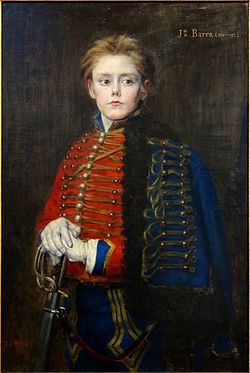
François Joseph Bara (30 July 1779[1] – 7 December 1793) was a French soldier best known for his death during the War in the Vendée. At the age of twelve, he joined the French Revolutionary Army as a drummer boy after the outbreak of French Revolutionary Wars, and was killed by Chouan rebels while defending a pair of horses he was leading. Bara was transformed after his death into a martyr for the French Revolution and has been depicted in several works of art.
Life, death, and legacy
[edit]François Joseph Bara was born on 30 July 1779 in Palaiseau. Bara's father was a gamekeeper, and his mother was a domestic servant. Both worked in the Palaiseau district for the Princes of Condé. When Bara was twelve, his father died, so when the Levée en masse was issued, his mother enlisted him in the French Revolutionary Army.[1]
Bara was too young to join the French army, but despite this, he joined a unit fighting against Chouan rebels during the War in the Vendée as a drummer boy. After his death, General J. B. Desmarres gave this account, by letter, to the convention. "Yesterday this courageous youth, surrounded by brigands, chose to perish rather than give them the two horses he was leading."[2]
The boy's death was seized on as an opportunity by the revolutionaries, who praised him at the Convention's tribune, saying that "only the French have thirteen-year-old heroes". But rather than simply being killed by rebels who solely wanted to steal horses, Bara was transformed into a figure who resisted the Ancien Régime at the cost of his death. His story became that, having been trapped by the enemy and being ordered to cry "Vive le Roi" ("Long live the King") to save his own life, he preferred instead to die crying "Vive la République" ("Long live the Republic").
His remains were to be transferred to the Panthéon during a revolutionary festival in his honour, but the event was cancelled when Robespierre was overthrown the day before it was to take place.[2]
Gallery
[edit]-
 The Death of Young Bara (1794) by a pupil of Jacques-Louis David
 -
 The Death of Bara (Charles Moreau-Vauthier, 1850)
 -
 The Death of Bara (Jean-Joseph Weerts, 1880)


.jpg)
Commemoration
[edit]- A 1794 painting by Jacques-Louis David depicts the dying Bara.
- A statue of Bara (called Barra) lying dead by David d'Angers in 1838.
- An 1880 painting (La Mort de Bara) by Jean-Joseph Weerts also depicts Bara's death.
- A painting (La Mort de Bara) by Charles Moreau-Vauthier depicts Bara as a dead drummer boy.[3]
- A painting (Bara) by Jean-Jacques Henner in 1882.
- A street in the 6th arrondissement of Paris is named after him.
- Bara is alluded to in the Chant du départ.
- A ship of the line of the French Navy was launched in 1794 with the name Barra in his honour.
- There is a statue in his honour at Palaiseau in the Southern suburbs of Paris.
- Opera "Joseph Barra" (1794) by André Ernest Modeste Grétry.
References
[edit]- ^ a b Walton, Geri (30 July 2018). "Joseph Bara: The Legendary French Drummer Boy". Geri Walton. Retrieved 15 November 2021.
- ^ a b Roberts, Warren. Jacques-Louis David: Revolutionary Artist. pp. 85
- ^ "Les Moreau-Vauthier : une famille d'artistes". apophtegme.com. Archived from the original on 2 March 2015. Retrieved 7 February 2015.
External links
[edit] Media related to Joseph Bara at Wikimedia Commons
| International | |
|---|---|
| National | |
| Artists | |
| People | |
| Other | |

Joseph Bara
View on GrokipediaEarly Life
Birth and Family Background
François Joseph Bara was born on 30 July 1779 in Palaiseau, a commune near Versailles then part of the Seine-et-Oise department.[6][7] He was baptized François Joseph in the local parish, reflecting standard naming practices of the era for children of modest rural families.[6] Bara was the ninth of ten children born to François Bara, a garde-chasse (gamekeeper) employed on a nearby estate, and his wife Marie Anne Leroy, whose occupation is not detailed in surviving records but aligned with typical domestic roles in pre-revolutionary rural France.[6][7] The family's socioeconomic status was humble, dependent on the father's wage labor in estate management and enforcement of hunting laws under the Ancien Régime. Financial strain intensified after François Bara's death in October 1784, leaving Marie Anne to support the large household amid limited welfare provisions.[6] Among his siblings, two elder brothers later enlisted in republican forces on the frontiers, indicative of broader family mobilization during the revolutionary wars, while a younger brother was noted as physically invalid, and the remainder included several sisters whose fates are sparsely recorded.[6] These details derive from local parish registers and later commemorative accounts cross-referenced with revolutionary-era documents, though early biographical elements remain limited due to the family's obscurity prior to Bara's posthumous fame.[7]Local Context in Vendée
The Vendée department, situated in western France along the Atlantic coast, encompassed a predominantly rural landscape known as bocage, featuring small fields enclosed by hedges, ditches, and dense woodlands that facilitated defensive guerrilla warfare and ambushes during conflicts. This terrain supported an agricultural economy centered on subsistence farming, livestock rearing, and modest crop cultivation such as wheat, rye, and flax, with the population in the 1780s estimated at around 500,000 inhabitants, the vast majority being independent smallholding peasants who had acquired land through sales during the late Ancien Régime and achieved relative economic stability without widespread feudal burdens.[8][9] Socially, Vendée society in the 1770s and 1780s was hierarchical yet cohesive, dominated by Catholic peasants with strong communal ties to local parishes and clergy, who wielded significant moral authority; noble landowners were few and often impoverished, while urban centers like La Roche-sur-Yon were sparse and underdeveloped, fostering a culture of isolation from Parisian influences and a profound attachment to traditional monarchy as a divine institution intertwined with religious practice. The region's devout Catholicism, resistant to Enlightenment secularism, intensified opposition to revolutionary reforms, including the Civil Constitution of the Clergy in 1790, which subordinated the Church to state control and led to the dismissal of refractory priests, alienating rural communities who viewed these measures as assaults on their faith and autonomy.[10][8] By the early 1790s, economic pressures from wartime inflation and poor harvests compounded resentment toward the Revolution's centralizing policies, but the decisive catalyst for unrest was the February 1793 decree imposing levée en masse conscription of 300,000 men, perceived by peasants as an infringement on family labor and local self-governance; refusals escalated into organized rebellion in March 1793, when armed peasants under local leaders seized weapons from arsenals and formed the Armée Catholique et Royale, a popular insurgency driven by defense of religion, king, and customary life rather than aristocratic restoration. This context of civil strife transformed Vendée into a war zone by mid-1793, pitting Republican "Blues" against royalist "Whites" in a conflict marked by mutual atrocities, with the bocage landscape enabling prolonged irregular resistance against superior Republican forces.[10][9]Military Involvement
Enlistment and Service as Drummer Boy
François Joseph Bara, born on 30 July 1779, volunteered for service in the French Republican army in 1793 at the age of 13 or 14, during the early phases of the War in the Vendée, a counter-revolutionary uprising by royalist Chouans against the Republic.[11] Being below the minimum enlistment age, he could not formally join but attached himself to a military unit operating in the region, a common occurrence amid the levée en masse that mobilized volunteers of various ages to bolster Republican forces against insurgents.[11] Bara served under General Louis des Marres (also spelled Desmarres), attaching to his troops as a young attendant, with duties that reportedly included drumming signals for troop movements and maneuvers, as well as assisting with horses and other support tasks typical of boy soldiers or vivandiers in revolutionary armies.[11] Historical accounts, including letters from Desmarres, confirm his presence and service in the Vendée theater, where Republican columns conducted operations to suppress rebel strongholds around areas like Tiffauges and Cholet.[11] While some depictions emphasize his role as a dedicated drummer boy to symbolize youthful republican zeal, primary reports describe him more generally as a volunteer helper in hussar detachments, reflecting the fluid and ad hoc nature of auxiliary service in the conflict.[11]Role in the War in the Vendée
Joseph Bara, aged 14 in 1793, volunteered for the Republican army during the War in the Vendée, attaching himself to forces combating royalist insurgents despite lacking the requisite age for formal enlistment. He joined the staff of General Jean-Baptiste Desmarres, a native of Bara's hometown Palaiseau who commanded Republican troops in the region, serving primarily as a drummer boy equipped in hussar attire. In this capacity, Bara beat drums to transmit orders, rally infantry, and coordinate cavalry maneuvers against Chouan rebels, contributing to the operational tempo of Republican columns advancing through Vendée strongholds.[12][6] Beyond drumming, Bara assisted with logistical support for Desmarres' cavalry, including tending horses and foraging for provisions in contested rural areas rife with ambush risks from Vendéan forces. These duties positioned him at the vanguard of expeditions, where he reportedly faced daily perils alongside mounted units tasked with suppressing rebel concentrations near Cholet and surrounding communes. Desmarres' contemporary account to the National Convention highlights Bara's voluntary zeal and exposure to combat hazards, framing his service as integral to sustaining Republican momentum amid the insurgency's guerrilla tactics.[13][14] Bara's involvement exemplified the Republic's reliance on youthful volunteers to bolster manpower shortages in the Vendée theater, where conscription evaded formal structures due to the conflict's intensity and the insurgents' control over local populations. While primary documentation from Desmarres emphasizes his auxiliary contributions, later Republican narratives amplified these to underscore ideological loyalty, though core details of his drummer and forage roles align across military dispatches from the period.[4][6]Death and Immediate Aftermath
Circumstances of Death
François Joseph Bara, aged 14, was killed on December 7, 1793, in Jallais (Maine-et-Loire department), during a skirmish in the War in the Vendée amid the republican army's pursuit of Vendean forces following their failed Virée de Galerne expedition.[1] As a young volunteer attached to a Republican unit rather than formally enlisted, Bara had been tasked with guarding army horses detached from the main column. Confronted by Chouan royalist insurgents seeking to seize the animals, he resisted their demands to surrender them, leading to his death by bayonet or gunshot in the confrontation.[4] Contemporary military reports from Republican officers, such as General Henri Desmarres, emphasized this defensive action against the rebels, framing it as an act of loyalty without reference to verbal defiance of royalist slogans.[4] The canonical narrative of Bara's final moments—wherein he was ordered to cry "Vive le Roi!" and instead shouted "Vive la République!" before being executed—emerged shortly after in speeches by Maximilien Robespierre, who elevated the boy as a symbol of youthful republican virtue during a Convention session on December 18, 1793.[4] However, this dramatic element was promptly contested even among Republicans; Desmarres issued a corrective letter clarifying the horse-guarding incident as the core event, suggesting Robespierre's version amplified unverified details for propagandistic effect amid the Terror's need for martyrs.[4] Such accounts, originating from biased Republican military dispatches, lack independent corroboration from royalist sources and reflect the era's ideological pressures to mythologize casualties in the brutal counterinsurgency, where child auxiliaries like Bara were common but rarely documented with precision.[1] No autopsy or eyewitness testimonies beyond partisan reports survive, and the precise manner of death—whether stabbing, shooting, or both—remains unspecified in primary dispatches, though it occurred in a context of widespread atrocities on both sides of the Vendée conflict. Bara's body was reportedly recovered and buried locally by Republicans, underscoring his immediate recognition as a casualty rather than an orchestrated hero.[4]Initial Reports and Burial
The death of Joseph Bara was first reported in a letter dated December 8, 1793, from adjudant-général Jean-Baptiste Desmarres, his commanding officer, to the Committee of Public Safety at the National Convention.[15] Desmarres described Bara, aged 14, as having been killed the previous day near Jallais during a skirmish with Vendéan insurgents, where the boy heroically refused to surrender or join the rebels despite being surrounded, instead shouting patriotic defiance and choosing death while attempting to protect the army's horses from seizure.[15] This account, read aloud in the Convention on December 15, 1793, emphasized Bara's orphan status, family devotion, and request for a pension for his mother, framing the incident amid a Republican defeat that left Desmarres vulnerable to criticism for inadequate leadership.[15] Historians note the letter as the sole contemporary primary source, potentially embellished by Desmarres to mitigate blame for the loss and highlight a child martyr amid the brutal Virée de Galerne campaign.[6] A follow-up undated letter from Desmarres, read in the Convention on January 10, 1794, reiterated Bara's final acts—gripping horse bridles and cursing the "bandits"—and offered to exhume the body for sketching by artist Jacques-Louis David to aid commemorative efforts.[16] No exhumation occurred, however, and Bara's remains were almost certainly interred unceremoniously in a communal grave at the Jallais cemetery, located approximately 200 meters from the skirmish site, consistent with hasty battlefield disposals during the Vendée War's chaos.[6] Subsequent revolutionary honors, including symbolic "ashes" transferred to the Panthéon in 1794, relied on these reports rather than verified recovery, underscoring the rapid shift from local burial to national propaganda.[6]Mythologization by Republicans
Propaganda Efforts During the Revolution
Republican propagandists during the French Revolution capitalized on the death of François Joseph Bara on December 7, 1793, to symbolize youthful devotion to the Republic amid the brutal War in the Vendée. An official report from Bara's unit commander, read to the National Convention on December 11, 1793, embellished the circumstances, claiming the 14-year-old drummer boy had refused demands by Chouan insurgents to shout "Vive le Roi!" and instead cried "Vive la République!" before being killed while attempting to escape with stolen horses.[12] Maximilien Robespierre, a leading Jacobin figure, seized this narrative in the same Convention session to rally support, eulogizing Bara as a paragon of civic virtue whose sacrifice demonstrated the moral superiority of republican youth over royalist barbarity, declaring that "only the monsters who govern us could have conceived the death of this young hero."[12] [13] This speech framed Bara's death as a deliberate martyrdom, contrasting it with the perceived depravity of Vendéan forces to justify intensified repression and conscription efforts.[17] In response, the Convention passed decrees honoring Bara: his name was to be inscribed on the walls of the Panthéon alongside great republicans, and public festivals were mandated to commemorate his example, aiming to foster patriotic fervor among children and soldiers.[12] These events, part of broader Year II (1793–1794) commemorative practices, positioned Bara—often paired with the similarly mythologized Joseph-Agricol Viala—as an emblem of self-sacrificing purity to counteract counter-revolutionary sentiment and promote indoctrination through heroic archetypes.[4] [18] Such efforts extended to printed pamphlets and official gazettes, disseminating the standardized tale to provincial audiences despite limited contemporaneous evidence of Bara's final words.[12]Elevation to Martyr Status by Robespierre and Others
On 28 December 1793 (8 Nivôse Year II), Maximilien Robespierre addressed the National Convention, seizing upon reports of Joseph Bara's death three weeks earlier to elevate the 14-year-old drummer boy as a symbol of republican virtue and sacrifice.[6] In his speech, Robespierre described Bara's refusal to join royalist Vendéans and his subsequent bayoneting as a heroic stand against "monsters devouring France," asserting that only such enemies could remain indifferent to the boy's fate, thereby framing the incident as a moral imperative for revolutionary unity amid the Vendée insurgency.[13] He explicitly called for Bara's remains to be transferred to the Panthéon, positioning the youth's death as proof of the Republic's capacity to inspire selfless patriotism even among children, in contrast to the perceived corruption of monarchical forces.[19] The Convention, swayed by Robespierre's Jacobin rhetoric, responded with decrees honoring Bara: his name was to be inscribed in the registers of his native Palaiseau, his mother received a lifelong pension of 300 livres annually, and his father was granted an equivalent sum until his death, with provisions for siblings.[6] These measures, while presented as tributes to civic heroism, served propagandistic ends, amplifying unverified accounts of Bara's final words—such as shouting "Vive la République!"—to indoctrinate the public with ideals of youthful martyrdom, despite the revolutionary leadership's control over narrative dissemination amid wartime censorship.[12] Other figures, including Bertrand Barère de Vieuzac as Convention president, reinforced this elevation by integrating Bara's story into broader panegyrics on republican martyrs, often pairing him with 13-year-old Joseph-Agricol Viala, killed in June 1793, to evoke collective outrage against Vendéan royalists.[4] By early 1794, the Committee of Public Safety promoted such child heroes through official discourse, commissioning engravings and public notices that depicted Bara's purity as antithetical to aristocratic vice, though these efforts reflected strategic myth-making rather than impartial historiography, given the regime's suppression of dissenting Vendéan perspectives.[17] Robespierre revisited the theme on 7 May 1794 (18 Floréal Year II), urging a national festival for Bara and Viala's "ashes" to foster dechristianized civic cults, underscoring the instrumental use of their legends to sustain Terror-era mobilization.[6]Artistic and Cultural Depictions
Paintings and Visual Representations
The primary visual representations of Joseph Bara center on his death, portraying him as a youthful martyr stripped and killed by Vendéan insurgents, emphasizing his republican virtue and innocence. Jacques-Louis David's oil sketch La Mort de Joseph Bara (1794), housed in the Musée Calvet in Avignon, depicts the 13-year-old Bara nude and recumbent on the ground, his body arranged in a classical pose evoking ancient heroism, with his horse and drum nearby symbolizing his military role.[20] This unfinished work, intended as a revolutionary emblem but never publicly exhibited during David's imprisonment, reflects neoclassical ideals of sacrifice amid the Reign of Terror.[21] In the 19th century, renewed interest in revolutionary icons led to further paintings, often dramatizing Bara's final moments to evoke pathos and national pride. Jean-Joseph Weerts' Mort de Bara (c. 1880), a large-scale canvas now in the Musée La Piscine in Roubaix, shows Bara's naked body being dragged by a horse, his expression defiant, surrounded by royalist soldiers, blending historical reenactment with romantic realism.[12] Charles Moreau-Vauthier also painted Mort de Joseph Bara (1880), featuring the boy in a dynamic death scene, underscoring the era's fascination with youthful heroism in Republican narratives.[22] These works, exhibited at the Salon, perpetuated Bara's myth through idealized nudity and tragic staging, though contemporary critics noted their propagandistic exaggeration of the boy's age and deeds.[13] Engravings and lesser-known portraits proliferated in the 19th century, such as those depicting Bara in uniform as a drummer boy, distributed in educational materials to instill patriotic values in French youth. Sculptural representations, including busts and statues like Pierre Cartellier's marble bust (early 19th century), extended visual iconography but remained secondary to paintings in capturing the dramatic narrative of his demise.[23] Overall, these depictions prioritized symbolic martyrdom over historical fidelity, with Bara's nudity serving as a motif of purity rather than literal accuracy, as primary accounts lack such details.[24]Interpretations of Homoerotic Elements
Interpretations of homoerotic elements in artistic depictions of Joseph Bara focus predominantly on Jacques-Louis David's unfinished 1794 sketch The Death of Joseph Bara, which renders the youth nude in a twisted, agonized pose that scholars have analyzed as blending classical idealism with erotic undertones. The figure's smooth, unblemished form, contorted limbs awkwardly concealing the genitals, and expression of passive beatitude evoke vulnerability and sensuality, diverging from the violent historical context to prioritize aesthetic purity akin to ancient ephebes. Art historian Thomas Crow observes that this abstraction, constrained by Robespierre's demand for republican virtue symbolism, heightens an inherent erotic ambiguity, contrasting the propaganda's martial intent with a more contemplative, bodily focus.[25] David's portrayal incorporates androgynous traits—prominent hips, pouting mouth, and flowing hair—that lend femininity to the adolescent male form, facilitating homoerotic readings within the neoclassical tradition influenced by Johann Joachim Winckelmann's emphasis on noble, youthful nudity as a conduit for elevated emotion. Jean-Clément Martin notes David's challenge in reconciling narrative fidelity to Bara's martyrdom with personal artistic vision, resulting in a composition where erotic potential emerges despite political dictates. Such interpretations align with broader analyses of revolutionary art, where idealizations of young male heroes often intersected with homoerotic motifs derived from Greco-Roman precedents, though proponents attribute this primarily to aesthetic emulation rather than explicit intent.[25][4] In contrast, later 19th-century works, such as Jean-Joseph Weerts' 1880 painting The Death of Bara, depict the figure semi-nude amid explicit violence by royalist assailants, shifting emphasis toward dramatic action and reducing overt eroticism while retaining the nude youth as a symbol of innocence violated. Scholarly discourse cautions against overemphasizing homoeroticism, viewing it as a modern projection onto revolutionary iconography intended to foster civic devotion, yet the persistence of nude, idealized portrayals underscores how Bara's mythologization invited layered readings beyond strict historical or propagandistic frames. These analyses, drawn from art historical examinations, highlight tensions between ideological utility and the visceral appeal of the youthful body in Western visual tradition.[25]Legacy and Historical Assessment
Long-Term Commemoration in France
A bronze statue of Bara, sculpted by Albert Lefeuvre, was inaugurated in Palaiseau—his birthplace—on September 11, 1881, following a committee formed in 1876 and centennial celebrations in July 1879 marking his birth.[26][27] This monument, depicting the young drummer as a heroic figure, symbolized enduring republican ideals amid the Third Republic's emphasis on revolutionary martyrs to foster national unity and civic education.[6] In 1886, the French Ministry of War permitted revolutionary regiments to install statues of Bara alongside Joseph-Agricol Viala in their barracks, aiming to instill patriotism and martial virtue in soldiers through these youthful exemplars.[27] Street names and public institutions further perpetuated his memory, such as Rue Joseph-Bara in Paris's 6th arrondissement (renamed from Rue Carnot in the 19th century) and Avenue Bara in Saint-Maur-des-Fossés (established 1884), reflecting selective republican toponymy that prioritized revolutionary heroes over counterrevolutionary contexts like the Vendée War.[28] A collège in Palaiseau also bears his name, underscoring local educational ties to his legacy.[29] Post-Third Republic, commemoration waned nationally but persisted locally in Essonne and Parisian suburbs, with the Palaiseau statue serving as a focal point for occasional civic events rather than widespread veneration. Unlike during the Revolution, 20th- and 21st-century observances lack the propagandistic fervor, aligning instead with municipal heritage preservation amid debates over revolutionary iconography's historical veracity.[6]Debates on Historical Accuracy and Propaganda Value
The historicity of Joseph Bara's death is supported by a contemporary military report: a letter from General Louis des Marres to the Committee of Public Safety, dated December 8, 1793, documenting the 14-year-old drummer boy's fatal encounter with Chouan rebels near Jallais in the Vendée on December 7.[6] This primary source confirms his enlistment in the republican army and death in action, corroborated by local records from Palaiseau, his birthplace on July 30, 1779.[12] However, the dramatic details of his defiance—refusing conscription into the royalist ranks, rejecting cries of "Vive le Roi!", and expiring with "Vive la République!" on his lips—derive exclusively from Desmarres' embellished account and subsequent Jacobin retellings, lacking independent eyewitness testimony or archival substantiation beyond revolutionary propaganda organs.[6][12] Scholars debate the narrative's fidelity, noting that republican sources from the Terror era, inherently biased toward glorifying the regime and demonizing Vendéans as barbaric child-slayers, systematically amplified unverified anecdotes to fabricate moral exemplars.[4] Counter-narratives, such as a royalist memoir by the comtesse de La Bouëre, depict Bara not as a virtuous martyr but as a local thief caught in foraging, implying the heroic construct served to fabricate outrage and justify reprisals against the Vendée insurgency.[6] While the core event of his death aligns with the chaotic guerrilla warfare of the Vendée revolt—where child auxiliaries like drummers faced high risks—the absence of Bara's body (buried in an unmarked communal grave) and sparse pre-propaganda records fuel skepticism about the hagiography's precision, viewing it as a template for revolutionary myth-making akin to other child-martyr tales.[12][4] Bara's story held immense propaganda value for the Jacobins, who leveraged it to inculcate civic virtue and patriotism in the youth, as Maximilien Robespierre emphasized in Convention speeches decrying Vendéan "atrocities" to erode public sympathy for the counter-revolution and rally enlistments amid military setbacks.[12] This instrumentalization extended to civic festivals, odes, and planned pantheonization rites by Jacques-Louis David, positioning Bara as an asexual, selfless ideal to counter aristocratic decadence narratives and foster a cult of republican self-sacrifice.[4] Critics, assessing from a post-revolutionary vantage, argue such elevation exemplifies causal manipulation: by attributing fabricated eloquence to a illiterate peasant boy, authorities manufactured emotional leverage to sustain the Terror's ideological fervor, prioritizing regime survival over factual rigor—a pattern evident in the parallel mythologization of Joseph Viala.[6][4] The enduring debates underscore how propaganda distorted juvenile sacrifice into timeless symbolism, often at the expense of empirical scrutiny into the Vendée's brutal reciprocity.Criticisms of Revolutionary Indoctrination of Youth
Historians have critiqued the elevation of Joseph Bara as a child martyr as a mechanism for revolutionary indoctrination, whereby his purported final words—"Vive la République!"—and heroic defiance were disseminated through prints, plays (including six Parisian productions in 1794), and Jacques-Louis David's commissioned painting intended for school display, aiming to instill patriotic fervor and self-sacrifice in young audiences.[4] This propaganda targeted children explicitly, portraying Bara's vulnerability and courage to evoke emulation, as evidenced by Convention decrees mandating his image in educational settings to symbolize innate republican virtue.[30] Such efforts aligned with broader Year II (1793–1794) initiatives to politicize youth, including festivals where children marched in uniforms and wielded symbolic weapons, reinforcing the Republic's claim on their loyalty over familial or traditional ties.[4] Critics, including contemporary opponents post-Thermidor, dismissed these narratives as fabricated to sustain mobilization amid the Vendée counter-revolution; a 1795 petition explicitly labeled companion martyr Joseph-Agricol Viala's heroism a "lie," reflecting backlash against Robespierre-linked cults that waned after his fall on 27 July 1794.[4] Modern scholarship highlights the exploitative nature of this indoctrination, noting the scarcity of impartial eyewitness accounts of Bara's death on 7 December 1793 and the posthumous repurposing of his innocence for state ends, which prioritized political strategy over historical fidelity.[30] Performative child roles in revolutionary spectacles—such as scripted speeches by figures like 12-year-old Joséphine Fontanier reciting the Declaration of the Rights of Man—further underscore questions of agency, with participation often guided by adults to extract emotional displays of zeal rather than foster genuine conviction.[30] Proposals for systemic indoctrination amplified these concerns, as seen in Louis-Michel Lepeletier's 1793 plan to remove children from parents at age five for communal, spartan rearing in state institutions, emphasizing military drills and civic oaths to engineer "new men" untainted by aristocracy or religion; this drew resistance from Convention members like Henri Grégoire and Georges Danton, who defended sentimental family structures against total state subsumption.[30] Educational tools, such as republican alphabets replacing religious primers with symbols like liberty caps and pikes alongside slogans ("Liberté, Égalité, Fraternité"), embedded ideology from infancy, critiqued as manipulative substitution of dogma for critical thought.[30] While intended to regenerate society through youth, these practices risked alienating children from natural development, exploiting their impressionability to fuel levées en masse that conscripted over 1.2 million by 1794, often under duress.[4]References
- https://commons.wikimedia.org/wiki/File:MortdeJosephBara.jpg