


Community hub
Recent from talks
Contribute something
Nothing was collected or created yet.
Joukowsky transform
View on Wikipedia | This article includes a list of general references, but it lacks sufficient corresponding inline citations. (May 2017) |

In applied mathematics, the Joukowsky transform (sometimes transliterated Joukovsky, Joukowski or Zhukovsky) is a conformal map historically used to understand some principles of airfoil design. It is named after Nikolai Zhukovsky, who published it in 1910.[1]
The transform is

where is a complex variable in the new space and is a complex variable in the original space.


In aerodynamics, the transform is used to solve for the two-dimensional potential flow around a class of airfoils known as Joukowsky airfoils. A Joukowsky airfoil is generated in the complex plane (-plane) by applying the Joukowsky transform to a circle in the -plane. The coordinates of the centre of the circle are variables, and varying them modifies the shape of the resulting airfoil. The circle encloses the point (where the derivative is zero) and intersects the point This can be achieved for any allowable centre position by varying the radius of the circle.


Joukowsky airfoils have a cusp at their trailing edge. A closely related conformal mapping, the Kármán–Trefftz transform, generates the broader class of Kármán–Trefftz airfoils by controlling the trailing edge angle. When a trailing edge angle of zero is specified, the Kármán–Trefftz transform reduces to the Joukowsky transform.
General Joukowsky transform
[edit]The Joukowsky transform of any complex number to is as follows:
![{\displaystyle {\begin{aligned}z&=x+iy=\zeta +{\frac {1}{\zeta }}\\&=\chi +i\eta +{\frac {1}{\chi +i\eta }}\\[2pt]&=\chi +i\eta +{\frac {\chi -i\eta }{\chi ^{2}+\eta ^{2}}}\\[2pt]&=\chi \left(1+{\frac {1}{\chi ^{2}+\eta ^{2}}}\right)+i\eta \left(1-{\frac {1}{\chi ^{2}+\eta ^{2}}}\right).\end{aligned}}}](https://wikimedia.org/api/rest_v1/media/math/render/svg/8e2b2f8c9848f1657d05a4cc14dd96c9a3e87507)
So the real () and imaginary () components are:


![{\displaystyle {\begin{aligned}x&=\chi \left(1+{\frac {1}{\chi ^{2}+\eta ^{2}}}\right),\\[2pt]y&=\eta \left(1-{\frac {1}{\chi ^{2}+\eta ^{2}}}\right).\end{aligned}}}](https://wikimedia.org/api/rest_v1/media/math/render/svg/f0a50c5ba8c65bcd954c518839f845f2acb3e598)
Sample Joukowsky airfoil
[edit]The transformation of all complex numbers on the unit circle is a special case.
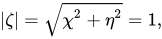
which gives
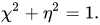
So the real component becomes and the imaginary component becomes .


Thus the complex unit circle maps to a flat plate on the real-number line from −2 to +2.
Transformations from other circles make a wide range of airfoil shapes.
Velocity field and circulation for the Joukowsky airfoil
[edit]The solution to potential flow around a circular cylinder is analytic and well known. It is the superposition of uniform flow, a doublet, and a vortex.
The complex conjugate velocity around the circle in the -plane is
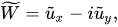

where
- is the complex coordinate of the centre of the circle,
- is the freestream velocity of the fluid,
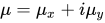

is the angle of attack of the airfoil with respect to the freestream flow,

- is the radius of the circle, calculated using ,
- is the circulation, found using the Kutta condition, which reduces in this case to

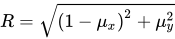


The complex velocity around the airfoil in the -plane is, according to the rules of conformal mapping and using the Joukowsky transformation,


Here with and the velocity components in the and directions respectively ( with and real-valued). From this velocity, other properties of interest of the flow, such as the coefficient of pressure and lift per unit of span can be calculated.



Kármán–Trefftz transform
[edit]


The Kármán–Trefftz transform is a conformal map closely related to the Joukowsky transform. While a Joukowsky airfoil has a cusped trailing edge, a Kármán–Trefftz airfoil—which is the result of the transform of a circle in the -plane to the physical -plane, analogue to the definition of the Joukowsky airfoil—has a non-zero angle at the trailing edge, between the upper and lower airfoil surface. The Kármán–Trefftz transform therefore requires an additional parameter: the trailing-edge angle This transform is[2][3]

| A |
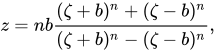
where is a real constant that determines the positions where , and is slightly smaller than 2. The angle between the tangents of the upper and lower airfoil surfaces at the trailing edge is related to as[2]



The derivative , required to compute the velocity field, is

![{\displaystyle {\frac {dz}{d\zeta }}={\frac {4n^{2}}{\zeta ^{2}-1}}{\frac {\left(1+{\frac {1}{\zeta }}\right)^{n}\left(1-{\frac {1}{\zeta }}\right)^{n}}{\left[\left(1+{\frac {1}{\zeta }}\right)^{n}-\left(1-{\frac {1}{\zeta }}\right)^{n}\right]^{2}}}.}](https://wikimedia.org/api/rest_v1/media/math/render/svg/9e8c37052334854a67b3388bf8047e96fbc966a3)
Background
[edit]First, add and subtract 2 from the Joukowsky transform, as given above:
![{\displaystyle {\begin{aligned}z+2&=\zeta +2+{\frac {1}{\zeta }}={\frac {1}{\zeta }}(\zeta +1)^{2},\\[3pt]z-2&=\zeta -2+{\frac {1}{\zeta }}={\frac {1}{\zeta }}(\zeta -1)^{2}.\end{aligned}}}](https://wikimedia.org/api/rest_v1/media/math/render/svg/ef1652730dc32a9ba2669f06a26a1aa45cb43455)
Dividing the left and right hand sides gives
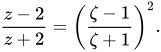
The right hand side contains (as a factor) the simple second-power law from potential flow theory, applied at the trailing edge near From conformal mapping theory, this quadratic map is known to change a half plane in the -space into potential flow around a semi-infinite straight line. Further, values of the power less than 2 will result in flow around a finite angle. So, by changing the power in the Joukowsky transform to a value slightly less than 2, the result is a finite angle instead of a cusp. Replacing 2 by in the previous equation gives[2]

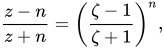
which is the Kármán–Trefftz transform. Solving for gives it in the form of equation A.
Symmetrical Joukowsky airfoils
[edit]In 1943 Hsue-shen Tsien published a transform of a circle of radius into a symmetrical airfoil that depends on parameter and angle of inclination :[4]



The parameter yields a flat plate when zero, and a circle when infinite; thus it corresponds to the thickness of the airfoil. Furthermore the radius of the cylinder .

Notes
[edit]- ^ Joukowsky, N. E. (1910). "Über die Konturen der Tragflächen der Drachenflieger". Zeitschrift für Flugtechnik und Motorluftschiffahrt (in German). 1: 281–284 and (1912) 3: 81–86.
- ^ a b c Milne-Thomson, Louis M. (1973). Theoretical aerodynamics (4th ed.). Dover Publ. pp. 128–131. ISBN 0-486-61980-X.
- ^ Blom, J. J. H. (1981). "Some Characteristic Quantities of Karman-Trefftz Profiles" (Document). NASA Technical Memorandum TM-77013.
- ^ Tsien, Hsue-shen (1943). "Symmetrical Joukowsky airfoils in shear flow". Quarterly of Applied Mathematics. 1 (2): 130–248. doi:10.1090/qam/8537.
References
[edit]- Anderson, John (1991). Fundamentals of Aerodynamics (Second ed.). Toronto: McGraw–Hill. pp. 195–208. ISBN 0-07-001679-8.
- Zingg, D. W. (1989). "Low Mach number Euler computations". NASA TM-102205.
External links
[edit]Joukowsky transform
View on GrokipediaIntroduction
Definition
The Joukowsky transform is a conformal mapping in the field of complex analysis, which maps points from the complex ζ-plane to the complex z-plane while preserving angles locally, thereby simplifying the solution of boundary value problems in two-dimensional potential flow.[4] This transform is particularly valuable in aerodynamics for converting flow solutions around simple geometries, such as cylinders, into those around more complex shapes.[5] The transform is mathematically defined by the equation where represents coordinates in the z-plane and represents coordinates in the ζ-plane, with being real numbers. Expanding this in terms of real and imaginary parts yields [6] A representative example of the mapping's behavior is observed when applying it to the unit circle in the ζ-plane, which is transformed into a flat plate segment along the real axis from to in the z-plane.[7] Conformal mappings like the Joukowsky transform serve as a foundational tool in potential flow theory, where the Laplace equation governing irrotational, incompressible flow is preserved under such transformations, allowing analytical solutions for velocity and pressure fields.[5]Historical background
The Joukowsky transform was introduced by the Russian mathematician and aerodynamics pioneer Nikolai Zhukovsky around 1910, as a key tool in his foundational work on airfoil theory.[1] This conformal mapping technique emerged from Zhukovsky's efforts to model fluid flow around wing profiles using complex analysis, building directly on his earlier investigations into lift generation.[3] Zhukovsky, recognized as the father of Russian aviation, established the Moscow School of Aerodynamics and played a central role in developing the field through experimental and theoretical advancements, including the construction of Russia's first wind tunnel in 1904.[1] His 1906 memoir on wing theory provided the theoretical groundwork for the transform by deriving the fundamental lift equation—now known as the Kutta–Joukowski theorem—which explained circulation around airfoils and necessitated mappings to represent realistic shapes.[1] This work marked a pivotal step in integrating vortex theory with potential flow, setting the stage for the formulation around 1910. The transform was applied by Zhukovsky in his work on aviation theory to generate airfoil contours from circular geometries, enabling precise calculations of pressure distributions and lift.[8] During the 1910s and 1930s, it profoundly influenced airfoil design theories by bridging complex variable methods from mathematics with practical fluid dynamics problems, facilitating the analysis of two-dimensional incompressible flows around symmetric and cambered profiles.[3] Named after Zhukovsky (often transliterated as Joukowsky in Western sources), the transform gained recognition beyond Russia and was adopted in European aerodynamic literature, including references in the works of Ludwig Prandtl and the German school, which extended early conformal mapping approaches to boundary layer effects and three-dimensional wings.[1]Mathematical formulation
The Joukowsky mapping
The Joukowsky mapping arises as a specialized case of the Schwarz-Christoffel transformation, which generally maps the upper half-plane to polygonal regions but can be adapted to generate smooth, airfoil-like shapes from circular boundaries in the complex plane. Specifically, for a flat plate—a degenerate airfoil—the Schwarz-Christoffel formula simplifies to a form that aligns with the Joukowsky transform when considering the mapping from a unit circle to a line segment, treating the plate as an equilateral bi-angle polygon with interior angle π. This connection highlights how the Joukowsky mapping approximates more complex airfoil geometries by leveraging the conformal properties of Schwarz-Christoffel integrals for streamlined shapes.[9] The generalized form of the Joukowsky mapping is expressed as where denotes points in the physical (airfoil) plane, are coordinates in the auxiliary (circle) plane, and is a scaling parameter that adjusts the size of the mapped shape; the case yields the standard unit mapping. This form extends the classical transformation by allowing control over the chord length, which is approximately for symmetric cases. The mapping is analytic except at specific points, preserving angles and facilitating the transfer of geometric properties from simple domains.[3] Critical points occur where the derivative vanishes, given by yielding ; at these locations, the mapping fails to be conformal, leading to cusps or sharp features in the image. The function exhibits a pole singularity at , where the term dominates and the mapping becomes unbounded, though this point lies outside the typical exterior domain considered for airfoil mappings. Branch points are absent in this rational function, but the behavior near introduces multivaluedness if encircling the origin, affecting the global topology of the mapped region.[10] A key application involves mapping circles in the -plane to airfoil contours in the -plane. Consider an offset circle defined by , where is the complex center offset (typically real for symmetric camber) and is the radius to ensure the circle passes through or near the critical point for a cusped trailing edge. This maps to a closed, cusped airfoil shape with thickness controlled by and camber by the imaginary part of , producing symmetric airfoils when is real and positive. For instance, parametrizing the circle as for traces the airfoil boundary in , with the cusp at the trailing edge corresponding to the image of .[3][10][11] The step-by-step mapping process transforms domains conformally, preserving interior and exterior regions. First, select the exterior (or interior) of the offset circle in the -plane as the source domain. Apply the mapping pointwise to each , which extends continuously to the exterior region since the singularity at is enclosed by the circle for . The image under this transformation yields the exterior (or interior) of the cusped airfoil in the -plane, with the boundary circle mapping to the airfoil contour and the cusp arising from the critical point . This process maintains one-to-one correspondence away from the critical points, ensuring the mapped domain avoids self-intersections for appropriate and .[11][3]Properties and inverse
The Joukowsky transform is a conformal mapping, preserving angles and local shapes in the complex plane, which ensures that infinitesimal circles in the ζ-plane map to infinitesimal circles in the z-plane, maintaining the analyticity of functions across the transformation except at critical points. Specifically, the points ζ = ±m in the circle plane correspond to z = ±2m in the airfoil plane, with the trailing edge cusp typically at z = 2m where the mapping derivative vanishes, leading to a breakdown in conformality. This property allows the transform to model potential flows around airfoils by inheriting the simplicity of uniform flow past a circle while accurately representing sharp-edged geometries in the physical plane. At the trailing edge, the mapping exhibits a singularity characterized by a double point, resulting in a sharp 0° cusp that models the finite trailing edge angle essential for Kutta-Joukowski lift conditions in aerodynamics. This cusp arises because the inverse mapping branches meet at z = ±2m, and while the flow remains smooth away from this point due to the conformal nature elsewhere, in modeling potential flow, the Kutta condition ensures finite velocity at the cusp in the idealized inviscid model, with real flows featuring rounded edges due to viscosity. The preservation of conformality thus facilitates the exact solution of Laplace's equation for irrotational flow, with the only irregularity confined to the trailing edge. To invert the Joukowsky transform for design purposes, such as obtaining the circle parameters from a given airfoil shape, one solves the quadratic equation for given , yielding the two branches . The principal branch, typically the one with the positive square root for the exterior region, is selected to map the airfoil exterior back to the exterior of the circle of radius m, ensuring the flow domain correspondence. This inversion is crucial for airfoil optimization, as it allows engineers to parameterize shapes by adjusting the circle's center and radius . However, the process is not unique due to the two-valued nature of the square root, requiring careful branch selection to avoid mapping interior points incorrectly. A key limitation of the inversion arises from parameter sensitivity: if the offset exceeds , the resulting airfoil may self-intersect, producing invalid shapes like cusps on the leading edge or figure-eight profiles, which violate the simply connected domain assumption for exterior flow. This constraint ensures the mapped circle lies appropriately to generate convex, closed airfoils without topological defects, highlighting the transform's utility within bounded design spaces. By providing an explicit inverse, the Joukowsky mapping enables iterative design workflows that were historically underdeveloped in early applications.Aerodynamic applications
Generation of airfoils
The Joukowsky transform generates airfoil shapes through conformal mapping of a circular boundary in the ζ-plane to the z-plane. The circle is centered at an offset μ from the origin, with radius R = |1 - μ| to ensure the boundary passes through the critical point ζ = 1, and the mapping is given by (in normalized units where the transformation constant is 1). This process transforms the exterior of the offset circle into the exterior of an airfoil profile, featuring a rounded leading edge and a sharp cusped trailing edge, enabling the study of potential flow around realistic wing sections.[3] A representative example is obtained with μ = 0.2 along the real axis and R = 0.8, yielding a thin cambered airfoil. In this case, the leading edge maps to approximately z ≈ -2, while the trailing edge forms a cusp at z = 2, producing a chord length of roughly 4 units and a profile with moderate camber suitable for introductory aerodynamic computations.[11] The geometric properties are tuned by the parameters μ and R. An increase in the magnitude of μ enhances the camber, curving the airfoil's mean line to generate positive lift at zero incidence; R governs the overall thickness, with higher values creating thicker sections that influence drag and stall characteristics. The angle of attack is introduced by rotating the offset circle in the ζ-plane prior to mapping, aligning the profile with the oncoming flow.[12] The camber line, representing the midline of the airfoil, is derived by parameterizing the image of the circle's boundary and averaging the upper and lower coordinates along streamwise positions; for μ real, this yields a parabolic curve with maximum displacement at 50% chord for small μ in normalized coordinates. Airfoil profiles appear cambered when μ lies on the real axis, exhibiting an arched upper surface relative to a straighter lower surface for enhanced lift. Typical parameter ranges include 0 < |μ| < 0.3 and R ≈ 1 - μ to maintain thin-to-moderate sections without excessive distortion or negative camber.[12]Velocity field and circulation
The velocity field around a Joukowsky airfoil is obtained by conformally mapping the known potential flow solution for a circular cylinder in the -plane to the airfoil in the -plane. In the -plane, the flow consists of a uniform stream at infinity with speed and angle of attack , superposed with a doublet to enforce the no-penetration boundary condition on the circle of radius centered at , and a vortex at to introduce circulation . The complex velocity in the -plane is given by where the vortex term accounts for lift generation and the doublet term represents the induced flow due to the cylinder.[2][14] Under the Joukowsky transformation , the complex velocity in the -plane is obtained via the chain rule as with as the inverse map from . Stagnation points in the -plane occur where , corresponding to points on the airfoil surface where the velocity vanishes.[2][14] The Kutta condition, which physically ensures smooth flow departure from the sharp trailing edge in viscous reality, is mathematically enforced in this inviscid model by requiring the rear stagnation point to coincide with the trailing edge cusp (typically at ). This fixes the circulation as placing one stagnation point at the trailing edge while the forward stagnation moves accordingly. The cusp geometry is crucial here, as the mapping derivative at this point would otherwise produce infinite velocity unless there, allowing finite speeds elsewhere on the airfoil.[2][14][4] The lift per unit span follows from the Kutta-Joukowski theorem as , yielding a lift coefficient where is the chord length. In the thin airfoil limit (), this simplifies to . The pressure distribution is computed via Bernoulli's equation: , with suction peaks near the leading edge and higher pressures on the lower surface due to circulation.[2][14]Generalizations and variants
Kármán–Trefftz transform
The Kármán–Trefftz transform, developed by Theodore von Kármán and Erich Trefftz in 1918, extends the Joukowsky transform to address its limitation of producing airfoils with a cusped trailing edge of 0° angle, enabling more realistic profiles with finite trailing-edge angles for improved aerodynamic modeling.[15][16] This generalization arose from early 20th-century advances in experimental aerodynamics, which highlighted the need for conformal mappings that better match observed airfoil behaviors in wind tunnel tests.[15] The mathematical formulation of the transform is given by where is the position in the physical plane, is the complex parameter in the transformed plane, is a scaling parameter, and with specifying the interior trailing-edge angle .[15][16] When (corresponding to , or a 180° cusp), the mapping reduces to the standard Joukowsky transform.[15] This transform generates airfoils by mapping circles or ellipses in the -plane to closed contours in the -plane, producing sharp-nosed profiles with a specified trailing-edge angle; the parameters and primarily control the thickness distribution and overall camber, respectively.[16] For practical airfoil design, parameters are selected iteratively using methods like Timman's approach, which matches desired nose radius , maximum thickness ratio, and trailing-edge slope by solving relations such as for symmetrical cases, ensuring the profile approximates empirical shapes like early NACA series.[16] In applications, the Kármán–Trefftz transform facilitates more accurate predictions of lift and pressure distributions on sharp-edged airfoils compared to the cusped Joukowsky profiles, as the finite trailing-edge angle better represents flow separation and Kutta condition enforcement in potential flow theory.[15] It saw historical use in pre- and post-World War II aircraft design for generating baseline profiles in theoretical analyses, serving as a starting point for numerical optimizations in wing sections.[16]Symmetrical Joukowsky airfoils
The standard Joukowsky transform, when applied to a circle offset along the real axis in the ζ-plane, generates airfoils with camber, resulting in asymmetric mean lines that are unsuitable for applications requiring symmetric flow conditions, such as zero-lift symmetric profiles in subsonic aerodynamics.[17] To address this, modifications focus on zero-camber configurations that maintain upper-lower surface symmetry while preserving the transform's conformal properties for potential flow analysis.[18] A key historical variant is Tsien's 1943 modification, which maps a circle of radius to a symmetrical airfoil via the transformation where , is a small parameter controlling thickness, and is the angle of attack.[18] This adjustment shifts the singularity and adds a constant term to ensure the resulting profile is symmetric about the chord line, with a rounded leading edge and sharp trailing edge. The parameter directly influences the geometry, yielding profiles suitable for shear flow analysis while maintaining symmetry.[18] These symmetrical profiles exhibit a maximum thickness-to-chord ratio for small , providing a controllable family of thin airfoils with predictable scaling between the parameter and geometric thickness.[18] Compared to empirical series like the NACA 00xx symmetrical airfoils, Tsien's variants offer theoretical exactness in potential flow but show similar lift-curve slopes near per radian, though with slightly higher predicted values due to idealized inviscid assumptions.[17] In modern contexts, symmetrical Joukowsky airfoils serve as benchmarks for computational fluid dynamics validation, enabling assessment of numerical schemes in transitional and low-Reynolds flows without empirical tuning.[19]References
- https://ntrs.[nasa](/page/NASA).gov/api/citations/19880004688/downloads/19880004688.pdf