Hubbry Logo
JubeatJubeatMain
Open search
Jubeat
Community hub
Jubeat
logo
8 pages, 0 posts
0 subscribers
Be the first to start a discussion here.
Jubeat
Jubeat
from Wikipedia
Jubeat
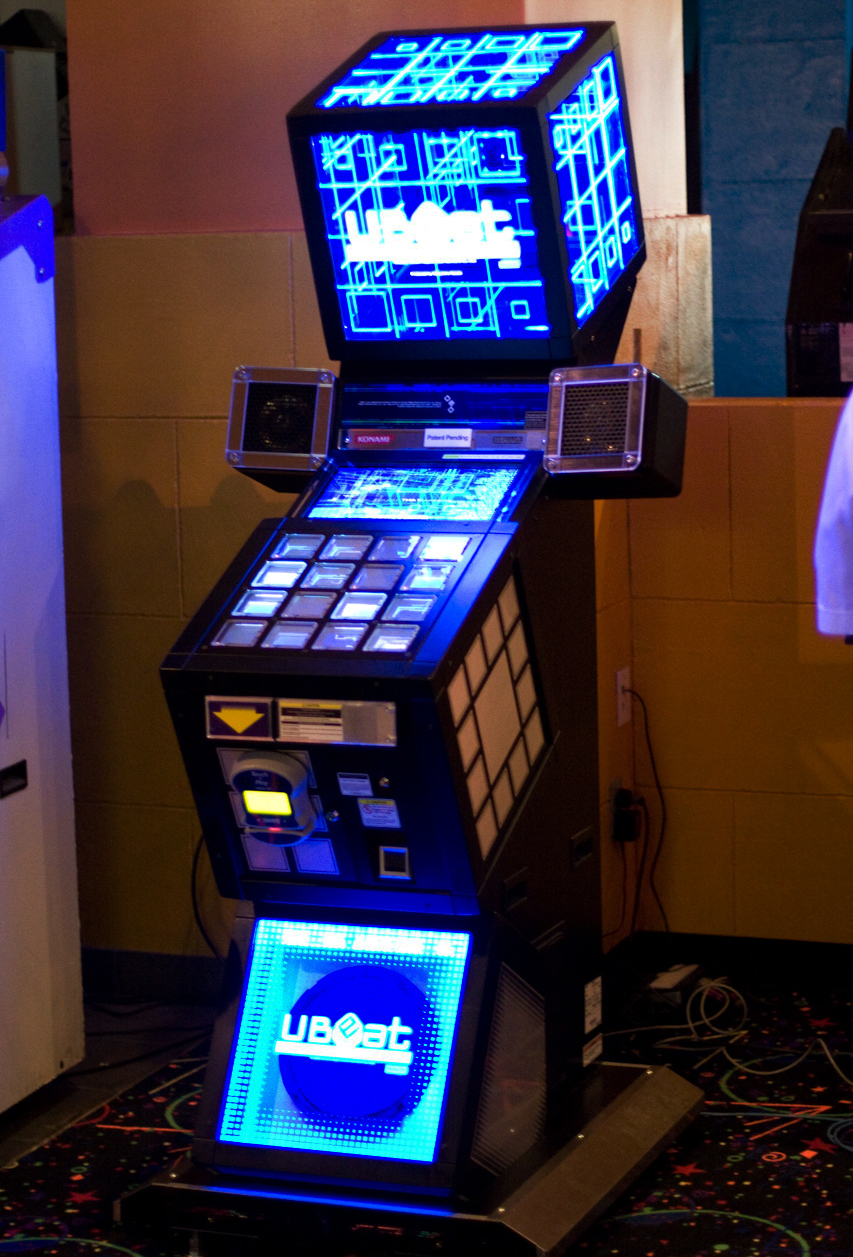
A Jubeat cabinet (under the title "UBeat") during an American location test in 2008
DeveloperKonami
PublisherKonami
SeriesBemani
PlatformsArcade game, iOS
GenreMusic
ModesSingle-player, Multiplayer

Jubeat (ユビート, Yubīto), stylized as jubeat, is a series of arcade music video games developed by Konami, and is a part of Konami's Bemani line of music video games. The series uses an arrangement of 16 transparent buttons in a 4x4 grid for gameplay, and each of the 16 buttons overlays a screen.

The game went on several location tests in Asia since December 2007, and was released on July 24, 2008,[1] in Japan, and December in Hong Kong and Macau. The game was not available in mainland China until early 2010. Two attempts to localize the game for the United States market have been made since August 2008, including UBeat, a variant of the first version,[2] and Jukebeat in 2009, a variant based on Jubeat Ripples.[3]

A port of the game for the iOS, Jubeat Plus, was released on Apple's Japanese App Store in 2010. The game was released in the US App Store under the name Jukebeat in 2011.[4] On April 1, 2021, Konami announced a major overhaul to Jubeat Plus via the official Jubeat Twitter account, rebranding it as Jubeat.[5] On May 7, 2021, the rebranded title was launched as a successor to both Jukebeat and Jubeat Plus on both Android and iOS.[6]

The series' current arcade release is Jubeat Beyond the Ave, released on September 20, 2023.[7]

Gameplay

[edit]

The basic gameplay of the series can be roughly compared to Nintendo DS music games such as Osu! Tatakae! Ouendan and Elite Beat Agents and can be considered to be similar to Whac-A-Mole. The play area is divided into 16 squares, each of which is a touch-sensitive panel with a screen underneath used to navigate and play the game. Animated explosions or other animations, called "markers", that can be chosen at the song select screen are shown within the panels synced to a track of the player's choosing; when they reach a "hot point", which is dependent on the marker chosen, the player must tap the corresponding screen along with the rhythm of the song to score points.[8] Taps can be judged as either Perfect, いい感じ (Good), 早い (Fast), or 遅い (Slow). 3 difficulties (Basic, Advanced, and Extreme) are offered for each song.

As with other Konami games, an e-Amusement card can be used to save statistics and a player ranking, and can also be used to access unlockable songs.[9] Single player and linked multiplayer modes with multiple cabinets are also offered. In the app version of Jubeat, players can choose from three different levels of difficulty, just like in the arcade version: basic, advanced and extreme.

Games in the series

[edit]
  • jubeat (July 24, 2008)
  • jubeat ripples (August 5, 2009)
  • jubeat ripples APPEND (March 18, 2010)
  • jubeat Plus (November 8, 2010)[10]
  • jubeat knit (July 29, 2010)
  • jubeat knit APPEND (March 23, 2011)
  • jubeat copious (September 15, 2011)
  • jubeat copious APPEND (March 14, 2012)
  • jubeat saucer (September 25, 2012)
  • jubeat saucer fulfill (March 3, 2014)
  • jubeat prop (February 20, 2015)
  • jubeat Qubell (March 30, 2016)
  • jubeat clan (July 26, 2017)
  • jubeat festo (September 5, 2018)
  • jubeat Ave. (August 3, 2022)
  • jubeat beyond the Ave. (September 20, 2023)

References

[edit]
[edit]
Revisions and contributorsEdit on WikipediaRead on Wikipedia
from Grokipedia
Jubeat is a series of arcade rhythm video games developed and published by as part of its franchise, in which players tap illuminated touch-sensitive panels arranged in a 4x4 grid to hit notes in synchronization with various music tracks. The series debuted in Japanese arcades on July 24, 2008, with the original jubeat, marking 's first major release since 2006 and introducing a touchscreen-based interface distinct from traditional button or controller mechanics in prior titles like or beatmania. Subsequent iterations expanded the franchise, including jubeat ripples in 2009, jubeat copious in 2011, jubeat saucer in 2012, jubeat Qubell in 2016, jubeat clan in 2017, jubeat festo in 2018 (celebrating the series' 10th anniversary), and jubeat Ave. in 2022, each incorporating updated song libraries, visual effects, and online features via 's e-amusement network. Gameplay centers on timing taps or holds on the 16 panels as markers align with on-screen cues, scoring points based on accuracy while building combos to activate like panel flashes or background animations; difficulty levels range from beginner-friendly to expert charts with complex patterns, supporting genres from and soundtracks to electronic and rock music. The arcade cabinets feature multiple LCD screens, including the interactive grid and a central display for videos and scoring, with later models like jubeat Qubell adding enhanced lighting and unlocking systems for custom experiences. In addition to arcades, Konami released mobile adaptations, starting with jubeat plus for in 2010 and Android in 2012, which allowed home play of arcade songs via downloads, and rebranded it as simply jubeat in 2021 for broader accessibility on smartphones with touch controls simulating the panel grid. As of 2025, the series remains active primarily in , with ongoing updates to jubeat Ave. and its extensions like beyond the Ave., maintaining a dedicated player base through competitive events such as the KONAMI Arcade Championship.

Overview

Concept and Origins

Jubeat is a series of arcade music video games developed and published by , forming part of the company's franchise, which focuses on rhythm-based synchronized to tracks. The series emphasizes interactive music experiences, where players engage with on-screen cues to match beats, drawing from the broader tradition of music simulation games within the Bemani lineup. The core concept of Jubeat revolves around a 4x4 grid of touch-sensitive panels integrated into the cabinet's display, allowing players to tap illuminated sections in with the selected song. This design sets it apart from traditional button-pressing or foot-pedal mechanics in other games, offering a direct, screen-based interaction that enhances visual feedback and player immersion. By utilizing the entire playfield as an , Jubeat aims to make gameplay more intuitive and engaging for a wider audience. Development origins trace back to location tests conducted in starting in December 2007, where evaluated the game's mechanics and cabinet design in select arcades. The full Japanese release followed on July 24, 2008, marking the official launch of the series with integration into 's e-Amusement network for online features. attempted to expand westward with localized versions, including a North American location test for UBeat in 2008 and a subsequent trial as Jukebeat in 2009, but both efforts failed to secure widespread adoption or a commercial release outside .

Development Team and Technology

The jubeat series is primarily developed by Amusement, which succeeded Konami Computer Entertainment Japan, as an integral component of Konami's line of rhythm games. Key contributions to the series' audio come from sound teams, including prominent composers such as DJ Yoshitaka (Yoshitaka Nishimura), who has created and arranged numerous original tracks across various installments. Central to jubeat's functionality is Konami's proprietary e-amusement platform, launched in 2002, which provides online connectivity for arcade cabinets, enabling features like player data storage, high-score rankings, and song unlocks tied to the e-amusement pass system. This network infrastructure allows persistent progress across play sessions and facilitates event participation, distinguishing jubeat from standalone rhythm titles. Technologically, jubeat employs a distinctive 4x4 grid of touch-sensitive panels arranged in a portrait-oriented display, allowing players to interact directly with on-screen cues for precise timing. Later iterations have incorporated enhancements such as improved panel responsiveness and synchronized LED lighting effects that align with video animations and music beats, heightening visual feedback during gameplay. Development has faced challenges in adapting to arcade hardware constraints, including the need for durable touch panels to withstand intensive use, as well as difficulties in Western market entry. conducted location tests for a localized version titled UBeat in and around 2008, but ultimately canceled full releases.

Gameplay

Core Mechanics

Jubeat's core gameplay centers on a unique player interface featuring 16 transparent touch panels arranged in a 4x4 grid that overlay a vertical display oriented in portrait mode. As a song plays, visual markers representing notes appear and approach target zones on the panels, either falling from above or expanding toward the bottom of the screen, precisely synchronized to the music's beats. Players engage by tapping the corresponding panels at the exact moment the markers align with the targets, creating an intuitive rhythm-based interaction that emphasizes timing and spatial awareness. The judgment system assesses each tap's timing relative to the ideal beat position, categorizing hits into tiers that directly influence scoring and performance feedback. A Perfect judgment requires the most precise timing, within a narrow window equivalent to about 1/24 of a beat; Great and Good judgments allow for progressively wider timing tolerances, while taps outside these windows result in misses or Early/Late penalties that break the combo chain. Accuracy across all notes determines overall performance, with combos—sequences of non-miss judgments—multiplying rewards and enabling higher scores through sustained precision. Songs in Jubeat are selectable from a diverse library of licensed tracks spanning genres like , electronic, rock, and themes, each available in three escalating difficulty levels to accommodate varying skill sets. Basic level features straightforward patterns with fewer notes and slower speeds, ideal for newcomers; Advanced introduces moderate complexity with branching rhythms and multi-panel coordination; Extreme delivers high-density charts at rapid tempos, demanding advanced finger dexterity and . Scoring follows a foundational formula where each note contributes a base value multiplied by an accuracy multiplier—highest for Perfect (1.0), scaling down for Great (0.7), Good (0.4), and minimal for poorer hits (0.1)—then amplified by bonuses that grow with consecutive successes. Full combos, achieved by hitting every note without misses, maximize the total score, often reaching up to 1,000,000 points per song and unlocking performance-based bonuses like the shutter effect for additional rewards.

Modes and Features

Jubeat supports both single-player and multiplayer experiences, allowing up to four players to compete simultaneously on linked cabinets with shared screens displaying individual progress and collective leaderboards. In versus modes, players engage in score battles, where performance directly compares against opponents in real-time, fostering competitive play during sessions. Special features in the series enhance engagement through customization and community elements, such as unlock challenges introduced in later titles, which enable players to unlock additional official songs via targeted performance goals and e-amusement . Clan systems, prominent in titles like jubeat , facilitate team-based progression where groups collaborate on to earn OMIYAGE points for unlocking content, promoting social interaction beyond solo play. Event-specific challenges, including seasonal campaigns, offer limited-time objectives that reward participants with exclusive tracks, avatars, or bonuses, encouraging regular arcade visits. Progression in Jubeat revolves around grade rankings that evaluate performance per , ranging from (under 500,000 points) for basic clears to SSS (980,000–999,999 points) for near-perfect executions, with an EXCELLENT designation for full 1,000,000-point scores. Players unlock avatars, themes, and cosmetic items by achieving play milestones, such as accumulating high grades or completing sets of songs, which personalize profiles visible on leaderboards. Boss songs serve as gated challenges, requiring players to attain specific high scores on prerequisite tracks to access them, adding layers of difficulty and accomplishment to extended sessions. Accessibility options cater to diverse skill levels, including auto-play assists that automate certain note sequences for or practice purposes, helping users familiarize themselves with patterns without full manual input. Speed adjustments allow customization from 0.5x to 2.0x the default tempo, enabling slower playback for learning complex rhythms or faster for advanced challenges. Hidden commands, activated via specific button sequences during options menus, provide practice tools like note visualization aids or replay analysis to refine timing and accuracy.

Hardware

Arcade Cabinets

The Jubeat arcade cabinets are upright models primarily designed for standing play in Japanese arcades, featuring a central 4x4 grid of touch-sensitive panels that serve as the primary input mechanism, with each panel measuring approximately 4 inches square and overlaying an individual display screen for visual cues. Above the grid sits a main LCD monitor, typically 29 inches in size, which handles navigation, background videos, and scoring displays, flanked by stereo speakers and standard coin slots for operation. The overall cabinet includes 17 screens in total—16 small ones under the panels plus the main monitor—and weighs around 150 kg in recent configurations, with dimensions of roughly 75 cm wide, 109 cm deep, and 193 cm tall. Early cabinets, debuting with the 2008 original Jubeat, adopted a bulkier, cube-stacked aesthetic to accommodate the hardware, measuring about 84 cm wide, 74 cm deep, and 227 cm tall, which provided robust enclosure for the initial resistive touch panels and supporting electronics. Starting in the early , later models such as jubeat Knit APPEND shifted to slimmer profiles that reduced depth and height while preserving the 4x4 grid layout, allowing for denser arcade installations without sacrificing functionality. These evolutions also introduced enhanced LED illumination under the panels for clearer note visualization during gameplay, addressing visibility in varied lighting conditions. Optional accessories enhance usability, including stools for seated play in some locations, built-in e-Amusement card readers that enable player data syncing across sessions, and supporting multiple languages for broader Asian market deployment. Maintenance challenges arise from intensive use, particularly panel wear and sensor degradation in the touch grid, often necessitating disassembly for cleaning or replacement to restore responsiveness. Japanese cabinets emphasize standing operation to facilitate rapid player turnover in high-traffic venues, with no integrated seating in standard setups. Widespread availability remains confined primarily to . More recent updates include the jubeat Beyond the Ave. in September 2023, which maintains the slimmer design with software enhancements, and a new cabinet design for the Chinese market announced in August 2025.

Digital Adaptations

Jubeat's digital adaptations began with mobile releases aimed at emulating the arcade experience on touch-based devices. In 2010, Konami launched jubeat plus exclusively on the Japanese iOS App Store as a freemium application, featuring a virtual 4x4 grid that players tapped using multi-touch gestures to match on-screen markers with music beats. The app included initial free songs, with additional music packs available via in-app purchases priced at approximately 500 yen each, alongside options to remove advertisements. A localized version titled Jukebeat followed in August 2011 for international iOS markets, incorporating some Western music but maintaining the core touch-screen mechanics. Early Android support was limited, with jubeat mobile released in 2010 as a paid application for Japanese feature phones via DoCoMo's service, offering song packs for 525 yen and focusing on simplified gameplay for non-smartphone devices. did not pursue widespread Android ports at the time, though the platform later gained access through broader mobile expansions. No official console ports of jubeat have been released for systems like PlayStation or , distinguishing it from other series that have seen home adaptations. Adapting the arcade's physical 16-panel interface to mobile posed unique challenges, primarily in scaling to smaller screens while ensuring responsive virtual buttons that supported simultaneous inputs without accidental overlaps. relied on in-app purchases for unlocking song libraries and cosmetic items, though this model evolved to balance accessibility with revenue. The core translated effectively to touch devices, preserving the rhythmic tapping but requiring players to adjust to screen size limitations compared to the arcade cabinet's larger, dedicated panels. In April 2021, announced a major overhaul of jubeat plus, rebranding it simply as jubeat and delivering a significant update on May 7 that expanded compatibility to iOS 11.0 and later, as well as Android 5.0 and above. This version introduced over 800 free songs, including hits and arcade crossovers, a music player mode for offline listening, and user-generated chart editing with hold note support. The update shifted toward a free-to-play structure with gacha elements for unlocks, while retaining in-app purchases for premium content. The international Jukebeat app, however, entered out-of-service status, limiting users to three free songs without further downloads or connectivity. As of 2025, the jubeat mobile app remains actively supported on both (via the Japanese App Store) and Android platforms, with version 4.4.3 released on October 23 featuring bug fixes and ongoing additions. Konami's focus has shifted primarily to arcade hardware, supplemented by the web-based e-Amusement platform, which allows remote content unlocks and progress syncing for arcade players without a dedicated mobile counterpart beyond the existing app.

Games in the Series

Mainline Installments

The mainline installments of the jubeat series represent major arcade releases developed by , each introducing distinct , visual, or social features while building on the core 4x4 touch panel mechanic. These titles have typically launched in on an annual or biennial cycle, with location tests conducted 3-6 months in advance to refine hardware and software elements. jubeat launched on July 24, 2008, establishing the foundational grid-based where players tap illuminated panels in time with music tracks from various genres. jubeat ripples, released on August 5, 2009, enhanced visual feedback by introducing a "ripples" effect, where note markers propagate outward like waves across the panel grid upon successful hits. jubeat knit arrived on July 29, 2010, pioneering team-based unlock systems that allowed players to collaborate online or locally to progressively reveal new songs and customization options. jubeat copious, debuting on September 15, 2011, significantly broadened the song library with over 200 tracks at launch and implemented full combo bonuses that rewarded perfect runs with score multipliers and exclusive rewards. jubeat saucer was released on September 25, 2012, featuring UFO-themed visuals and animations that integrated cosmic motifs into the interface and background effects for a more immersive presentation. jubeat prop, launched on February 20, 2015, focused on performance optimizations, including smoother panel responsiveness and reduced latency to support higher-speed songs and competitive play. jubeat Qubell followed on March 30, 2016, introducing cubic note designs that added three-dimensional depth to falling markers, enhancing visual complexity without altering core timing mechanics. jubeat clan, released on July 26, 2017, incorporated social clan systems where groups of players could join themed communities to share achievements, compete in rankings, and unlock collective bonuses. jubeat festo debuted on September 5, 2018, as the series' tenth anniversary entry with a theme, integrating live event tie-ins such as seasonal campaigns and real-world arcade promotions synchronized with in-game content. jubeat Ave., launched on August 3, 2022, adopted an avenue-themed evoking urban streets, with streamlined navigation and modular panel lighting to emphasize progression through song selections. jubeat beyond the Ave., released on September 20, 2023, extended song support to include legacy tracks from prior installments and improved compatibility for cross-version unlocks, allowing seamless integration of historical content. As of November 2025, it continues to receive periodic updates adding new songs and events.

Updates and Expansions

The Jubeat series utilized append releases to significantly expand post-launch content, adding new songs, features, and elements to existing arcade installations without requiring full hardware replacements. jubeat ripples , launched in early 2010, marked the first such expansion in the series, incorporating 21 additional songs for a total library of 131 tracks, including originals like "A & A " by REDEMPTION and licensed tracks such as "ALBIDA" by DJ YOSHITAKA. This append introduced e-AMUSEMENT online support for player data storage and the series' inaugural cross- unlock event with 17 SIRIUS, allowing players to access exclusive songs like "AIR RAID FROM THA UNDAGROUND" through linked play sessions from March to July 2010. Similarly, jubeat copious , released on March 14, 2012, added 35 new songs to reach 247 total, featuring diverse difficulties across levels 1 to 10 and events such as , which rewarded cross-game participation in seven titles with unlocks like "532 nm" by Ryu☆. Further expansions continued this model, with jubeat saucer fulfill arriving on March 3, 2014, as a major content update to the saucer base game, introducing 107 new songs to expand the catalog to 554 tracks, exemplified by additions like "101回目の呪い" at level 9 and "Daydream café" at level 8. It emphasized fulfillment-themed mechanics, including the saucer macchiato unlock system where players collected virtual coffee beans and milk to access hidden content such as "DANCE ALL NIGHT," alongside new modes like COURSE (pre-set five-song challenges) and EXTRA STAGE bonuses purchasable via PASELI cards. A subsequent system update on July 23, 2014, revamped core modes and reintroduced the FLOOR INFECTION competitive feature, enhancing replayability. Beyond append discs, Jubeat titles received ongoing firmware updates and content cycles via the e-AMUSEMENT platform, typically involving monthly or periodic song packs that players unlocked using passes, ensuring fresh material without cabinet downtime. Hardware maintenance supported these cycles through official panel replacement kits, addressing wear on the 4x4 touch grid to maintain responsiveness, while end-of-life transitions facilitated seamless data carryover—such as score histories and unlocks—to successor titles, preserving player progress across generations. Expansion mechanics enriched engagement with layered unlock systems for concealed songs, often tied to performance thresholds or e-AMUSEMENT milestones, alongside seasonal events like Halloween-themed charts that introduced temporary spooky variants or bonus tracks. Cross-BEMANI collaborations amplified this, with campaigns such as the 2012 Gita・dora・jubeat dainatsumatsuri event linking GuitarFreaks, DrumMania, and Jubeat to unlock 10 shared like "Rush!!," fostering interconnected play across Konami's ecosystem. These updates and expansions prolonged the operational viability of Jubeat arcade cabinets, enabling arcades to sustain revenue streams from legacy hardware for 1–2 years per title by delivering iterative content that delayed the need for costly overhauls, thereby supporting the series' longevity in competitive locations.

Music and Content

Song Libraries

The song libraries in the Jubeat series have grown significantly since the 2008 debut, starting with 63 total tracks in the original arcade release, including 47 default songs and 16 unlockables via class progression and features. By the jubeat knit installment in 2010, the library expanded to 184 songs, incorporating 53 new additions alongside carried-over content from prior versions. Subsequent titles like jubeat saucer (2012) reached 462 unique songs through iterative unlocks and version-specific expansions, while later entries such as jubeat Ave. (2022) and its successor jubeat beyond the Ave. (2023) have access to over 1,500 unique tracks across the series as of November 2025, with thousands of total charts unlocked via player progression systems. This growth reflects a mix of licensed tracks, original soundtracks, Western pop selections, and original compositions from Konami's lineup, enabling broad accessibility in arcade environments. Each song features 3 to 5 difficulty variants—typically Basic, Advanced, and Extreme, with occasional Hard or MASTER levels in later versions—designed to scale challenge progressively. BPM ranges from 60 to over 200, accommodating diverse tempos while prioritizing note patterns that demand finger independence across the 4x4 touch panel and syncopated rhythms to align with . These charts emphasize arcade playability, with curation focused on intuitive touch interactions that reward precise timing without requiring complex hardware inputs. Song selection prioritizes tracks suitable for short arcade sessions, with initial launches averaging 200 to 400 unique songs per title, expandable through unlocks tied to player achievements like full combos or event participation. Unlocks often involve random matchmaking or shop packages, ensuring gradual library access based on engagement rather than upfront availability. Genre diversity includes licensed Japanese artists, Konami originals, international pop, and crossovers from other Bemani series, fostering a balanced catalog that appeals to varied player preferences. This structure maintains conceptual focus on rhythmic variety and replayability, with notes synced to beats for immersive gameplay.

Licensing and Collaborations

The Jubeat series secures its music catalog through licensing agreements with major Japanese record labels, including Avex Music Publishing and , enabling the inclusion of licensed tracks from popular artists. These deals facilitate the integration of contemporary Japanese music into the , with credits for licensed content appearing in official soundtrack releases. International licensing arrangements have also been established for select titles, particularly in mobile adaptations like jukebeat, which featured Western artists such as through partnerships with global publishers, incorporating songs like "Bad Romance" and "Poker Face" in dedicated packs. Collaborations extend to tie-ins with anime franchises, such as the inclusion of tracks from , enhancing cross-media appeal by blending rhythm gameplay with thematic content from animated series. Within the broader ecosystem, Jubeat shares tracks with other titles like through crossover events, including the APPEND FESTIVAL and Grand Prix song packs that unlock mutual content across platforms. Event-based partnerships, such as exclusives at the , further promote limited-time collaborations that introduce promotional songs tied to Konami's arcade showcases. Licensing challenges have arisen from expiring agreements, resulting in song removals from digital ports; for instance, the iOS version of jubeat (2021) delisted numerous packs and tracks unavailable for new purchases or transfers due to license terminations. Regional restrictions have similarly limited Western music availability in Japanese arcade installations, confining international content primarily to global mobile releases and select overseas cabinets. These issues highlight the temporal nature of music rights in rhythm games, often necessitating content rotation or revival systems like jubeat saucer's song swap feature to manage licensed material. Notable partnerships include ongoing collaborations with real-world DJs and producers, such as DJ YOSHITAKA and dj TAKA, who contribute original compositions and remixes tailored for the series, as seen in joint tracks like "Elemental Creation." Later installments, including jubeat clan, incorporate community-driven elements through events that encourage user participation in unlocking remixes and custom content, fostering creative involvement akin to remix contests. These alliances with established electronic music creators underscore Jubeat's emphasis on high-quality, producer-endorsed audio integrated into its touch-based mechanics.

Reception and Legacy

Critical Response

Critics have praised jubeat for its intuitive touch controls and engaging visual feedback, which make accessible even to newcomers in the . Eurogamer's hands-on emphasized the instinctive operation of the 16 touch-sensitive quadrants, where expanding green circles provide clear guidance for timing hits, creating an addictive "Zone" experience without relying on cumbersome peripherals. Similarly, a user highlighted the responsive LCD buttons and vibrant animations that enhance player immersion, awarding it a perfect 5/5 for its fresh take on Bemani-style action. The series' innovative 4x4 grid system has been lauded for fostering social and collaborative play, distinguishing it from traditional button-based rhythm games. Nihonshock described as a defining feature that eliminates conventional waterfalls, allowing players to focus on musical flow and combo-building in a visually sleek interface. This design encourages multiplayer sessions in arcades, where groups can share the cabinet's layout for simultaneous input, as noted in Eurogamer's coverage of its arcade appeal. Despite these strengths, early jubeat titles faced criticism for their Japan-centric availability, limiting broader appeal in Western markets. pointed out the game's confinement to Japanese arcades. Mobile adaptations received mixed reception, with reviewers noting touch inaccuracies that undermine precision compared to the arcade's physical buttons. Pocket Gamer critiqued the iOS version (jukebeat) for delayed visual cues and less tactile feedback on smartphones, rating it 6/10 and likening it to a reactive rather than true rhythm synchronization. Reception evolved positively with later installments, as refinements addressed initial limitations in depth and variety. While specific scores for titles like jubeat festo are sparse in English media, Japanese outlets and user feedback reflect growing appreciation for expanded song libraries and refined mechanics that build on the core grid . Overall, arcade releases have garnered solid aggregate praise in Japanese gaming media, around 70% on user-driven platforms like Backloggd, underscoring jubeat's enduring within the rhythm genre.

Commercial Performance

The Jubeat series has achieved notable commercial success in the arcade sector, reflecting strong demand during its early years. The franchise reached peak popularity between 2010 and 2012, particularly with the release of Jubeat Copious. In the digital space, the Jubeat Plus iOS application surpassed 1 million downloads shortly after its 2010 launch, offering portable access to the series' touchscreen rhythm gameplay. It received updates until 2018 and was rebranded as jubeat in 2021, with ongoing support including version 4.4.3 released in October 2025. Jubeat maintains a robust presence in Asian markets, primarily in , with additional installations in locations like and , underscoring its alignment with local arcade culture. Declining interest in Western markets after has limited global expansion, but ongoing e-Amusement platform subscriptions—priced at around ¥500 per month—have sustained player engagement and generated steady recurring . The series' update-driven model has ensured longevity for existing hardware, allowing older cabinets to remain profitable through content expansions; for instance, the 2023 release of Jubeat Beyond the Ave. featured refreshed song libraries and network features. As of November 2025, the arcade version remains active with ongoing updates.

Cultural Impact

Jubeat has built a strong community among players through dedicated fan resources and participation in official . Fan-maintained databases like RemyWiki offer detailed tracking of song charts, unlock conditions, and gameplay strategies, serving as essential hubs for enthusiasts worldwide. Tournaments and promotions tied to Konami's PRO LEAGUE have further engaged the community, with jubeat-specific song unlocks and cross-game incentives encouraging competitive play and event attendance. At arcades and conventions, such as Zenkaikon and San , jubeat cabinets facilitate live events where players gather for group sessions, often incorporating elements inspired by the game's vibrant visuals and themes. The series has extended its reach beyond , contributing to BEMANI's global fanbase with localized arcade releases in and . In , mobile adaptations like jubeat plus have popularized touch-based gameplay, while in , recent developments include exclusive cabinet designs showcased at expos like GTI Asia 2025, ensuring ongoing accessibility in regional arcades. Jubeat's touch-panel mechanics have influenced the broader landscape, promoting interactive, screen-based controls in both arcade and mobile titles. As of 2025, jubeat endures as an arcade staple amid the rise of mobile gaming, with steady updates to its song library and hardware refreshes maintaining its appeal, including mobile version 4.4.3 in October 2025. The series plays a key role in preserving J-pop licensing within gaming, featuring licensed tracks from popular artists that introduce players to contemporary Japanese music culture. Its design fosters social rhythm gaming trends, where group play in arcades encourages communal cheering and shared experiences, strengthening bonds in gaming spaces.

References

Add your contribution
Related Hubs
User Avatar
No comments yet.